
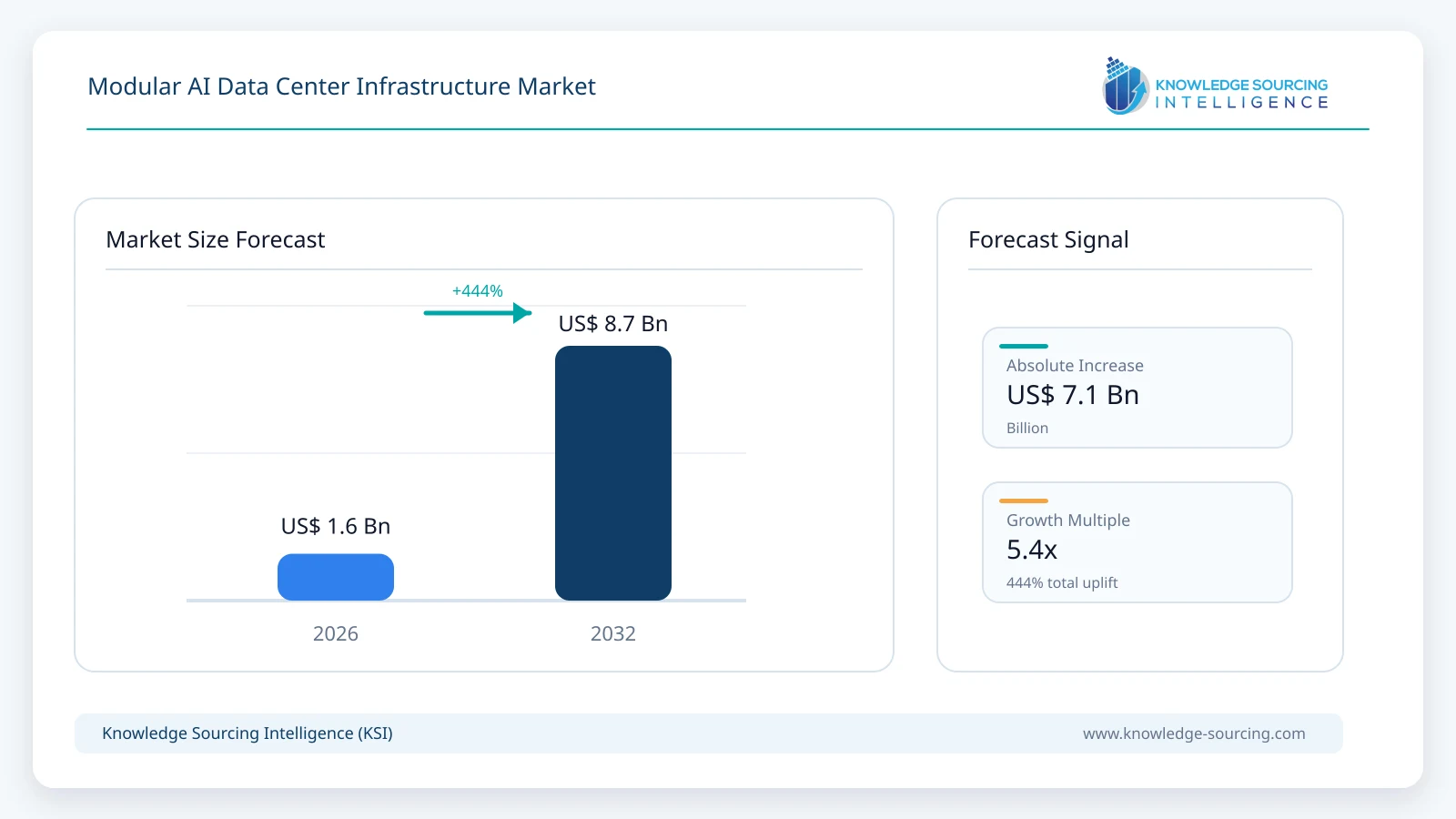
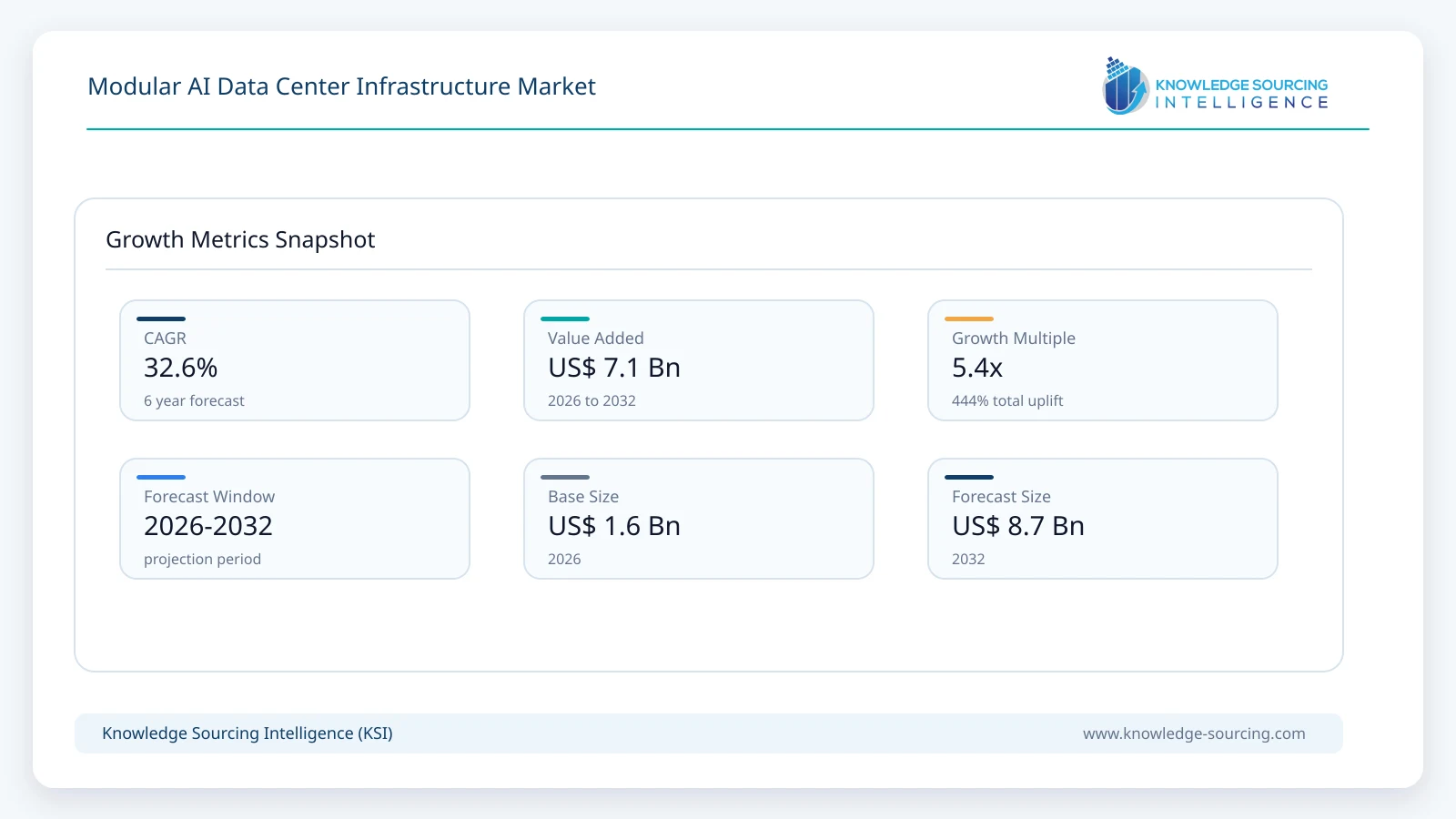
The Modular AI Data Center Infrastructure Market is estimated at USD 1.60 billion in 2026 and is projected to reach USD 8.71 billion by 2032, representing a CAGR of 32.6% during 2026-2032.
Highlights:
- 1AI infrastructure is moving from bespoke construction toward repeatable, factory-integrated deployment blocks.
- 2Prefabrication transfers complex electrical and thermal integration away from constrained construction sites.
- 3Power modules represent the largest 2026 revenue pool within AI-specific modular infrastructure.
- 4Integrated AI-factory blocks are expected to record the fastest growth through 2032.
- 5Vertiv OneCore supports standardized 12.5 MW building blocks for scalable AI deployments.
- 6Schneider Electric offers 2 MW to 2.5 MW prefabricated power modules for AI facilities.
- 7Crusoe Spark modular AI factories can be deployed from edge sites to clustered campuses.
- 8Delta combines high-voltage direct current power with liquid cooling in modular AI systems.
- 9Factory testing reduces commissioning risk as rack power and coolant requirements rise sharply.
- 10North America leads early adoption through hyperscale, neocloud and sovereign AI investment.
- 11Modular white-space pods help operators add high-density capacity inside existing data-center campuses.
- 12Standardized reference designs improve repeatability while retaining configuration flexibility across compute generations.
Market Overview
The AI data-center construction problem is increasingly one of industrial execution rather than only equipment availability. Accelerator generations change faster than traditional building cycles, and each new rack can require substantially more power, liquid flow, busway capacity, control integration and heat rejection than the previous generation. Building every campus as a bespoke project increases engineering effort and exposes schedules to on-site labor availability, sequencing conflicts and commissioning rework. Prefabricated systems address these constraints by standardizing interfaces between power, cooling and IT space and moving repeatable assembly into factories where systems can be tested before shipment.
The category now extends well beyond containerized edge facilities. Large AI projects are adopting modular power rooms, prefabricated substations, UPS blocks, busway skids, liquid-cooling plants, coolant distribution modules, overhead infrastructure and pre-engineered IT pods as components of facilities that may ultimately reach hundreds of megawatts. Vertiv OneCore is designed for data centers from roughly 10 MW to 250 MW and beyond, while its NVIDIA Vera Rubin DSX implementation uses 12.5 MW infrastructure blocks. Schneider Electric is scaling modular power and IT-pod manufacturing for hyperscale, neocloud and colocation customers, and Delta is integrating 800-volt direct current architecture with liquid-cooled modular designs. These offerings show that modularization is becoming a deployment method for large AI factories rather than a small-site form factor.
The economic case combines schedule compression, quality control and repeatability. Factory assembly allows electrical and mechanical interfaces to be validated before site installation and reduces the amount of specialist work performed under field conditions. Vertiv states that OneCore can reduce on-site work, commissioning and time-to-token by up to 50% compared with traditional builds, while Schneider Electric reports that prefabricated approaches can materially shorten deployment schedules and that IT pods can reduce installation from months to days. These benefits are most valuable where expensive GPU capacity is waiting on physical infrastructure and each month of delay postpones revenue-producing compute.
Year | Market Size (USD billion) | Year-on-Year Growth |
2026 | 1.60 | - |
2027 | 2.03 | 27.0% |
2028 | 2.66 | 31.0% |
2029 | 3.57 | 34.0% |
2030 | 4.85 | 36.0% |
2031 | 6.55 | 35.0% |
2032 | 8.71 | 33.0% |
Market Drivers
AI deployment schedules increasingly favor manufactured infrastructure
AI operators are competing for speed to power and speed to first token. Traditional site-built projects require sequential electrical, mechanical and white-space construction, often using specialist labor that is already constrained in major data-center markets. Factory-integrated modules allow multiple workstreams to proceed in parallel: the site and utility connection can advance while power, cooling and IT blocks are assembled and tested off-site. This changes modular infrastructure from a convenience into a schedule-risk tool, particularly for neocloud providers and hyperscalers that need to add capacity in repeatable increments across several regions.
Extreme rack density increases the value of pre-integrated power and cooling
AI racks are moving from tens of kilowatts toward several hundred kilowatts, increasing the coordination required between electrical conversion, busway, liquid cooling, heat rejection and controls. A field-designed combination of independently sourced systems creates more interface risk as densities rise. Prefabricated AI modules can combine these subsystems around validated rack envelopes, standardized connection points and known control logic. Vertiv OneCore configurations extend to 600 kW per rack, while Schneider Electric and Delta are integrating liquid cooling directly with modular white-space and power architectures. Higher density therefore increases not only the amount of infrastructure per MW but also the commercial value of system-level integration.
Reference architectures improve repeatability across rapidly changing compute generations
NVIDIA DSX and vendor-specific AI reference designs are giving infrastructure suppliers a common set of power, cooling and spatial assumptions for next-generation AI systems. Manufacturers can build reusable modules around these envelopes and then update selected components as rack and accelerator generations change. Digital validation and simulation-ready equipment models also reduce the need to redesign every site from the beginning. Standardization is particularly important for operators developing multiple campuses because a qualified module can be repeated across locations while preserving local flexibility in utility connection, heat rejection and site layout.
Distributed and sovereign AI creates demand for turnkey modular facilities
Not all AI deployment occurs in gigawatt campuses. Sovereign AI, industrial inference, healthcare, research and regional cloud applications require high-performance compute closer to users or data sources. Turnkey modular AI factories provide a way to deploy dedicated capacity without constructing a conventional data center from the ground up. Crusoe Spark can be deployed as individual units or grouped into larger clusters, and the company is using a dedicated manufacturing facility to industrialize production. This application expands the addressable market beyond modular components inside large campuses toward complete, self-contained AI facilities.
Restraints and Adoption Challenges
Modularization does not eliminate site-specific engineering. Large AI projects still depend on utility interconnection, substations, fuel or energy systems, water availability, heat rejection, structural conditions and local permitting. Transport dimensions and road access can also limit the size of factory-built assemblies. Standardized modules may create stranded capacity if a future compute platform requires materially different electrical or thermal interfaces, while excessive customization can erode the manufacturing advantages that make modular systems attractive. Supplier concentration is another consideration because integrated modules can place more design, commissioning and lifecycle responsibility with a smaller number of vendors. Operators therefore balance speed and repeatability against multi-vendor flexibility, local sourcing requirements and long-term maintainability.
Segment Analysis
By Modular Infrastructure Type
Prefabricated power modules represent the largest revenue pool in 2026. AI facilities require substantial medium- and low-voltage distribution, uninterruptible power supply capacity, switchgear, busway and power-management content before compute can be energized, and many of these systems are well suited to factory assembly. Large projects often deploy power modules earlier than fully prefabricated white space because the electrical chain is a critical-path constraint. Schneider Electric's 2 MW to 2.5 MW power modules and the modular electrical elements within Vertiv OneCore illustrate how vendors are turning power capacity into repeatable blocks rather than site-built rooms.
Integrated AI-factory blocks are expected to expand fastest through 2032. These systems combine multiple domains such as power, liquid cooling, overhead distribution, controls and IT white space under one validated architecture. Their value rises as rack density increases because the interaction between electrical and thermal systems becomes more important than the performance of an individual component. Integrated blocks also support phased campus expansion: operators can commission an initial set of modules and repeat the architecture as utility capacity and GPU availability increase.
Category | Typical Content | Primary AI Data Center Use |
Prefabricated power modules and skids | UPS, switchgear, transformers, busway, batteries, controls | Rapid addition of repeatable electrical capacity |
Thermal and liquid-cooling modules | CDUs, pumps, heat exchangers, liquid loops, heat rejection | Factory-integrated cooling for high-density GPU racks |
White-space and IT pods | High-density rack bays, power distribution, liquid/air cooling interfaces | Fast expansion of AI capacity within new or existing campuses |
Integrated AI-factory infrastructure blocks | Power, cooling, controls, overhead infrastructure and IT space | Repeatable multi-MW deployment for hyperscale and neocloud facilities |
Turnkey modular AI data centers | Enclosure, racks, power, cooling, fire protection and remote controls | Sovereign, edge, industrial and distributed AI deployment |
Development and Adoption Indicators
Indicator | Recent Evidence | Market Relevance |
Large modular building blocks | Vertiv OneCore Rubin DSX uses standardized 12.5 MW infrastructure blocks. | Shows modular deployment scaling into large AI factories rather than only edge sites. |
High-density readiness | Vertiv OneCore configurations support rack densities up to 600 kW. | Raises the value of factory-integrated power and liquid-cooling interfaces. |
Prefabricated power capacity | Schneider Electric launched 2 MW to 2.5 MW AI-ready power modules in September 2026. | Demonstrates productization of multi-megawatt AI power capacity. |
Manufacturing expansion | Crusoe opened a 352,000-square-foot Spark Factory with more than USD 200 million committed. | Indicates dedicated industrial capacity for repeatable modular AI factory production. |
Commercial clustered deployment | Crusoe and Redwood expanded a site from 4 to 24 Spark modular data centers in March 2026. | Shows modular AI capacity scaling through repeated units after initial deployment. |
Integrated 800 VDC architecture | Delta launched a prefabricated AI modular data center with 800 VDC and liquid cooling in 2026. | Connects modular construction with next-generation AI power architecture. |
Regional Opportunity
North America
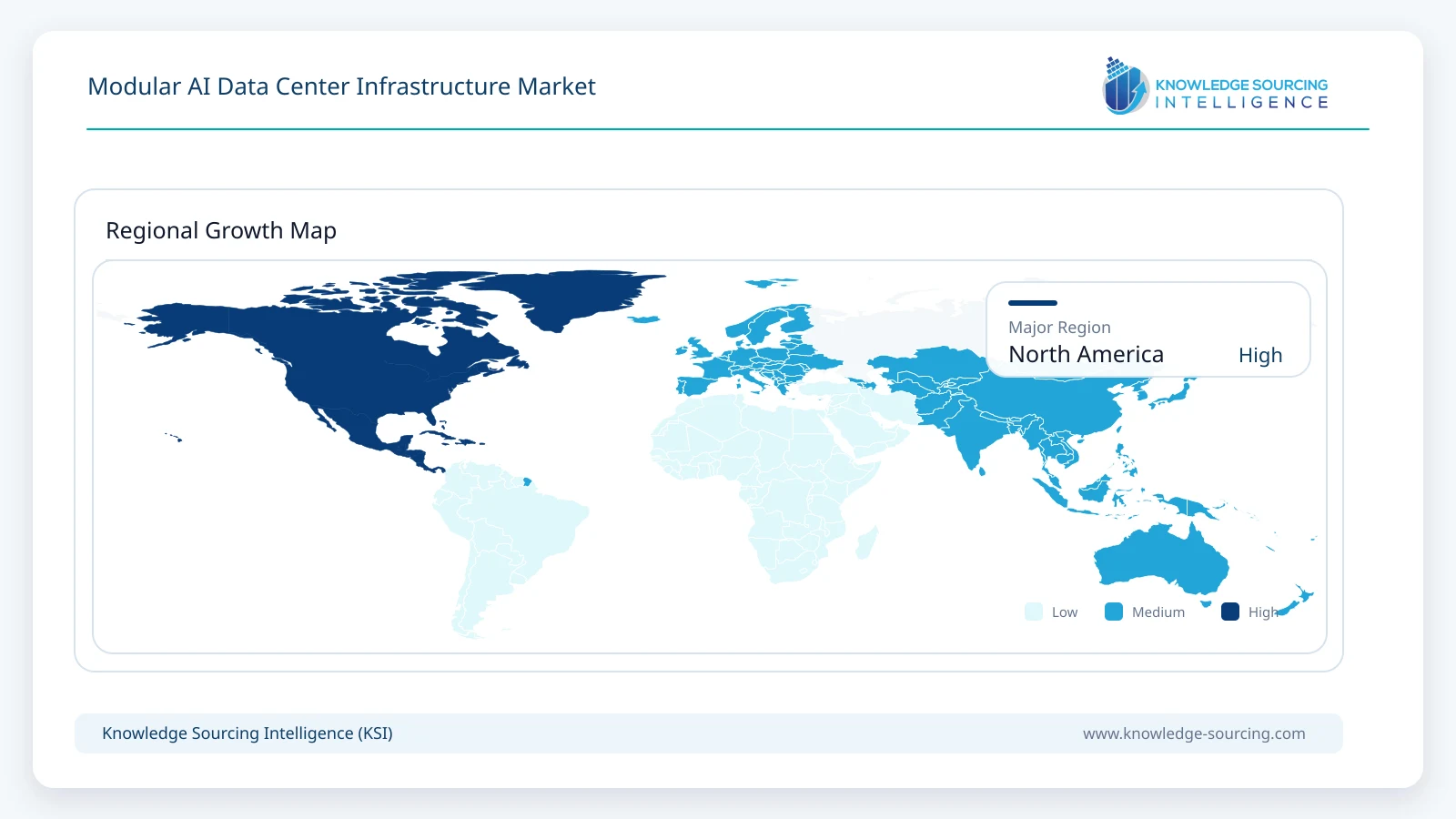
North America represents the largest early market for modular AI data-center infrastructure because the United States combines the world's largest concentration of hyperscale and neocloud investment with severe pressure on construction schedules, skilled labor and grid-connected capacity. Vertiv, Schneider Electric, Crusoe, Eaton, PCX, Dell, HPE and other relevant suppliers have major manufacturing or commercial operations in the region, while operators such as Hut 8, Switch, Digital Realty and AI cloud providers are adopting repeatable infrastructure designs. The economic incentive is strongest where expensive accelerator capacity can be commissioned sooner by moving assembly and testing off-site.
The region also contains several of the clearest examples of modular AI infrastructure moving from product launch into scaled deployment. Crusoe opened a dedicated 352,000-square-foot factory in Colorado for Spark modular AI factories and states that the units can be delivered in as little as three months. Its Redwood Materials deployment expanded from four to 24 modular data centers in 2026. Vertiv and Hut 8 are collaborating on industrialized OneCore infrastructure for selected AI projects, while Schneider Electric has expanded prefabricated manufacturing capacity and supplies power modules and IT pods to large data-center operators. These deployments create a visible installed base for recurring modules, lifecycle services and subsequent capacity additions.
North American demand is expected to split between two architectures. Large hyperscale and neocloud campuses will use modularization primarily as a construction method, combining prefabricated electrical, thermal and white-space blocks inside conventional campus layouts. Sovereign, enterprise and edge AI deployments will use more complete all-in-one modular facilities where factory integration replaces a larger share of on-site construction. Through 2032, the first architecture is expected to account for the larger revenue pool, while the second broadens the number of potential deployment sites and customers.
Other Regions
Europe is adopting modular AI infrastructure where schedule certainty, constrained construction labor and sustainability requirements favor factory-tested systems. Schneider Electric's Barcelona manufacturing expansion and September 2026 launch of 2 MW to 2.5 MW prefabricated power modules support regional availability. Asia Pacific combines rapid AI investment with a large power-electronics and manufacturing base; Delta, Huawei Digital Power and regional system manufacturers are important participants. Middle Eastern demand is concentrated in large greenfield AI and sovereign-compute projects where standardized infrastructure blocks can be incorporated into new campuses from the beginning. These regions are commercially important, but North America is discussed in greater depth because it currently provides the clearest combination of AI demand, manufacturing investment and scaled modular deployments.
Competitive Landscape
Competition spans full-system modular data-center vendors, critical-power suppliers, thermal-management companies, rack and enclosure manufacturers, and vertically integrated AI infrastructure developers. Schneider Electric and Vertiv have the broadest portfolios across prefabricated power, cooling, controls and integrated facility modules. Delta Electronics is combining high-voltage direct current power with liquid cooling and containerized AI systems, while Eaton, ABB, Siemens, Legrand, Rittal and Huawei Digital Power participate through power distribution, modular electrical rooms, racks, controls and integrated data-center infrastructure.
Crusoe represents a different competitive model because it manufactures modular AI factories as part of a vertically integrated AI infrastructure and cloud platform. PCX and Cannon Technologies contribute specialist prefabrication and modular electrical or facility capabilities, while Flex provides manufacturing and integration capacity relevant to scaled infrastructure production. Dell Technologies, Hewlett Packard Enterprise and Supermicro influence modular designs through rack-scale compute and liquid-cooled systems even when the physical infrastructure is supplied by partners. Johnson Controls and Trane Technologies participate where modular thermal plants and liquid-cooling systems are integrated into broader AI factory blocks.
Competitive differentiation is moving toward system integration and manufacturing repeatability rather than simple enclosure fabrication. Buyers increasingly evaluate how quickly a supplier can translate a reference design into repeatable production, validate power and cooling interfaces before shipment, manage multi-vendor equipment, and provide lifecycle support across successive compute generations. Vendors with large factory footprints, standardized design libraries and digital validation capabilities are positioned to capture a larger share of multi-site AI build programs.
Major companies and ecosystem participants covered: Schneider Electric, Vertiv, Delta Electronics, Crusoe, Eaton, ABB, Siemens, Huawei Digital Power, Rittal, Legrand, PCX Holding, Cannon Technologies, Flex, Hewlett Packard Enterprise, Dell Technologies, Supermicro, Johnson Controls and Trane Technologies.
Recent Developments
September 2026: Schneider Electric launched standardized 2 MW, 2.25 MW and 2.5 MW prefabricated power modules and skids for hyperscale, neocloud and colocation AI environments, with reference designs intended to reduce deployment timelines to as little as six months.
June 2026: Delta Electronics launched a prefabricated AI modular data-center solution integrating 800 VDC power architecture with advanced liquid cooling and stated that the modular approach can reduce deployment time by up to 60%.
May 2026: NVIDIA expanded the DSX platform and partner ecosystem for AI factories, reinforcing modular reference architectures and repeatable infrastructure integration across power, cooling, controls and operations.
March 2026: Crusoe and Redwood Materials expanded their Nevada deployment from four to 24 Crusoe Spark modular data centers, materially increasing compute density on the existing energy platform.
March 2026: Crusoe opened a 352,000-square-foot Colorado manufacturing facility dedicated to Crusoe Spark modular AI factories, supported by more than USD 200 million of investment in the facility and initial fleet.
March 2026: Vertiv introduced OneCore Rubin DSX infrastructure based on repeatable 12.5 MW building blocks for NVIDIA Vera Rubin AI factories.
February 2026: Vertiv and Hut 8 announced collaboration on OneCore converged modular infrastructure for selected AI data-center projects, targeting shorter deployment schedules and repeatable high-density designs.
Modular AI Data Center Infrastructure Market Scope:
| Report Metric | Details |
|---|---|
| Total Market Size in 2026 | USD 1.60 billion |
| Total Market Size in 2032 | USD 8.71 billion |
| Forecast Unit | USD Billion |
| Growth Rate | 32.6% |
| Study Period | 2021 to 2032 |
| Historical Data | 2021 to 2024 |
| Base Year | 2025 |
| Forecast Period | 2026 – 2032 |
| Segmentation | Modular Infrastructure Type, Deployment Scale, Rack Density, Power Architecture |
| Companies |
|
Market Segmentation
By Modular Infrastructure Type
Prefabricated Power Modules and Skids
Thermal and Liquid-Cooling Modules
White-Space and IT Pods
Integrated AI-Factory Infrastructure Blocks
Turnkey Modular AI Data Centers
Factory Integration and Deployment Services
By Deployment Scale
Hyperscale and Gigawatt AI Campuses
Neocloud and GPU Cloud Facilities
Sovereign and Enterprise AI
Edge and Distributed AI
By Rack Density
Below 100 kW
100-250 kW
250-500 kW
Above 500 kW
By Power Architecture
Conventional AC Distribution
Hybrid AC and 48/54 VDC
800 VDC-Ready Modular Infrastructure
Integrated Energy Storage and Backup
By Cooling Architecture
Air and Hybrid Cooling
Direct-to-Chip Liquid Cooling
Rear-Door Heat Exchangers
Immersion and Other High-Density Cooling
By Region
North America
United States
Canada
Europe
Asia Pacific
Middle East and Rest of World
Table of Contents
1. EXECUTIVE SUMMARY
1.1. Market Opportunity and Key Findings
1.2. Modular AI Infrastructure Adoption Timeline
1.3. Principal Revenue Pools
2. MARKET OVERVIEW
2.1. Industrialization of AI Data Center Construction
2.2. High-Density Power and Cooling Requirements
2.3. Factory Integration and Validation
2.4. Modular Deployment Economics
3. MARKET SIZE AND FORECAST, 2026-2032
3.1. Global Market Revenue
3.2. Annual Growth Analysis
3.3. Modular Capacity Delivered
3.4. Revenue by New Build and Expansion
4. MARKET BY MODULAR INFRASTRUCTURE TYPE
4.1. Prefabricated Power Modules and Skids
4.2. Thermal and Liquid-Cooling Modules
4.3. White-Space and IT Pods
4.4. Integrated AI-Factory Infrastructure Blocks
4.5. Turnkey Modular AI Data Centers
4.6. Factory Integration and Deployment Services
5. MARKET BY DEPLOYMENT SCALE
5.1. Hyperscale and Gigawatt AI Campuses
5.2. Neocloud and GPU Cloud Facilities
5.3. Sovereign and Enterprise AI
5.4. Edge and Distributed AI
6. MARKET BY RACK DENSITY
6.1. Below 100 kW
6.2. 100-250 kW
6.3. 250-500 kW
6.4. Above 500 kW
7. MARKET BY POWER ARCHITECTURE
7.1. Conventional AC Distribution
7.2. Hybrid AC and 48/54 VDC
7.3. 800 VDC-Ready Modular Infrastructure
7.4. Integrated Energy Storage and Backup
8. MARKET BY COOLING ARCHITECTURE
8.1. Air and Hybrid Cooling
8.2. Direct-to-Chip Liquid Cooling
8.3. Rear-Door Heat Exchangers
8.4. Immersion and Other High-Density Cooling
9. REGIONAL MARKET
9.1. North America
9.1.1. United States
9.1.2. Canada
9.2. Europe
9.3. Asia Pacific
9.4. Middle East and Rest of World
10. TECHNOLOGY AND COMMERCIALIZATION OUTLOOK
10.1. AI Factory Reference Architectures
10.2. Factory-Tested Power and Cooling Blocks
10.3. 800 VDC and Next-Generation Rack Power
10.4. Modular Liquid Cooling
10.5. Digital Validation and Simulation-Ready Modules
10.6. Multi-Site Standardization and Repeatable Deployment
10.7. Lifecycle Upgradeability Across Compute Generations
11. COMPETITIVE LANDSCAPE
11.1. Value Chain
11.2. Full-System Modular Infrastructure Vendors
11.3. Prefabricated Power and Electrical Suppliers
11.4. Modular Thermal Infrastructure Suppliers
11.5. Turnkey Modular AI Factory Developers
11.6. Manufacturing and Integration Partners
11.7. Partnerships and Capacity Expansion
12. COMPANY PROFILES
12.1. Schneider Electric
12.2. Vertiv
12.3. Delta Electronics
12.4. Crusoe
12.5. Eaton
12.6. ABB
12.7. Siemens
12.8. Huawei Digital Power
12.9. Rittal
12.10. Legrand
12.11. PCX Holding
12.12. Cannon Technologies
12.13. Flex
12.14. Hewlett Packard Enterprise
12.15. Dell Technologies
12.16. Supermicro
12.17. Johnson Controls
12.18. Trane Technologies
13. APPENDIX
13.1. Definitions and Abbreviations
13.2. Modular Infrastructure Classification
13.3. Rack Density and Power Architecture Framework
13.4. Source and Data Notes
Navigate
Trusted by the world's leading organizations











