
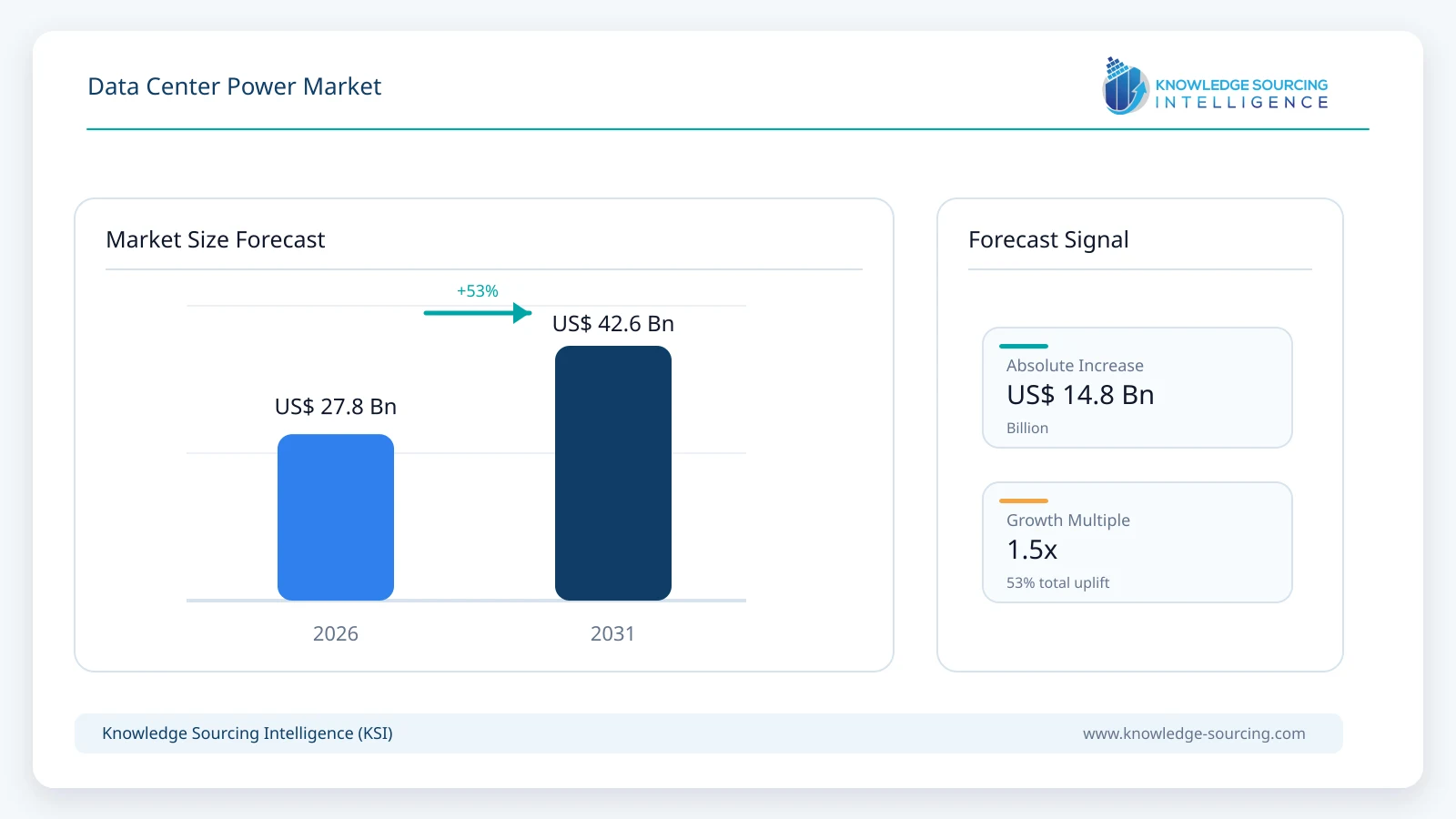
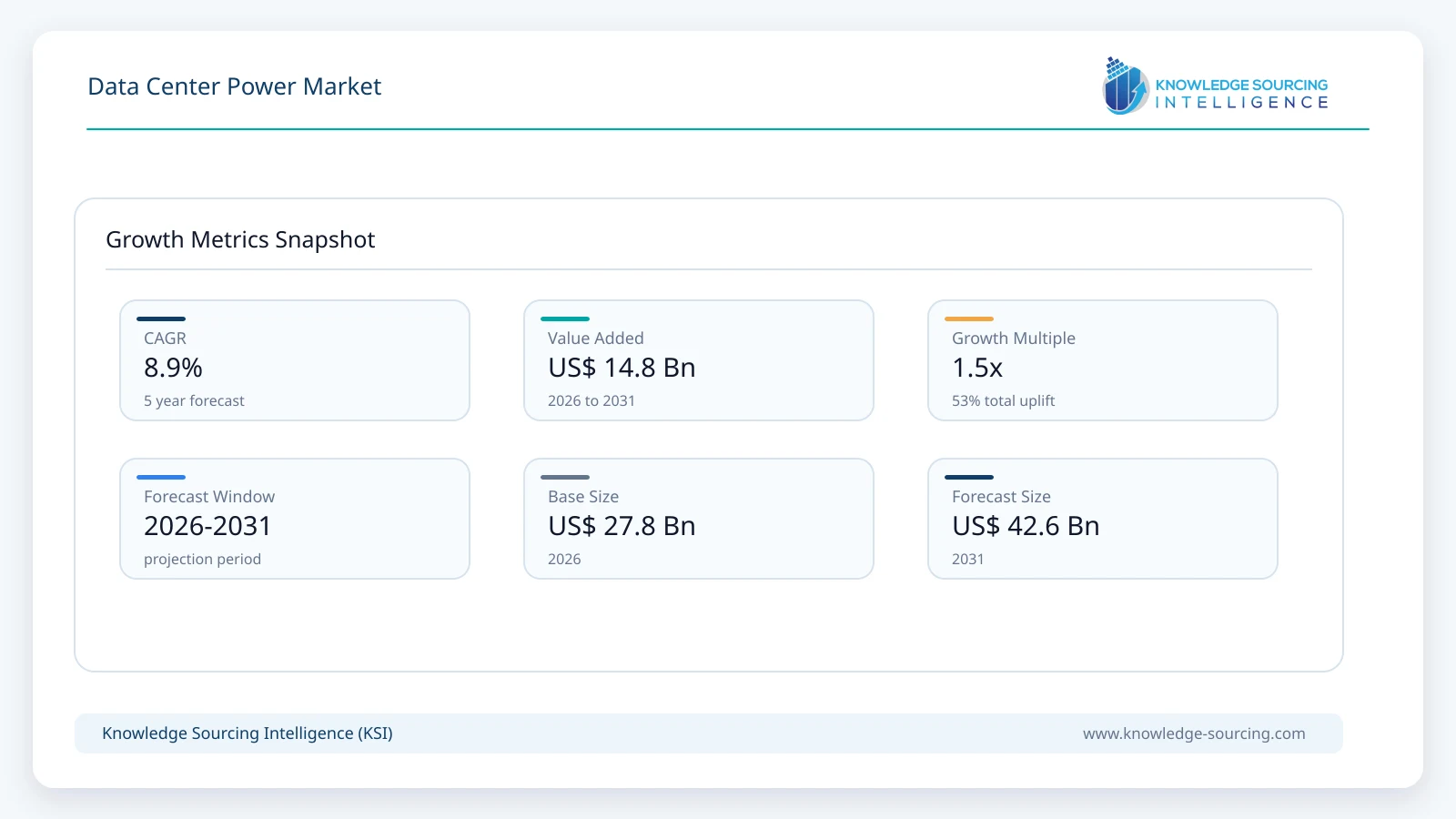
The Data Center Power Market is forecast to grow at a CAGR of 8.90%, reaching USD 42.57 billion in 2031 from USD 27.80 billion in 2026.
Highlights:
- 1Expansion of AI computing infrastructure is increasing demand for higher-capacity and modular data center power systems.
- 2UPS solutions remain the most commercially important product category due to their role in ensuring uninterrupted operations.
- 3Asia Pacific continues to attract substantial investment through hyperscale campus construction and enterprise digital infrastructure expansion.
- 4Intelligent power monitoring, predictive maintenance, and software-integrated power management are influencing purchasing decisions.
- 5Energy efficiency regulations and sustainability targets are encouraging replacement of legacy electrical infrastructure.
- 6Competition is increasingly based on integrated solutions combining hardware, software, engineering services, and long-term maintenance support.
The data center power market comprises the electrical infrastructure, equipment, and power management solutions required to ensure uninterrupted and energy-efficient operation of data centers. Core solutions include uninterruptible power supply (UPS) systems, power distribution units (PDUs), and busway systems that collectively support continuous computing operations, protect mission-critical equipment from power disturbances, and optimize electrical distribution across server environments. Demand for these solutions extends across hyperscale cloud facilities, colocation campuses, enterprise data centers, telecommunications infrastructure, financial institutions, healthcare organizations, government facilities, and industrial digital infrastructure.
Demand for data center power solutions is being shaped by sustained expansion in cloud computing, artificial intelligence (AI) workloads, enterprise digital services, edge computing deployments, and growing data sovereignty requirements. Computing densities continue to rise as AI clusters, graphics processing units (GPUs), and high-performance computing (HPC) installations consume substantially more power than conventional server environments. This shift has increased procurement of higher-capacity UPS systems, intelligent PDUs capable of outlet-level monitoring, and scalable busway architectures that simplify capacity expansion while minimizing downtime.
Buyer priorities have also changed. Instead of evaluating equipment solely on initial acquisition costs, operators increasingly assess lifecycle efficiency, energy utilization, predictive maintenance capabilities, modular scalability, service availability, and compliance with reliability standards. Large colocation operators and hyperscale cloud providers emphasize equipment standardization across global campuses to simplify maintenance and reduce operating costs, while enterprise buyers prioritize reliability, redundancy, and ease of integration with existing electrical infrastructure.
The industry exhibits a combination of global electrical equipment manufacturers, specialized power infrastructure providers, and integrated digital infrastructure solution companies. Competition extends beyond hardware performance to include software-enabled monitoring, remote diagnostics, lifecycle services, preventive maintenance contracts, and system integration capabilities. Long-term customer relationships remain commercially valuable because replacement cycles often extend over several years and ongoing maintenance services generate recurring revenue.
Investment in sustainable infrastructure is another defining characteristic of the market. Operators seek solutions that improve power usage effectiveness (PUE), reduce conversion losses, and support renewable energy integration. Government energy-efficiency initiatives and corporate carbon reduction targets are encouraging procurement of high-efficiency power systems that lower operational expenditure while supporting environmental objectives.
Market Drivers
Expansion of AI and High-Density Computing Infrastructure
AI training clusters and HPC environments require substantially higher electrical loads than traditional enterprise servers. GPU-intensive computing environments increase rack densities, placing greater demands on power delivery systems capable of maintaining stable voltage and minimizing downtime. Buyers therefore invest in scalable UPS architectures and intelligent distribution systems that accommodate future capacity expansion without major facility redesign. Suppliers continue developing modular systems that simplify deployment while improving operational flexibility for rapidly expanding facilities.
Rising Global Investment in Colocation and Hyperscale Data Centers
Cloud service providers and colocation companies continue expanding capacity to support enterprise migration toward outsourced digital infrastructure. New facilities require complete electrical ecosystems from utility connection through rack-level power distribution. Procurement decisions increasingly favor vendors capable of supplying integrated power infrastructure, engineering expertise, commissioning services, and lifecycle maintenance. This creates opportunities for manufacturers offering comprehensive portfolios rather than standalone products.
Greater Emphasis on Operational Resilience
Business continuity has become a board-level priority across banking, healthcare, telecommunications, manufacturing, and public sector organizations. Even brief power interruptions may result in financial losses, regulatory penalties, or service disruption. Consequently, buyers prioritize redundant power architectures, predictive maintenance capabilities, and systems designed for high availability. Vendors compete by demonstrating reliability records, service responsiveness, and compliance with recognized industry standards.
Energy Efficiency and Sustainability Objectives
Electricity represents one of the largest operating expenses for data center operators. Organizations therefore seek power equipment with higher conversion efficiency, lower heat generation, and improved energy monitoring. Intelligent PDUs and modern UPS technologies provide detailed operational analytics that support optimization of power consumption. Sustainability commitments further encourage replacement of older systems with equipment capable of reducing energy losses and supporting renewable energy integration.
Market Restraints and Challenges
High Capital Investment Requirements
Power infrastructure constitutes a substantial portion of overall data center construction expenditure. Large facilities require significant investment in UPS systems, switchgear, distribution infrastructure, backup power integration, and monitoring platforms. Smaller enterprises often postpone modernization because return on investment depends on long-term operational savings rather than immediate financial benefits. Vendors increasingly address this challenge through modular deployment models that allow phased capacity expansion.
Supply Chain Constraints for Critical Electrical Components
Power electronics, semiconductors, transformers, and electrical distribution equipment remain subject to procurement challenges resulting from global manufacturing capacity limitations and geopolitical uncertainty. Extended lead times may delay construction schedules for new facilities while increasing project costs. Manufacturers are responding through supplier diversification, regional manufacturing investments, and inventory optimization.
Skilled Workforce Limitations
Installation and maintenance of sophisticated power infrastructure require experienced electrical engineers, commissioning specialists, and service technicians. Labor shortages can delay deployment schedules and increase maintenance expenses, particularly in emerging markets experiencing accelerated data center construction. Equipment suppliers are expanding certification programs, remote diagnostics, and predictive maintenance services to improve operational efficiency.
Increasing System Complexity
Modern data centers integrate renewable energy sources, battery energy storage systems, intelligent monitoring software, and advanced cooling technologies. Integrating these systems while maintaining reliability presents engineering challenges for facility operators. Buyers increasingly favor suppliers capable of providing complete engineering support and interoperable solutions that reduce implementation risk.
Major Segment Analysis
Uninterruptible Power Supply (UPS)
UPS systems represent the most commercially important solution segment because uninterrupted electrical supply remains fundamental to data center operations. Every mission-critical computing facility requires continuous protection against voltage fluctuations, utility failures, and transient electrical disturbances. As computing densities increase, buyers are replacing conventional centralized architectures with modular UPS systems capable of incremental expansion while maintaining high operating efficiency.
Procurement decisions extend beyond power capacity. Buyers evaluate efficiency under varying load conditions, battery technologies, maintenance requirements, remote monitoring capabilities, redundancy configurations, and lifecycle operating costs. Lithium-ion battery adoption has increased because longer service life and reduced maintenance requirements improve long-term economics despite higher initial investment.
Competition within the UPS segment increasingly emphasizes digital capabilities. Remote diagnostics, predictive analytics, cloud-based asset monitoring, and automated maintenance scheduling improve operational visibility while reducing unplanned outages. Vendors capable of integrating UPS equipment into broader data center infrastructure management platforms strengthen customer retention through recurring service contracts and software-enabled value-added services.
The commercial importance of UPS systems will remain high because every new data center requires resilient electrical infrastructure regardless of facility size or ownership model.
Regional Analysis
North America
North America remains a mature market supported by continuous expansion of hyperscale cloud campuses, enterprise modernization, AI infrastructure investment, and established colocation providers. Procurement priorities emphasize operational efficiency, sustainability, and long-term service agreements. Strong regulatory expectations regarding infrastructure resilience encourage investment in premium power systems, although utility constraints in selected metropolitan areas influence project timelines.
Europe
European demand reflects energy efficiency objectives, sustainability regulations, and modernization of enterprise infrastructure. Operators increasingly prioritize equipment capable of reducing electricity consumption while supporting corporate carbon reduction targets. Growing investment in sovereign cloud infrastructure and regional data localization initiatives supports demand, although permitting requirements and energy availability remain constraints in certain markets.
Asia Pacific
Asia Pacific represents the fastest-expanding regional opportunity due to cloud adoption, digital economy initiatives, manufacturing digitization, and rising internet usage. China, India, Japan, South Korea, Taiwan, and Southeast Asian economies continue attracting investment from hyperscale operators and colocation providers. Buyers emphasize scalable infrastructure capable of supporting long-term expansion while balancing capital expenditure with operational efficiency.
Middle East and Africa
The region benefits from government-supported digital transformation initiatives, smart city projects, financial sector modernization, and increasing cloud infrastructure investment. Gulf countries continue developing regional data center hubs supported by strategic connectivity and national digital strategies. However, electricity infrastructure variability and skilled workforce availability continue influencing project implementation.
South America
Brazil remains the principal regional market, supported by financial services, telecommunications, cloud infrastructure expansion, and enterprise digital investment. Argentina and other regional economies are gradually expanding data center capacity despite macroeconomic uncertainty. Buyers focus on cost-efficient, reliable power infrastructure capable of supporting long operational lifecycles under varying grid conditions.
Competitive Landscape
Competition within the data center power market is characterized by established multinational electrical equipment manufacturers with extensive engineering capabilities, global service networks, and diversified product portfolios. Schneider Electric SE, Vertiv Group Corp., Eaton Corporation plc, ABB Ltd., Delta Electronics, Inc., Huawei Technologies Co., Ltd., Rittal GmbH & Co. KG (Friedhelm Loh Group), Raritan Inc. (Legrand), Siemens AG, and Legrand SA compete through integrated infrastructure offerings rather than individual hardware products.
Competitive differentiation increasingly depends on power efficiency, modular system architecture, intelligent monitoring software, predictive maintenance capabilities, engineering expertise, and lifecycle service offerings. Strategic partnerships with cloud providers, engineering contractors, and colocation developers strengthen market positioning. Geographic manufacturing presence, local service availability, and supply chain resilience also influence procurement decisions for large infrastructure projects.
Recent Developments
July 2026: Vertiv inaugurated a new manufacturing facility in Johor, Malaysia, expanding production capacity for critical power and thermal infrastructure to meet accelerating AI and high-density data center demand across Asia.
June 2026: Schneider Electric and Hon Hai Technology Group (Foxconn) announced a strategic collaboration to accelerate next-generation AI data centers by combining Schneider Electric's power and energy management expertise with Foxconn's AI manufacturing capabilities.
Regulatory and Policy Environment
The market operates within an extensive framework of electrical safety, energy efficiency, environmental, and operational reliability standards. International standards governing low-voltage electrical systems, UPS performance, electromagnetic compatibility, and electrical safety influence equipment design and procurement requirements. Data center operators also reference standards developed by organizations such as the Uptime Institute and relevant International Electrotechnical Commission (IEC) frameworks during infrastructure planning.
Government energy efficiency policies encourage adoption of higher-efficiency electrical equipment that reduces operating costs and environmental impact. Carbon reduction commitments, renewable energy integration policies, and reporting requirements further support modernization of legacy infrastructure. Compliance with electrical installation codes, battery safety regulations, and environmental directives remains essential for suppliers operating across multiple jurisdictions.
Outlook and Strategic Implications
Commercial opportunities will increasingly be shaped by AI infrastructure expansion, cloud investment, enterprise modernization, and continued demand for resilient digital infrastructure. Procurement strategies are expected to prioritize modularity, operational efficiency, lifecycle economics, and intelligent monitoring rather than simply expanding installed electrical capacity.
Investment is likely to concentrate on software-enabled power infrastructure that combines advanced analytics, predictive maintenance, and remote asset management with high-efficiency electrical hardware. Suppliers capable of delivering integrated engineering, installation, commissioning, and long-term maintenance services are expected to strengthen customer relationships while expanding recurring service revenue.
Competitive differentiation will continue shifting toward complete infrastructure ecosystems that integrate UPS systems, intelligent PDUs, busway solutions, monitoring software, and lifecycle services into unified platforms. Manufacturers with diversified manufacturing capacity and resilient supply chains will be better positioned to support global hyperscale expansion programs.
Potential risks include component supply constraints, prolonged project approval cycles, utility power limitations, and evolving sustainability regulations that require continuous product innovation. Nevertheless, rising dependence on digital infrastructure across government, enterprise, financial services, healthcare, telecommunications, manufacturing, and cloud computing will sustain long-term investment in reliable and energy-efficient data center power solutions.
Data Center Power Market Scope
| Report Metric | Details |
|---|---|
| Total Market Size in 2026 | USD 27.80 billion |
| Total Market Size in 2031 | USD 42.57 billion |
| Forecast Unit | Billion |
| Growth Rate | 8.90% |
| Study Period | 2021 to 2031 |
| Historical Data | 2021 to 2024 |
| Base Year | 2025 |
| Forecast Period | 2026 – 2031 |
| Segmentation | Solution, End-User, Geography |
| Companies |
|
Market Segmentation
By Solution
- Uninterruptible Power Supply (UPS)
- Power Distribution Unit (PDU)
- Busway
By End-User
- Colocation Providers
- Cloud Providers
- Enterprises
By Geography
- North America
- United States
- Canada
- Mexico
- South America
- Brazil
- Argentina
- Others
- Europe
- Germany
- France
- United Kingdom
- Spain
- Others
- Middle East and Africa
- Saudi Arabia
- Israel
- United Arab Emirates
- Others
- Asia Pacific
- China
- Japan
- South Korea
- India
- Taiwan
- Thailand
- Indonesia
- Others
Table of Contents
1. INTRODUCTION
1.1. Market Overview
1.2. Market Definition
1.3. Scope of the Study
1.4. Market Segmentation
1.5. Currency
1.6. Assumptions
1.7. Base and Forecast Years Timeline
1.8. Key Benefits to the Stakeholder
2. RESEARCH METHODOLOGY
2.1. Research Design
2.2. Research Processes
3. EXECUTIVE SUMMARY
3.1. Key Findings
4. MARKET DYNAMICS
4.1. Market Drivers
4.2. Market Restraints
4.3. Porter's Five Forces Analysis
4.3.1. Bargaining Power of Suppliers
4.3.2. Bargaining Power of Buyers
4.3.3. Threat of New Entrants
4.3.4. Threat of Substitutes
4.3.5. Competitive Rivalry in the Industry
4.4. Industry Value Chain Analysis
4.5. Analyst View
5. DATA CENTRE POWER MARKET BY SOLUTION
5.1. Introduction
5.2. Uninterruptible Power Supply (UPS)
5.3. Power Distribution Unit (PDU)
5.4. Busway
6. DATA CENTRE POWER MARKET BY END-USER
6.1. Introduction
6.2. Colocation Providers
6.3. Cloud Providers
6.4. Enterprises
7. DATA CENTRE POWER MARKET BY GEOGRAPHY
7.1. Introduction
7.2. North America
7.2.1. By Solution
7.2.2. By End-User
7.2.3. By Country
7.2.3.1. United States
7.2.3.2. Canada
7.2.3.3. Mexico
7.3. South America
7.3.1. By Solution
7.3.2. By End-User
7.3.3. By Country
7.3.3.1. Brazil
7.3.3.2. Argentina
7.3.3.3. Others
7.4. Europe
7.4.1. By Solution
7.4.2. By End-User
7.4.3. By Country
7.4.3.1. Germany
7.4.3.2. France
7.4.3.3. United Kingdom
7.4.3.4. Spain
7.4.3.5. Others
7.5. Middle East and Africa
7.5.1. By Solution
7.5.2. By End-User
7.5.3. By Country
7.5.3.1. Saudi Arabia
7.5.3.2. Israel
7.5.3.3. United Arab Emirates
7.5.3.4. Others
7.6. Asia Pacific
7.6.1. By Solution
7.6.2. By End-User
7.6.3. By Country
7.6.3.1. China
7.6.3.2. Japan
7.6.3.3. South Korea
7.6.3.4. India
7.6.3.5. Taiwan
7.6.3.6. Thailand
7.6.3.7. Indonesia
7.6.3.8. Others
8. COMPETITIVE ENVIRONMENT AND ANALYSIS
8.1. Major Players and Strategy Analysis
8.2. Market Share Analysis
8.3. Mergers, Acquisitions, Agreements, and Collaborations
8.4. Competitive Dashboard
9. COMPANY PROFILES
9.1. Schneider Electric SE
9.2. Vertiv Group Corp.
9.3. Eaton Corporation plc
9.4. ABB Ltd.
9.5. Delta Electronics, Inc.
9.6. Huawei Technologies Co., Ltd.
9.7. Rittal GmbH & Co. KG (Friedhelm Loh Group)
9.8. Raritan Inc. (Legrand)
9.9. Siemens AG
9.10. Legrand SA
Navigate
Trusted by the world's leading organizations











