
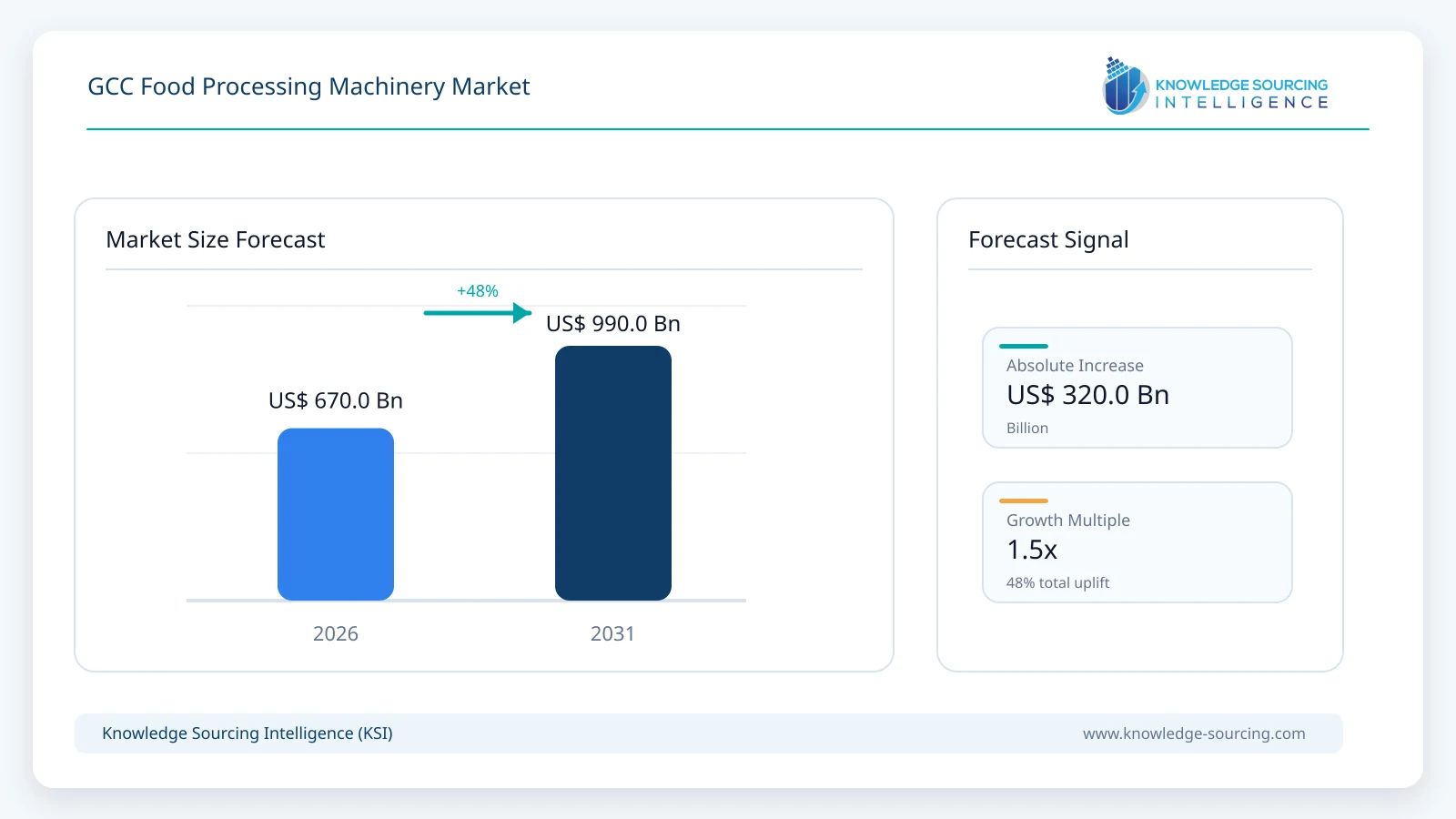
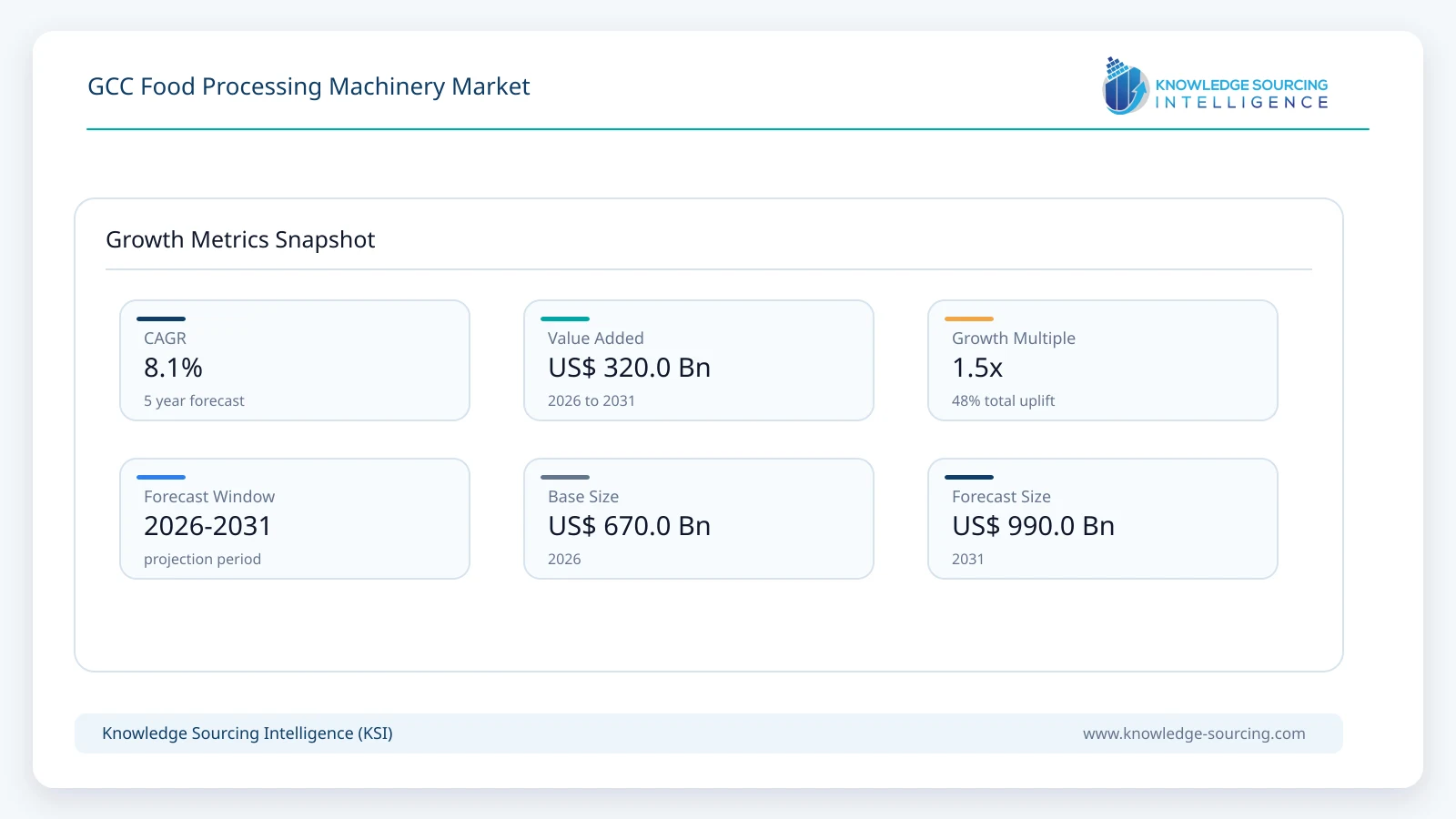
The GCC food processing machinery market is forecast to grow at a CAGR of 8.1%, reaching USD 990.0 million in 2031 from USD 670.0 million in 2026.
Highlights:
- 1Processing equipment accounts for approximately 73% of GCC market revenue in 2026.
- 2Automatic machinery is projected to grow about 9.4% annually through 2031.
- 3Bakery and confectionery equipment generates approximately USD 154 million in 2026.
- 4Saudi Arabia represents roughly 49% of GCC food processing machinery demand in 2026.
- 5The six GCC states imported about USD 378 million of HS 8438 food machinery in 2023.
- 6The UAE is targeting AED 2 billion of annual food-import substitution through expanded local production.
Market Overview
The GCC is increasingly treating food processing as industrial infrastructure rather than only as a downstream extension of food imports. Saudi Arabia is the largest manufacturing base in the region. Invest Saudi identifies an 85% food-processing localization target by 2030 and a food and beverage market of about USD 42 billion, while the Saudi Food and Drug Authority reported 624 licensed food factories in 2025. The UAE is developing a national Food Cluster that aims to increase the sector's GDP contribution from AED 30 billion to AED 40 billion by 2028. These initiatives create recurring machinery demand across dairy, meat, poultry, bakery, beverages, dates, prepared foods, and ingredient processing.
Trade data provide a useful lower-bound anchor for equipment demand because the GCC remains dependent on imported process technology. World Bank WITS data show 2023 HS 8438 imports of USD 182.1 million for Saudi Arabia, USD 107.4 million for the UAE, USD 54.4 million for Oman, USD 14.2 million for Kuwait, USD 10.3 million for Qatar and USD 9.6 million for Bahrain. The combined gross value was approximately USD 378.0 million. This total includes some intra-GCC redistribution and does not capture all dairy, separation, thermal, automation and line-integration equipment classified under other customs headings, so it is used as an import floor rather than as the complete market size.
The machinery supply base is correspondingly international. European suppliers remain strong in high-throughput dairy, beverage, bakery, protein, sorting and thermal-processing systems, while Asian suppliers compete in compact and mid-capacity equipment. Saudi Arabia and the UAE have the deepest local engineering and service ecosystems, but much of the core process equipment is still imported. This makes distributor capability, regional spare-parts inventory, commissioning support and remote diagnostics important purchasing criteria alongside machine price and throughput.
Market Trends
Localization Programs Are Shifting Demand Toward Complete Processing Lines
GCC food-security strategies are changing the composition of machinery demand. Instead of relying mainly on replacement purchases by established processors, the market is adding greenfield and brownfield lines designed to localize categories that were historically imported. In May 2026, the UAE announced a policy intended to enable AED 2 billion of annual food-import substitution through local production, support up to 200 food factories and raise local production capacity by 15-30% in targeted categories. Saudi investment programs similarly emphasize local production across poultry, seafood, dairy, dates and processed foods. These programs favor integrated lines because new plants require coordinated preparation, processing, inspection, handling and digital control rather than isolated machines.
Automation and Remote Service Are Becoming More Valuable in Import-Dependent Plants
Automatic machinery is gaining share because GCC processors place a high value on stable throughput, standardized quality and lower dependence on specialized operating labor. The case for automation is strengthened by the cost of unplanned downtime when critical components or technicians must be sourced internationally. Equipment suppliers are therefore adding line monitoring, predictive maintenance, remote diagnostics and standardized control architectures. Tetra Pak's Factory OS, launched in November 2025, reflects this broader shift toward connected food and beverage factories, while suppliers such as GEA and JBT Marel are integrating machine-level data with production optimization and service platforms.
Water, Energy and Hygienic Design Are Moving Higher in Equipment Specifications
Water and energy intensity matter more in the GCC than in many mature processing markets because utilities directly affect operating economics and food-security resilience. Buyers increasingly compare Clean-in-Place efficiency, heat recovery, water recirculation, motor efficiency, product giveaway, and sanitation time when evaluating equipment. Hygienic design is especially important in dairy, meat, poultry, and prepared foods, where high ambient temperatures increase the operational consequences of cleaning or temperature-control failures. The result is a gradual shift from lowest-capital-cost machinery toward systems that can demonstrate lower lifetime utility use and more consistent sanitation performance.
Market Drivers
Food Security and Industrial Localization Are Creating a Multi-Year Investment Pipeline
Government policy is the strongest structural driver. Saudi Arabia's localization agenda is designed to expand domestic food processing, while the UAE Food Cluster explicitly identifies advanced agriculture and food processing as a strategic growth area. Oman is also moving from food-security planning into investable processing projects: in April 2026, the Ministry of Commerce, Industry and Investment Promotion launched a portfolio that included onion and potato cultivation and processing projects, with the potato project alone carrying an indicated investment value of OMR 5.5 million. These programs do not translate one-for-one into machinery spending, but they widen the addressable installed base and reduce the market's dependence on replacement demand alone.
New Meat, Bakery, Dairy and Prepared-Food Capacity Is Supporting Equipment Orders
Recent projects show that the investment cycle is already moving into operating assets. Saudi Arabia opened Sinyora's SAR 150 million Jeddah food factory in January 2026 with annual capacity of 10,000 tons of chilled and frozen foods. Almunajem Foods has been developing a SAR 157 million Jeddah plant for poultry, red meat, seafood and dairy products with 35,000 tons of annual capacity, while Nestle's first Saudi food factory was announced with an initial SAR 270 million investment. In the UAE, Solico Group launched the AED 130 million SoFood facility in Jafza in January 2026, using advanced European technologies and an initial capacity of up to 40 tons per day. Projects of this type generate demand for preparation, mixing, cooking, portioning, forming, thermal-processing and inspection equipment.
Market Restraint
Imported Equipment Cost and Service Dependence Can Delay Automation for Smaller Processors
The main restraint is the high total cost of imported machinery relative to the scale of many regional processors. Advanced European processing lines carry not only purchase cost but also freight, installation, commissioning, spare-parts inventory, software support and specialist service requirements. Currency stability in most GCC states reduces one source of volatility, but long lead times and dependence on overseas components can still increase project risk. Large dairy, poultry, beverage and bakery groups can justify integrated automation, while smaller manufacturers often choose semi-automatic systems, locally fabricated tanks and conveyors, or staged line upgrades. This slows the conversion of the full installed base to high-end automatic equipment.
Segment Analysis
By Type - Processing Equipment
Processing equipment is the largest type category, with an estimated 2026 value of approximately USD 489 million. The segment includes mixing and blending, cutting and grinding, extrusion and forming, homogenization, cooking, baking, thermal processing and other equipment that directly changes the food product. It is projected to approach USD 738 million by 2031 as new plants adopt higher-capacity and more automated lines. Pre-processing equipment remains important in dates, fruits and vegetables, meat, seafood and primary ingredient handling, but its average unit value is generally lower than that of integrated thermal, extrusion, dairy and protein-processing systems.
By Food Matter Type - Solid
Solid-food processing represents the largest food-matter category, with an estimated value of about USD 348 million in 2026. Demand is spread across bakery, confectionery, meat, poultry, seafood, dates, snacks, grains and prepared foods. Solid processing requires a broad equipment set covering cutting, grinding, forming, coating, baking, roasting, extrusion, portioning and conveying. Liquid and semi-solid applications are smaller in revenue terms but remain important in dairy, beverages, sauces and ingredients, where higher-value homogenization, separation and aseptic process systems can raise equipment intensity per production line.
By Automation Level - Automatic Machinery
Automatic machinery is estimated at approximately USD 395 million in 2026 and is expected to exceed USD 615 million by 2031. Adoption is strongest in high-volume dairy, beverage, industrial bakery, poultry and prepared-food plants where repeatability and line uptime justify the higher capital cost. Semi-automatic equipment remains relevant for smaller bakeries, specialty food manufacturers and processors adding capacity in stages. Manual machinery retains a limited role in small-batch and low-throughput operations but is losing share as food-safety documentation and traceability requirements become more demanding.
By Application - Bakery and Confectionery
Bakery and confectionery accounts for roughly 23% of GCC machinery demand in 2026. The segment benefits from the large regional consumption of bread, flatbreads, biscuits, snacks, chocolate and sweet baked products, as well as the growth of industrial and frozen bakery formats. Machinery demand ranges from mixers, proofing and dough-handling systems to depositors, ovens, cooling systems and automated handling. Meat, poultry and seafood is a similarly important application because Saudi Arabia and the UAE are expanding local protein processing, while dairy remains equipment-intensive due to pasteurization, separation, homogenization and hygienic handling requirements.
By Country - Saudi Arabia
Saudi Arabia is the largest GCC country market, with estimated 2026 machinery demand of approximately USD 328 million. Its scale is supported by the region's largest consumer base, 624 licensed food factories reported by the SFDA for 2025, and policy support for food-processing localization. The country's 2023 HS 8438 imports were USD 182.1 million, already well above the UAE and other GCC states before adding machinery classified elsewhere. The UAE is the second-largest market and acts as both a manufacturing center and a distribution hub, while Oman has a smaller but relatively equipment-intensive base linked to fisheries, dairy, grains and new food-security projects. Kuwait, Qatar and Bahrain are smaller markets concentrated in targeted dairy, bakery, beverage and prepared-food investments.
Competitive Environment
The GCC market is led by multinational process-equipment suppliers with strong regional sales and service capability. GEA, JBT Marel, Tetra Pak, Bühler, Krones, Alfa Laval and SPX FLOW compete across dairy, beverages, protein, bakery, ingredients and thermal processing. Their advantage is not only equipment breadth but also commissioning, hygienic design expertise, spare-parts support, digital monitoring and the ability to integrate complete lines. Suppliers with established teams in the UAE or Saudi Arabia are better positioned to reduce service response time across the region.
Specialist suppliers compete successfully where application knowledge matters more than full-line scale. Heat and Control is relevant in snack, frying and coating systems; TOMRA Food in sorting; Clextral in extrusion; BAADER and Provisur in protein processing; Handtmann in portioning and forming; and ANKO in compact automated food production. The GCC also supports a layer of local engineering firms and stainless-steel fabricators that provide tanks, conveyors, piping, platforms and lower-complexity machines, often integrating imported process equipment into complete plants.
Competition is becoming more lifecycle-oriented. Buyers increasingly compare energy and water use, sanitation time, spare-parts availability, remote support, line flexibility and the ability to expand capacity without replacing the entire system. This favors modular platforms and suppliers that can combine process engineering with service contracts. Price remains important, particularly among SMEs, but downtime risk and the cost of overseas technical support make local service infrastructure a stronger differentiator than in markets with deeper domestic machinery manufacturing.
Recent Developments
May 2026: The UAE announced an industrial policy targeting AED 2 billion of annual food-import substitution and support for up to 200 food factories.
April 2026: Oman launched a new food-security investment portfolio that included multiple cultivation-and-processing projects.
January 2026: Sinyora opened a SAR 150 million food factory in Jeddah with annual capacity of 10,000 tons.
January 2026: Solico Group launched the AED 130 million SoFood manufacturing facility in Jafza with advanced European processing technology.
November 2025: Tetra Pak launched Factory OS, an open digital platform for connected food and beverage factories.
January 2025: JBT completed the Marel transaction, creating a larger global food-processing technology platform.
GCC Food Processing Machinery Market Scope:
| Report Metric | Details |
|---|---|
| Total Market Size in 2026 | USD 670.0 million |
| Total Market Size in 2031 | USD 990.0 million |
| Forecast Unit | Billion |
| Growth Rate | 8.1% |
| Study Period | 2021 to 2031 |
| Historical Data | 2021 to 2024 |
| Base Year | 2025 |
| Forecast Period | 2026 – 2031 |
| Segmentation | Type, Food Matter Type, Automation Level, Application |
| Companies |
|
Market Segmentation
By Type
Pre-Processing Equipment
Cleaning
Grading and Sorting
Peeling and Preparation
Processing Equipment
Mixing and Blending
Cutting and Grinding
Extrusion and Forming
Homogenization
Thermal Processing and Baking
Others
By Food Matter Type
Solid
Semi-Solid
Liquid
By Automation Level
Manual
Semi-Automatic
Automatic
By Application
Bakery and Confectionery
Meat, Poultry and Seafood
Dairy
Beverages
Fruits and Vegetables
Others
By Country
Saudi Arabia
United Arab Emirates
Oman
Kuwait
Qatar
Bahrain
Table of Contents
1. EXECUTIVE SUMMARY
2. MARKET SNAPSHOT
2.1. Market Overview
2.2. Market Definition
2.3. Market Segmentation
3. BUSINESS LANDSCAPE
3.1. Market Drivers
3.1.1. Food Security and Industrial Localization Are Creating a Multi-Year Investment Pipeline
3.1.2. New Meat, Bakery, Dairy and Prepared-Food Capacity Is Supporting Equipment Orders
3.2. Market Restraint
3.2.1. Imported Equipment Cost and Service Dependence Can Delay Automation for Smaller Processors
3.3. Market Opportunities
3.4. Porter's Five Forces Analysis
3.5. Industry Value Chain Analysis
3.6. Policies and Regulations
3.7. Strategic Recommendations
4. TECHNOLOGICAL OUTLOOK
4.1. Connected Production and Remote Diagnostics
4.2. Robotics and Automated Handling
4.3. Water- and Energy-Efficient Processing
4.4. Hygienic Design and Advanced Thermal Processing
5. GCC FOOD PROCESSING MACHINERY MARKET BY TYPE
5.1. Introduction
5.2. Pre-Processing Equipment
5.2.1. Cleaning
5.2.2. Grading and Sorting
5.2.3. Peeling and Preparation
5.3. Processing Equipment
5.3.1. Mixing and Blending
5.3.2. Cutting and Grinding
5.3.3. Extrusion and Forming
5.3.4. Homogenization
5.3.5. Thermal Processing and Baking
5.3.6. Others
6. GCC FOOD PROCESSING MACHINERY MARKET BY FOOD MATTER TYPE
6.1. Introduction
6.2. Solid
6.3. Semi-Solid
6.4. Liquid
7. GCC FOOD PROCESSING MACHINERY MARKET BY AUTOMATION LEVEL
7.1. Introduction
7.2. Manual
7.3. Semi-Automatic
7.4. Automatic
8. GCC FOOD PROCESSING MACHINERY MARKET BY APPLICATION
8.1. Introduction
8.2. Bakery and Confectionery
8.3. Meat, Poultry and Seafood
8.4. Dairy
8.5. Beverages
8.6. Fruits and Vegetables
8.7. Others
9. GCC FOOD PROCESSING MACHINERY MARKET BY COUNTRY
9.1. Introduction
9.2. Saudi Arabia
9.3. United Arab Emirates
9.4. Oman
9.5. Kuwait
9.6. Qatar
9.7. Bahrain
10. COMPETITIVE ENVIRONMENT AND ANALYSIS
10.1. Major Players and Strategy Analysis
10.2. Market Share Analysis
10.3. Mergers, Acquisitions, Agreements and Collaborations
10.4. Competitive Dashboard
11. COMPANY PROFILES
11.1. GEA Group AG
11.2. JBT Marel Corporation
11.3. Tetra Pak International S.A.
11.4. Bühler AG
11.5. Krones AG
11.6. Alfa Laval AB
11.7. SPX FLOW, Inc.
11.8. Heat and Control, Inc.
11.9. The Middleby Corporation
11.10. TOMRA Food
11.11. Clextral SAS
11.12. FAM Stumabo
11.13. ANKO Food Machine Co., Ltd.
11.14. Handtmann Group
11.15. Provisur Technologies, Inc.
11.16. BAADER Group
11.17. Hosokawa Micron Group
11.18. Bertuzzi Food Processing S.r.l.
12. APPENDIX
12.1. Currency
12.2. Assumptions
12.3. Base and Forecast Years Timeline
12.4. Key Benefits for Stakeholders
12.5. Research Methodology
12.6. Abbreviations
Navigate
Trusted by the world's leading organizations











