
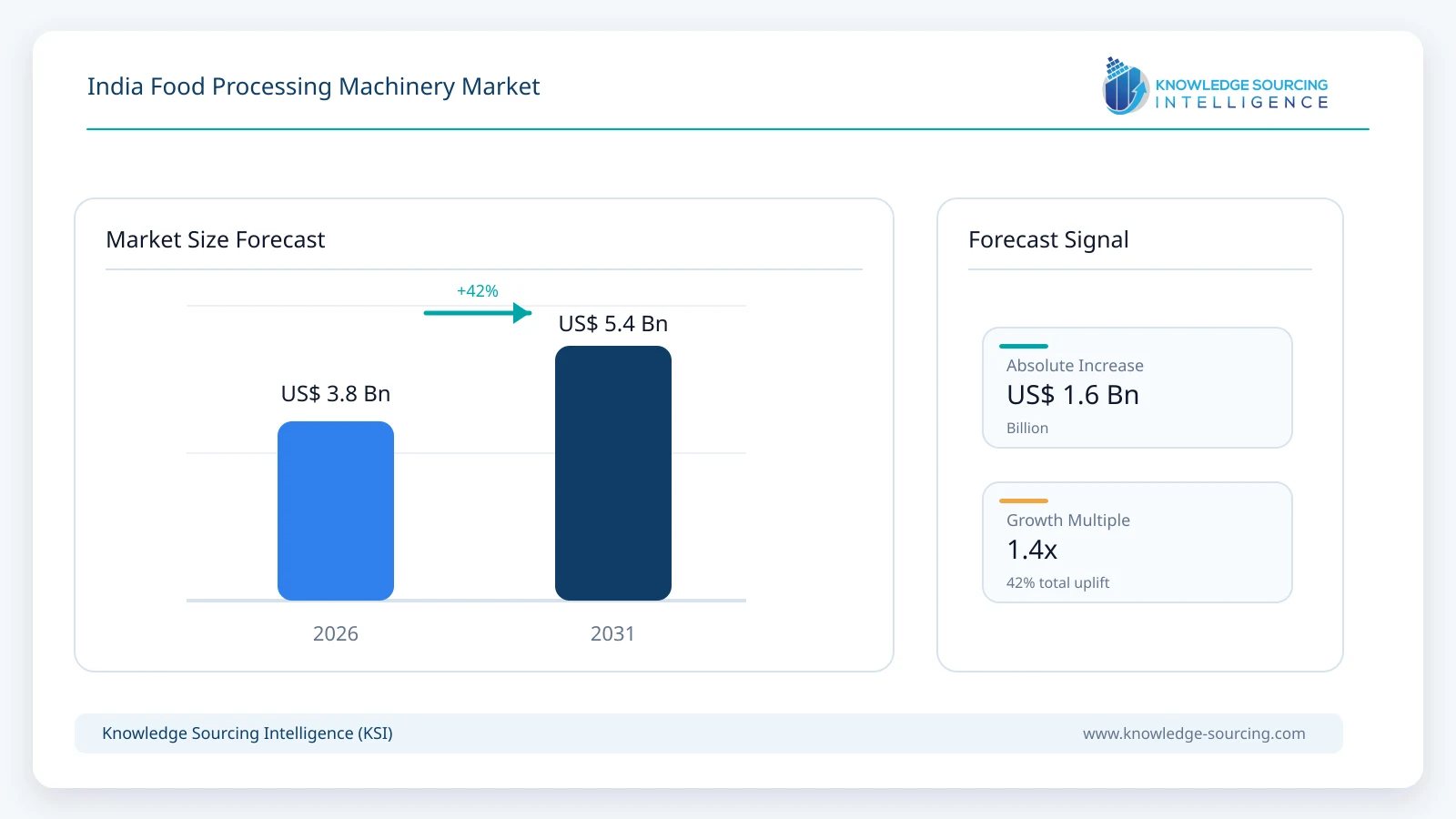
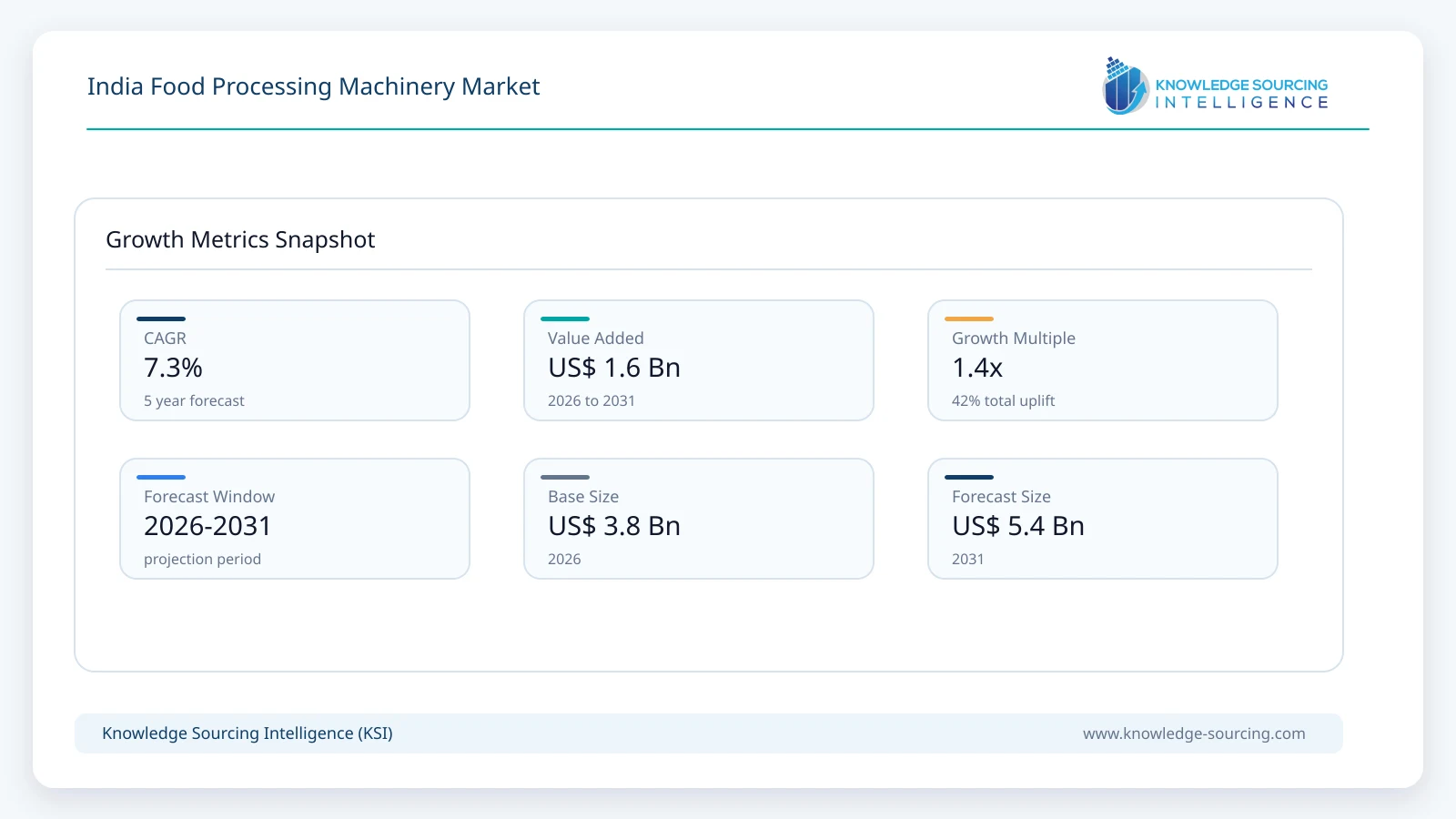
The India food processing machinery market is forecast to grow at a CAGR of 7.3%, reaching USD 5.4 billion in 2031 from USD 3.8 billion in 2026.
Highlights:
- 1Processing equipment represents approximately 71% of India market revenue in 2026.
- 2Automatic machinery is projected to grow about 8.6% annually through 2031.
- 3Solid-food processing equipment generates approximately USD 2.13 billion in 2026.
- 4Bakery and confectionery machinery generates approximately USD 0.84 billion in 2026.
- 5Western India accounts for roughly 31% of machinery demand in 2026.
- 6World Food India 2025 generated food-processing investment commitments above INR 1.02 lakh crore.
Market Overview
India combines one of the world's largest agricultural raw-material bases with a food-processing sector that is still moving toward deeper value addition. The Ministry of Food Processing Industries reported that food processing grew at an average annual rate of about 6.55% during the nine years ending 2023-24, faster than agriculture and allied activities over the same period. The sector also represented 7.93% of manufacturing GVA in 2022-23 at constant prices. This scale supports recurring machinery demand across grains and pulses, dairy, bakery, confectionery, fruits and vegetables, beverages, edible oils, spices, snacks, meat, poultry, seafood and ready-to-eat foods.
The supply structure is unusually mixed. India has a large domestic base of fabricators and specialist equipment companies for mixers, conveyors, vessels, grain processing, dairy systems, snack equipment and other general process machinery, while advanced high-speed, precision and fully automated systems remain more import-dependent. MoFPI's food processing machinery sector profile states that India imported about USD 857.2 million of plants and machinery in fiscal 2024 and estimates import dependency at roughly 14-18% of overall equipment demand. The same study notes that large processors import around 40% of their equipment needs, while medium-scale processors typically import 12-15%, illustrating the large gap between premium automated plants and the broader domestic installed base.
Customs data reinforce the importance of advanced imported equipment in selected applications. In 2024, India imported about USD 72.8 million of bakery and pasta machinery, USD 69.9 million of confectionery machinery, USD 58.2 million of fruit and vegetable machinery, USD 16.3 million of meat and poultry machinery, USD 99.5 million of other industrial food-preparation machinery and USD 18.1 million of dairy machinery under the corresponding WITS categories. These headings do not capture the full market because thermal systems, pumps, separators, controls, process skids and other equipment can be classified elsewhere, while much of India's general machinery demand is supplied locally.
Market Trends
The Market Is Moving from Fabricated Equipment Toward Engineered Processing Systems
Domestic fabrication remains central to India's equipment base, especially for tanks, conveyors, mixers, dryers, handling systems and made-to-order machinery. However, larger processors increasingly specify hygienic design, automated cleaning, recipe control, traceability, energy monitoring and tighter process tolerances. MoFPI's machinery study notes that most food processing plants have more than 50% automation and that the level is rising. This is changing procurement from machine-by-machine purchasing toward engineered lines that combine process equipment, automation, inspection and digital controls. Domestic suppliers are responding through technology partnerships, better controls and higher stainless-steel fabrication standards, while global suppliers are expanding localized service and integration capability.
Automation Adoption Is Splitting the Market Between Large Plants and Cost-Sensitive SMEs
Automation is expanding fastest in dairy, beverages, industrial bakery, confectionery, snacks, ready-to-eat foods and export-oriented processing, where consistency, hygiene and throughput can justify higher capital expenditure. SMEs remain more price-sensitive and often add machinery in stages, combining locally made mechanical systems with imported sensors, drives, optical sorting, thermal equipment or control components. This produces a broad market for modular upgrades rather than only complete greenfield lines. Suppliers that can retrofit controls, automate bottlenecks and integrate legacy machinery therefore address a larger customer base than vendors focused solely on high-capacity turnkey plants.
Energy, Water and Cleaning Efficiency Are Becoming Purchase Criteria
Food processors are increasingly comparing equipment on total operating cost rather than purchase price alone. Steam demand, electrical load, water consumption, product loss, cleaning time and changeover time materially affect economics in dairy, beverages, bakery, sauces and thermal processing. More automated Clean-in-Place systems, heat recovery, efficient motors and digital utility monitoring are therefore moving into equipment specifications. This trend favors suppliers that can quantify lifecycle savings and validate hygienic performance, particularly when processors are building facilities for modern retail, institutional customers or export markets where repeatable quality and documented sanitation are essential.
Market Drivers
Government-Supported Capacity Addition Is Expanding the Addressable Installed Base
Government programs are translating policy support into physical processing capacity. As of February 2026, approved applicants under the Production Linked Incentive Scheme for Food Processing Industries had made cumulative investments of about INR 9,207 crore and created roughly 35 lakh metric tonnes per year of processing and preservation capacity. PMKSY had already sanctioned more than 1,600 projects across mega food parks, cold-chain infrastructure, agro-processing clusters and individual processing units by early 2025. PMFME is widening the lower end of the machinery market as micro enterprises formalize and invest in basic cleaning, milling, grinding, mixing, drying and packaging-adjacent processing equipment. Together, these programs increase both the number of equipment buyers and the average sophistication of new capacity.
Private Investment and Export-Oriented Processing Are Raising Equipment Intensity
World Food India 2025 produced investment commitments of more than INR 1.02 lakh crore from 26 domestic and global companies, demonstrating a pipeline of new and expanded food manufacturing capacity beyond government-funded projects. At the same time, processed food accounts for a rising share of India's agricultural exports, increasing the commercial value of consistent quality, food safety and traceability. Export-oriented plants require more precise thermal control, automated sorting, hygienic handling, metal detection, inspection and process documentation than traditional small-scale processing. The result is a gradual increase in machinery spending per unit of processed output even when food-production volumes grow more slowly.
Market Restraint
Capital Cost and Domestic Technology Gaps Slow Advanced-Machinery Penetration
The market remains constrained by the fragmented structure of India's food-processing industry and the high upfront cost of advanced machinery. Many micro and small processors operate at utilization levels that do not support fully automated lines, while financing and working-capital constraints make staged purchases more practical. Domestic manufacturers are competitive in standard fabrication and customized mechanical equipment but continue to face gaps in precision, high-speed automation, specialized blades, sensors, controls, and certain thermal or dehydration technologies. Imported equipment can solve these gaps but adds currency exposure, lead time, service cost, and spare-parts dependence. This keeps semi-automatic and hybrid domestic-imported systems relevant even as large processors increase automation.
Segment Analysis
By Type - Processing Equipment
Processing equipment is the largest type category, with an estimated 2026 value of approximately USD 2.70 billion. It covers mixing and blending, cutting and grinding, extrusion and forming, homogenization, baking, cooking, frying, pasteurization and other machinery that directly changes the food product. Demand is supported by the transition from primary agricultural handling toward secondary and tertiary processing, where equipment value per production line rises sharply. Pre-processing equipment remains a substantial category in grains, pulses, fruits, vegetables, spices and nuts, but average machine values are generally lower and domestic supply is stronger.
By Food Matter Type - Solid
Solid-food processing represents about 56% of machinery demand in 2026. India's large bakery, confectionery, snack, grain, pulse, spice, ready-to-eat and protein-processing base requires a broad range of grinders, mixers, extruders, forming systems, ovens, fryers, dryers, cutters, sorters and conveyors. Liquid processing is smaller in equipment count but remains capital-intensive in dairy and beverages because of pasteurization, separation, homogenization, aseptic processing, and sanitary fluid handling. Semi-solid applications are concentrated in sauces, purees, pastes, batters and prepared foods where flexible batch systems are increasingly automated.
By Automation Level - Automatic Machinery
Automatic machinery is estimated at approximately USD 1.94 billion in 2026 and is projected to approach USD 2.94 billion by 2031. Adoption is strongest among large branded food companies, dairy cooperatives, beverage manufacturers, export-oriented processors and industrial bakery or snack producers. Semi-automatic machinery remains important because it allows processors to automate high-risk or high-throughput stages without replacing complete lines. Manual equipment retains a meaningful role in micro and small units but is gradually losing share as formalization, food-safety controls and labor productivity requirements increase.
By Application - Bakery and Confectionery
Bakery and confectionery accounts for roughly 22% of India machinery demand in 2026. The segment benefits from strong biscuit, bread, snack, chocolate, sweets and industrial bakery production, while import data show unusually high spending on specialized bakery, pasta and confectionery machinery. Equipment demand spans dough handling, mixers, laminators, depositors, ovens, cooling, enrobing, tempering, extrusion and automated handling. Dairy and beverages remain highly equipment-intensive because sanitary processing and thermal control are critical, while fruits and vegetables are generating demand for washing, sorting, pulping, dehydration, freezing and value-addition systems.
By Region - Western India
Western India represents an estimated USD 1.18 billion of machinery demand in 2026, led by Maharashtra and Gujarat. The region combines a dense base of branded food and beverage processors with major dairy, edible oil, bakery, confectionery and ingredient clusters, as well as a strong engineering and machinery-manufacturing ecosystem around Pune, Mumbai, Ahmedabad, Vadodara and Anand. Southern India is another important market through dairy, beverages, grains, spices, seafood and ready-to-eat manufacturing, while northern India benefits from grain, dairy, bakery and snack processing. Eastern and northeastern states remain smaller in installed value but have growing opportunities in rice, tea, fruits, vegetables and regional food processing.
Competitive Environment
India's competitive landscape combines multinational process-equipment suppliers with a deep but fragmented domestic engineering base. Alfa Laval, Bühler, GEA, Tetra Pak, Krones, Heat and Control, JBT Marel, SPX FLOW and Middleby compete in higher-value dairy, beverage, bakery, snack, protein and thermal-processing systems. Their advantages include process engineering, high-speed automation, hygienic design, commissioning, digital monitoring and access to global product platforms. Local manufacturing, assembly and service capability are important because they reduce delivery time and improve after-sales support.
Domestic and India-based specialists compete strongly in categories where customization and cost matter. Fowler Westrup and Sona Machinery are relevant in grain processing; IDMC, SSP, Goma Engineering and Neologic Engineers participate in dairy and liquid processing; Kanchan Metals and Heat and Control address snack and prepared-food applications; T&I Global is established in tea machinery; Meatek focuses on meat and poultry systems; Satake India supplies grain-processing and sorting solutions. These companies often win business by adapting equipment to local raw materials, space constraints, batch sizes and customer budgets.
Competition is increasingly shifting from upfront equipment price toward lifecycle economics. Large processors evaluate throughput, yield, utility consumption, cleaning time, line flexibility, automation architecture, spare-parts availability and service response. Smaller processors still prioritize purchase price and customization, but they increasingly expect machines to be automation-ready so capacity can be expanded without complete replacement. This creates opportunities for suppliers offering modular platforms, retrofit controls, local spare-parts inventories and financing or leasing partnerships.
Recent Developments
April 2026: MoFPI highlighted PLISFPI capacity additions of about 34-35 lakh MT per year and cumulative investment near INR 9,207 crore.
March 2026: PMFME reported 59,202 formalized micro food-processing enterprises and more than INR 17,000 crore of mobilized investment.
November 2025: Tetra Pak launched Factory OS, an open digital platform for connected food and beverage factories.
September 2025: World Food India 2025 concluded with investment commitments above INR 1.02 lakh crore from 26 companies.
September 2025: World Food India provided credit-linked support/subsidies of over INR 770 crore to around 26,000 beneficiaries for micro food-processing projects worth more than INR 2,510 crore under the PMFME scheme.
January 2025: JBT completed the Marel transaction, creating a larger global food-processing technology platform.
India Food Processing Machinery Market Scope:
| Report Metric | Details |
|---|---|
| Total Market Size in 2026 | USD 3.8 billion |
| Total Market Size in 2031 | USD 5.4 billion |
| Forecast Unit | Billion |
| Growth Rate | 7.3% |
| Study Period | 2021 to 2031 |
| Historical Data | 2021 to 2024 |
| Base Year | 2025 |
| Forecast Period | 2026 – 2031 |
| Segmentation | Pre-Processing Equipment, Processing Equipment, Food Matter Type, Automation Level |
| Companies |
|
Market Segmentation
By Type
Pre-Processing Equipment
Cleaning
Grading and Sorting
Peeling and Preparation
Processing Equipment
Mixing and Blending
Cutting and Grinding
Extrusion and Forming
Homogenization
Thermal Processing and Baking
Others
By Food Matter Type
Solid
Semi-Solid
Liquid
By Automation Level
Manual
Semi-Automatic
Automatic
By Application
Bakery and Confectionery
Dairy
Beverages
Fruits and Vegetables
Meat, Poultry and Seafood
Others
By Region
Western India
Maharashtra
Gujarat
Southern India
Karnataka
Tamil Nadu
Telangana and Andhra Pradesh
Northern India
Uttar Pradesh
Punjab and Haryana
Delhi NCR and Others
Eastern and Northeastern India
West Bengal
Assam and Northeast
Other States
Table of Contents
1. EXECUTIVE SUMMARY
2. MARKET SNAPSHOT
2.1. Market Overview
2.2. Market Definition
2.3. Market Segmentation
3. BUSINESS LANDSCAPE
3.1. Market Drivers
3.1.1. Government-Supported Capacity Addition Is Expanding the Addressable Installed Base
3.1.2. Private Investment and Export-Oriented Processing Are Raising Equipment Intensity
3.2. Market Restraint
3.2.1. Capital Cost and Domestic Technology Gaps Slow Advanced-Machinery Penetration
3.3. Market Opportunities
3.4. Porter's Five Forces Analysis
3.5. Industry Value Chain Analysis
3.6. Policies and Regulations
3.7. Strategic Recommendations
4. TECHNOLOGICAL OUTLOOK
4.1. Automated Process Control and Connected Production
4.2. Optical Sorting, Machine Vision and Inspection
4.3. Energy- and Water-Efficient Processing
4.4. Hygienic Design, CIP and Advanced Thermal Processing
5. INDIA FOOD PROCESSING MACHINERY MARKET BY TYPE
5.1. Introduction
5.2. Pre-Processing Equipment
5.2.1. Cleaning
5.2.2. Grading and Sorting
5.2.3. Peeling and Preparation
5.3. Processing Equipment
5.3.1. Mixing and Blending
5.3.2. Cutting and Grinding
5.3.3. Extrusion and Forming
5.3.4. Homogenization
5.3.5. Thermal Processing and Baking
5.3.6. Others
6. INDIA FOOD PROCESSING MACHINERY MARKET BY FOOD MATTER TYPE
6.1. Introduction
6.2. Solid
6.3. Semi-Solid
6.4. Liquid
7. INDIA FOOD PROCESSING MACHINERY MARKET BY AUTOMATION LEVEL
7.1. Introduction
7.2. Manual
7.3. Semi-Automatic
7.4. Automatic
8. INDIA FOOD PROCESSING MACHINERY MARKET BY APPLICATION
8.1. Introduction
8.2. Bakery and Confectionery
8.3. Dairy
8.4. Beverages
8.5. Fruits and Vegetables
8.6. Meat, Poultry and Seafood
8.7. Others
9. INDIA FOOD PROCESSING MACHINERY MARKET BY REGION
9.1. Introduction
9.2. Western India
9.2.1. Maharashtra
9.2.2. Gujarat
9.3. Southern India
9.3.1. Karnataka
9.3.2. Tamil Nadu
9.3.3. Telangana and Andhra Pradesh
9.4. Northern India
9.4.1. Uttar Pradesh
9.4.2. Punjab and Haryana
9.4.3. Delhi NCR and Others
9.5. Eastern and Northeastern India
9.5.1. West Bengal
9.5.2. Assam and Northeast
9.5.3. Other States
10. COMPETITIVE ENVIRONMENT AND ANALYSIS
10.1. Major Players and Strategy Analysis
10.2. Market Share Analysis
10.3. Mergers, Acquisitions, Agreements and Collaborations
10.4. Competitive Dashboard
11. COMPANY PROFILES
11.1. Alfa Laval India Pvt. Ltd.
11.2. Bühler India Pvt. Ltd.
11.3. GEA Process Engineering (India) Pvt. Ltd.
11.4. Heat and Control (South Asia) Pvt. Ltd.
11.5. Tetra Pak India Pvt. Ltd.
11.6. Krones India Pvt. Ltd.
11.7. Fowler Westrup (India) Pvt. Ltd.
11.8. Kanchan Metals Pvt. Ltd.
11.9. IDMC Limited
11.10. SSP Pvt. Ltd.
11.11. Goma Engineering Pvt. Ltd.
11.12. T&I Global Ltd.
11.13. JBT Marel India
11.14. Meatek Food Machineries India Pvt. Ltd.
11.15. Sona Machinery Ltd.
11.16. Neologic Engineers Pvt. Ltd.
11.17. Satake India Engineering Pvt. Ltd.
11.18. The Middleby Corporation
11.19. SPX FLOW India
11.20. Allround Vegetable Processing India
12. APPENDIX
12.1. Currency
12.2. Assumptions
12.3. Base and Forecast Years Timeline
12.4. Key Benefits for Stakeholders
12.5. Research Methodology
12.6. Abbreviations
Navigate
Trusted by the world's leading organizations











