
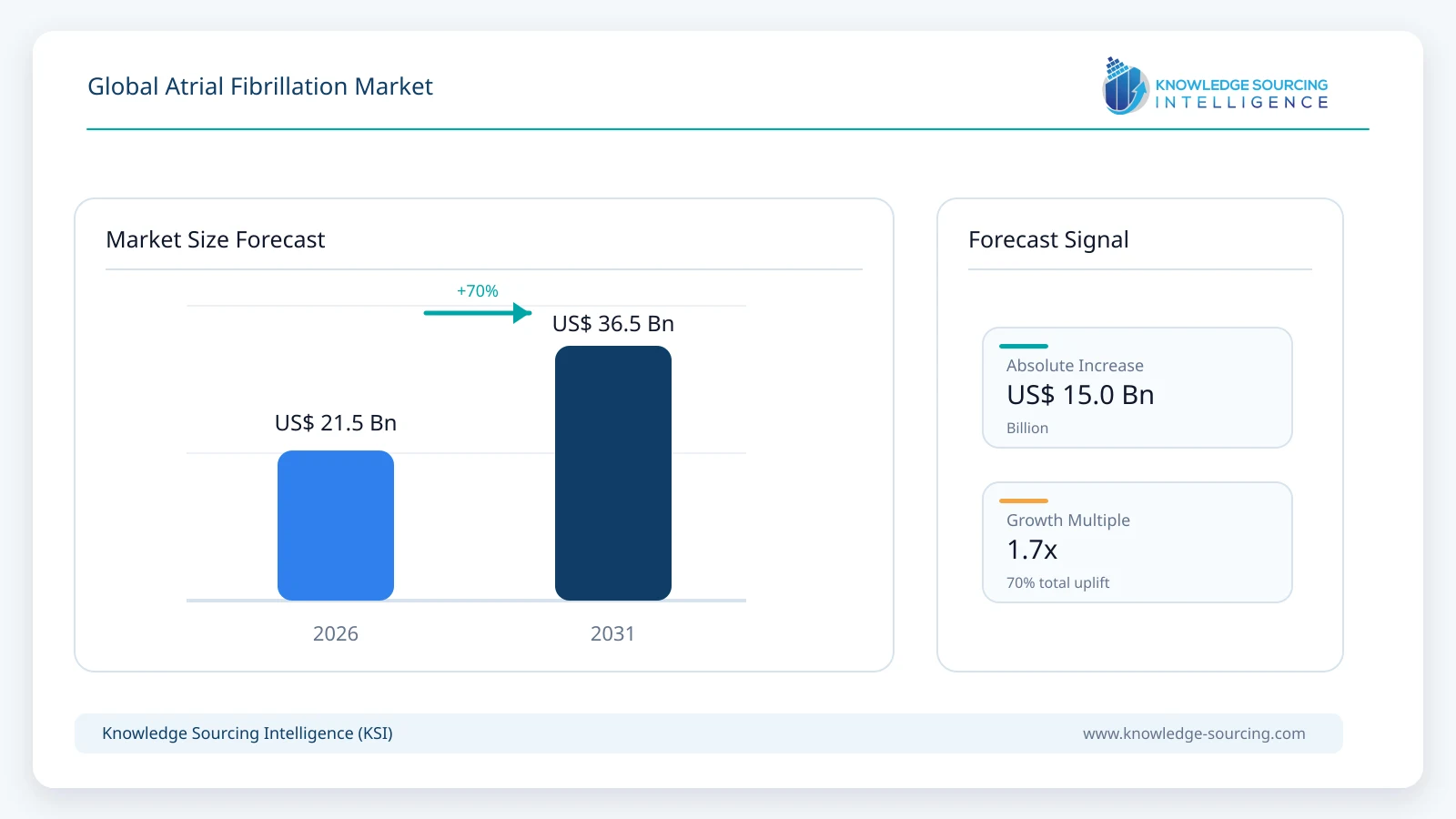
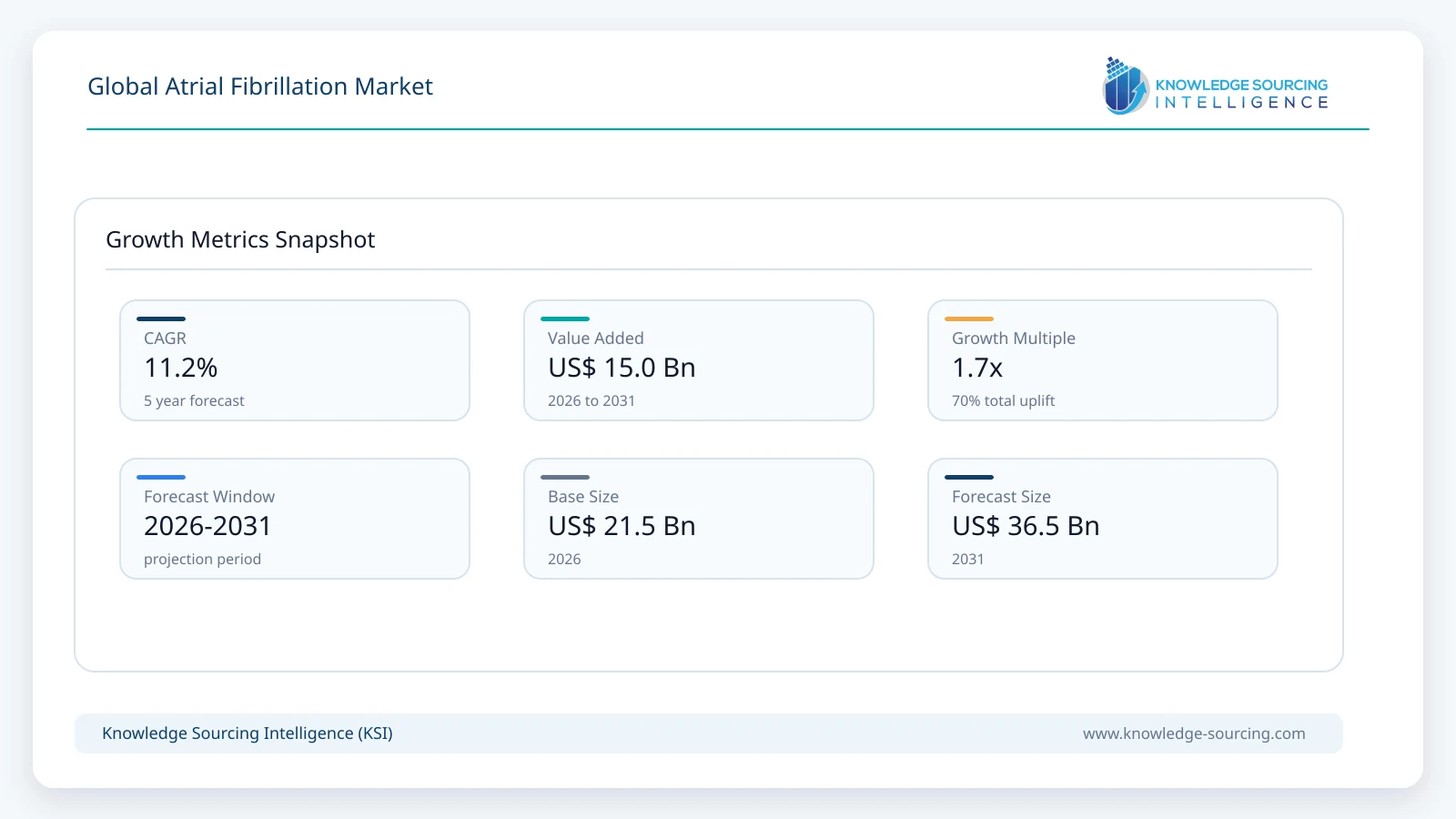
The Global Atrial Fibrillation market is projected to grow at a CAGR of 11.2% over the forecast period, increasing from USD 21.5 billion in 2026 to USD 36.5 billion by 2031.
Highlights:
- 1Rising aging populations are increasing atrial fibrillation prevalence because age-related cardiovascular remodeling continues expanding long-term arrhythmia burden.
- 2Growing stroke prevention awareness is strengthening demand for direct oral anticoagulants because healthcare systems are prioritizing therapies with reduced monitoring complexity.
- 3Electrophysiology centers are increasing adoption of catheter ablation technologies because minimally invasive rhythm control improves long-term procedural outcomes.
- 4Demand is shifting toward pulsed field ablation because electrophysiologists are prioritizing safer tissue-selective cardiac intervention technologies.
Atrial fibrillation management increasingly depends on integrated cardiovascular intervention because chronic arrhythmia progression frequently leads to stroke, heart failure, and recurrent hospitalization burden. Demand for rhythm control therapies is increasing because physicians increasingly recognize the long-term clinical impact associated with sustained atrial remodeling and delayed intervention. This clinical transition is strengthening dependency on advanced electrophysiology infrastructure, continuous cardiac monitoring, and minimally invasive ablation technologies.
Regulatory systems continue prioritizing cardiovascular innovation because healthcare agencies are attempting to reduce long-term stroke incidence and cardiac hospitalization costs. Device manufacturers are expanding pulsed field ablation development because procedural safety and reduced collateral tissue damage increasingly influence electrophysiology adoption. Pharmaceutical companies are strengthening anticoagulant lifecycle strategies because long-duration stroke prevention remains central to atrial fibrillation management.
Healthcare systems are integrating outpatient arrhythmia monitoring programs because asymptomatic atrial fibrillation continues contributing to delayed diagnosis and preventable stroke events. Demand is shifting toward wearable monitoring technologies and implantable cardiac monitoring systems because continuous rhythm surveillance improves early intervention capabilities. This market evolution is increasing strategic importance for integrated cardiovascular management ecosystems combining therapeutics, diagnostics, digital monitoring, and electrophysiology procedures.
Market Dynamics
Market Drivers
Rising Adoption of Catheter Ablation Procedures: Catheter ablation increasingly defines long-term atrial fibrillation management because healthcare providers are prioritizing rhythm control strategies capable of reducing recurrent arrhythmia burden. Demand is increasing for minimally invasive electrophysiology procedures because procedural recovery time and hospitalization duration continue to decline with technological advancement. Infrastructure limitations remain significant because advanced electrophysiology laboratories require specialized cardiac mapping systems and trained electrophysiologists. Device manufacturers are expanding pulsed field ablation and high-density mapping technologies as procedural precision increasingly influences long-term treatment success. This transition strengthens demand for integrated electrophysiology ecosystems.
Increasing Demand for Direct Oral Anticoagulants: Stroke prevention remains central to atrial fibrillation management because thromboembolic complications continue driving long-term cardiovascular mortality and disability. Healthcare providers are increasing adoption of direct oral anticoagulants because reduced monitoring dependency improves patient adherence and outpatient treatment continuity. Reimbursement pressure remains substantial because long-duration anticoagulant therapy continues increasing chronic cardiovascular expenditure. Pharmaceutical manufacturers are strengthening cardiovascular outcomes evidence generation as healthcare systems continue evaluating long-term stroke prevention efficiency. This demand shift sustains expansion across anticoagulant therapy markets.
Expansion of Remote Cardiac Monitoring: Continuous rhythm monitoring increasingly influences atrial fibrillation diagnosis because asymptomatic arrhythmia episodes frequently remain undetected through episodic clinical assessment. Hospitals are expanding wearable and implantable monitoring programs as healthcare systems continue prioritizing early cardiovascular intervention and outpatient disease management. Data integration complexity remains a challenge because continuous rhythm monitoring generates substantial cardiovascular information volume. Device manufacturers are integrating AI-enabled arrhythmia analytics as predictive cardiac monitoring continues expanding across ambulatory care settings. This transition strengthens demand for connected cardiac management technologies.
Growing Burden of Cardiometabolic Disorders: Atrial fibrillation prevalence continues increasing because obesity, diabetes, hypertension, and heart failure remain closely associated with chronic arrhythmia progression. Healthcare systems are experiencing higher cardiovascular management demand as metabolic disease prevalence continues expanding globally. Treatment complexity remains elevated because cardiometabolic patients frequently require multidrug therapy and long-term rhythm surveillance. Pharmaceutical and device manufacturers are strengthening integrated cardiovascular management strategies as chronic disease overlap increasingly shapes treatment pathways. This epidemiological trend supports long-term market expansion.
Market Restraints
High electrophysiology procedure costs continue limiting broad access because advanced catheter ablation infrastructure requires substantial capital investment.
Bleeding complications associated with long-term anticoagulation continue constraining therapy adherence because elderly cardiovascular populations remain clinically vulnerable.
Limited electrophysiology specialist availability restricts advanced arrhythmia management because emerging healthcare systems continue facing cardiology workforce shortages.
Market Opportunities
Expansion of Pulsed Field Ablation Technologies: Electrophysiology demand increasingly favors pulsed field ablation because tissue-selective energy delivery reduces collateral cardiac damage during rhythm intervention procedures. Hospitals are increasing investment in next-generation ablation platforms as procedural efficiency and safety become central electrophysiology priorities. Technology validation requirements remain substantial because long-term arrhythmia recurrence outcomes continue influencing physician adoption. Device manufacturers are accelerating pulsed field ablation commercialization strategies as minimally invasive rhythm control demand continues expanding. This transition creates significant opportunities within advanced electrophysiology infrastructure.
Growth of AI-Enabled Cardiac Diagnostics: Atrial fibrillation diagnosis increasingly depends on predictive analytics because intermittent arrhythmia episodes frequently remain undetected through conventional cardiac assessment methods. Healthcare systems are expanding AI-assisted monitoring programs as wearable and ambulatory cardiac technologies continue improving rhythm surveillance capabilities. Diagnostic integration challenges remain significant because cardiovascular data management requires interoperability across multiple clinical systems. Technology companies are strengthening digital cardiovascular partnerships as remote arrhythmia management continues expanding globally. This trend supports long-term growth across AI-driven cardiac diagnostics.
Increasing Demand for Outpatient Electrophysiology Programs: Healthcare providers increasingly prioritize outpatient electrophysiology care because minimally invasive procedures reduce hospitalization burden and optimize cardiovascular resource utilization. Demand is shifting toward ambulatory arrhythmia intervention because healthcare systems continue attempting to improve procedural efficiency and reduce inpatient dependency. Infrastructure standardization remains limited because outpatient electrophysiology capabilities vary substantially across healthcare regions.
Government Regulations
Region | Regulatory Authority | Regulatory Focus |
United States | FDA | Anticoagulant approvals, electrophysiology device PMA pathways, post-market surveillance |
Europe | EMA / EU MDR | Drug safety evaluation, cardiac device compliance, electrophysiology monitoring oversight |
Japan | PMDA | Cardiovascular therapy approvals and long-term rhythm management safety assessment |
India | CDSCO | Drug and cardiac device approvals, pharmacovigilance oversight |
China | NMPA | Accelerated arrhythmia therapy review and localized cardiovascular validation |
Market Segmentation
By Therapy Type
Pharmacological therapies remain central to atrial fibrillation management because long-term stroke prevention and rhythm stabilization depend on sustained cardiovascular intervention. Demand is shifting toward catheter ablation devices because electrophysiologists increasingly prioritize minimally invasive rhythm control procedures capable of reducing recurrent arrhythmia burden. Cardiac monitoring devices continue gaining strategic importance because asymptomatic atrial fibrillation detection increasingly depends on continuous rhythm surveillance. Left atrial appendage closure devices are expanding because healthcare providers require alternative stroke prevention strategies for anticoagulation-intolerant patients. Digital cardiac monitoring platforms continue strengthening outpatient cardiovascular management because remote rhythm tracking improves early clinical intervention.
By Indication
Paroxysmal atrial fibrillation remains a major treatment segment because intermittent rhythm instability frequently drives initial cardiovascular intervention and early rhythm management adoption. Demand is increasing for persistent atrial fibrillation therapies because prolonged arrhythmia duration continues increasing stroke and heart failure risk. Long-standing persistent atrial fibrillation maintains strong electrophysiological dependence because advanced atrial remodeling frequently requires complex catheter ablation strategies. Permanent atrial fibrillation management continues emphasizing stroke prevention and ventricular rate control because long-term rhythm restoration often becomes clinically challenging. This indication structure strengthens demand for integrated arrhythmia management pathways.
By Route of Administration
Oral therapies maintain dominant utilization because chronic atrial fibrillation management depends heavily on long-duration anticoagulation and antiarrhythmic treatment continuity. Intravenous administration remains critical because acute arrhythmia stabilization and peri-procedural electrophysiology management frequently require immediate cardiovascular intervention. Catheter-based delivery systems are expanding because minimally invasive ablation procedures increasingly define long-term rhythm control strategies. Healthcare providers are increasing adoption of connected electrophysiology technologies because continuous rhythm surveillance improves procedural planning and early recurrence detection. Device-assisted intervention increasingly defines advanced atrial fibrillation management pathways.
Regional Analysis
North America Market Analysis
North America maintains leadership in atrial fibrillation management because advanced electrophysiology infrastructure supports broad adoption of catheter ablation systems, direct oral anticoagulants, and connected cardiac monitoring technologies. Demand is increasing for pulsed field ablation because electrophysiologists continue prioritizing minimally invasive rhythm intervention with improved safety and procedural precision. Healthcare expenditure remains elevated because chronic arrhythmia management requires repeated rhythm surveillance, long-term anticoagulation, and specialized electrophysiology procedures. Hospitals are expanding outpatient electrophysiology programs because healthcare systems continue attempting to reduce inpatient utilization and optimize cardiovascular resource allocation. Regulatory agencies continue accelerating cardiovascular innovation because atrial fibrillation remains a major contributor to ischemic stroke burden and cardiac hospitalization. The region maintains strong competitive intensity because pharmaceutical and device manufacturers continue expanding integrated arrhythmia management ecosystems.
Europe Market Analysis
Europe maintains a strong atrial fibrillation treatment ecosystem because universal healthcare systems support broad access to cardiovascular therapies and electrophysiology intervention programs. Demand is shifting toward catheter ablation and continuous rhythm monitoring because European cardiology guidelines increasingly prioritize early rhythm control strategies. Reimbursement pressure continues to affect premium electrophysiology technology expansion because centralized healthcare systems remain highly cost-sensitive. Healthcare providers are increasing adoption of wearable and implantable monitoring systems because outpatient arrhythmia management reduces long-term hospitalization burden. Regulatory oversight remains stringent because cardiovascular drug safety and connected electrophysiology device monitoring continue expanding under EMA and MDR frameworks. The region maintains strong adoption of digital arrhythmia management technologies because aging populations continue increasing cardiovascular disease prevalence.
Asia Pacific Market Analysis
Asia Pacific represents a rapidly expanding atrial fibrillation market because aging populations, hypertension prevalence, and metabolic disease burden continue increasing across major economies. Demand is increasing for anticoagulants, catheter ablation systems, and remote monitoring technologies because governments are improving tertiary cardiovascular infrastructure and arrhythmia management programs. Access disparities remain significant because rural healthcare systems frequently lack electrophysiology expertise and advanced monitoring infrastructure. Hospitals are expanding electrophysiology laboratories and digital cardiovascular capabilities because minimally invasive arrhythmia intervention reduces long-term healthcare resource utilization. International pharmaceutical and device manufacturers continue strengthening regional partnerships because atrial fibrillation diagnosis rates are improving across urban healthcare systems. The region maintains strong long-term growth potential because chronic cardiovascular disease burden continues increasing substantially.
Rest of the World
Rest of the World markets maintain uneven atrial fibrillation treatment accessibility because healthcare infrastructure variability limits advanced cardiovascular care availability. Demand is increasing for early arrhythmia diagnosis and stroke prevention because untreated atrial fibrillation continues contributing significantly to cardiovascular morbidity across underserved regions. Financial limitations continue restricting access to premium anticoagulants and electrophysiology procedures because reimbursement infrastructure remains inconsistent. Governments are increasing cardiovascular disease management investment because stroke-related healthcare expenditure continues placing pressure on public healthcare sustainability. International partnerships are supporting electrophysiology infrastructure expansion because specialist shortages continue constraining advanced arrhythmia management. Long-term market expansion depends on healthcare modernization, reimbursement development, and cardiovascular workforce growth.
Regulatory Landscape
Regulatory systems increasingly prioritize long-term cardiovascular outcome evidence because advanced atrial fibrillation therapies require extensive stroke prevention and procedural safety validation across diverse patient populations. The FDA maintains accelerated cardiovascular review pathways because chronic arrhythmia burden continues increasing healthcare expenditure and ischemic stroke incidence. European MDR frameworks continue strengthening electrophysiology device surveillance because implantable and catheter-based cardiac technologies require extensive long-term safety assessment.
Drug and device approval complexity remains substantial because atrial fibrillation management increasingly combines pharmacological therapies, catheter ablation systems, implantable monitors, and AI-enabled diagnostics within integrated cardiovascular pathways. Regulatory agencies are increasing real-world evidence integration because chronic arrhythmia management depends heavily on long-term safety and effectiveness evaluation. Manufacturers continue expanding post-market surveillance and cardiovascular registry programs because connected cardiac technologies require continuous lifecycle monitoring.
Global regulatory harmonization remains limited because anticoagulant reimbursement, cardiovascular procedure coverage, and electrophysiology device approval pathways differ substantially across regional healthcare systems. Companies are expanding regional regulatory partnerships because long-term arrhythmia therapy adoption increasingly depends on localized clinical validation and reimbursement alignment. Regulatory evolution continues shaping advanced atrial fibrillation innovation pathways.
Pipeline Analysis
The atrial fibrillation pipeline increasingly focuses on advanced rhythm control technologies because recurrent arrhythmia progression continues limiting long-term cardiovascular stability despite existing intervention strategies. Pulsed field ablation development programs continue expanding because tissue-selective energy delivery improves procedural precision and reduces collateral cardiac injury risk. Companies are increasing investment in next-generation electrophysiology mapping platforms and AI-assisted rhythm analytics because procedural accuracy increasingly determines long-term ablation success.
Novel anticoagulation strategies are progressing because bleeding risk and long-term therapy adherence continue constraining chronic stroke prevention outcomes. Pharmaceutical manufacturers are developing Factor XI inhibitors because selective coagulation pathway targeting may reduce hemorrhagic complications while maintaining antithrombotic efficacy. Clinical development remains complex because cardiovascular outcome validation requires extensive patient monitoring and large-scale trial enrollment.
AI-assisted cardiac monitoring programs are expanding because continuous rhythm surveillance increasingly determines early atrial fibrillation diagnosis and intervention timing. Device manufacturers are integrating predictive analytics and wearable cardiovascular monitoring because outpatient arrhythmia management continues gaining strategic importance. The pipeline increasingly reflects integration between therapeutics, electrophysiology systems, connected monitoring technologies, and digital cardiovascular infrastructure.
Competitive Landscape
Bristol Myers Squibb
Bristol Myers Squibb maintains strong strategic positioning because Eliquis established broad clinical relevance across long-term stroke prevention pathways in atrial fibrillation management. Demand continues increasing because healthcare providers prioritize anticoagulants demonstrating strong cardiovascular outcomes and reduced monitoring complexity. The company continues strengthening cardiovascular evidence generation because long-term differentiation increasingly depends on real-world stroke prevention validation.
Pfizer
Pfizer strengthens cardiovascular market relevance through alliance commercialization of Eliquis because stroke prevention remains central to long-term atrial fibrillation management. Demand is shifting toward direct oral anticoagulants because outpatient cardiovascular care increasingly prioritizes simplified treatment adherence and reduced laboratory monitoring dependency. The company continues expanding cardiovascular outcomes collaboration strategies because preventive arrhythmia management increasingly depends on measurable stroke reduction outcomes.
Bayer AG
Bayer maintains strong anticoagulant positioning because Xarelto achieved broad physician adoption across chronic atrial fibrillation stroke prevention pathways. Healthcare systems are increasing utilization because reduced monitoring complexity improves outpatient cardiovascular management efficiency. The company continues strengthening cardiovascular lifecycle management strategies because reimbursement agencies increasingly prioritize long-term clinical outcome improvement.
Johnson & Johnson
Johnson & Johnson strengthens cardiovascular participation through alliance commercialization of Xarelto because long-term anticoagulation continues defining chronic atrial fibrillation management. Demand is increasing because physicians increasingly prioritize therapies reducing ischemic stroke risk without extensive monitoring burden. The company continues strengthening integrated cardiovascular commercialization strategies because preventive arrhythmia management continues expanding globally.
Boehringer Ingelheim
Boehringer Ingelheim remains strategically important because Pradaxa established early direct oral anticoagulant relevance within atrial fibrillation stroke prevention. Demand continues expanding because chronic cardiovascular management increasingly favors therapies simplifying outpatient treatment continuity. The company continues strengthening long-term cardiovascular evidence generation because healthcare providers continue evaluating bleeding risk and stroke reduction outcomes.
Daiichi Sankyo
Daiichi Sankyo maintains cardiovascular relevance because Savaysa/Lixiana supports long-term stroke prevention across chronic atrial fibrillation populations. Demand is increasing because healthcare systems continue expanding direct oral anticoagulant utilization across outpatient cardiovascular management pathways. The company continues strengthening regional cardiovascular expansion strategies because arrhythmia diagnosis rates continue increasing globally.
Boston Scientific
Boston Scientific maintains strong electrophysiology differentiation because FARAPULSE and WATCHMAN FLX technologies support advanced rhythm control and stroke prevention intervention strategies. Hospitals are increasing adoption because minimally invasive electrophysiology and left atrial appendage closure procedures reduce long-term cardiovascular complication burden. The company continues strengthening pulsed field ablation commercialization because procedural safety increasingly influences electrophysiology adoption.
Medtronic
Medtronic remains strategically distinct because cryoballoon ablation systems and insertable cardiac monitors support integrated atrial fibrillation diagnosis and rhythm management pathways. Healthcare providers are increasing dependence on connected electrophysiology technologies because continuous cardiac monitoring becomes increasingly important for outpatient arrhythmia management. The company continues expanding digital cardiovascular integration capabilities because predictive arrhythmia management continues evolving globally.
Key Developments
April 2026: Johnson & Johnson announced the launch of VARIPULSE Pro in Europe following CE Mark approval, further advancing its pulsed field ablation (PFA) portfolio.
January 2026: Medtronic plc, a global leader in healthcare technology, announced two major milestones for the Affera™ Sphere-360™ catheter, a first-of-its-kind, all-in-one mapping and single-shot pulsed field ablation (PFA) catheter for treatment of paroxysmal atrial fibrillation (AFib): CE Mark in Europe and the completion of first cases in the Horizon 360 IDE pivotal trial in the United States.
December 2025: Abbott announced the U.S. Food and Drug Administration (FDA) has approved the company's Volt™ PFA System to treat patients battling atrial fibrillation (AFib).
Strategic Insights and Future Market Outlook
The atrial fibrillation market continues transitioning toward integrated rhythm management because aging populations and chronic cardiovascular disease prevalence continue increasing sustained arrhythmia treatment dependency globally. Demand is shifting toward minimally invasive electrophysiology intervention because healthcare systems are reducing reliance on long-duration inpatient cardiovascular management. This transition strengthens long-term adoption of catheter ablation systems, direct oral anticoagulants, implantable monitors, and AI-enabled cardiac diagnostics.
Healthcare systems are increasing investment in continuous rhythm surveillance and outpatient electrophysiology infrastructure because early atrial fibrillation diagnosis directly improves stroke prevention outcomes and cardiovascular resource optimization. Pharmacological and electrophysiology technologies continue evolving because chronic arrhythmia populations frequently require multidimensional rhythm control, anticoagulation, and long-term monitoring strategies. Manufacturers are integrating therapeutics, diagnostics, and digital monitoring systems because atrial fibrillation management increasingly depends on continuous multidisciplinary cardiovascular care.
The competitive landscape will continue emphasizing integrated electrophysiology ecosystems because predictive analytics, pulsed field ablation, and connected cardiac monitoring remain accelerating globally. Emerging healthcare markets are expanding cardiovascular infrastructure because chronic arrhythmia burden continues increasing substantially across aging and urbanizing populations. Long-term market development depends on reimbursement expansion, electrophysiology workforce growth, digital cardiovascular integration, and continued advancement in minimally invasive rhythm management technologies.
Atrial fibrillation management increasingly reflects a prevention-oriented cardiovascular care model because advances in electrophysiology intervention, anticoagulation therapy, and continuous cardiac monitoring continue transforming long-term arrhythmia outcomes across global patient populations.
Global Atrial Fibrillation Market Scope:
| Report Metric | Details |
|---|---|
| Total Market Size in 2026 | USD 21.5 billion |
| Total Market Size in 2031 | USD 36.5 billion |
| Forecast Unit | USD Billion |
| Growth Rate | 11.2% |
| Study Period | 2021 to 2031 |
| Historical Data | 2021 to 2024 |
| Base Year | 2025 |
| Forecast Period | 2026 – 2031 |
| Segmentation | Therapy Type, Drug Class, Indication, Geography |
| Companies |
|
Market Segmentation
By Geography
Key Countries Analysis
Regulatory & Policy Landscape
Table of Contents
1. EXECUTIVE SUMMARY
1.1 Market Overview
1.2 Key Findings
1.3 Snapshot of Global Atrial Fibrillation Market
1.4 Key Therapeutic and Device Trends
1.5 Market Attractiveness Analysis
1.6 Strategic Recommendations
1.7 Future Market Outlook
2. DISEASE & EPIDEMIOLOGY ANALYSIS
2.1 Introduction to Atrial Fibrillation
2.1.1 Definition and Clinical Overview
2.1.2 Pathophysiology of Atrial Fibrillation
2.1.3 Classification of Atrial Fibrillation
2.1.3.1 Paroxysmal Atrial Fibrillation
2.1.3.2 Persistent Atrial Fibrillation
2.1.3.3 Long-Standing Persistent Atrial Fibrillation
2.1.3.4 Permanent Atrial Fibrillation
2.2 Etiology and Risk Factors
2.2.1 Hypertension
2.2.2 Coronary Artery Disease
2.2.3 Heart Failure
2.2.4 Diabetes Mellitus
2.2.5 Obesity and Metabolic Syndrome
2.2.6 Valvular Heart Disease
2.2.7 Sleep Apnea
2.2.8 Genetic Predisposition and Aging
2.3 Disease Burden and Epidemiology
2.3.1 Global Prevalence of Atrial Fibrillation
2.3.2 Incidence Trends Analysis
2.3.3 Mortality and Morbidity Assessment
2.3.4 Stroke Risk Associated with Atrial Fibrillation
2.3.5 Hospitalization Burden
2.3.6 Epidemiology by Gender
2.3.7 Epidemiology by Age Group
2.3.8 Epidemiology by AF Subtype
2.4 Diagnostic Pathway Analysis
2.4.1 Electrocardiography (ECG)
2.4.2 Holter Monitoring
2.4.3 Implantable Cardiac Monitoring
2.4.4 Echocardiography
2.4.5 Electrophysiological Testing
2.4.6 AI-Enabled Arrhythmia Detection
2.4.7 Clinical Practice Guidelines for Diagnosis
3. MARKET DYNAMICS
3.1 Market Drivers
3.1.1 Rising Aging Population
3.1.2 Increasing Stroke Prevention Awareness
3.1.3 Expanding Adoption of Catheter Ablation
3.1.4 Increasing Use of Direct Oral Anticoagulants (DOACs)
3.1.5 Rising Adoption of Remote Cardiac Monitoring
3.2 Market Restraints
3.2.1 High Cost of Electrophysiology Procedures
3.2.2 Bleeding Risk Associated with Anticoagulants
3.2.3 Limited Electrophysiology Infrastructure in Emerging Markets
3.2.4 Underdiagnosis of Asymptomatic AF
3.3 Market Opportunities
3.3.1 AI-Based Arrhythmia Detection Platforms
3.3.2 Expansion of Pulsed Field Ablation Technologies
3.3.3 Growth in Wearable Cardiac Monitoring Devices
3.3.4 Expansion of Outpatient Electrophysiology Procedures
3.4 Market Challenges
3.4.1 Procedure Complexity in Persistent AF
3.4.2 Recurrent AF after Ablation
3.4.3 Reimbursement Variability Across Regions
3.4.4 Long-Term Anticoagulation Adherence Challenges
3.5 Porter’s Five Forces Analysis
3.6 PESTLE Analysis
3.7 Unmet Needs Assessment
3.8 Value Chain Analysis
4. COMMERCIAL & MARKET ACCESS
4.1 Pricing Analysis
4.1.1 Anticoagulant Pricing Trends
4.1.2 Ablation Procedure Cost Analysis
4.1.3 Implantable Monitoring Device Pricing
4.2 Reimbursement Landscape
4.2.1 Public Reimbursement Systems
4.2.2 Private Insurance Coverage
4.2.3 Value-Based Cardiovascular Care Models
4.2.4 Reimbursement Challenges in Emerging Markets
4.3 Market Access Challenges
4.3.1 Access to Electrophysiology Specialists
4.3.2 Hospital Infrastructure Limitations
4.3.3 Regional Treatment Accessibility Gaps
4.4 Healthcare Infrastructure Assessment
4.4.1 Electrophysiology Centers
4.4.2 Ambulatory Cardiac Care Facilities
4.4.3 Remote Monitoring Infrastructure
5. INNOVATION & PIPELINE LANDSCAPE
5.1 Innovation Trends in Atrial Fibrillation Management
5.2 Evolution of Catheter Ablation Technologies
5.3 Pipeline Landscape Overview
5.4 Pipeline Candidates by Clinical Phase
5.4.1 Phase I Pipeline Candidates
5.4.2 Phase II Pipeline Candidates
5.4.3 Phase III Pipeline Candidates
5.5 Pipeline Analysis by Mechanism of Action
5.5.1 Antiarrhythmic Agents
5.5.2 Anticoagulants
5.5.3 Factor XI Inhibitors
5.5.4 Cardiac Electrophysiology Mapping Technologies
5.5.5 Pulsed Field Ablation Technologies
5.6 Pipeline Analysis by Modality
5.6.1 Small Molecules
5.6.2 Biologics
5.6.3 Medical Devices
5.6.4 Digital Health Platforms
5.6.5 AI-Driven Diagnostics
5.7 Clinical Trial Landscape
5.7.1 Ongoing Clinical Trials
5.7.2 Trials by Phase
5.7.3 Trials by Geography
5.7.4 Key Clinical Endpoints and Outcomes
6. TREATMENT LANDSCAPE
6.1 Current Treatment Algorithm
6.2 Pharmacological Treatment Landscape
6.2.1 Direct Oral Anticoagulants (DOACs)
6.2.2 Vitamin K Antagonists
6.2.3 Beta Blockers
6.2.4 Calcium Channel Blockers
6.2.5 Sodium Channel Blockers
6.2.6 Potassium Channel Blockers
6.2.7 Rate Control Therapies
6.2.8 Rhythm Control Therapies
6.3 Approved Drug Analysis
6.3.1 Eliquis (apixaban)
6.3.2 Xarelto (rivaroxaban)
6.3.3 Pradaxa (dabigatran)
6.3.4 Savaysa/Lixiana (edoxaban)
6.3.5 Tikosyn (dofetilide)
6.3.6 Multaq (dronedarone)
6.3.7 Cordarone/Pacerone (amiodarone)
6.3.8 Betapace (sotalol)
6.4 Medical Device Landscape
6.4.1 Radiofrequency Ablation Systems
6.4.2 Cryoballoon Ablation Systems
6.4.3 Pulsed Field Ablation Systems
6.4.4 Cardiac Mapping Systems
6.4.5 Implantable Cardiac Monitors
6.4.6 Left Atrial Appendage Closure Devices
6.5 Surgical and Interventional Landscape
6.5.1 Catheter Ablation
6.5.2 Maze Procedure
6.5.3 Hybrid Ablation Approaches
6.5.4 Left Atrial Appendage Closure Procedures
6.6 Clinical Practice Guidelines
6.6.1 ACC/AHA Guidelines
6.6.2 ESC Guidelines
6.6.3 Regional Guideline Comparisons
7. GLOBAL ATRIAL FIBRILLATION MARKET SIZE & FORECAST
7.1 Global Atrial Fibrillation Market Overview
7.2 Historical Market Analysis (2021–2024)
7.3 Market Forecast Analysis (2025–2035)
7.4 Revenue Forecast by Therapy Type
7.5 Revenue Forecast by Drug Class
7.6 Revenue Forecast by Indication
7.7 Revenue Forecast by Route of Administration
7.8 Revenue Forecast by End User
7.9 Revenue Forecast by Distribution Channel
7.10 Market Forecast by Region
8. GLOBAL ATRIAL FIBRILLATION MARKET SEGMENTATION
8.1 By Therapy Type
8.1.1 Pharmacological Therapies
8.1.2 Catheter Ablation Devices
8.1.3 Cardiac Monitoring Devices
8.1.4 Left Atrial Appendage Closure Devices
8.1.5 Digital Cardiac Monitoring Platforms
8.2 By Drug Class
8.2.1 DOACs
8.2.2 Vitamin K Antagonists
8.2.3 Beta Blockers
8.2.4 Calcium Channel Blockers
8.2.5 Sodium Channel Blockers
8.2.6 Potassium Channel Blockers
8.2.7 Others
8.3 By Indication
8.3.1 Paroxysmal AF
8.3.2 Persistent AF
8.3.3 Long-Standing Persistent AF
8.3.4 Permanent AF
8.4 By Route of Administration
8.4.1 Oral
8.4.2 Intravenous
8.4.3 Catheter-Based
8.4.4 Implantable
8.5 By End User
8.5.1 Hospitals
8.5.2 Electrophysiology Centers
8.5.3 Ambulatory Surgical Centers
8.5.4 Cardiac Specialty Clinics
8.6 By Distribution Channel
8.6.1 Hospital Pharmacies
8.6.2 Retail Pharmacies
8.6.3 Online Pharmacies
8.6.4 Specialty Distribution Networks
9. GEOGRAPHICAL ANALYSIS
9.1 North America
9.1.1 Market Size and Growth
9.1.2 Demand Drivers
9.1.3 Regulatory Overview
9.1.4 Competitive Intensity
9.2 Europe
9.2.1 Market Size and Growth
9.2.2 Demand Drivers
9.2.3 Regulatory Overview
9.2.4 Competitive Intensity
9.3 Asia-Pacific
9.3.1 Market Size and Growth
9.3.2 Demand Drivers
9.3.3 Regulatory Overview
9.3.4 Competitive Intensity
9.4 Latin America
9.4.1 Market Size and Growth
9.4.2 Demand Drivers
9.4.3 Regulatory Overview
9.4.4 Competitive Intensity
9.5 Middle East & Africa
9.5.1 Market Size and Growth
9.5.2 Demand Drivers
9.5.3 Regulatory Overview
9.5.4 Competitive Intensity
10. KEY COUNTRIES ANALYSIS
10.1 United States
10.1.1 Market Size and Forecast
10.1.2 Epidemiology Analysis
10.1.3 FDA Regulatory Framework
10.1.4 Reimbursement Landscape
10.1.5 Key Companies and Product Presence
10.2 Canada
10.2.1 Market Size and Forecast
10.2.2 Epidemiology Analysis
10.2.3 Regulatory Framework
10.2.4 Reimbursement Landscape
10.2.5 Key Companies and Product Presence
10.3 Germany
10.3.1 Market Size and Forecast
10.3.2 Epidemiology Analysis
10.3.3 EMA and National Regulatory Framework
10.3.4 Reimbursement Landscape
10.3.5 Key Companies and Product Presence
10.4 United Kingdom
10.4.1 Market Size and Forecast
10.4.2 Epidemiology Analysis
10.4.3 Regulatory Framework
10.4.4 Reimbursement Landscape
10.4.5 Key Companies and Product Presence
10.5 France
10.5.1 Market Size and Forecast
10.5.2 Epidemiology Analysis
10.5.3 Regulatory Framework
10.5.4 Reimbursement Landscape
10.5.5 Key Companies and Product Presence
10.6 Italy
10.6.1 Market Size and Forecast
10.6.2 Epidemiology Analysis
10.6.3 Regulatory Framework
10.6.4 Reimbursement Landscape
10.6.5 Key Companies and Product Presence
10.7 Spain
10.7.1 Market Size and Forecast
10.7.2 Epidemiology Analysis
10.7.3 Regulatory Framework
10.7.4 Reimbursement Landscape
10.7.5 Key Companies and Product Presence
10.8 China
10.8.1 Market Size and Forecast
10.8.2 Epidemiology Analysis
10.8.3 NMPA Regulatory Framework
10.8.4 Reimbursement Landscape
10.8.5 Key Companies and Product Presence
10.9 Japan
10.9.1 Market Size and Forecast
10.9.2 Epidemiology Analysis
10.9.3 PMDA Regulatory Framework
10.9.4 Reimbursement Landscape
10.9.5 Key Companies and Product Presence
10.10 India
10.10.1 Market Size and Forecast
10.10.2 Epidemiology Analysis
10.10.3 CDSCO Regulatory Framework
10.10.4 Reimbursement Landscape
10.10.5 Key Companies and Product Presence
10.11 South Korea
10.11.1 Market Size and Forecast
10.11.2 Epidemiology Analysis
10.11.3 Regulatory Framework
10.11.4 Reimbursement Landscape
10.11.5 Key Companies and Product Presence
10.12 Australia
10.12.1 Market Size and Forecast
10.12.2 Epidemiology Analysis
10.12.3 Regulatory Framework
10.12.4 Reimbursement Landscape
10.12.5 Key Companies and Product Presence
10.13 Brazil
10.13.1 Market Size and Forecast
10.13.2 Epidemiology Analysis
10.13.3 Regulatory Framework
10.13.4 Reimbursement Landscape
10.13.5 Key Companies and Product Presence
10.14 Mexico
10.14.1 Market Size and Forecast
10.14.2 Epidemiology Analysis
10.14.3 Regulatory Framework
10.14.4 Reimbursement Landscape
10.14.5 Key Companies and Product Presence
10.15 Saudi Arabia
10.15.1 Market Size and Forecast
10.15.2 Epidemiology Analysis
10.15.3 Regulatory Framework
10.15.4 Reimbursement Landscape
10.15.5 Key Companies and Product Presence
10.16 South Africa
10.16.1 Market Size and Forecast
10.16.2 Epidemiology Analysis
10.16.3 Regulatory Framework
10.16.4 Reimbursement Landscape
10.16.5 Key Companies and Product Presence
11. REGULATORY & POLICY LANDSCAPE
11.1 United States FDA Regulatory Framework
11.1.1 Drug Approval Pathways
11.1.2 Cardiac Device Approval Pathways
11.1.3 Breakthrough Device Designations
11.2 Europe Regulatory Framework
11.2.1 EMA Drug Approval Process
11.2.2 EU MDR Compliance
11.2.3 HTA and Reimbursement Integration
11.3 Japan PMDA Regulatory Framework
11.4 India CDSCO Regulatory Framework
11.5 China NMPA Regulatory Framework
11.6 Pharmacovigilance and Post-Marketing Surveillance
11.7 Cardiovascular Clinical Practice Guidelines
11.8 Intellectual Property and Patent Landscape
12. COMPETITIVE LANDSCAPE
12.1 Market Share Analysis
12.2 Competitive Benchmarking
12.3 Strategic Initiatives
12.3.1 Product Launches
12.3.2 Mergers and Acquisitions
12.3.3 Licensing and Partnership Agreements
12.3.4 Clinical Collaborations
12.4 SWOT Analysis
12.5 Emerging Market Participants
12.6 Competitive Positioning by Technology Platform
13. COMPANY PROFILES
13.1 Bristol Myers Squibb
13.1.1 Company Overview
13.1.2 Approved Product Portfolio
13.1.2.1 Eliquis (apixaban)
13.1.3 Key Indications
13.1.4 Pipeline Candidates and Clinical Development
13.1.5 Financial Performance
13.1.6 Strategic Developments
13.2 Pfizer
13.2.1 Company Overview
13.2.2 Approved Product Portfolio
13.2.2.1 Eliquis (apixaban – alliance commercialization)
13.2.3 Key Indications
13.2.4 Pipeline Candidates and Clinical Development
13.2.5 Strategic Developments
13.3 Bayer AG
13.3.1 Company Overview
13.3.2 Approved Product Portfolio
13.3.2.1 Xarelto (rivaroxaban)
13.3.3 Key Indications
13.3.4 Pipeline Candidates and Clinical Development
13.3.5 Strategic Developments
13.4 Johnson & Johnson
13.4.1 Company Overview
13.4.2 Approved Product Portfolio
13.4.2.1 Xarelto (rivaroxaban – alliance commercialization)
13.4.3 Key Indications
13.4.4 Pipeline Candidates and Clinical Development
13.4.5 Strategic Developments
13.5 Boehringer Ingelheim
13.5.1 Company Overview
13.5.2 Approved Product Portfolio
13.5.2.1 Pradaxa (dabigatran)
13.5.3 Key Indications
13.5.4 Pipeline Candidates and Clinical Development
13.5.5 Strategic Developments
13.6 Daiichi Sankyo
13.6.1 Company Overview
13.6.2 Approved Product Portfolio
13.6.2.1 Savaysa/Lixiana (edoxaban)
13.6.3 Key Indications
13.6.4 Pipeline Candidates and Clinical Development
13.6.5 Strategic Developments
13.7 Boston Scientific
13.7.1 Company Overview
13.7.2 Approved Device Portfolio
13.7.2.1 FARAPULSE Pulsed Field Ablation System
13.7.2.2 WATCHMAN FLX
13.7.3 Key Indications
13.7.4 Pipeline and Innovation Programs
13.7.5 Strategic Developments
13.8 Medtronic
13.8.1 Company Overview
13.8.2 Approved Device Portfolio
13.8.2.1 Arctic Front Cryoballoon Ablation System
13.8.2.2 LINQ Insertable Cardiac Monitor
13.8.3 Key Indications
13.8.4 Pipeline and Innovation Programs
13.8.5 Strategic Developments
13.9 Abbott Laboratories
13.9.1 Company Overview
13.9.2 Approved Device Portfolio
13.9.2.1 EnSite X EP System
13.9.2.2 Confirm Rx Insertable Cardiac Monitor
13.9.3 Key Indications
13.9.4 Pipeline and Innovation Programs
13.9.5 Strategic Developments
13.10 Johnson & Johnson MedTech
13.10.1 Company Overview
13.10.2 Approved Device Portfolio
13.10.2.1 CARTO 3 Mapping System
13.10.2.2 VARIPULSE Platform
13.10.3 Key Indications
13.10.4 Pipeline and Innovation Programs
13.10.5 Strategic Developments
14. FUTURE OUTLOOK
14.1 Future Market Projections
14.2 Evolution of AF Ablation Technologies
14.3 Expansion of AI-Based Arrhythmia Monitoring
14.4 Personalized Electrophysiology Approaches
14.5 Integration of Wearable Cardiac Monitoring
14.6 Strategic Recommendations for Stakeholders
14.7 Long-Term Outlook Through 2035
15. METHODOLOGY
15.1 Research Methodology Overview
15.2 Secondary Research Sources
15.3 Primary Research Methodology
15.4 Market Size Estimation Techniques
15.5 Forecasting Methodology
15.6 Data Triangulation
15.7 Assumptions and Limitations
15.8 Abbreviations and Definitions
Navigate
Trusted by the world's leading organizations











