
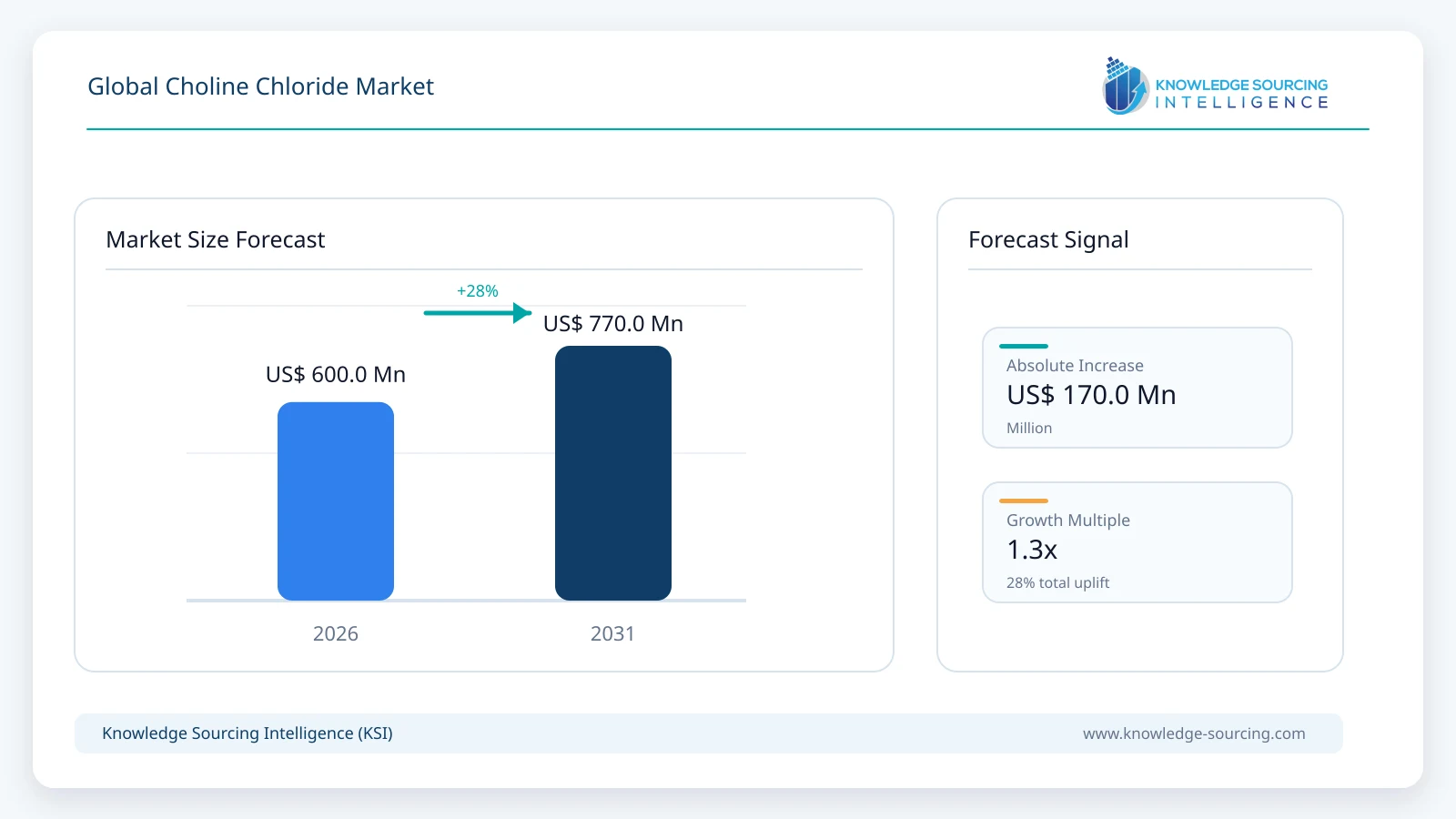
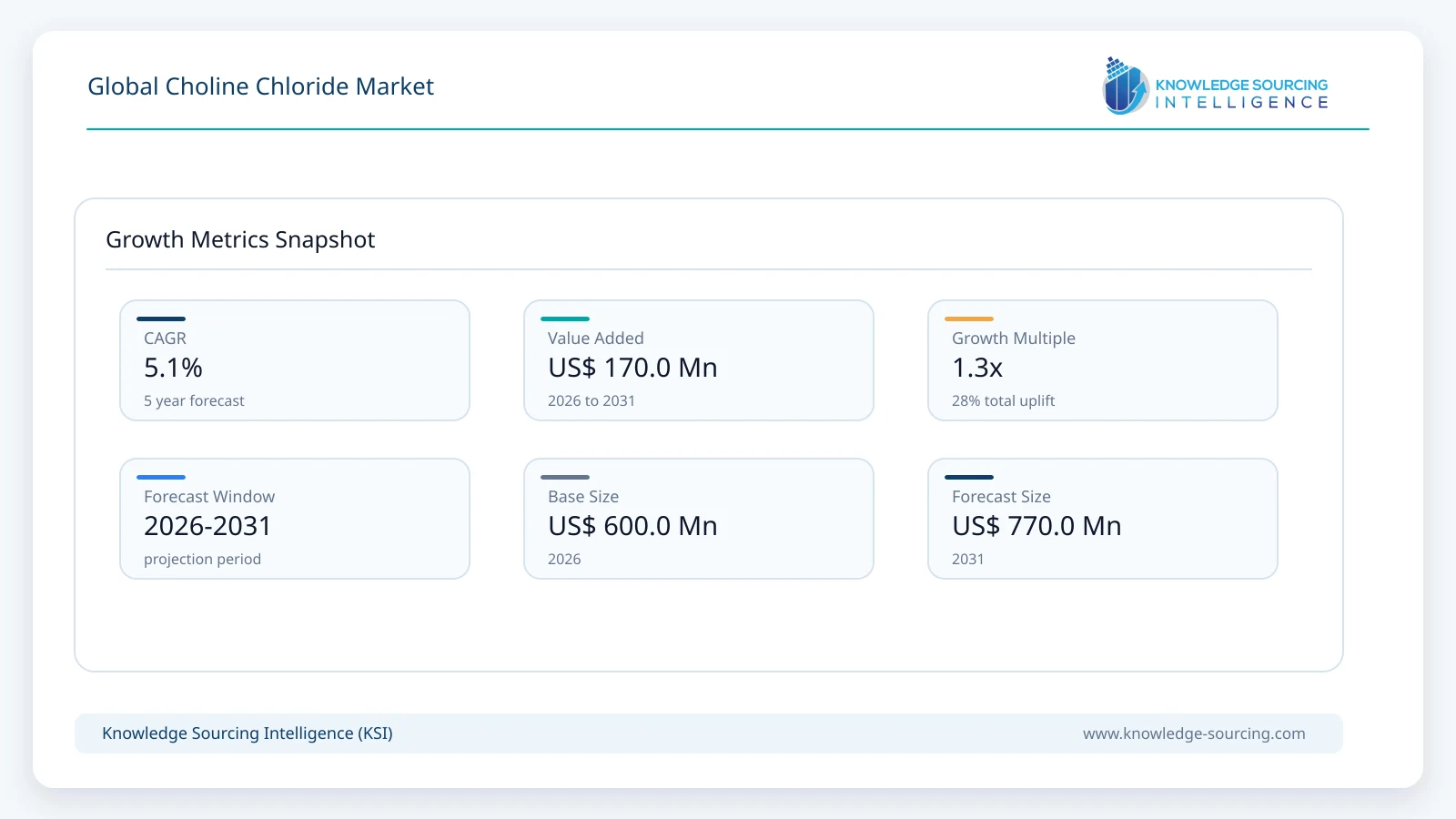
The global choline chloride market is forecast to grow at a CAGR of 5.1%, reaching USD 770.0 million in 2031 from USD 600.0 million in 2026.
Highlights:
- 1Animal feed accounts for approximately 80.0% of global 2026 revenue, equivalent to about USD 480.0 million, with poultry representing the largest species-level demand pool.
- 2Dry and powder choline chloride represents approximately 57.0% of global 2026 value, or about USD 342.0 million, supported by storage stability, export economics and established use in premixes and compound feed.
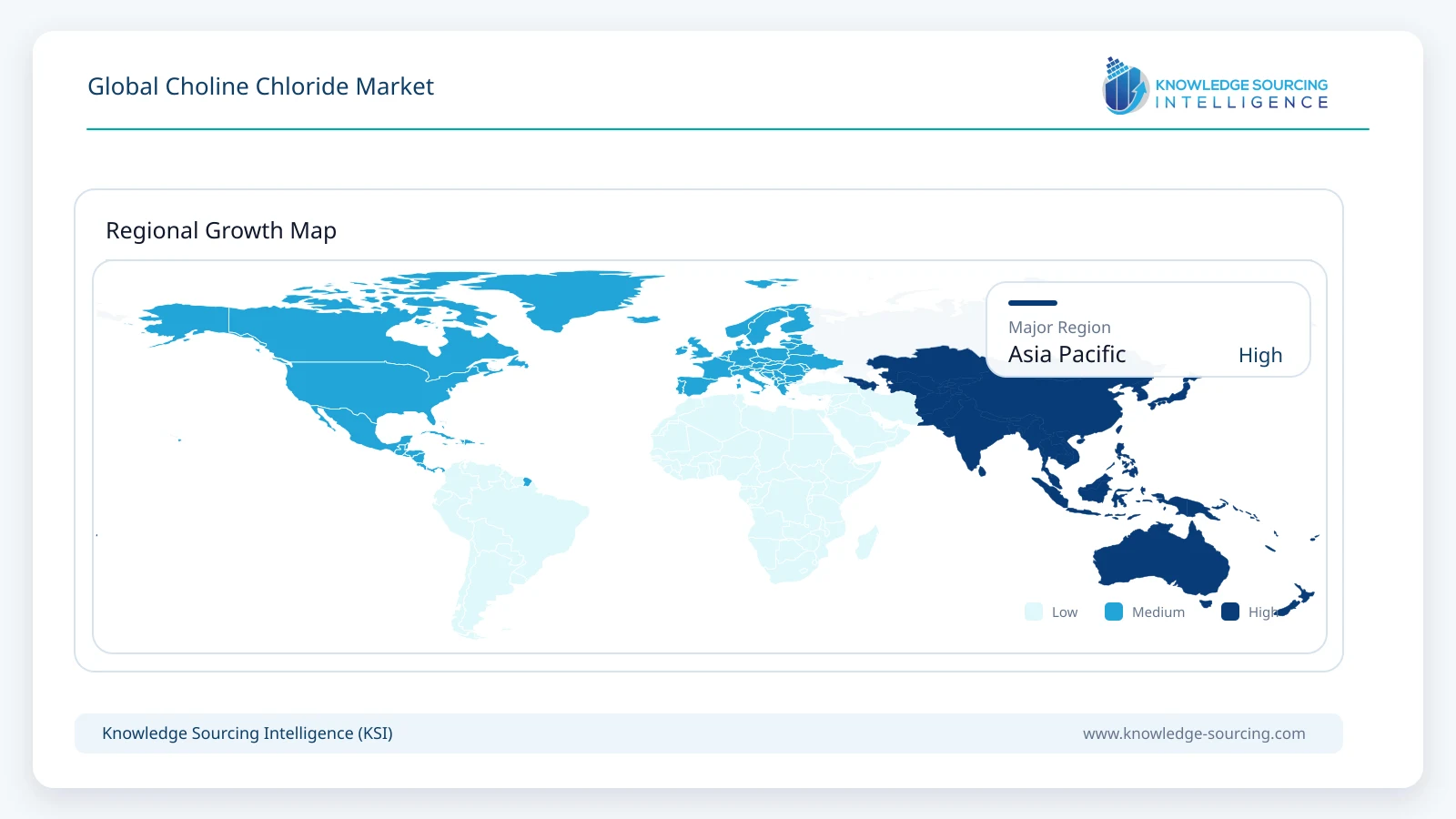
- 3Asia Pacific accounts for approximately 47.0% of 2026 revenue, equivalent to about USD 282.0 million, reflecting the concentration of livestock production, feed manufacturing and choline chloride capacity in China and India.
- 4Feed-grade choline chloride remains the largest grade, but higher-value human-nutrition, pet-food and rumen-protected formulations provide smaller premium niches.
- 5The European Union imposed definitive anti-dumping duties on choline chloride originating in China in December 2025, materially changing trade economics and supplier positioning in Europe.
- 6Nominal market value remains sensitive to trimethylamine, ethylene oxide, energy and freight costs; 2026 supplier price increases indicate that revenue growth cannot be interpreted as pure volume growth.
Market Overview
Choline chloride is a quaternary ammonium salt widely used as a nutritional source of choline. In animal nutrition, choline supports phospholipid formation, methyl-group metabolism and normal liver function, making supplementation important where natural feed ingredients do not provide a consistent dietary supply. Commercial products are sold primarily as aqueous solutions and as dry powders adsorbed onto carriers such as corn cob or silica. Concentration varies by form and application, so market value must be assessed on a commercial-product basis rather than by active ingredient tonnage alone.
The market is highly concentrated in animal feed but is not exclusively a feed additive market. Eastman markets choline chloride for feed and for oilfield applications, including clay stabilization. Jubilant Ingrevia supplies food-grade and nutrition-oriented choline products alongside feed applications. Kemin and Impextraco market protected or specialty choline products for ruminant nutrition. Human nutrition, pet food and industrial applications therefore represent smaller but strategically relevant value pools.
The existing KSI page places the market at USD 500.0 million in 2026. A current volume-and-price cross-check suggests a higher base. Industry data published for 2025 indicate global choline chloride sales of roughly 757 thousand tonnes and an average selling price around USD 768 per tonne, implying a market value close to USD 580 million before 2026 price changes. The revised 2026 estimate of USD 600.0 million is consistent with that physical scale, recent supplier price actions and the premium associated with dry, food-grade and specialty formulations.
The modeled forecast path is approximately USD 600.0 million in 2026, USD 630.0 million in 2027, USD 660.0 million in 2028, USD 690.0 million in 2029, USD 730.0 million in 2030 and USD 770.0 million in 2031. This is intentionally non-uniform. Feed demand provides steady volume growth, while annual market value can move more sharply with raw-material pricing, energy, freight and trade duties. Balchem announced a global price increase across its animal nutrition portfolio, including choline chloride, in 2026, illustrating this pricing sensitivity.
Trade policy is becoming more important to competitive structure. The European Union introduced definitive anti-dumping duties in December 2025 on choline chloride originating in China, with company-specific and residual rates ranging from 90.0% to 115.9%. The measures raise the delivered cost of affected Chinese material and strengthen the strategic importance of European, Indian and other non-Chinese supply options. They also make country of origin, documentation and supply-chain traceability more commercially significant for European buyers.
Global Choline Chloride Market Trends
European Anti-Dumping Measures Reshape Supplier Economics
The European Union moved from provisional measures to definitive anti-dumping duties on Chinese choline chloride in December 2025. The duties substantially change landed-cost economics in Europe and can redirect trade toward local, Indian or other non-Chinese producers. European buyers are therefore placing greater emphasis on origin documentation, continuity of supply and contractual pricing rather than simply comparing ex-factory Chinese prices.
Dry and Liquid Forms Serve Different Feed-Mill Economics
Liquid choline chloride can be cost-effective for integrated feed operations with storage and dosing infrastructure, while dry material is easier to handle in premixes, bags and long-distance distribution. Eastman supplies 70% liquid feed-grade products, while Aocter and other producers offer both concentrated liquid and dry carrier grades. The form mix therefore depends on logistics, mill configuration and local production economics rather than one format replacing the other.
Rumen-Protected Choline Creates a Higher-Value Dairy Nutrition Niche
Standard choline is extensively degraded in the rumen, creating demand for encapsulated or protected products in dairy cattle. Kemin markets CholiGEM and Impextraco offers protected choline solutions for ruminants. This niche is small compared with commodity poultry feed but commands higher value per unit because formulation, coating and delivery technology are more complex.
Food-Grade and Human-Nutrition Uses Broaden the Market Beyond Feed
Food-grade choline salts are used in infant nutrition, supplements, clinical nutrition and selected fortified foods and beverages. Jubilant Ingrevia supplies food-grade choline chloride and related choline salts. The segment is materially smaller than feed, but tighter purity specifications and regulatory requirements create a higher-value product tier.
Raw Material, Energy and Freight Costs Drive Nominal Price Cycles
Choline chloride manufacturing is exposed to trimethylamine, ethylene oxide, energy and logistics costs. GHW International reported higher choline chloride volumes in 2025 while average selling prices for choline-related products declined, illustrating how volume and value can diverge. Balchem subsequently announced 2026 price increases in response to geopolitical, energy, raw-material and freight pressures. Market revenue therefore should not be projected solely from feed-volume growth.
Segment Analysis
By Form - Dry / Powder Choline Chloride
Dry and powder choline chloride is estimated at approximately USD 342.0 million in 2026, representing about 57.0% of global market value. Commercial dry grades are commonly sold at 50%, 60% or 70% choline chloride on carriers. Their principal advantages are ease of bagged transport, premix compatibility, storage flexibility and reduced need for liquid dosing equipment. The format is especially important in export markets and fragmented feed-manufacturing systems.
Liquid choline chloride accounts for approximately USD 258.0 million, or 43.0% of 2026 revenue. Liquid 70% to 75% products can be economically attractive for large feed mills and industrial users with appropriate storage and metering systems. Liquid demand is also relevant in oilfield applications where choline chloride is used as a clay-stabilizing chemical. The relative value share of dry products is somewhat higher than their active-volume share because drying, carrier systems and handling add processing value.
By Grade - Feed Grade
Feed-grade choline chloride is estimated at approximately USD 492.0 million in 2026, representing about 82.0% of total market value. It is sold to compound-feed producers, premix manufacturers, integrators and animal-nutrition distributors. Quality differentiation centers on active concentration, trimethylamine odor, carrier quality, flowability, contaminant control, moisture stability and documentation.
Food and pharmaceutical-grade material accounts for approximately USD 48.0 million, or 8.0% of market value, while industrial grades account for approximately USD 60.0 million, or 10.0%. Higher-purity grades are smaller in tonnage but can achieve higher unit pricing due to tighter manufacturing and documentation requirements.
By Application - Animal Feed
Animal feed accounts for approximately USD 480.0 million in 2026, equivalent to 80.0% of global revenue. Within this pool, poultry is estimated at about USD 264.0 million, or 55.0% of feed-related demand, because commercial poultry diets are intensively formulated and produced at very large scale. Swine represents about USD 100.8 million, ruminants about USD 57.6 million, and aquaculture and other species approximately USD 57.6 million.
Pet food accounts for approximately USD 30.0 million of total choline chloride revenue, human nutrition approximately USD 36.0 million, and oil, gas and other industrial applications about USD 54.0 million. Industrial demand is smaller in volume but remains strategically relevant because oilfield clay-stabilization formulations can use concentrated liquid choline chloride.
By Geography - Asia Pacific
Asia Pacific is estimated at approximately USD 282.0 million in 2026, representing about 47.0% of global revenue. China is both a major producer and consumer, while India combines a large feed industry with established chemical manufacturers. Poultry, swine and aquaculture feed production across Southeast Asia also supports regional demand.
North America accounts for approximately USD 108.0 million, or 18.0%, while Europe represents about USD 102.0 million, or 17.0%. South America contributes approximately USD 60.0 million and the Middle East and Africa about USD 48.0 million. Europe is distinctive because anti-dumping duties on Chinese imports can increase local market value even when physical consumption grows more slowly.
Market Drivers
Expansion of Commercial Poultry and Livestock Feed
Large integrated poultry and livestock systems rely on formulated diets with consistent nutrient specifications. Choline chloride remains a standard feed additive where naturally occurring choline is insufficient or variable.
Growth of Compound Feed and Premix Industries
Industrial feed production increases the use of standardized micro-ingredients and premixes. Dry choline chloride is particularly well suited to premix manufacturing and distribution.
Higher Productivity Requirements in Animal Nutrition
Feed producers seek improved feed efficiency, liver health and metabolic performance. This supports continued use of choline even when overall livestock growth is moderate.
Specialty Ruminant and Pet-Nutrition Formulations
Rumen-protected choline and premium pet-food formulations create higher-value niches that are less commodity-like than standard poultry feed grades.
Industrial Demand for Clay Stabilization
Oil and gas service formulations use choline chloride as a clay stabilizer. This provides a diversified demand stream outside nutrition, particularly for liquid grades.
Market Restraints
Raw-Material and Energy Price Volatility
Trimethylamine, ethylene oxide, electricity, steam and freight can materially change manufacturing cost. Suppliers may pass these changes through with a lag, creating volatile nominal revenue and margin pressure.
Commodity Price Competition
Feed-grade choline chloride is relatively standardized. Large-volume buyers can switch between qualified suppliers, which constrains margins when supply is abundant.
Trade Barriers and Origin Compliance
Anti-dumping duties in Europe make sourcing decisions more complex and can disrupt established China-to-Europe trade flows. Importers need stronger origin documentation and may face higher working-capital costs.
Handling and Stability Constraints
Dry products can absorb moisture or cake, while liquid products require dedicated tanks and dosing systems. Poor carrier quality or elevated trimethylamine can also reduce acceptance in feed applications.
Substitution and Formulation Optimization
Nutritionists can adjust formulations based on natural choline content, methionine, betaine and other methyl-donor strategies. This limits the ability to increase choline inclusion indefinitely and keeps demand linked to formulation economics.
Competitive Environment
The choline chloride market combines multinational specialty-chemical and nutrition suppliers with large Asian feed-additive manufacturers. Balchem is a major North American and European choline supplier and played an active role in the European trade case. Eastman supplies both animal-nutrition and oilfield grades. Jubilant Ingrevia combines feed and food-grade choline products with a broad specialty-chemicals platform.
Chinese manufacturers remain important to global capacity and export supply. Shandong Aocter offers liquid and dry choline chloride and exports internationally. Shandong FY Feed Technology and Shandong Yinfeng Biological are identified in the European anti-dumping regulation as cooperating or investigated Chinese exporters. GHW International operates through chemical and nutrition subsidiaries and reported higher choline chloride sales volumes in 2025.
Competition differs by product tier. Commodity dry feed grade competes heavily on delivered cost, active concentration, carrier quality and reliability. Food-grade, low-odor and protected choline products compete more on quality systems, formulation performance and technical support. European trade measures increase the value of regional production, diversified origin and secure logistics.
Recent Developments
• 2026: Eastman continued offering dedicated choline chloride products for animal nutrition and oilfield clay-stabilization applications, illustrating the market's split between nutritional and industrial demand.
• FY2026: Jubilant Ingrevia reported improvement in its choline business, including stronger exports to Europe, reflecting changing European sourcing conditions and continued demand for non-Chinese supply.
• May 2026: Balchem announced a global price increase across its Animal Nutrition and Health portfolio, including choline chloride, citing energy, raw-material, freight and geopolitical cost pressures.
• 2025–2026 : Impextraco and Kemin continued marketing rumen-protected and specialty choline products for dairy nutrition, supporting a higher-value niche beyond conventional feed-grade choline chloride.
• December 2025: The European Union imposed definitive anti-dumping duties of 90.0% to 115.9% on choline chloride originating in China, following an investigation into import pricing and injury to the Union industry.
• 2025: GHW International reported approximately 10% growth in choline chloride sales volume in the first half of the year, although average selling prices for choline-related products declined, highlighting the divergence between volume and value.
Market Outlook
The global choline chloride market is expected to grow at a moderate rate through 2031. Physical demand will be anchored by poultry, swine, aquaculture and compound-feed production, while nominal revenue will remain sensitive to chemical feedstocks, energy, freight and regional trade policy.
Dry feed-grade products will remain the largest commercial segment because of their flexibility in premixes and exports. Liquid grades will retain an important position in integrated feed mills and industrial applications. Human nutrition, pet food and protected ruminant products will remain smaller but provide attractive premium niches.
Asia Pacific will remain the largest production and consumption region, but the European market will undergo the most significant competitive restructuring because of anti-dumping duties on Chinese-origin material. Suppliers with diversified manufacturing, strong documentation, consistent low-odor quality and secure distribution are expected to gain the most durable positions.
Choline Chloride Market Scope
| Report Metric | Details |
|---|---|
| Total Market Size in 2026 | USD 600.0 million |
| Total Market Size in 2031 | USD 770.0 million |
| Forecast Unit | Million |
| Growth Rate | 5.1% |
| Study Period | 2021 to 2031 |
| Historical Data | 2021 to 2024 |
| Base Year | 2025 |
| Forecast Period | 2026 – 2031 |
| Segmentation | Form, Grade, Application, Geography |
| Companies |
|
Market Segmentation
By Form
Dry / Powder Choline Chloride
50% Choline Chloride
60% Choline Chloride
70% Choline Chloride and Other Dry Grades
Liquid Choline Chloride
70% Solution
75% and Other Concentrations
By Grade
Feed Grade
Food and Pharmaceutical Grade
Industrial Grade
By Application
Animal Feed
Poultry
Swine
Ruminants
Aquaculture and Others
Pet Food
Human Nutrition and Food
Oil, Gas and Other Industrial Applications
By Geography
North America
United States
Canada
Mexico
South America
Brazil
Argentina
Others
Europe
Germany
United Kingdom
France
Netherlands
Spain
Others
Middle East and Africa
Saudi Arabia
UAE
South Africa
Others
Asia Pacific
China
India
Japan
South Korea
Southeast Asia
Others
Table of Contents
1. INTRODUCTION
1.1. Market Overview
1.2. Market Definition
1.3. Scope of the Study
1.4. Market Segmentation
1.5. Currency
1.6. Assumptions
1.7. Base and Forecast Years Timeline
2. RESEARCH METHODOLOGY
2.1. Research Design
2.2. Secondary Research
2.3. Primary Validation
2.4. Market Estimation and Forecasting
2.5. Data Triangulation and Quality Control
3. EXECUTIVE SUMMARY
3.1. Key Findings
3.2. Global Market Size, 2026-2031
3.3. Segment Summary
3.4. Regional Summary
4. MARKET DYNAMICS
4.1. Market Drivers
4.1.1. Expansion of Commercial Poultry and Livestock Feed
4.1.2. Growth of Compound Feed and Premix Industries
4.1.3. Higher Productivity Requirements in Animal Nutrition
4.1.4. Specialty Ruminant and Pet-Nutrition Formulations
4.1.5. Industrial Demand for Clay Stabilization
4.2. Market Restraints
4.2.1. Raw-Material and Energy Price Volatility
4.2.2. Commodity Price Competition
4.2.3. Trade Barriers and Origin Compliance
4.2.4. Handling and Stability Constraints
4.2.5. Substitution and Formulation Optimization
5. GLOBAL CHOLINE CHLORIDE MARKET BY FORM
5.1. Dry / Powder Choline Chloride
5.1.1. 50% Choline Chloride
5.1.2. 60% Choline Chloride
5.1.3. 70% Choline Chloride and Other Dry Grades
5.2. Liquid Choline Chloride
5.2.1. 70% Solution
5.2.2. 75% and Other Concentrations
6. GLOBAL CHOLINE CHLORIDE MARKET BY GRADE
6.1. Feed Grade
6.2. Food and Pharmaceutical Grade
6.3. Industrial Grade
7. GLOBAL CHOLINE CHLORIDE MARKET BY APPLICATION
7.1. Animal Feed
7.1.1. Poultry
7.1.2. Swine
7.1.3. Ruminants
7.1.4. Aquaculture and Others
7.2. Pet Food
7.3. Human Nutrition and Food
7.4. Oil, Gas and Other Industrial Applications
8. GLOBAL CHOLINE CHLORIDE MARKET BY GEOGRAPHY
8.1. North America
8.1.1. United States
8.1.2. Canada
8.1.3. Mexico
8.2. South America
8.2.1. Brazil
8.2.2. Argentina
8.2.3. Others
8.3. Europe
8.3.1. Germany
8.3.2. United Kingdom
8.3.3. France
8.3.4. Netherlands
8.3.5. Spain
8.3.6. Others
8.4. Middle East and Africa
8.4.1. Saudi Arabia
8.4.2. UAE
8.4.3. South Africa
8.4.4. Others
8.5. Asia Pacific
8.5.1. China
8.5.2. India
8.5.3. Japan
8.5.4. South Korea
8.5.5. Southeast Asia
8.5.6. Others
9. COMPETITIVE ENVIRONMENT AND ANALYSIS
9.1. Major Players and Strategy Analysis
9.2. Dry versus Liquid Product Positioning
9.3. Feed-Grade and Specialty Product Positioning
9.4. Trade Flows and European Anti-Dumping Measures
9.5. Recent Developments
9.6. Competitive Dashboard
10. COMPANY PROFILES
10.1. Balchem Corporation
10.2. Eastman Chemical Company
10.3. Jubilant Ingrevia Limited
10.4. BASF SE / BTC Europe GmbH
10.5. GHW International
10.6. Shandong Aocter Biotechnology Co., Ltd.
10.7. Balaji Amines Limited
10.8. Impextraco N.V.
10.9. Kemin Industries, Inc.
10.10. Shandong FY Feed Technology Co., Ltd.
10.11. Shandong Yinfeng Biological Technology Co., Ltd.
10.12. Liaoning Biochem Co., Ltd.
10.13. NB Group Co., Ltd.
10.14. Dazheng Feed Science & Technology Co., Ltd.
10.15. Jinan Asia Pharmaceutical Co., Ltd.
10.16. Algry Quimica S.L.
11. APPENDIX
11.1. Currency
11.2. Assumptions
11.3. Base and Forecast Years Timeline
11.4. Abbreviations
Navigate
Trusted by the world's leading organizations











