
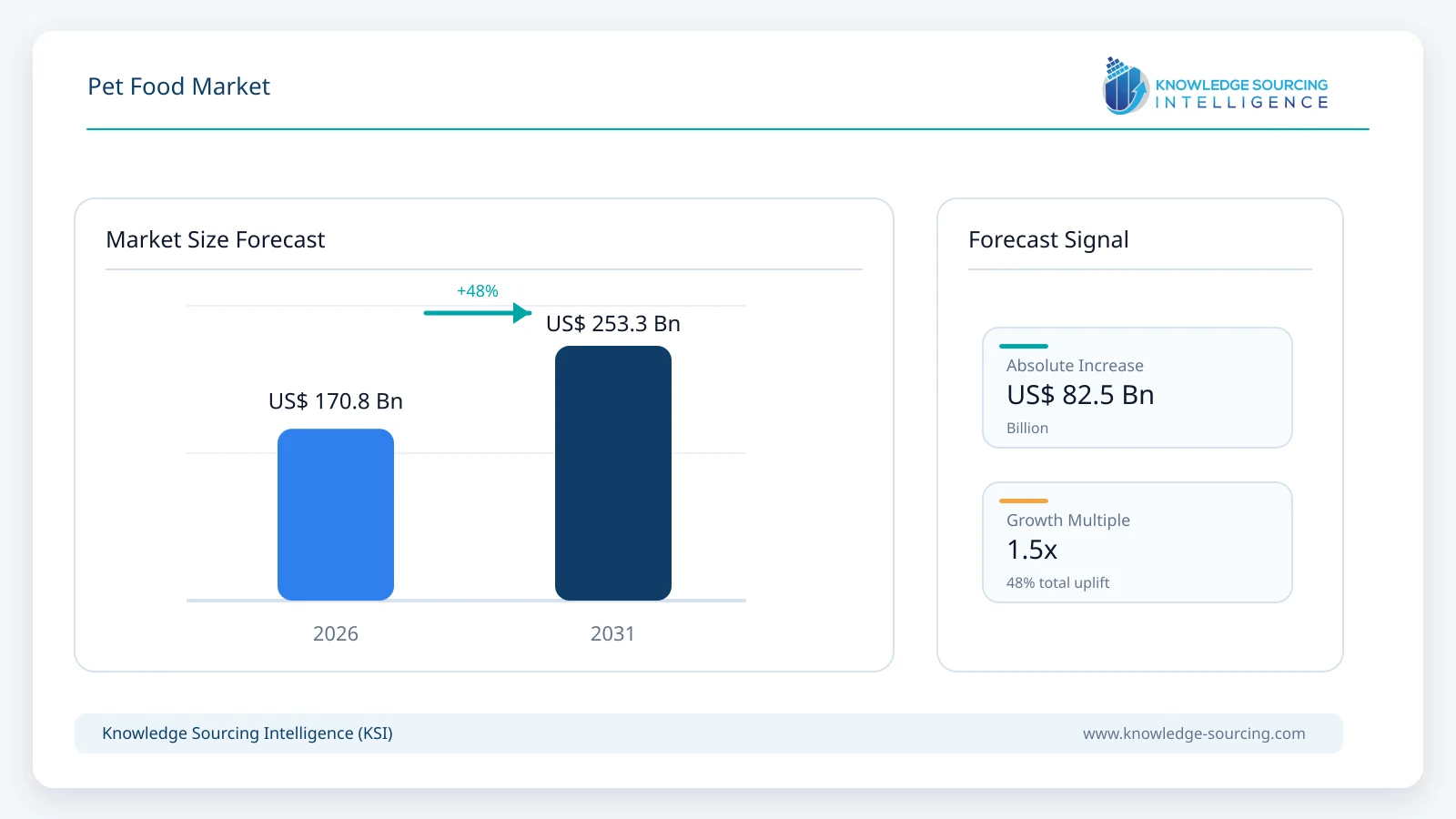
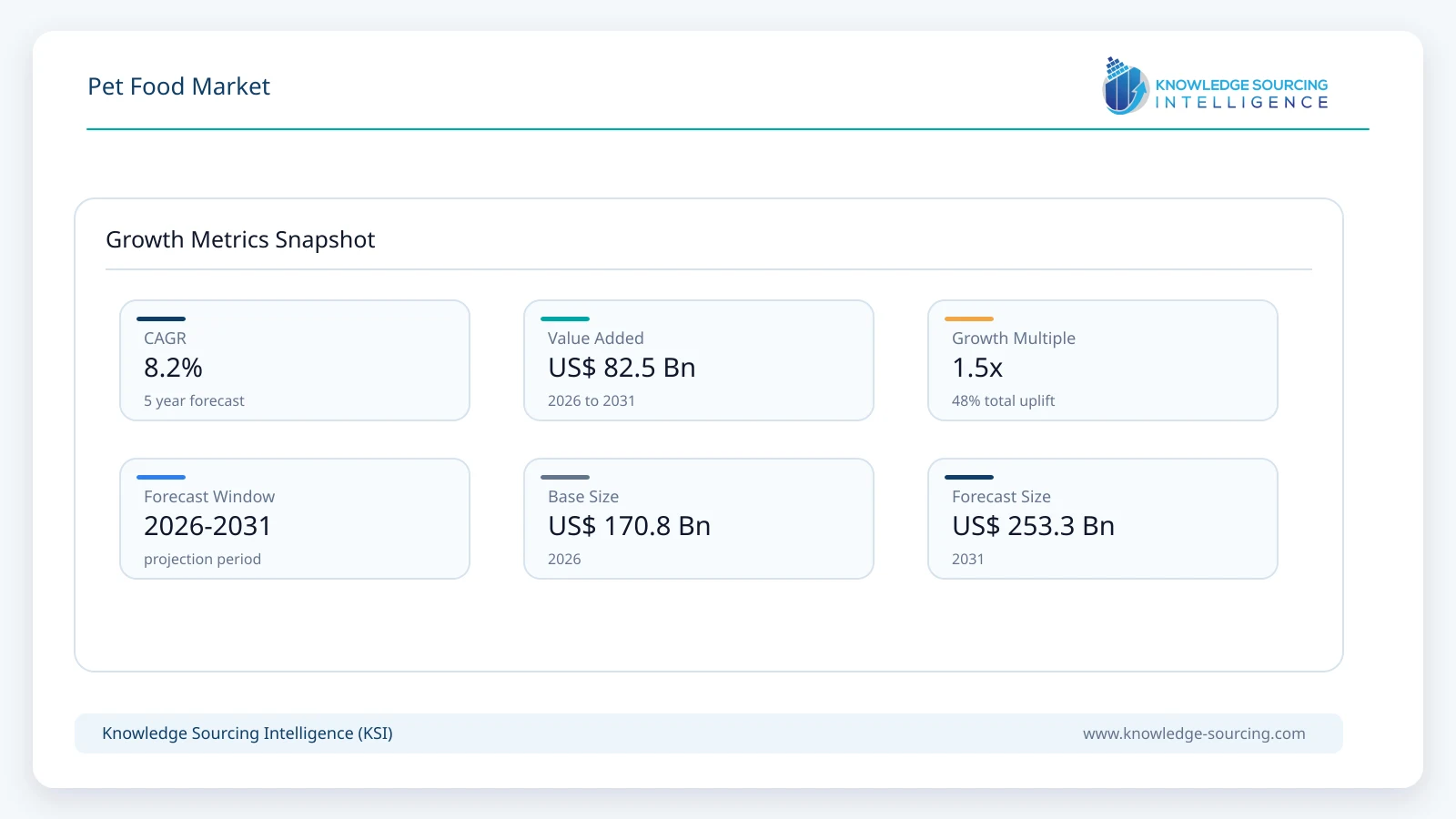
The Pet Food Market is expected to grow at a CAGR of 8.2%, reaching a market size of USD 253.3 billion in 2031 from USD 170.8 billion in 2026.
Highlights:
- 1Dry food represents 43% of global pet food revenue in 2026, remaining the largest format.
- 2Premium and super-premium pet food is projected to grow at 12.2% CAGR through 2031.
- 3Cat food is projected to grow at 10.0% CAGR, outpacing dog food through 2031.
- 4Online pet food sales increase from 26% market share in 2026 to 32% by 2031.
- 5Asia Pacific rises from 24% of market revenue in 2026 to 29% by 2031.
Pet Food Market Overview
The pet food market is increasingly shaped by nutritional positioning rather than basic feeding requirements alone. Consumers are purchasing products according to pet age, breed, digestive health, weight management, allergies, and broader wellness requirements, creating a wider price and product spectrum across dry food, wet food, treats, fresh diets, and veterinary nutrition. Dry food continues to provide the largest revenue pool because of affordability, shelf stability, and widespread use, but premium wet products, fresh food, and therapeutic formulations are contributing disproportionately to incremental market value.
The underlying demand base remains resilient. In the United States, pet industry expenditure reached USD 158 billion in 2025 and is projected by the American Pet Products Association to reach USD 165 billion in 2026. Approximately 95 million U.S. households owned at least one pet in 2025, while dog ownership reached 71 million households. This broad household penetration supports recurring food purchases even when discretionary spending weakens, although consumers can adjust product tier, pack size and treat expenditure according to economic conditions.
Current manufacturer performance points to stronger opportunities in premium nutrition, cat food and specialised formats rather than uniform growth across the industry. Nestlé reported 2.7% organic growth in Petcare during the first half of 2026, with cat products remaining particularly strong and premium wet cat supporting performance in Europe. Freshpet, meanwhile, increased second-quarter 2026 net sales by 15.5% to USD 305.6 million, illustrating considerably faster growth within refrigerated fresh food than the conventional packaged-food category.
Major Market Drivers
Premiumization and Health-Specific Pet Nutrition
Premiumization is the most important structural value driver in pet food. Owners are increasingly selecting diets around digestive health, skin and coat support, weight control, urinary health, mobility and life-stage requirements rather than relying on one general-purpose formulation throughout a pet’s life. This shift supports higher-value dry and wet food, functional formulations and veterinarian-recommended diets, while allowing manufacturers to compete through nutritional differentiation instead of price alone.
The trend is visible across the portfolios of leading companies. Nestlé identified Pro Plan, Purina ONE and Felix among the key contributors to Petcare growth during 2026, while premium wet cat products supported European performance. The company also reported that wet cat products were an important growth driver across Asia, Oceania and Africa. As pet owners increasingly associate nutrition with longevity and quality of life, premium and super-premium pet food is projected to grow materially faster than the overall market through 2031.
Expanding Packaged Pet Food Adoption and Spending per Pet
Market growth also comes from the combination of a large existing pet population in developed markets and increasing commercial pet food penetration across emerging economies. In mature markets, growth increasingly depends on spending per pet, including higher-value food, specialised diets and treats. In developing markets, the opportunity also includes conversion from household-prepared feeding toward formulated packaged nutrition.
Asia Pacific provides the clearest example. Nestlé stated in September 2026 that Asia, Oceania and Africa contained more than 350 million domestic cats and dogs and that owners were increasingly moving from home-prepared meals toward packaged nutrition, particularly premium products. The company is investing CHF 157 million to expand Purina manufacturing in Thailand, increasing production for brands including Felix, Friskies, Pro Plan and Purina ONE for domestic and international markets.
Major Market Restraints
Consumer Affordability and Ingredient Cost Pressure
Pet food benefits from recurring essential demand, but consumers can adjust the quality and type of product purchased when household budgets tighten. Premium buyers may trade down to mainstream formulations, while price-sensitive households can shift toward larger pack sizes, promotions and private-label alternatives. APPA’s 2026 industry research describes U.S. pet owners as becoming more intentional with expenditure even while continuing to prioritise essential care.
Manufacturers face the opposite pressure from meat, grains, oils, packaging and transportation costs. Passing these increases fully to consumers can weaken premium conversion, while absorbing them reduces margins. The resulting need to balance formulation quality, pack architecture and retail pricing becomes particularly important in mainstream food, where consumers can compare competing products relatively easily.
Higher Manufacturing and Distribution Complexity for Growth Formats
Several faster-growing pet food formats require significantly more complex infrastructure than conventional dry kibble. Wet food involves sterilisation, heavier packaging and more expensive logistics, while refrigerated fresh products require cold-chain distribution, dedicated retail refrigerators and tighter inventory management.
Recent investments illustrate the capital required. Nestlé announced a CHF 520 million integrated wet pet food plant and logistics platform in Italy in July 2026, scheduled to produce super-premium wet food for cats and dogs from 2029. In March 2026, the company opened a CHF 370 million wet pet food factory in Brazil that will nearly double its local wet-food capacity. Mars also opened an AUD 112.6 million wet cat food pouch facility in Australia capable of producing approximately 290 million pouches annually.
Pet Food Market Trends
Wet Cat Food Is Becoming a Larger Growth Pool
Cat food is gaining importance as cat ownership expands and consumers increasingly purchase wet products for hydration, palatability, and portion control. Nestlé reported that wet cat food was the key pet care growth driver in Asia, Oceania, and Africa during the second quarter of 2026, while premium wet cat food also supported growth in Europe. Cat food is therefore expected to increase its share of global pet food revenue through 2031.
Fresh Food Is Moving Toward Mainstream Retail
Refrigerated fresh pet food continues to expand beyond specialist direct-to-consumer distribution. Freshpet’s 15.5% second-quarter 2026 sales growth demonstrates that consumers are willing to pay higher prices for refrigerated products positioned around recognisable ingredients and less-processed formulations. Retail refrigerator availability and manufacturing capacity remain constraints, but the format is becoming a meaningful premium alternative to conventional dry and wet products.
Functional Nutrition Is Extending Into Treats
Functional benefits are becoming more important within treats and snacks. Dental care, digestion, calming, joint health and training functionality provide manufacturers with opportunities to differentiate products beyond flavour. Smaller serving sizes also make premium functional positioning easier to absorb from a household-budget perspective than equivalent premiumisation of complete daily diets.
Manufacturing Investment Is Moving Closer to Regional Demand
Pet food manufacturers are increasingly adding production capacity within major consumption regions rather than depending exclusively on long-distance supply networks. Nestlé’s recent projects in Brazil, Italy and Thailand and Mars’ expansion in Australia demonstrate a broader emphasis on local capacity, particularly for wet food. The strategy shortens supply chains for heavy finished products and allows manufacturers to respond more quickly to regional format and flavour preferences.
Segment Analysis:
By Product Format
Dry Food
Dry food is the largest product format, accounting for approximately 43% of global pet food revenue in 2026. Its position is supported by lower cost per serving, long shelf life, efficient transportation and broad use as a complete everyday diet, particularly for dogs. Manufacturers are increasingly differentiating dry formulations through higher protein content, probiotics, life-stage nutrition and specific health claims rather than changing the basic format.
The segment continues growing in absolute value through 2031 but loses some market share as wet, fresh and specialist products expand faster. Its scale nevertheless means that dry food remains strategically important to every major global pet food manufacturer throughout the forecast period.
By Pet Type
Dogs
Dogs represent approximately 58% of global pet food revenue in 2026, making them the largest pet-type segment. Larger average food requirements, extensive treat consumption and a broad range of age-, breed- and health-specific products support market value.
Dog food growth remains positive through 2031, but its share gradually moderates as cat food expands faster. APPA reported 71 million dog-owning households in the United States during 2025, demonstrating the depth of the established consumption base in the world’s largest pet food market.
By Price Positioning
Premium and Super-Premium
Premium and super-premium food accounts for approximately 30% of market revenue in 2026 and is projected to grow at around 12.2% annually through 2031. The segment includes products differentiated through protein quality, natural positioning, specialised ingredients, functional nutrition and more advanced manufacturing formats.
Growth is supported by pet owners’ increasing focus on health and longevity and by manufacturers broadening premium propositions beyond specialist stores into supermarkets and e-commerce. Premiumisation is also increasingly visible in wet and fresh food, where higher revenue per serving can offset more complex manufacturing and distribution requirements.
By Distribution Channel
Online
Online channels account for approximately 26% of pet food revenue in 2026 and are projected to approach 32% by 2031. Pet food is particularly compatible with e-commerce because purchases are repetitive, product specifications change infrequently and bulky packs can be delivered directly to households.
Subscription and auto-replenishment services further strengthen the channel by reducing the risk of consumers running out of staple products. Nestlé reported strong Petcare performance through e-commerce in Europe during 2026, while broader online adoption is particularly significant in Asian markets where digital platforms can expand access to imported and premium products.
By Geography
North America
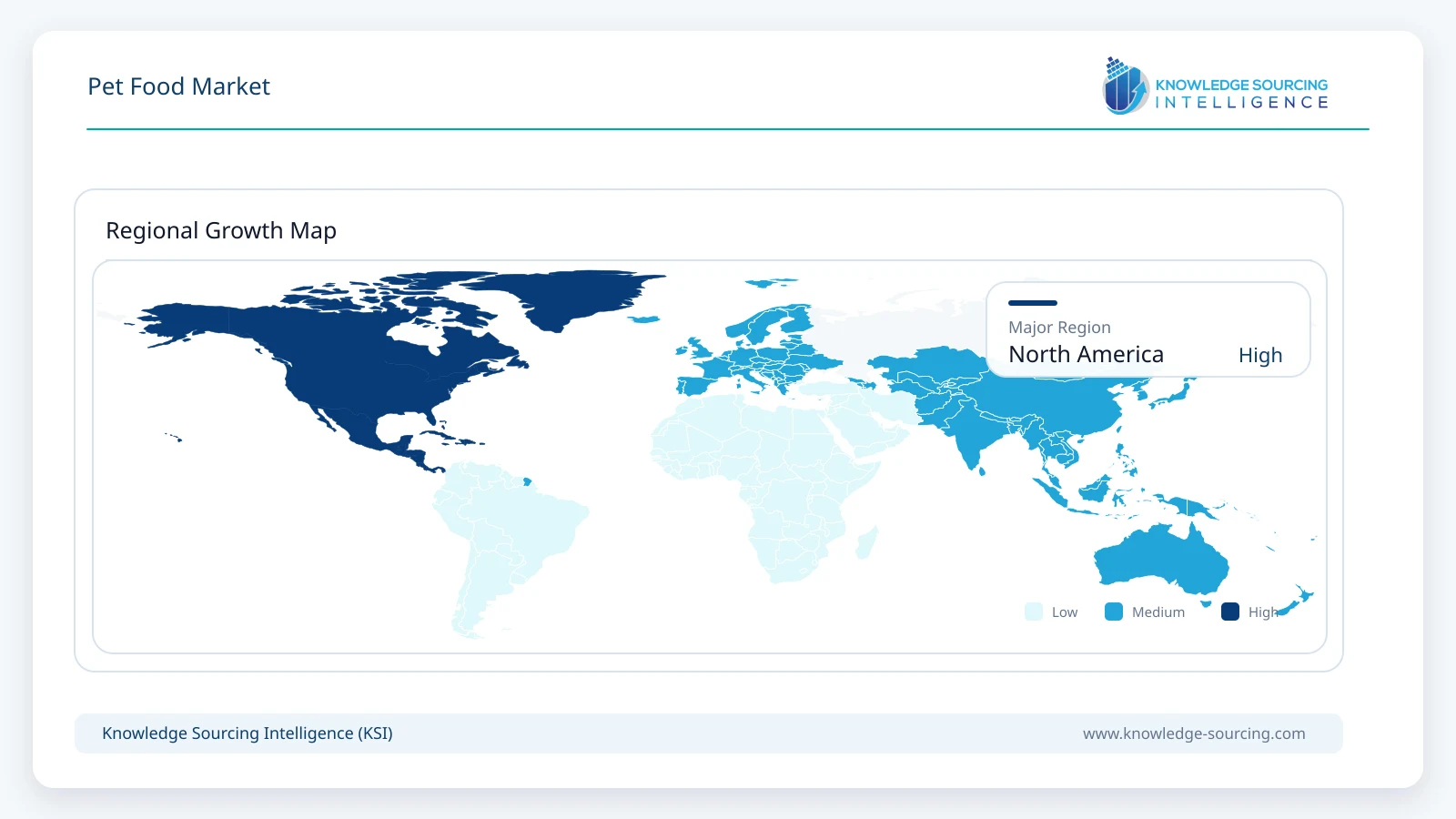
North America remains the largest regional market, accounting for approximately 38% of global revenue in 2026. The region combines high pet ownership with substantial expenditure on premium nutrition, treats, therapeutic diets and fresh food.
The United States accounts for the majority of regional demand. APPA estimates total U.S. pet industry expenditure at USD 165 billion in 2026, reinforcing the depth of the broader pet economy supporting food purchases. Canada maintains high packaged-food penetration, while Mexico provides additional long-term growth through rising branded pet food adoption.
Competitive Landscape
The pet food market remains concentrated among several global manufacturers with extensive portfolios and distribution networks. Mars, Incorporated and Nestlé Purina operate across mainstream, premium and specialised nutrition, while Colgate-Palmolive participates through Hill’s Pet Nutrition with particularly strong exposure to science-led and therapeutic diets. General Mills competes through Blue Buffalo and its broader pet portfolio, while The J.M. Smucker Company maintains important positions in cat food and dog snacks.
Competition is also widening through specialist companies. Freshpet has established a scaled refrigerated pet food platform, while Farmina, Diamond Pet Foods, United Petfood, VAFO and other companies compete through premium brands, private-label manufacturing or regional strength. Competitive differentiation increasingly depends on nutritional claims, manufacturing capability, product quality, retail availability and the ability to support growth formats such as premium wet and fresh food.
Capacity investment remains an important competitive tool. Nestlé’s manufacturing projects across Brazil, Italy and Thailand and Mars’ recent Australian investment indicate that leading companies expect premium wet and specialist pet nutrition to require significantly greater production capacity during the forecast period.
Recent Developments
September 2026: Nestlé announced a CHF 157 million expansion of Purina pet food manufacturing capacity in Thailand.
August 2026: Freshpet reported second-quarter net sales of USD 305.6 million, representing 15.5% year-over-year growth.
July 2026: Nestlé announced a CHF 520 million integrated wet pet food and logistics facility in Italy.
June 2026: Mars opened a AUD 112.6 million dedicated wet cat food pouch facility in Australia.
March 2026: Nestlé opened a CHF 370 million wet pet food factory in Brazil.
Market Outlook
The global pet food market is expected to add more than USD 82 billion in annual revenue between 2026 and 2031. Growth increasingly reflects higher expenditure per pet, premium nutrition and specialised formats rather than simple expansion in pet populations. Dry food remains the largest format and dogs remain the largest pet type, but premium food, cat nutrition, wet products, fresh diets and online distribution capture a greater proportion of incremental market value.
Asia Pacific provides the strongest regional growth opportunity as packaged commercial feeding expands and owners spend more on specialised nutrition. North America remains the largest market by value, supported by high ownership and mature premium demand, while Europe retains substantial wet-food and therapeutic nutrition consumption.
Pet Food Market Scope:
| Report Metric | Details |
|---|---|
| Total Market Size in 2026 | USD 170.8 billion |
| Total Market Size in 2031 | USD 253.3 billion |
| Forecast Unit | Billion |
| Growth Rate | 8.2% |
| Study Period | 2021 to 2031 |
| Historical Data | 2021 to 2024 |
| Base Year | 2025 |
| Forecast Period | 2026 – 2031 |
| Segmentation | Product Format, Pet Type, Price Positioning, Distribution Channel |
| Companies |
|
Market Segmentation
By Product Format
· Dry Food
· Wet Food
· Treats and Snacks
· Fresh, Refrigerated, Frozen, Freeze-Dried and Specialty Food
By Pet Type
· Dogs
· Cats
· Other Pets
By Price Positioning
· Economy
· Mid-Range and Mainstream
· Premium and Super-Premium
· Veterinary and Therapeutic
By Distribution Channel
Online
Offline
· Supermarkets and Hypermarkets
· Pet Specialty Stores
· Veterinary Clinics
· Others
By Geography
North America
· United States
· Canada
· Mexico
South America
· Brazil
· Argentina
· Chile
· Colombia
· Others
Europe
· Germany
· United Kingdom
· France
· Italy
· Spain
· Poland
· Others
Middle East and Africa
· Saudi Arabia
· United Arab Emirates
· South Africa
· Israel
· Others
Asia Pacific
· China
· Japan
· Australia
· South Korea
· India
· Indonesia
· Thailand
· Others
Table of Contents
1. EXECUTIVE SUMMARY
1.1. Key Findings
1.2. Pet Food Market Size, 2026-2031
1.3. Product Format Outlook
1.4. Pet Type Outlook
1.5. Price Positioning Outlook
1.6. Distribution Channel Outlook
1.7. Regional Opportunity Summary
2. MARKET SNAPSHOT
2.1. Market Overview
2.2. Market Definition
2.3. Scope of the Study
2.4. Market Segmentation
3. BUSINESS LANDSCAPE
3.1. Market Drivers
3.1.1. Premiumization, Functional Nutrition and Veterinary Diet Adoption
3.1.2. Expanding Pet Ownership and Higher Spending per Pet
3.1.3. Growth of Wet, Fresh and Specialty Pet Food Formats
3.1.4. Increasing Packaged Pet Food and E-Commerce Penetration in Emerging Markets
3.2. Market Restraints
3.2.1. Consumer Affordability and Pet Food Input-Cost Inflation
3.2.2. Manufacturing, Cold-Chain and Distribution Complexity
3.2.3. Regulatory, Food-Safety and Product Recall Exposure
3.2.4. Sustainability Pressure on Animal Protein and Packaging
3.3. Market Opportunities
3.4. Porter’s Five Forces Analysis
3.5. Industry Value Chain Analysis
3.6. Policies and Regulations
3.7. Strategic Recommendations
4. TECHNOLOGICAL OUTLOOK
4.1. Extrusion and Dry Food Processing
4.2. Wet Food Sterilisation and Retort Processing
4.3. Fresh and Refrigerated Pet Food Processing
4.4. Freeze-Drying Technology
4.5. Functional Ingredient and Nutritional Formulation Development
5. PET FOOD MARKET BY PRODUCT FORMAT
5.1. Introduction
5.2. Dry Food
5.3. Wet Food
5.4. Treats and Snacks
5.5. Fresh, Refrigerated, Frozen, Freeze-Dried and Specialty Food
6. PET FOOD MARKET BY PET TYPE
6.1. Introduction
6.2. Dogs
6.3. Cats
6.4. Other Pets
7. PET FOOD MARKET BY PRICE POSITIONING
7.1. Introduction
7.2. Economy
7.3. Mid-Range and Mainstream
7.4. Premium and Super-Premium
7.5. Veterinary and Therapeutic
8. PET FOOD MARKET BY DISTRIBUTION CHANNEL
8.1. Introduction
8.2. Online
8.3. Offline
8.3.1. Supermarkets and Hypermarkets
8.3.2. Pet Specialty Stores
8.3.3. Veterinary Clinics
8.3.4. Others
9. PET FOOD MARKET BY GEOGRAPHY
9.1. North America
9.1.1. By Product Format
9.1.2. By Pet Type
9.1.3. By Price Positioning
9.1.4. By Distribution Channel
9.1.5. By Country
9.1.5.1. United States
9.1.5.2. Canada
9.1.5.3. Mexico
9.2. South America
9.2.1. By Product Format
9.2.2. By Pet Type
9.2.3. By Distribution Channel
9.2.4. By Country
9.2.4.1. Brazil
9.2.4.2. Argentina
9.2.4.3. Chile
9.2.4.4. Colombia
9.2.4.5. Others
9.3. Europe
9.3.1. By Product Format
9.3.2. By Pet Type
9.3.3. By Price Positioning
9.3.4. By Distribution Channel
9.3.5. By Country
9.3.5.1. Germany
9.3.5.2. United Kingdom
9.3.5.3. France
9.3.5.4. Italy
9.3.5.5. Spain
9.3.5.6. Poland
9.3.5.7. Others
9.4. Middle East and Africa
9.4.1. By Product Format
9.4.2. By Pet Type
9.4.3. By Distribution Channel
9.4.4. By Country
9.4.4.1. Saudi Arabia
9.4.4.2. United Arab Emirates
9.4.4.3. South Africa
9.4.4.4. Israel
9.4.4.5. Others
9.5. Asia Pacific
9.5.1. By Product Format
9.5.2. By Pet Type
9.5.3. By Price Positioning
9.5.4. By Distribution Channel
9.5.5. By Country
9.5.5.1. China
9.5.5.2. Japan
9.5.5.3. Australia
9.5.5.4. South Korea
9.5.5.5. India
9.5.5.6. Indonesia
9.5.5.7. Thailand
9.5.5.8. Others
10. COMPETITIVE ENVIRONMENT AND ANALYSIS
10.1. Major Players and Strategy Analysis
10.2. Market Share Analysis
10.3. Emerging Players
10.4. Mergers, Acquisitions, Partnerships and Agreements
10.5. Recent Developments
10.6. Competitive Dashboard
11. COMPANY PROFILES
11.1. Mars, Incorporated
11.2. Nestlé S.A.
11.3. Colgate-Palmolive Company
11.4. General Mills, Inc.
11.5. The J.M. Smucker Company
11.6. Freshpet, Inc.
11.7. Diamond Pet Foods
11.8. Affinity Petcare S.A.
11.9. United Petfood
11.10. Farmina Pet Foods
11.11. Simmons Pet Food, Inc.
11.12. VAFO PRAHA s.r.o.
12. APPENDIX
Navigate
Trusted by the world's leading organizations











