
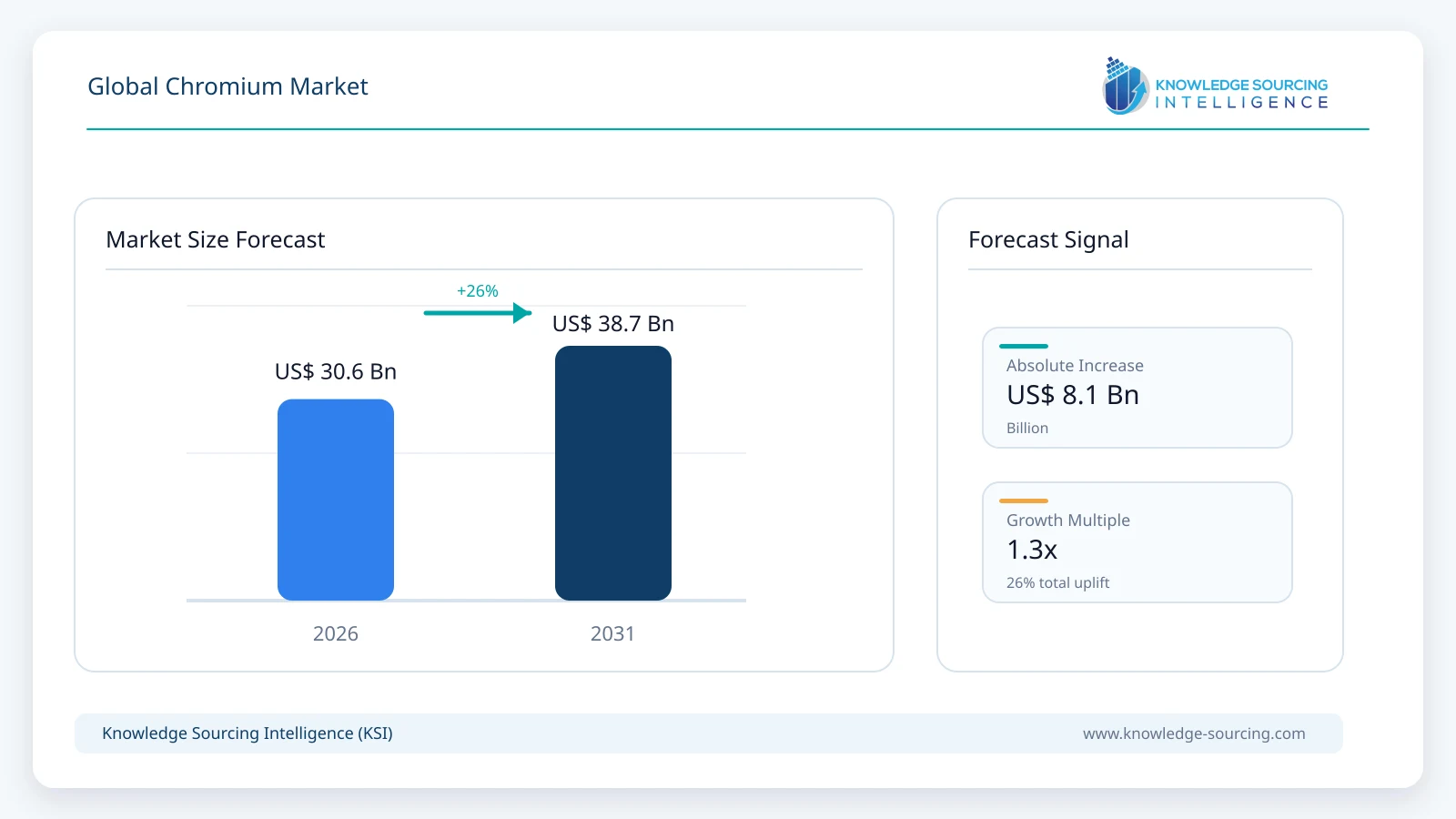
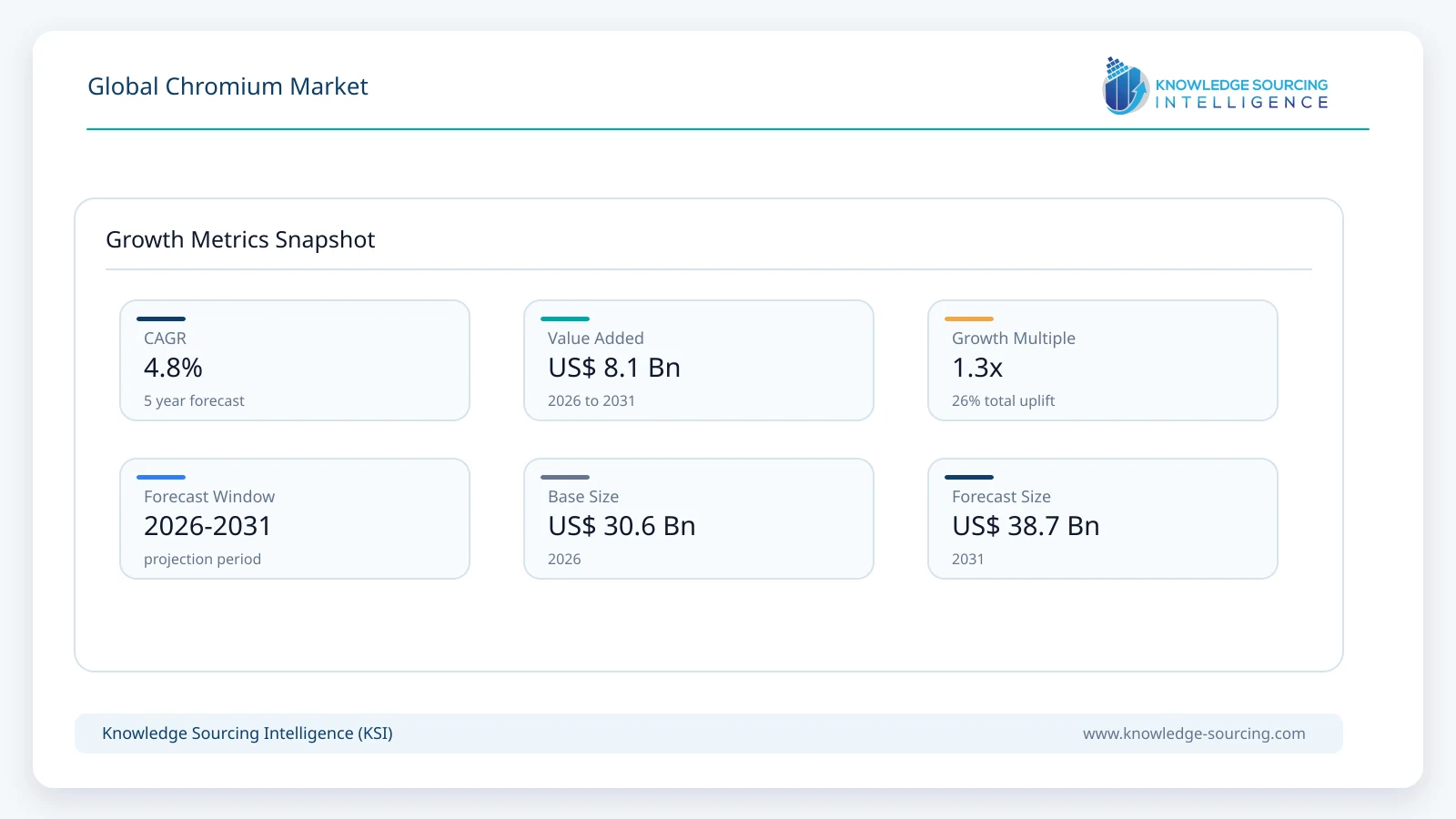
The global chromium market is forecast to grow at a CAGR of 4.8%, reaching USD 38.7 billion in 2031 from USD 30.6 billion in 2026.
Highlights:
- 1Stainless steel remains the principal demand anchor, making ferrochrome purchasing closely tied to stainless steel production volumes, furnace economics, and alloy specifications.
- 2Integrated supply chains are commercially valuable, particularly where producers control chromite resources, beneficiation, ferrochrome smelting, and logistics.
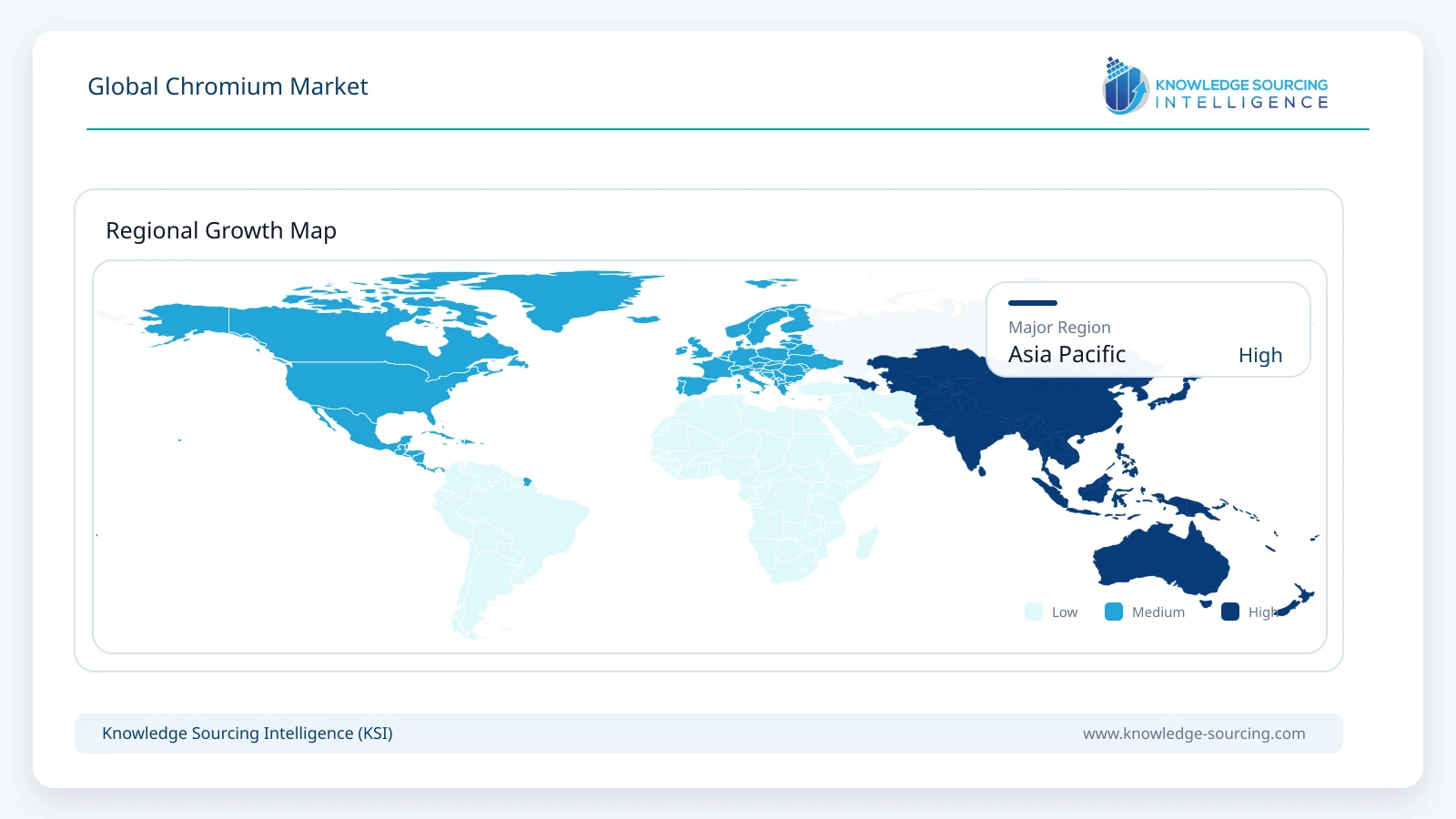
- 3Asia-Pacific is the central demand region, supported by large stainless steel, engineering, construction, automotive, and manufacturing industries, while China and India remain important consumption and processing centers.
- 4Low-emission ferrochrome is gaining commercial importance, particularly in Europe, where carbon accounting and trade policy are affecting the relative attractiveness of imported and domestically produced material.
- 5Chromium chemicals and electroplating face tighter regulatory scrutiny, especially for hexavalent chromium substances, increasing compliance costs and encouraging process substitution.
- 6South Africa's ferrochrome policy is becoming strategically important, with government measures addressing electricity tariffs, chrome ore exports, domestic beneficiation, and the competitiveness of local smelting.
The Chromium Market covers the commercial production, processing, refining, distribution, and consumption of chromite ore, ferrochrome or ferrochromium, chromium metal, chromium chemicals, and related chromium-bearing products. Demand spans upstream mining and beneficiation through ferroalloy smelting, chemical processing, specialty-metal production, and downstream manufacturing. The market is therefore closely connected with stainless steel, specialty alloys, aerospace, energy equipment, surface treatment, pigments, leather processing, refractories, and foundry operations.
Chromium is commercially important because its metallurgical properties are difficult to replace in several demanding applications. Chromium improves corrosion and oxidation resistance, contributes to hardness and wear resistance, and supports strength at elevated temperatures. The U.S. Geological Survey identifies chromium as an essential feedstock for stainless steel and superalloys and classifies it as a strategic and critical mineral for the United States.
The market is dominated by the relationship between chromite ore, ferrochrome, and stainless steel production. Most chromium consumed in steelmaking enters the furnace through ferrochrome, although chromium-containing scrap, chromium metal, and other feedstocks also contribute. Consequently, stainless steel output, furnace utilization, ferrochrome contract pricing, electricity costs, reductant availability, ore quality, and logistics have a direct influence on chromium procurement.
The buyer base is heterogeneous. Stainless steel producers purchase large volumes of ferrochrome under specifications covering chromium content, carbon, silicon, phosphorus, sulfur, sizing, and physical consistency. Specialty alloy manufacturers place greater emphasis on purity, trace elements, and predictable chemistry. Chemical producers require suitable chromium-bearing intermediates for compounds such as chromates and chromium oxides. Electroplating and surface-treatment companies have more stringent requirements concerning process consistency, worker protection, regulatory compliance, and substitution options.
Procurement decisions increasingly incorporate security of supply alongside unit price. Integrated miners and ferrochrome producers can reduce exposure to intermediate-market disruptions by controlling chromite resources, beneficiation, smelting, and logistics. Tata Steel, for example, operates an integrated chromite and ferroalloy value chain in India, with captive chromite mines and ferrochrome plants. Its Ferro Alloys and Minerals Division supplies ferrochrome in multiple grades and sizes, including customized specifications for steel producers.
Energy economics remain particularly important in ferrochrome. Smelting requires substantial electricity and reductants, making power tariffs, furnace utilization, ore characteristics, and recovery rates major determinants of production economics. South Africa illustrates this exposure. Government assessments in 2025 identified electricity costs and industrial competitiveness as major issues affecting the domestic ferrochrome industry, with policy intervention directed toward tariff realignment and beneficiation.
The market also has an important geographic imbalance. Chromite resources and ferrochrome production are concentrated in countries such as South Africa, Kazakhstan, India, Finland, and other producing jurisdictions, while major stainless steel consumption is concentrated in Asia and other industrial economies. This creates substantial cross-border movement of ore, ferrochrome, chromium chemicals, and finished stainless steel.
The United States remains structurally dependent on imports for chromium-bearing materials. USGS data indicate that the country consumed an estimated 4% of world chromite ore production in 2025 through imported chromite ore, chromium chemicals, ferrochromium, chromium metal, and stainless steel. U.S. chromium-material consumption, excluding stainless steel, was estimated at $720 million in 2025.
Market Drivers
Expansion of Stainless Steel Production and Consumption
Stainless steel provides the largest structural demand base for chromium because chromium is fundamental to corrosion resistance and therefore to the performance characteristics of stainless grades. Stainless steel producers do not simply purchase chromium as a commodity; they procure ferrochrome according to metallurgical requirements that determine final alloy chemistry.
The purchasing mechanism is therefore closely connected to stainless steel melt schedules. When mills increase production of chromium-intensive grades, ferrochrome requirements rise. Conversely, lower mill utilization can reduce ferrochrome demand quickly, even when downstream construction or engineering activity remains relatively stable.
This relationship creates a commercially important distinction between end-use demand and immediate chromium demand. A stainless steel producer may face strong long-term orders but defer ferrochrome purchases when inventories are high. Procurement teams therefore monitor steel order books, inventory positions, furnace utilization, ferrochrome prices, and anticipated alloy requirements simultaneously.
USGS identifies stainless and heat-resisting steel producers as the leading U.S. consumers of ferrochromium, confirming the direct relationship between chromium demand and steelmaking.
For suppliers, the implication is clear: reliable chemistry, consistent sizing, predictable delivery schedules, and supply continuity can matter as much as headline pricing.
Increasing Demand for Corrosion- and Heat-Resistant Alloys
Chromium consumption extends beyond conventional stainless steel. Superalloys and specialty alloys require chromium where high-temperature oxidation resistance, corrosion resistance, and mechanical stability are important.
Aerospace engines, power-generation equipment, chemical-processing systems, industrial furnaces, and other demanding applications can require alloy systems with tightly controlled compositions. These buyers typically purchase smaller volumes than stainless steel mills but place greater emphasis on purity, trace-element control, certification, and consistency.
This creates an opportunity for higher-value chromium products. Suppliers capable of moving beyond conventional ferrochrome toward enriched ferrochrome, refined ferroalloys, chromium metal, and other specialty materials can access customers with different purchasing criteria and potentially higher technical barriers.
Outokumpu's strategy illustrates this direction. Its 2025–2030 strategy includes increasing value from its chrome mine and ferrochrome operations by moving toward higher-value chromium products, while its 2026 program includes development of low-CO? enriched ferrochrome and chromium metal.
Government Support for Domestic Mineral Beneficiation
Countries with substantial chromite resources are placing greater emphasis on domestic processing rather than exporting unprocessed ore. The commercial rationale is straightforward: mining generates value, but beneficiation and ferrochrome production can create additional industrial activity, employment, energy demand, infrastructure utilization, and export value.
South Africa has made this policy direction explicit. In June 2025, the government approved measures involving tariff realignment for ferrochrome, export controls on chrome ore, development of a chrome ore export tax, and expansion of incentives for smelters in Special Economic Zones.
The country's 2025 Critical Minerals and Metals Strategy similarly identifies competitive electricity tariffs, chrome ore export instruments, ferroalloy incentives, dedicated rail infrastructure, and increased domestic stainless steel production as strategic interventions.
For producers, these measures can alter the economics between ore exports and domestic ferrochrome conversion. For international buyers, they can increase the importance of long-term supply arrangements and geographic diversification.
Demand for Lower-Carbon Chromium Supply
Carbon intensity is becoming a procurement consideration in markets where stainless steel and ferrochrome cross borders and buyers face environmental reporting requirements.
Ferrochrome is electricity-intensive, so the carbon profile of power generation can materially affect the embedded emissions of the finished product. Producers using lower-carbon electricity, efficient furnaces, improved recovery systems, and integrated logistics can therefore develop a commercial advantage with buyers that track product-level emissions.
Outokumpu reported solid demand for its European low-emission ferrochrome in 2025 and continued expansion of its low-emission product portfolio. Its Kemi mine and Tornio ferrochrome operations form an integrated production chain in Finland.
Tata Steel has also emphasized environmental performance in its ferrochrome operations, including an Environmental Product Declaration and alignment of direct emissions with global benchmarks and EU CBAM considerations.
Market Restraints and Challenges
High Electricity and Smelting Costs
Ferrochrome production depends heavily on electricity, making producers vulnerable to power tariffs, availability, grid reliability, and carbon-related energy costs.
South Africa's ferrochrome industry demonstrates the scale of this issue. Government reporting in 2025 stated that 30 of the country's 59 chrome furnaces had either been shut down or placed under care and maintenance, while a ministerial task team examined measures to revive the smelting sector.
High energy costs can push producers toward reduced furnace utilization rather than immediate price increases because customers can switch among geographically diverse suppliers. Producers therefore face a difficult balance between maintaining operating rates and protecting margins.
Mitigation increasingly involves energy-efficiency projects, furnace modernization, waste-heat recovery, alternative power arrangements, improved burden preparation, and higher recovery of chromium from fines and slags.
Concentrated Supply and Geographic Disruption Risk
Chromium supply is geographically concentrated. A disruption at a major mining or smelting region can affect international availability, freight flows, contract negotiations, and inventory requirements.
Glencore's 2025 production provides a clear example. Attributable ferrochrome production fell 63% year over year to 436,000 tonnes following suspension of operations at its Boshoek and Wonderkop smelters, while underlying attributable chrome ore production remained broadly in line with the prior year.
The episode demonstrates that mine availability and ferrochrome availability are not interchangeable. Ore can remain available while downstream smelting capacity declines. Buyers therefore need to assess both upstream resource security and operating furnace capacity.
Environmental and Occupational Regulation
Certain chromium compounds, particularly hexavalent chromium substances, face substantial regulatory scrutiny because of their hazardous properties. This affects chemical manufacturers, electroplating companies, surface-treatment operators, and downstream users.
Under the European Union's REACH framework, chromium trioxide and several other chromium(VI) compounds are included in the authorization system. ECHA's regulatory work also covers potential restrictions on certain chromium(VI) oxides, oxyacids, and salts.
For buyers, regulatory compliance can influence material selection, process design, worker-protection systems, documentation, and supplier qualification. Producers that depend heavily on regulated chromium compounds may need to invest in containment, monitoring, substitution programs, or alternative chemistries.
Logistics and Freight Exposure
Chromium products often travel across long distances between mines, smelters, ports, and stainless steel mills. Ferrochrome is also a relatively energy-intensive product to manufacture, meaning freight is only one part of the delivered-cost equation.
Rail availability, port capacity, shipping rates, border procedures, and inland transport can therefore alter procurement economics. Kazakhstan's ERG, for example, identifies export markets across Japan, China, Korea, and Europe and maintains mining, processing, ferroalloy, and logistics capabilities across multiple regions.
Supply-chain resilience consequently favors producers with dependable transport networks and buyers with multiple qualified suppliers.
Major Segment Analysis
Ferrochrome/Ferrochromium
Ferrochrome is the most commercially important product segment because it provides the principal chromium input for stainless steelmaking. Its importance arises from the metallurgical efficiency of adding chromium through a ferroalloy rather than using pure chromium metal for conventional stainless grades.
The segment operates through a tightly linked chain: chromite mining, ore beneficiation, agglomeration where required, submerged-arc-furnace smelting, crushing and sizing, quality testing, storage, and delivery to steel mills. Each stage affects the final economics.
Buyer requirements differ by steel grade and furnace practice. Stainless steel mills typically specify chromium concentration, carbon, silicon, phosphorus, sulfur, particle size, and physical characteristics. Lower-impurity and customized grades can command differentiated commercial positioning because they reduce the need for downstream chemistry correction.
Tata Steel's Ferro Alloys and Minerals Division provides an example of this specification-driven model. Its ferrochrome portfolio includes generic, low-phosphorus, low-silicon, and ultra-low-silicon products in different sizes and packaging formats.
Energy remains the central cost variable. Producers with efficient furnaces, favorable electricity arrangements, high ore recovery, integrated mining assets, and effective logistics can compete more consistently across commodity cycles.
The segment is also moving toward greater product differentiation. European stainless steel producers are placing more emphasis on low-emission ferrochrome, while specialty alloy producers require higher-purity chromium-bearing inputs. Outokumpu reported 395,000 tonnes of ferrochrome deliveries in 2025 and stated that its ferrochrome strategy includes moving up the chromium value ladder.
The commercial implication for 2026–2031 is that ferrochrome competition is unlikely to depend solely on volume. Cost position, carbon intensity, ore security, product consistency, logistics, and proximity to major steelmaking customers will increasingly determine supplier attractiveness.
Regional Analysis
North America
North American chromium demand is concentrated in stainless steel, specialty steel, aerospace, defense, industrial equipment, chemicals, and surface-treatment applications. The region has significant downstream consumption but relies heavily on imported chromium-bearing materials.
The United States considers chromium a strategic and critical mineral, and USGS data show substantial dependence on imported chromite ore, ferrochromium, chromium chemicals, chromium metal, and stainless steel.
Buyer behavior is therefore shaped by supply security. U.S. consumers have an incentive to diversify suppliers, maintain strategic inventories, and establish relationships with producers that can meet consistent chemical specifications.
Canada has relevance through stainless steel and industrial materials supply chains, while Mexico provides a manufacturing base connected to North American automotive, industrial, and appliance production.
The region also offers an opportunity for higher-value chromium materials. Outokumpu announced a USD 45 million U.S. pilot plant investment dedicated to chromium metal and enriched ferrochrome, targeting applications including defense and aerospace.
Europe
Europe combines mature stainless steel demand with strict environmental and chemical regulation. The region has limited domestic chromite production, with Finland hosting the European Union's only chrome mine at Kemi, operated by Outokumpu.
European buyers increasingly evaluate ferrochrome through both metallurgical and environmental criteria. Low-emission production can improve supplier attractiveness because carbon costs and disclosure requirements influence the economics of imported materials.
The EU's Carbon Border Adjustment Mechanism entered its definitive regime in 2026 and covers iron and steel among the regulated sectors. Although CBAM does not cover every chromium product directly, its treatment of steel-related trade has implications for chromium-bearing inputs incorporated into European steel supply chains.
Chemical and electroplating applications face another regulatory layer. ECHA continues to administer authorization processes for chromium trioxide and related substances, increasing the compliance burden for industrial users.
Asia-Pacific
Asia-Pacific represents the principal industrial demand center because of its extensive stainless steel, engineering, construction, automotive, chemical, and manufacturing base.
China is a major stainless steel producer and therefore an important consumer of ferrochrome and chromium-bearing raw materials. Japan and South Korea have sophisticated stainless steel and specialty-alloy industries with demanding procurement standards.
India combines mining, ferrochrome production, stainless steelmaking, and export capabilities. Tata Steel operates chromite mines and ferrochrome plants in Odisha, while its ferrochrome products serve domestic and broader industrial customers.
Kazakhstan has a particularly strong integrated position. ERG's Kazchrome operations combine chrome mining and ferroalloy production, with Donskoy GOK listed at 5.64 million tonnes per year of chrome ore capacity and ferroalloy facilities in Aktobe and Aksu. Its principal markets include China, Japan, Korea, and Europe.
The region's primary constraint is exposure to steel cycles, electricity costs, freight rates, and trade-policy changes. Producers with integrated resources and flexible export channels are better positioned to manage these variables.
Middle East and Africa
South Africa remains the defining chromium supply market in Africa because of its large chromite resource base and established ferrochrome industry. Its position is supported by mining infrastructure and an existing smelting ecosystem, but electricity costs and industrial competitiveness have weakened the economics of local ferrochrome production.
The South African government's 2025 policy response aims to retain more chrome value domestically through export controls, possible export taxation, tariff interventions, and incentives for beneficiation.
For the Middle East, demand is primarily downstream and connected to construction, engineering, energy infrastructure, specialty metals, and industrial manufacturing. Saudi Arabia and the United Arab Emirates can become important trading and distribution points because of their logistics infrastructure and industrial diversification programs.
The main regional opportunity is therefore not only consumption but also the development of trading, processing, and industrial supply-chain links between African producers and Asian or European customers.
South America
South America's chromium market is smaller than Asia-Pacific, Europe, or Africa, with demand centered on stainless steel, foundry operations, specialty materials, chemicals, and industrial manufacturing.
Brazil provides the region's largest industrial base and has established mining and metallurgical capabilities. Argentina and other markets provide additional demand from engineering and manufacturing.
The main limitation is the comparatively smaller downstream stainless steel and ferroalloy ecosystem. Consequently, regional buyers can remain exposed to imported ferrochrome and chromium chemicals, while suppliers must evaluate freight economics carefully before targeting smaller markets.
Competitive Landscape
The chromium industry contains a mixture of integrated mining-to-ferroalloy producers, diversified resource companies, stainless steel manufacturers with captive chromium assets, and specialized ferroalloy suppliers.
The competitive structure is therefore determined less by branding and more by resource ownership, cost position, energy access, metallurgical efficiency, product quality, logistics, and customer relationships.
The companies included in the competitive landscape are Samancor Chrome, Glencore, Tata Steel, Assmang Proprietary Limited, CRONIMET, Balasore Alloys Limited, Eurasian Resources Group (ERG), Outokumpu, and Yildirim Group.
Integrated producers have an advantage where chromite resources feed their own beneficiation and ferrochrome operations. This structure can reduce exposure to spot ore markets and improve production planning. Tata Steel's integrated chromite-to-ferrochrome operations illustrate this approach, while ERG's Kazchrome combines substantial chrome ore resources with ferroalloy plants.
Diversified mining groups can compete through portfolio scale and geographic reach. Glencore's ferroalloy operations demonstrate both the potential scale and the risks associated with large integrated assets. Its 2025 attributable ferrochrome production declined sharply following the suspension of two South African smelters, while chrome ore production remained comparatively stable.
Outokumpu occupies a different competitive position because chromium supply is directly connected to its stainless steel business. Its Kemi mine supplies its ferrochrome operations, which are located beside its Tornio stainless steel facilities. This integration links chromium procurement directly to downstream steel production.
Product differentiation is becoming more important. Suppliers can distinguish themselves through low-emission ferrochrome, refined grades, controlled impurities, customized sizing, higher chromium concentration, and improved traceability.
Technology investment also provides a route toward differentiation. Outokumpu is developing technology to produce enriched ferrochrome and chromium metal with lower carbon intensity, while Tata Steel has invested in ferrochrome process improvements, including recovery of value from fines and more efficient processing routes.
Competition during 2026–2031 is therefore expected to emphasize cost discipline, resource security, emissions performance, higher-value products, and geographic flexibility rather than capacity expansion alone.
Recent Developments
August 2026: Glencore’s 2026 Half-Year Report confirmed continued operational performance across its portfolio, with H1 results reflecting commodity-market conditions and ongoing ferroalloy operations.
July 2026: Outokumpu reported that its low-CO?-enriched ferrochrome and chromium-metal technology was progressing toward industrialization, with first patent applications covering key process elements published during July. The development strengthens its strategy of producing higher-value chromium materials.
July 2026: Glencore reported H1 2026 attributable chrome ore production of 1.647 million tonnes, down 4% year-on-year, citing operating conditions during the reporting period.
November 2025: Tata Steel signed an Asset Transfer Agreement with Indian Metals & Ferro Alloys Limited for the sale of its ferro alloy plant at Jajpur, Odisha, for a base consideration of Rs. 610 crore, subject to approvals. The transaction indicates portfolio optimization within India's ferroalloy industry.
Regulatory and Policy Environment
Chromium regulation differs substantially by product and application. Chromite ore and ferrochrome are primarily influenced by mining, environmental, trade, energy, and industrial policies, while chromium chemicals and surface-treatment applications face additional chemical-safety requirements.
South Africa is implementing one of the most commercially consequential policy approaches. In June 2025, Cabinet approved chrome ore export controls requiring permits through the International Trade Administration Commission, alongside work on a chrome ore export tax and expanded incentives for ferrochrome smelters.
The country's 2025 Critical Minerals and Metals Strategy also calls for competitive electricity tariffs, ferroalloy export incentives, potential dedicated rail corridors, stronger domestic stainless steel demand, and review of carbon-tax and CBAM implications for ferrochrome.
In Europe, chemical regulation has a more direct effect on chromium compounds. Chromium trioxide is included in the EU REACH authorization framework, while ECHA maintains regulatory processes covering several chromium(VI) substances.
These requirements affect electroplating, surface treatment, chemical production, and industrial users. Compliance may require authorization, exposure controls, monitoring, substitution assessments, documentation, and process modifications.
Trade-related carbon policy is also becoming relevant. The EU's CBAM definitive regime applies to selected goods including iron and steel, creating additional carbon-cost considerations for carbon-intensive international supply chains.
For chromium suppliers, the practical implication is that environmental performance increasingly becomes part of commercial qualification. A supplier may need to provide emissions information, product documentation, traceability data, and evidence of responsible production in addition to conventional chemical specifications.
Outlook and Strategic Implications
The 2026–2031 chromium market outlook will be determined primarily by stainless steel production, ferrochrome economics, regional beneficiation policies, energy costs, supply concentration, and environmental requirements.
Stainless steel should remain the principal demand anchor. This makes chromium demand sensitive to industrial production, construction activity, automotive manufacturing, food-processing equipment, energy infrastructure, and capital goods investment. Procurement teams are likely to maintain closer alignment between stainless steel production plans and ferrochrome inventories to reduce working-capital exposure.
The strongest supply-side opportunity lies in integrated and cost-efficient production. Producers controlling chromite resources, beneficiation, smelting, and logistics can reduce exposure to intermediate-market volatility. However, integration alone will not guarantee competitiveness. Electricity cost, furnace productivity, recovery rates, carbon intensity, and freight economics will remain decisive.
Low-carbon production is likely to become a more important purchasing criterion, particularly for European customers. Outokumpu's investment in enriched ferrochrome and chromium metal demonstrates a move toward higher-value products rather than reliance solely on conventional ferrochrome volumes.
South Africa's policy direction may reshape global chrome trade. If export controls, taxation, electricity interventions, and beneficiation incentives materially change the relative economics of ore and ferrochrome, international buyers may need to adjust sourcing strategies. The resulting effect could extend beyond South African producers to suppliers in Kazakhstan, India, Finland, and other producing countries.
Procurement diversification will remain important. Buyers are likely to favor suppliers capable of maintaining delivery consistency through energy disruptions, furnace outages, shipping constraints, and policy changes. Long-term contracts can become more attractive where the cost of production interruption exceeds the savings available from short-term spot purchasing.
Chromium chemicals represent a different strategic pathway. Regulatory scrutiny of hexavalent chromium substances will continue to influence electroplating and chemical applications. Companies operating in these segments will need to evaluate authorized uses, containment requirements, substitution technologies, and customer compliance obligations.
Technology investment will increasingly focus on resource efficiency and product upgrading. Recovery of chromium from fines, slag, and other secondary streams can improve material yield. Tata Steel's reported commissioning of facilities for metal recovery from ferrochrome-related material illustrates the commercial relevance of these initiatives.
For producers, the strategic priority should be to protect the cost position while developing differentiated products. For stainless steel manufacturers, secure access to qualified chromium feedstock remains central to production continuity. For specialty alloy producers, higher-purity chromium products can reduce dependence on conventional ferrochrome. For chemical and electroplating companies, regulatory compliance and process substitution will increasingly influence procurement.
The competitive environment will consequently favor companies that can combine resource security, efficient processing, reliable logistics, environmental performance, and technical product quality. The market should remain closely tied to global steel cycles, but its supply-side economics will increasingly be shaped by national beneficiation policies and carbon-related trade requirements.
Overall, the chromium industry's commercial trajectory through 2031 will depend less on a single demand event and more on the interaction between stainless steel consumption, constrained and geographically concentrated supply, energy economics, downstream specialization, and regulatory requirements. Companies that maintain secure raw-material access while improving recovery, emissions performance, product quality, and logistics flexibility should be better positioned to defend margins and capture higher-value applications.
Approved data-source basis: This analysis relies on official information from the U.S. Geological Survey, South African Government, European Chemicals Agency, European Commission, Tata Steel, Glencore, Outokumpu, and Eurasian Resources Group. No syndicated market-research source has been used.
Additional assumption: Because no market size or CAGR was supplied in the input, this RD deliberately excludes an invented market valuation or growth rate. The 2026–2031 outlook is qualitative and evidence-led, based on verified industry, regulatory, production, investment, and policy developments available through September 2026.
Chromium Market Scope:
| Report Metric | Details |
|---|---|
| Total Market Size in 2026 | USD 30.6 billion |
| Total Market Size in 2031 | USD 38.7 billion |
| Forecast Unit | Billion |
| Growth Rate | 4.8% |
| Study Period | 2021 to 2031 |
| Historical Data | 2021 to 2024 |
| Base Year | 2025 |
| Forecast Period | 2026 – 2031 |
| Segmentation | Product Type, Application, Geography |
| Companies |
|
Market Segmentation
By Product Type
By Application
By Geography
Table of Contents
1. EXECUTIVE SUMMARY
2. MARKET SNAPSHOT
2.1. Market Overview
2.2. Market Definition
2.3. Scope of the Study
2.4. Market Segmentation
3. BUSINESS LANDSCAPE
3.1. Market Drivers
3.2. Market Restraints
3.3. Market Opportunities
3.4. Porter’s Five Forces Analysis
3.5. Industry Value Chain Analysis
3.6. Policies and Regulations
3.7. Strategic Recommendations
4. TECHNOLOGICAL OUTLOOK
5. GLOBAL CHROMIUM MARKET BY PRODUCT TYPE
5.1. Introduction
5.2. Chromite Ore
5.3. Ferrochrome/Ferrochromium
5.4. Chromium Metal
5.5. Chromium Chemicals
5.6. Others
6. GLOBAL CHROMIUM MARKET BY APPLICATION
6.1. Introduction
6.2. Stainless Steel
6.3. Superalloys and Specialty Alloys
6.4. Chromium Chemicals
6.5. Paints and Pigments
6.6. Electroplating and Surface Treatment
6.7. Leather Processing
6.8. Refractory and Foundry Applications
6.9. Others
7. GLOBAL CHROMIUM MARKET BY GEOGRAPHY
7.1. Introduction
7.2. North America
7.2.1. United States
7.2.2. Canada
7.2.3. Mexico
7.3. South America
7.3.1. Brazil
7.3.2. Argentina
7.3.3. Others
7.4. Europe
7.4.1. Germany
7.4.2. France
7.4.3. United Kingdom
7.4.4. Finland
7.4.5. Spain
7.4.6. Others
7.5. Middle East and Africa
7.5.1. South Africa
7.5.2. Saudi Arabia
7.5.3. United Arab Emirates
7.5.4. Others
7.6. Asia-Pacific
7.6.1. China
7.6.2. India
7.6.3. Japan
7.6.4. South Korea
7.6.5. Kazakhstan
7.6.6. Indonesia
7.6.7. Thailand
7.6.8. Others
8. COMPETITIVE ENVIRONMENT AND ANALYSIS
8.1. Major Players and Strategy Analysis
8.2. Market Share Analysis
8.3. Mergers, Acquisitions, Agreements, and Collaborations
8.4. Competitive Dashboard
9. COMPANY PROFILES
9.1. Samancor Chrome
9.2. Glencore
9.3. Tata Steel
9.4. Assmang Proprietary Limited
9.5. CRONIMET
9.6. Balasore Alloys Limited
9.7. Eurasian Resources Group (ERG)
9.8. Outokumpu
9.9. Yildirim Group
10. APPENDIX
10.1. Currency
10.2. Assumptions
10.3. Base and Forecast Years Timeline
10.4. Key Benefits for Stakeholders
10.5. Research Methodology
10.6. Abbreviations
LIST OF FIGURES
LIST OF TABLES
Navigate
Trusted by the world's leading organizations











