
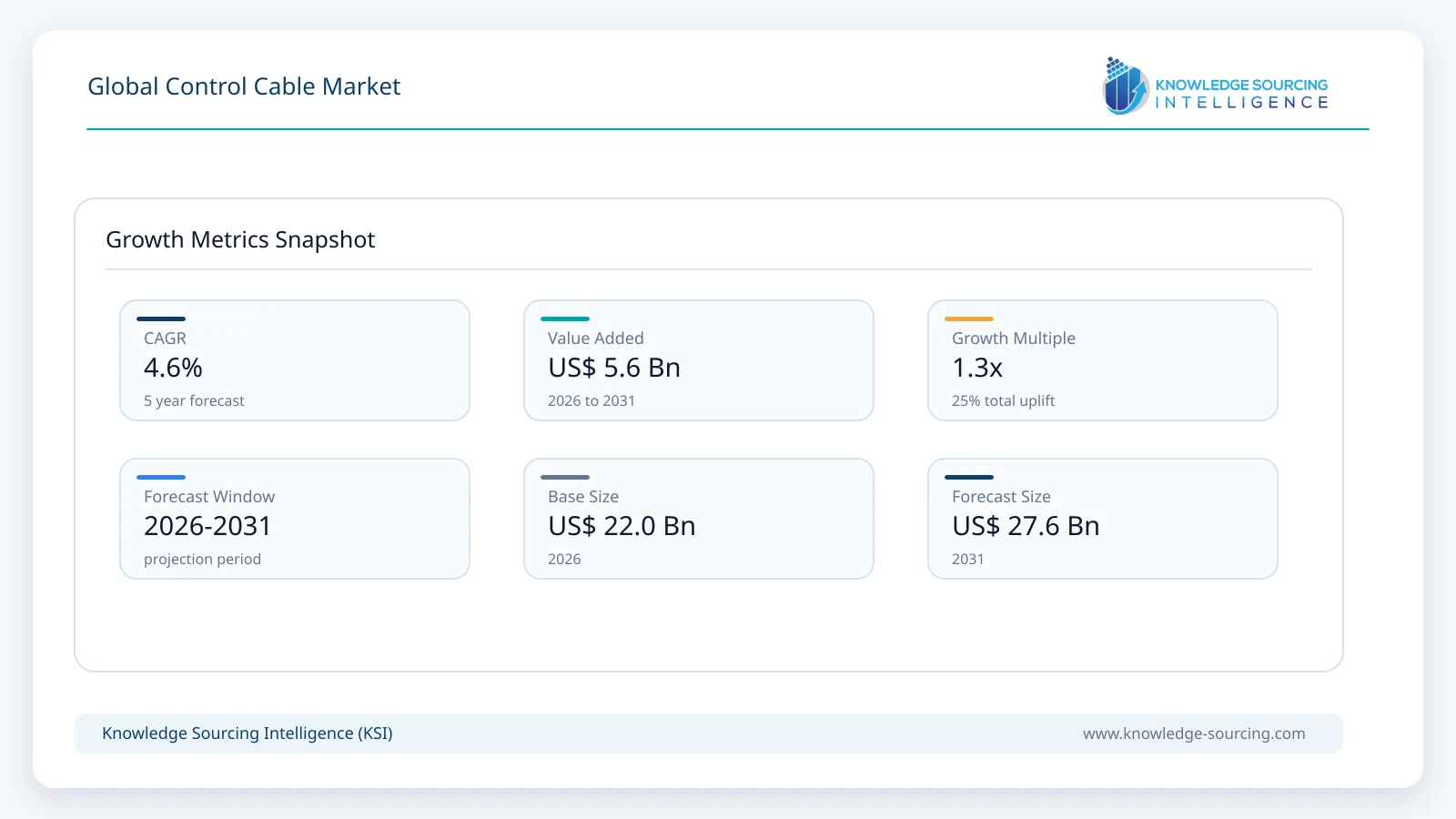
The global control cable market is forecast to grow from USD 22.00 billion in 2026 to USD 27.60 billion in 2031, representing a CAGR of 4.64% over the forecast period.
Highlights:
- 1Screened control cables account for approximately 58.0% of global control cable revenue in 2026.
- 2PVC-jacketed control cables represent approximately 52.0% of global 2026 market revenue.
- 3Fixed and occasional-flex control cables account for approximately 64.0% of global 2026 market revenue.
- 4Industrial automation and manufacturing applications represent approximately 39.0% of global control cable revenue in 2026.
- 5Asia Pacific accounts for approximately 45.0% of global control cable revenue in 2026.
- 6Demand is increasingly shaped by higher flex life, electromagnetic compatibility, oil and chemical resistance, halogen-free construction and compatibility with robotic and automated machinery.
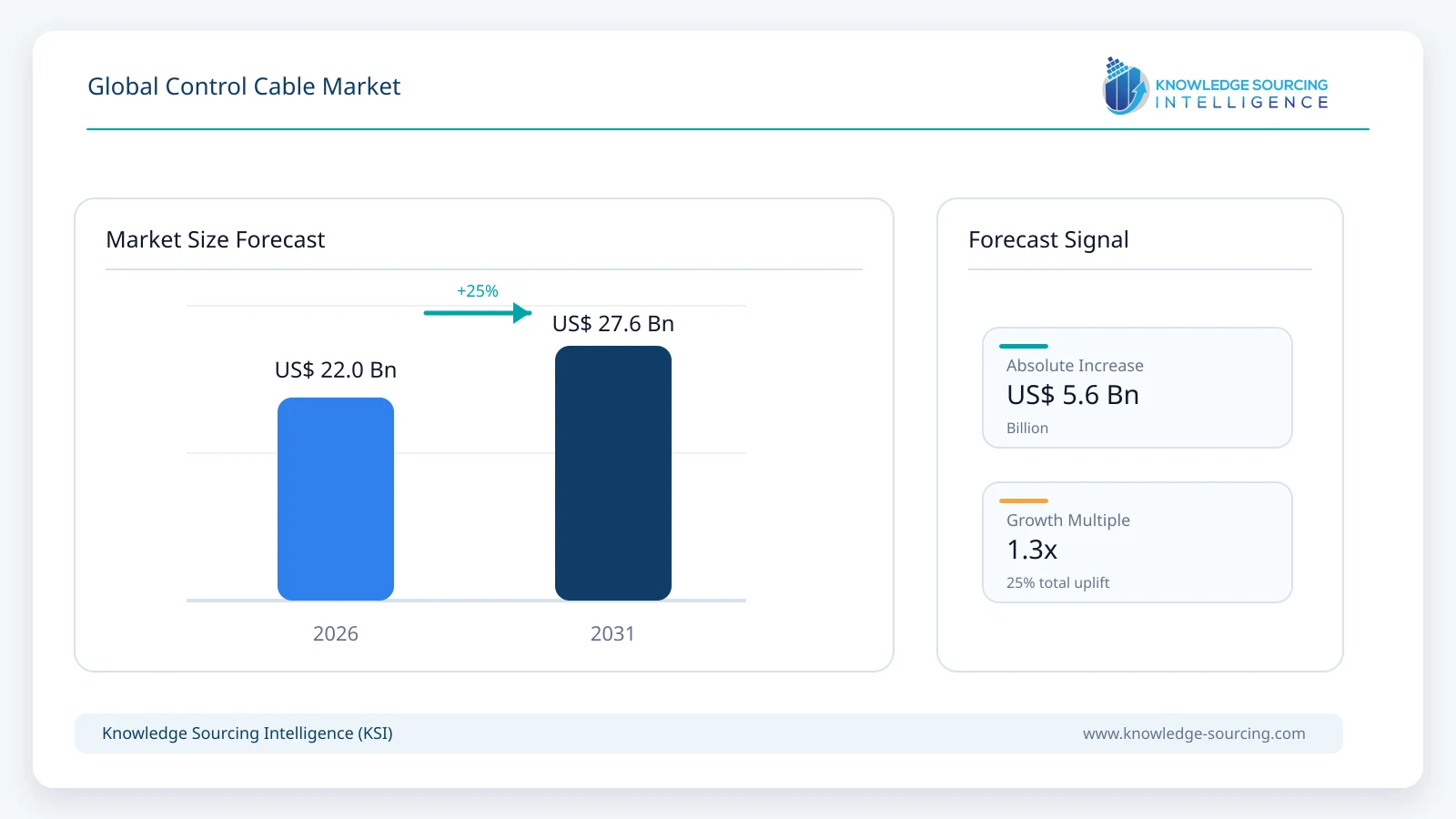
The market is supported by a large installed base of industrial machinery, conveyors, packaging equipment, process plants, utilities and automated production lines. Prysmian's global cable revenue exceeded EUR 19 billion in 2025, while its Industrial & Construction business continued to post organic growth in 2026. Control cable represents only a portion of these diversified cable portfolios, but the presence of large global suppliers and numerous specialist automation-cable companies supports a market above USD 20 billion.
Growth is driven more by industrial automation intensity and replacement demand than by greenfield manufacturing alone. Modern machinery uses more sensors, variable-speed drives, safety circuits and distributed control functions, increasing cable density. At the same time, control cables used in robotics and drag chains require more expensive conductor stranding, shielding and jacket materials than conventional static cable, lifting average revenue per meter.
The forecast through 2031 assumes steady manufacturing investment, continued expansion of robotics and automated material handling, infrastructure modernization and replacement of older cable in harsh industrial environments. Growth remains moderate because copper and polymer pricing can fluctuate, mature fixed-installation applications are replacement-driven, and industrial Ethernet or hybrid cabling can absorb selected control functions.
Control Cable Market Trends
Continuous-Flex Control Cable Becomes a Higher-Value Segment
Automation systems increasingly require cables to survive millions of bending, torsion and drag-chain cycles. LAPP expanded its OLFLEX portfolio in April 2026 with new robotics and drag-chain products, while igus and SAB Bröckskes continue to extend control-cable families designed for high-cycle motion. These products use finer conductor stranding, specialized shielding and PUR or TPE jackets, increasing unit value compared with conventional static control cable.
EMC Performance Drives Screened-Cable Adoption
Modern factories contain variable-frequency drives, servo systems, switching power electronics and high-density communications that increase electromagnetic interference. Screened control cables are therefore becoming more important where reliable low-voltage control signals must coexist with power equipment. Copper braids, foil screens and individually shielded pairs are increasingly specified in machinery and process-control applications.
Halogen-Free and PFAS-Free Materials Gain Attention
Industrial customers are tightening material requirements around fire performance, worker safety and environmental compliance. SAB Bröckskes markets PFAS-free control-cable constructions, while igus and other automation-cable suppliers continue to expand halogen-free TPE and PUR ranges. Material compliance is becoming a differentiator alongside flex life and oil resistance.
Machine Builders Demand Multi-Regional Approvals
OEM machine builders increasingly sell the same equipment into Europe, North America and Asia. This raises demand for control cables carrying UL, CSA, CE, CPR and related approvals within one construction. HELUKABEL and LAPP maintain extensive multi-standard ranges specifically to reduce the need for region-specific cable redesign.
Hybridization Changes the Boundary of Control Cabling
Industrial Ethernet, single-pair Ethernet and hybrid power-data cables are absorbing some functions historically performed by discrete control wiring. Amphenol TPC introduced a new industrial single-pair Ethernet portfolio in 2026. This creates both a substitution risk for basic control cable and an opportunity for suppliers that can combine control, data and motion requirements in engineered cable systems.
Global Control Cable Market Segment Analysis
By Shielding
Screened Control Cable
Screened control cables are estimated at approximately USD 12.76 billion in 2026. The segment is the largest revenue pool because electromagnetic compatibility is increasingly important in factories containing drives, motors, switching equipment, sensors and high-speed data systems. Screened constructions use foil, copper braid or combined shielding to reduce electromagnetic interference and improve signal integrity in control circuits. The additional conductor, shielding and manufacturing content also raises average selling prices relative to comparable unscreened cable. Prysmian, HELUKABEL, LAPP, igus, SAB Bröckskes and Amphenol TPC all maintain screened control-cable ranges for industrial machinery, robotics and continuous-motion applications.
By Jacket Material
PVC
PVC-jacketed control cable is estimated at approximately USD 11.44 billion in 2026. PVC remains the largest jacket material because it provides a favorable balance of cost, flame resistance, processability and availability for fixed and moderate-flex applications. It is widely used in switch cabinets, conveyors, production lines, machine tools and general industrial control circuits. PUR and TPE command higher value in demanding drag-chain, oil-resistant and robotic applications, but the installed base and lower cost of PVC keep it dominant in conventional machinery. Fire-safety requirements are also increasing demand for low-smoke and halogen-free alternatives in selected infrastructure and enclosed-building applications.
By Motion Requirement
Fixed and Occasional Flex
Fixed and occasional-flex control cables are estimated at approximately USD 14.08 billion in 2026. Most industrial control wiring remains installed in cable trays, conduits, machine panels or equipment runs where movement is limited after installation. These applications consume large cable volumes across factories, utilities, buildings and infrastructure while using less expensive constructions than continuous-flex drag-chain cable. Dynamic robotics and automated handling systems are growing faster, but their installed base is smaller. The fixed and occasional-flex category therefore remains the largest market segment even as high-flex applications capture a growing share of technology development and supplier margins.
By End User
Industrial Automation and Manufacturing
Industrial automation and manufacturing applications are estimated at approximately USD 8.58 billion in 2026. The segment is the largest end-use market because control cable is a basic physical layer connecting PLCs, relays, safety systems, sensors, actuators, drives and machinery across production environments. Automotive plants, packaging lines, food and beverage facilities, machine builders, electronics manufacturing and material-handling systems all use substantial quantities of multi-core control cable. Increasing robot density and distributed sensing raise cable requirements per production line, while replacement demand remains steady because oil, heat, repeated flexing and mechanical abrasion gradually degrade installed cable.
By Geography
Asia Pacific
Asia Pacific is estimated at approximately USD 9.90 billion in 2026. The region combines the world's largest manufacturing base with extensive machinery production, automotive assembly, electronics manufacturing and infrastructure investment. China, Japan, South Korea, India and Southeast Asia are major users of industrial automation cable, while regional manufacturers compete alongside Prysmian, LAPP, HELUKABEL and other global suppliers.
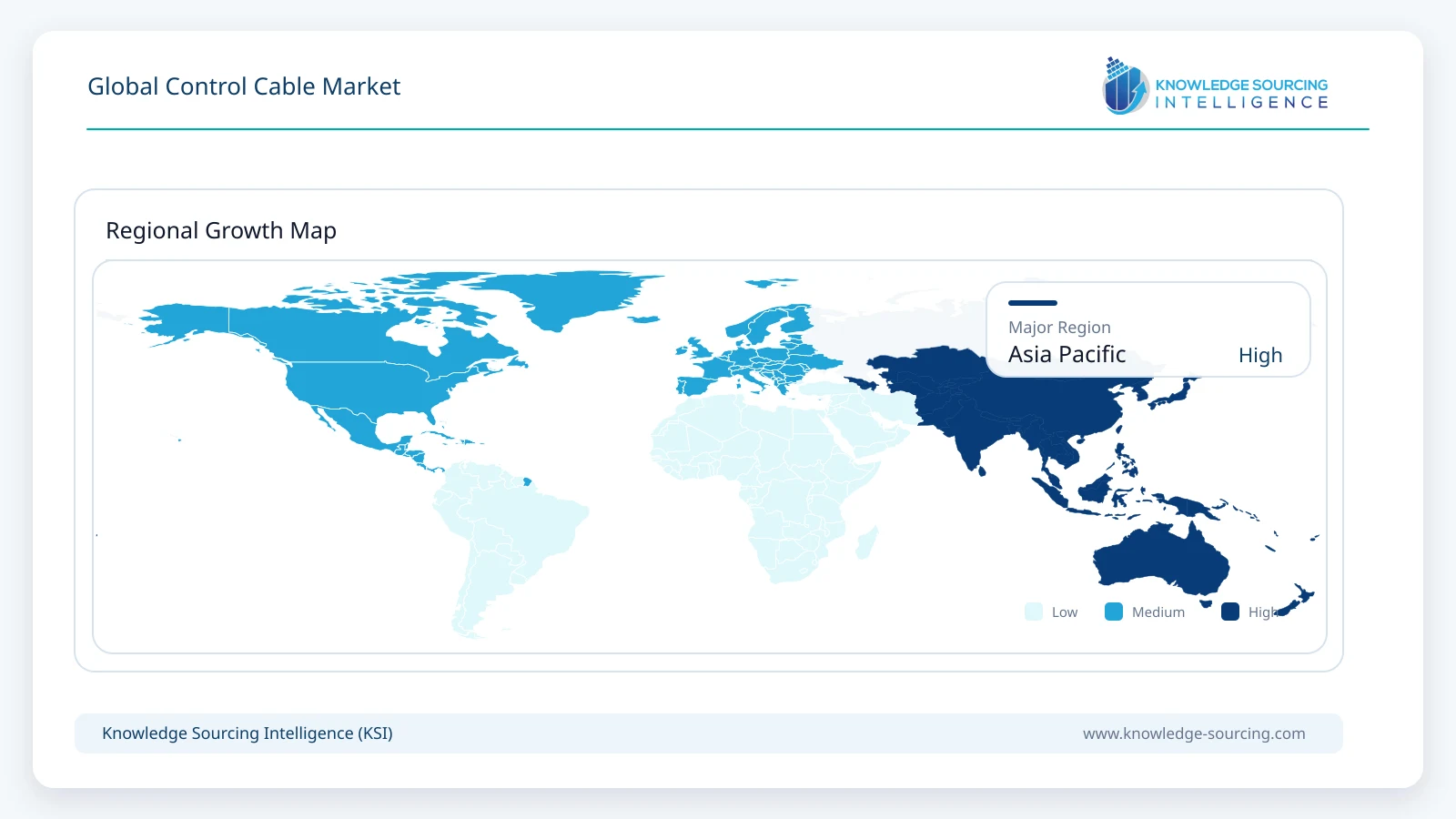
Growth is supported by factory modernization, robotics, renewable-energy equipment manufacturing and expansion of local machine-building industries. Asia Pacific is expected to retain the largest regional share through 2031 despite mature replacement demand in Europe and North America.
Market Drivers
Expansion of Industrial Automation
More automated machines increase the number of sensors, actuators, control circuits and safety devices that require physical wiring. Control-cable demand therefore rises with automation intensity even when factory floor space remains unchanged.
Growth of Robotics and Material Handling
Robots, gantries, conveyors, automated warehouses and packaging machines require flexible, abrasion-resistant cable capable of repeated motion. These applications support higher-value continuous-flex control cable.
Infrastructure and Utility Modernization
Substations, water systems, transportation infrastructure and renewable-energy facilities use control cable for switching, monitoring and protection. Modernization projects create steady replacement and expansion demand.
Higher Reliability Requirements
Unplanned cable failure can stop production. Industrial users increasingly specify oil-resistant, flame-retardant, shielded and mechanically robust constructions to extend service life and reduce downtime.
Global Machine Exports
Machine builders seek cable products carrying multiple regional approvals so the same equipment design can be exported across markets. This favors suppliers with broad certification portfolios and global distribution.
Market Restraints
Copper Price Volatility
Copper represents a major share of cable material cost. Price swings can raise working-capital requirements and cause rapid changes in selling prices, complicating purchasing and supplier margins.
Substitution by Industrial Networks
Industrial Ethernet, fieldbus and single-pair Ethernet can reduce the number of discrete control conductors required in some machine architectures, particularly where distributed I/O is adopted.
Price Competition in Standard Cable
Conventional PVC control cable is highly standardized, creating strong competition among regional manufacturers and limiting margins in fixed-installation applications.
Long Replacement Cycles
Static control cable can remain in service for many years when installed in benign conditions. This slows replacement demand outside harsh industrial or continuous-motion applications.
Certification and Compliance Costs
Machine builders serving multiple regions require cables that meet different fire, electrical and environmental standards. Maintaining broad certifications increases development and testing costs.
Competitive Environment
The control cable market combines large diversified cable manufacturers with specialist automation-cable suppliers. Prysmian, Nexans, Belden, LAPP and HELUKABEL have broad industrial portfolios, while igus, SAB Bröckskes and Amphenol TPC compete strongly in continuous-flex, robotic and harsh-environment applications. Indian suppliers such as KEI Industries, Polycab, RR Kabel and Universal Cables provide substantial regional manufacturing scale.
Competition is differentiated by application severity. Standard PVC cable competes heavily on price and distribution, while high-flex PUR, TPE and shielded control cable competes on cycle life, bend radius, oil resistance, EMC performance and certification. Suppliers with in-house test laboratories and application engineering can command higher value in robotics and motion systems.
Product breadth is also important. Customers increasingly prefer suppliers that can provide control, data, servo, motor and hybrid cables within one automation architecture. This favors companies with broad cable portfolios and global logistics capabilities, while specialist firms defend their positions through deep expertise in continuous movement and harsh industrial environments.
Recent Developments
August 2026: Prysmian announced an agreement to acquire Atkore, expanding its North American electrical-infrastructure portfolio and strengthening its position across industrial and construction applications.
August 2026: Belden launched new industrial connectivity products and portfolio expansions for operational-technology environments, reflecting continued investment in rugged industrial connection systems.
July 2026: igus expanded its CFROBOT8.PLUS cable family with a new DeviceNet cable rated for up to +/-360 degrees per meter of torsion in robotic applications.
April 2026: LAPP expanded its OLFLEX portfolio with the new OLFLEX ROBOT 909 and additional drag-chain products for dynamic automation and robotics applications.
2026: SAB Bröckskes expanded its SABdynamic control-cable range for long-travel drag chains and robotics, including PFAS-free, shielded and high-flex constructions.
August 2026: Amphenol TPC introduced a new industrial single-pair Ethernet portfolio, illustrating the increasing convergence of control and data connectivity on the factory floor.
Market Outlook
The control cable market is expected to grow at a moderate mid-single-digit rate through 2031. Core fixed-installation demand will remain replacement-driven, while robotics, automated material handling and high-flex machinery provide the strongest growth in value.
Screened cable will remain the largest shielding category as electromagnetic compatibility becomes more important, while PVC retains the largest jacket-material share because of its cost advantage. PUR, TPE and halogen-free materials should gain share in high-performance applications.
Asia Pacific will remain the largest regional market because of manufacturing scale, while Europe remains an important center for high-specification automation cable. Suppliers with broad approvals, strong flex-life performance and integrated control/data portfolios are best positioned to capture premium demand.
Global Control Cable Market Scope:
| Report Metric | Details |
|---|---|
| Total Market Size in 2026 | USD 22.00 billion |
| Total Market Size in 2031 | 27.60 billion |
| Forecast Unit | Billion |
| Growth Rate | 4.64% |
| Study Period | 2021 to 2031 |
| Historical Data | 2021 to 2024 |
| Base Year | 2025 |
| Forecast Period | 2026 – 2031 |
| Segmentation | Shielding, Jacket Material, Motion Requirement, End User, Geography |
| Companies |
|
Market Segmentation
By Shielding
Screened Control Cable
Unscreened Control Cable
By Jacket Material
PVC
PUR
TPE
XLPE and Low-Smoke Halogen-Free Materials
Others
By Motion Requirement
Fixed and Occasional Flex
Continuous Flex / Drag Chain
Robotic / Torsional Motion
By End User
Industrial Automation and Manufacturing
Power and Utilities
Transportation and Infrastructure
Building Systems
Automotive and EV Manufacturing
Others
By Geography
North America
United States
Canada
Mexico
South America
Brazil
Argentina
Others
Europe
Germany
United Kingdom
France
Italy
Spain
Others
Middle East and Africa
Saudi Arabia
UAE
South Africa
Others
Asia Pacific
China
Japan
India
South Korea
Southeast Asia
Others
Table of Contents
1. INTRODUCTION
1.1. Market Overview
1.2. Market Definition
1.3. Scope of the Study
1.4. Market Segmentation
1.5. Currency
1.6. Assumptions
1.7. Base and Forecast Years Timeline
2. RESEARCH METHODOLOGY
2.1. Research Design
2.2. Secondary Research
2.3. Primary Validation
2.4. Market Estimation and Forecasting
2.5. Data Triangulation and Quality Control
3. EXECUTIVE SUMMARY
3.1. Key Findings
3.2. Global Market Size, 2026-2031
3.3. Segment Summary
3.4. Regional Summary
4. MARKET DYNAMICS
4.1. Market Drivers
4.1.1. Expansion of Industrial Automation
4.1.2. Growth of Robotics and Material Handling
4.1.3. Infrastructure and Utility Modernization
4.1.4. Higher Reliability Requirements
4.1.5. Global Machine Exports
4.2. Market Restraints
4.2.1. Copper Price Volatility
4.2.2. Substitution by Industrial Networks
4.2.3. Price Competition in Standard Cable
4.2.4. Long Replacement Cycles
4.2.5. Certification and Compliance Costs
5. CONTROL CABLE MARKET BY SHIELDING
5.1. Screened Control Cable
5.2. Unscreened Control Cable
6. CONTROL CABLE MARKET BY JACKET MATERIAL
6.1. PVC
6.2. PUR
6.3. TPE
6.4. XLPE and Low-Smoke Halogen-Free Materials
6.5. Others
7. CONTROL CABLE MARKET BY MOTION REQUIREMENT
7.1. Fixed and Occasional Flex
7.2. Continuous Flex / Drag Chain
7.3. Robotic / Torsional Motion
8. CONTROL CABLE MARKET BY END USER
8.1. Industrial Automation and Manufacturing
8.2. Power and Utilities
8.3. Transportation and Infrastructure
8.4. Building Systems
8.5. Automotive and EV Manufacturing
8.6. Others
9. CONTROL CABLE MARKET BY GEOGRAPHY
9.1. North America
9.1.1. United States
9.1.2. Canada
9.1.3. Mexico
9.2. South America
9.2.1. Brazil
9.2.2. Argentina
9.2.3. Others
9.3. Europe
9.3.1. Germany
9.3.2. United Kingdom
9.3.3. France
9.3.4. Italy
9.3.5. Spain
9.3.6. Others
9.4. Middle East and Africa
9.4.1. Saudi Arabia
9.4.2. UAE
9.4.3. South Africa
9.4.4. Others
9.5. Asia Pacific
9.5.1. China
9.5.2. Japan
9.5.3. India
9.5.4. South Korea
9.5.5. Southeast Asia
9.5.6. Others
10. COMPETITIVE ENVIRONMENT AND ANALYSIS
10.1. Major Players and Strategy Analysis
10.2. Standard and High-Flex Product Positioning
10.3. Shielding and EMC Performance
10.4. Regional Certifications and Distribution
10.5. Recent Developments
10.6. Competitive Dashboard
11. COMPANY PROFILES
11.1. Prysmian S.p.A.
11.2. Nexans S.A.
11.3. Belden Inc.
11.4. LAPP Holding SE
11.5. HELUKABEL GmbH
11.6. igus SE & Co. KG
11.7. SAB Bröckskes GmbH & Co. KG
11.8. Amphenol TPC Wire & Cable
11.9. Eland Cables Ltd.
11.10. Southwire Company, LLC
11.11. KEI Industries Limited
11.12. Polycab India Limited
11.13. RR Kabel Limited
11.14. Universal Cables Limited
11.15. ZW Cable
12. APPENDIX
12.1. Currency
12.2. Assumptions
12.3. Base and Forecast Years Timeline
12.4. Abbreviations
Navigate
Trusted by the world's leading organizations











