
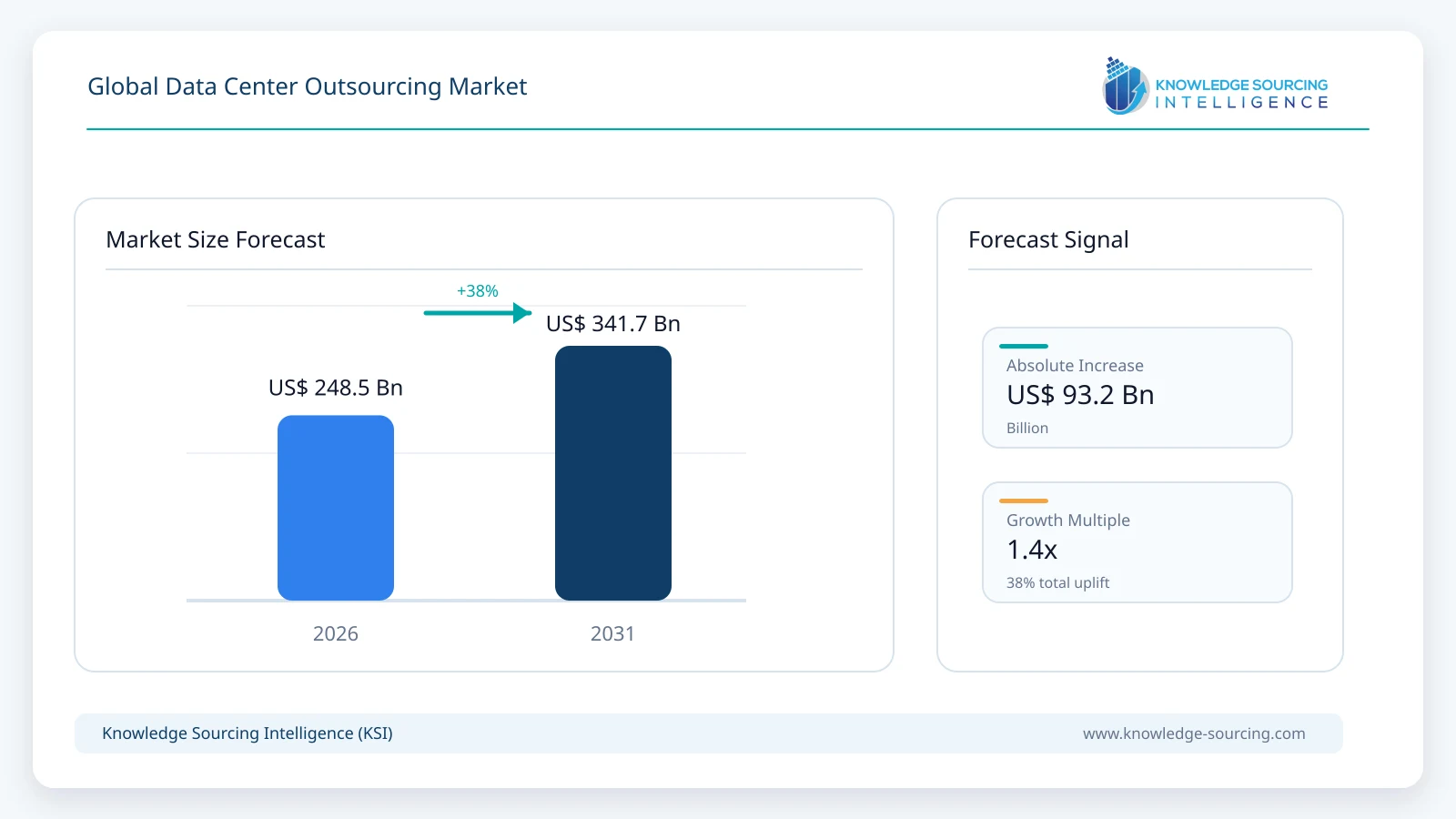
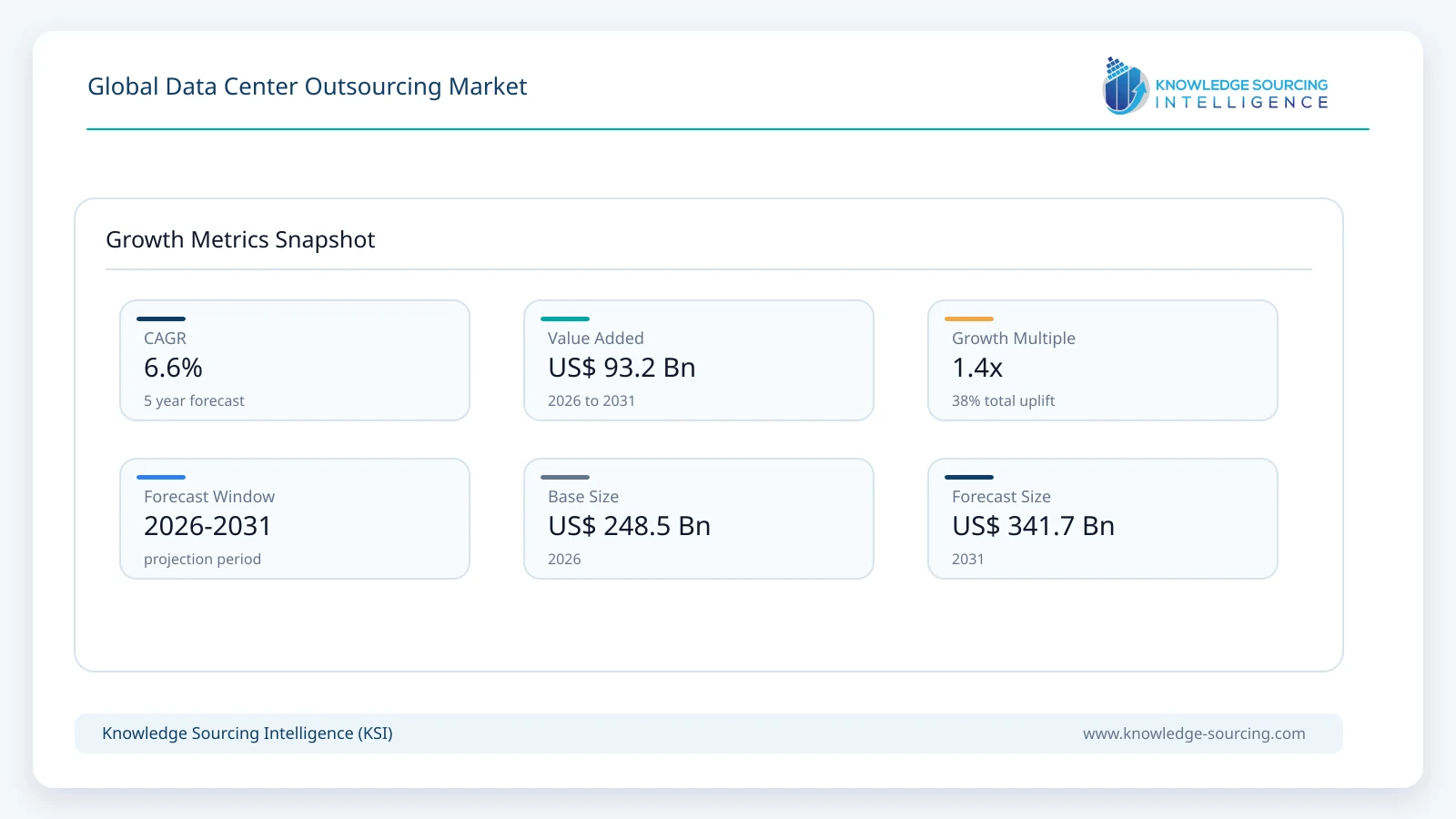
The Global Data Center Outsourcing market is forecast to grow at a CAGR of 6.6%, reaching USD 341.7 billion in 2031 from USD 248.5 billion in 2026.
Highlights:
- 1Hybrid infrastructure management remains the strongest demand catalyst as enterprises balance legacy systems with public cloud environments.
- 2Large enterprises account for a substantial share of outsourcing expenditure due to extensive infrastructure portfolios and stringent uptime requirements.
- 3Asia Pacific presents considerable commercial opportunities through enterprise IT investment, expanding digital economies, and rising regional data centre capacity.
- 4Automation, artificial intelligence-assisted operations (AIOps), and predictive infrastructure monitoring are improving operational efficiency and service quality.
- 5Data sovereignty regulations and cybersecurity requirements continue influencing outsourcing provider selection and contract structures.
- 6Competition increasingly centres on integrated managed services, operational expertise, sustainability capabilities, and industry-specific compliance support.
The data center outsourcing market comprises managed infrastructure services where enterprises transfer responsibility for operating, maintaining, monitoring, and securing data center environments to specialist service providers. These services include infrastructure management, server administration, storage management, disaster recovery, backup, network operations, security monitoring, and hybrid infrastructure support delivered from customer-owned facilities or vendor-operated data centers. The outsourcing model enables organizations to reduce operational complexity while improving service continuity, compliance, and infrastructure resilience.
Enterprise demand continues to expand as organizations face growing infrastructure complexity driven by hybrid cloud adoption, artificial intelligence workloads, stricter cybersecurity requirements, and rising energy costs. Rather than maintaining large in-house operational teams, many organizations are shifting routine infrastructure management to external specialists capable of delivering standardized service-level agreements (SLAs), continuous monitoring, and predictable operating expenditure. Buyers increasingly evaluate outsourcing providers based on operational reliability, compliance capabilities, automation maturity, geographic coverage, and industry-specific expertise rather than pricing alone.
Large enterprises remain the principal buyers because they operate geographically distributed IT estates, multiple applications, and business-critical workloads requiring around-the-clock management. However, small and medium enterprises are also expanding adoption as managed infrastructure services provide access to enterprise-grade operational capabilities without significant capital investment. Financial institutions, healthcare providers, manufacturers, government agencies, and telecommunications operators represent important demand centres due to their requirements for uninterrupted operations, regulatory compliance, and secure data handling.
Commercial competition extends beyond traditional infrastructure management. Providers increasingly integrate automation platforms, artificial intelligence for predictive maintenance, cybersecurity operations, workload optimisation, sustainability consulting, and hybrid cloud orchestration into outsourcing contracts. Long-term managed service agreements are gradually replacing purely infrastructure-focused engagements as enterprises seek partners capable of supporting business continuity alongside digital infrastructure modernisation.
The industry also reflects changing procurement priorities. Organisations now seek flexible consumption models, measurable performance metrics, carbon reporting capabilities, and integration across public cloud, private cloud, and legacy infrastructure. Service providers with extensive delivery centres, certified operational processes, and strong partnerships with hyperscale cloud providers hold competitive advantages in securing multi-year outsourcing contracts.
Market Drivers
Growing Complexity of Hybrid IT Environments
Most enterprises now operate workloads across on-premises infrastructure, private clouds, colocation facilities, and hyperscale public clouds. Managing these distributed environments requires specialised operational expertise, unified monitoring platforms, and consistent governance. Internal IT departments frequently lack sufficient resources to manage heterogeneous infrastructure efficiently.
This complexity has increased demand for outsourcing partners capable of delivering integrated management across multiple technology environments. Service providers respond by expanding hybrid operations platforms, automation capabilities, and cloud management expertise. As organisations consolidate vendors, comprehensive infrastructure management contracts generate recurring service revenue while improving operational consistency.
Rising Cybersecurity and Operational Resilience Requirements
Cybersecurity has become a board-level investment priority as ransomware incidents, supply chain attacks, and regulatory scrutiny continue affecting enterprise infrastructure. Organisations increasingly require continuous monitoring, incident response, vulnerability management, and infrastructure hardening alongside conventional data centre operations.
Buyers therefore prefer outsourcing providers capable of combining infrastructure operations with managed security services and compliance reporting. Investments in security operations centres, zero-trust implementation, and automated threat detection strengthen provider competitiveness while supporting premium service offerings.
Escalating Infrastructure Operating Costs
Electricity prices, hardware maintenance expenses, skilled workforce shortages, and infrastructure refresh cycles continue increasing operational expenditure for enterprise-owned data centres. Many organisations seek predictable operating costs rather than recurring capital investments.
Outsourcing providers achieve economies of scale by operating multiple customer environments through standardised delivery frameworks and automation. This commercial model allows customers to optimise expenditure while maintaining infrastructure availability, supporting wider adoption across capital-intensive industries.
Expansion of Regulatory Compliance Requirements
Financial services, healthcare, government, and telecommunications organisations face increasingly stringent compliance obligations regarding data security, availability, audit readiness, and operational governance. Maintaining internal compliance capabilities requires continuous investment in specialised personnel and documented operational procedures.
Outsourcing providers strengthen their market position by obtaining recognised certifications, implementing documented governance frameworks, and offering compliance reporting aligned with sector-specific regulations. Buyers increasingly incorporate compliance expertise into supplier evaluation criteria during procurement.
Market Restraints and Challenges
Data Sovereignty and Jurisdictional Restrictions
Many countries have strengthened requirements governing where sensitive information may be stored and processed. Multinational enterprises therefore encounter challenges when outsourcing infrastructure spanning multiple jurisdictions.
Providers mitigate this challenge by expanding regional delivery facilities, establishing sovereign cloud partnerships, and maintaining country-specific operational capabilities. Nevertheless, regulatory fragmentation continues increasing operational complexity and contract costs.
Vendor Lock-In Concerns
Long-term outsourcing agreements often involve proprietary operational platforms, customised workflows, and integrated monitoring systems. Organisations remain cautious about becoming overly dependent on a single service provider due to switching costs and potential service disruptions.
Customers increasingly negotiate flexible contract terms, transition assistance clauses, and interoperability requirements. Providers consequently invest in open management platforms and standardised operational frameworks to improve customer confidence.
Shortage of Skilled Infrastructure Professionals
Demand for specialists in cloud operations, cybersecurity, automation, and enterprise networking continues exceeding labour supply across many regions. Workforce shortages increase operating costs and affect service delivery capacity.
Providers respond through automation investments, global delivery centres, workforce development programmes, and artificial intelligence-assisted operations. Despite these initiatives, specialised talent remains a competitive differentiator throughout the industry.
Legacy Infrastructure Integration
Many enterprises continue operating ageing applications that cannot be migrated easily to modern environments. Integrating these systems into outsourced operations often requires customised processes and specialised technical expertise.
Suppliers increasingly adopt phased migration strategies, application modernisation services, and hybrid operating models to reduce implementation risks while supporting long-term infrastructure transformation.
Major Segment Analysis
The Large Enterprises segment represents the most commercially significant portion of the data center outsourcing market. Large organisations operate geographically dispersed infrastructure supporting thousands of users, multiple business applications, and mission-critical workloads that require uninterrupted availability. These enterprises frequently manage complex technology estates combining legacy systems with modern cloud-native applications, creating sustained demand for specialised operational expertise.
Procurement decisions within this segment extend beyond cost reduction. Buyers prioritise operational resilience, regulatory compliance, cybersecurity integration, disaster recovery capabilities, and measurable service-level performance. Multi-year outsourcing contracts typically include infrastructure monitoring, capacity planning, lifecycle management, incident response, automation services, and strategic consulting. Consequently, contract values remain substantially higher than those within the SME segment.
Competition for large enterprise contracts emphasises delivery capability rather than pricing alone. Providers differentiate themselves through global service delivery networks, industry certifications, automation maturity, integrated security operations, and experience managing hybrid infrastructure. Long-term customer relationships also generate opportunities to expand into cloud migration, application management, workplace services, and broader digital infrastructure operations, strengthening recurring revenue streams.
Regional Analysis
North America maintains a leading position due to mature enterprise IT infrastructure, extensive cloud adoption, strong cybersecurity investment, and widespread outsourcing acceptance. Financial institutions, healthcare organisations, telecommunications operators, and technology companies remain major buyers. Regulatory requirements concerning operational resilience and cybersecurity continue supporting managed infrastructure demand, although labour costs encourage greater automation.
Europe demonstrates steady demand driven by data protection regulations, sustainability objectives, and enterprise infrastructure modernisation. Organisations increasingly seek outsourcing partners capable of supporting multi-country operations while complying with national data residency requirements. Energy efficiency initiatives also influence provider selection as operating costs remain elevated.
Asia Pacific represents the fastest expanding opportunity due to sustained enterprise digital investment, growing regional cloud infrastructure, and expanding data centre construction across India, Japan, Singapore, Australia, and Southeast Asia. Enterprises increasingly outsource infrastructure management to address shortages of specialised operational talent while supporting business expansion across multiple markets.
Middle East and Africa continue attracting investment through national digital economy strategies, smart government initiatives, and financial sector modernisation. Demand remains concentrated within government, banking, telecommunications, and energy sectors. However, varying regulatory frameworks and skills shortages influence outsourcing implementation across individual countries.
South America experiences gradual adoption supported by financial services, retail, manufacturing, and telecommunications sectors seeking operational efficiency. Economic volatility and currency fluctuations occasionally delay large outsourcing decisions, although managed infrastructure services continue attracting organisations seeking predictable operating expenditure.
Competitive Landscape
Competition within the data center outsourcing market combines global technology service providers with established infrastructure management specialists. Service differentiation increasingly depends upon operational excellence, automation capabilities, cybersecurity integration, regulatory compliance expertise, and hybrid cloud management rather than conventional infrastructure administration alone.
Providers including IBM Corporation, NTT DATA, Inc., Kyndryl Holdings, Inc., DXC Technology Company, Accenture plc, Cognizant Technology Solutions Corporation, Atos SE, Tata Consultancy Services Limited, Capgemini SE, Infosys Limited, HCL Technologies Limited, and Wipro Limited compete through long-term managed services agreements supported by extensive global delivery networks. Strategic alliances with cloud providers, investments in artificial intelligence-enabled operations, sustainability consulting, and regional expansion continue strengthening competitive positioning. Large outsourcing engagements increasingly incorporate cloud optimisation, infrastructure automation, security operations, and consulting services into integrated enterprise contracts.
Recent Developments
June 2026: Equinix partnered with Cisco and NVIDIA to deploy secure AI factories across its global data center footprint, enabling enterprises to outsource high-performance AI infrastructure with integrated networking, accelerated computing, and colocation services.
May 2026: Kyndryl expanded its distributed cloud and infrastructure management capabilities through enhanced AI-powered operational services. The development strengthens enterprise automation and hybrid infrastructure management.
April 2026: Equinix launched Fabric Intelligence, a new capability designed to accelerate enterprise AI workloads by improving hybrid multicloud connectivity, helping organisations optimise outsourced data center and interconnection infrastructure.
January 2026: LightHouse Data Centers and Wharton Digital launched a strategic hyperscale platform to develop, own, and operate more than 2 GW of North American data center capacity, addressing rising outsourcing demand from AI, hyperscale, and cloud customers.
Regulatory and Policy Environment
The regulatory environment increasingly shapes outsourcing procurement decisions as governments strengthen cybersecurity, privacy, and operational resilience requirements. Regulations governing personal data protection, financial sector resilience, healthcare information security, and critical infrastructure protection require outsourcing providers to maintain documented governance processes, audit capabilities, and incident response procedures.
International standards including ISO/IEC 27001 for information security management, ISO 22301 for business continuity, ISO/IEC 20000 for IT service management, and SOC reporting frameworks remain important procurement requirements. Many enterprise buyers require independent certification before awarding long-term infrastructure management contracts.
Government investment in sovereign cloud initiatives, cybersecurity programmes, and national digital infrastructure further influences outsourcing strategies. Organisations increasingly evaluate providers according to regional data residency capabilities, sustainability reporting, operational transparency, and compliance maturity, making regulatory competence an important competitive differentiator.
Outlook and Strategic Implications
Commercial demand for data center outsourcing will increasingly reflect enterprise efforts to simplify hybrid infrastructure management while improving operational resilience and financial predictability. Buyers are expected to favour providers capable of integrating infrastructure operations, cybersecurity, cloud orchestration, automation, and sustainability reporting within unified managed service agreements.
Investment priorities will focus on artificial intelligence-assisted operations, predictive maintenance, energy-efficient infrastructure management, and automation platforms capable of reducing operational costs without compromising service quality. Procurement teams are also expected to place greater emphasis on provider resilience, regulatory compliance, geographic delivery capability, and supply chain transparency during contract evaluations.
Competitive dynamics will continue shifting towards outcome-based service models supported by measurable operational performance rather than traditional infrastructure administration alone. Providers capable of combining industry expertise, advanced operational automation, compliance assurance, and global service delivery are likely to strengthen their long-term market positions. At the same time, evolving cybersecurity threats, data sovereignty requirements, and skilled workforce constraints will remain important strategic considerations influencing investment decisions throughout the forecast period.
Data Center Outsourcing Market Scope
| Report Metric | Details |
|---|---|
| Total Market Size in 2026 | USD 248.5 billion |
| Total Market Size in 2031 | USD 341.7 billion |
| Forecast Unit | Billion |
| Growth Rate | 6.6% |
| Study Period | 2021 to 2031 |
| Historical Data | 2021 to 2024 |
| Base Year | 2025 |
| Forecast Period | 2026 – 2031 |
| Segmentation | Enterprise Size, Deployment Location, Industry Vertical, Geography |
| Companies |
|
Market Segmentation
By Enterprise Size
- Small and Medium Enterprises (SMEs)
- Large Enterprises
By Deployment Location
- Customer Premises (On-premises)
- Vendor Premises (Off-premises)
By Industry Vertical
- Banking, Financial Services, and Insurance (BFSI)
- IT and Telecommunications
- Manufacturing
- Healthcare
- Government and Public Sector
- Retail and E-commerce
- Others
By Geography
- North America
- United States
- Canada
- Mexico
- South America
- Brazil
- Argentina
- Others
- Europe
- United Kingdom
- Germany
- France
- Italy
- Others
- Middle East and Africa
- Saudi Arabia
- United Arab Emirates
- South Africa
- Others
- Asia Pacific
- China
- Japan
- India
- South Korea
- Australia
- Singapore
- Others
Table of Contents
1. INTRODUCTION
1.1. Market Overview
1.2. Market Definition
1.3. Scope of the Study
1.4. Market Segmentation
1.5. Currency
1.6. Assumptions
1.7. Base and Forecast Years Timeline
1.8. Key Benefits to the Stakeholder
2. RESEARCH METHODOLOGY
2.1. Research Design
2.2. Research Process
3. EXECUTIVE SUMMARY
3.1. Key Findings
4. MARKET DYNAMICS
4.1. Market Drivers
4.2. Market Restraints
4.3. Porter's Five Forces Analysis
4.3.1. Bargaining Power of Suppliers
4.3.2. Bargaining Power of Buyers
4.3.3. Threat of New Entrants
4.3.4. Threat of Substitutes
4.3.5. Competitive Rivalry in the Industry
4.4. Industry Value Chain Analysis
4.5. Analyst View
5. GLOBAL DATA CENTRE OUTSOURCING MARKET BY ENTERPRISE SIZE
5.1. Introduction
5.2. Small and Medium Enterprises (SMEs)
5.3. Large Enterprises
6. GLOBAL DATA CENTRE OUTSOURCING MARKET BY DEPLOYMENT LOCATION
6.1. Introduction
6.2. Customer Premises (On-premises)
6.3. Vendor Premises (Off-premises)
7. GLOBAL DATA CENTRE OUTSOURCING MARKET BY INDUSTRY VERTICAL
7.1. Introduction
7.2. Banking, Financial Services, and Insurance (BFSI)
7.3. IT and Telecommunications
7.4. Manufacturing
7.5. Healthcare
7.6. Government and Public Sector
7.7. Retail and E-commerce
7.8. Others
8. GLOBAL DATA CENTRE OUTSOURCING MARKET BY GEOGRAPHY
8.1. Introduction
8.2. North America
8.2.1. By Enterprise Size
8.2.2. By Deployment Location
8.2.3. By Industry Vertical
8.2.4. By Country
8.2.4.1. United States
8.2.4.2. Canada
8.2.4.3. Mexico
8.3. South America
8.3.1. By Enterprise Size
8.3.2. By Deployment Location
8.3.3. By Industry Vertical
8.3.4. By Country
8.3.4.1. Brazil
8.3.4.2. Argentina
8.3.4.3. Others
8.4. Europe
8.4.1. By Enterprise Size
8.4.2. By Deployment Location
8.4.3. By Industry Vertical
8.4.4. By Country
8.4.4.1. United Kingdom
8.4.4.2. Germany
8.4.4.3. France
8.4.4.4. Italy
8.4.4.5. Others
8.5. Middle East and Africa
8.5.1. By Enterprise Size
8.5.2. By Deployment Location
8.5.3. By Industry Vertical
8.5.4. By Country
8.5.4.1. Saudi Arabia
8.5.4.2. United Arab Emirates
8.5.4.3. South Africa
8.5.4.4. Others
8.6. Asia Pacific
8.6.1. By Enterprise Size
8.6.2. By Deployment Location
8.6.3. By Industry Vertical
8.6.4. By Country
8.6.4.1. China
8.6.4.2. Japan
8.6.4.3. India
8.6.4.4. South Korea
8.6.4.5. Australia
8.6.4.6. Singapore
8.6.4.7. Others
9. COMPETITIVE ENVIRONMENT AND ANALYSIS
9.1. Major Players and Strategy Analysis
9.2. Market Share Analysis
9.3. Mergers, Acquisitions, Agreements, and Collaborations
9.4. Competitive Dashboard
10. COMPANY PROFILES
10.1. IBM Corporation
10.2. NTT DATA, Inc.
10.3. Kyndryl Holdings, Inc.
10.4. DXC Technology Company
10.5. Accenture plc
10.6. Cognizant Technology Solutions Corporation
10.7. Atos SE
10.8. Tata Consultancy Services Limited
10.9. Capgemini SE
10.10. Infosys Limited
10.11. HCL Technologies Limited
10.12. Wipro Limited
Navigate
Trusted by the world's leading organizations











