
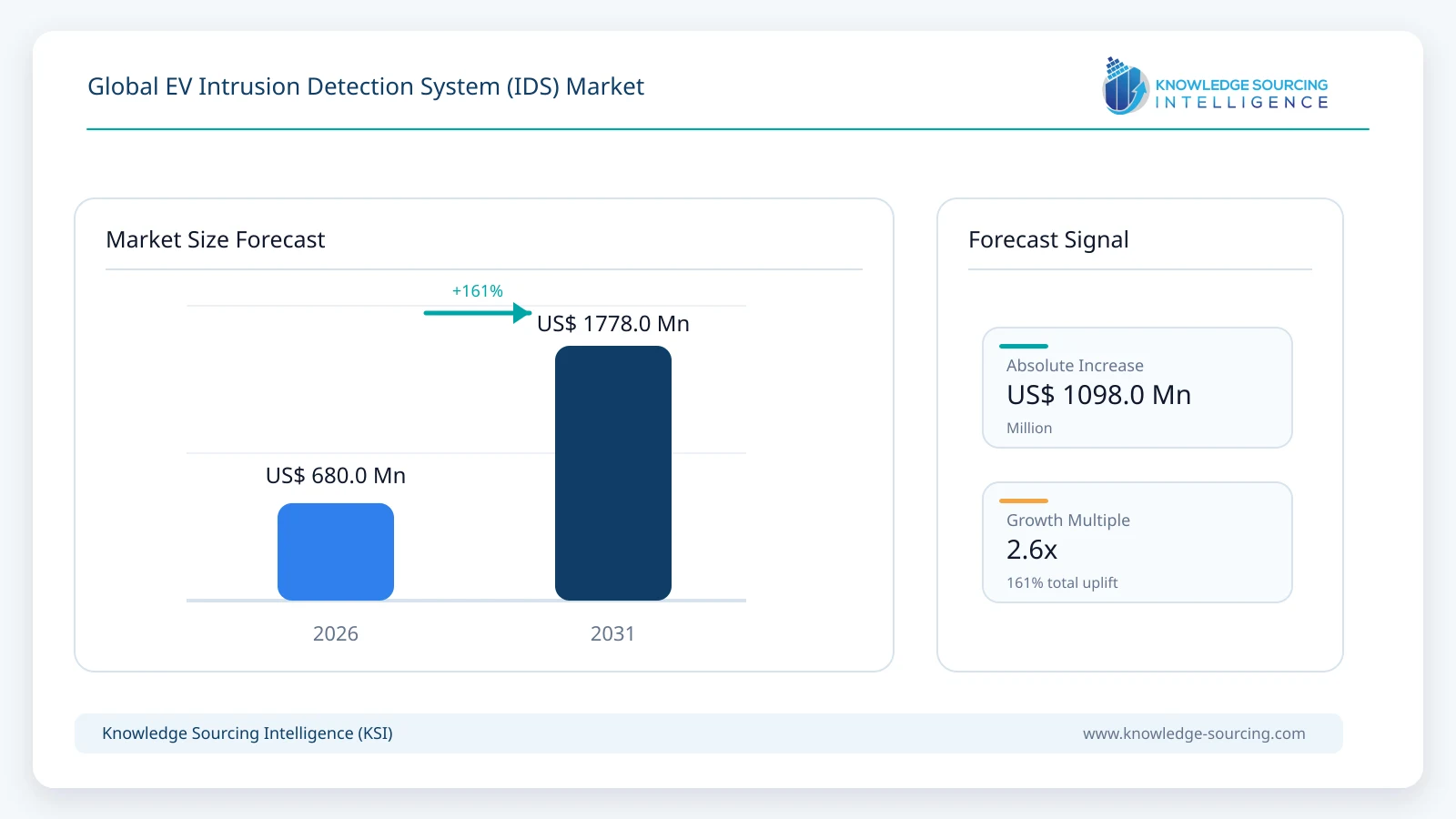
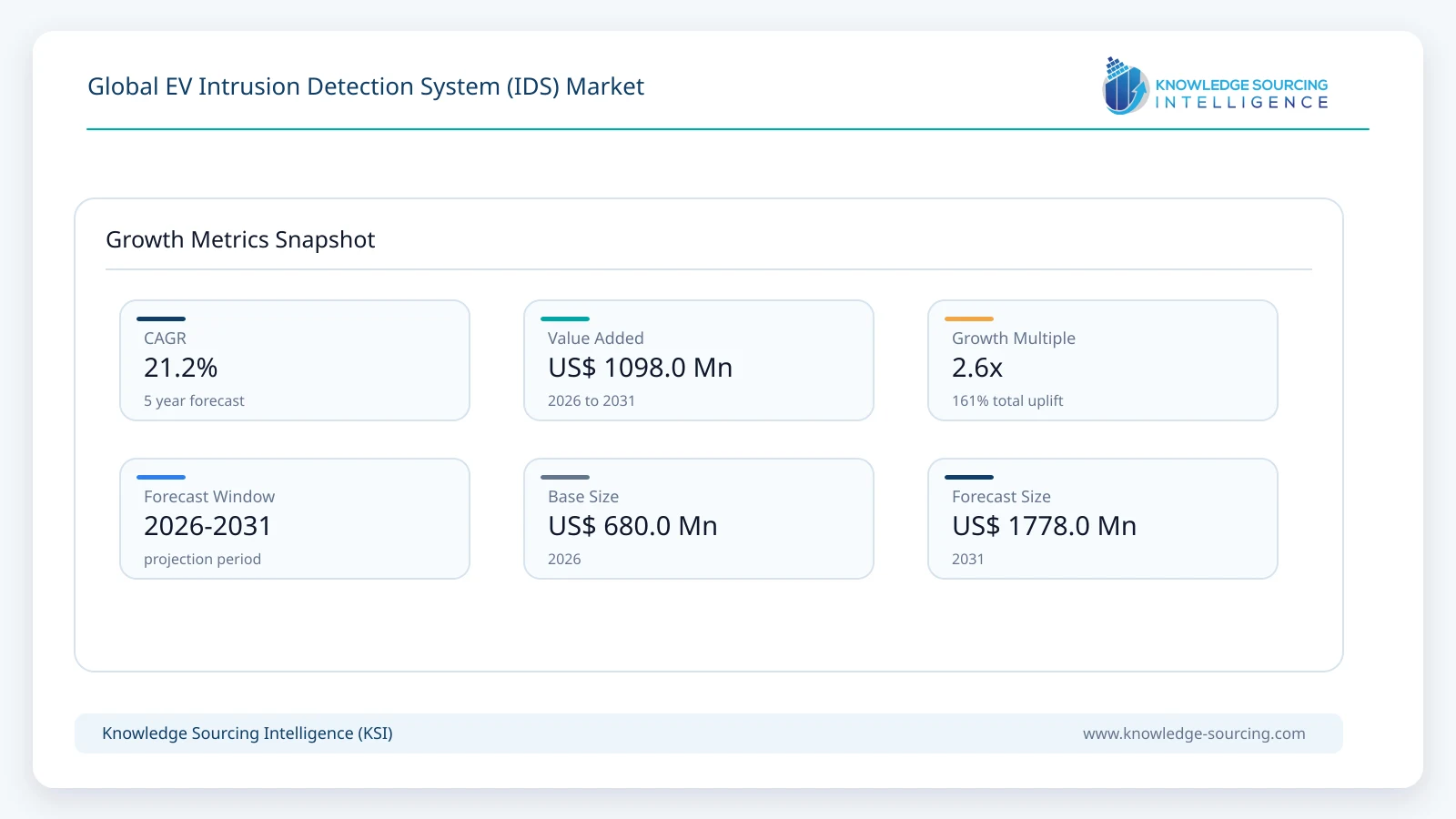
The global EV intrusion detection system market will grow from USD 680.0 million in 2026 to USD 1,778 million by 2031, at a CAGR of 21.2% during the forecast period.
Highlights:
- 1Global electric-car sales are expected to reach approximately 23 million units in 2026, expanding the addressable base for embedded vehicle IDS.
- 2Network-based IDS remains central to monitoring CAN, CAN FD and automotive Ethernet traffic for abnormal communication patterns.
- 3Host-based IDS is gaining relevance as software-defined vehicles consolidate functions onto Linux, QNX and AUTOSAR Adaptive compute platforms.
- 4Distributed IDS architectures reduce data overload by filtering and qualifying security events before they are transmitted to a vehicle security operations center.
- 5Machine-learning-based IDS is progressing toward detection of unknown attacks, but explainability and false-positive control remain critical for production deployment.
- 6EV-specific attack surfaces include battery management, charging communication, telematics and high-voltage powertrain control networks.
- 7UN Regulation No. 155 reinforces the need for ongoing cyber-risk monitoring and incident management across the vehicle lifecycle.
- 8Automotive Ethernet growth is increasing demand for IDS capable of monitoring service-oriented and IP-based in-vehicle communications.
Market Overview
An automotive intrusion detection system observes vehicle software and network activity and identifies events that may indicate unauthorized access, message injection, abnormal diagnostic activity, compromised applications or malicious communication. Unlike an intrusion prevention system, the core purpose of IDS is detection, logging, qualification and reporting. Some commercial products combine both functions, but this market focuses on the attributable intrusion-detection layer used within electric vehicles and their connected monitoring environments.
Modern EV architectures require more than one type of sensor. CAN-based IDS monitors message identifiers, timing, payload behavior and bus activity. Ethernet IDS can inspect IP traffic and automotive application protocols such as SOME/IP and Diagnostics over Internet Protocol (DoIP). Host-based IDS observes processes, files, system calls and operating-system behavior inside higher-performance electronic control units. IDS managers aggregate security events from several sensors, while reporters transmit qualified events to the VSOC for fleet-wide analysis.
Electric vehicles create several additional security priorities. Battery management systems exchange safety-critical state and control information; charging interfaces can connect the vehicle to external infrastructure; and high-voltage propulsion systems increasingly use centralized controllers and Ethernet-connected domains. These factors strengthen the need for low-latency monitoring that does not interfere with safety-critical vehicle functions.
IDS Architecture Comparison
IDS Layer | Primary Monitoring Target | Typical Deployment | Key Requirement |
Network IDS - CAN / CAN FD | Message identifiers, frequency, payload and diagnostic requests | Gateway, domain controller, ECU | Very low resource use and deterministic detection |
Network IDS - Automotive Ethernet | IP traffic, SOME/IP, DoIP and service behavior | Ethernet switch, gateway, vehicle computer | High throughput and protocol-aware inspection |
Host-Based IDS | Processes, system calls, files and application behavior | High-performance computer, infotainment, telematics ECU | OS integration and low runtime overhead |
IDS Manager / Event Aggregator | Security events from multiple sensors | Domain or central vehicle controller | Filtering, correlation and event prioritization |
IDS Reporter / VSOC Link | Qualified security-event transmission | Telematics or connectivity domain | Secure reporting with low cellular-data overhead |
Market Dynamics
Software-Defined EVs Require Continuous Post-Production Monitoring
Electric vehicles increasingly receive new features and software after start of production. This changes cybersecurity from a one-time development activity into a lifecycle requirement. Intrusion detection provides visibility into attacks and abnormal behavior after vehicles have entered service, helping manufacturers identify emerging threats and determine whether a problem affects one vehicle, one software version or an entire fleet.
Automotive Regulation Supports Lifecycle Security Monitoring
UN Regulation No. 155 requires manufacturers to operate a Cybersecurity Management System and maintain processes for identifying, assessing and responding to cyber risks. UNECE specifically requires monitoring and reporting of cyber incidents. ISO/SAE 21434 extends cybersecurity engineering across development, production, operation, maintenance and decommissioning. Neither framework mandates one specific IDS implementation, but both strengthen the commercial case for continuous security monitoring.
EV Charging and Powertrain Interfaces Expand the Attack Surface
Electric vehicles combine traditional connected-car interfaces with charging communication, battery management and high-voltage control. Charging systems exchange information with external equipment, while battery and powertrain controllers carry safety-critical information inside the vehicle. Intrusion detection can monitor traffic around these domains and identify unusual diagnostic commands, message injection, abnormal timing or unexpected system behavior before the event is escalated to fleet security teams.
False Positives and Resource Constraints Remain Important Barriers
Vehicle IDS must operate within strict processor, memory and latency constraints. Excessive security-event generation can consume vehicle resources, cellular bandwidth and analyst capacity. False positives are particularly problematic because normal vehicle behavior changes with software versions, driving conditions and optional features. Production IDS therefore needs careful policy tuning, event filtering and validation rather than simply maximizing detection sensitivity.
Technology Outlook
Specification- and Rule-Based Detection
Rule-based IDS compares live vehicle traffic with expected communication specifications, including message frequency, identifier whitelists, diagnostic restrictions and state-dependent behavior. A 2026 EV powertrain study demonstrated sub-2 millisecond detection with false-positive rates below 1% in the tested CAN environment. Deterministic rules remain attractive for safety-critical embedded systems because they are predictable and computationally efficient.
Machine Learning and Unknown-Attack Detection
Machine-learning IDS can identify patterns that were not explicitly included in a rule set. Research published during 2026 includes explainable automotive IDS, federated-learning systems and models designed to recognize unknown attacks. These approaches can improve adaptability, but production deployment depends on dataset quality, explainability, memory use and the ability to control false alarms under changing vehicle conditions.
Distributed IDS
Distributed architectures position security sensors close to different vehicle domains and use an IDS manager to aggregate and qualify events. ETAS and AUTOCRYPT both offer architectures that combine local sensors, event management and reporting to a VSOC. Filtering inside the vehicle helps prevent large volumes of low-value telemetry from being sent to the cloud while preserving the information needed for incident analysis.
Edge AI and Autonomous Response
IDS is beginning to overlap with edge AI and intrusion prevention. VicOne and Trustonic introduced an ECU-level architecture in April 2026 that combines IDS/IPS, a trusted execution environment and edge AI. AI can correlate security events from several ECUs and improve detection of unfamiliar behavior, while prevention functions can apply policies or virtual patches after suspicious activity has been validated.
Segment Analysis
By IDS Type
Network-based IDS is the most direct fit for vehicle communication monitoring and can be deployed on CAN, CAN FD and Ethernet networks. Host-based IDS becomes more important as EVs consolidate software onto high-performance computers running complex operating systems. Distributed architectures combine both approaches so that local security events can be normalized and evaluated across the complete vehicle.
By Detection Method
Specification and rule-based approaches are widely suited to deterministic automotive communications. Signature-based IDS identifies known attack patterns, while anomaly-based and machine-learning methods can detect deviations from expected behavior. Production systems increasingly combine methods rather than relying on one technique because known attacks, unknown attacks and protocol misuse have different detection characteristics.
By Vehicle Domain
Central gateways and vehicle computers are natural IDS locations because they observe traffic between several domains. Powertrain and battery domains are particularly important in EVs because attacks can affect propulsion or high-voltage control. Infotainment and telematics remain common external entry points, while charging and connected-services domains create interfaces between the vehicle and external systems.
By Vehicle Type
Passenger battery-electric vehicles provide the largest unit opportunity as global EV sales expand. Commercial electric vehicles create additional requirements because long vehicle life, fleet operation and high utilization make continuous monitoring valuable. Electric buses and trucks also benefit from centralized fleet cybersecurity because operators can manage incidents across many connected vehicles.
By Deployment
Embedded IDS runs directly on vehicle networks or electronic control units and must meet automotive resource constraints. Cloud and VSOC components provide fleet-wide correlation and incident analysis. Hybrid deployment is therefore the prevailing architectural direction, combining local detection with backend monitoring rather than moving all analysis to either the vehicle or the cloud.
Market and Demand Indicators
Indicator | Latest Development | Market Impact |
Global EV demand | IEA expects approximately 23 million electric-car sales in 2026, representing 28% of global car sales. | Expands the annual vehicle base requiring connected-vehicle cybersecurity controls. |
Regulatory lifecycle monitoring | UN Regulation No. 155 requires cybersecurity management, risk assessment, monitoring and incident reporting. | Supports continuous post-production security capabilities including IDS and VSOC monitoring. |
EV-specific IDS research | A study published April 22, 2026 demonstrated a real-time IDS on an EV powertrain CAN network with sub-2 ms detection in the tested system. | Confirms feasibility of low-latency embedded IDS in EV-specific control networks. |
Unknown-attack detection | Multiple 2026 studies evaluated machine-learning IDS for unknown and generalized automotive attacks. | Supports movement beyond static signatures toward adaptive detection. |
Commercial embedded IDPS | VicOne and Trustonic launched an ECU-level IDPS plus edge-AI security architecture on April 14, 2026. | Shows intrusion detection moving deeper into centralized and software-defined vehicle compute. |
Vehicle-wide detection | PlaxidityX vCore combines in-vehicle IDS sensors, edge event management and cloud analytics. | Demonstrates a commercial transition toward distributed end-to-end vehicle detection. |
Europe Market Analysis
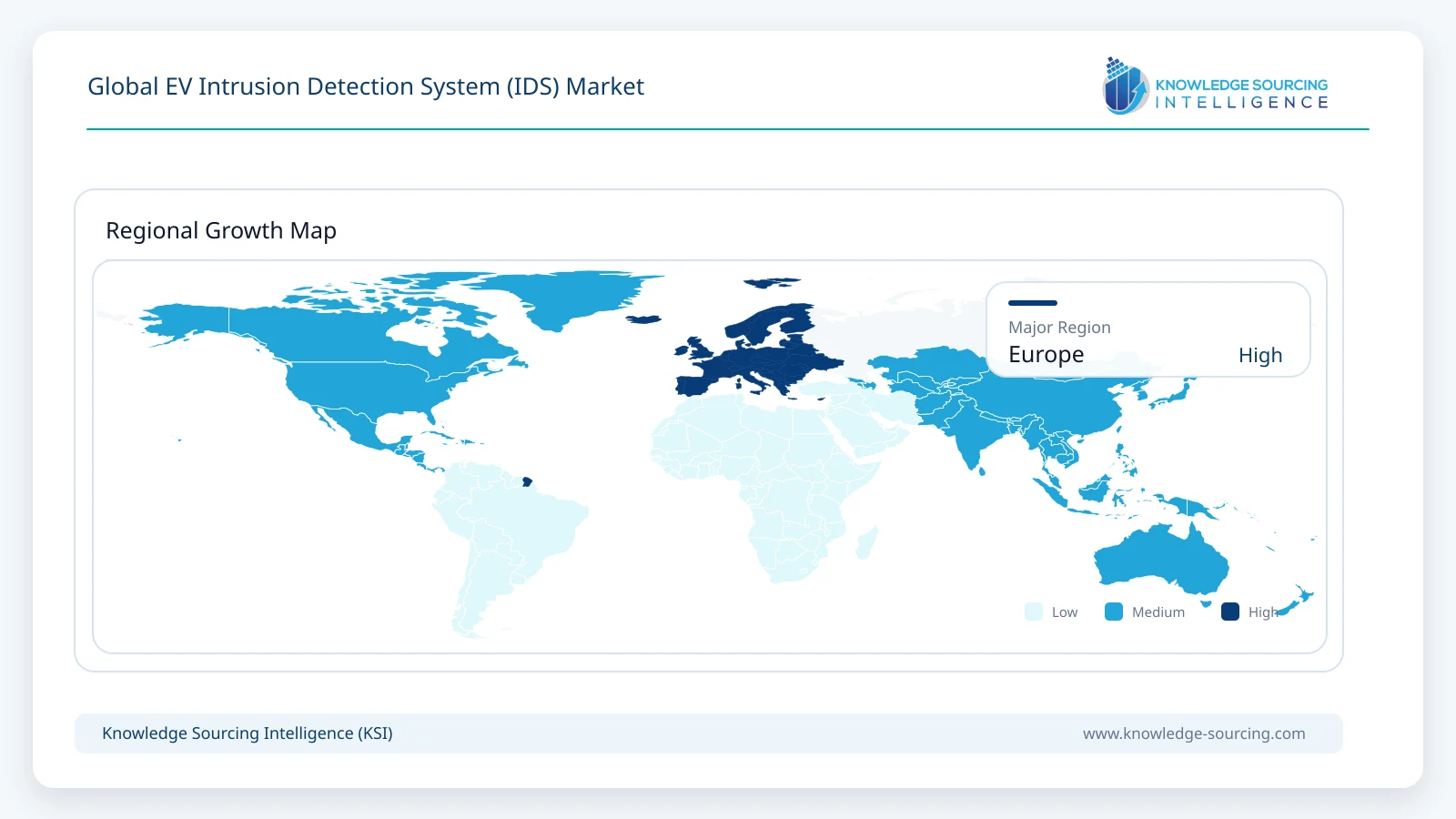
Europe is a major market for EV intrusion detection because vehicle cybersecurity is closely linked to type approval and cybersecurity management requirements. UN Regulation No. 155 has applied within the European regulatory environment and requires manufacturers to maintain cybersecurity processes across the vehicle lifecycle. As EV production grows, manufacturers must demonstrate not only that vehicles were designed securely but that cyber risks can be monitored and managed after vehicles enter service.
European suppliers also have strong capabilities in embedded automotive cybersecurity. ETAS offers ESCRYPT CycurIDS components for CAN, Ethernet, IDS management and reporting, with integration into Vehicle Security Operations Center workflows. PlaxidityX and other automotive cybersecurity specialists serve European OEM programs with distributed vehicle-detection architectures. AUTOSAR security-event and IDS-manager specifications further support standardized implementation across different electronic control units and suppliers.
The transition toward centralized vehicle computers and automotive Ethernet is likely to increase IDS value per vehicle. A single high-performance computer can host several vehicle functions, making host-level monitoring more important, while Ethernet creates higher data rates and more complex application protocols than traditional CAN. Europe is therefore expected to remain a leading market for multi-layer IDS deployments that combine embedded monitoring with fleet-wide security operations.
Competitive Landscape
The competitive landscape includes specialist automotive cybersecurity companies and automotive software suppliers. ETAS provides the ESCRYPT CycurIDS family across CAN, Ethernet, IDS management and reporting. AUTOCRYPT offers network- and host-based IDS with automated policy generation and integration with third-party or proprietary vehicle security operations centers. VicOne's xCarbon combines IDS and prevention functions with automotive threat intelligence, while PlaxidityX integrates in-vehicle sensors with edge management and cloud-based vehicle detection and response.
Argus Cyber Security, C2A Security, Karamba Security and other automotive cybersecurity vendors compete across complementary parts of the vehicle protection stack. Competitive differentiation depends on processor overhead, detection coverage, automotive protocol support, false-positive performance, AUTOSAR compatibility, policy-management tooling, ability to update detection logic over the air and integration with fleet security operations.
Recent Developments
June 3, 2026: PlaxidityX announced that its vCore Vehicle Cyber Protection system, which unifies in-vehicle security sensors, edge management and cloud analytics, received the AutoTech & Wards Cybersecurity Excellence Award.
April 23, 2026: VicOne and Intellias announced integration of the xCarbon intrusion detection and prevention system into Intellias' IntelliKit software-defined vehicle platform running on QNX and optimized for Qualcomm processors.
April 14, 2026: VicOne and Trustonic launched a layered ECU-level cybersecurity solution combining xCarbon IDS/IPS, a trusted execution environment and edge AI.
January 7, 2026: AUTOCRYPT launched Automotive-CIS at CES 2026, expanding its integrated automotive cybersecurity infrastructure across development, production, driving and maintenance.
October 8, 2025: VicOne announced collaboration with Red Hat to validate xCarbon intrusion detection and prevention support for Red Hat In-Vehicle Operating System.
EV Intrusion Detection System (IDS) Market Scope
| Report Metric | Details |
|---|---|
| Total Market Size in 2026 | USD 680.0 million |
| Total Market Size in 2031 | USD 1,778 million |
| Forecast Unit | Million |
| Growth Rate | 21.2% |
| Study Period | 2021 to 2031 |
| Historical Data | 2021 to 2024 |
| Base Year | 2025 |
| Forecast Period | 2026 – 2031 |
| Segmentation | IDS Type, Detection Method, Vehicle Domain, Vehicle Type, Deployment, Geography |
| Companies |
|
Market Segmentation
By IDS Type
Network-Based IDS
CAN and CAN FD IDS
Automotive Ethernet IDS
Host-Based IDS
Distributed / Hybrid IDS
By Detection Method
Specification / Rule-Based
Signature-Based
Anomaly-Based
Machine Learning / Hybrid
By Vehicle Domain
Central Gateway and Vehicle Computer
Battery and Powertrain Domain
Infotainment and Telematics
Charging and Connectivity Domain
ADAS and Other Domains
By Vehicle Type
Passenger Battery Electric Vehicles
Plug-in Hybrid Electric Vehicles
Commercial Electric Vehicles
Electric Buses and Other EVs
By Deployment
Embedded / In-Vehicle
Cloud / VSOC
Hybrid
By Geography
North America
United States
Canada
Mexico
South America
Brazil
Argentina
Rest of South America
Europe
Germany
United Kingdom
France
Italy
Rest of Europe
Middle East and Africa
Saudi Arabia
United Arab Emirates
South Africa
Rest of Middle East and Africa
Asia Pacific
China
Japan
India
South Korea
Rest of Asia Pacific
Table of Contents
1. EXECUTIVE SUMMARY
2. MARKET SNAPSHOT
2.1. Market Overview
2.2. Market Segmentation
3. BUSINESS LANDSCAPE
3.1. Market Drivers
3.1.1. Software-Defined EVs Require Continuous Post-Production Monitoring
3.1.2. Automotive Regulation Supports Lifecycle Security Monitoring
3.1.3. EV Charging and Powertrain Interfaces Expand the Attack Surface
3.2. Market Restraints
3.2.1. False Positives and Resource Constraints Remain Important Barriers
3.3. Market Opportunities
3.4. Porter's Five Forces Analysis
3.5. Industry Value Chain Analysis
3.6. Regulatory and Standards Landscape
4. TECHNOLOGICAL OUTLOOK
4.1. Specification- and Rule-Based Detection
4.2. Machine Learning and Unknown-Attack Detection
4.3. Distributed IDS
4.4. Edge AI and Autonomous Response
5. GLOBAL EV INTRUSION DETECTION SYSTEM MARKET BY IDS TYPE
5.1. Network-Based IDS
5.1.1. CAN and CAN FD IDS
5.1.2. Automotive Ethernet IDS
5.2. Host-Based IDS
5.3. Distributed / Hybrid IDS
6. GLOBAL EV INTRUSION DETECTION SYSTEM MARKET BY DETECTION METHOD
6.1. Specification / Rule-Based
6.2. Signature-Based
6.3. Anomaly-Based
6.4. Machine Learning / Hybrid
7. GLOBAL EV INTRUSION DETECTION SYSTEM MARKET BY VEHICLE DOMAIN
7.1. Central Gateway and Vehicle Computer
7.2. Battery and Powertrain Domain
7.3. Infotainment and Telematics
7.4. Charging and Connectivity Domain
7.5. ADAS and Other Domains
8. GLOBAL EV INTRUSION DETECTION SYSTEM MARKET BY VEHICLE TYPE
8.1. Passenger Battery Electric Vehicles
8.2. Plug-in Hybrid Electric Vehicles
8.3. Commercial Electric Vehicles
8.4. Electric Buses and Other EVs
9. GLOBAL EV INTRUSION DETECTION SYSTEM MARKET BY DEPLOYMENT
9.1. Embedded / In-Vehicle
9.2. Cloud / VSOC
9.3. Hybrid
10. GLOBAL EV INTRUSION DETECTION SYSTEM MARKET BY GEOGRAPHY
10.1. North America
10.1.1. United States
10.1.2. Canada
10.1.3. Mexico
10.2. South America
10.2.1. Brazil
10.2.2. Argentina
10.2.3. Rest of South America
10.3. Europe
10.3.1. Germany
10.3.2. United Kingdom
10.3.3. France
10.3.4. Italy
10.3.5. Rest of Europe
10.4. Middle East and Africa
10.4.1. Saudi Arabia
10.4.2. United Arab Emirates
10.4.3. South Africa
10.4.4. Rest of Middle East and Africa
10.5. Asia Pacific
10.5.1. China
10.5.2. Japan
10.5.3. India
10.5.4. South Korea
10.5.5. Rest of Asia Pacific
11. COMPETITIVE ENVIRONMENT AND ANALYSIS
11.1. Major Players and Strategy Analysis
11.2. Market Share Analysis
11.3. Product Development, Partnerships and Platform Integration
11.4. Competitive Dashboard
12. COMPANY PROFILES
12.1. ETAS GmbH
12.2. AUTOCRYPT Co., Ltd.
12.3. VicOne Corporation
12.4. PlaxidityX
12.5. Argus Cyber Security Ltd.
12.6. C2A Security Ltd.
12.7. Karamba Security Ltd.
12.8. Vector Informatik GmbH
12.9. HARMAN International
12.10. Keysight Technologies, Inc.
12.11. Elektrobit Automotive GmbH
12.12. NXP Semiconductors N.V.
12.13. Trustonic Limited
12.14. Upstream Security Ltd.
12.15. Synopsys, Inc.
12.16. Trend Micro Incorporated
12.17. Intellias
12.18. Sasken Technologies Limited
13. RECENT DEVELOPMENTS
14. APPENDIX
14.1. Currency
14.2. Assumptions
14.3. Base and Forecast Years Timeline
14.4. Abbreviations
Navigate
Trusted by the world's leading organizations











