
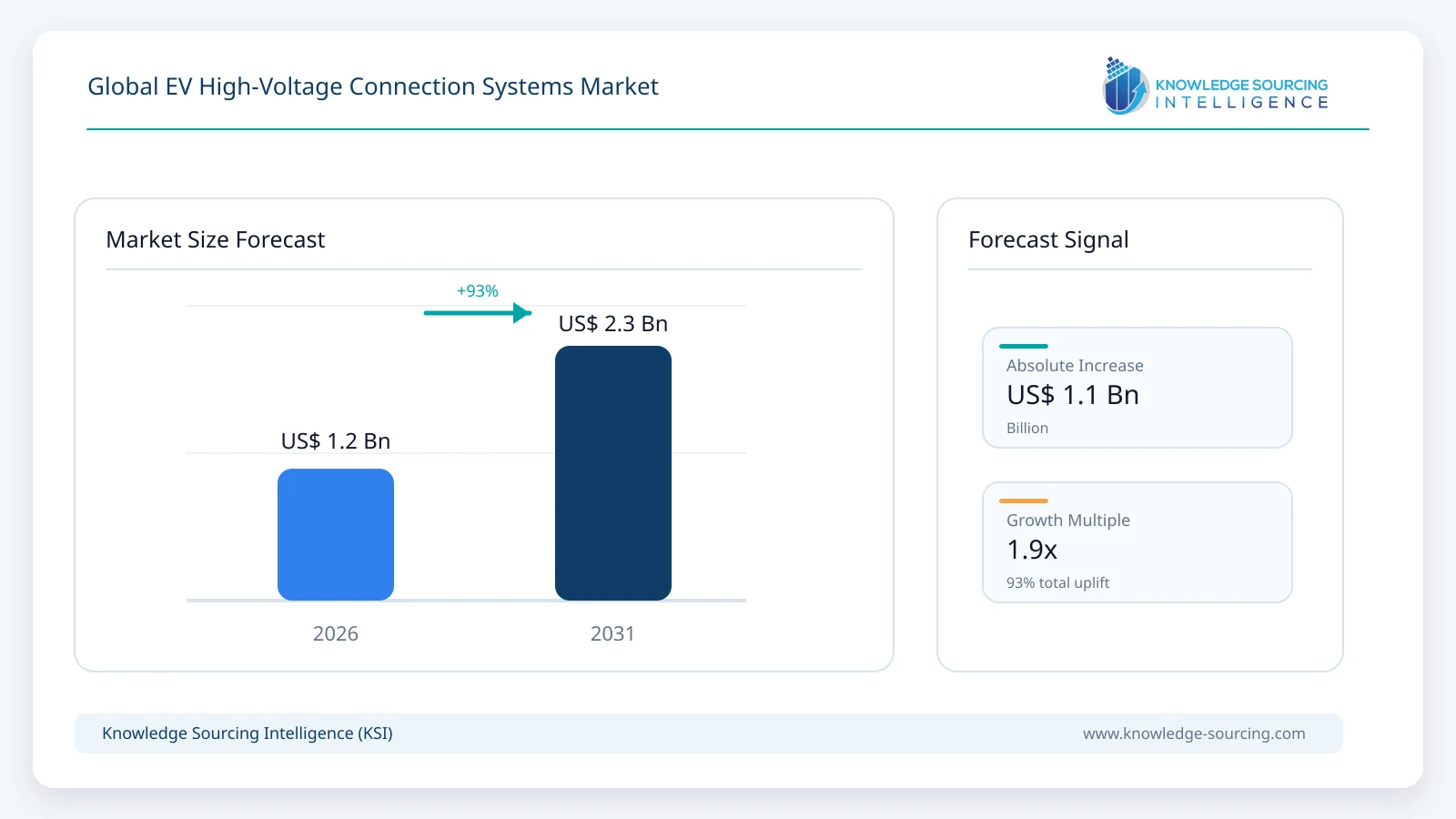
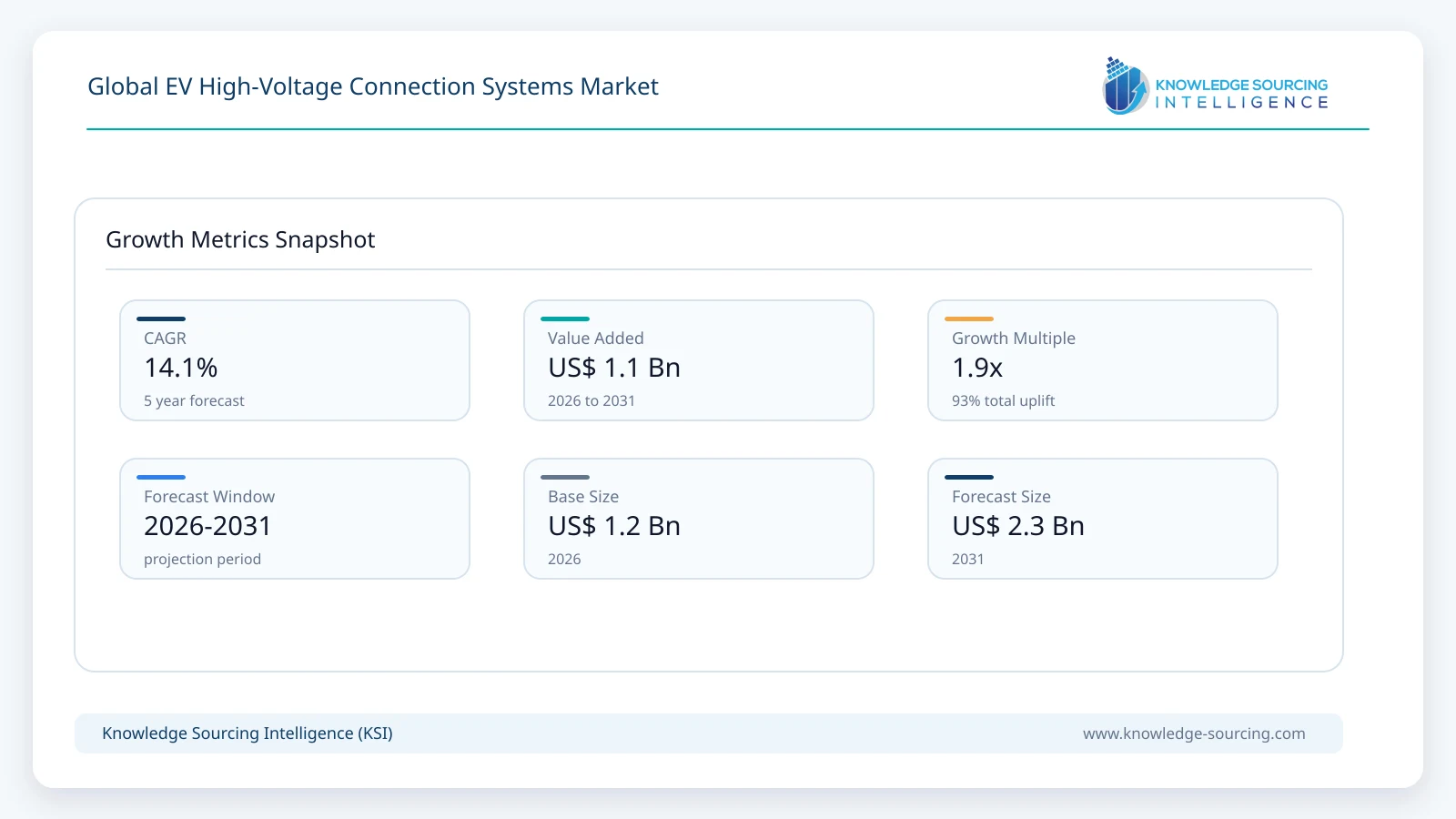
The global EV high-voltage connection systems market is estimated at USD 1.18 billion in 2026 and is projected to reach USD 2.28 billion by 2031, representing a compound annual growth rate (CAGR) of 14.1% during the forecast period.
Highlights:
- 1High-current drivetrain connection systems account for approximately 48% of global revenue in 2026.
- 2Auxiliary high-voltage connection systems generate approximately USD 307 million in revenue during 2026.
- 3800-1,000 V connection systems grow at approximately 22.0% CAGR through 2031.
- 4Passenger battery electric vehicles account for approximately 78% of global demand in 2026.
- 5Commercial electric vehicle connection systems grow at approximately 19.5% CAGR through 2031.
- 6Asia Pacific generates approximately USD 720 million of market revenue in 2026.
- 7Connector suppliers are expanding automation-ready designs for higher-voltage EV platforms.
Market Overview
High-voltage interconnection is a core part of every battery-electric and plug-in hybrid powertrain. Connectors must transfer hundreds of amps between the traction battery, inverter, motor, power distribution unit and charging electronics while maintaining electrical isolation and electromagnetic compatibility. TE Connectivity, for example, offers automotive connector families rated up to 1,000 VDC and several hundred amps for battery-to-inverter and inverter-to-motor applications. Newer systems are also being engineered for 1,200 V operation as manufacturers prepare for future higher-voltage architectures.
The market is broadening beyond the primary drivetrain connection. Electric compressors, heaters, onboard chargers, DC/DC converters, e-axles and other high-voltage auxiliaries add additional connection points inside the vehicle. Suppliers are therefore developing separate families for high-current drivetrain and lower-current auxiliary applications. Molex's eHV60, introduced in November 2025, is positioned around auxiliary high-voltage functions including DC/DC converters, onboard chargers, electric compressors and e-axles, while TE's high-current systems address the battery, inverter and motor power path.
Commercial vehicles impose an additional design burden because connectors must withstand severe vibration, larger conductor cross-sections, higher continuous loads and harsh environmental conditions. HUBER+SUHNER's RADOX EV-C 2 is an example of a commercial-vehicle connection system designed for buses, trucks and heavy equipment. It is treated in this report as one supplier product within the wider market rather than as a standalone market category.
Market Dynamics
Higher-Voltage Vehicle Architectures Increase Connector Performance Requirements
The migration from conventional 400-volt EV platforms toward 800-volt architectures is raising voltage, insulation, shielding and packaging requirements. Higher voltage allows a given power level to be transmitted at lower current, supporting faster charging and smaller conductor cross-sections, but the connection system must maintain creepage, clearance and touch-safety performance over the vehicle lifetime. Rosenberger's HVR 210, introduced in September 2026, is rated to 1,200 V and positioned for current and next-generation EV architectures, illustrating how connector design is moving ahead of today's mainstream voltage levels.
EV Production Growth Expands the Installed Base of High-Voltage Interfaces
Global electric-car sales are expected to reach approximately 23 million in 2026, or around 28% of global car sales, according to the International Energy Agency. Each battery-electric vehicle requires multiple high-voltage interfaces across the battery, charging and propulsion systems. Continued growth in electric commercial vehicles adds a higher-value segment because trucks and buses use larger conductors, more demanding vibration classes and high-current components designed for longer duty cycles.
Automation and Platform Standardisation Are Becoming Procurement Priorities
Connector suppliers increasingly compete on manufacturability in addition to electrical performance. Automotive OEMs and harness manufacturers are seeking interfaces that can be assembled automatically, support copper and aluminium conductors and minimise manual fastening or routing work. Rosenberger's 2026 HVR 210 emphasises automation-ready assembly, while TE's current high-voltage product families support multiple conductor sizes and packaging configurations. These features lower platform integration effort and support higher-volume EV production.
Qualification Requirements and Platform Lock-In Slow Supplier Substitution
High-voltage connectors are safety-critical and must be validated for electrical loading, sealing, thermal cycling, vibration and high-voltage interlock performance. Once an interface is designed into an EV platform, changing suppliers can require mechanical redesign and requalification. This gives incumbent connector families durable program positions but also raises entry barriers for new suppliers. The market is therefore competitive at the platform-design stage but relatively sticky after vehicle launch.
Technological Outlook
High-Current Drivetrain Interconnections
High-current connectors link the traction battery to the power distribution unit, inverter and electric motor. Modern systems commonly support several hundred amps and up to 1,000 V or more. TE's HC-STAK family supports up to 400 amps of continuous current and 1,000 VDC, while Rosenberger is extending automotive connector families to 1,200 V. Design priorities include low contact resistance, 360-degree shielding, vibration resistance, touch-safe interfaces and compact packaging.
Auxiliary High-Voltage Connection Systems
High-voltage auxiliaries are increasing as EVs electrify thermal management, charging and accessory functions. These interfaces carry less current than primary drivetrain connectors but must meet the same automotive environmental and safety requirements. Molex's eHV60 supports up to 1,000 VDC and targets DC/DC converters, onboard chargers, compressors and e-axles. Growth in this segment is supported by higher-voltage HVAC, battery-conditioning and charging subsystems.
Cable Glands and Semi-Pluggable Commercial-Vehicle Systems
Heavy-duty electric vehicles create demand for robust cable-entry and semi-pluggable designs that can tolerate high vibration and larger cable cross-sections. HUBER+SUHNER's EV-C 2 family includes single-core, flexible and multicore variants and is designed for commercial vehicles and heavy equipment. Its 150 mm2 flexible single-core version was released in 2025, demonstrating demand for larger and more installation-friendly power connections in high-load applications.
1,000-1,200 V Future Architectures
Connector development is beginning to extend beyond mainstream 800-volt platforms. Higher operating voltages can reduce current for the same power output and support smaller cable cross-sections, but connector materials, insulation design and thermal management must evolve accordingly. Suppliers are already positioning 1,200-volt products for battery packs, power distribution units, inverters and e-axles.
Segment Analysis
By Connection Class - High-Current Drivetrain
High-current drivetrain connection systems represent an estimated USD 566 million in 2026 and are projected to grow at approximately 13.2% CAGR through 2031. These connectors serve the battery-to-PDU, PDU-to-inverter and inverter-to-e-motor power path, where high continuous current and low electrical resistance are essential. Demand scales directly with battery-electric vehicle production but value per platform is also influenced by current rating, shielding architecture, conductor material and the number of separate high-voltage interfaces.
By Connection Class - Auxiliary High Voltage
Auxiliary high-voltage systems account for approximately 26% of the market in 2026 and are projected to grow at around 15.7% CAGR through 2031. Growth is supported by onboard chargers, DC/DC converters, electric compressors, battery heaters and other high-voltage auxiliary loads. These systems generally use smaller conductor cross-sections than the traction power path, but the number of connections per vehicle is increasing as more auxiliary functions electrify.
By Voltage Class - 800-1,000 V
The 800-1,000 V segment represents approximately 21% of global market revenue in 2026, equivalent to about USD 248 million. Adoption is concentrated in premium passenger vehicles, performance EVs and newer charging-focused platforms. The segment is expected to gain share rapidly as OEMs seek shorter charging times and lower current losses at high power.
By Vehicle Type - Passenger Battery Electric Vehicles
Passenger battery electric vehicles generate approximately USD 920 million in 2026 and are projected to expand at roughly 13.0% CAGR through 2031. High production volumes create scale for standardized connector families across multiple vehicle platforms. Packaging pressure also supports compact, lightweight and automation-ready designs as manufacturers integrate battery, inverter, motor and charging electronics into increasingly dense architectures.
By Vehicle Type - Commercial Electric Vehicles
Commercial EVs account for approximately 12% of the market in 2026, representing around USD 142 million. The segment carries higher connection-system value per vehicle than passenger cars because trucks, buses, mining equipment and construction vehicles use larger cable cross-sections and more robust mechanical protection. The sharp increase in electric truck sales, particularly in China, is expanding this addressable market.
By Geography - Asia Pacific
Asia Pacific accounts for approximately 61% of the global market in 2026 and is projected to grow at around 14.7% CAGR through 2031. China is the largest contributor because it combines the world's highest EV production with a broad domestic connector and wiring-harness supplier base. Japan and South Korea remain important for automotive electronics and connector technology, while India is expanding alongside local EV manufacturing.
Market and Demand Indicators
Indicator | Latest Development | Market Impact |
Electric car sales | IEA expects about 23 million global electric-car sales in 2026. | Expands the vehicle base requiring multiple high-voltage connections. |
Electric trucks | Global electric truck sales exceeded 400,000 units in 2025. | Raises demand for high-current and heavy-duty connector systems. |
Higher voltage | Rosenberger launched a 1,200 V HVR 210 connector in September 2026. | Confirms product development beyond mainstream 800 V platforms. |
Auxiliary HV | Molex launched the eHV60 in November 2025 for OBC, DC/DC, compressors and e-axles. | Shows expansion of high-voltage connectivity beyond the primary traction path. |
Commercial EV connectivity | HUBER+SUHNER added a 150 mm2 flexible EV-C 2 variant in 2025. | Supports larger-cable and heavy-duty connection requirements. |
Asia Pacific Market Analysis
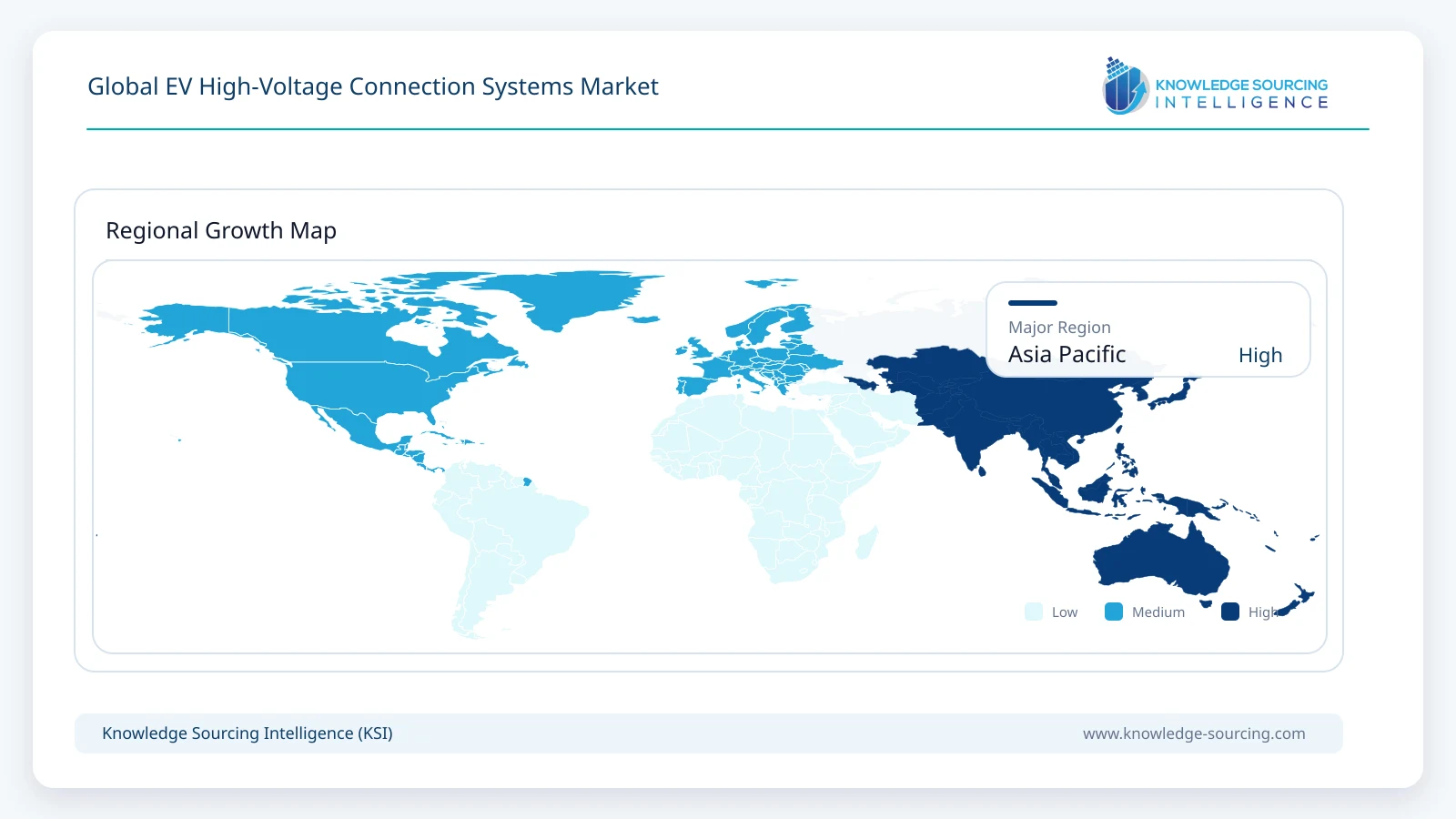
Asia Pacific is the largest regional market for EV high-voltage connection systems because the region contains the majority of global EV production and a dense automotive electronics supply chain. China dominates both passenger EV and electric truck volumes. The International Energy Agency reported that more than 400,000 electric trucks were sold globally in 2025 and that China accounted for more than 90% of those sales. This is particularly important for connection-system suppliers because heavy-duty EVs use higher-current interfaces and more robust cable assemblies than passenger vehicles.
Japan and South Korea contribute established connector, harness and automotive electronics capabilities, while India is becoming increasingly relevant as domestic electric two-wheelers, passenger EVs and commercial vehicles expand. Regional growth is also supported by the transition to higher-voltage architectures and local-for-local component production. Through 2031, Asia Pacific is expected to remain the largest market even as Europe records strong adoption of 800-volt and automation-ready connector platforms.
Competitive Landscape
The competitive landscape includes large global connector manufacturers, automotive wiring-system suppliers and specialist high-voltage connectivity companies. TE Connectivity, Aptiv, Amphenol, Molex, Rosenberger, Yazaki, Sumitomo Wiring Systems, Japan Aviation Electronics, JST, Hirose and HUBER+SUHNER compete across high-voltage automotive interfaces. Chinese suppliers including Yonggui Electric and AVIC Jonhon have also expanded alongside the country's large EV manufacturing base.
Competition increasingly centers on current density, voltage capability, package size, aluminium-conductor compatibility, shielding, sealing and automated assembly. Supplier portfolios are also becoming more segmented between primary drivetrain connections and auxiliary high-voltage interfaces. A strong position therefore depends on having multiple connector classes that can be designed into a common global vehicle platform rather than relying on a single connector family.
Recent Developments
September 2026: Rosenberger introduced the HVR 210, a compact automation-ready automotive connector rated to 1,200 V DC and 208 A at 85 degrees Celsius.
September 2026: Rosenberger introduced HVS 240 and HVS 420 high-voltage connectors for high-performance electric motors, supporting up to 1,200 V DC.
November 2025: Molex introduced the eHV60, the first product in its eHV high-voltage automotive connector portfolio for auxiliary EV applications.
2025: HUBER+SUHNER released a 150 mm² flexible single-core version of its RADOX EV-C 2 connection system for heavy-duty electric vehicle applications.
EV High-Voltage Connection Systems Market Scope
| Report Metric | Details |
|---|---|
| Total Market Size in 2026 | USD 1.18 billion |
| Total Market Size in 2031 | USD 2.28 billion |
| Forecast Unit | Billion |
| Growth Rate | 14.1% |
| Study Period | 2021 to 2031 |
| Historical Data | 2021 to 2024 |
| Base Year | 2025 |
| Forecast Period | 2026 – 2031 |
| Segmentation | Connection Class, Voltage Class, Vehicle Type, Application |
| Companies |
|
Market Segmentation
By Connection Class
High-Current Drivetrain Connections
Auxiliary High-Voltage Connections
Battery and Module Connections
Other High-Voltage Connections
By Voltage Class
Below 400 V
400-600 V
800-1,000 V
Above 1,000 V
By Vehicle Type
Passenger Battery Electric Vehicles
Plug-in Hybrid Electric Vehicles
Commercial Electric Vehicles
Off-Highway Electric Vehicles
By Application
Battery and Power Distribution
Inverter and E-Motor
Onboard Charger and DC/DC Converter
High-Voltage Auxiliary Systems
By Geography
North America
United States
Canada
Mexico
South America
Brazil
Argentina
Rest of South America
Europe
Germany
United Kingdom
France
Italy
Rest of Europe
Middle East and Africa
Saudi Arabia
United Arab Emirates
South Africa
Rest of Middle East and Africa
Asia Pacific
China
Japan
India
South Korea
Rest of Asia Pacific
Table of Contents
1. EXECUTIVE SUMMARY
2. MARKET SNAPSHOT
2.1. Market Overview
2.2. Market Segmentation
3. BUSINESS LANDSCAPE
3.1. Market Drivers
3.1.1. Higher-Voltage Vehicle Architectures Increase Connector Performance Requirements
3.1.2. EV Production Growth Expands the Installed Base of High-Voltage Interfaces
3.1.3. Automation and Platform Standardisation Are Becoming Procurement Priorities
3.2. Market Restraints
3.2.1. Qualification Requirements and Platform Lock-In Slow Supplier Substitution
3.3. Market Opportunities
3.4. Porter's Five Forces Analysis
3.5. Industry Value Chain Analysis
3.6. Automotive Standards and Safety Requirements
4. TECHNOLOGICAL OUTLOOK
4.1. High-Current Drivetrain Interconnections
4.2. Auxiliary High-Voltage Connection Systems
4.3. Cable Glands and Semi-Pluggable Commercial-Vehicle Systems
4.4. 1,000-1,200 V Future Architectures
5. GLOBAL EV HIGH-VOLTAGE CONNECTION SYSTEMS MARKET BY CONNECTION CLASS
5.1. High-Current Drivetrain Connections
5.2. Auxiliary High-Voltage Connections
5.3. Battery and Module Connections
5.4. Other High-Voltage Connections
6. GLOBAL EV HIGH-VOLTAGE CONNECTION SYSTEMS MARKET BY VOLTAGE CLASS
6.1. Below 400 V
6.2. 400-600 V
6.3. 800-1,000 V
6.4. Above 1,000 V
7. GLOBAL EV HIGH-VOLTAGE CONNECTION SYSTEMS MARKET BY VEHICLE TYPE
7.1. Passenger Battery Electric Vehicles
7.2. Plug-in Hybrid Electric Vehicles
7.3. Commercial Electric Vehicles
7.4. Off-Highway Electric Vehicles
8. GLOBAL EV HIGH-VOLTAGE CONNECTION SYSTEMS MARKET BY APPLICATION
8.1. Battery and Power Distribution
8.2. Inverter and E-Motor
8.3. Onboard Charger and DC/DC Converter
8.4. High-Voltage Auxiliary Systems
9. GLOBAL EV HIGH-VOLTAGE CONNECTION SYSTEMS MARKET BY GEOGRAPHY
9.1. North America
9.1.1. United States
9.1.2. Canada
9.1.3. Mexico
9.2. South America
9.2.1. Brazil
9.2.2. Argentina
9.2.3. Rest of South America
9.3. Europe
9.3.1. Germany
9.3.2. United Kingdom
9.3.3. France
9.3.4. Italy
9.3.5. Rest of Europe
9.4. Middle East and Africa
9.4.1. Saudi Arabia
9.4.2. United Arab Emirates
9.4.3. South Africa
9.4.4. Rest of Middle East and Africa
9.5. Asia Pacific
9.5.1. China
9.5.2. Japan
9.5.3. India
9.5.4. South Korea
9.5.5. Rest of Asia Pacific
10. COMPETITIVE ENVIRONMENT AND ANALYSIS
10.1. Major Players and Strategy Analysis
10.2. Market Share Analysis
10.3. Product Launches, Agreements and Collaborations
10.4. Competitive Dashboard
11. COMPANY PROFILES
11.1. TE Connectivity Ltd.
11.2. Aptiv PLC
11.3. Amphenol Corporation
11.4. Molex LLC
11.5. Rosenberger Hochfrequenztechnik GmbH & Co. KG
11.6. Yazaki Corporation
11.7. Sumitomo Wiring Systems, Ltd.
11.8. Japan Aviation Electronics Industry, Ltd.
11.9. JST Mfg. Co., Ltd.
11.10. Hirose Electric Co., Ltd.
11.11. HUBER+SUHNER AG
11.12. Yonggui Electric
11.13. AVIC Jonhon Optronic Technology Co., Ltd.
11.14. ODU GmbH & Co. KG
11.15. BizLink Holding Inc.
11.16. Luxshare Precision Industry Co., Ltd.
11.17. Kostal Kontakt Systeme GmbH
11.18. Lear Corporation
12. RECENT DEVELOPMENTS
13. APPENDIX
13.1. Currency
13.2. Assumptions
13.3. Base and Forecast Years Timeline
13.4. Abbreviations
Navigate
Trusted by the world's leading organizations











