
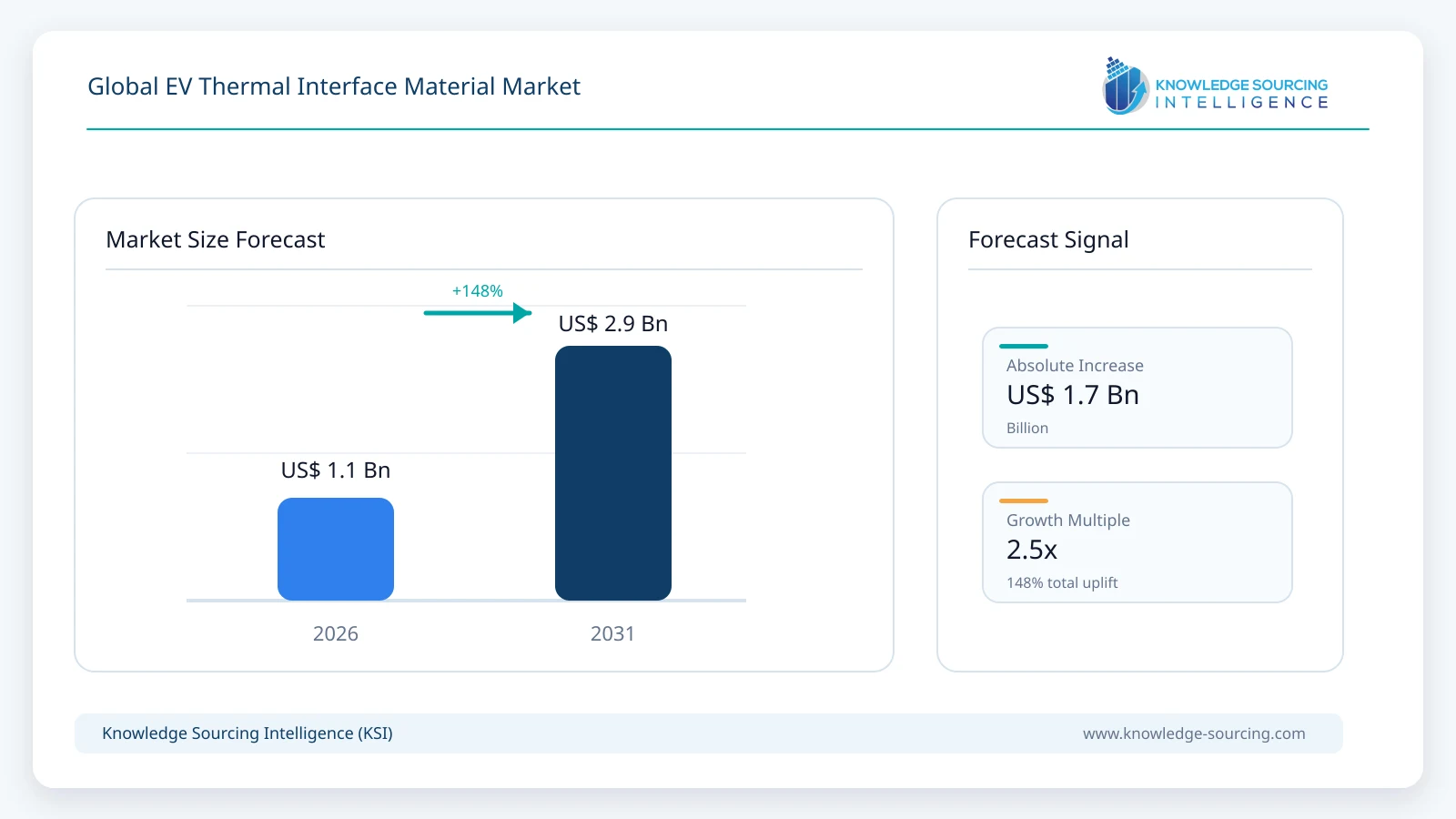
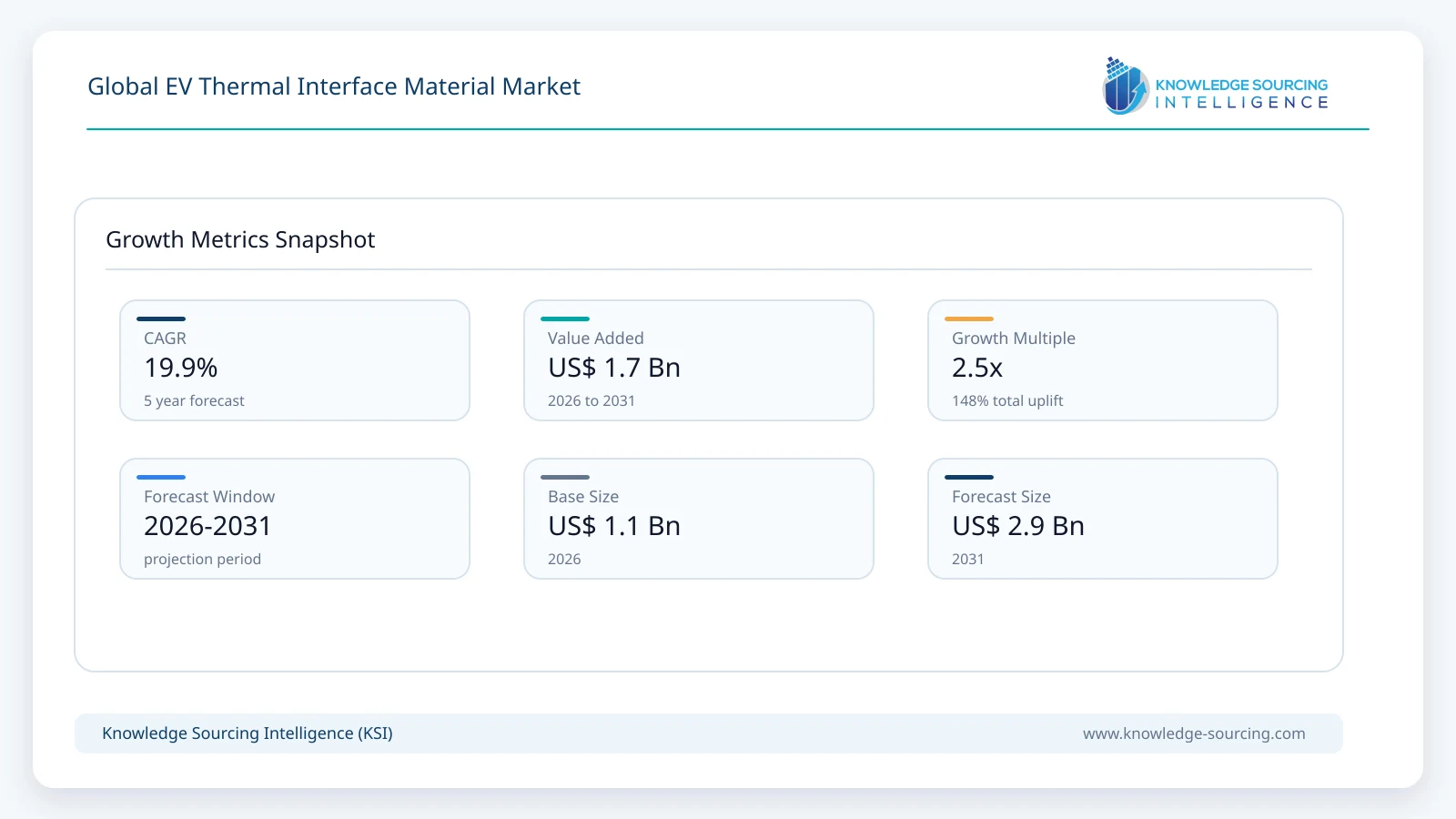
The global EV thermal interface material market is estimated at USD 1.15 billion in 2026 and is projected to reach USD 2.85 billion by 2031, representing a CAGR of 19.9% during the forecast period.
Highlights:
- 1Gap fillers and thermal gels generate approximately USD 621.0 million in global revenue during 2026.
- 2Thermally conductive adhesives are projected to approach USD 0.79 billion by 2031 as structural battery designs expand.
- 3Battery-pack applications generate approximately USD 920.0 million of thermal interface material demand in 2026.
- 4Commercial electric vehicles account for approximately 13% of the 2026 market as large battery packs raise material consumption.
- 5Asia Pacific generates approximately USD 736.0 million of global EV thermal interface material revenue in 2026.
- 6Polyurethane-based thermal interface materials account for approximately 27% of 2026 market revenue as silicone-free adoption rises.
Market Overview
Thermal interface materials have become a distinct value layer within EV thermal management because the cooling system cannot perform effectively when air gaps remain between heat-generating components and cold plates, heat sinks or housings. The battery pack is the largest demand centre. Large-area gap fillers are dispensed between cell or module assemblies and cooling plates to compensate for dimensional tolerances and maintain a continuous heat-transfer path. Thermally conductive adhesives increasingly perform both heat-transfer and structural functions in cell-to-pack and cell-to-chassis designs, while pads, films and gels remain important where reworkability, controlled thickness or low compression force are priorities.
Market scale is being supported by rapid EV battery deployment. The International Energy Agency reported 1.2 TWh of EV battery deployment in 2025, almost 30% above 2024, with light-duty vehicles accounting for more than 85% of deployment. Global electric-car sales exceeded 20 million in 2025 and are expected to reach approximately 23 million in 2026. Material intensity varies considerably by pack architecture: production guidance from Atlas Copco indicates that some battery packs can use up to five litres, or approximately 15 kg, of thermal interface material. This makes TIM demand sensitive not only to EV units but also to pack size, cooling architecture, interface thickness and the transition toward larger bonded surfaces.
The market remains materially narrower than the broader EV thermal management systems industry. Thermal interface materials do not include heat pumps, coolant circuits, cold plates, pumps, chillers or cabin heating and cooling hardware. Their value instead lies in the physical interface between a hot component and the structure that removes heat. This makes the competitive set more heavily weighted toward specialty chemical, adhesive, silicone and engineered-material suppliers than toward automotive thermal-system integrators.
Market Dynamics
Higher Battery Energy Density and Fast Charging Increase Interface Heat Loads
The most direct demand driver is the rise in thermal load per battery pack. Higher-energy-density cells concentrate more stored energy into less space, while high-rate direct-current charging increases resistive heating during short charging windows. The thermal path between cells and the cold plate therefore becomes more important to vehicle charging performance, battery life and safety. Suppliers are responding with higher-conductivity materials, lower bond-line thickness, improved dielectric properties and formulations that can maintain contact through repeated thermal cycling. Henkel's July 2026 automotive-electronics launch reached 6.5 W/mK thermal conductivity, while Parker Chomerics has introduced cure-in-place materials at 6.0 W/mK and pads at 7.0 W/mK, illustrating the upward performance trend.
Cell-to-Pack and Cell-to-Chassis Architectures Raise Material Functionality
Structural battery integration is increasing the value of thermally conductive adhesives. Traditional packs relied on discrete modules that could be mechanically fastened to a cooling structure. Cell-to-pack and cell-to-chassis architectures remove intermediate structures and require materials to maintain thermal contact while also contributing to bonding, crash durability, vibration resistance and electrical insulation. This favours polyurethane and other multifunctional adhesive systems, particularly where manufacturers want to reduce part count and automate assembly. Dow's VORATRON MA 8300 series and Henkel's Loctite TLB 9270APS are examples of products designed for integrated battery bonding and thermal management.
EV Battery Deployment Expands the Addressable Material Base
EV battery deployment reached 1.2 TWh in 2025 and is expected by the International Energy Agency to approach 3 TWh by 2030. China accounted for around 60% of global deployment in 2025, the European Union for almost 15% and the United States for around 10%. As deployment grows, TIM consumption expands with both battery capacity and the number of thermal interfaces within packs and power electronics. Commercial vehicles are increasingly important because electric-truck battery demand more than doubled in 2025, creating a disproportionately large material requirement per vehicle compared with passenger cars.
Material Cost, Weight and Dispensing Efficiency Remain Important Constraints
TIMs improve thermal performance but can add meaningful mass and cost when applied across large battery surfaces. Atlas Copco notes that some batteries can use up to five litres of thermal interface compound, equivalent to as much as 15 kg of additional material, with indicative costs around EUR 10 per kilogram. This creates strong pressure to optimize bead geometry, interface thickness and dispensing accuracy. Materials also need to cure fast enough for automotive takt times without generating excessive equipment wear, voids or rework. Formulations that achieve higher conductivity at lower density therefore gain an economic advantage beyond their thermal performance.
Automotive Qualification and Material Compatibility Slow Supplier Switching
EV thermal interface materials operate alongside aluminum cooling plates, coated cells, polymers, busbars, electrical insulation and sensitive electronics. A change in chemistry can affect adhesion, corrosion, dielectric performance, outgassing, serviceability and long-term thermal resistance. Qualification cycles are therefore lengthy, particularly for materials used directly inside high-voltage battery packs. Silicone migration or contamination concerns also encourage silicone-free alternatives in selected applications, while repairability requirements are increasing interest in materials that can be removed or debonded without damaging high-value battery components.
Technological Outlook
High-Conductivity Dispensable Gap Fillers
Dispensable two-component gap fillers are becoming the default solution for large, irregular battery interfaces because they can accommodate manufacturing tolerances without imposing the compression forces associated with thicker pads. High-throughput dispensing, low abrasion and stable rheology are increasingly as important as conductivity. Current commercial portfolios span roughly 1.5 W/mK to above 6 W/mK for automotive use, allowing OEMs to balance material cost, interface thickness and cooling requirements.
Silicone-Free Polyurethane and Hybrid Systems
Silicone remains the dominant chemistry because of thermal stability, flexibility and proven automotive reliability, but polyurethane and other silicone-free formulations are gaining share. Their adoption is strongest where manufacturers require structural bonding, lower density or reduced risk of silicone contamination. Henkel's 2026 battery launch combined a silicone-free gap filler with a polyurethane thermally conductive adhesive, while Dow's polyurethane adhesive series targets cell-to-module, cell-to-pack and cell-to-chassis designs.
Repairable and Debondable Thermal Interfaces
Circularity is creating a new performance requirement: thermal materials must increasingly support disassembly as well as assembly. Battery repair, second-life use and recycling are difficult when thermally conductive structural adhesives permanently bond cells to pack structures. Suppliers are therefore developing debond-on-demand concepts, removable interface materials and formulations that preserve thermal contact while reducing pull-out force. These technologies are likely to remain a minority of 2026 demand but become more commercially important as battery-service and recycling requirements mature.
Segment Analysis
By Product Form - Gap Fillers and Thermal Gels
Gap fillers and thermal gels are the largest product-form segment, accounting for approximately 54% of global EV thermal interface material revenue in 2026. Their position reflects the large surface area between battery modules or cell assemblies and liquid-cooled plates, where rigid contact cannot be maintained across manufacturing tolerances. Dispensable systems support automated high-volume production and can conform around irregular surfaces without creating high compression forces. The format also extends into inverters, converters and on-board chargers where compact components create localized thermal loads.
By Product Form - Thermally Conductive Adhesives
Thermally conductive adhesives are forecast to record the fastest product-form growth, at approximately 24.5% CAGR through 2031. Their commercial advantage increases as pack architecture shifts from separately fastened modules toward cell-to-pack and cell-to-chassis structures. The material performs two functions simultaneously: transferring heat to the cooling structure and securing cells or modules mechanically. This can reduce fasteners and intermediate structures, although repairability and recycling requirements create a parallel need for controlled debonding technologies.
By Chemistry - Silicone-based Materials
Silicone-based materials remain the largest chemistry, accounting for approximately 57% of 2026 market revenue. Silicone systems tolerate wide temperature ranges, remain compliant under vibration and thermal cycling, and can be formulated across a broad conductivity range. They are particularly established in gap fillers, gels, pads and power-electronics interfaces. Their position is strongest where long-term reliability and low mechanical stress matter more than structural bonding.
By Chemistry - Polyurethane-based Materials
Polyurethane-based TIMs are expected to grow at approximately 23.5% CAGR through 2031, supported by thermally conductive structural adhesives and silicone-free battery formulations. The chemistry is attractive for large bonded surfaces because density, cure profile, elasticity and mechanical strength can be tailored alongside heat-transfer performance. Cell-to-pack manufacturing is therefore creating a wider addressable role for polyurethane than conventional module-based battery designs.
By Application - Battery Packs
Battery packs account for approximately 80% of global EV thermal interface material revenue in 2026. The segment combines the industry's largest thermal-interface area with the highest material volume per vehicle. TIMs are used between cells or modules and cold plates, around selected busbars and electronics, and increasingly as multifunctional bonding layers. Power electronics remain a smaller but technically demanding application because silicon carbide inverters, direct-current converters and on-board chargers require high conductivity within constrained spaces.
By Vehicle Type - Passenger Electric Vehicles
Passenger electric vehicles remain the largest vehicle segment, representing approximately 82% of 2026 market revenue because they account for most global EV battery deployment and vehicle production. Battery electric cars create the greatest TIM opportunity within passenger vehicles due to larger pack capacities than plug-in hybrids. The segment's material intensity rises further in premium and performance vehicles using high-rate charging and large battery packs.
By Vehicle Type - Commercial Electric Vehicles
Commercial electric vehicles are forecast to grow fastest, at approximately 27.0% CAGR through 2031. Electric trucks and buses use large battery packs, high continuous power and demanding duty cycles, creating more thermal-interface area per vehicle. The International Energy Agency reported that electric-truck battery demand more than doubled in 2025. Although commercial EV unit volumes remain much smaller than passenger cars, their material consumption per vehicle makes them increasingly important to TIM suppliers.
Market and Demand Indicators
Indicator | Latest Development | Market Impact |
EV battery deployment | 1.2 TWh in 2025, up almost 30% year on year. | Expands the physical battery area requiring thermal interfaces. |
2026 electric-car sales | IEA expects approximately 23 million vehicles. | Raises annual TIM volume across batteries and power electronics. |
Battery TIM intensity | Some pack designs use up to 5 litres / 15 kg of TIM. | Shows why large packs can carry substantial material value. |
New battery TIM | Henkel launched TGF 2030APS and TLB 9270APS in May 2026. | Confirms shift toward silicone-free and multifunctional materials. |
Higher-conductivity TIM | Henkel launched 6.5 W/mK TGF 6500LVO in July 2026. | Supports rising heat flux in compact EV electronics. |
Integrated adhesives | Dow VORATRON MA 8300 targets CTP and CTC battery bonding. | Links structural integration directly with thermal management. |
Asia Pacific Market Analysis
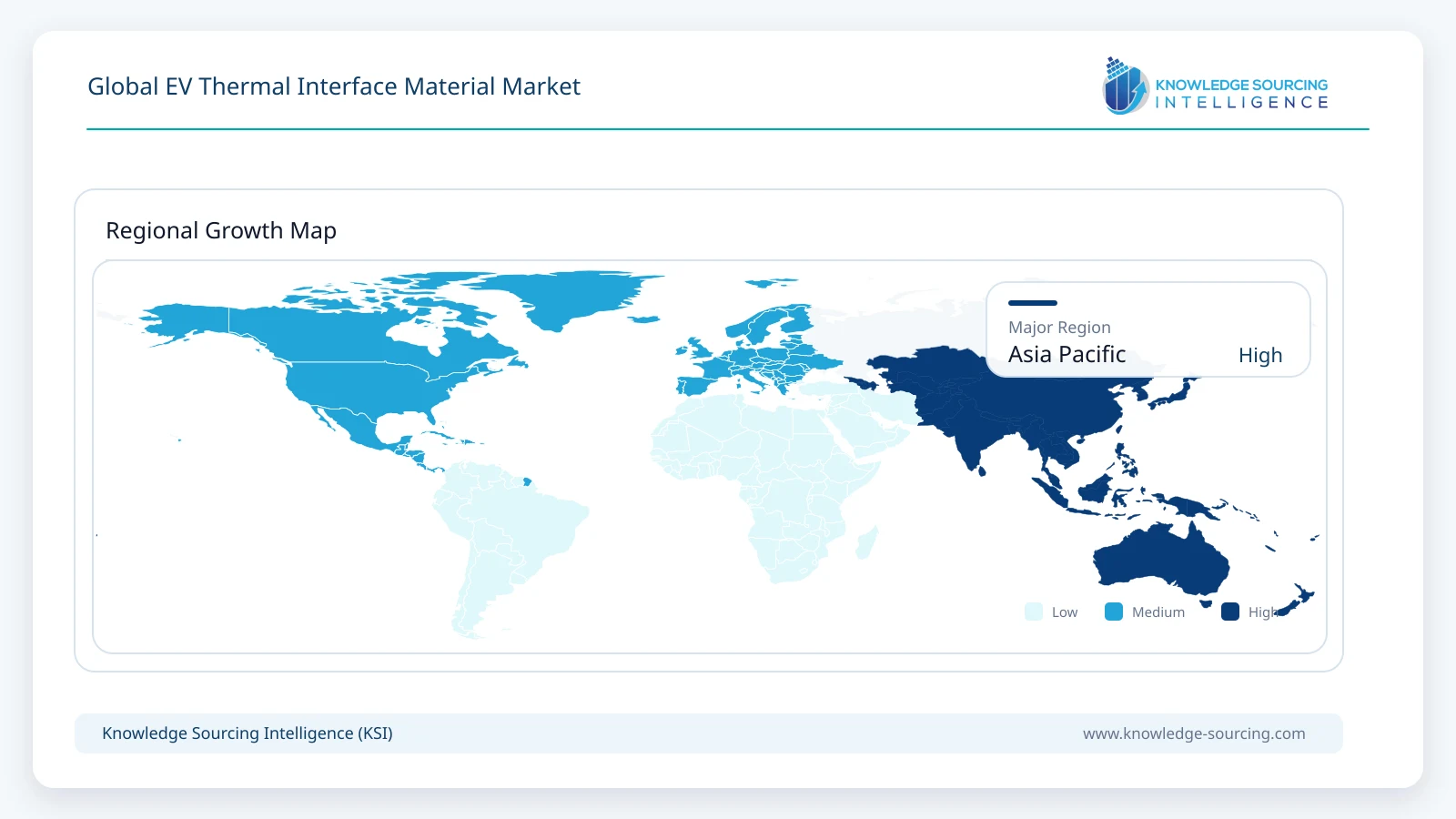
Asia Pacific is the largest regional market, accounting for approximately 64% of global EV thermal interface material revenue in 2026. China is the principal demand centre because it represented around 60% of worldwide EV battery deployment in 2025 and hosts the industry's deepest battery-cell, pack and electric-vehicle manufacturing ecosystem. The region also contains major thermal-material manufacturing capacity across China, Japan, South Korea and Southeast Asia. This proximity allows TIM suppliers to work directly with battery and vehicle manufacturers on dispensing process, cure profile, interface thickness and automotive qualification.
Regional demand is evolving from conventional module-based gap filling toward integrated pack architectures and higher-performance power electronics. Chinese cell-to-pack designs, larger lithium iron phosphate packs and rapid charging increase the need for large-area thermal interfaces, while Japanese and South Korean material suppliers remain important in silicone, engineered films and specialty electronic materials. Asia Pacific is also forecast to remain the fastest-growing major region, at roughly 21% CAGR through 2031, because EV battery deployment continues to expand across China, India and Southeast Asia while regional supply chains deepen.
Competitive Landscape
Competition spans global adhesive suppliers, silicone producers, engineered polymer companies and specialist thermal-management material manufacturers. Henkel is strongly positioned in liquid gap fillers and thermally conductive adhesives through the Bergquist and Loctite portfolios. Dow combines DOWSIL silicone gap fillers with VORATRON polyurethane battery adhesives, while DuPont offers BETATECH and thermally conductive structural adhesives. Parker Chomerics competes across pads, gels and cure-in-place materials, and Wacker, Shin-Etsu and Momentive bring vertically integrated silicone chemistry. Sika, Saint-Gobain, 3M, H.B. Fuller, Huntsman, Boyd and Fujipoly broaden the field across battery bonding, pads, films and specialty interfaces.
Competitive advantage increasingly depends on more than headline thermal conductivity. Automotive customers evaluate dispensing speed, filler abrasiveness, density, bond-line control, dielectric strength, flame performance, long-term compression set, pump-out resistance and compatibility with automated manufacturing. Suppliers that can support OEM design simulation, dispensing-process optimization and regional technical service are therefore better positioned than vendors offering commodity conductive compounds alone.
Recent Developments
July 2026: Henkel launched Bergquist TGF 6500LVO, a 6.5 W/mK low-volatile silicone thermal gap filler for demanding automotive electronics and power-conversion applications.
July 2026: Mouser Electronics announced a global distribution agreement with Parker Chomerics covering high-performance thermal interface materials and EMI shielding solutions.
May 2026: Henkel launched Bergquist TGF 2030APS silicone-free battery gap filler and Loctite TLB 9270APS polyurethane thermally conductive adhesive for EV battery systems.
May 2026: Henkel presented expanded battery specialty tapes, functional coatings and debonding technologies at The Battery Show Europe 2026.
2026: Dow VORATRON MA 8300 thermally conductive polyurethane adhesive series received a BIG Innovation Award for EV and energy-storage battery assembly.
2026: Parker Chomerics expanded its thermal interface material portfolio across new gap pads, gels, dispensable gap fillers and greases.
EV Thermal Interface Material Market Scope
| Report Metric | Details |
|---|---|
| Total Market Size in 2026 | USD 1.15 billion |
| Total Market Size in 2031 | 2.85 billion |
| Forecast Unit | Billion |
| Growth Rate | 19.9% |
| Study Period | 2021 to 2031 |
| Historical Data | 2021 to 2024 |
| Base Year | 2025 |
| Forecast Period | 2026 – 2031 |
| Segmentation | Product Form, Chemistry, Application, Vehicle Type, Geography |
| Companies |
|
Market Segmentation
By Product Form
Gap Fillers and Thermal Gels
Thermally Conductive Adhesives
Thermal Pads and Films
Thermal Greases and Phase-Change Materials
Others
By Chemistry
Silicone-based
Polyurethane-based
Epoxy and Acrylic-based
Others
By Application
Battery Packs
Power Electronics
E-Drive and Motor Systems
On-Board Chargers and DC-DC Converters
Others
By Vehicle Type
Passenger Electric Vehicles
Commercial Electric Vehicles
Electric Two- and Three-Wheelers
By Geography
North America
United States
Canada
Mexico
South America
Brazil
Argentina
Rest of South America
Europe
Germany
France
United Kingdom
Italy
Rest of Europe
Middle East and Africa
Saudi Arabia
United Arab Emirates
South Africa
Rest of Middle East and Africa
Asia Pacific
China
Japan
South Korea
India
Rest of Asia Pacific
Table of Contents
1. EXECUTIVE SUMMARY
2. MARKET SNAPSHOT
2.1. Market Overview
2.2. Market Segmentation
3. BUSINESS LANDSCAPE
3.1. Market Drivers
3.1.1. Higher Battery Energy Density and Fast Charging Increase Interface Heat Loads
3.1.2. Cell-to-Pack and Cell-to-Chassis Architectures Raise Material Functionality
3.1.3. EV Battery Deployment Expands the Addressable Material Base
3.2. Market Restraints
3.2.1. Material Cost, Weight and Dispensing Efficiency Remain Important Constraints
3.2.2. Automotive Qualification and Material Compatibility Slow Supplier Switching
3.3. Market Opportunities
3.4. Porter's Five Forces Analysis
3.5. Industry Value Chain Analysis
3.6. Regulatory Landscape
4. TECHNOLOGICAL OUTLOOK
4.1. High-Conductivity Dispensable Gap Fillers
4.2. Silicone-Free Polyurethane and Hybrid Systems
4.3. Repairable and Debondable Thermal Interfaces
5. GLOBAL EV THERMAL INTERFACE MATERIAL MARKET BY PRODUCT FORM
5.1. Gap Fillers and Thermal Gels
5.2. Thermally Conductive Adhesives
5.3. Thermal Pads and Films
5.4. Thermal Greases and Phase-Change Materials
5.5. Others
6. GLOBAL EV THERMAL INTERFACE MATERIAL MARKET BY CHEMISTRY
6.1. Silicone-based
6.2. Polyurethane-based
6.3. Epoxy and Acrylic-based
6.4. Others
7. GLOBAL EV THERMAL INTERFACE MATERIAL MARKET BY APPLICATION
7.1. Battery Packs
7.2. Power Electronics
7.3. E-Drive and Motor Systems
7.4. On-Board Chargers and DC-DC Converters
7.5. Others
8. GLOBAL EV THERMAL INTERFACE MATERIAL MARKET BY VEHICLE TYPE
8.1. Passenger Electric Vehicles
8.2. Commercial Electric Vehicles
8.3. Electric Two- and Three-Wheelers
9. GLOBAL EV THERMAL INTERFACE MATERIAL MARKET BY GEOGRAPHY
9.1. North America
9.1.1. United States
9.1.2. Canada
9.1.3. Mexico
9.2. South America
9.2.1. Brazil
9.2.2. Argentina
9.2.3. Rest of South America
9.3. Europe
9.3.1. Germany
9.3.2. France
9.3.3. United Kingdom
9.3.4. Italy
9.3.5. Rest of Europe
9.4. Middle East and Africa
9.4.1. Saudi Arabia
9.4.2. United Arab Emirates
9.4.3. South Africa
9.4.4. Rest of Middle East and Africa
9.5. Asia Pacific
9.5.1. China
9.5.2. Japan
9.5.3. South Korea
9.5.4. India
9.5.5. Rest of Asia Pacific
10. COMPETITIVE ENVIRONMENT AND ANALYSIS
10.1. Major Players and Strategy Analysis
10.2. Market Share Analysis
10.3. Mergers, Acquisitions, Agreements and Collaborations
10.4. Competitive Dashboard
11. COMPANY PROFILES
11.1. Henkel AG & Co. KGaA
11.2. Dow Inc.
11.3. Parker Hannifin Corporation (Chomerics)
11.4. DuPont
11.5. Wacker Chemie AG
11.6. Shin-Etsu Chemical Co., Ltd.
11.7. Sika AG
11.8. Saint-Gobain
11.9. 3M
11.10. Momentive Performance Materials
11.11. H.B. Fuller Company
11.12. Huntsman Corporation
11.13. Boyd Corporation
11.14. Fujipoly
11.15. Panasonic Industry Co., Ltd.
11.16. T-Global Technology
11.17. Sekisui Chemical Co., Ltd.
11.18. Elkem ASA
12. RECENT DEVELOPMENTS
13. APPENDIX
13.1. Currency
13.2. Assumptions
13.3. Base and Forecast Years Timeline
13.4. Research Methodology
13.5. Abbreviations
Navigate
Trusted by the world's leading organizations











