
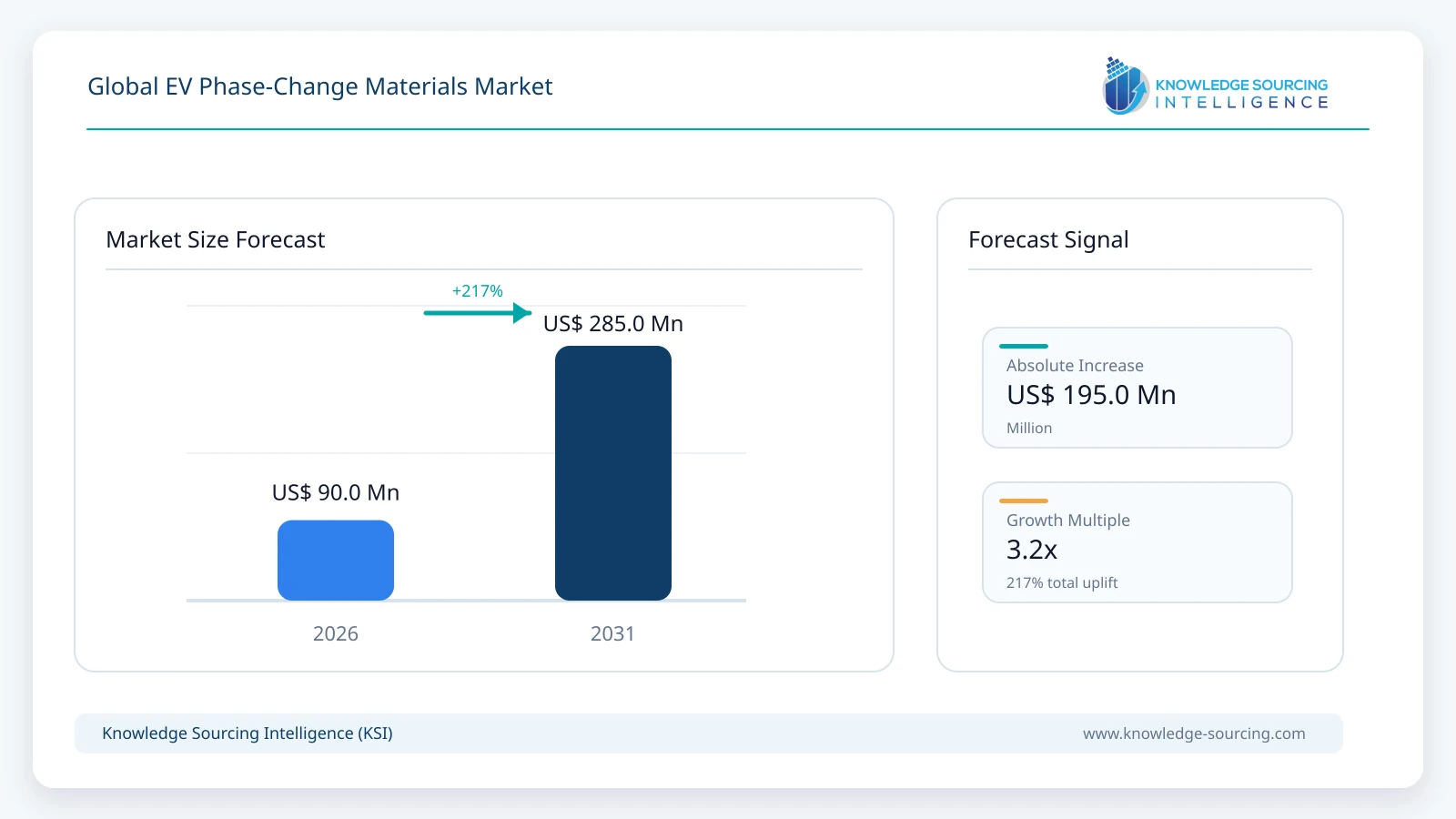
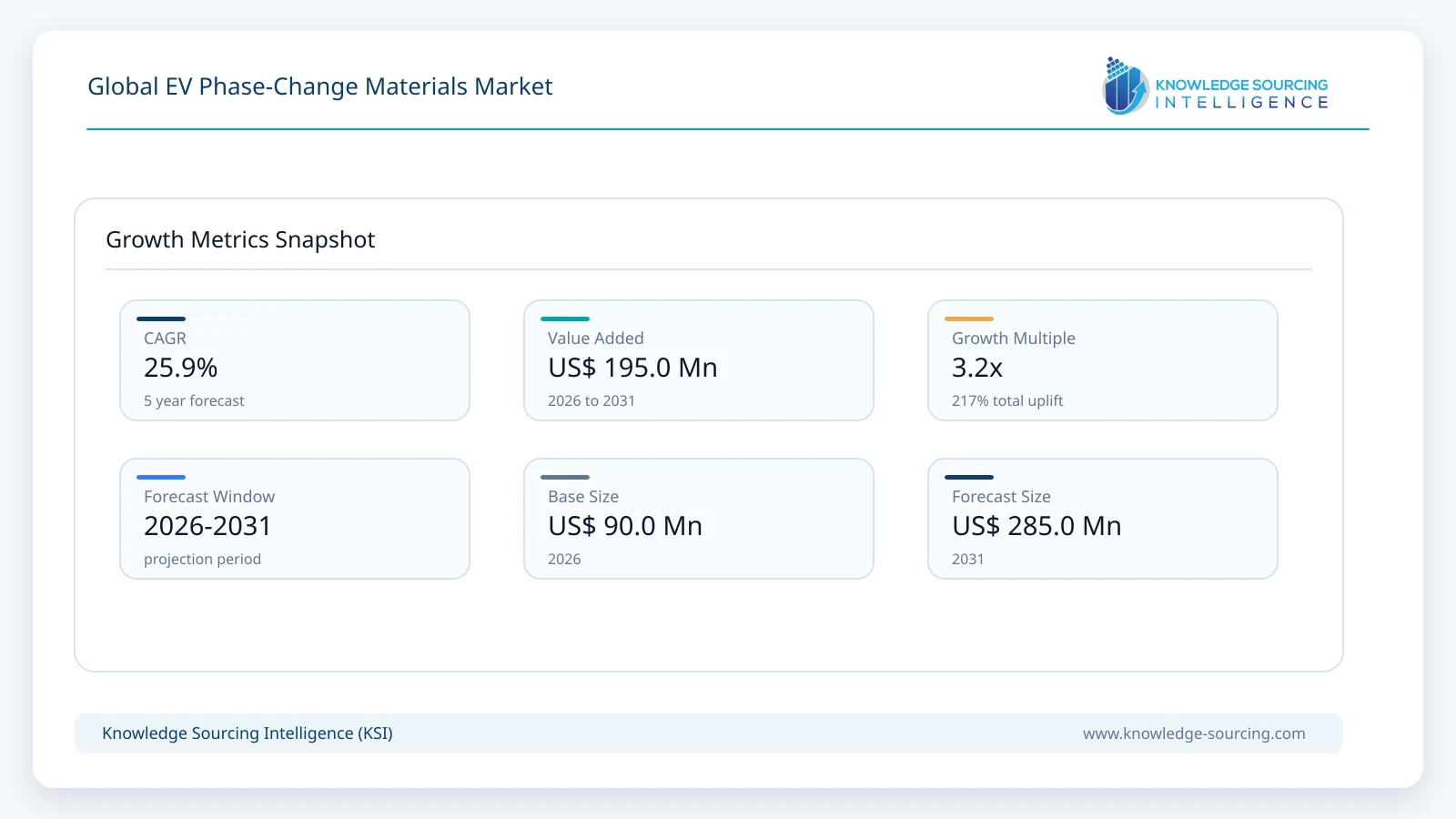
The global EV phase-change materials market is estimated at USD 90.0 million in 2026 and is projected to reach USD 285.0 million by 2031, at a CAGR of 25.9% during the forecast period.
Highlights:
- 1Organic phase-change materials account for approximately 52% of global EV PCM revenue in 2026.
- 2Composite and conductivity-enhanced PCMs generate approximately USD 30.6 million in revenue during 2026.
- 3Battery-pack thermal management grows at approximately 27.5% CAGR through 2031.
- 4Passenger battery electric vehicles account for approximately USD 64.8 million of market revenue in 2026.
- 5Commercial electric vehicle applications grow at approximately 30.0% CAGR through 2031.
- 6Asia Pacific represents approximately 58% of the global EV phase-change materials market in 2026.
- 7Hybrid PCM-liquid cooling designs gain attention as manufacturers seek lower peak temperatures with reduced active-cooling load.
Market Overview
Phase-change materials regulate heat by absorbing latent energy as they transition between solid and liquid, solid and solid, or other engineered states. In EV batteries, the material can be positioned around cells, modules or thermal interfaces to absorb short-duration heat spikes and reduce temperature gradients. Unlike pumps or refrigeration loops, the material itself does not consume electrical power during the phase transition. This creates an efficiency advantage in conditions where thermal peaks are intermittent rather than continuous.
The technology is most relevant where passive control can reduce the burden on active cooling without replacing it entirely. A 2025 SAE study found that a hybrid system combining PCM and liquid cold plates limited battery temperature more effectively than liquid cooling alone under the tested conditions. Another 2025 SAE study on bio-based composite PCM showed that adding PCM and copper fins reduced cell surface temperatures under higher discharge rates. These results support the commercial direction toward hybrid architectures rather than stand-alone PCM cooling in high-power EVs.
The market excludes ordinary thermal interface materials, conventional coolant fluids, cold plates, heat pumps and complete battery thermal-management systems. It includes only the PCM material and directly attributable encapsulation or conductivity-enhancement layers used to provide latent-heat buffering. This keeps the market distinct from KSI's EV battery-cooling reports and from broader thermal interface material markets.
Market Dynamics
Higher Battery Power Density Increases the Value of Thermal Buffering
EV batteries are being designed for faster charging, higher continuous power and more compact packaging. These trends increase local heat generation and temperature gradients, especially during high-rate charge and discharge. Phase-change materials can absorb short thermal peaks and delay the point at which active cooling must operate at full capacity. The value proposition becomes stronger as OEMs seek to reduce auxiliary energy consumption while preserving battery life.
Hybrid Cooling Architectures Improve Commercial Relevance
Research and prototype activity increasingly combines PCM with liquid cold plates, fins, graphite structures or heat pipes. Hybrid designs address the key weakness of many PCMs: low thermal conductivity. The combination allows latent heat to absorb thermal spikes while conductive structures and liquid loops remove stored heat over a longer period. This makes PCM more practical for high-power EV use than passive material alone.
Material Engineering Is Expanding Beyond Conventional Paraffin
Organic paraffin-based PCMs remain the most widely studied class because of chemical stability and predictable transition temperatures. However, development is broadening toward bio-based materials, salt hydrates, eutectic systems and graphite-enhanced composites. Conductivity-enhanced formulations are especially important because they improve heat transfer into and out of the PCM without losing the latent-heat advantage.
Weight, Packaging and Re-Solidification Remain Commercial Constraints
PCM adds material mass and occupies pack volume, while repeated melting and re-solidification can complicate mechanical design. Passive PCM also requires a path to reject stored heat after a high-load event. These constraints mean the technology is more likely to complement active cooling than fully replace it in mainstream passenger EVs. Commercial adoption will therefore depend on whether the reduction in cooling-system load and temperature peaks justifies the added material and packaging cost.
Technological Outlook
Organic Phase-Change Materials
Organic PCMs, particularly paraffin-based formulations, offer chemically stable melting behavior and are available across useful automotive temperature ranges. Their main limitation is relatively low thermal conductivity, which is commonly addressed through graphite, metallic foams, fins or other heat-spreading structures.
Inorganic and Eutectic Materials
Inorganic PCMs can provide higher latent heat density and different phase-transition characteristics, but issues such as corrosion, phase separation and supercooling can complicate automotive use. Eutectic systems allow transition temperatures to be tailored more precisely and may gain relevance in specialised pack designs.
Composite and Conductivity-Enhanced PCM
Composite PCM is becoming one of the most commercially important development areas. Expanded graphite, carbon structures, metal foams and encapsulation can improve thermal conductivity, structural stability and integration into battery modules. These enhancements raise material cost but reduce the performance gap between passive PCM and active cooling.
Hybrid PCM-Liquid Cooling
Hybrid architectures combine PCM's ability to absorb transient heat with the sustained heat-removal capability of liquid cooling. This arrangement can reduce maximum cell temperature and improve temperature uniformity while allowing the active system to operate less aggressively under moderate loads.
Segment Analysis
By Material Type - Organic PCM
Organic phase-change materials generate approximately USD 46.8 million in 2026 and are projected to grow at around 23.5% CAGR through 2031. Paraffin-based materials dominate current research and prototype activity because of their stable phase-change behaviour and availability across relevant operating temperatures. Their future share will depend on continued improvements in conductivity and flame-resistance performance.
By Material Type - Composite and Conductivity-Enhanced PCM
Composite and conductivity-enhanced materials account for approximately 34% of the market in 2026 and are projected to expand at around 29.5% CAGR through 2031. These formulations are gaining attention because graphite, fins and other conductive structures address the slow heat-transfer characteristics of unmodified PCM while preserving latent-heat storage.
By Application - Battery-Pack Thermal Management
Battery-pack applications account for approximately 81% of global revenue in 2026 and are projected to approach USD 240 million by 2031. The segment includes PCM positioned around cells, modules and thermal spreaders to control temperature rise and improve uniformity. Power-electronics applications remain smaller but may grow as compact inverter and charger designs increase thermal density.
By Vehicle Type - Passenger Battery Electric Vehicles
Passenger BEVs account for approximately 72% of the market in 2026 and are projected to grow at roughly 24.5% CAGR through 2031. Adoption is concentrated in high-performance, premium and advanced battery-pack designs where the value of thermal uniformity and reduced peak load can justify added material cost.
By Vehicle Type - Commercial Electric Vehicles
Commercial EV applications account for approximately 15% of the market in 2026 and are projected to reach about USD 50 million by 2031. Longer duty cycles, higher battery throughput and repeated fast charging create a stronger need for thermal buffering, especially where active cooling systems operate near continuous load.
By Geography - Asia Pacific
Asia Pacific generates approximately USD 52.2 million in 2026 and is projected to grow at around 26.8% CAGR through 2031. China leads because of its large EV and battery-manufacturing base, while Japan and South Korea contribute materials, electronics and battery engineering capabilities. India is emerging as a research and pilot market alongside rapid EV production growth.
Market and Demand Indicators
Indicator | Latest Development | Market Impact |
Hybrid PCM cooling | A 2025 SAE study found PCM plus liquid cooling limited pack temperature more effectively than liquid cooling alone in the tested configuration. | Supports hybrid rather than PCM-only commercialization. |
Bio-based PCM | A 2025 SAE study found bio-based composite PCM with copper fins improved cell temperature control at high discharge rates. | Broadens the materials pipeline beyond conventional paraffin. |
Reduced active cooling | A 2025 SAE assessment reported up to 80% longer operation without active cooling in the modeled case using a suitable PCM. | Strengthens the energy-efficiency case for complementary PCM use. |
Research direction | A 2026 review compared organic, inorganic and eutectic PCMs under EV-relevant battery conditions. | Shows the category is moving toward structured material benchmarking. |
Commercial application | Henkel markets phase-change materials for EV power-conversion thermal interfaces. | Confirms automotive use beyond battery-only research. |
Asia Pacific Market Analysis
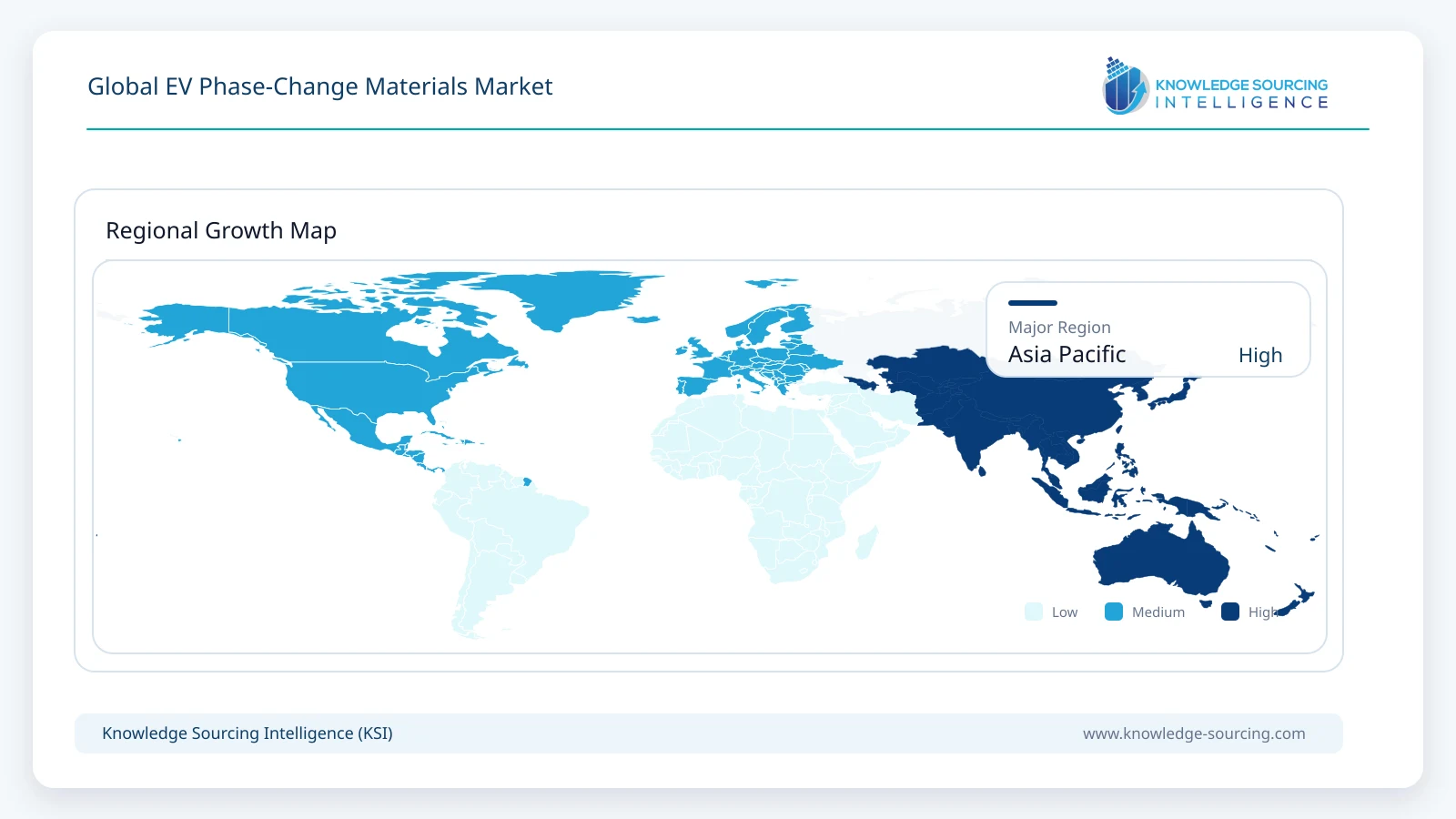
Asia Pacific is the largest EV phase-change materials market because the region contains the highest concentration of electric vehicle production, lithium-ion battery manufacturing and thermal-management engineering. China is the principal volume market, supported by large battery and vehicle platforms. Japan and South Korea contribute advanced materials, battery chemistry and electronics expertise, while India is increasingly visible in PCM-based battery thermal-management research and engineering.
The region's advantage is especially important for composite PCM because battery makers and materials suppliers can co-develop pack structures, thermal spreaders and encapsulated materials close to final vehicle production. As EV charging rates and pack density increase, Asia Pacific is expected to remain the main test bed for high-volume thermal-management material integration through 2031.
Competitive Landscape
The competitive environment includes specialty chemical suppliers, thermal-interface material producers, advanced materials companies and automotive thermal-management specialists. Henkel has direct automotive exposure through phase-change thermal interface products for EV power conversion. Other relevant participants include Parker LORD, Boyd, Croda, Honeywell, Climator, Rubitherm, Pluss Advanced Technologies, PureTemp and PCM Products, alongside graphite, encapsulation and thermal-composite suppliers.
Competition is driven by phase-transition temperature, latent heat capacity, thermal conductivity, flammability, cycle stability, packaging compatibility and ease of integration. Suppliers that can provide encapsulated or structurally stable composite PCM are better positioned for automotive adoption because OEMs require repeatable material behaviour over long service lives.
Recent Developments
June 2026: A systematic review in the World Electric Vehicle Journal compared organic, inorganic and eutectic PCMs for EV battery thermal-management applications.
October 2025: Materials published a review of advanced EV battery thermal-management systems, identifying PCM as a key passive thermal-management strategy.
September 2025: SAE published a critical assessment of PCM for EV efficiency, including modeled reductions in active-cooling operation.
April 2025: SAE published research on bio-based composite PCM with copper fins for EV battery thermal management.
February 2025: SAE published a study evaluating PCM integrated with liquid cold plates in an EV battery thermal-management system.
EV Phase-Change Materials Market Scope
| Report Metric | Details |
|---|---|
| Total Market Size in 2026 | USD 90.0 million |
| Total Market Size in 2031 | USD 285.0 million |
| Forecast Unit | Million |
| Growth Rate | 25.9% |
| Study Period | 2021 to 2031 |
| Historical Data | 2021 to 2024 |
| Base Year | 2025 |
| Forecast Period | 2026 – 2031 |
| Segmentation | Material Type, Application, Vehicle Type, Form, Geography |
| Companies |
|
Market Segmentation
By Material Type
Organic PCM
Inorganic PCM
Eutectic PCM
Composite / Enhanced PCM
By Application
Battery-Pack Thermal Management
Power Electronics
Other EV Thermal Applications
By Vehicle Type
Passenger Battery Electric Vehicles
Plug-in Hybrid Electric Vehicles
Commercial Electric Vehicles
Electric Two-Wheelers and Three-Wheelers
By Form
Bulk / Molded PCM
Encapsulated PCM
Composite Sheets and Pads
Other Forms
By Geography
North America
United States
Canada
Mexico
South America
Brazil
Argentina
Rest of South America
Europe
Germany
United Kingdom
France
Italy
Rest of Europe
Middle East and Africa
Saudi Arabia
United Arab Emirates
South Africa
Rest of Middle East and Africa
Asia Pacific
China
Japan
India
South Korea
Rest of Asia Pacific
Table of Contents
1. EXECUTIVE SUMMARY
2. MARKET SNAPSHOT
2.1. Market Overview
2.2. Market Segmentation
3. BUSINESS LANDSCAPE
3.1. Market Drivers
3.1.1. Higher Battery Power Density Increases the Value of Thermal Buffering
3.1.2. Hybrid Cooling Architectures Improve Commercial Relevance
3.1.3. Material Engineering Is Expanding Beyond Conventional Paraffin
3.2. Market Restraints
3.2.1. Weight, Packaging and Re-Solidification Remain Commercial Constraints
3.3. Market Opportunities
3.4. Porter's Five Forces Analysis
3.5. Industry Value Chain Analysis
3.6. Automotive Safety and Material Requirements
4. TECHNOLOGICAL OUTLOOK
4.1. Organic Phase-Change Materials
4.2. Inorganic and Eutectic Materials
4.3. Composite and Conductivity-Enhanced PCM
4.4. Hybrid PCM-Liquid Cooling
5. GLOBAL EV PHASE-CHANGE MATERIALS MARKET BY MATERIAL TYPE
5.1. Organic PCM
5.2. Inorganic PCM
5.3. Eutectic PCM
5.4. Composite / Enhanced PCM
6. GLOBAL EV PHASE-CHANGE MATERIALS MARKET BY APPLICATION
6.1. Battery-Pack Thermal Management
6.2. Power Electronics
6.3. Other EV Thermal Applications
7. GLOBAL EV PHASE-CHANGE MATERIALS MARKET BY VEHICLE TYPE
7.1. Passenger Battery Electric Vehicles
7.2. Plug-in Hybrid Electric Vehicles
7.3. Commercial Electric Vehicles
7.4. Electric Two-Wheelers and Three-Wheelers
8. GLOBAL EV PHASE-CHANGE MATERIALS MARKET BY FORM
8.1. Bulk / Molded PCM
8.2. Encapsulated PCM
8.3. Composite Sheets and Pads
8.4. Other Forms
9. GLOBAL EV PHASE-CHANGE MATERIALS MARKET BY GEOGRAPHY
9.1. North America
9.1.1. United States
9.1.2. Canada
9.1.3. Mexico
9.2. South America
9.2.1. Brazil
9.2.2. Argentina
9.2.3. Rest of South America
9.3. Europe
9.3.1. Germany
9.3.2. United Kingdom
9.3.3. France
9.3.4. Italy
9.3.5. Rest of Europe
9.4. Middle East and Africa
9.4.1. Saudi Arabia
9.4.2. United Arab Emirates
9.4.3. South Africa
9.4.4. Rest of Middle East and Africa
9.5. Asia Pacific
9.5.1. China
9.5.2. Japan
9.5.3. India
9.5.4. South Korea
9.5.5. Rest of Asia Pacific
10. COMPETITIVE ENVIRONMENT AND ANALYSIS
10.1. Major Players and Strategy Analysis
10.2. Market Share Analysis
10.3. Product Development, Partnerships and Collaborations
10.4. Competitive Dashboard
11. COMPANY PROFILES
11.1. Henkel AG & Co. KGaA
11.2. Parker LORD
11.3. Boyd Corporation
11.4. Croda International Plc
11.5. Honeywell International Inc.
11.6. Climator Sweden AB
11.7. Rubitherm Technologies GmbH
11.8. Pluss Advanced Technologies Pvt. Ltd.
11.9. PureTemp LLC
11.10. PCM Products Ltd.
11.11. Outlast Technologies LLC
11.12. Phase Change Energy Solutions
11.13. SGL Carbon SE
11.14. Graphite India Limited
11.15. Laird Thermal Systems
12. RECENT DEVELOPMENTS
13. APPENDIX
13.1. Currency
13.2. Assumptions
13.3. Base and Forecast Years Timeline
13.4. Abbreviations
Navigate
Trusted by the world's leading organizations











