
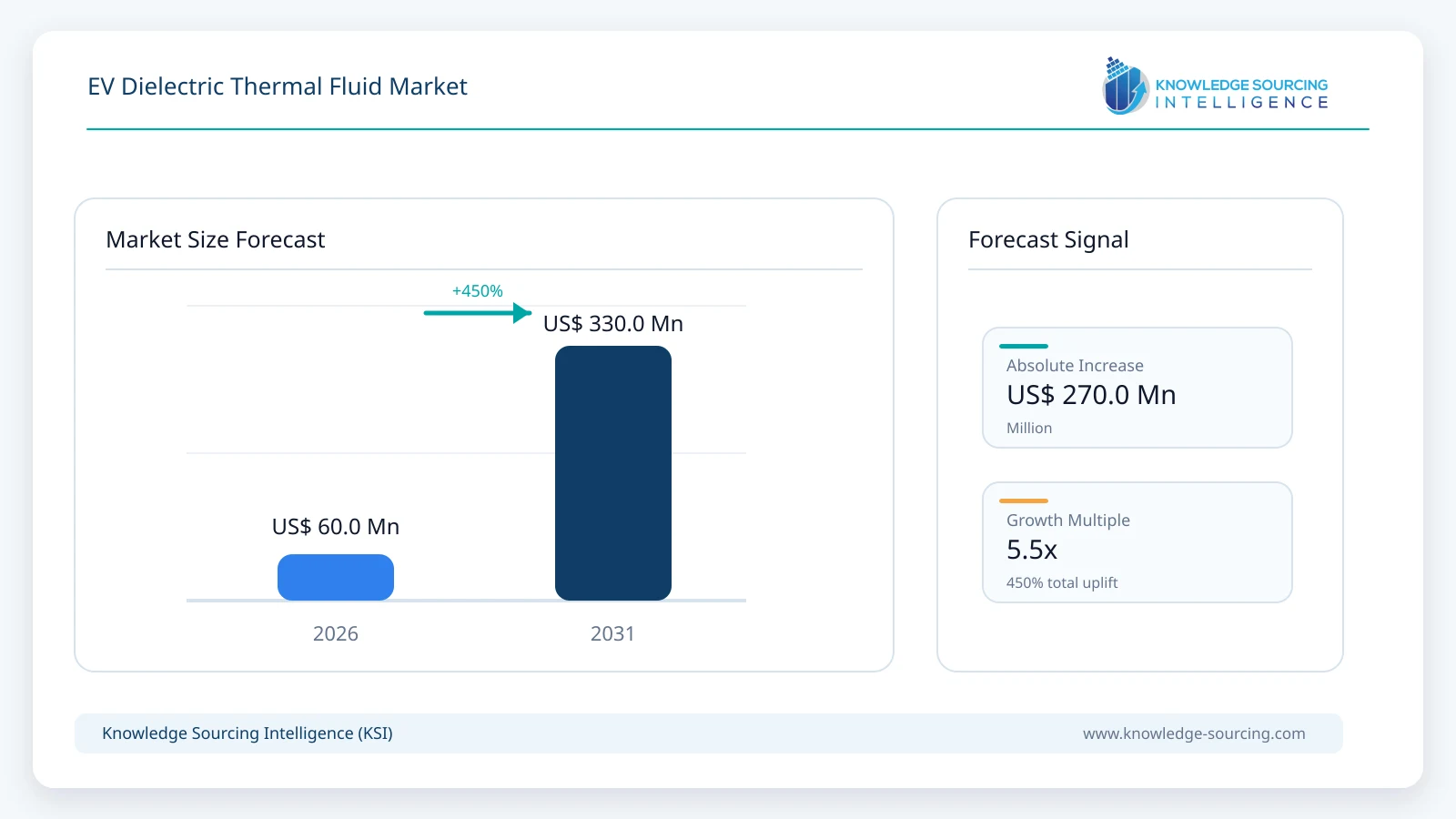
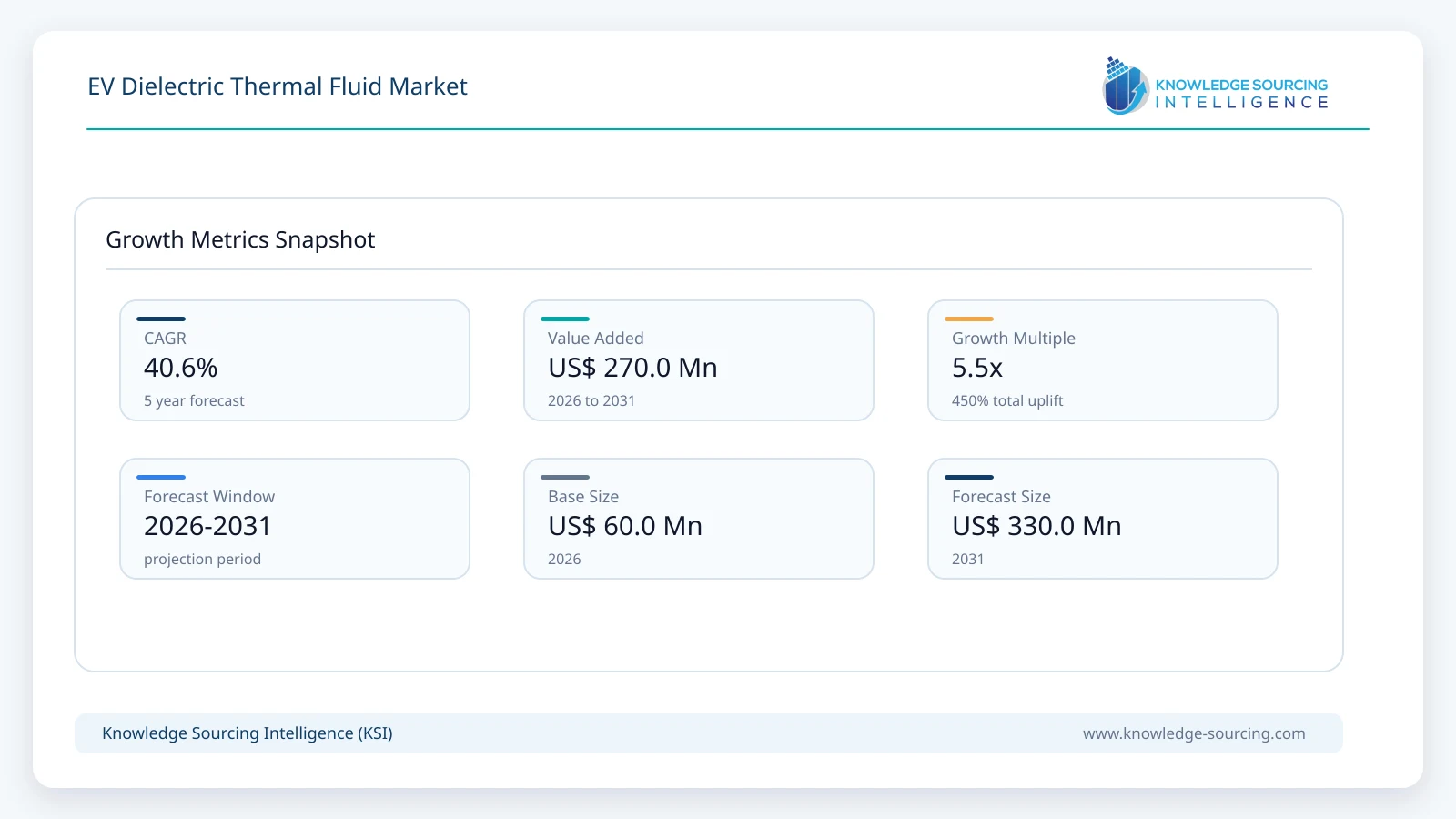
The global EV dielectric thermal fluid market is estimated at USD 60.0 million in 2026 and is projected to reach USD 330.0 million by 2031, at a CAGR of 40.6% during the forecast period.
Highlights:
- 1Battery immersion cooling accounts for approximately 68% of global dielectric thermal-fluid revenue in 2026.
- 2Direct cooling of e-motors and power electronics grows at approximately 44.0% CAGR through 2031.
- 3Synthetic hydrocarbon fluids generate approximately USD 32.4 million of market revenue in 2026.
- 4Passenger battery electric vehicles represent approximately 73% of global demand in 2026.
- 5Commercial electric vehicle applications grow at approximately 46.5% CAGR through 2031.
- 6Asia Pacific generates approximately USD 27.6 million of market revenue in 2026.
- 7OEM validation and materials compatibility remain the main barriers to wider series-production adoption.
Dielectric thermal fluids address a different engineering problem from conventional EV coolants. In an indirect battery system, water-glycol fluid removes heat through a cold plate and must remain physically separated from electrical components. Direct cooling instead places a non-conductive fluid in contact with the heat source. Castrol describes dielectric thermal fluid as an enabling technology for next-generation direct battery cooling, while FUCHS markets separate dielectric fluids for direct battery cooling and direct-cooled electric motors. This distinction makes electrical insulation, low viscosity, flash point, oxidation stability and materials compatibility central product requirements.
The immediate commercial case is strongest around fast charging and high thermal loads. Shell's 2026 Triple 10 concept demonstrated 10%-80% charging in under ten minutes using direct battery immersion and a simplified thermal architecture. TotalEnergies reports that optimized immersion packs can require only around 4.5-5 litres of dielectric fluid, while prototype configurations may use considerably more. Lower fluid volumes improve packaging economics, but they also make the market dependent on a relatively small number of high-value vehicle programs rather than on large coolant volumes per vehicle.
The market is therefore expected to remain a specialized subset of the wider EV fluids industry through 2031. Conventional battery coolants, transmission fluids and greases continue to account for much larger volumes. Dielectric thermal fluids gain relevance when vehicle architecture is redesigned around direct heat extraction, compact battery packaging, ultra-fast charging or direct-cooled motors and power electronics. This makes adoption closely linked to OEM platform decisions and qualification cycles rather than simply to the number of EVs sold.
Market Dynamics
Ultra-Fast Charging Raises the Value of Direct Cell Cooling
Fast charging increases heat generation inside battery cells and places greater demands on temperature uniformity across the pack. Direct contact allows dielectric fluid to remove heat from cell surfaces, tabs and surrounding structures without a cold plate between the cell and coolant. Shell demonstrated this architecture in a 2026 road-worthy concept vehicle, while TotalEnergies reports that immersion cooling can materially improve heat transfer and reduce thermal gradients. The commercial opportunity is strongest where charging speed is a product differentiator and where a smaller, lighter thermal system can offset part of the cost of specialty fluid.
Thermal-Runaway Management Is Becoming a Design Priority
Battery safety is a second major driver. Dielectric fluids can act as both a heat-transfer medium and a thermal barrier around cells, helping absorb heat during abnormal events. TotalEnergies reports that its immersion work has focused on limiting thermal-runaway propagation, while Lubrizol's EVOGEN thermal-management fluids are formulated specifically for EV immersion cooling and emphasize electrical insulation, corrosion control and materials compatibility. As battery packs become denser, the ability to manage localized heat without compromising electrical safety becomes increasingly valuable.
Single-Fluid Architectures Could Expand the Addressable Market Beyond Batteries
The addressable market broadens if one dielectric medium can manage several high-voltage components. Shell reported in November 2025 and again through its 2026 vehicle demonstration that its thermal fluid can cool the battery directly while also supporting motor and power-electronics thermal management. FUCHS separately offers dielectric fluids for direct battery cooling and direct-cooled electric motors. This direction could reduce the number of separate fluid circuits and create additional thermal-fluid value per EV platform.
Long Qualification Cycles and Materials Compatibility Constrain Adoption
Direct-contact fluids must remain electrically stable while interacting with seals, plastics, coatings, copper, adhesives, cell housings and other battery or motor materials over many years. A formulation that performs well thermally can still fail an automotive program if it causes swelling, leaching, corrosion or insulation degradation. OEM validation therefore involves extended materials, ageing and safety testing. This slows platform conversion and favors suppliers with automotive formulation laboratories, component testing capability and co-development relationships with OEMs and Tier 1 suppliers.
Technological Outlook
Single-Phase Immersion Cooling
Single-phase immersion is the leading technical pathway because the fluid remains liquid throughout normal operation, simplifying pressure management and system control. Heat is removed through forced circulation to a heat exchanger. This approach is compatible with low-viscosity synthetic hydrocarbons and ester-based fluids and currently has the strongest automotive development activity.
Low-Viscosity Dielectric Fluids
Pumping losses matter in EVs because every auxiliary load affects range. Castrol and FUCHS emphasize low viscosity as a key property of their direct-cooling fluids, while Lubrizol offers formulations spanning a range of viscosity and flash-point profiles. Product development therefore balances heat transfer, pump efficiency, electrical insulation, volatility and fire behavior rather than optimizing thermal conductivity alone.
Ester and Biodegradable Fluid Platforms
Natural and synthetic ester-based fluids are gaining attention because they can combine dielectric performance with high flash points and improved environmental profiles. Shell's thermal-fluid portfolio has expanded through ester technology alongside gas-to-liquid base oils, while several suppliers are evaluating lower-carbon and biodegradable formulations for vehicle and stationary electrification. Commercial adoption will depend on oxidation stability, materials compatibility and cost at automotive scale.
Direct-Cooled Motors and Power Electronics
Dielectric thermal fluids are also being developed for energized drivetrain components. FUCHS BluEV TF 9136 is formulated for direct-cooled electric motors, including compatibility with copper and bearing-protection requirements. Shell's 2026 thermal architecture extends the same fluid concept across the battery, motor and power electronics. These developments could create a broader thermal-fluid category if integrated powertrains move toward common fluid circuits.
Segment Analysis
By Application - Battery Immersion Cooling
Battery immersion cooling generates approximately USD 40.8 million in 2026 and is projected to grow at approximately 39.0% CAGR through 2031. The segment benefits from the direct link between battery temperature, charging speed, cell life and thermal-runaway management. Commercialization is expected to begin with performance-sensitive or high-utilization platforms before expanding into higher-volume passenger EVs as pack designs become standardized.
By Application - E-Motor and Power Electronics
Direct cooling of e-motors and power electronics represents approximately 32% of market revenue in 2026 and is projected to approach USD 119 million by 2031. Higher motor speeds, silicon-carbide power electronics and tighter integrated e-drive packaging increase local heat flux. Dielectric fluids can contact energized components directly, creating opportunities to simplify cooling paths while maintaining electrical insulation.
By Fluid Chemistry - Synthetic Hydrocarbon
Synthetic hydrocarbon fluids account for approximately 54% of the market in 2026 and are projected to grow at about 37.8% CAGR through 2031. The chemistry benefits from established lubricant manufacturing, tunable viscosity, dielectric strength and compatibility with automotive additive systems. Suppliers are increasingly optimizing these fluids specifically for battery and power-electronics thermal management rather than adapting conventional transformer or industrial oils.
By Vehicle Type - Passenger Battery Electric Vehicles
Passenger battery electric vehicles generate approximately USD 43.8 million in 2026 and are projected to grow at around 40.0% CAGR through 2031. Premium and performance models provide the strongest near-term fit because charging speed and sustained power command greater value. Broader adoption depends on whether immersion architectures can deliver lower pack cost and simpler assembly at high production volumes.
By Vehicle Type - Commercial Electric Vehicles
Commercial electric vehicles account for approximately 15% of 2026 revenue and are projected to approach USD 61 million by 2031. Trucks and buses operate under higher continuous loads and face stronger economic pressure to minimize charging downtime. Shell and FAW TRUCKS' September 2026 immersion-cooled battery work highlights the relevance of direct thermal management as commercial vehicles move toward higher charging power.
By Geography - Asia Pacific
Asia Pacific accounts for approximately 46% of the global market in 2026 and is projected to grow at around 43.0% CAGR through 2031. China provides the largest addressable platform base because it dominates global EV and battery production, while Japan and South Korea contribute advanced fluids, battery and automotive materials capability. Regional commercialization is expected to accelerate as high-power charging and commercial EV platforms move into series production.
Market and Demand Indicators
Indicator | Latest Development | Market Impact |
Global EV sales | IEA expects approximately 23 million electric-car sales in 2026. | Expands the vehicle base in which advanced thermal architectures can be deployed. |
Road-worthy direct cooling | Shell unveiled its Triple 10 concept vehicle in June 2026 using dielectric battery immersion cooling. | Moves the technology beyond bench testing into a complete vehicle demonstration. |
Commercial-vehicle development | Shell and FAW TRUCKS reported successful immersion-cooled battery testing in September 2026. | Extends the use case into trucks and higher-duty-cycle applications. |
Fluid volume | TotalEnergies states optimized immersion packs can use around 4.5-5 litres of dielectric fluid. | Improves packaging and materials economics for production-scale systems. |
Supplier readiness | FUCHS, Castrol, Lubrizol, Shell and TotalEnergies maintain dedicated dielectric thermal-fluid technologies. | Confirms an established supplier base ahead of wider OEM adoption. |
Asia Pacific Market Analysis
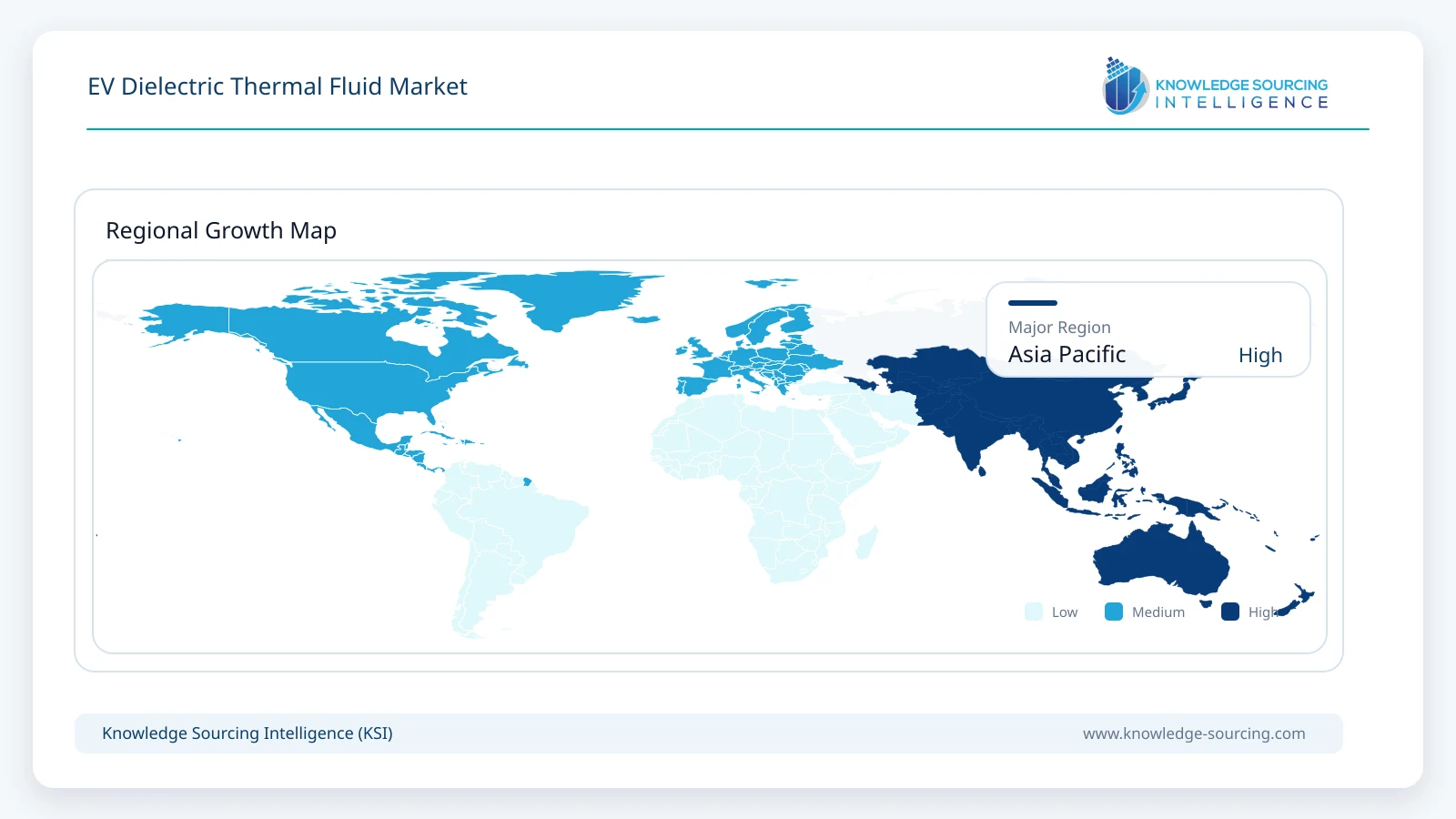
Asia Pacific is the largest regional opportunity for EV dielectric thermal fluids because it combines the highest EV production volumes with the world's deepest battery and power-electronics manufacturing ecosystem. China is particularly important for battery innovation, fast-charging deployment and commercial electric vehicles. The International Energy Agency expects global electric-car sales to reach about 23 million in 2026, with China remaining the largest single market, while commercial EV development in the region creates an additional route for high-load direct-cooling systems.
Regional growth is also supported by local materials and lubricant suppliers in Japan, South Korea and China, alongside global suppliers that operate technical and manufacturing facilities in Asia. FUCHS highlighted its BluEV thermal-management solution at a major battery-industry event in Shanghai in March 2026, while Shell and FAW TRUCKS announced successful commercial-vehicle immersion-cooling testing in September. Through 2031, the region is expected to remain the largest revenue pool as platform-level validation converts into selected series-production programs.
Competitive Landscape
The competitive landscape is led by global lubricant and specialty-fluid companies with experience in dielectric oils, EV fluids and automotive materials qualification. Shell, Castrol, TotalEnergies, FUCHS and Lubrizol currently have some of the clearest dedicated direct-cooling technology portfolios. ExxonMobil, PETRONAS Lubricants, Valvoline Global Operations, ENEOS, Idemitsu, SK Enmove and GS Caltex bring adjacent e-fluid, base-oil and automotive-fluid capabilities that can support future product expansion.
Competitive differentiation depends on more than heat-transfer performance. Suppliers must prove electrical insulation, low-temperature pumpability, flash point, oxidation resistance, copper compatibility, seal and polymer compatibility, contamination tolerance and long-term stability. Co-development capability with battery-system companies and OEMs is particularly important because the fluid and hardware must be validated as one thermal system. Partnerships with battery integrators such as XING Mobility and LION Smart therefore provide an important route to commercialization.
Recent Developments
September 2026: Shell and FAW TRUCKS reported successful testing of an immersion-cooled battery pack for future commercial-vehicle applications.
June 2026: Shell unveiled the road-worthy Triple 10 Challenge concept car using dielectric battery immersion cooling and a simplified thermal architecture.
March 2026: FUCHS BluEV thermal-management technology received a battery thermal-management innovation award at an industry conference in Shanghai.
November 2025: Shell demonstrated a single-fluid architecture capable of managing battery, motor and power-electronics thermal loads across a complete BEV powertrain.
September 2025: Shell demonstrated a 34 kWh immersion-cooled battery pack capable of 10%-80% charging in under ten minutes.
July 2025: TotalEnergies and XING Mobility signed a memorandum of understanding to expand immersion-cooling battery technology across electrification applications.
February 2025: TotalEnergies demonstrated an immersion-cooled battery architecture in a Renault Mégane E-Tech platform.
EV Dielectric Thermal Fluid Market Scope
| Report Metric | Details |
|---|---|
| Total Market Size in 2026 | USD 60.0 million |
| Total Market Size in 2031 | USD 330.0 million |
| Forecast Unit | Million |
| Growth Rate | 40.6% |
| Study Period | 2021 to 2031 |
| Historical Data | 2021 to 2024 |
| Base Year | 2025 |
| Forecast Period | 2026 – 2031 |
| Segmentation | Application, Fluid Chemistry, Vehicle Type, Cooling Architecture, Geography |
| Companies |
|
Market Segmentation
By Application
Battery Immersion Cooling
E-Motor Cooling
Power Electronics Cooling
Integrated Powertrain Thermal Management
By Fluid Chemistry
Synthetic Hydrocarbons
Synthetic Esters
Natural Esters
Other Dielectric Fluids
By Vehicle Type
Passenger Battery Electric Vehicles
Plug-in Hybrid Electric Vehicles
Commercial Electric Vehicles
Electric Two- and Three-Wheelers
Off-Highway Electric Vehicles
By Cooling Architecture
Full Immersion
Partial / Targeted Immersion
Integrated Single-Fluid Systems
By Geography
North America
United States
Canada
Mexico
South America
Brazil
Argentina
Rest of South America
Europe
Germany
United Kingdom
France
Italy
Rest of Europe
Middle East and Africa
Saudi Arabia
United Arab Emirates
South Africa
Rest of Middle East and Africa
Asia Pacific
China
Japan
India
South Korea
Rest of Asia Pacific
Table of Contents
1. EXECUTIVE SUMMARY
2. MARKET SNAPSHOT
2.1. Market Overview
2.2. Market Segmentation
3. BUSINESS LANDSCAPE
3.1. Market Drivers
3.1.1. Ultra-Fast Charging Raises the Value of Direct Cell Cooling
3.1.2. Thermal-Runaway Management Is Becoming a Design Priority
3.1.3. Single-Fluid Architectures Could Expand the Addressable Market Beyond Batteries
3.2. Market Restraints
3.2.1. Long Qualification Cycles and Materials Compatibility Constrain Adoption
3.3. Market Opportunities
3.4. Porter's Five Forces Analysis
3.5. Industry Value Chain Analysis
3.6. Automotive Safety and Materials Requirements
4. TECHNOLOGICAL OUTLOOK
4.1. Single-Phase Immersion Cooling
4.2. Low-Viscosity Dielectric Fluids
4.3. Ester and Biodegradable Fluid Platforms
4.4. Direct-Cooled Motors and Power Electronics
5. GLOBAL EV DIELECTRIC THERMAL FLUID MARKET BY APPLICATION
5.1. Battery Immersion Cooling
5.2. E-Motor Cooling
5.3. Power Electronics Cooling
5.4. Integrated Powertrain Thermal Management
6. GLOBAL EV DIELECTRIC THERMAL FLUID MARKET BY FLUID CHEMISTRY
6.1. Synthetic Hydrocarbons
6.2. Synthetic Esters
6.3. Natural Esters
6.4. Other Dielectric Fluids
7. GLOBAL EV DIELECTRIC THERMAL FLUID MARKET BY VEHICLE TYPE
7.1. Passenger Battery Electric Vehicles
7.2. Plug-in Hybrid Electric Vehicles
7.3. Commercial Electric Vehicles
7.4. Electric Two- and Three-Wheelers
7.5. Off-Highway Electric Vehicles
8. GLOBAL EV DIELECTRIC THERMAL FLUID MARKET BY COOLING ARCHITECTURE
8.1. Full Immersion
8.2. Partial / Targeted Immersion
8.3. Integrated Single-Fluid Systems
9. GLOBAL EV DIELECTRIC THERMAL FLUID MARKET BY GEOGRAPHY
9.1. North America
9.1.1. United States
9.1.2. Canada
9.1.3. Mexico
9.2. South America
9.2.1. Brazil
9.2.2. Argentina
9.2.3. Rest of South America
9.3. Europe
9.3.1. Germany
9.3.2. United Kingdom
9.3.3. France
9.3.4. Italy
9.3.5. Rest of Europe
9.4. Middle East and Africa
9.4.1. Saudi Arabia
9.4.2. United Arab Emirates
9.4.3. South Africa
9.4.4. Rest of Middle East and Africa
9.5. Asia Pacific
9.5.1. China
9.5.2. Japan
9.5.3. India
9.5.4. South Korea
9.5.5. Rest of Asia Pacific
10. COMPETITIVE ENVIRONMENT AND ANALYSIS
10.1. Major Players and Strategy Analysis
10.2. Market Share Analysis
10.3. Product Development, Agreements and Collaborations
10.4. Competitive Dashboard
11. COMPANY PROFILES
11.1. Shell plc
11.2. BP p.l.c. / Castrol
11.3. TotalEnergies SE
11.4. FUCHS SE
11.5. The Lubrizol Corporation
11.6. Exxon Mobil Corporation
11.7. PETRONAS Lubricants International
11.8. Valvoline Global Operations
11.9. ENEOS Corporation
11.10. Idemitsu Kosan Co., Ltd.
11.11. SK Enmove Co., Ltd.
11.12. GS Caltex Corporation
11.13. Gulf Oil International Ltd.
11.14. XING Mobility
11.15. LION Smart GmbH
12. RECENT DEVELOPMENTS
13. APPENDIX
13.1. Currency
13.2. Assumptions
13.3. Base and Forecast Years Timeline
13.4. Abbreviations
Navigate
Trusted by the world's leading organizations











