
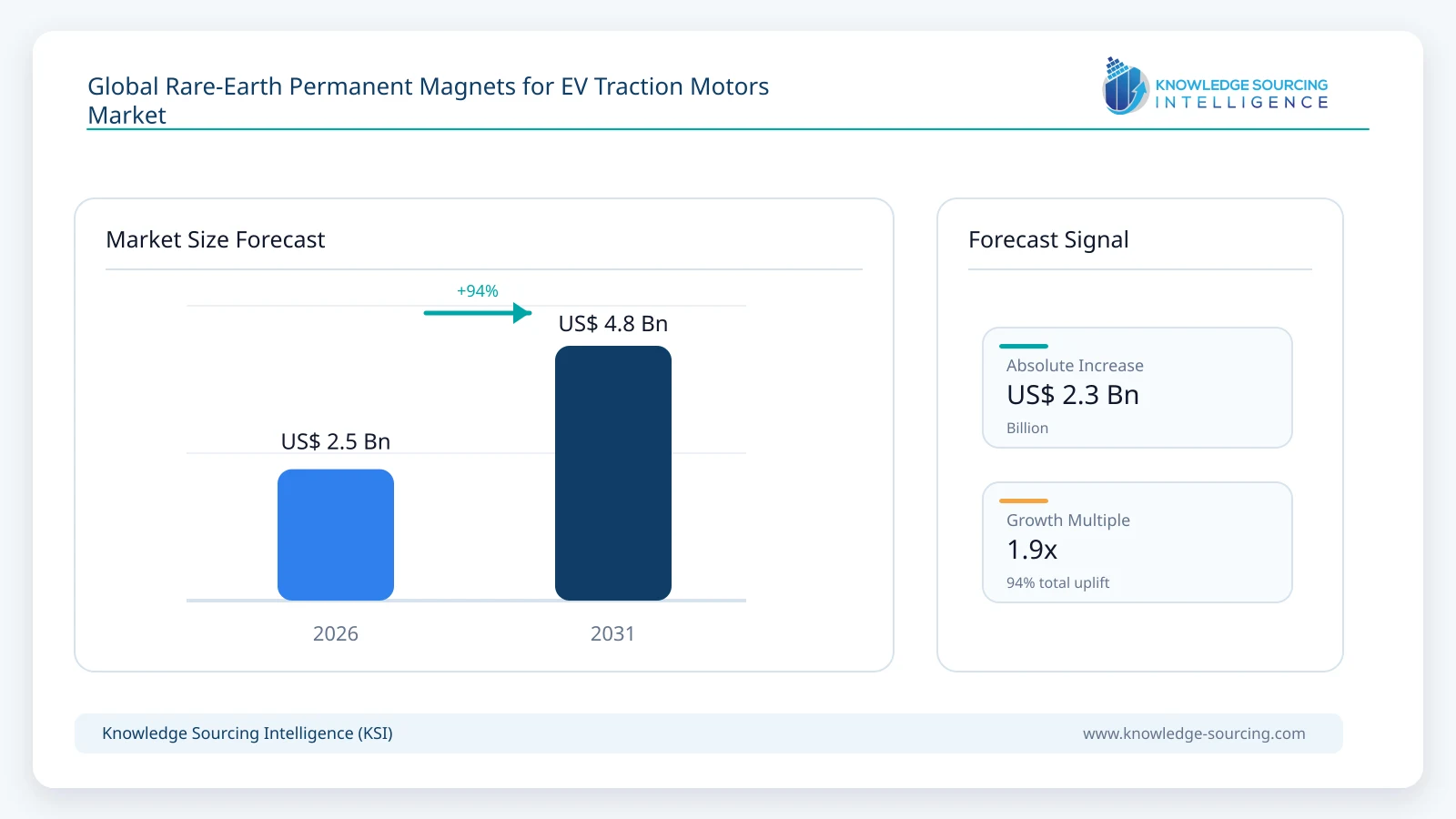
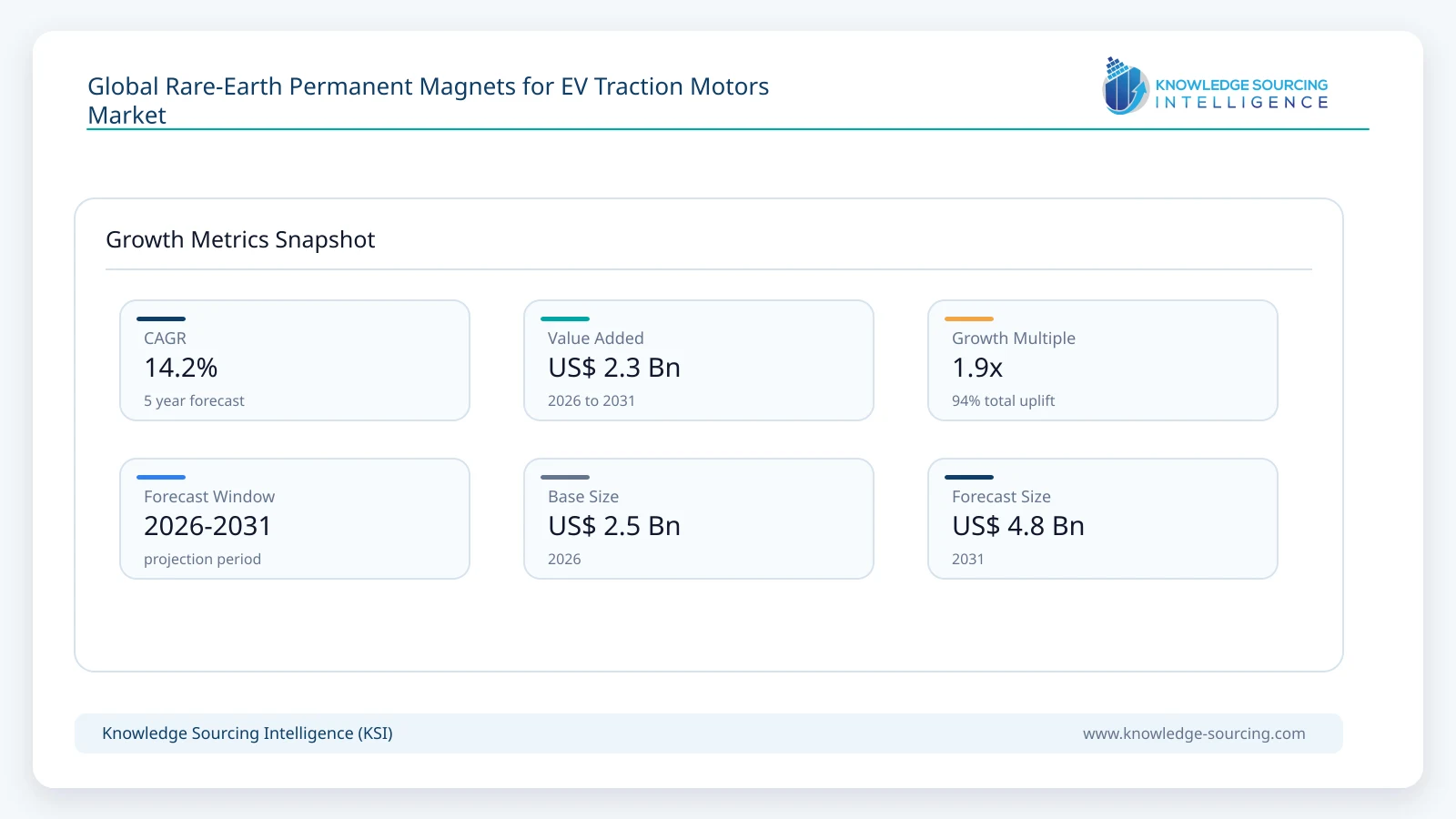
The revenue from rare-earth permanent magnets used in EV traction motors is expected to increase from USD 2.45 billion in 2026 to USD 4.75 billion in 2031 at a robust 14.2% CAGR over this period.
Highlights:
- 1EV traction motors are among the fastest-growing end uses for high-performance neodymium-iron-boron permanent magnets.
- 2Global electric-car sales are expected to reach about 23 million units in 2026, expanding the underlying motor and magnet demand base.
- 3China accounts for nearly 95% of global permanent-magnet manufacturing, creating a highly concentrated downstream supply chain.
- 4Neodymium and praseodymium provide the principal magnetic performance, while dysprosium and terbium improve high-temperature coercivity in selected grades.
- 5Heavy rare-earth intensity per motor is declining as manufacturers adopt grain-boundary diffusion and improved thermal management.
- 6Export licensing introduced by China in April 2025 raised procurement risk even without an outright blanket export ban.
- 7North American and European capacity expansion is accelerating, but ex-China magnet output remains small relative to projected demand.
- 8Rare-earth-free traction motors create a substitution risk, although efficiency and packaging advantages continue to support permanent-magnet architectures.
Market Overview
High-performance EV traction motors commonly use sintered NdFeB magnets because the material delivers strong magnetic energy density in a compact rotor. This allows automakers to obtain high torque from a smaller and lighter machine, supporting packaging flexibility and vehicle efficiency. The magnet typically contains neodymium and praseodymium as the core magnetic rare-earth inputs, while dysprosium or terbium can be introduced in selected grades to improve resistance to demagnetization under elevated operating temperatures.
Material intensity varies by motor design, vehicle performance and rotor architecture. A widely cited industry benchmark from MP Materials indicates that approximately 1,000 tonnes of finished NdFeB magnets can support around 500,000 EV motors, implying roughly 2 kg of magnet content per motor for the referenced applications. Actual vehicle-level demand varies because some electric vehicles use a single propulsion motor while all-wheel-drive and performance platforms can use two or more motors.
The analysis is limited to rare-earth permanent magnets incorporated into road-vehicle traction motors. Magnets used in auxiliary pumps, actuators, infotainment systems, industrial motors, wind turbines and consumer electronics are not included. Complete traction-motor assemblies, inverters, reduction gears and integrated drive units are also outside the market value presented here.
China Export Controls and Supply-Chain Exposure
China's April 4, 2025 export-control announcement placed selected medium and heavy rare-earth items under a licensing regime. The controlled list included samarium, gadolinium, terbium, dysprosium, lutetium, scandium and yttrium, together with specified compounds, alloys and permanent-magnet materials. Exporters are required to apply for licenses from the competent commerce authority. The rules therefore did not constitute a universal ban on all rare-earth exports, but licensing delays quickly created practical shortages for downstream manufacturers.
The disruption was particularly significant because China dominates not only mining but also the more difficult midstream and downstream stages. The International Energy Agency estimates that China accounted for about 60% of global mining of magnet rare earths in 2024, more than 90% of separation and refining, and almost 95% of permanent-magnet manufacturing. This concentration means that even an EV manufacturer sourcing non-Chinese ore can remain exposed if refining, alloying or magnet production takes place in China.
China announced broader rare-earth controls on October 9, 2025, including additional elements, processing equipment and certain overseas products containing Chinese-origin rare earths. Several of those expanded October measures were subsequently suspended until November 10, 2026. The original April 2025 licensing controls, however, remain central to the current supply environment. By September 2026, magnet exports had recovered toward historical levels for many destinations, yet U.S.-bound shipments remained weaker and controlled rare-earth compounds and metals continued to show substantial volatility.
China Rare-Earth Control Timeline
Date | Policy / Market Event | Implication for EV Magnet Supply |
April 4, 2025 | China imposed export controls on seven medium/heavy rare-earth elements and related items, including specified permanent-magnet materials. | Introduced export licensing and immediately tightened availability of critical heavy rare-earth inputs. |
April-May 2025 | Exports of controlled rare-earth items and magnets fell sharply as license applications accumulated. | Automakers and suppliers reported shortages, reduced utilisation and temporary production interruptions. |
October 9, 2025 | China announced broader controls covering additional rare-earth elements, equipment, technology and certain overseas products. | Raised the potential reach of Chinese controls across global magnet and component supply chains. |
November 10, 2025 | China suspended several October 2025 measures until November 10, 2026. | Reduced the immediate impact of the broader rules but did not eliminate the April licensing regime. |
August-September 2026 | Global magnet flows largely recovered, but U.S.-bound shipments and selected controlled materials remained constrained. | Supply risk remains a strategic sourcing issue despite improved headline export volumes. |
Market Dynamics
Electric Vehicle Production Continues to Expand Magnet Demand
Electric-car sales exceeded 20 million units globally in 2025, and the International Energy Agency expects approximately 23 million sales in 2026. Permanent-magnet traction motors remain widely used in passenger battery-electric and plug-in hybrid vehicles because of their efficiency and compactness. The market also benefits from dual-motor all-wheel-drive designs, which increase magnet content per vehicle relative to single-motor platforms.
China's Downstream Dominance Raises the Value of Supply Security
Rare-earth ore availability alone does not solve the automotive supply-chain challenge. Converting separated oxides into metals, alloys and automotive-grade sintered magnets requires specialized process capability and large-scale quality control. China's concentration in these stages allows policy changes or licensing delays to transmit quickly into global motor production. As a result, automakers are placing greater value on geographically diversified magnet supply even when non-Chinese magnets carry a cost premium.
Heavy Rare-Earth Reduction Is Becoming a Core Design Objective
Dysprosium and terbium improve coercivity at high temperatures but are scarcer and more supply-concentrated than neodymium and praseodymium. Magnet producers are therefore using grain-boundary diffusion and improved microstructures to place smaller amounts of heavy rare earths only where they are most effective. Better motor cooling also allows designers to reduce the maximum operating temperature that the magnet must withstand, further lowering heavy rare-earth requirements.
Rare-Earth-Free Motor Architectures Create a Long-Term Substitution Risk
Externally excited synchronous motors and induction motors remove the need for rare-earth permanent magnets. Valeo and Renault plan 2027 series production of a 200 kW, 800 V rare-earth-free motor, while several major suppliers maintain magnet-free technologies in parallel with permanent-magnet platforms. These alternatives limit the assumption that EV unit growth will translate one-for-one into rare-earth magnet demand, particularly in markets where supply security is prioritized.
Technology Outlook
Sintered NdFeB Magnets
Sintered NdFeB remains the principal high-performance magnet technology for EV traction motors. It offers high remanence, coercivity and energy product, enabling compact rotor designs with strong torque density. Automotive grades must also satisfy thermal stability, corrosion resistance, dimensional tolerance and long-term reliability requirements under repeated high-load cycles.
Heavy Rare-Earth Lean Magnets
Heavy rare-earth lean designs reduce dysprosium and terbium use through microstructure control, localized diffusion and improved alloy design. These approaches are strategically important because export controls introduced in 2025 specifically affected several heavy rare-earth elements. Lower heavy rare-earth loading can reduce material risk without forcing a complete change in motor architecture.
Recycled Rare-Earth Magnets
Closed-loop recovery from manufacturing scrap and end-of-life motors is moving from pilot activity toward commercial-scale planning. Recycling can reduce exposure to newly mined material while retaining high-value magnet rare earths in automotive supply chains. The economics improve where magnet scrap can be separated and returned directly into alloy or magnet production rather than processed through a full mining-style separation route.
Magnet-Free Motor Substitution
Magnet-free propulsion systems eliminate rare-earth exposure but require different compromises in rotor excitation, inverter control, thermal performance and packaging. Their adoption is therefore expected to vary by vehicle segment rather than replace permanent-magnet motors universally. High-efficiency and space-constrained EVs continue to provide a strong use case for rare-earth magnets.
Market and Demand Indicators
Indicator | Latest Development | Market Impact |
Global EV demand | IEA expects approximately 23 million electric-car sales in 2026. | Provides the principal annual volume base for traction-motor magnet consumption. |
China supply concentration | IEA estimates almost 95% of permanent-magnet manufacturing was located in China in 2024. | Makes export policy and licensing a direct automotive supply-chain risk. |
India EV magnet demand | India's Ministry of Heavy Industries estimates EVs will require 3,250 tonnes of rare-earth permanent magnets in 2030. | Demonstrates the scale of emerging-market demand outside China. |
U.S. capacity expansion | MP Materials' planned 10X campus is expected to lift its total NdFeB magnet capacity to about 10,000 tonnes per year. | Creates a meaningful future non-Chinese source of automotive-grade magnet supply. |
Current U.S. commercial capacity | eVAC's South Carolina facility has about 2,000 tonnes per year of nameplate rare-earth magnet capacity. | Adds near-term localized capacity for automotive traction-motor applications. |
Substitution pressure | Valeo and Renault target 2027 series production of a 200 kW rare-earth-free EV motor. | Limits long-term rare-earth intensity growth per EV even as vehicle sales rise. |
Asia Pacific Market Analysis
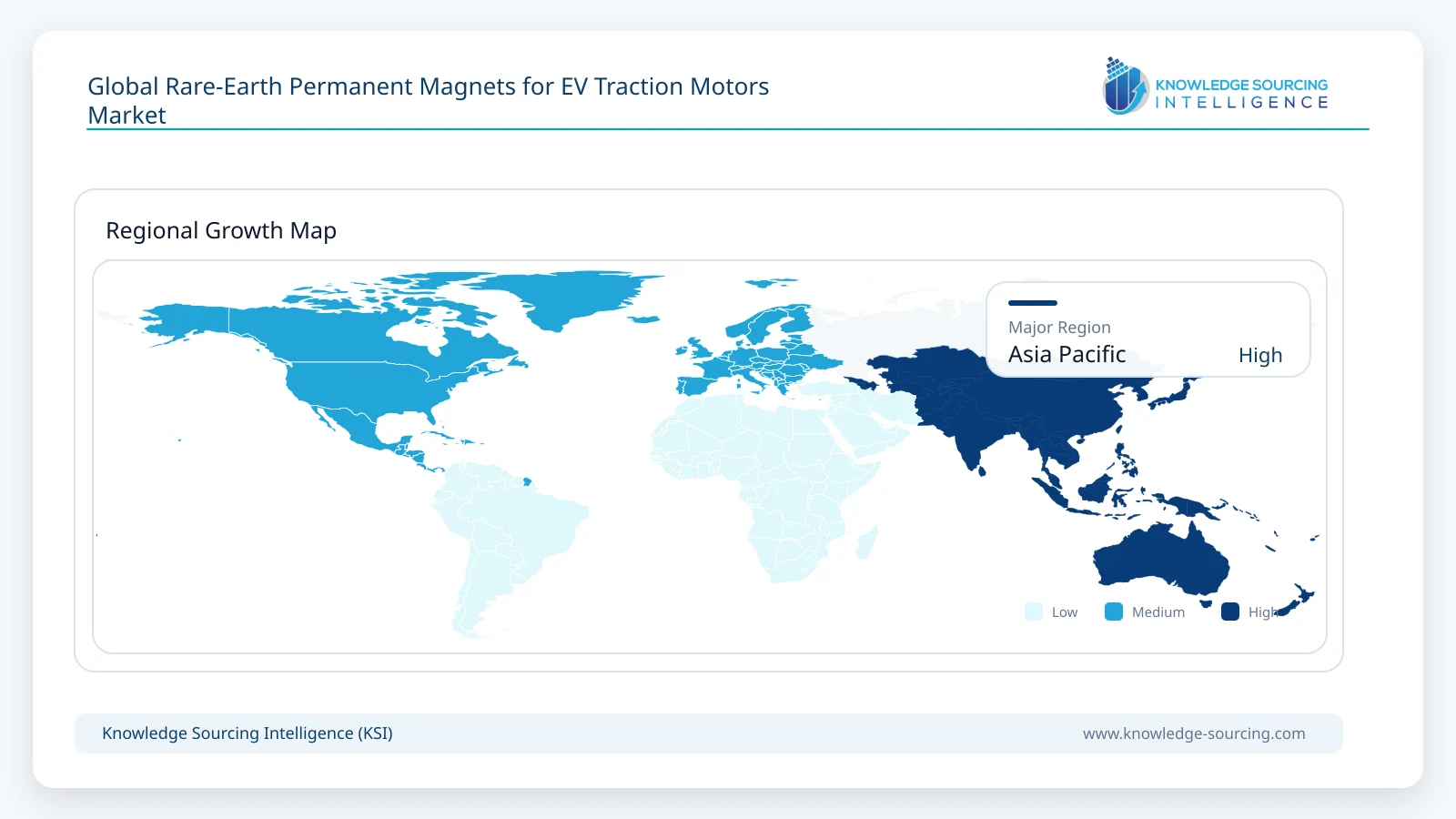
Asia Pacific dominates the EV traction-motor rare-earth magnet market because China combines the world's largest electric-vehicle manufacturing base with the most concentrated rare-earth refining and magnet-production ecosystem. Chinese magnet producers supply both domestic vehicle manufacturers and global Tier 1 motor suppliers, while the country's scale provides cost advantages in alloy production, sintering, machining and coating. Japan remains important through Shin-Etsu Chemical, Proterial, TDK and Daido Steel, which have long histories in high-performance automotive magnet development.
China's 2025 export controls have encouraged other Asia Pacific economies to accelerate domestic supply initiatives. India approved a INR 72.8 billion scheme in November 2025 to establish 6,000 tonnes per year of integrated sintered rare-earth permanent magnet capacity. In July 2026, the Ministry of Heavy Industries estimated that Indian EVs alone could require 3,250 tonnes per year by 2030. The policy direction reflects a shift from importing finished magnets toward building oxide-to-metal, alloy and magnet manufacturing capability.
India is also seeing private investment. By September 2026, Lohum was developing a 1,200-tonne rare-earth magnet plant in Uttar Pradesh, while other announced projects target integrated NdFeB production. These investments remain small relative to China's scale, but they can materially improve supply resilience for local two-, three- and four-wheel electric vehicle manufacturers.
Competitive Landscape
The competitive landscape includes large Chinese magnet manufacturers, established Japanese materials companies and a smaller group of expanding North American and European producers. Major Chinese suppliers include JL MAG Rare-Earth, Ningbo Yunsheng, Beijing Zhong Ke San Huan and Earth-Panda. Japan's Shin-Etsu Chemical, Proterial, TDK and Daido Steel compete in high-performance automotive grades, while VACUUMSCHMELZE and eVAC are expanding localized supply in Europe and the United States.
Outside Asia, MP Materials is building an integrated U.S. mine-to-magnet supply chain and announced a new North Texas manufacturing campus in February 2026. Noveon Magnetics, Arnold Magnetic Technologies and Neo Performance Materials also participate in regional magnet and alloy supply. Competition increasingly centers on automotive qualification, heavy rare-earth reduction, traceable sourcing, recycling capability and the ability to offer long-term supply contracts rather than spot magnet sales.
Recent Developments
September 2026: Lohum said it was developing a 1,200-tonne rare-earth magnet plant in Uttar Pradesh as part of a broader critical-minerals expansion strategy.
July 2026: India's Ministry of Heavy Industries published an assessment placing 2030 rare-earth permanent magnet demand from electric vehicles at 3,250 tonnes per year.
July 2026: eVAC Magnetics and VACUUMSCHMELZE marked the opening of their Sumter, South Carolina rare-earth magnet facility, which has about 2,000 tonnes per year of nameplate capacity and produces automotive-grade sintered magnets.
February 2026: GKN Powder Metallurgy cancelled plans for a European rare-earth magnet production facility, highlighting the financing and competitiveness challenges facing new non-Chinese capacity.
February 2026: MP Materials selected Northlake, Texas, for its USD 1.25 billion-plus 10X rare-earth magnet manufacturing campus, with total company NdFeB capacity targeted at approximately 10,000 tonnes per year.
November 2025: India's Union Cabinet approved an INR 72.8 billion scheme designed to establish 6,000 tonnes per year of integrated sintered rare-earth permanent magnet manufacturing capacity.
Rare-Earth Permanent Magnets for EV Traction Motors Market Scope
| Report Metric | Details |
|---|---|
| Total Market Size in 2026 | USD 2.45 billion |
| Total Market Size in 2031 | USD 4.75 billion |
| Forecast Unit | Billion |
| Growth Rate | 14.2% |
| Study Period | 2021 to 2031 |
| Historical Data | 2021 to 2024 |
| Base Year | 2025 |
| Forecast Period | 2026 – 2031 |
| Segmentation | Magnet Type, Rare-Earth Input, Vehicle Type, Motor Configuration, Geography |
| Companies |
|
Market Segmentation
By Magnet Type
Sintered NdFeB
Bonded NdFeB
Other Rare-Earth Permanent Magnets
By Rare-Earth Input
Neodymium-Praseodymium
Dysprosium
Terbium
Other Rare-Earth Inputs
By Vehicle Type
Passenger Battery Electric Vehicles
Plug-in Hybrid Electric Vehicles
Commercial Electric Vehicles
Electric Two- and Three-Wheelers
By Motor Configuration
Single-Motor Vehicles
Dual-Motor Vehicles
Multi-Motor Vehicles
By Geography
North America
United States
Canada
Mexico
South America
Brazil
Argentina
Rest of South America
Europe
Germany
United Kingdom
France
Italy
Rest of Europe
Middle East and Africa
Saudi Arabia
United Arab Emirates
South Africa
Rest of Middle East and Africa
Asia Pacific
China
Japan
India
South Korea
Rest of Asia Pacific
Table of Contents
1. EXECUTIVE SUMMARY
2. MARKET SNAPSHOT
2.1. Market Overview
2.2. Market Segmentation
3. BUSINESS LANDSCAPE
3.1. Market Drivers
3.1.1. Electric Vehicle Production Continues to Expand Magnet Demand
3.1.2. China's Downstream Dominance Raises the Value of Supply Security
3.1.3. Heavy Rare-Earth Reduction Is Becoming a Core Design Objective
3.2. Market Restraints
3.2.1. Rare-Earth-Free Motor Architectures Create a Long-Term Substitution Risk
3.3. Market Opportunities
3.4. Porter's Five Forces Analysis
3.5. Industry Value Chain Analysis
3.6. China Export Controls and Supply-Chain Exposure
4. TECHNOLOGICAL OUTLOOK
4.1. Sintered NdFeB Magnets
4.2. Heavy Rare-Earth Lean Magnets
4.3. Recycled Rare-Earth Magnets
4.4. Magnet-Free Motor Substitution
5. GLOBAL RARE-EARTH PERMANENT MAGNETS FOR EV TRACTION MOTORS MARKET BY MAGNET TYPE
5.1. Sintered NdFeB
5.2. Bonded NdFeB
5.3. Other Rare-Earth Permanent Magnets
6. GLOBAL RARE-EARTH PERMANENT MAGNETS FOR EV TRACTION MOTORS MARKET BY RARE-EARTH INPUT
6.1. Neodymium-Praseodymium
6.2. Dysprosium
6.3. Terbium
6.4. Other Rare-Earth Inputs
7. GLOBAL RARE-EARTH PERMANENT MAGNETS FOR EV TRACTION MOTORS MARKET BY VEHICLE TYPE
7.1. Passenger Battery Electric Vehicles
7.2. Plug-in Hybrid Electric Vehicles
7.3. Commercial Electric Vehicles
7.4. Electric Two- and Three-Wheelers
8. GLOBAL RARE-EARTH PERMANENT MAGNETS FOR EV TRACTION MOTORS MARKET BY MOTOR CONFIGURATION
8.1. Single-Motor Vehicles
8.2. Dual-Motor Vehicles
8.3. Multi-Motor Vehicles
9. GLOBAL RARE-EARTH PERMANENT MAGNETS FOR EV TRACTION MOTORS MARKET BY GEOGRAPHY
9.1. North America
9.1.1. United States
9.1.2. Canada
9.1.3. Mexico
9.2. South America
9.2.1. Brazil
9.2.2. Argentina
9.2.3. Rest of South America
9.3. Europe
9.3.1. Germany
9.3.2. United Kingdom
9.3.3. France
9.3.4. Italy
9.3.5. Rest of Europe
9.4. Middle East and Africa
9.4.1. Saudi Arabia
9.4.2. United Arab Emirates
9.4.3. South Africa
9.4.4. Rest of Middle East and Africa
9.5. Asia Pacific
9.5.1. China
9.5.2. Japan
9.5.3. India
9.5.4. South Korea
9.5.5. Rest of Asia Pacific
10. COMPETITIVE ENVIRONMENT AND ANALYSIS
10.1. Major Players and Strategy Analysis
10.2. Market Share Analysis
10.3. Capacity Expansion, Supply Agreements and Recycling
10.4. Competitive Dashboard
11. COMPANY PROFILES
11.1. JL MAG Rare-Earth Co., Ltd.
11.2. Ningbo Yunsheng Co., Ltd.
11.3. Beijing Zhong Ke San Huan High-Tech Co., Ltd.
11.4. Earth-Panda Advanced Magnetic Material Co., Ltd.
11.5. Shin-Etsu Chemical Co., Ltd.
11.6. Proterial, Ltd.
11.7. TDK Corporation
11.8. Daido Steel Co., Ltd.
11.9. VACUUMSCHMELZE GmbH / eVAC Magnetics
11.10. MP Materials Corp.
11.11. Neo Performance Materials Inc.
11.12. Noveon Magnetics Inc.
11.13. Arnold Magnetic Technologies
11.14. USA Rare Earth, LLC
11.15. Magnequench
11.16. Less Common Metals Ltd.
11.17. Yantai Zhenghai Magnetic Material Co., Ltd.
11.18. Zhejiang Innuovo Magnetics Co., Ltd.
12. RECENT DEVELOPMENTS
13. APPENDIX
13.1. Currency
13.2. Assumptions
13.3. Base and Forecast Years Timeline
13.4. Abbreviations
Navigate
Trusted by the world's leading organizations











