
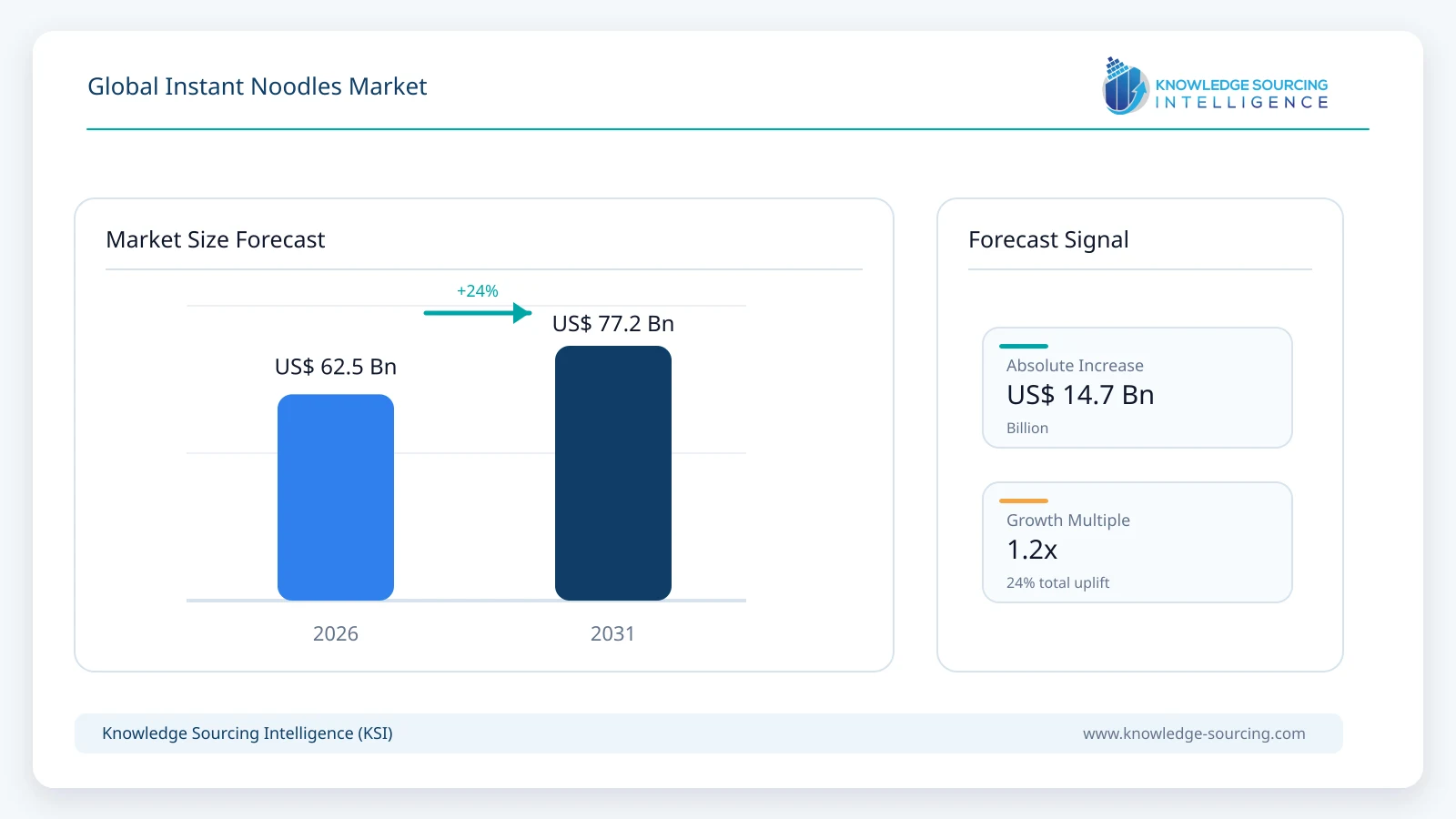
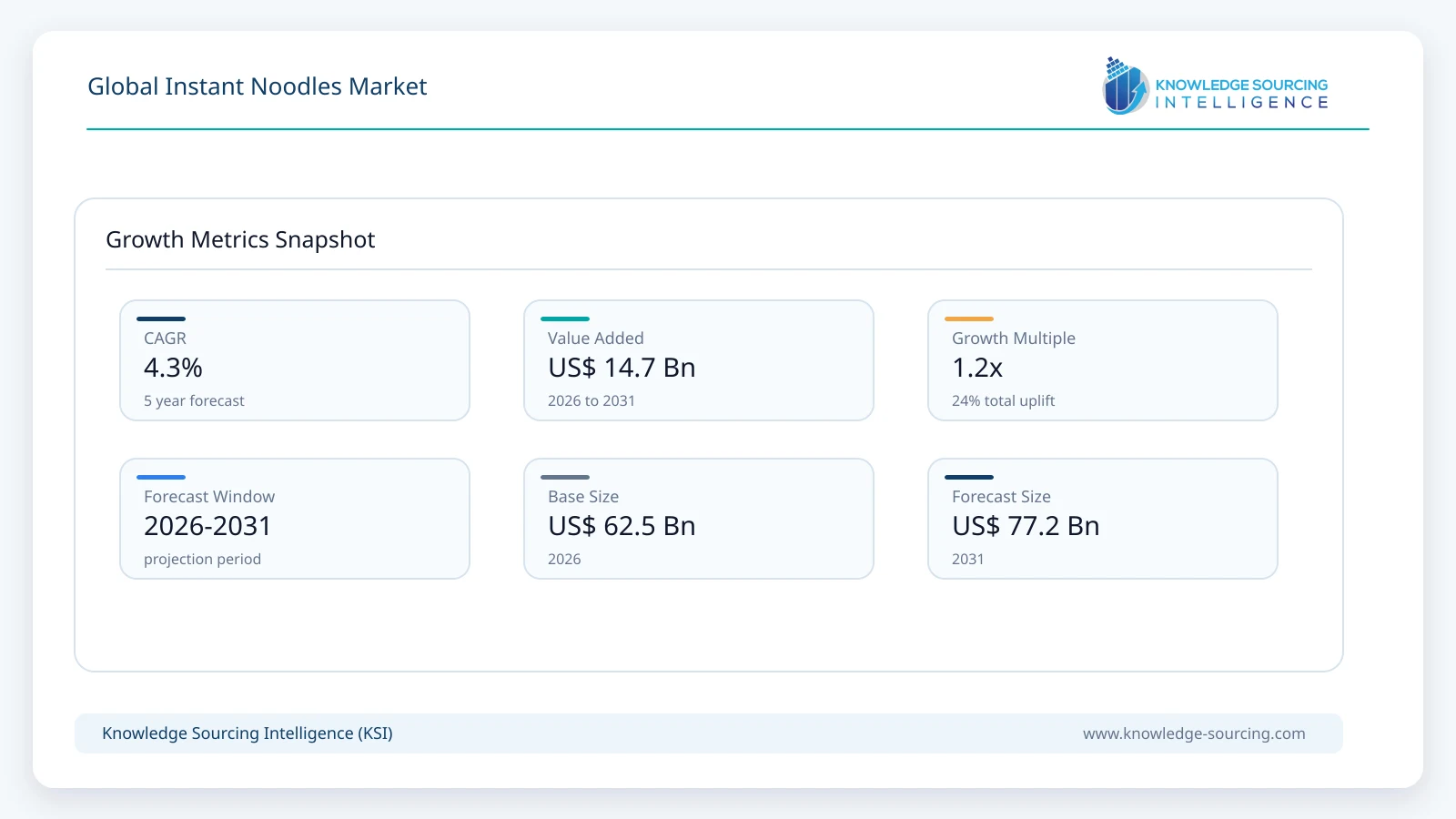
The Global Instant Noodles Market is estimated at USD 62.5 billion in 2026 and will expand at a CAGR of 4.3% to reach USD 77.2 billion by 2031.
Highlights:
- 1Global instant noodle consumption reached 124.2 billion servings in 2025, with China/Hong Kong accounting for 43.27 billion servings.
- 2Fried Noodles account for approximately 82% of market value in 2026, although Non-Fried Noodles record materially faster growth through 2031.
- 3Cup packaging is projected to grow at approximately 6.5% annually, supported by individual consumption, convenience channels and premium product positioning.
- 4Offline retail remains the principal distribution channel, while Online sales gain share through marketplaces, grocery e-commerce and quick-commerce platforms.
- 5Asia Pacific accounts for approximately 71% of global market value in 2026, reflecting its overwhelming share of worldwide consumption.
- 6India increased instant noodle demand by almost 9% in 2025 to 9.60 billion servings, making it one of the strongest growth markets among the world’s largest consuming countries.
- 7The competitive market includes major manufacturers from China, Indonesia, Japan, South Korea, India, Vietnam, Thailand, Taiwan and the Philippines rather than being concentrated among a small group of Western packaged-food companies. WINA lists leading manufacturers from these countries among its governors and member companies.
Instant noodles continue to combine attributes that are difficult for most packaged meal categories to replicate simultaneously: short preparation time, long shelf life, broad flavour adaptability, low entry price and distribution through both traditional and modern retail. The resulting consumption base is already exceptionally large. The World Instant Noodles Association estimates that global demand reached 124.2 billion servings in 2025, compared with 123.3 billion in 2024 and 118.0 billion in 2021. China/Hong Kong remained the largest market at 43.27 billion servings, followed by Indonesia at 14.54 billion, India at 9.60 billion, Vietnam at 8.23 billion and Japan at 5.95 billion.
The market is nevertheless becoming less dependent on uniform volume expansion. Consumption in China/Hong Kong declined modestly in 2025, while India increased from 8.82 billion servings in 2024 to 9.60 billion in 2025, Thailand increased to 4.20 billion and Nigeria reached 3.12 billion. Mature markets are therefore contributing increasingly through premium products, cup formats, more complex flavours and higher-value meal propositions, while India and selected emerging economies provide stronger incremental volume. Nestlé reported that noodles became the largest growth driver within its food category in 2025 after introducing products such as Maggi Saucy Noodles in Europe, while Masan Consumer is positioning Omachi around premium instant noodles and more complete meal solutions.
Fried Noodles remain the largest product type and account for more than four-fifths of market value in 2026. The format remains commercially dominant because flash frying creates rapid rehydration, familiar texture and efficient high-volume production. Non-Fried Noodles develop faster from a smaller base as manufacturers use air-drying, alternative processing technologies and health-oriented positioning to broaden their portfolios. Acecook Vietnam, for example, is investing in a new R&D centre scheduled for completion in 2026, with research covering reduced salt and fat, freeze-drying, plant-based ingredients and new instant-noodle technologies.
Packaging is also becoming a more important value driver. Packets remain the largest format globally because of their lower unit cost and dominance in high-volume Asian markets, but cup products continue to increase their contribution. Nissin Foods announced in August 2026 that it will invest approximately ¥70 billion in a new Cup Noodles-focused factory in Japan with maximum annual capacity of 500 million servings. The company stated that cumulative worldwide Cup Noodles sales surpassed 60 billion servings in August 2025 and that domestic sales had reached record levels for nine consecutive fiscal years. The combination of emerging-market volume growth and higher-value formats keeps market-value growth above the underlying expansion in global servings.
Market Growth Drivers and Trends
Large Existing Consumption Base Supports Recurring Demand
The primary structural advantage of instant noodles is the frequency with which consumers already purchase and consume the product. Global demand exceeded 124 billion servings in 2025, equivalent to more than 340 million servings per day. This gives manufacturers a large recurring transaction base on which relatively small changes in frequency, population penetration, pricing or product mix can generate meaningful additional market value.
The category is also geographically diversified. China/Hong Kong accounts for the largest individual volume, but Indonesia, India, Vietnam, Japan, the United States, the Philippines, Thailand, South Korea and Nigeria each consume several billion servings annually. This reduces dependence on any one market and allows manufacturers to develop products around local food habits rather than relying on a standardized global recipe.
The underlying value proposition remains stable across income groups. In lower- and middle-income markets, instant noodles provide an affordable meal or snack with limited preparation requirements, while consumers in higher-income markets increasingly use premium cups, restaurant-inspired flavours and international noodle styles. The same category can therefore participate simultaneously in value-oriented and premium convenience-food demand.
India and Other Emerging Markets Are Providing Incremental Volume Growth
The geographic pattern of consumption is changing gradually. China’s enormous market remains central but is comparatively mature, while India is gaining importance as both a volume and competitive market. WINA estimates that Indian consumption increased from 7.56 billion servings in 2021 to 9.60 billion in 2025, including an increase of almost 800 million servings during 2025 alone. Nigeria, Thailand, Malaysia and Brazil also recorded increases during the latest year.
Manufacturers are increasing investment accordingly. ITC reported that YiPPee! sustained its position as a strong number-two instant noodle brand in India during the quarter ended June 2026 and delivered robust volume-led growth. The company has also expanded into premium Pan-Asian variants including Gochujang, Tom Yum and Yaki Udon.
International manufacturers are pursuing the same opportunity. Nongshim entered a distribution partnership with Blinkit in May 2026 to expand Shin Ramyun across major Indian urban markets and reported in September that its first-half exports to India had increased approximately 47% year-on-year. These developments indicate that future Indian growth is unlikely to come only from conventional mass-market flavours. International, Korean and premium products increasingly compete alongside established local brands.
Premiumisation and Global Flavours Are Raising Value per Serving
Mature instant noodle markets cannot sustain high-volume growth indefinitely, making product mix increasingly important. Manufacturers are adding thicker noodles, premium sauces, meat-style toppings, restaurant-inspired recipes, imported flavours and more elaborate cup products to raise average selling value and differentiate brands.
Nestlé’s 2025 food-category performance illustrates the trend. The company launched Maggi Saucy Noodles in European flavours including Japanese Teriyaki and Pad Thai and reported that noodles became its largest growth driver within the food category during the year. ITC expanded YiPPee! with Korean Gochujang, Thai Tom Yum and Yaki Udon variants, while Masan Consumer plans to continue using Omachi to redefine premium noodles as fuller meal solutions.
Korean products provide another important premiumisation route. Nongshim, Samyang and other Korean manufacturers have built international consumer demand around spicy flavours, stir-fried noodles and recognizable brands rather than competing solely on affordability. This broadens the category’s appeal beyond its traditional positioning as an inexpensive convenience meal and supports higher price realization in North America, Europe and emerging premium segments across Asia.
Cup Formats Are Expanding Consumption Occasions
Packet noodles remain the dominant format because consumers can prepare them in household kitchens at a low unit cost, but cups create additional occasions where cooking utensils are unavailable or inconvenient. Offices, convenience stores, travel, universities and individual meals all favour packaging that functions as both cooking vessel and serving container.
Nissin’s latest capacity decision indicates continuing confidence in this segment. Its planned Tsukubamirai factory will be dedicated to cup noodles and is designed for maximum capacity of approximately 500 million servings per year. The company cited both cumulative global Cup Noodles sales above 60 billion servings and record domestic sales as justification for the investment.
Cup products also support premiumisation because package design, toppings and differentiated recipes can justify higher per-serving prices. The format is consequently projected to grow faster than Packets through 2031, although Packets retain the majority of global volume and value.
Digital Retail Is Increasing Product Discovery and Availability
Offline retail continues to dominate because instant noodles are commonly purchased through supermarkets, convenience stores, small grocery shops and traditional retail. Digital channels nevertheless change the way new products reach consumers. Marketplaces allow manufacturers to sell multipacks and imported varieties beyond their conventional retail footprint, while quick commerce allows low-ticket convenience products to participate in immediate-delivery orders.
Nongshim’s 2026 partnership with Blinkit illustrates this effect in India. Rather than building physical distribution one city at a time, the company can use an established digital-delivery network to place Shin Ramyun products in front of younger urban consumers across multiple major locations.
Digital channels are also well suited to premium and imported products because consumers can search by cuisine, flavour or brand instead of choosing only from products stocked on a nearby shelf. Online Distribution therefore grows substantially faster than the total market through 2031, even though Offline channels continue to account for most global sales.
Market Restraints
Sodium, Fat and Nutrition Concerns Influence Product Development
Instant noodles remain convenient and affordable, but their nutritional profile can create resistance among health-conscious consumers. Sodium levels, frying oils and the balance between noodles and protein, vegetables or micronutrients receive increasing attention from consumers, regulators and manufacturers.
The industry’s response is more important to the forecast than generalized claims that instant noodles are inherently unhealthy. WINA has formally added nutritiousness and health to its industry development principles, while individual manufacturers continue to reformulate products. Acecook Vietnam’s new R&D programme includes reduced salt and fat, healthy ingredients, plant-based products and alternative processing technologies.
Nutrition concerns therefore encourage innovation rather than necessarily causing category contraction, but reformulation can increase development costs and requires manufacturers to preserve taste while adjusting established recipes.
Wheat, Palm Oil and Seasoning Costs Can Pressure Margins
The category uses large quantities of wheat flour, edible oils, seasonings, packaging and energy. Fried noodles are particularly exposed to cooking-oil costs, while flavour sachets can contain multiple agricultural and processed ingredients.
Commodity inflation can be difficult to pass through immediately because affordability is central to the category’s value proposition, particularly in India, Indonesia, Vietnam, Nigeria and other high-volume markets. Manufacturers must therefore balance pack size, pricing and formulation while protecting margins.
Larger producers generally hold procurement and scale advantages, increasing the difficulty for smaller competitors when raw-material costs rise sharply.
Mature Markets Offer Limited Headroom for Volume Expansion
China/Hong Kong consumed 43.27 billion servings in 2025 but recorded a modest decline from 43.80 billion in 2024. Indonesia also declined slightly, while South Korean volume eased from 4.10 billion to 4.06 billion.
These markets remain extremely valuable, but manufacturers cannot assume that consumption will rise continually from already high levels. Growth increasingly depends on premiumisation, cup formats, innovation and market-share gains rather than broader household penetration.
This also increases competitive intensity because manufacturers are fighting for consumer attention inside an established category rather than benefiting from rapid category expansion.
Competitive Intensity Limits Pricing Power
Instant noodles have relatively low switching costs for consumers. A shopper can change brands or flavours easily, while supermarkets can stock national brands, regional manufacturers and private-label alternatives side by side.
The competitive landscape is particularly deep in Asia. WINA’s current membership includes leading manufacturers such as Nissin Foods, Indofood, Nongshim, Tingyi, Baixiang, Jinmailang, Monde Nissin, Uni-President, Acecook Vietnam and leading Thai manufacturers, alongside dozens of additional instant noodle producers.
Brands therefore need continuous investment in advertising, new flavours, packaging, distribution and promotions to defend share. Premium products can improve margins, but mass-market categories remain highly price sensitive.
Packaging and Sustainability Requirements Increase Operating Complexity
Instant noodles use flexible plastic packets, seasoning sachets, cups, lids, cartons and other packaging materials. Environmental pressure on single-use packaging therefore affects both packet and cup formats.
The industry has already incorporated environmental sustainability into its formal development principles. WINA’s 2025 Manila Summit focused specifically on nutrition, environmental sustainability, food safety and broader social issues, with major global manufacturers committing to collective industry targets.
Manufacturers are responding through material reduction, recyclable packaging, lower-energy factories and production-efficiency improvements. Nissin’s proposed new Japanese factory, for example, is designed to cut manufacturing CO2 emissions per serving by more than 10% compared with its current Kanto plant through heat recovery and energy-efficiency measures. These investments improve sustainability but add capital and technical requirements to an otherwise highly cost-sensitive category.
Global Instant Noodles Market Segmentation Analysis
By Type
Fried Noodles account for approximately 82% of global market value in 2026 and remain the dominant product type throughout the forecast period. Flash frying removes moisture rapidly, allows noodles to rehydrate within minutes and creates the texture consumers associate with many major instant noodle brands. Large manufacturing lines and established consumer preferences further support the format’s economic position.
Non-Fried Noodles are projected to grow at approximately 7.6% annually through 2031, materially faster than the overall market. The segment includes air-dried and other alternative processes that allow manufacturers to position products around lower oil content, different noodle textures and more premium eating experiences. Growth remains from a smaller base, meaning Fried Noodles continue to represent the majority of global value in 2031 even as their share gradually declines.
The shift is therefore evolutionary rather than a replacement of fried products. Major manufacturers continue to invest simultaneously in conventional noodles and alternative processing technologies because consumer preferences vary significantly by country, price point and eating occasion.
By Flavor Type
Chicken remains the largest individual flavour base and accounts for approximately 30% of market value in 2026. Its global relevance comes from broad cultural acceptance and the ability to combine chicken seasoning with spicy, creamy, herb-based and regional flavour profiles. WINA similarly identifies chicken as one of the most broadly applicable instant noodle broth bases.
Seafood flavours are projected to grow at approximately 4.8% annually through 2031, supported particularly by East and Southeast Asian demand and localized shrimp, seafood, tom yum and related variants. Beef remains a major flavour family across Asia, the Americas and parts of the Middle East, while Pork has a strong position in China, Japan, Thailand and other markets but a narrower global addressable base because of dietary restrictions.
Vegetable-based flavours represent a market of approximately USD 6-7 billion in 2026 and are supported by vegetarian consumers and products where vegetables form the principal seasoning identity. Spicy, curry, cheese, kimchi and other regional flavours cut across the traditional broth categories and are becoming increasingly important in premium and international product development. The complete internal model therefore retains the principal KSI flavour groups while treating these emerging variants within the wider flavour mix rather than implying that all instant noodles are traditional soup products.
By Packaging
Packets represent approximately 65% of market value in 2026 and remain dominant because of their lower packaging cost, established household consumption and importance in high-volume Asian markets. Multipacks also allow manufacturers and retailers to reduce packaging and logistics cost per serving.
Cups are projected to record a CAGR of approximately 6.5% between 2026 and 2031. The format benefits from greater convenience and generally higher revenue per serving, particularly in Japan, North America, South Korea, urban China and premium international segments. Nissin’s planned 500-million-serving annual Cup Noodles plant reinforces expectations of continued demand growth.
Packets therefore retain the larger absolute market, while Cups account for a progressively larger share of forecast-period value creation.
By Distribution Channel
Offline Distribution represents an estimated USD 54 billion market in 2026. Supermarkets, hypermarkets, convenience stores, traditional grocery retailers and smaller independent outlets provide widespread physical availability and remain particularly important in developing markets where daily grocery shopping is highly fragmented.
Online Distribution grows at a double-digit CAGR through 2031 from a considerably smaller base. Marketplaces support multipack and imported-product purchases, while online grocery and quick-commerce services make instant noodles available as part of immediate-delivery baskets. Nongshim’s Blinkit partnership in India illustrates how digital channels can accelerate geographic distribution for international brands.
Offline remains dominant by 2031, but the online share expands materially as consumers become increasingly comfortable buying packaged foods digitally.
Geographical Outlook
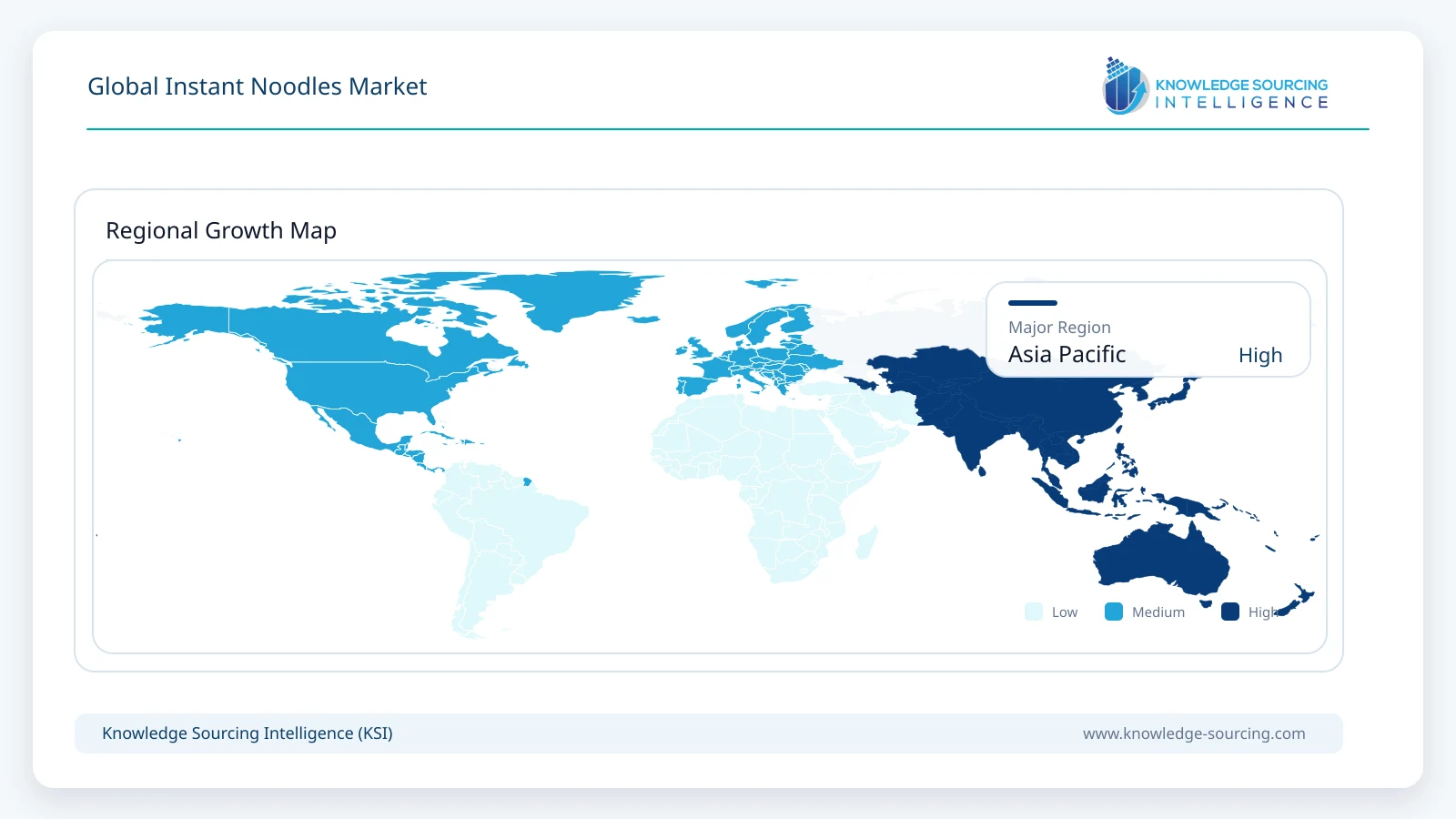
Asia Pacific accounts for approximately 71% of global market value in 2026 and an even greater share of physical consumption. The dominance is supported by the world’s largest markets, including China/Hong Kong, Indonesia, India, Vietnam, Japan, the Philippines, Thailand and South Korea. These eight markets alone consumed almost 94 billion servings during 2025.
China remains the largest country market but is comparatively mature, while India is projected to grow at a materially higher rate through 2031. Indonesian and Vietnamese demand remains structurally large, and Japan and South Korea continue to support premium product development despite modest volume growth. Competition across the region is unusually deep because many countries have powerful domestic manufacturers rather than relying primarily on multinational packaged-food companies.
North America represents an estimated USD 6-7 billion market in 2026. The United States consumed 5.23 billion servings during 2025 and continues to support both mass-market products and higher-value Asian brands. Nissin and Toyo Suisan/Maruchan have extensive local manufacturing and distribution, while Korean brands are increasing their exposure.
Europe is projected to grow at approximately 4.8% annually through 2031 as Asian cuisines become more mainstream and manufacturers introduce products designed specifically for European tastes. Nestlé’s Maggi Saucy Noodles initiative and Nissin’s European manufacturing investment support this gradual broadening of the category.
Middle East & Africa remain smaller in value but provide meaningful volume growth, particularly through Nigeria and other youthful, urbanizing markets. Nigeria consumed 3.12 billion servings in 2025. South America is led by Brazil, where demand reached 2.65 billion servings and Nissin has invested in a third manufacturing facility to expand domestic and export capacity.
Recent Developments
September 2026, Nongshim reported that first-half exports to India had increased approximately 47% year-on-year as the company expanded Shin Ramyun distribution and consumer marketing. The company had previously partnered with Blinkit in May to strengthen quick-commerce distribution across major Indian cities.
August 2026, Nissin Foods announced plans to construct a new Cup Noodles-focused factory in Tsukubamirai, Japan. The facility will involve approximately ¥70 billion of investment and is designed for maximum annual capacity of 500 million servings, with operations planned during fiscal 2029.
August 2026, the World Instant Noodles Association released its latest global demand data, reporting consumption of 124.209 billion servings during 2025, compared with 123.305 billion servings in the previous year.
During 2026, Acecook Vietnam continued development of its new R&D centre focused on instant noodle technologies including reduced salt and fat, freeze-drying, plant-based ingredients and advanced packaging. The company also broke ground in late 2025 on a new Thang Long manufacturing plant as part of its next stage of capacity and international expansion.
In the financial year ended March 2026, ITC reported strong growth in YiPPee! Noodles while expanding the portfolio into premium Pan-Asian variants including Gochujang, Tom Yum and Yaki Udon.
Competitive Environment
The Global Instant Noodles Market has a geographically distributed competitive structure in which major national manufacturers often hold stronger positions than broad global food conglomerates. WINA’s governor structure reflects this pattern and includes representative leading manufacturers from Brazil, China, India, Indonesia, Japan, South Korea, the Philippines, Russia, Taiwan, Thailand and Vietnam.
Indofood CBP is one of the world’s largest instant noodle producers through Indomie and related brands and benefits from Indonesia’s position as the second-largest consumption market globally. Nissin Foods combines strong positions in Japan, the United States, Brazil, Europe and multiple Asian markets, with Cup Noodles providing one of the category’s most internationally recognized brands. Tingyi competes through Master Kong in China, while Baixiang Food and Jinmailang provide additional scale within the world’s largest national market.
South Korea contributes an increasingly international competitive cluster. Nongshim is expanding Shin Ramyun globally and is accelerating distribution in India, while Samyang Foods has built substantial international recognition around spicy Buldak products. Paldo and Ottogi provide additional competition in Korean and export markets.
Southeast Asia contains several major regional manufacturers. Acecook Vietnam operates a leading Vietnamese instant noodle business and distributes products to more than 40 countries, while Masan Consumer competes through Omachi and other convenience-food brands. Thai President Foods is associated with the MAMA brand in Thailand, Monde Nissin is a major Philippine manufacturer and Uni-President has extensive instant noodle operations in Taiwan and China. ITC’s YiPPee! is one of the largest brands in India, while CG Foods’ Wai Wai maintains a strong position across Nepal, India and selected export markets.
Competition increasingly takes place across three dimensions simultaneously: mass-market affordability, premium flavour innovation and distribution breadth. Scale remains important in basic packet noodles, but brand strength and product innovation matter more in cups, premium international flavours and online channels. The companies best positioned through 2031 are therefore those able to maintain low-cost high-volume production while also increasing the value generated per serving.
Analyst View
The Global Instant Noodles Market is projected to increase, but the underlying growth profile is more nuanced than a simple convenience-food expansion story. Global consumption is already above 124 billion servings, meaning most forecast-period value is generated from incremental volume in selected markets combined with price, packaging and product-mix improvements across mature markets.
Asia Pacific remains the centre of gravity, yet its largest markets are moving in different directions. China provides unmatched scale but limited volume expansion, Indonesia remains large and relatively mature, while India offers a significantly stronger growth runway. At the same time, Korean brands, premium Asian flavours and cup products are expanding internationally, creating higher-value demand in North America, Europe and affluent urban markets.
The market therefore rewards manufacturers that can operate across multiple price points. Packets and fried noodles continue to generate most volume, but Cups, Non-Fried Noodles, premium recipes and digital distribution grow faster. Nutritional reformulation and sustainable packaging add cost and complexity, yet they also provide opportunities for product differentiation. Through 2031, competitive advantage is likely to come from combining manufacturing scale with localized flavour innovation, strong retail availability and the ability to participate in premium and digital channels without weakening the affordability that made instant noodles a global staple.
Instant Noodles Market Scope:
| Report Metric | Details |
|---|---|
| Total Market Size in 2026 | USD 62.5 billion |
| Total Market Size in 2031 | USD 77.2 billion |
| Forecast Unit | Billion |
| Growth Rate | 4.3% |
| Study Period | 2021 to 2031 |
| Historical Data | 2021 to 2024 |
| Base Year | 2025 |
| Forecast Period | 2026 – 2031 |
| Segmentation | Type, Flavor Type, Packaging, Distribution Channel, Geography |
| Companies |
|
Market Segmentation
By Type
Fried Noodles
Non-Fried Noodles
By Flavor Type
Chicken
Pork
Beef
Seafood
Vegetables
Other Flavors
By Packaging
Packets
Cups
By Distribution Channel
Online
Offline
By Geography
North America
USA
Canada
Mexico
South America
Brazil
Argentina
Others
Europe
United Kingdom
Germany
France
Spain
Others
Middle East and Africa
Saudi Arabia
UAE
Others
Asia Pacific
China
Japan
India
South Korea
Indonesia
Taiwan
Thailand
Others
Table of Contents
1. INTRODUCTION
1.1. Market Overview
1.2. Market Definition
1.3. Scope of the Study
1.4. Market Segmentation
1.5. Currency
1.6. Assumptions
1.7. Base and Forecast Years Timeline
1.8. Key Benefits for Stakeholders
2. RESEARCH METHODOLOGY
2.1. Research Design
2.2. Research Process
3. EXECUTIVE SUMMARY
3.1. Key Findings
4. MARKET DYNAMICS
4.1. Market Drivers
4.2. Market Restraints
4.3. Porter’s Five Forces Analysis
4.3.1. Bargaining Power of Suppliers
4.3.2. Bargaining Power of Buyers
4.3.3. Threat of New Entrants
4.3.4. Threat of Substitutes
4.3.5. Competitive Rivalry in the Industry
4.4. Industry Value Chain Analysis
4.5. Analyst View
5. GLOBAL INSTANT NOODLES MARKET BY TYPE
5.1. Introduction
5.2. Fried Noodles
5.3. Non-Fried Noodles
6. GLOBAL INSTANT NOODLES MARKET BY FLAVOR TYPE
6.1. Introduction
6.2. Chicken
6.3. Pork
6.4. Beef
6.5. Seafood
6.6. Vegetables
6.7. Other Flavors
7. GLOBAL INSTANT NOODLES MARKET BY PACKAGING
7.1. Introduction
7.2. Packets
7.3. Cups
8. GLOBAL INSTANT NOODLES MARKET BY DISTRIBUTION CHANNEL
8.1. Introduction
8.2. Online
8.3. Offline
9. GLOBAL INSTANT NOODLES MARKET BY GEOGRAPHY
9.1. Introduction
9.2. North America
9.2.1. By Type
9.2.2. By Flavor Type
9.2.3. By Packaging
9.2.4. By Distribution Channel
9.2.5. By Country
9.2.5.1. USA
9.2.5.2. Canada
9.2.5.3. Mexico
9.3. South America
9.3.1. By Type
9.3.2. By Flavor Type
9.3.3. By Packaging
9.3.4. By Distribution Channel
9.3.5. By Country
9.3.5.1. Brazil
9.3.5.2. Argentina
9.3.5.3. Others
9.4. Europe
9.4.1. By Type
9.4.2. By Flavor Type
9.4.3. By Packaging
9.4.4. By Distribution Channel
9.4.5. By Country
9.4.5.1. United Kingdom
9.4.5.2. Germany
9.4.5.3. France
9.4.5.4. Spain
9.4.5.5. Others
9.5. Middle East and Africa
9.5.1. By Type
9.5.2. By Flavor Type
9.5.3. By Packaging
9.5.4. By Distribution Channel
9.5.5. By Country
9.5.5.1. Saudi Arabia
9.5.5.2. UAE
9.5.5.3. Others
9.6. Asia Pacific
9.6.1. By Type
9.6.2. By Flavor Type
9.6.3. By Packaging
9.6.4. By Distribution Channel
9.6.5. By Country
9.6.5.1. China
9.6.5.2. Japan
9.6.5.3. India
9.6.5.4. South Korea
9.6.5.5. Indonesia
9.6.5.6. Taiwan
9.6.5.7. Thailand
9.6.5.8. Others
10. COMPETITIVE ENVIRONMENT AND ANALYSIS
10.1. Major Players and Strategy Analysis
10.2. Market Share Analysis
10.3. Mergers, Acquisitions, Agreements and Collaborations
10.4. Competitive Dashboard
11. COMPANY PROFILES
11.1. PT Indofood CBP Sukses Makmur Tbk
11.2. Nissin Foods Holdings Co., Ltd.
11.3. Nestlé S.A.
11.4. Tingyi (Cayman Islands) Holding Corp.
11.5. Nongshim Co., Ltd.
11.6. Toyo Suisan Kaisha, Ltd. / Maruchan
11.7. Samyang Foods Co., Ltd.
11.8. Monde Nissin Corporation
11.9. Uni-President Enterprises Corporation
11.10. Acecook Vietnam Joint Stock Company
11.11. Thai President Foods Public Company Limited
11.12. Masan Consumer Corporation
11.13. ITC Limited
11.14. Baixiang Food Group
11.15. Jinmailang Food Co., Ltd.
11.16. Paldo Co., Ltd.
11.17. Universal Robina Corporation
11.18. C.G. Foods / Wai Wai
11.19. Mamee-Double Decker (M) Sdn. Bhd.
12. APPENDIX
12.1. Currency
12.2. Assumptions
12.3. Base and Forecast Years Timeline
12.4. Key Benefits for Stakeholders
12.5. Research Methodology
12.6. Abbreviations
Navigate
Trusted by the world's leading organizations











