
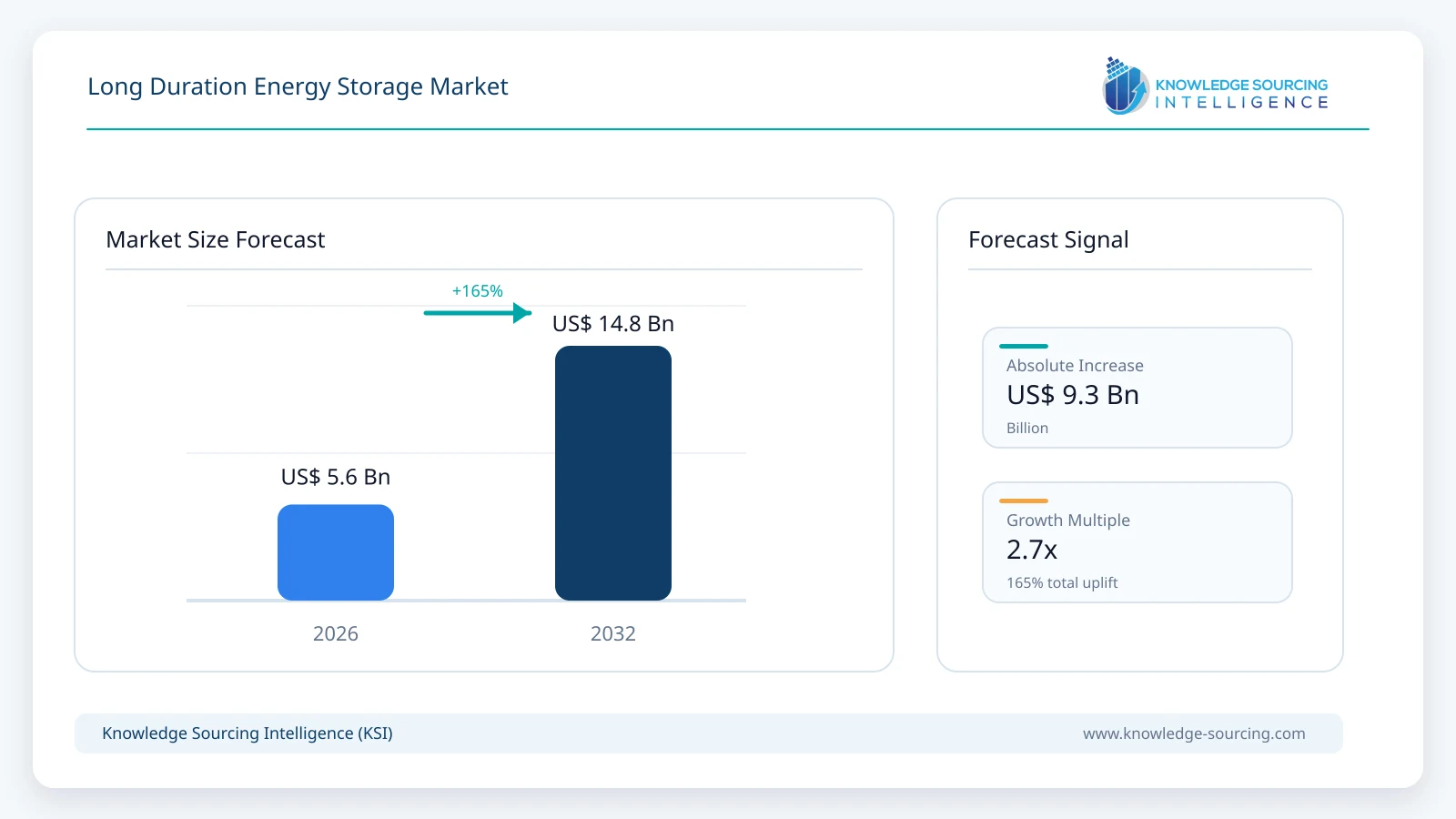
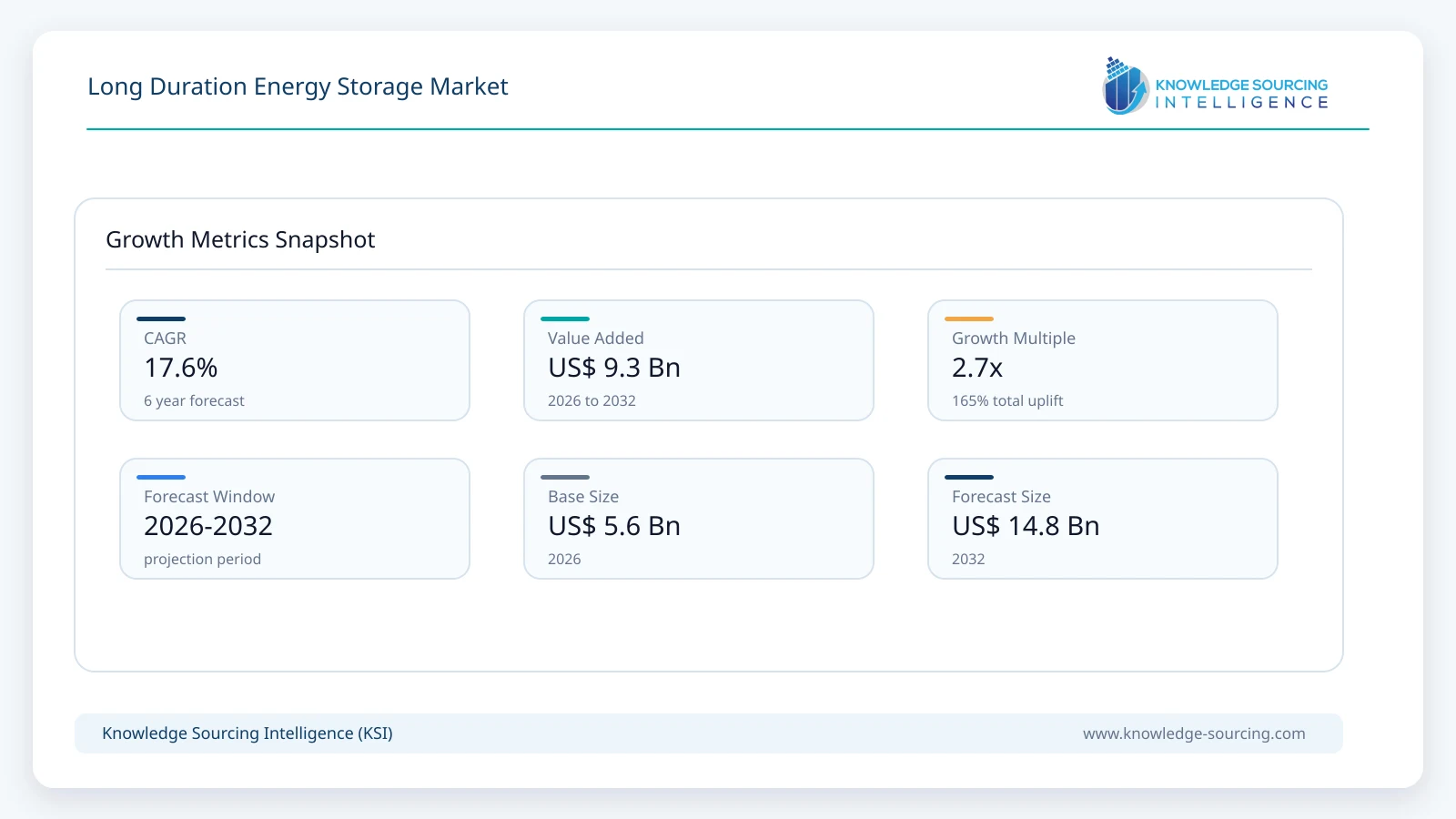
The Long Duration Energy Storage Market is estimated at USD 5.60 billion in 2026 and is projected to reach USD 14.85 billion by 2032, representing a CAGR of 17.6% during 2026-2032.
Highlights:
- 1Electrochemical LDES represents an estimated 39.2% of 2026 market revenue, supported by flow, zinc and emerging iron-air systems.
- 2Thermal and thermo-mechanical storage is the fastest-expanding technology group as commercial projects move beyond pilot scale.
- 3Eight-to-24-hour systems remain the largest duration class, while multi-day systems gain importance for reliability and firm renewable power.
- 4North America accounts for an estimated 36.8% of 2026 revenue, supported by project finance, utility procurement and domestic manufacturing investment.
- 5The supplier base is still concentratedcredible commercial and late-stage developers are materially fewer than the long lists often associated with the wider battery ecosystem.
Market Overview
LDES sits between daily battery cycling and seasonal fuel storage. Its economic value rises when grids experience longer periods of renewable oversupply, transmission constraints or low renewable output. Unlike conventional four-hour lithium-ion systems, many LDES technologies separate power capacity from stored-energy capacity, allowing the discharge duration to be extended without increasing every system component proportionally. Flow batteries, compressed-air systems, thermal stores and hydrogen-based systems therefore become more competitive as required duration increases, although each technology carries different efficiency, siting and construction constraints.
Technology choice is becoming application-led. Utilities seeking capacity replacement may accept lower round-trip efficiency if a system can deliver eight to 100 hours at low energy-capacity cost. Industrial sites may prefer thermal batteries that directly supply steam or process heat. Data centres and isolated systems value multi-day resilience and rapid siting. Projects also increasingly combine technologies: short-duration batteries handle fast response while a longer-duration system supplies sustained energy. This hybrid architecture is visible in commercial projects and is likely to widen the addressable market without requiring one technology to satisfy every grid-service requirement.
Market Drivers
Renewable curtailment and longer net-load ramps increase the value of stored energy
Wind and solar additions are increasing the number of hours in which generation is abundant but cannot be absorbed locally. As curtailment costs rise, storage that can shift energy across an overnight period or across several low-renewable days becomes more valuable. LDES can also reduce the need to build peaking capacity solely for infrequent stress events. The commercial signal is visible in utility procurements for eight-hour and multi-day resources, in long-term service agreements and in capacity contracts that reward sustained delivery rather than only short bursts of power.
Commercial-scale reference projects reduce technology risk
The market is benefiting from larger operating references and projects under construction. Energy Vault reports a commissioned 25 MW/100 MWh gravity system in Rudong, while Highview Power is building a 50 MW/300 MWh liquid-air plant in the United Kingdom. Energy Dome is contracting 8- to 24-hour carbon-dioxide battery projects, and Hydrostor has secured offtake for the 500 MW/4,000 MWh Willow Rock advanced compressed-air project. These projects provide lenders, utilities and engineering firms with better evidence on construction schedules, performance guarantees, maintenance requirements and operating economics.
Data-centre and industrial demand creates additional routes to market
LDES is no longer limited to utility renewable-shifting applications. Form Energy has announced multi-gigawatt-hour capacity agreements associated with data-centre development, while thermal-battery companies are targeting industrial heat and power. Antora Energy commissioned a 5 GWh thermal battery system at POET in 2026, demonstrating that large storage projects can be built around a contracted industrial energy offtake rather than a wholesale power-market revenue stack. This broadens the market beyond utilities and creates bankable projects where the customer values firm power, steam, resilience or faster grid interconnection.
Restraints and Adoption Challenges
Long-duration projects remain capital-intensive and frequently face first-of-a-kind engineering risk, long permitting cycles and uncertain revenue recognition for capacity that may be used only during infrequent system stress. Technologies based on caverns, large civil structures or cryogenic systems can be site- and construction-dependent. Electrochemical alternatives have simpler siting but must prove manufacturing scale, field life and warranty performance. The market also lacks a single globally accepted duration threshold: some procurement programmes classify four-to-eight-hour systems as long duration, while multi-day developers focus on 24 hours or more. This report therefore uses an eight-hour threshold for the revenue estimate and treats shorter systems only where they form part of a dedicated long-duration project architecture.
Segment Analysis
By Technology
Electrochemical systems are the largest technology group in 2026, supported by commercially available vanadium-flow and zinc-based systems and the rapid scale-up of iron-air and other aqueous chemistries. Their modularity and relatively straightforward site development make them attractive where geological conditions are unsuitable for cavern-based systems. The technology group accounts for an estimated 39.2% of 2026 market revenue. Thermal and thermo-mechanical storage is expected to record the strongest growth through 2032 as liquid-air, carbon-dioxide, pumped-heat and high-temperature thermal systems progress into larger contracted projects.
Technology | Typical Duration | Current Commercial Position | Primary Fit |
Flow / zinc / iron-air batteries | 8-100+ hours | Commercial to early-scale deployment | Utility shifting, capacity, microgrids |
Advanced compressed air | 8+ hours | Large late-stage projects; operating references | Grid capacity and renewable integration |
Liquid air / CO? storage | 6-24+ hours | Commercial-scale deployment accelerating | Grid shifting and capacity replacement |
Gravity / advanced hydro | 4-20+ hours | Commercial gravity reference; advanced hydro pilots | Bulk shifting where site conditions fit |
Thermal / pumped heat | 10 hours to multi-day | Industrial commercial deployment; grid projects developing | Industrial heat, firm power and data centres |
Hydrogen power storage | Multi-day to seasonal | Commercial components; integrated projects emerging | Seasonal balancing and resilience |
By Duration and Application
Eight-to-24-hour systems form the largest revenue pool because they can address daily renewable shifting and capacity needs while keeping equipment utilisation high. Multi-day systems are the fastest-developing duration class as utilities plan for prolonged low-wind or low-solar periods and as large loads seek resilience beyond conventional backup windows. Grid-scale renewable integration remains the largest application, while industrial energy and data-centre applications are expanding faster from a smaller base.
Commercial Project Indicators
Company / Project | Technology | Scale / Duration | 2025-2026 Evidence |
Form Energy / Great River Energy & pipeline | Iron-air | 100-hour systems | First commercial demonstration deployment in 2025-2026; additional 2026 international and data-centre agreements |
Hydrostor / Willow Rock | A-CAES | 500 MW / 4,000 MWh | 2026 offtake agreements and project financing progress |
Highview Power / Carrington | Liquid air | 50 MW / 300 MWh | Groundbreaking in Nov. 2025; project under construction with grid-stability phase targeted from 2026 |
Energy Dome / Ireland & Arizona | CO? Battery | 23 MW / 200 MWh and 19 MW / 190 MWh | Commercial agreements announced in June 2026 |
Antora / Project Big Stone | Thermal battery | 5 GWh multi-day | Commissioned in May 2026 and delivering energy to POET |
CMBlu / Uniper framework | Organic SolidFlow | Framework for at least 5 GWh | Site acceptance completed; long-term framework signed in Jan. 2026 |
Regional Opportunity
North America
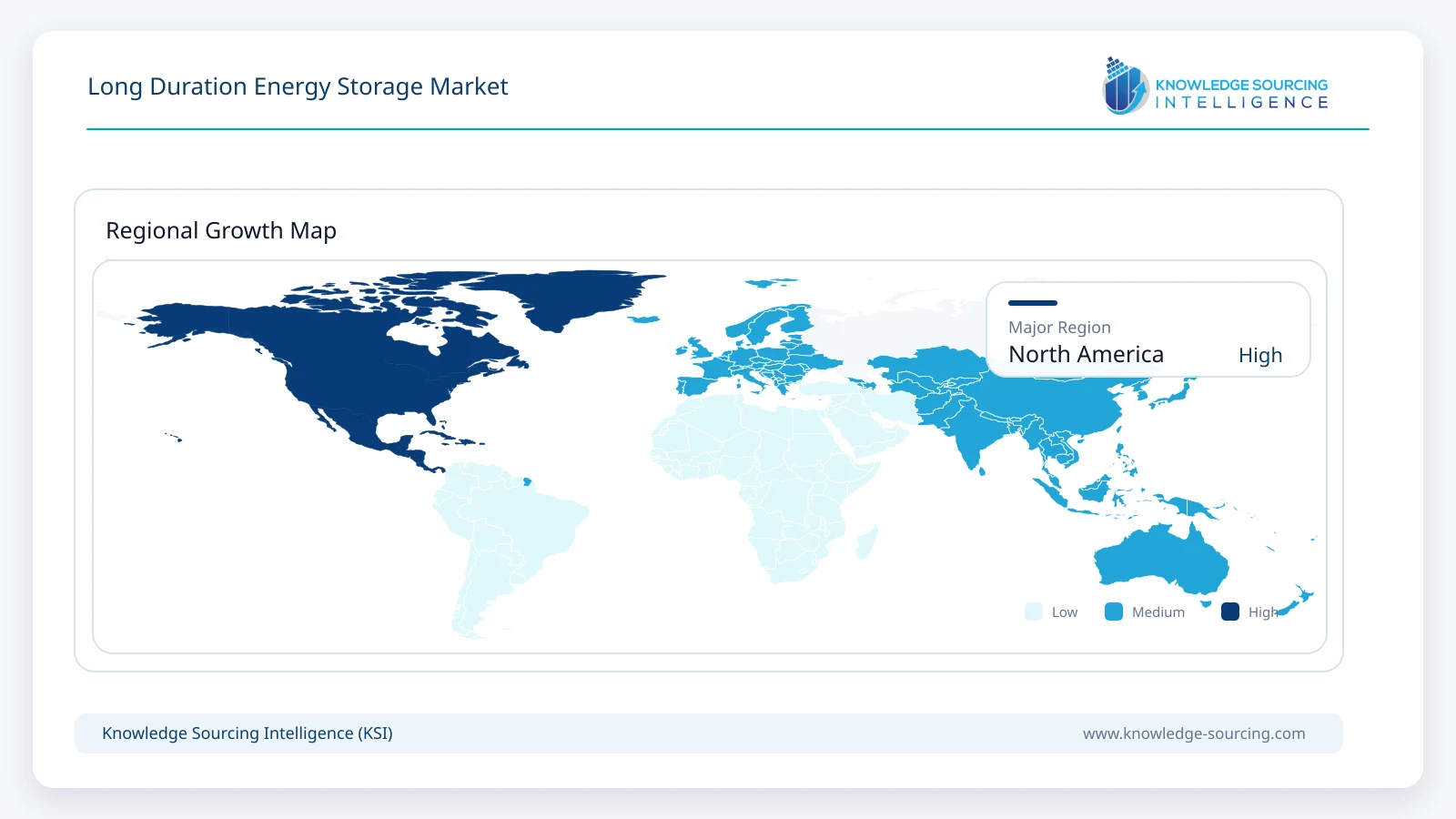
North America is the largest regional market in 2026, with an estimated 36.8% share. The United States combines utility procurement, federal and state demonstration support, large renewable curtailment zones and a rapidly expanding data-centre load. The region also contains several of the most advanced technology developers, including Form Energy, Hydrostor, Eos Energy Enterprises, ESS Tech, Antora Energy and Fourth Power. California is important for long-duration procurement and compressed-air development, while the Midwest and Northeast are becoming important for iron-air, flow-battery and industrial thermal projects. Canada contributes through Hydrostor and utility storage programmes, while the U.S. manufacturing push is supporting domestic supply chains for non-lithium batteries and thermal systems.
Competitive Landscape
The competitive landscape is defined by a relatively small group of companies with current products, operating references, contracted projects or late-stage commercial programmes. The market should not be treated as a conventional battery-vendor list: many adjacent cell manufacturers, engineering contractors, utilities and materials suppliers do not provide a long-duration storage product. The participants below have been retained because each has a current technology or project directly addressing long-duration storage and current evidence of activity.
Key Market Participant | Technology | Commercial Status | Current Evidence |
Form Energy | Iron-air, 100-hour battery | Commercial-scale deployment / manufacturing ramp | 2026 100-hour performance and project pipeline; first commercial demonstration deployment underway |
Hydrostor | Advanced compressed-air energy storage | Commercial developer / operator | 2026 Willow Rock offtake and financing milestones; operating contracted facility in Canada |
Highview Power | Liquid-air energy storage | Commercial-scale project developer | Carrington under construction; 2026 leadership and project programme active |
Energy Dome | CO? Battery | Commercial supplier / developer | MW-scale plant operating; multiple 2026 bilateral project contracts |
Energy Vault | Gravity and integrated LDES | Commercial supplier / developer / owner | 100 MWh gravity system commissioned; 2026 multi-GWh gravity and eight-hour project activity |
Eos Energy Enterprises | Zinc-based LDES | Commercial supplier | 2026 production ramp, backlog growth and 750 MWh DACH supply agreement |
Invinity Energy Systems | Vanadium flow batteries | Commercial supplier | 20.7 MWh UK delivery and GWh-scale Swiss engineering award in 2026 |
CMBlu Energy | Organic SolidFlow battery | Commercialising supplier | 2026 5 GWh Uniper framework following site acceptance; 1 GWh Alzenau production capacity |
Sumitomo Electric | Vanadium redox flow batteries | Commercial supplier | 2026 Japanese orders including 8 MWh and 33 MWh projects plus long-term service |
ESS Tech | Iron-flow LDES | Commercial supplier / portfolio transition | 2026 LDES commissioning and U.S. defence project; also expanding into sodium-ion systems |
Malta Inc. | Pumped-heat / molten-salt LDES | Pilot / early commercial developer | 2026 ACWA collaboration for pilot testing and utility-scale deployment evaluation |
Antora Energy | High-temperature thermal battery | Commercial supplier / project developer | 5 GWh Project Big Stone commissioned in 2026 |
Fourth Power | High-temperature thermal-to-power storage | Demonstration-stage developer | Current 50-hour product architecture and commissioning of first full-scale demonstration |
RheEnergise | High-Density Hydro | Pilot-stage developer | First project achieved full power in Jan. 2026; commercial-scale development follows |
Customers, utilities, EPC contractors, investors and materials suppliers are discussed as ecosystem participants where relevant but are not included in the Key Market Participants list unless they directly supply or develop the storage technology.
Recent Developments
September 2026: Energy Vault advanced its 125 MW / 1 GWh Stoney Creek eight-hour project in New South Wales through full project-land acquisition and construction-readiness milestones.
August 2026: Hydrostor secured USD 230 million to progress its advanced compressed-air energy storage portfolio, including large projects in California and Australia.
July 2026: Antora Energy announced a USD 550 million Series C after commissioning its 5 GWh multi-day thermal-battery project in South Dakota.
June 2026: Eos Energy Enterprises signed a 750 MWh long-duration storage supply commitment for Germany, Austria and Switzerland with a pathway to 2 GWh.
May 2026: Invinity Energy Systems was selected to engineer a GWh-scale vanadium-flow battery for the Technology Centre Laufenburg in Switzerland.
January 2026: CMBlu Energy and Uniper signed a conditional framework covering at least 5 GWh of Organic SolidFlow systems through 2037.
Long Duration Energy Storage Market Scope
| Report Metric | Details |
|---|---|
| Total Market Size in 2026 | USD 5.60 billion |
| Total Market Size in 2032 | USD 14.85 billion |
| Forecast Unit | Billion |
| Growth Rate | 17.6% |
| Study Period | 2021 to 2032 |
| Historical Data | 2021 to 2024 |
| Base Year | 2025 |
| Forecast Period | 2026 – 2032 |
| Segmentation | Technology, Duration, Application, Deployment Type, Geography |
| Companies |
|
Market Segmentation
By Technology
Flow Batteries
Zinc-Based and Iron-Air Batteries
Advanced Compressed-Air Energy Storage
Liquid-Air Energy Storage
Carbon-Dioxide Energy Storage
Gravity and Advanced Hydro Storage
Thermal and Pumped-Heat Storage
Hydrogen-Based Energy Storage
By Duration
8-12 Hours
12-24 Hours
24-100 Hours
Above 100 Hours / Seasonal
By Application
Renewable Energy Shifting
Capacity and Resource Adequacy
Grid Congestion and Curtailment Management
Industrial Energy
Data Centres and Critical Infrastructure
Microgrids and Remote Power
By Deployment Type
Utility-Owned
Independent Power Producer / Storage-as-a-Service
Behind-the-Meter and Industrial
By Geography
North America
United States
Canada
Europe
Asia Pacific
Rest of World
Table of Contents
1. EXECUTIVE SUMMARY
1.1. Market Opportunity and Key Findings
1.2. LDES Technology and Duration Outlook
1.3. Commercialisation and Project Pipeline
2. MARKET OVERVIEW
2.1. Long-Duration Energy Storage Fundamentals
2.2. Storage Duration and Grid-Service Requirements
2.3. Long-Duration versus Short-Duration Storage
2.4. Hybrid Storage Architectures
3. MARKET SIZE AND FORECAST, 2026-2032
3.1. Global Market Revenue
3.2. Annual Growth Analysis
4. MARKET BY TECHNOLOGY
4.1. Flow Batteries
4.2. Zinc-Based and Iron-Air Batteries
4.3. Advanced Compressed-Air Energy Storage
4.4. Liquid-Air Energy Storage
4.5. Carbon-Dioxide Energy Storage
4.6. Gravity and Advanced Hydro Storage
4.7. Thermal and Pumped-Heat Storage
4.8. Hydrogen-Based Energy Storage
5. MARKET BY DURATION
5.1. 8-12 Hours
5.2. 12-24 Hours
5.3. 24-100 Hours
5.4. Above 100 Hours / Seasonal
6. MARKET BY APPLICATION
6.1. Renewable Energy Shifting
6.2. Capacity and Resource Adequacy
6.3. Grid Congestion and Curtailment Management
6.4. Industrial Energy
6.5. Data Centres and Critical Infrastructure
6.6. Microgrids and Remote Power
7. MARKET BY DEPLOYMENT TYPE
7.1. Utility-Owned
7.2. Independent Power Producer / Storage-as-a-Service
7.3. Behind-the-Meter and Industrial
8. REGIONAL MARKET
8.1. North America
8.1.1. United States
8.1.2. Canada
8.2. Europe
8.3. Asia Pacific
8.4. Rest of World
9. MARKET DYNAMICS
9.1. Drivers
9.1.1. Renewable Curtailment and Grid Congestion
9.1.2. Capacity Replacement and Reliability
9.1.3. Data-Centre and Industrial Load Growth
9.1.4. Commercial-Scale Project Validation
9.2. Restraints
9.2.1. First-of-a-Kind Project Risk
9.2.2. Permitting and Construction Lead Times
9.2.3. Revenue-Stack and Market-Design Uncertainty
9.2.4. Technology-Specific Siting Constraints
10. COMPETITIVE LANDSCAPE
10.1. Electrochemical LDES Suppliers
10.2. Thermo-Mechanical Storage Developers
10.3. Thermal and Multi-Day Storage Developers
10.4. Commercial Project Pipeline
11. COMPANY PROFILES
11.1. Form Energy
11.2. Hydrostor
11.3. Highview Power
11.4. Energy Dome
11.5. Energy Vault
11.6. Eos Energy Enterprises
11.7. Invinity Energy Systems
11.8. CMBlu Energy
11.9. Sumitomo Electric
11.10. ESS Tech
11.11. Malta Inc.
11.12. Antora Energy
11.13. Fourth Power
11.14. RheEnergise
12. RECENT DEVELOPMENTS
13. APPENDIX
Navigate
Trusted by the world's leading organizations











