
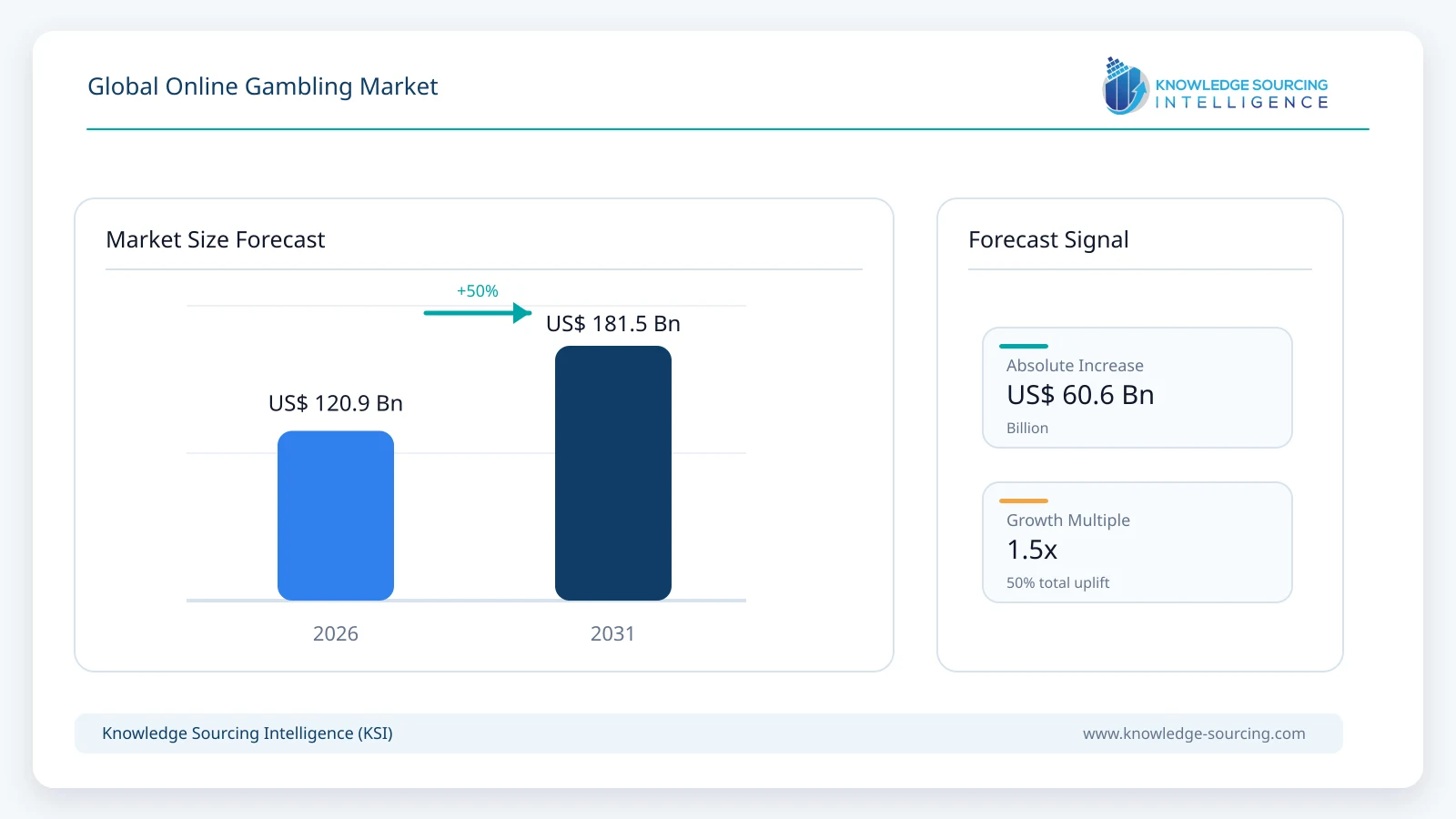
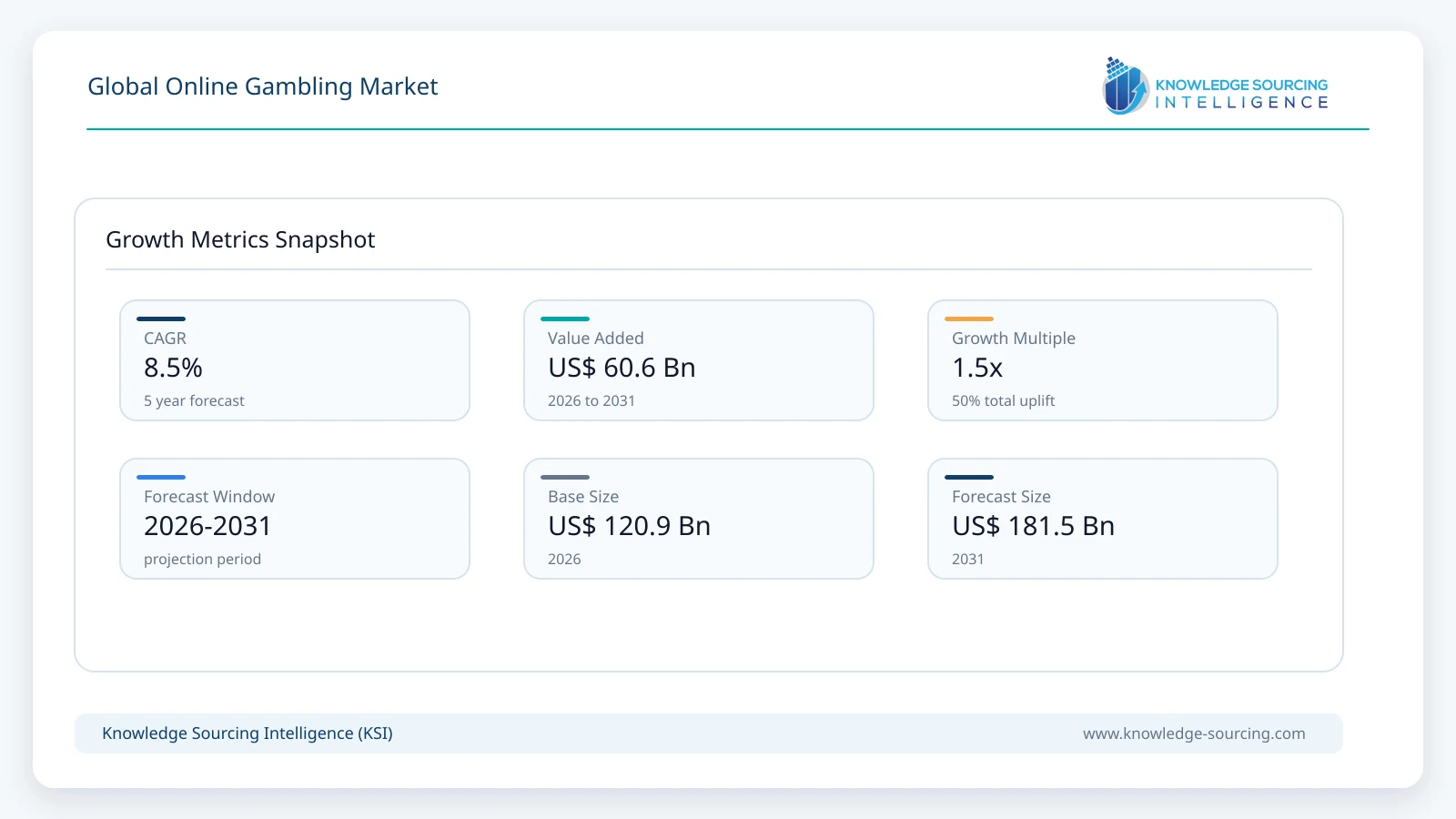
The global online gambling market is estimated at USD 120.9 billion in 2026 and is projected to reach approximately USD 181.5 billion by 2031, representing a CAGR of 8.48% during the forecast period.
Highlights:
- 1Mobile platforms account for approximately 80% of global regulated online gambling revenue in 2026.
- 2Sports betting remains the largest game category, while online casino is generally growing faster in mature regulated markets.
- 3Europe remains the largest regulated regional market, supported by mature licensing regimes and high digital penetration.
- 4The United Kingdom increased Remote Gaming Duty from 21% to 40% on 1 April 2026.
- 5Brazil strengthened online betting advertising requirements in July 2026 while maintaining a broad licensed operator base.
- 6Operator consolidation is reshaping the market as Kindred moves into FDJ UNITED and William Hill and 888 operate under evoke plc.
Online gambling has shifted from a desktop extension of retail betting into a mobile entertainment platform built around real-time data, personalization, live streaming, in-play wagering and digital payments. Sports betting remains the largest global game category, but online casino and iGaming generate structurally higher engagement in markets where both products are permitted. BetMGM's second-quarter 2026 results illustrate the difference: iGaming net revenue increased 8% year over year while online sports revenue was flat, and the company continued to emphasize multi-product states. Rush Street Interactive similarly reported 46% year-over-year quarterly revenue growth in Q2 2026, driven by online casino and sportsbook activity across North and South America.
The competitive landscape is becoming more concentrated around scaled technology platforms and multi-brand groups. Flutter operates FanDuel, Paddy Power, Betfair, PokerStars, Sportsbet, Sisal and other brands and completed its move to full ownership of FanDuel in 2025. FDJ UNITED completed the integration of Kindred, while evoke plc now houses 888, William Hill and Mr Green. Entain remains a global operator through Ladbrokes, Coral, bwin, Sportingbet and other brands while jointly owning BetMGM with MGM Resorts. These structures mean market-share analysis should be performed at parent-company or operating-platform level rather than counting individual consumer brands as independent competitors.
Regulation is the biggest source of geographic divergence. The UK increased Remote Gaming Duty from 21% to 40% in April 2026, materially changing iGaming economics. Brazil strengthened marketing and warning-label requirements in July 2026, while Alberta opened a broader regulated iGaming market during 2026. India moved in the opposite direction after its 2025 legislation restricted online money games, leading large operators to discontinue real-money products. The global market therefore grows through regulated-market expansion, but operator profitability depends increasingly on local taxation, product permissions and responsible-gambling requirements.
Market Trends
Online Casino Is Becoming the Profit Engine in Multi-Product Markets
Operators increasingly use sports betting as a customer-acquisition funnel while online casino drives higher-frequency engagement and more stable margins. BetMGM reported USD 483 million of Q2 2026 iGaming net revenue compared with USD 228 million from online sports, while Caesars Digital also reported stronger iGaming activity in early 2026. Fanatics, Hard Rock Bet, PENN and Bally's are similarly integrating sportsbook and casino products into single-account ecosystems where permitted. This cross-sell model is strongest in U.S. states such as New Jersey, Michigan and Pennsylvania and in mature European markets.
Mobile-First Product Design Is Replacing Desktop-Led Gambling Journeys
Mobile is now the default access point for most online bettors and casino players. Operators compete on load speed, live-betting latency, personalized home screens, same-game parlays, payment friction, loyalty integration and in-app casino discovery. Fanatics combined sportsbook, casino and prediction-market functionality into one app in September 2026, while bet365 continued to expand its mobile sportsbook across additional U.S. jurisdictions. Desktop remains relevant for poker, high-value casino and some professional betting activity, but incremental consumer growth is overwhelmingly mobile.
AI and Proprietary Trading Technology Are Moving Deeper Into Sportsbook Operations
Sports betting platforms are investing in proprietary pricing, risk management and personalized content rather than relying entirely on third-party trading systems. Kaizen Gaming acquired GameplAI in May 2026 to strengthen AI-driven sports trading and analytics, while Fanatics integrates technology acquired with PointsBet and Banach into its sportsbook stack. AI is also being used for promotional targeting, fraud detection, responsible-gambling monitoring and player support. The competitive advantage increasingly comes from combining pricing accuracy, speed and personalization rather than simply offering more betting markets.
Prediction Markets Are Creating an Adjacent Competitive Threat
Event-contract and prediction-market platforms expanded during 2025 and 2026, creating regulatory disputes over whether certain sports-linked contracts should be treated as gambling. Entain and other licensed operators have highlighted the issue in U.S. regulatory disclosures. KSI excludes prediction markets from the base online gambling estimate because they operate under different legal frameworks in several jurisdictions, but they remain commercially relevant because they compete for sports-event engagement, customer deposits and mobile attention.
Market Drivers
Regulated Market Openings Expand the Addressable Customer Base
Online gambling revenue grows when jurisdictions move activity from unlicensed or retail-only channels into licensed digital frameworks. Brazil's national regulated market began in 2025 and continued to develop stricter advertising rules in 2026. Alberta opened its broader iGaming market in 2026, attracting operators including BetMGM, bet365 and Hard Rock Bet. In the United States, sports betting continues to expand state by state, while iGaming remains legal in fewer jurisdictions and therefore offers greater long-term regulatory upside.
Digital Payments and Account-Based Play Improve Conversion and Retention
Modern platforms support card payments, bank transfers, digital wallets, instant withdrawals and identity verification within the same mobile experience. Faster deposit and withdrawal processes reduce friction and support repeated engagement, while account-based play allows operators to integrate rewards, personalization and responsible-gambling controls. The strongest platforms also connect online wagering to broader loyalty ecosystems, such as FanCash at Fanatics and Unity at Hard Rock.
Live Betting and Real-Time Content Increase Engagement
In-play betting, live casino, same-game parlays and real-time streaming increase the number of wagering opportunities within a single sporting event or gaming session. The 2026 FIFA World Cup created a large global engagement window for operators, and bet365 reported more than GBP 125 million of payouts from one football-specific promotional mechanic during the tournament. Live products increase monetization but also require low-latency data, reliable trading systems and stronger player-protection tools.
Market Restraints
Higher Taxes, Marketing Restrictions and Illegal Competition Pressure Licensed Operators
The regulated industry faces rising tax and compliance costs. The UK doubled Remote Gaming Duty from 21% to 40% in April 2026 and plans a higher remote-betting rate from April 2027. Brazil introduced stronger advertising warnings and accountability requirements in July 2026. Entain's research indicates illegal online gambling remains material in some restrictive jurisdictions, allowing unlicensed operators to compete without equivalent tax, know-your-customer and responsible-gambling obligations. Excessive tax or product restrictions can therefore compress licensed-operator margins while also reducing channelization into regulated platforms.
Global Online Gambling Market Segment Analysis
By Game Type
Sports Betting
Online sports betting is estimated at approximately USD 63 billion in 2026 and remains the largest game-type segment. Football, basketball, tennis, horse racing and U.S. professional sports provide the core wagering base, while in-play betting and same-game parlays increase revenue per active customer. Online casino and iGaming are expected to grow faster in jurisdictions where slots, table games and live dealer products are permitted because customers can play continuously rather than only around sporting events. Poker, bingo and online lottery products form smaller specialist segments.
By Platform
Mobile
Mobile is the dominant platform because smartphones combine account creation, payments, live data, betting and streaming in one device. The strongest operators increasingly design products natively for iOS and Android rather than adapting desktop interfaces. Desktop and browser-based wagering remain relevant for higher-information betting, poker and some casino use cases, but the majority of new customer acquisition and active-session growth is mobile-led.
By Geography
Europe
Europe is estimated at approximately USD 42 billion in 2026 and remains the largest regulated regional market. The UK, Italy, Spain, Germany, the Nordic markets and several Central and Eastern European countries have long-established online betting or gaming frameworks.
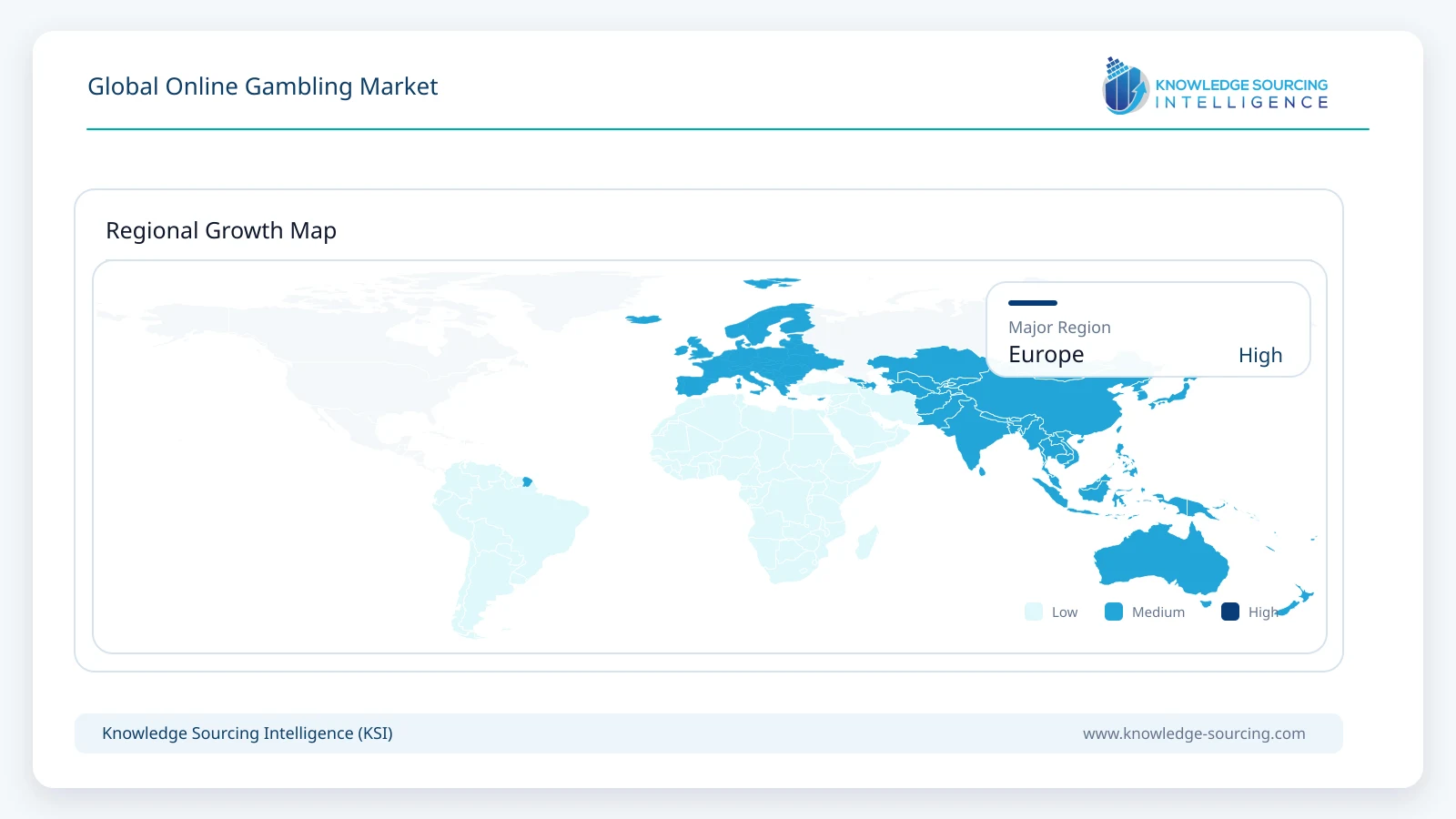
Growth is increasingly shaped by tax and player-protection changes rather than first-time digital adoption. North America is the fastest-expanding large region as U.S. states and Canadian provinces regulate online betting and iGaming, while Latin America is gaining importance through Brazil, Colombia, Mexico and Argentina.
Competitive Environment
The market is led by scaled global operators, regional champions and U.S.-focused digital platforms. Flutter Entertainment is the largest diversified online betting and gaming group and owns FanDuel outright, while Entain, FDJ UNITED, evoke, bet365, Betsson, Super Group and Kaizen Gaming maintain broad international footprints. DraftKings, BetMGM, Caesars Digital, Rush Street Interactive, Fanatics Betting & Gaming, PENN Entertainment and Hard Rock Digital are especially important in North America. Bally's combines Bally Bet, Bally Casino and its international interactive business.
Recent Developments
September 2026: Fanatics launched a unified Sports & Casino app combining sportsbook, online casino and its adjacent prediction-market product under one customer account.
August 2026: Entain reported 7% year-over-year first-half revenue growth and continued reshaping its portfolio while retaining major online betting and gaming operations.
July 2026: Brazil introduced stricter online betting advertising rules requiring prominent gambling-risk warnings and broader accountability across advertisers.
July 2026: BetMGM reported Q2 net revenue of USD 711 million, with iGaming revenue increasing 8% year over year.
July 2026: Hard Rock Bet entered Ontario with a combined online casino and sportsbook, marking its first international market.
Global Online Gambling Market Scope:
| Report Metric | Details |
|---|---|
| Total Market Size in 2026 | USD 120.9 billion |
| Total Market Size in 2031 | USD 181.5 billion |
| Forecast Unit | Billion |
| Growth Rate | 8.48% |
| Study Period | 2021 to 2031 |
| Historical Data | 2021 to 2024 |
| Base Year | 2025 |
| Forecast Period | 2026 – 2031 |
| Segmentation | Game Type, Platform, Geography |
| Companies |
|
Market Segmentation
BY GAME TYPE
Sports Betting
Online Casino / iGaming
Poker and Bingo
Online Lottery and Other Regulated Games
BY PLATFORM
Mobile
Desktop / Web
BY GEOGRAPHY
North America
United States
Canada
Mexico
South America
Brazil
Argentina
Colombia
Others
Europe
United Kingdom
Italy
Germany
Spain
Netherlands
Sweden
Others
Middle East & Africa
South Africa
Nigeria
Others
Asia Pacific
Australia
Japan
Philippines
New Zealand
Others
Table of Contents
1. EXECUTIVE SUMMARY
2. MARKET SNAPSHOT
2.1. Market Overview
2.2. Market Definition
2.3. Scope of the Study
2.4. Market Segmentation
3. BUSINESS LANDSCAPE
3.1. Market Drivers
3.1.1. Regulated Market Openings Expand the Addressable Customer Base
3.1.2. Digital Payments and Account-Based Play Improve Conversion and Retention
3.1.3. Live Betting and Real-Time Content Increase Engagement
3.2. Market Restraints
3.2.1. Higher Taxes, Marketing Restrictions and Illegal Competition Pressure Licensed Operators
3.3. Market Opportunities
3.4. Porter's Five Forces Analysis
3.5. Industry Value Chain Analysis
3.6. Regulatory and Tax Environment
3.7. Strategic Recommendations
4. TECHNOLOGICAL OUTLOOK
4.1. Mobile-First Sportsbook and Casino Platforms
4.2. Live Betting and Low-Latency Trading
4.3. AI-Driven Pricing and Personalization
4.4. Digital Identity, KYC and Fraud Detection
4.5. Payments and Instant Withdrawals
4.6. Responsible-Gambling Monitoring Technology
5. GLOBAL ONLINE GAMBLING MARKET BY GAME TYPE
5.1. Introduction
5.2. Sports Betting
5.3. Online Casino / iGaming
5.4. Poker and Bingo
5.5. Online Lottery and Other Regulated Games
6. GLOBAL ONLINE GAMBLING MARKET BY PLATFORM
6.1. Introduction
6.2. Mobile
6.3. Desktop / Web
7. GLOBAL ONLINE GAMBLING MARKET BY GEOGRAPHY
7.1. Introduction
7.2. North America
7.2.1. United States
7.2.2. Canada
7.2.3. Mexico
7.3. South America
7.3.1. Brazil
7.3.2. Argentina
7.3.3. Colombia
7.3.4. Others
7.4. Europe
7.4.1. United Kingdom
7.4.2. Italy
7.4.3. Germany
7.4.4. Spain
7.4.5. Netherlands
7.4.6. Sweden
7.4.7. Others
7.5. Middle East & Africa
7.5.1. South Africa
7.5.2. Nigeria
7.5.3. Others
7.6. Asia Pacific
7.6.1. Australia
7.6.2. Japan
7.6.3. Philippines
7.6.4. New Zealand
7.6.5. Others
8. COMPETITIVE ENVIRONMENT AND ANALYSIS
8.1. Major Operators and Strategy Analysis
8.2. Sportsbook versus iGaming Positioning
8.3. Regulation, Tax and Market-Access Strategy
8.4. Technology, M&A and Product Innovation
8.5. Competitive Dashboard
9. COMPANY PROFILES
9.1. Flutter Entertainment plc
9.2. Entain plc
9.3. DraftKings Inc.
9.4. BetMGM LLC
9.5. FDJ UNITED
9.6. evoke plc
9.7. bet365 Group Ltd.
9.8. Betsson AB
9.9. Super Group (SGHC) Limited
9.10. Rush Street Interactive, Inc.
9.11. Kaizen Gaming
9.12. Caesars Entertainment, Inc.
9.13. Fanatics Betting and Gaming
9.14. PENN Entertainment, Inc.
9.15. Hard Rock Digital
9.16. Bally's Corporation
10. APPENDIX
10.1. Currency
10.2. Assumptions
10.3. Base and Forecast Years Timeline
10.4. Key Benefits for Stakeholders
10.5. Research Methodology
10.6. Abbreviations
Navigate
Trusted by the world's leading organizations











