
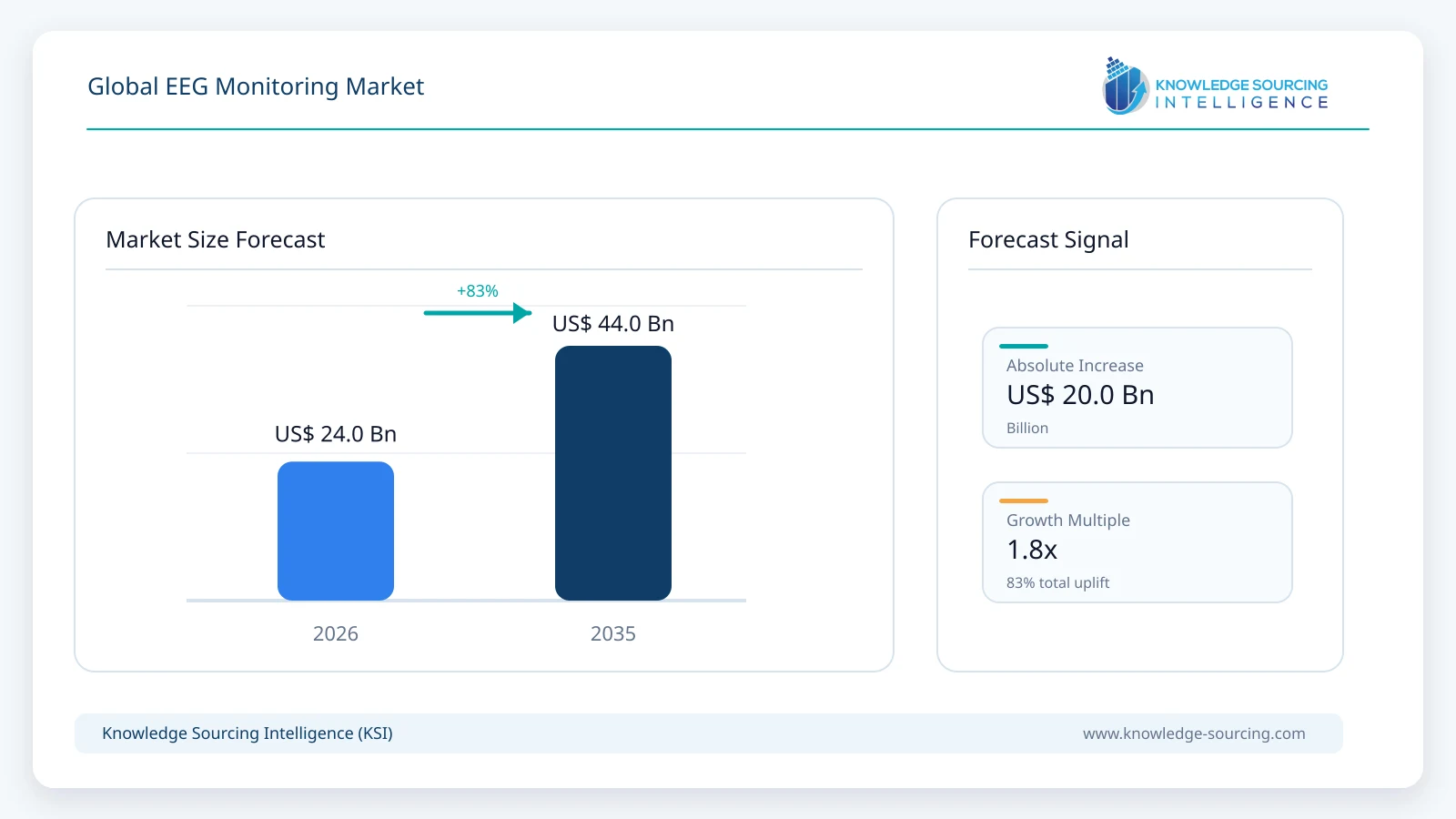
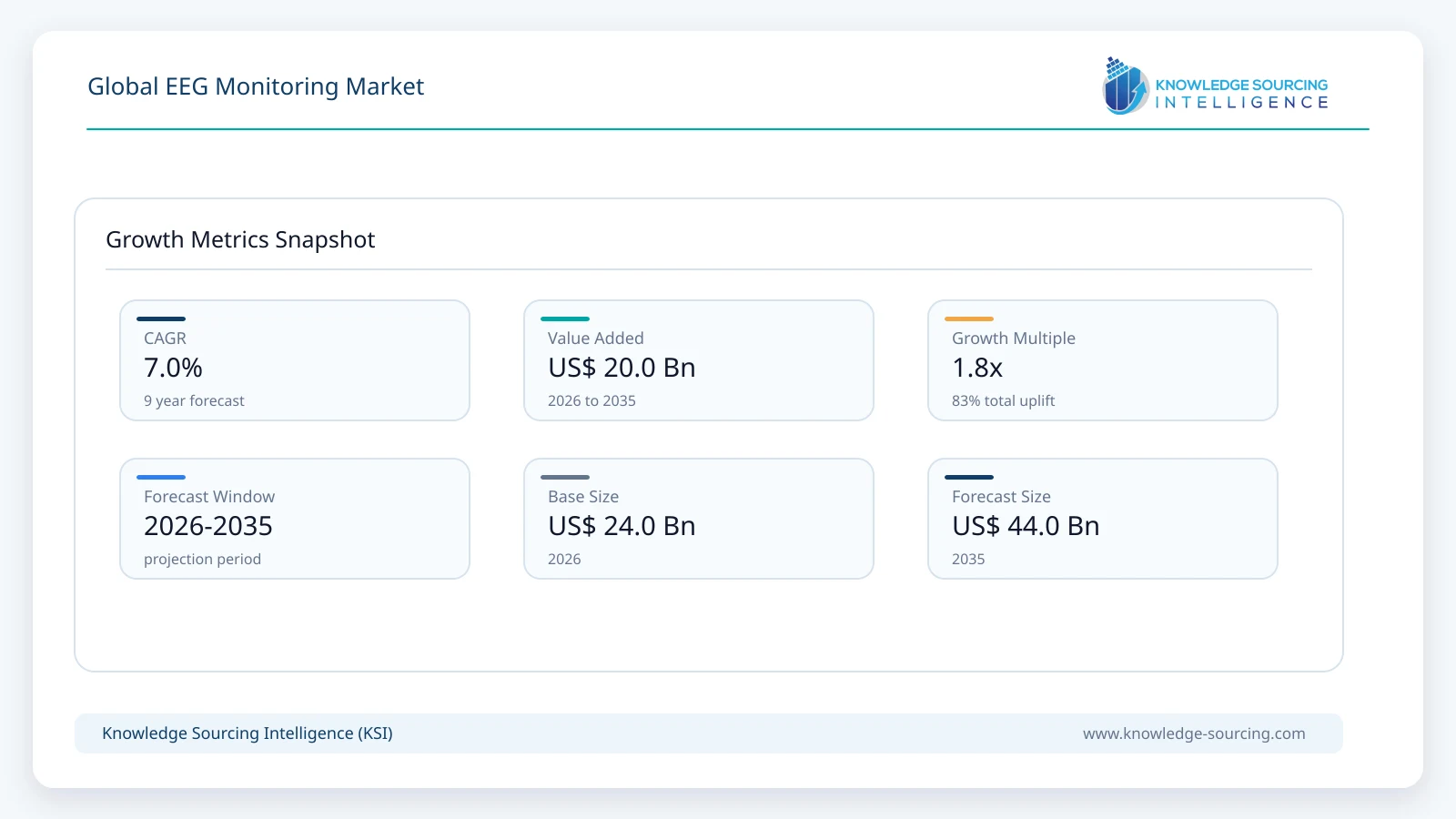
The Global EEG Monitoring Market is set to reach USD 44.0 billion in 2035, growing at a CAGR of 7.0% from USD 24.0 billion in 2026.
Highlights:
- 1Rising epilepsy prevalence is increasing demand for long-term EEG monitoring.
- 2Expansion of remote patient monitoring is accelerating adoption of ambulatory and wearable EEG systems.
- 3Intensive care units are increasing continuous EEG utilization to support neurological monitoring.
- 4Artificial intelligence is improving EEG interpretation efficiency and diagnostic accuracy.
EEG monitoring records electrical activity generated by neuronal networks within the brain. Healthcare professionals utilize EEG systems because electrical abnormalities often provide critical diagnostic information that structural imaging alone cannot reveal.
Neurological disease management increasingly depends on functional brain monitoring because clinicians require objective physiological measurements to support diagnosis and treatment decisions. EEG monitoring fulfills this need because it provides real-time assessment of neural activity across multiple clinical settings.
Healthcare systems are expanding EEG utilization because neurological disorders continue increasing worldwide. Neurology departments are investing in advanced monitoring technologies because continuous assessment improves detection of seizures, sleep abnormalities, and acute neurological deterioration.
Strategic importance continues growing because precision neurology increasingly relies on objective functional biomarkers. EEG monitoring therefore supports diagnosis, treatment optimization, critical care management, and neuroscience research simultaneously.
Market Dynamics
Market Drivers
Growing Burden of Epilepsy
Epilepsy remains one of the largest applications for EEG monitoring because seizure diagnosis depends heavily on electrophysiological assessment. Healthcare providers increasingly adopt long-duration monitoring systems because intermittent seizures often require extended observation periods for accurate diagnosis. This trend strengthens demand for advanced EEG technologies.
Expansion of Critical Care Monitoring
Neurological complications frequently occur in critically ill patients because stroke, traumatic brain injury, and metabolic disturbances affect brain function. Hospitals are expanding continuous EEG monitoring because clinicians require real-time detection of neurological deterioration. This development supports broader adoption of advanced systems.
Rising Adoption of Ambulatory Monitoring
Healthcare systems increasingly emphasize outpatient care because long-term hospital-based monitoring increases healthcare costs. Providers are adopting ambulatory EEG systems because remote monitoring improves patient convenience while maintaining diagnostic effectiveness. This transition supports market expansion.
Advancements in Digital Neurodiagnostics
Manufacturers continue developing sophisticated software platforms because growing EEG data volumes require efficient analysis. Healthcare providers increasingly implement automated interpretation tools because workforce constraints create demand for improved workflow efficiency. This trend accelerates technology adoption.
Market Restraints
Limited availability of trained neurophysiology specialists restricts interpretation capacity.
Extended monitoring procedures increase operational complexity for healthcare providers.
Reimbursement variability affects adoption across certain outpatient and home-monitoring applications.
Market Opportunities
Expansion of Wearable EEG Technologies
Patients increasingly prefer convenient monitoring solutions because neurological conditions often require repeated assessments. Manufacturers are developing lightweight wearable systems because continuous monitoring outside hospital environments improves accessibility. This opportunity supports long-term market growth.
Growth of Home-Based Neurological Care
Healthcare systems continue shifting toward decentralized care models because remote monitoring reduces hospital resource utilization. Providers are integrating home-based EEG platforms because continuous observation improves disease management. This trend creates substantial opportunities for technology developers.
Integration of Artificial Intelligence
Clinicians face increasing diagnostic workloads because monitoring durations continue expanding. Software developers are introducing AI-enabled analytics because automated pattern recognition improves efficiency and consistency. This development strengthens innovation across the market.
Increasing Neuroscience Research Activity
Research institutions continue expanding brain function studies because neurological diseases remain major healthcare challenges. Academic centers are increasing EEG utilization because electrophysiological monitoring provides valuable insights into neural network behavior. This opportunity broadens market demand.
Disease & Epidemiology Analysis
Neurological disorders continue generating substantial demand for EEG monitoring because many conditions directly affect electrical brain activity. Clinicians utilize EEG assessment extensively because functional abnormalities frequently emerge before significant structural changes become detectable.
Epilepsy represents the largest clinical application because seizure diagnosis and management depend heavily on electrophysiological monitoring. Healthcare providers increasingly employ long-term and video EEG systems because seizure characterization requires detailed assessment of brain activity patterns.
Sleep disorders also contribute significantly to market demand because polysomnography frequently incorporates EEG monitoring to evaluate sleep architecture and neurological function. Intensive care monitoring continues expanding because critically ill patients require continuous neurological assessment.
According to the World Health Organization, neurological disorders remain among the leading causes of disability worldwide.
The International League Against Epilepsy continues supporting broader adoption of EEG-based diagnostic pathways because electrophysiological assessment remains central to epilepsy management.
Treatment Guidelines Landscape
Clinical Area | Current Direction | Demand Impact |
Epilepsy Diagnosis | Expanded long-term monitoring utilization | Increases video EEG demand |
ICU Neurological Monitoring | Greater continuous EEG adoption | Strengthens hospital deployment |
Sleep Medicine | Advanced sleep assessment protocols | Expands EEG utilization |
Stroke Management | Enhanced neurological monitoring | Supports continuous EEG demand |
Neurological Research | Increased electrophysiological studies | Drives research system adoption |
Market Segmentation
By Product Type
Conventional EEG systems continue serving as foundational neurodiagnostic tools because hospitals require standardized electrophysiological assessment capabilities. Video EEG monitoring systems generate strong demand because epilepsy diagnosis often requires simultaneous clinical and electrophysiological observation. Ambulatory EEG systems are gaining adoption because clinicians increasingly require extended monitoring outside hospital settings. Wireless and wearable EEG technologies continue expanding because healthcare providers seek more flexible and patient-friendly monitoring solutions.
By Application
Epilepsy diagnosis and monitoring represent the largest application segment because seizure disorders require detailed electrophysiological evaluation. Sleep disorder assessment continues driving demand because EEG monitoring remains essential for comprehensive sleep studies. Intensive care unit monitoring is expanding because critically ill patients increasingly require continuous neurological observation. Stroke assessment, traumatic brain injury monitoring, and brain tumor evaluation continue supporting utilization because neurological complications require objective functional assessment. Research applications remain significant because neuroscience investigations rely heavily on electrophysiological data.
By End User
Hospitals account for the largest share of EEG monitoring utilization because neurological diagnosis and critical care management frequently occur within hospital settings. Neurology clinics continue expanding adoption because outpatient neurological evaluation requires advanced electrophysiological tools. Diagnostic centers increasingly provide specialized EEG services because healthcare systems seek efficient diagnostic pathways. Academic and research institutes remain major users because neuroscience research depends on high-quality electrophysiological monitoring. Home care settings are emerging as important growth areas because remote neurological monitoring continues expanding.
Regional Analysis
North America
North America maintains market leadership because healthcare systems possess advanced neurodiagnostic infrastructure and strong neurological care networks. Hospitals increasingly deploy continuous EEG monitoring because critical care neurology programs continue expanding. Neurology clinics strengthen long-term monitoring capabilities because epilepsy diagnosis increasingly depends on extended observation. Research institutions increase investments in advanced electrophysiology because neuroscience remains a major scientific priority. These factors sustain strong regional demand.
Europe
European healthcare providers continue expanding EEG utilization because neurological disease burden continues increasing across aging populations. Hospitals strengthen continuous monitoring programs because neurological complications require rapid detection and intervention. Academic institutions increase neuroscience research activity because brain health remains a strategic healthcare priority. Healthcare organizations adopt advanced digital EEG systems because workflow efficiency and diagnostic accuracy remain important objectives.
Asia Pacific
Asia Pacific demonstrates significant growth potential because healthcare infrastructure investment continues accelerating. China, Japan, South Korea, and India strengthen neurodiagnostic capabilities because neurological disease prevalence continues increasing. Hospitals expand electrophysiological monitoring programs because demand for neurological services continues rising. Academic institutions invest in advanced neuroscience research because governments prioritize innovation and healthcare modernization. These developments create substantial growth opportunities.
Rest of the World
Healthcare systems across Latin America, the Middle East, and Africa continue improving access to neurological diagnostics. Governments invest in healthcare modernization because neurological disorders generate increasing clinical and economic challenges. Hospitals strengthen neurodiagnostic services because early diagnosis improves patient outcomes. Technology providers expand regional distribution networks because demand for affordable monitoring solutions continues increasing. These trends support gradual market expansion.
Regulatory Landscape
Regulatory agencies focus on device safety, software validation, data integrity, and clinical effectiveness because EEG monitoring directly influences neurological diagnosis and treatment decisions. Authorities increasingly evaluate connected monitoring technologies because remote patient management continues expanding.
The U.S. Food and Drug Administration reviews EEG systems, neurodiagnostic software, and wearable neurological monitoring technologies because digital healthcare adoption continues accelerating.
European regulatory authorities emphasize cybersecurity, interoperability, and clinical validation requirements because healthcare organizations increasingly integrate EEG systems into digital health ecosystems. These standards support innovation while maintaining patient safety and diagnostic reliability.
Pipeline Analysis
Manufacturers continue developing advanced wearable EEG platforms because healthcare providers increasingly require continuous neurological monitoring beyond traditional clinical environments. Companies focus on miniaturization and wireless connectivity because patient comfort and mobility influence long-term monitoring adherence.
Artificial intelligence development remains a major pipeline focus because clinicians require faster interpretation of increasingly complex electrophysiological datasets. Software developers are enhancing automated seizure detection and pattern recognition capabilities because healthcare systems seek greater diagnostic efficiency.
Research organizations continue advancing high-density EEG technologies because detailed neural network mapping improves understanding of brain function. These innovations are expanding EEG applications across both clinical and research environments.
Reimbursement Landscape
Healthcare payers recognize EEG monitoring as an essential neurodiagnostic tool because electrophysiological assessment directly supports diagnosis and treatment planning across multiple neurological conditions. Hospitals continue utilizing EEG extensively because reimbursement pathways remain established for core neurological applications.
Coverage for advanced ambulatory and home-based monitoring solutions is expanding because healthcare systems increasingly prioritize remote patient management. Reimbursement variability nevertheless persists because evidence requirements differ across healthcare jurisdictions and monitoring indications.
Competitive Landscape
Natus Medical Incorporated
Natus Medical maintains a strong position through comprehensive neurodiagnostic solutions focused on EEG monitoring and epilepsy management. The company expands advanced monitoring capabilities because healthcare providers increasingly require long-duration neurological assessment.
Nihon Kohden Corporation
Nihon Kohden leverages extensive expertise in neurological and critical care monitoring technologies. The company strengthens EEG solutions because hospitals increasingly require integrated neurological monitoring platforms.
Compumedics Limited
Compumedics focuses on neurodiagnostic and sleep monitoring technologies that support comprehensive neurological assessment. The company develops advanced software capabilities because clinicians require efficient interpretation workflows.
Koninklijke Philips N.V.
Philips integrates neurological monitoring into broader patient monitoring ecosystems. The company strengthens connected care capabilities because healthcare providers increasingly prioritize continuous patient observation.
Cadwell Industries, Inc.
Cadwell Industries specializes in neurodiagnostic technologies supporting EEG and neurophysiology applications. The company enhances diagnostic performance because neurological specialists require reliable electrophysiological assessment tools.
Electrical Geodesics, Inc.
Electrical Geodesics focuses on advanced high-density EEG technologies supporting neuroscience research and clinical applications. The company strengthens neural mapping capabilities because researchers increasingly investigate brain network function.
Medtronic plc
Medtronic participates in neurological care through broad neurotechnology expertise and integrated neurological solutions. The company expands neurological monitoring initiatives because precision neurology continues advancing.
Neurosoft LLC
Neurosoft develops neurophysiology systems supporting EEG diagnostics and neurological assessment. The company strengthens technology capabilities because healthcare providers require cost-effective and reliable monitoring solutions.
ANT Neuro B.V.
ANT Neuro specializes in advanced EEG and neuroimaging technologies that support clinical and research applications. The company expands high-density electrophysiology capabilities because neuroscience research continues evolving.
Brain Products GmbH
Brain Products maintains a strong position within neuroscience research through advanced EEG acquisition and analysis technologies. The company supports sophisticated brain research because investigators increasingly require high-resolution electrophysiological data.
Key Developments
January 2026: Nihon Kohden expanded advanced neurological monitoring capabilities across critical care environments.
December 2025: Natus Medical strengthened long-term EEG monitoring solutions supporting epilepsy management.
November 2025: Compumedics enhanced neurodiagnostic software capabilities for EEG interpretation workflows.
October 2025: Philips expanded connected neurological monitoring technologies supporting remote patient assessment.
Strategic Insights and Future Market Outlook
EEG monitoring is becoming increasingly central to neurological care because healthcare providers require objective, real-time assessment of brain function across diverse clinical settings. Continuous monitoring capabilities are expanding because neurological disorders frequently involve intermittent abnormalities that conventional assessments may miss.
Wearable technologies will continue reshaping market dynamics because healthcare systems increasingly favor decentralized and patient-centered care models. Manufacturers are developing lightweight and wireless solutions because long-term monitoring outside hospital environments improves accessibility and clinical efficiency.
Artificial intelligence and cloud-based analytics will strengthen future market growth because growing monitoring volumes require scalable interpretation solutions. Healthcare organizations increasingly adopt automated analysis capabilities because workforce shortages create operational challenges.
The EEG monitoring market will continue evolving toward connected, continuous, and data-driven neurological care ecosystems. Remote monitoring, artificial intelligence, wearable neurotechnology, and precision neurology initiatives will drive long-term demand across hospitals, outpatient clinics, research institutions, and home care environments.
Global EEG Monitoring Market Scope:
| Report Metric | Details |
|---|---|
| Total Market Size in 2026 | USD 24.0 billion |
| Total Market Size in 2035 | USD 44.0 billion |
| Forecast Unit | USD Billion |
| Growth Rate | 7.0% |
| Study Period | 2021 to 2035 |
| Historical Data | 2021 to 2024 |
| Base Year | 2025 |
| Forecast Period | 2026 – 2035 |
| Segmentation | Product Type, Application, End User, Modality |
| Companies |
|
Market Segmentation
By Product Type
- Conventional EEG Systems
- Video EEG Monitoring Systems
- Ambulatory EEG Systems
- Wireless EEG Systems
- Wearable EEG Devices
By Application
- Epilepsy Diagnosis and Monitoring
- Sleep Disorder Assessment
- Brain Tumor Evaluation
- Traumatic Brain Injury Monitoring
- Stroke Assessment
- Intensive Care Unit Monitoring
- Neurological Research
By End User
- Hospitals
- Neurology Clinics
- Diagnostic Centers
- Academic and Research Institutes
- Home Care Settings
By Modality
- Routine EEG
- Long-Term EEG Monitoring
- Continuous EEG Monitoring
- Ambulatory EEG Monitoring
By Geography
- North America
- Europe
- Asia-Pacific
- Latin America
- Middle East & Africa
Table of Contents
1.EXECUTIVE SUMMARY
1.1 Global EEG Monitoring Market Scope and Objectives
1.2 Key Market Insights and Strategic Highlights
1.3 EEG Procedure Volume and Adoption Trends
1.4 Market Growth Outlook and Revenue Forecast
1.5 Strategic Conclusions
2.Global EEG Monitoring Market Overview
2.1 Definition and Scope of Global EEG Monitoring Market
2.2 Global EEG Monitoring Market Size Analysis 2021–2024
2.3 Global EEG Monitoring Market Size Forecast 2025–2035
2.4 Market Drivers
2.4.1 Rising Prevalence of Neurological Disorders
2.4.2 Growing Demand for Continuous Brain Activity Monitoring
2.4.3 Increasing Adoption of Ambulatory and Wireless EEG Systems
2.4.4 Expanding Applications in Critical Care and Sleep Medicine
2.5 Market Restraints
2.5.1 High Cost of Advanced EEG Systems
2.5.2 Shortage of Skilled Neurophysiology Professionals
2.5.3 Data Interpretation and Workflow Challenges
2.6 Market Opportunities
2.6.1 AI-Based EEG Analysis Solutions
2.6.2 Growth of Remote and Home-Based EEG Monitoring
2.6.3 Expansion in Emerging Healthcare Markets
2.7 Global EEG Monitoring Market Segmentation
2.7.1 By Product Type
2.7.1.1 Conventional EEG Systems
2.7.1.2 Video EEG Monitoring Systems
2.7.1.3 Ambulatory EEG Systems
2.7.1.4 Wireless EEG Systems
2.7.1.5 Wearable EEG Devices
2.7.2 By Application
2.7.2.1 Epilepsy Diagnosis and Monitoring
2.7.2.2 Sleep Disorder Assessment
2.7.2.3 Brain Tumor Evaluation
2.7.2.4 Traumatic Brain Injury Monitoring
2.7.2.5 Stroke Assessment
2.7.2.6 Intensive Care Unit Monitoring
2.7.2.7 Neurological Research
2.7.3 By End User
2.7.3.1 Hospitals
2.7.3.2 Neurology Clinics
2.7.3.3 Diagnostic Centers
2.7.3.4 Academic and Research Institutes
2.7.3.5 Home Care Settings
2.7.4 By Modality
2.7.4.1 Routine EEG
2.7.4.2 Long-Term EEG Monitoring
2.7.4.3 Continuous EEG Monitoring
2.7.4.4 Ambulatory EEG Monitoring
3.NEUROLOGICAL DISEASE EPIDEMIOLOGY AND MONITORING DEMAND ANALYSIS
3.1 Global Burden of Neurological Disorders
3.2 Epilepsy Epidemiology
3.3 Sleep Disorder Epidemiology
3.4 Stroke and Traumatic Brain Injury Burden
3.5 Neurocritical Care Monitoring Trends
3.6 Forecast of EEG Monitoring Procedure Volumes
4.DISEASE AND UNMET NEED ANALYSIS
4.1 Need for Early Neurological Disease Detection
4.2 Challenges in Continuous Brain Monitoring
4.3 Need for Portable and Remote Monitoring Solutions
4.4 Limitations of Conventional Neurodiagnostic Methods
4.5 Unmet Need in Resource-Limited Healthcare Systems
5.Technology and Innovation Landscape
5.1 Evolution of EEG Monitoring Technologies
5.2 Video EEG Monitoring Technology Analysis
5.3 Wireless and Wearable EEG Innovations
5.4 Cloud-Based EEG Data Management Solutions
5.5 Artificial Intelligence and Automated Signal Analysis
5.6 Brain-Computer Interface Integration Trends
5.7 Comparative Performance and Diagnostic Accuracy Analysis
6.CLINICAL AND COMMERCIAL INTELLIGENCE
6.1 Clinical Guideline Positioning
6.2 EEG Monitoring Utilization Trends
6.3 Comparative Effectiveness Benchmarking
6.4 Pricing Trends and Reimbursement Dynamics
6.5 Market Share Analysis by Product Type
6.6 Hospital Procurement and Purchasing Trends
6.7 Lifecycle Management Strategies
6.8 Regulatory Approval and Compliance Analysis
7.PRODUCT BENCHMARKING
7.1 Conventional EEG System Benchmarking
7.2 Video EEG Monitoring System Benchmarking
7.3 Ambulatory EEG System Benchmarking
7.4 Wireless EEG Platform Benchmarking
7.5 AI-Enabled EEG Analysis Software Benchmarking
7.6 Competitive Differentiation Analysis
8.Market Forecast and Risk Analysis
8.1 Revenue Forecast Modeling
8.2 EEG Monitoring Procedure Volume Forecast
8.3 Technology Adoption Forecast
8.4 Pricing and Reimbursement Sensitivity Analysis
8.5 Key Risk Factors
8.5.1 Regulatory and Compliance Risks
8.5.2 Technology Adoption Risks
8.5.3 Reimbursement Risks
8.5.4 Data Security and Privacy Risks
8.6 Sensitivity and Scenario Analysis
9.COMPETITIVE LANDSCAPE
9.1 Market Share by Manufacturer
9.2 Competitive Positioning of EEG Monitoring Technologies
9.3 Innovation and Patent Landscape Analysis
9.4 Product Portfolio Breadth Analysis
9.5 Strategic Collaborations and Partnerships
9.6 Mergers, Acquisitions, and Investment Activity
10.GEOGRAPHIC ANALYSIS
10.1 North America
10.2 Europe
10.3 Asia-Pacific
10.4 Latin America
10.5 Middle East and Africa
11.KEY COUNTRIES ANALYSIS
11.1 United States
11.2 Canada
11.3 Germany
11.4 United Kingdom
11.5 France
11.6 Italy
11.7 Spain
11.8 China
11.9 Japan
11.10 India
11.11 South Korea
11.12 Australia
11.13 Brazil
11.14 Mexico
11.15 Saudi Arabia
11.16 South Africa
12.Company Profiles
12.1 Natus Medical Incorporated
12.1.1 Overview
12.1.2 Financials
12.1.3 Product Portfolio
12.1.4 Recent Developments
12.2 Nihon Kohden Corporation
12.2.1 Overview
12.2.2 Financials
12.2.3 Product Portfolio
12.2.4 Recent Developments
12.3 Compumedics Limited
12.3.1 Overview
12.3.2 Financials
12.3.3 Product Portfolio
12.3.4 Recent Developments
12.4 Koninklijke Philips N.V.
12.4.1 Overview
12.4.2 Financials
12.4.3 Product Portfolio
12.4.4 Recent Developments
12.5 Cadwell Industries, Inc.
12.5.1 Overview
12.5.2 Financials
12.5.3 Product Portfolio
12.5.4 Recent Developments
12.6 Electrical Geodesics, Inc.
12.6.1 Overview
12.6.2 Financials
12.6.3 Product Portfolio
12.6.4 Recent Developments
12.7 Medtronic plc
12.7.1 Overview
12.7.2 Financials
12.7.3 Product Portfolio
12.7.4 Recent Developments
12.8 Neurosoft LLC
12.8.1 Overview
12.8.2 Financials
12.8.3 Product Portfolio
12.8.4 Recent Developments
12.9 ANT Neuro B.V.
12.9.1 Overview
12.9.2 Financials
12.9.3 Product Portfolio
12.9.4 Recent Developments
12.10 Brain Products GmbH
12.10.1 Overview
12.10.2 Financials
12.10.3 Product Portfolio
12.10.4 Recent Developments
13.FUTURE OUTLOOK AND STRATEGIC INSIGHTS
13.1 Expansion of AI-Powered EEG Monitoring Solutions
13.2 Growth of Wearable and Home-Based EEG Technologies
13.3 Increasing Adoption in Neurocritical Care and Epilepsy Management
13.4 Opportunities in Brain-Computer Interface and Digital Neurology Applications
13.5 Strategic Recommendations
14.METHODOLOGY AND DATA FRAMEWORK
14.1 Data Sources
14.2 Epidemiology and Procedure Volume Modeling Approach
14.3 Market Sizing and Forecasting Methodology
14.4 Competitive Benchmarking Framework
14.5 Assumptions and Limitations
Navigate
Trusted by the world's leading organizations











