Report Overview
Healthcare Cloud Computing Services Market Size:
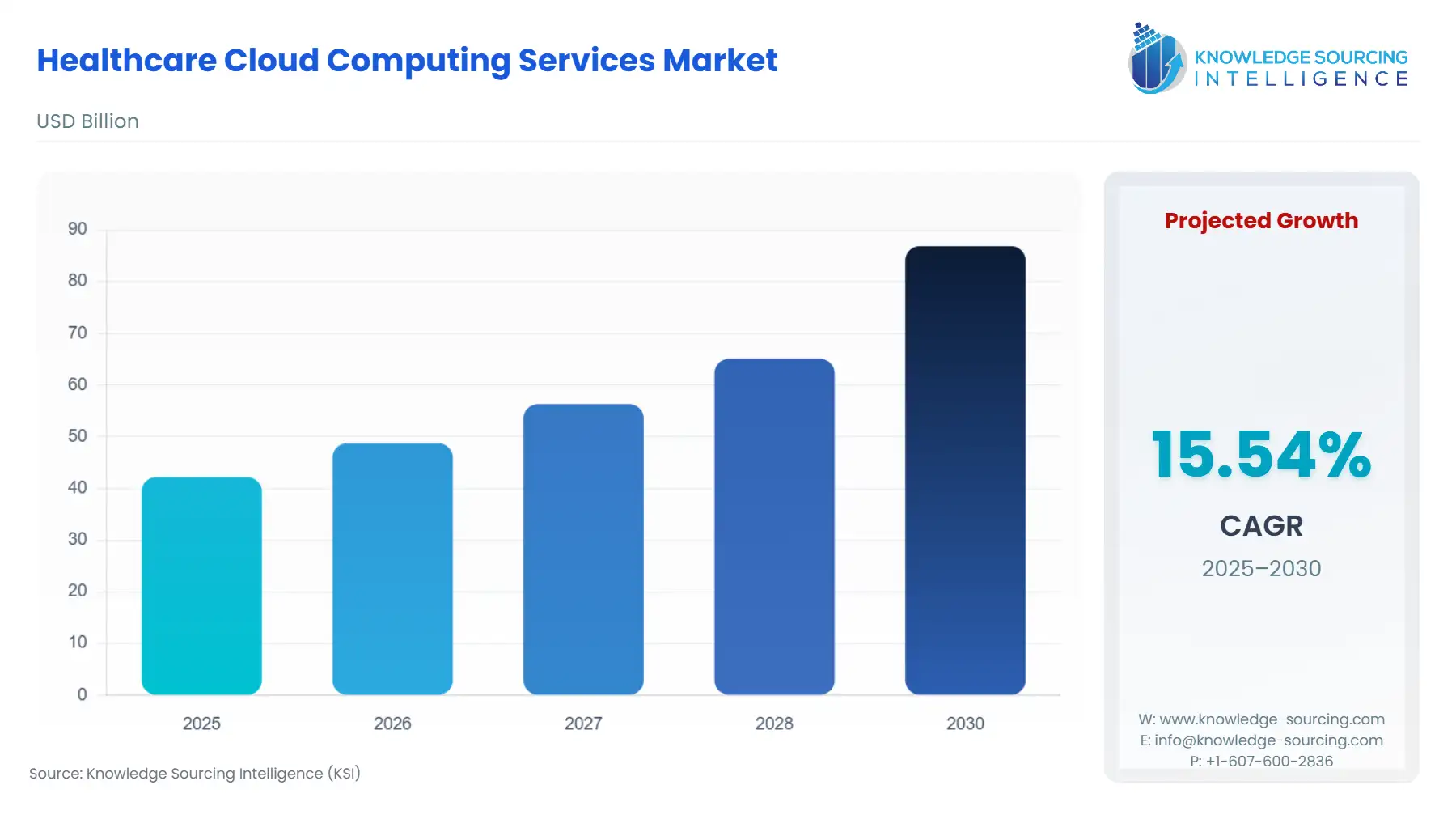
The Healthcare Cloud Computing Services Market is expected to increase from USD 42.208 billion in 2025 to USD 86.907 billion in 2030, driven by a 15.54% CAGR.
Highlights:
- 1Cloud adoption in healthcare is expanding with increasing digitalization and demand for scalable data storage.
- 2Software-as-a-Service models are dominating due to lower costs, secure access, and simplified maintenance.
- 3Clinical information systems are growing rapidly due to integration needs and real-time patient data access.
- 4Asia-Pacific is witnessing accelerating adoption supported by government healthcare digitalization initiatives.
Cloud computing is an innovative solution that offers users access to configurable computing resources such as servers, storage, and applications. Information technology solutions delivered through the cloud computing paradigm provide significant benefits in the healthcare industry. Cloud computing, through its wide array of features, aids in enhancing traditional in-house health information technology approaches in healthcare organizations such as hospitals, clinics, etc. Cloud computing services are being adopted in the healthcare industry to store and manage patients' healthcare data.
Furthermore, IT services offered through cloud computing provide numerous benefits in healthcare, including improved flexibility, higher availability of IT infrastructure to meet changing healthcare demands, and low upfront and maintenance costs for the use of IT.
Healthcare cloud computing services are estimated to grow at a significant rate over the forecasted period, owing to the increasing amount of data being generated by healthcare organizations. The growth is further bifurcated by the use of wearable devices and IoT in healthcare.
Moreover, the management of large customer data enables the application of big data analytics that aids in improved decision-making. Furthermore, rising investment in healthcare cloud computing solutions is anticipated to further boost demand in the market over the forecasted period. Moreover, the emergence of novel technological solutions such as Telecloud is further estimated to drive demand in the market.
However, concerns regarding the safety and confidentiality of patient data are expected to hamper growth in the global healthcare cloud computing services market.
Healthcare Cloud Computing Services Market Drivers:
- Clinical Information Systems hold a dominant market share.
Clinical information systems hold a notable market size and are estimated to grow at a significant rate over the forecasted period. Growth in patient data is driving demand in the market. Moreover, the growing demand for digitalization in clinical functions of data management, coupled with the growing adoption of novel technological solutions to sort and integrate enormous data, is estimated to further boost demand in the market. Furthermore, collective benefits offered through clinical information systems (CIS), such as data control, storage, security, on-demand storage, increased legibility, and improved searchability of records, are further driving growth opportunities in the market.
- The software-as-a-service segment accounts for the largest market share in the Global Healthcare Computing Services segment.
The Software-as-a-service model accounts for a dominant market share in the global health cloud computing services owing to its ability to offer a multitenant service that allows users to access data anytime, anywhere. Moreover, it facilitates reduced maintenance costs and increased use of resources, thereby increasing demand in the market. Furthermore, owing to its several benefits, such as faster deployment time, low cost, security, and limited upfront capital expenses, it has led to widespread application across the healthcare sector.
Healthcare Cloud Computing Services Market Geographical Outlook:
- Asia Pacific region is to witness lucrative growth opportunities in the Global Healthcare Cloud Computing Services Market.
The Asia Pacific region is estimated to grow at a significant rate over the forecasted period. The shifting demographic market trends in emerging economies such as China and India, coupled with large volumes of patient data generated in the region as a result of the growing disease burden, are driving demand in the market. Moreover, supportive government policies and initiatives facilitating digitalization in healthcare are further driving growth for healthcare cloud computing services in the region.
Furthermore, increasing investments in cloud computing services in the healthcare industry are anticipated to further augment the demand in the region over the forecasted period. Whereas, the North American region is expected to witness a noteworthy growth during the forecasted period, owing to large-scale adoption of these services coupled with increasing demand for full-body massage and beauty treatments in countries like the US and Canada.
Participation by market players.
The market is characterized by the applicability of cloud computing solutions across large hospitals as well as small clinics. Companies in the market are offering customizable service operations across healthcare industry segments. Companies in the market are employing various collaborative efforts, such as mergers and acquisitions, to grow and sustain in the market by delivering innovative technological solutions. For instance, CareCloud announced its acquisition by MTBC. The acquisition aims to aid MTBC in offering Carecloud's integrated financial and clinical tools to its customers and facilitate streamlining of physical workflows, patient outcomes, and better profitability.
Furthermore, novel product innovations and launches by eminent market players are driving growth opportunities in the market. For instance, IBM publicly released its novel hybrid cloud service, IBM Cloud Satellite, targeted toward the healthcare and banking industries. The cloud solution aims to offer its clients a cloud service that facilitates the storage of large volumes of data.
Healthcare Cloud Computing Services Market Competitive Insights:
The prominent players, including patients, medical billing service providers, the healthcare fraternity, and insurance providers, are implementing various growth strategies to gain a competitive advantage in the market. All market players have a definitive role in maintaining streamlined efficiency in the market.
Healthcare Cloud Computing Services Market Key Developments:
- November 2025: Tencent Cloud Charts New Growth with AI Healthcare Partnerships. Tencent Cloud announced collaborations with RYDE, Care, and Digital China at Cloud Day Singapore 2025, showcasing AI agents for healthcare workflows, including predictive analytics and cloud-based telemedicine integration.
- November 2025: Vitality and Google Partner to Launch AI-Powered Health Solutions. Vitality and Google launched Vitality AI, integrating Google Fit with cloud-based analytics for personalized insurance incentives and wellness coaching in healthcare delivery.
- October 2025: Microsoft Extends AI Advancements in Dragon Copilot for Healthcare. Microsoft announced Dragon Copilot updates for secure integration of partner AI apps in cloud-based EHRs, enabling nurses and clinicians to access real-time patient data and decision support.
- October 2025: AWS Releases Whitepaper on Health Data Marketplaces for Multi-Cloud Strategies. AWS published a whitepaper on health data marketplaces, detailing cloud tools for optimizing multi-cloud data strategies in healthcare, launched at the World Health Summit, October 12-14.
Healthcare Cloud Computing Services Market Scope:
| Report Metric | Details |
|---|---|
| Total Market Size in 2026 | USD 42.208 billion |
| Total Market Size in 2031 | USD 86.907 billion |
| Growth Rate | 15.54% |
| Study Period | 2021 to 2031 |
| Historical Data | 2021 to 2024 |
| Base Year | 2025 |
| Forecast Period | 2026 – 2031 |
| Segmentation | Model Type, Deployment Model, Application, Geography |
| Geographical Segmentation | North America, South America, Europe, Middle East and Africa, Asia Pacific |
| Companies |
|
Healthcare Cloud Computing Services Market Segmentation:
- By Model Type
- Deployment Model
- Private Cloud
- Public Cloud
- Hybrid Cloud
- Distribution Model
- Software-As-A-Service
- Platform-As-A-Service
- Infrastructure-As-A-Service
- Deployment Model
- By Application
- Clinical Information System
- Non-Clinical Information System
- By End-User
- Hospitals & Clinics
- Diagnostics & Imaging Centers
- Research & Academic Institutes
- Others
- By Geography
- North America
- USA
- Canada
- Mexico
- South America
- Brazil
- Argentina
- Others
- Europe
- Germany
- France
- United Kingdom
- Italy
- Spain
- Others
- Middle East and Africa
- Saudi Arabia
- UAE
- Israel
- Others
- Asia Pacific
- China
- India
- Japan
- South Korea
- Indonesia
- Thailand
- Taiwan
- Others
- North America
Our Best-Performing Industry Reports:
Market Segmentation
By Model Type
By Application
By End-user
By Geography
Table of Contents
1. EXECUTIVE SUMMARY
2. MARKET SNAPSHOT
2.1. Market Overview
2.2. Market Definition
2.3. Scope of the Study
2.4. Market Segmentation
3. BUSINESS LANDSCAPE
3.1. Market Drivers
3.2. Market Restraints
3.3. Market Opportunities
3.4. Porter’s Five Forces Analysis
3.5. Industry Value Chain Analysis
3.6. Policies and Regulations
3.7. Strategic Recommendations
4. TECHNOLOGICAL OUTLOOK
5. GLOBAL HEALTHCARE CLOUD COMPUTING SERVICES MARKET BY MODEL TYPE
5.1. Introduction
5.2. Deployment Model
5.2.1. Private Cloud
5.2.2. Public Cloud
5.2.3. Hybrid Cloud
5.3. Distribution Model
5.3.1. Software-As-A-Service
5.3.2. Platform-As-A-Service
5.3.3. Infrasturcture-As-A-Service
6. GLOBAL HEALTHCARE CLOUD COMPUTING SERVICES MARKET BY APPLICATION
6.1. Introduction
6.2. Clinical Information System
6.3. Non-Clinical Information System
7. GLOBAL HEALTHCARE CLOUD COMPUTING SERVICES MARKET BY END-USER
7.1. Introduction
7.2. Hospitals & Clinics
7.3. Diagnostics & Imaging Centers
7.4. Research & Academic Institutes
7.5. Others
8. GLOBAL HEALTHCARE CLOUD COMPUTING SERVICES MARKET BY GEOGRAPHY
8.1. Introduction
8.2. North America
8.2.1. By Model Type
8.2.2. By Application
8.2.3. By End-User
8.2.4. By Country
8.2.4.1. USA
8.2.4.2. Canada
8.2.4.3. Mexico
8.3. South America
8.3.1. By Model Type
8.3.2. By Application
8.3.3. By End-User
8.3.4. By Country
8.3.4.1. Brazil
8.3.4.2. Argentina
8.3.4.3. Others
8.4. Europe
8.4.1. By Model Type
8.4.2. By Application
8.4.3. By End-User
8.4.4. By Country
8.4.4.1. Germany
8.4.4.2. France
8.4.4.3. United Kingdom
8.4.4.4. Italy
8.4.4.5. Spain
8.4.4.6. Others
8.5. Middle East and Africa
8.5.1. By Model Type
8.5.2. By Application
8.5.3. By End-User
8.5.4. By Country
8.5.4.1. Saudi Arabia
8.5.4.2. UAE
8.5.4.3. Israel
8.5.4.4. Others
8.6. Asia Pacific
8.6.1. By Model Type
8.6.2. By Application
8.6.3. By End-User
8.6.4. By Country
8.6.4.1. China
8.6.4.2. India
8.6.4.3. Japan
8.6.4.4. South Korea
8.6.4.5. Indonesia
8.6.4.6. Thailand
8.6.4.7. Taiwan
8.6.4.8. Others
9. COMPETITIVE ENVIRONMENT AND ANALYSIS
9.1. Major Players and Strategy Analysis
9.2. Market Share Analysis
9.3. Mergers, Acquisitions, Agreements, and Collaborations
9.4. Competitive Dashboard
10. COMPANY PROFILES
10.1. CareCloud Corporation
10.2. ZYMR Inc.
10.3. ClearDATA
10.4. Dell Inc
10.5. IBM Corporation
10.6. Iron Mountain Inc.
10.7. Siemens Healthineers (Siemens AG)
10.8. Microsoft Corporation
10.9. e-Zest Solutions
10.10. OSP Labs
10.11. Google Inc.
11. APPENDIX
11.1. Currency
11.2. Assumptions
11.3. Base and Forecast Years Timeline
11.4. Key benefits for the stakeholders
11.5. Research Methodology
11.6. Abbreviations
LIST OF FIGURES
LIST OF TABLES
Navigate
Trusted by the world's leading organizations











