
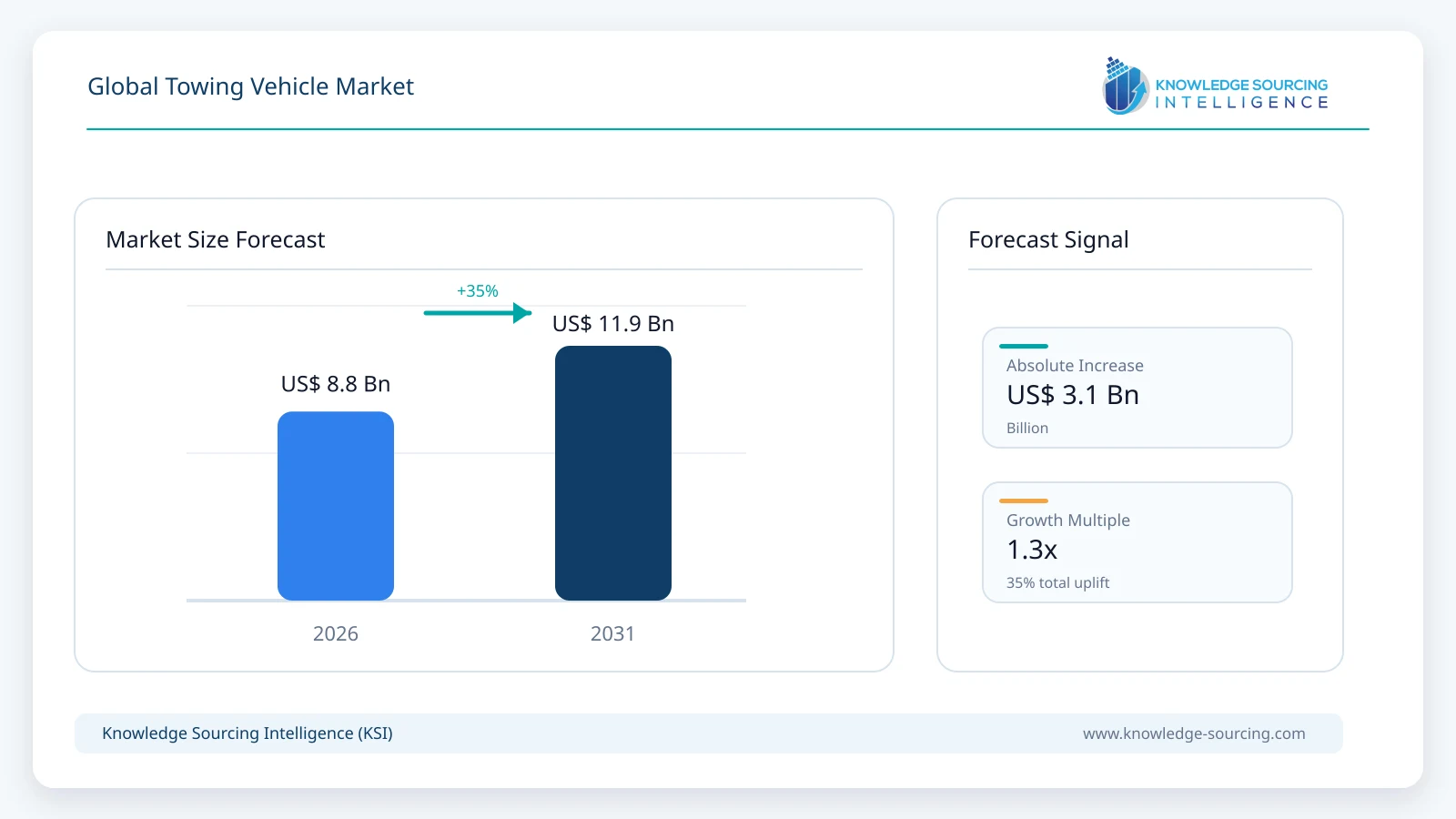
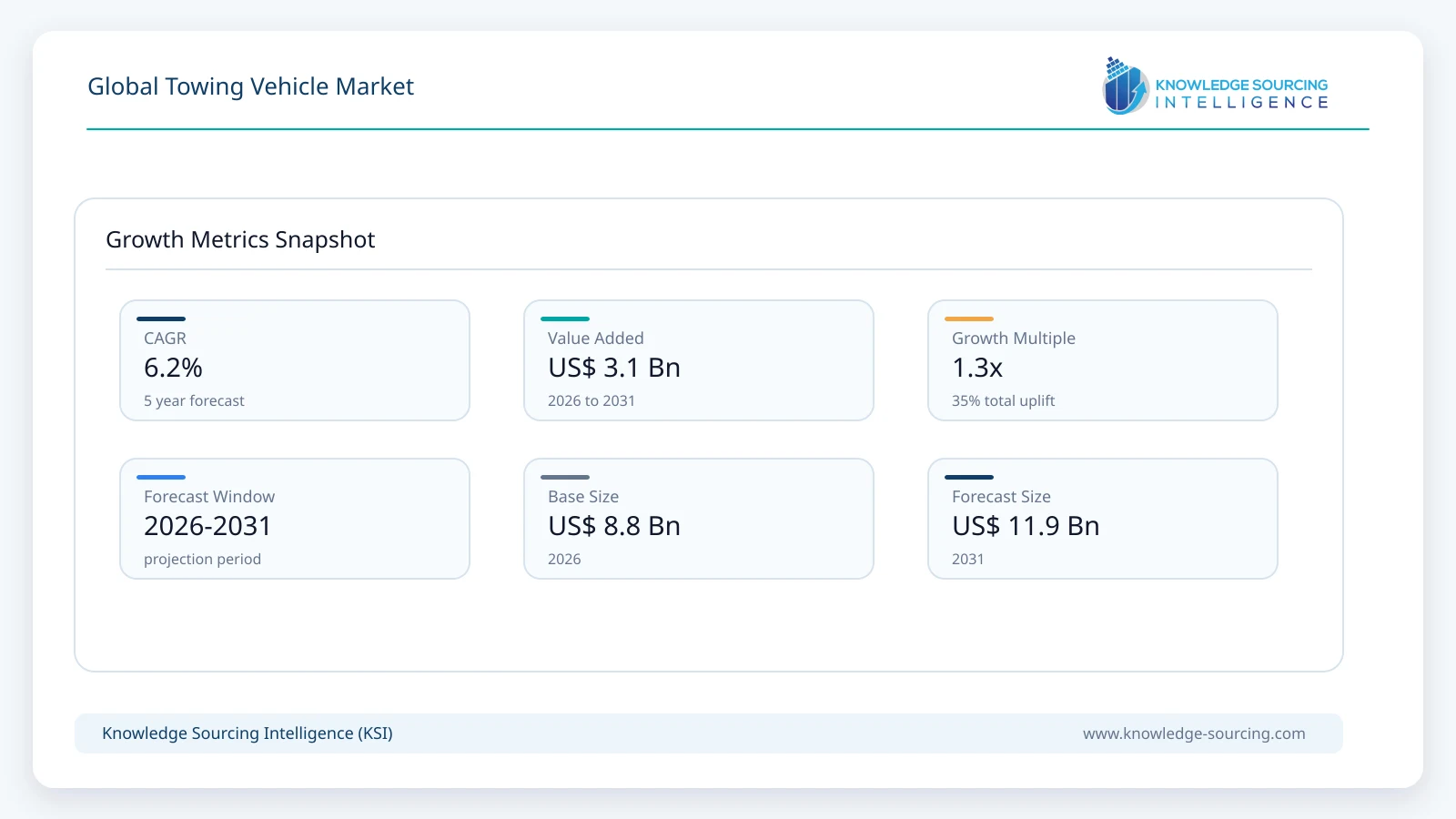
The global towing vehicle market is forecast to grow at a CAGR of 6.2%, reaching USD 11.86 billion in 2031 from USD 8.80 billion in 2026.
Highlights:
- 1Flatbed tow trucks account for approximately 45% of global towing vehicle revenue in 2026.
- 2Roadside assistance represents the largest application and generates about USD 3.43 billion in 2026.
- 3North America accounts for approximately 34% of global towing vehicle revenue in 2026.
- 4Integrated tow trucks are projected to grow at approximately 7.2% annually through 2031.
- 5Electric recovery vehicles are moving from pilot deployments into commercial fleet applications.
- 6Heavy-duty recovery demand is supporting investment in stronger underlifts, rotators and remote controls.
Towing vehicles are specialized commercial vehicles that combine a truck chassis with lifting, winching and transport equipment. Light-duty units recover passenger cars, sport utility vehicles and small vans. Medium-duty systems cover larger vans, buses and smaller commercial trucks. Heavy-duty wreckers and rotators are built for tractor-trailers, coaches, construction vehicles and other high-weight recovery jobs. The market value reflects the completed towing or recovery vehicle, including the recovery body and dedicated chassis where supplied as a complete unit.
The installed road fleet provides a large demand base. The European Union had around 256 million passenger cars, 31.1 million vans and 6.2 million trucks on the road in 2024. The average truck in the EU was about 14 years old. In the United States, vehicle miles travelled continued to rise in 2025 even as traffic fatalities declined. This combination of high vehicle utilization and aging fleets sustains breakdown, collision and roadside recovery activity. The towing vehicle market therefore depends more on the size and usage of the installed vehicle parc than on new-vehicle registrations alone.
Market Trends
Heavy-duty towing systems are becoming more capable without adding unnecessary vehicle weight
Manufacturers are redesigning booms, underlifts, outriggers and structural components to improve lifting capability while controlling vehicle weight. Miller Industries updated its Century 9055XL 50-ton wrecker in February 2026 with a redesigned underlift, stronger pivot geometry and improved stabilization features. Jerr-Dan has also expanded its heavy-duty range with newer rotator and low-profile underlift configurations. NRC continues to develop detachable and integrated heavy-duty recovery systems that can tow loads up to 90,000 pounds. These products allow operators to cover a wider set of recovery jobs with fewer specialized trucks.
Electrification is emerging first in carriers and urban recovery vehicles
Battery-electric tow trucks remain a small part of the market, but adoption is beginning in applications where daily routes are predictable and charging can be controlled. NRC offers electrically powered carrier configurations across multiple deck capacities. Fiault produced its first tow truck on a Volvo FM Electric chassis in 2025. Roger Dyson is also offering recovery systems on electric light-commercial chassis. Electric configurations are most relevant for municipal, roadside and urban fleets where low emissions and reduced noise have operational value.
Equipment financing and lifecycle support are becoming more important purchasing criteria
High-specification wreckers can require large capital commitments, especially when a heavy chassis, rotator, underlift and advanced controls are combined. Manufacturers are therefore expanding financing, service and parts support alongside product sales. Miller Industries launched Miller Finance Solutions in September 2026 to provide dedicated financing options for towing and recovery equipment. NRC introduced a North American ready-to-go equipment platform in February 2026 to improve access to new and used units. These initiatives reduce acquisition friction and help operators manage fleet replacement.
Market Drivers
Aging vehicle fleets and high road utilization sustain roadside recovery demand
Breakdowns remain a recurring source of towing demand because the global vehicle fleet continues to expand and age. Europe alone had more than 293 million cars, vans and trucks on the road in 2024. Older vehicles generally require more maintenance and have a higher probability of roadside failure. At the same time, commercial vehicles remain in service for long duty cycles and accumulate high annual mileage. This supports continued replacement of light-duty carriers and wheel-lift trucks used by roadside-assistance providers and independent towing operators.
Heavier vehicles and more complex powertrains increase the need for specialized recovery equipment
Recovery fleets must handle larger sport utility vehicles, battery-electric vehicles, buses and heavy trucks without causing additional damage. This is increasing demand for stronger wheel lifts, low-clearance loading systems, high-capacity winches and integrated heavy-duty wreckers. Battery-electric vehicles also require careful handling because wheel rotation, battery damage and vehicle weight can affect recovery procedures. Manufacturers are responding with more adaptable attachment systems and improved remote controls so operators can position equipment more accurately.
Municipal impoundment and organized roadside networks support recurring fleet purchases
Municipal authorities, police contractors, automobile clubs and insurance-linked roadside networks require dependable towing capacity across large service areas. These buyers create recurring demand for standardized equipment, replacement units and specialized impoundment vehicles. The AA in the United Kingdom introduced 36 new recovery trucks in September 2026 using MAN chassis with recovery systems supplied by Boniface Engineering and Roger Dyson. Large fleet orders of this type support manufacturers that can provide consistent specifications, training and after-sales support.
Market Restraint
High equipment costs, financing conditions and chassis availability limit faster fleet replacement
The main restraint is the cost of acquiring a complete towing vehicle. Heavy-duty wreckers and rotators require expensive commercial chassis, hydraulic systems, winches, structural components and safety equipment. Higher interest rates, insurance costs and used-truck values can therefore delay replacement decisions for smaller towing businesses. Manufacturers also depend on third-party chassis suppliers, which exposes production schedules to commercial-truck availability and component constraints. These factors can make revenue volatile even when long-term roadside demand remains stable.
Segment Analysis
By Type - Flatbed Tow Truck
Flatbed tow trucks form the largest product segment because they can transport damaged, disabled and high-value vehicles without keeping the recovered vehicle's wheels on the road. The segment accounts for approximately 45% of global market value in 2026, equivalent to about USD 3.96 billion. It is projected to reach approximately USD 5.42 billion by 2031. Flatbeds are widely used for passenger cars, electric vehicles and accident-damaged vehicles because they reduce drivetrain and wheel-contact risks during transport.
By Type - Integrated Tow Truck
Integrated tow trucks are the fastest-growing major type and are projected to expand at approximately 7.2% annually through 2031. The segment is estimated at about USD 2.11 billion in 2026 and is projected to approach USD 2.99 billion by 2031. Integrated units combine towing and recovery functions in a single chassis and are commonly used for medium-duty and heavy-duty operations. Growth is being supported by more capable underlifts, stronger winches and improved remote-control systems.
By Application - Roadside Assistance
Roadside assistance is the largest application and accounts for approximately 39% of global market revenue in 2026. The segment is valued at about USD 3.43 billion and is projected to reach approximately USD 4.68 billion by 2031. Demand comes from independent operators, automobile clubs, fleet service providers and insurance-linked networks. Accidental towing remains another major application because damaged vehicles often require flatbeds, integrated wreckers or heavy recovery equipment.
By Geography - North America
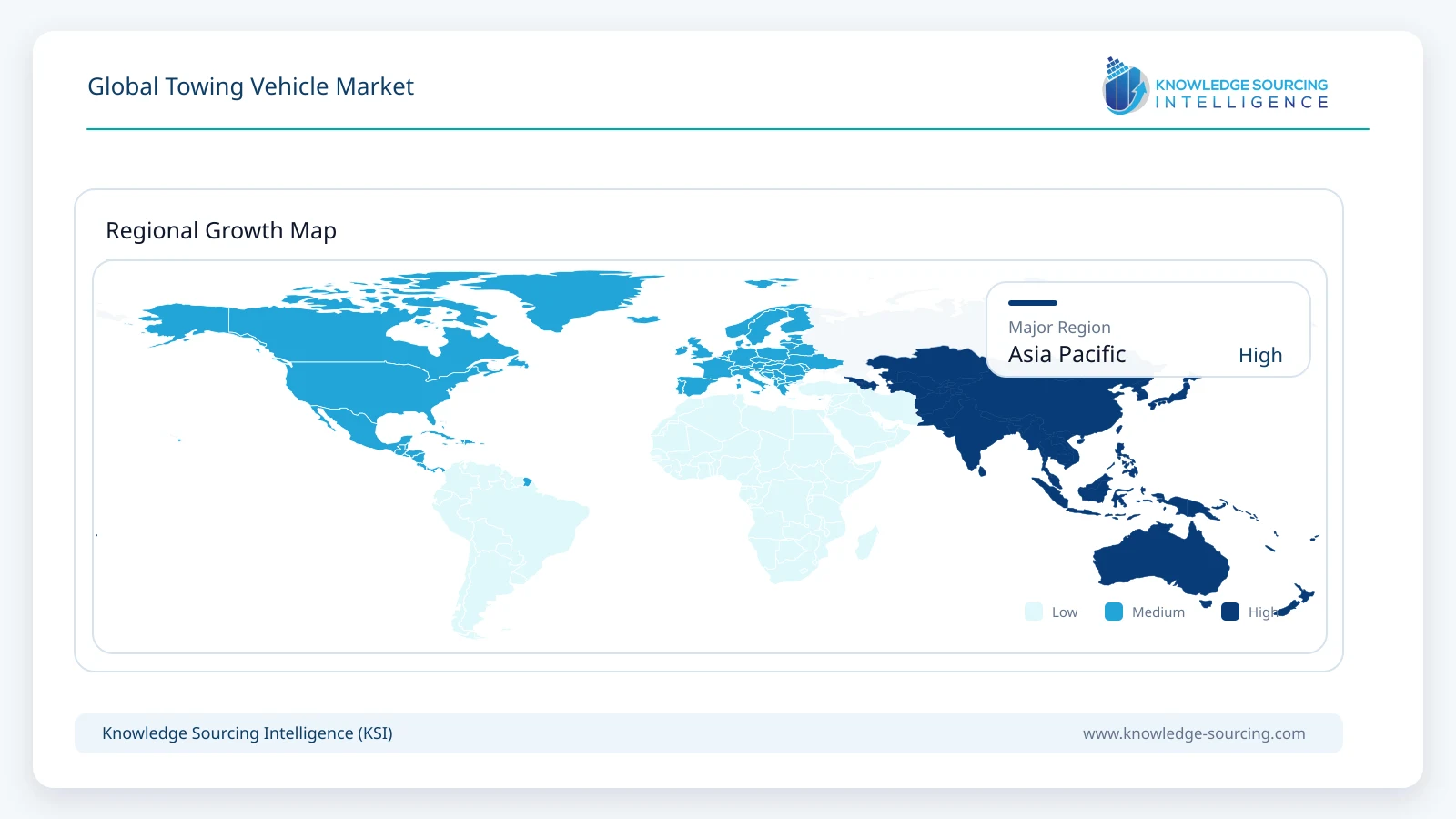
North America is the largest regional market in 2026 and accounts for approximately 34% of global revenue, equivalent to about USD 2.99 billion. The region has a mature towing industry, high vehicle ownership and a large installed base of light-duty and heavy-duty recovery equipment. Asia Pacific grows faster from a slightly smaller base as vehicle ownership, roadside-assistance coverage and formal recovery services expand across China, India and Southeast Asia.
Competitive Environment
Miller Industries is the largest global towing and recovery equipment manufacturer and operates multiple brands across light-duty, heavy-duty, carrier and rotator products. The company generated USD 790.3 million of net sales in 2025 and expects 2026 revenue of USD 850 million to USD 900 million. Its December 2025 acquisition of OMARS expanded its European manufacturing footprint. Miller is also investing about USD 100 million in a new 200,000-plus-square-foot facility in Tennessee to increase production capacity.
Jerr-Dan, part of Oshkosh Corporation, competes across carriers, wreckers and rotators in North America. NRC Industries is strong in heavy-duty wreckers, carriers and detachable recovery systems. Dynamic Towing Equipment, Dual-Tech, Danco Products and B&B Industries serve specialized North American towing applications. Competition in this region is influenced by distributor coverage, chassis integration, parts availability and operator familiarity.
Europe has a more fragmented manufacturing base. Fiault, Falkom, Isoli, TEVOR, Roger Dyson, EMPL and Global Towing Systems supply light, medium and heavy recovery vehicles. Erkin World Power serves heavy-duty and rotator applications from Turkey. European suppliers compete strongly on customized engineering, low-profile recovery systems, electric chassis integration and compliance with regional vehicle regulations.
Recent Developments
September 2026: Miller Industries launched Miller Finance Solutions with Commercial Fleet Financing to support towing-equipment purchases.
September 2026: The AA introduced 36 new recovery trucks built with MAN chassis and recovery systems from Boniface Engineering and Roger Dyson.
September 2026: Fiault updated its MAXILIFT PF3000 Assistance models with redesigned stainless-steel roll bars.
August 2026: Miller Industries reported second-quarter revenue of USD 240.0 million and confirmed progress on its Tennessee capacity expansion.
July 2026: NRC Industries marked the first year of its electrically powered E-20TB carrier platform.
February 2026: Miller Industries released an updated Century 9055XL 50-ton heavy-duty wrecker with structural and operator-focused improvements.
February 2026: NRC launched a North American ready-to-go platform for new and used towing and recovery equipment.
January 2026: Miller Industries became NASCAR's official towing and recovery equipment provider under a long-term agreement.
Towing Vehicle Market Scope:
| Report Metric | Details |
|---|---|
| Total Market Size in 2026 | USD 8.80 billion |
| Total Market Size in 2031 | USD 11.86 billion |
| Forecast Unit | Billion |
| Growth Rate | 6.2% |
| Study Period | 2021 to 2031 |
| Historical Data | 2021 to 2024 |
| Base Year | 2025 |
| Forecast Period | 2026 – 2031 |
| Segmentation | Type, Application, Geography |
| Companies |
|
Market Segmentation
By Type
Flatbed Tow Truck
Hook and Chain Tow Truck
Wheel Lift Tow Truck
Integrated Tow Truck
By Application
Vehicle Impoundment
Roadside Assistance
Accidental Towing
Others
By Geography
North America
United States
Canada
Mexico
South America
Brazil
Argentina
Others
Europe
Germany
United Kingdom
France
Italy
Spain
Others
Middle East and Africa
Saudi Arabia
UAE
South Africa
Others
Asia Pacific
China
Japan
India
South Korea
Indonesia
Thailand
Others
Table of Contents
1. EXECUTIVE SUMMARY
2. MARKET SNAPSHOT
2.1. Market Overview
2.2. Market Definition
2.3. Market Segmentation
3. BUSINESS LANDSCAPE
3.1. Market Drivers
3.1.1. Aging Vehicle Fleets and High Road Utilization Sustain Roadside Recovery Demand
3.1.2. Heavier Vehicles and More Complex Powertrains Increase the Need for Specialized Recovery Equipment
3.1.3. Municipal Impoundment and Organized Roadside Networks Support Recurring Fleet Purchases
3.2. Market Restraint
3.2.1. High Equipment Costs, Financing Conditions and Chassis Availability Limit Faster Fleet Replacement
3.3. Market Opportunities
3.4. Porter's Five Forces Analysis
3.5. Industry Value Chain Analysis
3.6. Policies and Regulations
3.7. Strategic Recommendations
4. TECHNOLOGICAL OUTLOOK
4.1. Integrated Wreckers and Rotators
4.2. Low-Profile Underlifts and Self-Loading Wheel Lifts
4.3. Electric Recovery Vehicles
4.4. Remote Controls and Load-Management Systems
4.5. Fleet Dispatch and Equipment Connectivity
5. GLOBAL TOWING VEHICLE MARKET BY TYPE
5.1. Introduction
5.2. Flatbed Tow Truck
5.3. Hook and Chain Tow Truck
5.4. Wheel Lift Tow Truck
5.5. Integrated Tow Truck
6. GLOBAL TOWING VEHICLE MARKET BY APPLICATION
6.1. Introduction
6.2. Vehicle Impoundment
6.3. Roadside Assistance
6.4. Accidental Towing
6.5. Others
7. GLOBAL TOWING VEHICLE MARKET BY GEOGRAPHY
7.1. Introduction
7.2. North America
7.2.1. United States
7.2.2. Canada
7.2.3. Mexico
7.3. South America
7.3.1. Brazil
7.3.2. Argentina
7.3.3. Others
7.4. Europe
7.4.1. Germany
7.4.2. United Kingdom
7.4.3. France
7.4.4. Italy
7.4.5. Spain
7.4.6. Others
7.5. Middle East and Africa
7.5.1. Saudi Arabia
7.5.2. UAE
7.5.3. South Africa
7.5.4. Others
7.6. Asia Pacific
7.6.1. China
7.6.2. Japan
7.6.3. India
7.6.4. South Korea
7.6.5. Indonesia
7.6.6. Thailand
7.6.7. Others
8. COMPETITIVE ENVIRONMENT AND ANALYSIS
8.1. Major Players and Strategy Analysis
8.2. Market Share Analysis
8.3. Product and Technology Positioning
8.4. Mergers, Acquisitions, Agreements and Collaborations
8.5. Competitive Dashboard
9. COMPANY PROFILES
9.1. Miller Industries, Inc.
9.2. Jerr-Dan, LLC (Oshkosh Corporation)
9.3. NRC Industries
9.4. Fiault SAS
9.5. Falkom B.V.
9.6. Isoli S.p.A.
9.7. Dynamic Towing Equipment & Manufacturing
9.8. Dual-Tech, Inc.
9.9. Danco Products
9.10. Global Towing Systems Kft.
9.11. TEVOR Sp. z o.o.
9.12. Erkin World Power
9.13. Roger Dyson Group
9.14. EMPL Fahrzeugwerk GmbH
9.15. B&B Industries
10. APPENDIX
10.1. Currency
10.2. Assumptions
10.3. Base and Forecast Years Timeline
10.4. Key Benefits for Stakeholders
10.5. Research Methodology
10.6. Abbreviations
Navigate
Trusted by the world's leading organizations











