
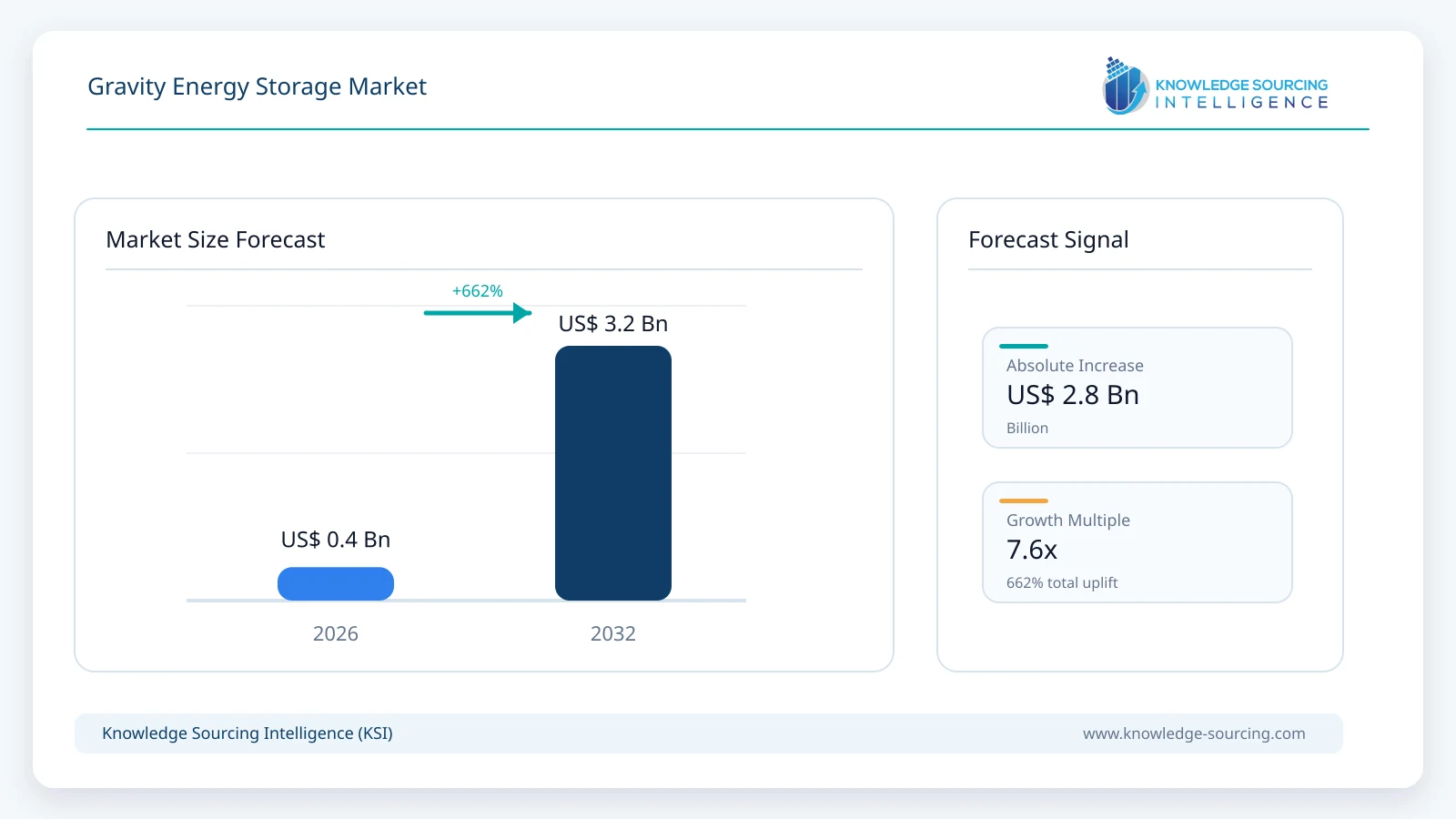
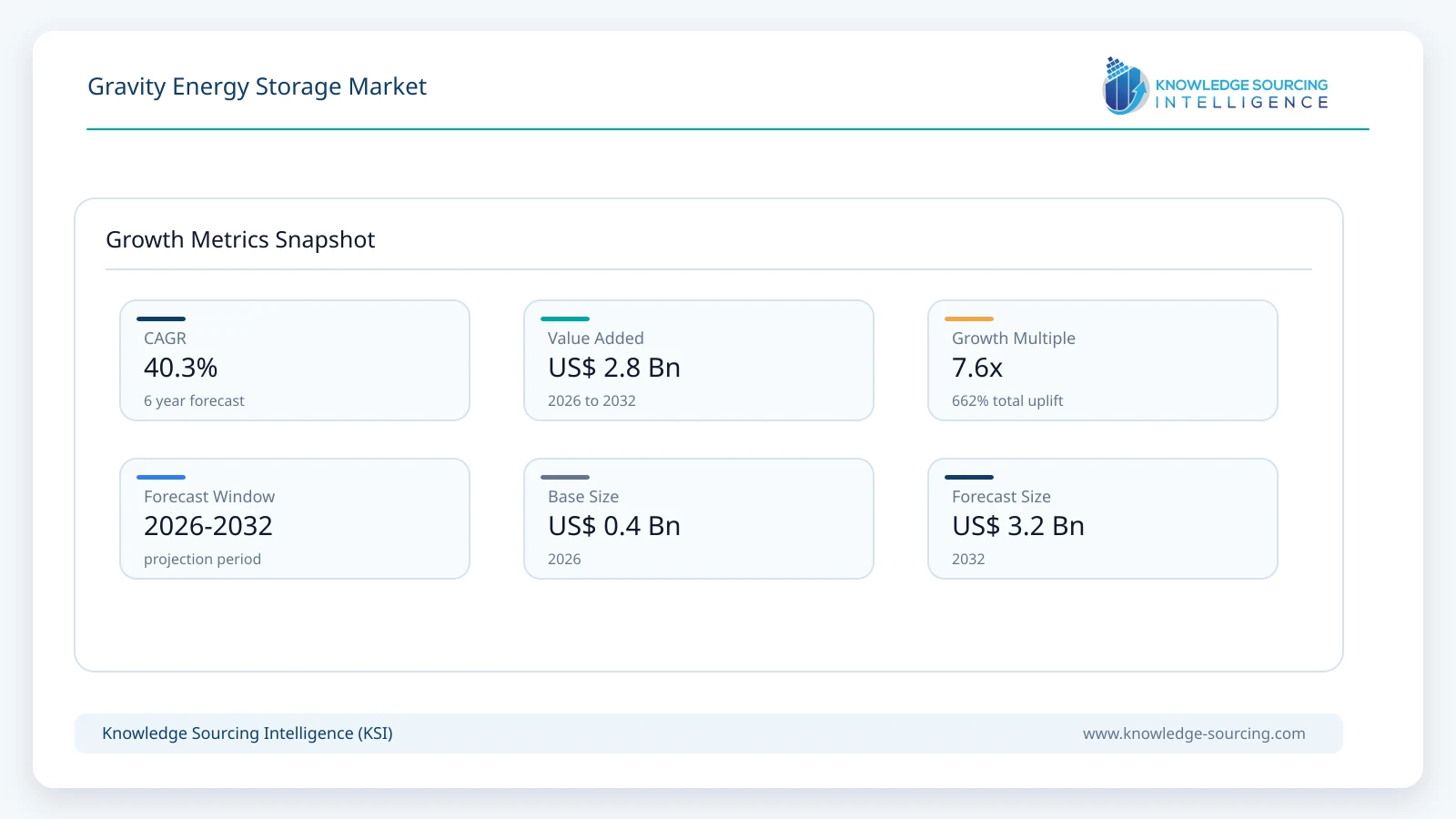
The Gravity Energy Storage Market is estimated at USD 0.42 billion in 2026 and is projected to reach USD 3.20 billion by 2032, representing a CAGR of 40.3% during the forecast period.
Key Highlights
• Commercial gravity storage is moving from pilots into 100 MWh-class projects and multi-gigawatt-hour development frameworks.
• Lifted-solid-mass systems offer long asset life and avoid electrochemical capacity degradation in the storage medium.
• Mine-shaft systems can repurpose existing vertical infrastructure, grid connections and mining-sector skills.
• High-density hydro expands gravity storage into sites with lower elevation differences than conventional pumped hydro.
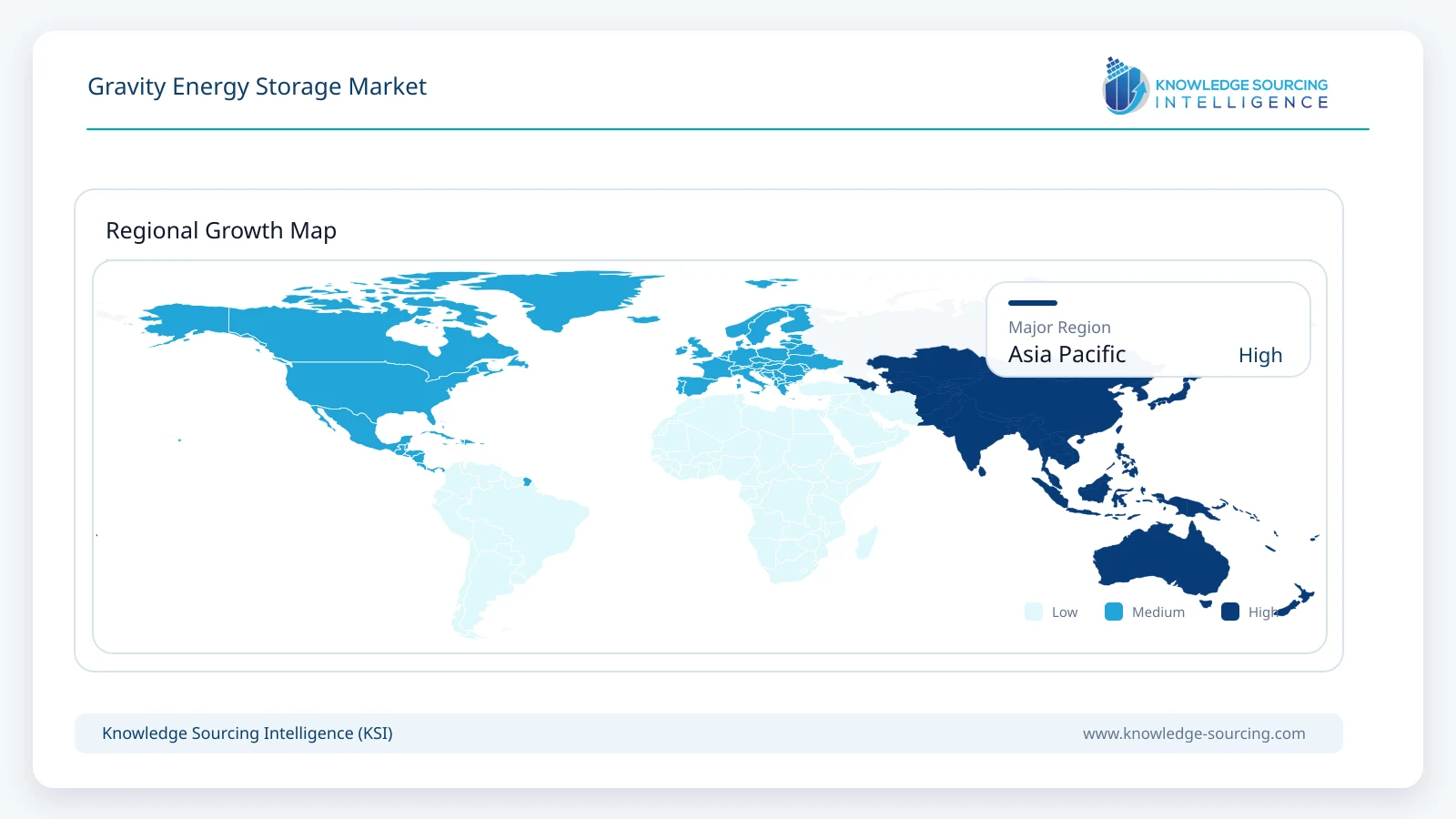
• Asia Pacific leads current commercial deployment, while Africa, Europe and Australia are expanding the development pipeline.
Market Overview
Engineered gravity storage follows the same physical principle as pumped hydro but replaces or modifies the storage medium and infrastructure. Above-ground systems use motors and mechanical handling equipment to lift heavy masses when electricity is abundant and lower them through regenerative drives when electricity is needed. Mine-shaft systems suspend weights in deep vertical shafts, allowing the mass to travel hundreds of metres while using existing industrial structures. High-density hydraulic systems pump a fluid substantially denser than water between upper and lower reservoirs, reducing the height and footprint required for a given energy capacity.
The market is therefore defined more by infrastructure architecture than by one storage chemistry. Power capacity depends on motors, generators, hoists, pumps, turbines and power electronics, while energy capacity depends on mass, elevation difference, working-fluid density and the usable travel distance. These systems can provide energy shifting, frequency response, capacity support and grid-stability services. Several platforms are designed for multi-decade life because the principal storage medium - blocks, steel weights or fluid - experiences limited cycle-related degradation.
Commercial economics depend strongly on civil works and site configuration. Above-ground systems need structures capable of moving very large masses safely and repeatedly. Mine-based systems can reduce excavation cost but require shaft-condition assessment, structural reinforcement and mine-safety work. Hydraulic variants need reservoirs or tanks and stable working-fluid properties. The highest-value sites are therefore those where grid connection, land, elevation or underground infrastructure already exists and can be repurposed.
Market Drivers
Renewable grids require storage with long technical life and flexible duration
Wind and solar growth is increasing demand for storage assets that can operate for several hours without requiring electrochemical augmentation every few years. Energy Vault positions its G-VAULT family for four- to 24-hour duration with asset lives of 35 years or more, while Gravitricity cites a design life above 50 years for mine-shaft systems. These characteristics support applications where owners value long service life, frequent cycling and stable capacity over decades.
Retired mines and industrial sites create a large repurposing opportunity
Mine closure can leave valuable shafts, grid connections, roads, workshops and skilled workforces underutilized. Underground gravity storage can turn those assets into part of the energy transition. Green Gravity is progressing a trial at the Russell Vale mine in New South Wales and is assessing mine-shaft opportunities in India. Gravitricity has identified hundreds of potential sites and is working with mine operators and engineering partners in Europe and other regions. Energy Vault is developing an underground gravity-plus-battery project in Sardinia using 500-metre-deep mine shafts.
Coal-transition projects create a second pathway for deployment
Coal power station retirement creates sites with transmission access, industrial land and large volumes of ash or other reusable material. Energy Vault's 2026 agreement with Eskom plans the first South African EVx 2.0 project at the Hendrina Power Station and includes the potential to use coal-combustion ash in the lifted storage blocks. Similar repurposing can reduce site-development cost while supporting employment and local supply chains in regions affected by thermal-plant closures.
Mechanical storage avoids several battery-material and fire-safety constraints
Gravity systems do not depend on lithium, nickel or cobalt for the storage medium and do not experience thermal runaway. Composite blocks can use locally sourced or recycled materials, suspended weights can use conventional steel and concrete, and hydraulic systems use reusable working fluids. This can reduce commodity exposure and simplify fire-protection requirements, particularly at large industrial sites. The benefit is most relevant where land and structural costs are manageable and long-duration operation matters more than volumetric energy density.
Restraints and Adoption Challenges
Gravity storage remains an early commercial market with limited operating history outside a small number of projects. The systems require substantial civil, structural and mechanical engineering, and project economics can vary widely by site. Above-ground structures have visual and land-use impacts, mine-shaft projects require detailed geotechnical and safety assessment, and hydraulic systems depend on suitable elevation and reservoir configuration. Capital cost is front-loaded, development timelines can be longer than containerized batteries, and project finance remains difficult until more assets demonstrate long-term availability and maintenance performance. The current supplier base is also narrow, increasing technology and counterparty concentration.
Segment Analysis
By Technology Architecture
Above-ground lifted-solid-mass systems are the most commercially advanced engineered-gravity category because Energy Vault's Rudong project is already operating and follow-on projects are being developed in China and South Africa. The architecture uses large mobile masses moved vertically within a purpose-built structure. It offers high round-trip efficiency and long storage-medium life but requires substantial structural works and a suitable project footprint.
Underground mine-shaft systems are the most attractive repurposing pathway. Gravitricity and Green Gravity use existing vertical shafts to move suspended masses, reducing the need to construct a full above-ground tower. The commercial opportunity depends on mine depth, shaft condition, grid access and decommissioning schedules. High-density hydraulic storage sits between gravity storage and pumped hydro: it still uses hydraulic potential energy, but a denser fluid enables commercial projects on smaller hills and industrial sites that would not support conventional pumped storage.
Technology Architecture | Storage Mechanism | Typical Site | Commercial Direction |
Above-ground lifted mass | Composite blocks or solid masses raised and lowered | Industrial land, grid nodes, renewable sites | Most commercially advanced engineered-gravity category |
Mine-shaft suspended mass | Weights move vertically through existing shafts | Retired coal and mineral mines | Strong repurposing potential; early commercial stage |
Modular underground gravity | Mass or hydraulic elements use mine and shaft infrastructure | Deep mines and underground industrial sites | Moving toward hybrid commercial projects |
High-density hydro | Dense fluid pumped between different elevations | Hills, quarries, mines and industrial land | Commercialization accelerating after 2026 demonstration |
Building-integrated gravity | Masses lifted within tall structures | Very tall buildings and mixed-use infrastructure | Longer-term development pathway |
Hybrid gravity + battery | Gravity provides duration; batteries provide fast response | Mine sites and grid-constrained nodes | Emerging architecture for multi-service operation |
Commercial Deployment Indicators
Project / Indicator | Current Evidence | Market Significance |
Rudong, China | 25 MW / 100 MWh EVx system fully grid interconnected, tested and commissioned. | First commercial-scale non-pumped-hydro gravity storage reference. |
Zhangye, China | 17 MW / 68 MWh EVx project under development in Gansu Province. | Shows replication of the Chinese commercial platform. |
Eskom / Hendrina, South Africa | 25 MW / 100 MWh first project announced in May 2026, with a framework for up to 4 GWh across SADC. | Creates a large coal-transition deployment pathway. |
RheEnergise, United Kingdom | First 500 kW High-Density Hydro project achieved full power in January 2026. | De-risks an engineered hydraulic gravity architecture before 10-100 MW projects. |
Green Gravity, Australia | Russell Vale mine trial agreement covers testing at up to 400 metres depth and 150 kW power. | Validates mine-shaft deployment using retired coal infrastructure. |
Miniera d'Energia, Italy | Energy Vault is developing a 100 MW hybrid gravity-plus-battery project in a 500-metre-deep Sardinian coal mine for 2028 COD. | Extends gravity storage into underground hybrid systems. |
Regional Opportunity
Asia Pacific
Asia Pacific is the largest current market for engineered gravity energy storage because China hosts the first commercial-scale operating project and the deepest announced pipeline of lifted-mass systems. Energy Vault's 25 MW / 100 MWh Rudong system in Jiangsu Province is fully grid interconnected and commissioned, while the 17 MW / 68 MWh Zhangye system in Gansu Province provides a second commercial-scale reference. Earlier announcements also identified several additional Chinese projects, giving the region a stronger installed and near-term construction base than other markets.
China's advantage comes from rapid renewable build-out, large grid-balancing requirements and the ability to localize heavy structural materials and construction. Gravity systems are well matched to local supply chains because concrete, steel, motors and civil works can be sourced domestically rather than imported as complete battery cells. The technology can also use recycled or locally available materials in the storage masses, supporting industrial-development objectives.
Australia is developing a different gravity-storage pathway based on legacy mines. Green Gravity is progressing its first underground trial at the Russell Vale mine in New South Wales and has completed a state-supported manufacturing project intended to move the technology toward commercial deployment. The company has also begun assessing opportunities in India through a collaboration with IIT (ISM) Dhanbad's TEXMiN research park, reflecting the large number of mine shafts that could potentially be repurposed.
Europe remains active through Gravitricity, RheEnergise and Energy Vault's Sardinian mine project. Africa became more important in 2026 after Energy Vault and Eskom announced a first 100 MWh project and an up-to-4 GWh regional development framework. North America has substantial long-duration-storage demand, but current gravity-specific commercial deployment is less advanced than in China.
Competitive Landscape
Energy Vault is the most commercially advanced supplier in engineered gravity storage, supported by the operating Rudong project, additional China projects, the South African Eskom agreement and the Sardinian mine development. Its current G-VAULT portfolio spans lifted-mass, mine-based and modular hydraulic gravity concepts. The company's EVx 2.0 design also focuses on automated construction, recycled material use and localized manufacturing.
Gravitricity is developing suspended-mass systems for deep mine shafts and has built a project pipeline across Europe, South Africa, India, Australia and the United States. Green Gravity is pursuing a multi-weight mine-shaft architecture from Australia and is moving toward underground field trials. RheEnergise offers a distinct High-Density Hydro approach using a fluid substantially denser than water, enabling smaller elevation differences and smaller reservoirs than conventional pumped storage.
Project and ecosystem partners include China Tianying and Atlas Renewable in China, Eskom in South Africa, Carbosulcis in Italy, ABB and Baker Hughes in engineering, and mine owners such as Wollongong Resources. These organizations support deployment, site access, engineering or project development but are not counted as standalone gravity-storage technology competitors.
Key Market Participants: Energy Vault; Gravitricity; Green Gravity; RheEnergise. Each has a current, identifiable engineered-gravity storage platform and active development or operating evidence. The short list avoids counting utilities, mine owners, engineering contractors and license/project partners as technology suppliers.
Recent Developments
• May 2026: Energy Vault and Eskom announced a 25 MW / 100 MWh gravity storage project at Hendrina Power Station and a framework covering up to 4 GWh across Southern Africa.
• February 2026: Green Gravity completed its NSW Government Net Zero Manufacturing project, advancing manufacturing and deployment preparation for mine-based gravity storage.
• January 2026: RheEnergise announced that its first High-Density Hydro demonstration project in Devon had achieved full power at the predicted output.
• 2026: Energy Vault continued development of the 100 MW Miniera d'Energia hybrid gravity-plus-battery project in Sardinia, with commercial operation targeted for 2028.
• 2026: Energy Vault's 25 MW / 100 MWh Rudong system remained the principal operating commercial reference for non-pumped-hydro gravity storage.
• 2026: Green Gravity continued field-development work for the Russell Vale mine trial and international mine-site assessment activities, including India.
Gravity Energy Storage Market Scope:
| Report Metric | Details |
|---|---|
| Total Market Size in 2026 | USD 0.42 billion |
| Total Market Size in 2032 | USD 3.20 billion |
| Forecast Unit | USD Billion |
| Growth Rate | 40.3% |
| Study Period | 2021 to 2032 |
| Historical Data | 2021 to 2024 |
| Base Year | 2025 |
| Forecast Period | 2026 – 2032 |
| Segmentation | Technology Architecture, Storage Duration, Application, Site Type, Project Scale, Geography |
| Companies |
|
Market Segmentation
By Technology Architecture
Above-Ground Lifted-Mass Systems
Mine-Shaft Suspended-Mass Systems
Modular Underground Gravity Systems
High-Density Hydro Systems
Building-Integrated Gravity Systems
Hybrid Gravity plus Battery Systems
By Storage Duration
Below 4 Hours
4-8 Hours
8-12 Hours
12-24 Hours
Above 24 Hours
By Application
Renewable Energy Shifting
Grid Capacity and Reliability
Frequency and Ancillary Services
Renewable Curtailment Reduction
Mine and Coal-Plant Repurposing
Industrial and Remote Energy Systems
By Site Type
Purpose-Built Above-Ground Sites
Retired Coal Mines
Metal and Mineral Mines
Quarries and Industrial Sites
Retired Thermal-Power Sites
By Project Scale
Below 10 MW
10-50 MW
50-100 MW
Above 100 MW
By Geography
Asia Pacific
China
Australia
India
Rest of Asia Pacific
Europe
United Kingdom
Italy
Rest of Europe
Middle East and Africa
South Africa
Rest of Africa
North America
Rest of World
Table of Contents
1. EXECUTIVE SUMMARY
1.1. Market Opportunity and Key Findings
1.2. Engineered Gravity Storage Outlook
1.3. Commercial Deployment and Mine Repurposing
2. MARKET OVERVIEW
2.1. Gravity Energy Storage Operating Principle
2.2. Mass, Height and Energy Capacity
2.3. Motor-Generator and Hoist Systems
2.4. Mine-Shaft and Underground Infrastructure
2.5. High-Density Hydraulic Storage
2.6. Hybrid Gravity and Battery Systems
3. MARKET SIZE AND FORECAST, 2026-2032
3.1. Global Market Revenue
3.2. Annual Growth Analysis
3.3. Equipment, EPC and Lifecycle Revenue
4. MARKET BY TECHNOLOGY ARCHITECTURE
4.1. Above-Ground Lifted-Mass Systems
4.2. Mine-Shaft Suspended-Mass Systems
4.3. Modular Underground Gravity Systems
4.4. High-Density Hydro Systems
4.5. Building-Integrated Gravity Systems
4.6. Hybrid Gravity plus Battery Systems
5. MARKET BY STORAGE DURATION
5.1. Below 4 Hours
5.2. 4-8 Hours
5.3. 8-12 Hours
5.4. 12-24 Hours
5.5. Above 24 Hours
6. MARKET BY APPLICATION
6.1. Renewable Energy Shifting
6.2. Grid Capacity and Reliability
6.3. Frequency and Ancillary Services
6.4. Renewable Curtailment Reduction
6.5. Mine and Coal-Plant Repurposing
6.6. Industrial and Remote Energy Systems
7. MARKET BY SITE TYPE
7.1. Purpose-Built Above-Ground Sites
7.2. Retired Coal Mines
7.3. Metal and Mineral Mines
7.4. Quarries and Industrial Sites
7.5. Retired Thermal-Power Sites
8. MARKET BY PROJECT SCALE
8.1. Below 10 MW
8.2. 10-50 MW
8.3. 50-100 MW
8.4. Above 100 MW
9. REGIONAL MARKET
9.1. Asia Pacific
9.1.1. China
9.1.2. Australia
9.1.3. India
9.1.4. Rest of Asia Pacific
9.2. Europe
9.2.1. United Kingdom
9.2.2. Italy
9.2.3. Rest of Europe
9.3. Middle East and Africa
9.3.1. South Africa
9.3.2. Rest of Africa
9.4. North America
9.5. Rest of World
10. MARKET DYNAMICS
10.1. Drivers
10.1.1. Long-Life Renewable Balancing
10.1.2. Mine and Industrial-Site Repurposing
10.1.3. Coal-Transition Infrastructure
10.1.4. Low Critical-Material and Fire Risk
10.2. Restraints
10.2.1. Early Commercial Operating History
10.2.2. Civil and Structural Capital Cost
10.2.3. Site-Specific Engineering
10.2.4. Supplier Concentration and Project Bankability
11. COMPETITIVE LANDSCAPE
11.1. Lifted-Mass Technology Developers
11.2. Mine-Shaft Gravity Developers
11.3. High-Density Hydraulic Storage
11.4. EPC, Hoist and Motor-Generator Ecosystem
11.5. Utility, Mine Owner and Industrial Partnerships
12. COMPANY PROFILES
13. RECENT DEVELOPMENTS
14. APPENDIX
Navigate
Trusted by the world's leading organizations











