
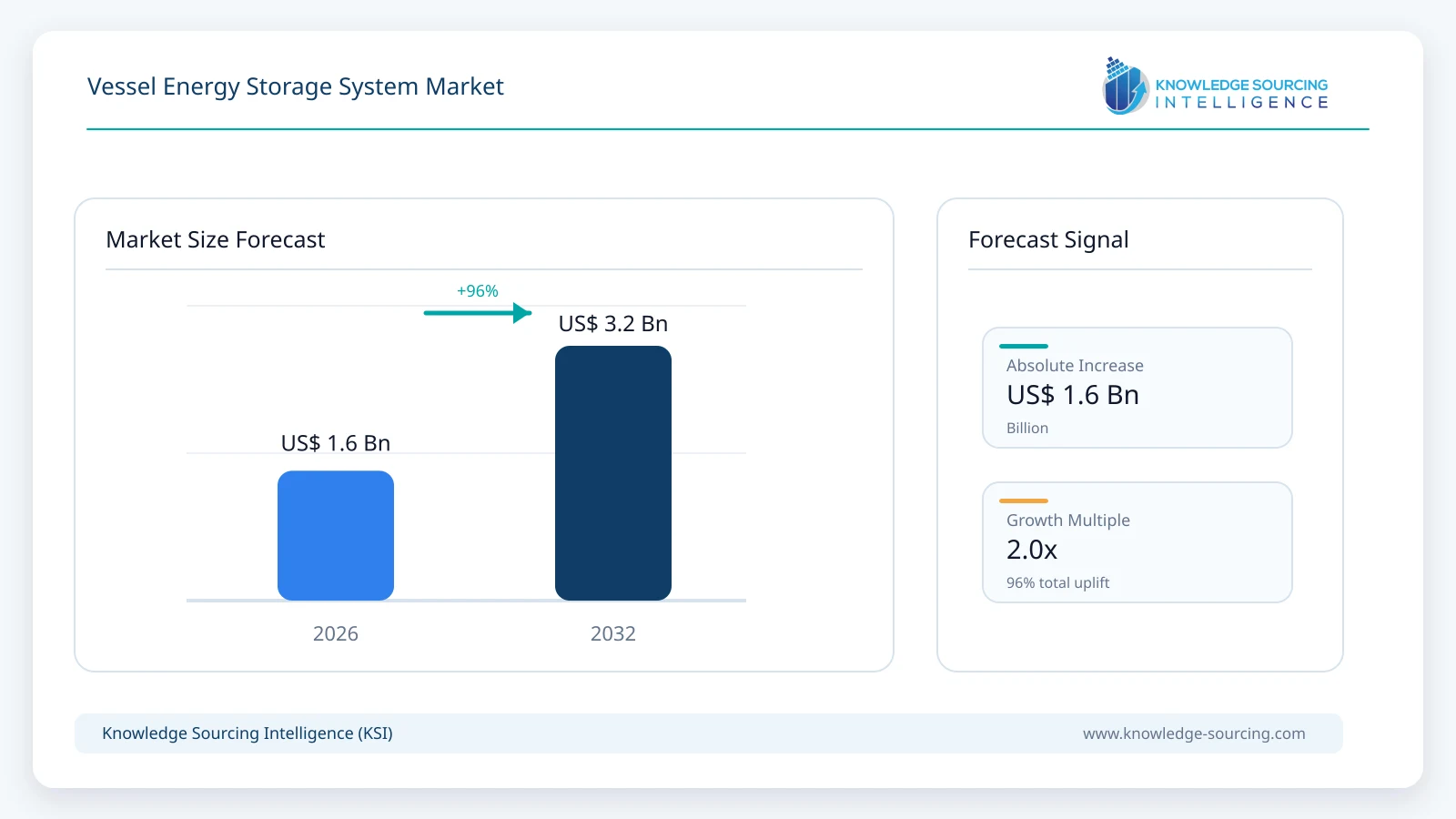
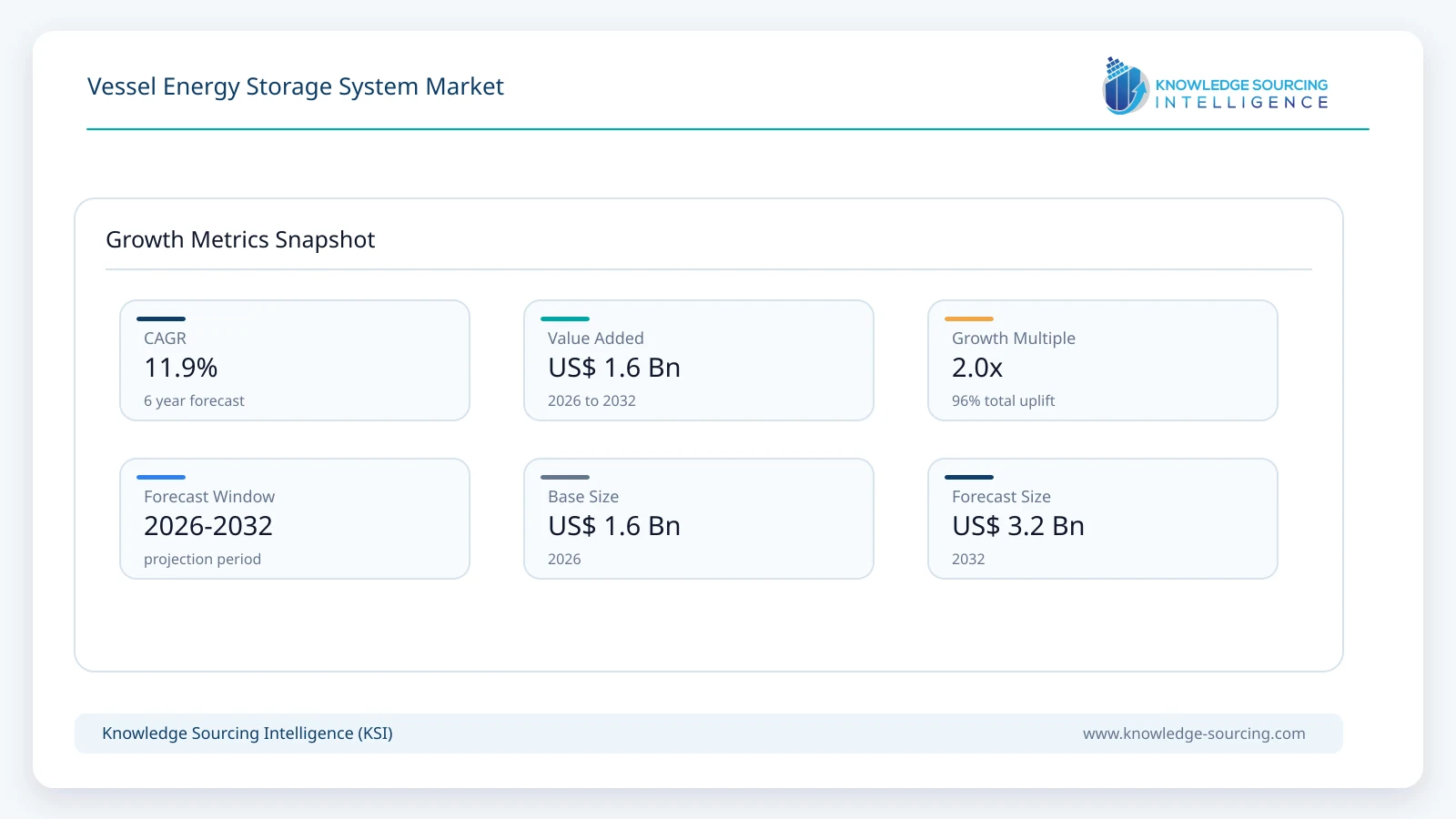
The Vessel Energy Storage System Market is estimated at USD 1.62 billion in 2026 and is projected to reach USD 3.18 billion by 2032, representing a CAGR of 11.9% during the forecast period.
Key Highlights
• Ferries and passenger vessels account for an estimated 39.0% of 2026 market revenue because predictable routes, frequent charging and port-emission requirements support high battery utilization.
• LFP is the fastest-expanding battery chemistry as suppliers introduce marine-certified platforms for higher-energy applications while NMC remains established across many existing fleets.
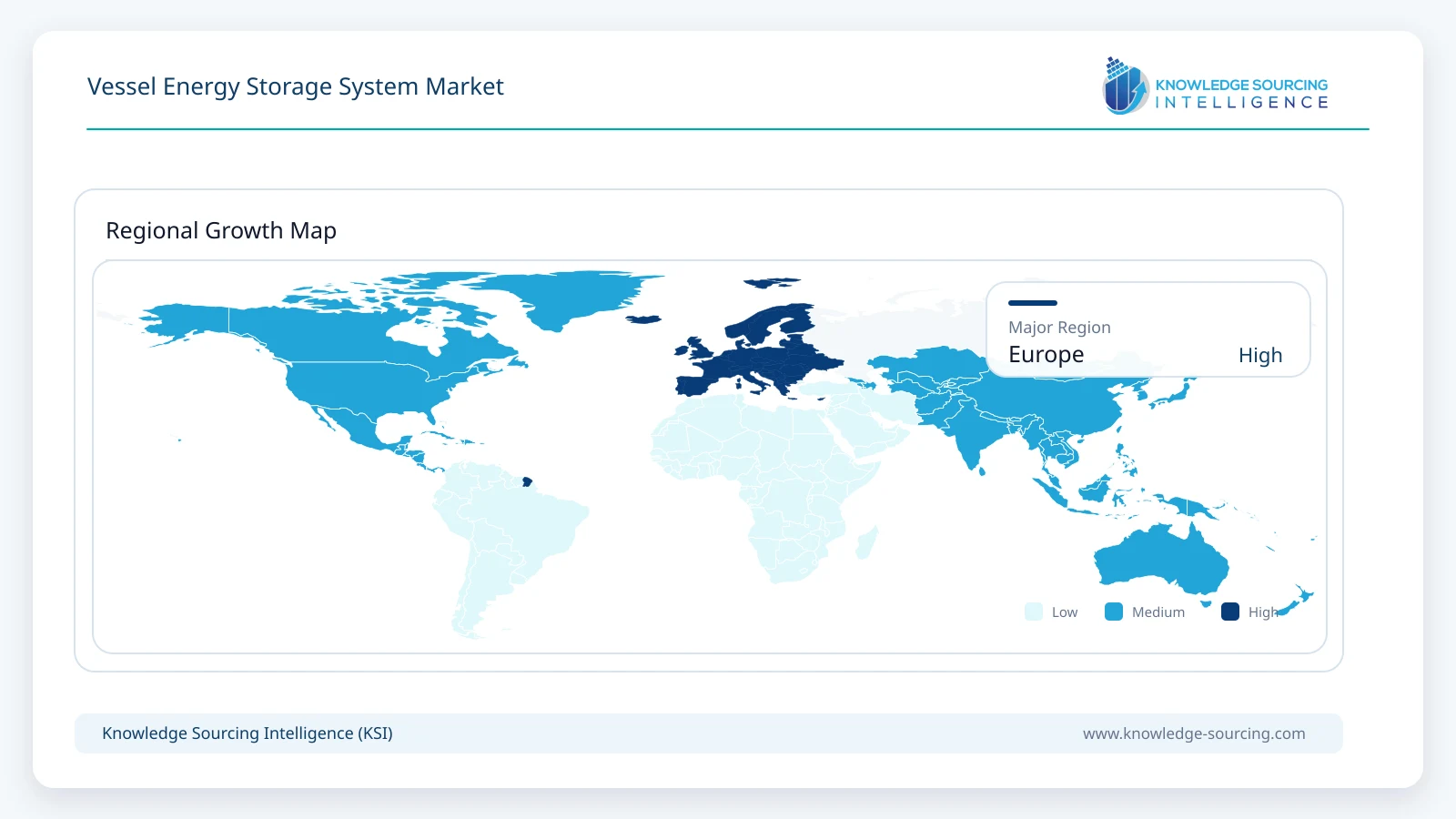
• Europe is the largest regional market, supported by Scandinavian ferry electrification, EU Emissions Trading System exposure, FuelEU Maritime requirements and extensive shore-charging deployment.
• Retrofit demand is expanding alongside newbuild installations as containerized ESS and modular battery rooms allow owners to add peak-shaving and zero-emission operating capability to existing vessels.
• Marine ESS competition is concentrated among a relatively small group of dedicated battery specialists and integrated marine-electrification suppliers; shipyards, cell makers and propulsion-only vendors are treated separately from direct ESS participants.
Market Overview
Onboard energy storage serves different functions depending on vessel duty cycle. Fully electric vessels use the battery as the primary propulsion-energy source and normally require high-capacity charging at one or both ends of a route. Hybrid vessels use storage with engines or fuel cells to smooth power demand, support low-load operation, provide spinning reserve and enable limited zero-emission sailing. Offshore and dynamically positioned vessels can use batteries to absorb rapid load changes that would otherwise require additional engines to remain online, while merchant ships increasingly use storage for port manoeuvring, hotel load, cargo operations and peak shaving.
System design therefore depends on more than installed megawatt-hours. Marine batteries must satisfy classification requirements for thermal propagation, ventilation, fire protection, electrical isolation and fault handling. The battery management system, cooling system, power conversion interface and energy-management software determine how effectively the stored energy can be used without accelerating degradation. Suppliers are also differentiating through lifetime guarantees, remote monitoring, modular expansion and higher-voltage architectures that reduce current and cable losses on larger systems.
Market Drivers
Maritime decarbonisation rules increase the value of onboard storage
The International Maritime Organization (IMO) targets net-zero greenhouse gas emissions from international shipping by or around 2050 and has indicative checkpoints for at least 20% emissions reduction by 2030 and 70% by 2040 compared with 2008. In Europe, maritime emissions are already included in the EU Emissions Trading System and FuelEU Maritime has applied from 2025, beginning with a 2% reduction in the greenhouse-gas intensity of energy used onboard. Batteries can support compliance by reducing engine run time, enabling zero-emission port operation and improving the efficiency of hybrid propulsion without requiring a vessel to rely on one future fuel pathway.
Ferry and workboat operating profiles fit battery economics
Short, repeated voyages allow batteries to cycle frequently and recharge at known locations, improving asset utilization. This makes ferries, harbour craft and tugs especially suitable for full-electric or plug-in hybrid operation. The same logic is expanding to inland cruise vessels and short-sea cargo ships. EST-Floattech, for example, secured a 2026 order to supply 9.7 MWh of battery capacity across 15 new river cruise vessels, while Echandia is supplying multi-megawatt-hour systems for electric tugs and ferries in several regions.
Larger systems make batteries relevant beyond short-distance vessels
Marine batteries are moving into higher-capacity applications. Corvus Energy secured a 40 MWh order for BC Ferries new major vessels in August 2026. Wärtsilä is integrating battery systems into bulk carriers and large passenger vessels, while AYK Energy has secured multi-megawatt-hour orders for RoPax vessels, research ships, tankers and tugs. Larger installations allow storage to support port operations, spinning reserve and engine optimization even when batteries cannot provide the vessel’s full voyage energy.
Retrofit architectures widen the addressable installed fleet
A large share of the global fleet will remain in service well beyond 2030, increasing demand for solutions that can be added without complete vessel replacement. Containerized ESS can place batteries, converters, controls and cooling in pre-engineered deck-mounted units. Modular rack systems can also be installed during major refits. These configurations reduce integration time and create a pathway for owners to add battery capacity gradually as charging infrastructure and operating requirements change.
Restraints and Adoption Challenges
Battery mass and volume remain limiting factors for long-distance propulsion because marine fuel carries substantially more usable energy per unit of weight than current batteries. High-capacity systems also require significant charging power and can shift infrastructure costs from the vessel to the port. Safety and classification requirements add engineering cost, particularly for thermal runaway management, fire boundaries, ventilation and emergency isolation. Battery degradation depends heavily on cycling profile and temperature, so a poorly sized system can lose economic value even when technically feasible. Retrofit projects face additional constraints from available deck space, stability, cable routing and the need to integrate new controls with legacy propulsion equipment.
Segment Analysis
By Battery Chemistry
NMC systems remain the largest commercial chemistry category because they combine high energy density with an established marine operating record and are used across ferries, offshore vessels and hybrid merchant ships. LFP is the fastest-growing chemistry as new type-approved platforms improve its suitability for marine installations where safety, cost and cycle life are prioritized over maximum volumetric energy density. Corvus Energy expanded its LFP portfolio in 2026, while EST-Floattech introduced an LFP module within the Octopus platform. LTO occupies a smaller but important high-cycle niche. Echandia uses LTO in systems designed for frequent fast charging and long service life, making the chemistry particularly relevant to ferries and harbour craft with multiple cycles per day.
By Vessel Type
Ferries and passenger vessels remain the largest vessel category. Their estimated 2026 revenue contribution is approximately USD 632 million, reflecting frequent cycling, predictable routes and substantial investment in European and North American ferry fleets. Tugs and workboats are a major growth area because high transient loads, harbour operation and short duty cycles favour batteries. Offshore service vessels use storage for dynamic positioning and spinning reserve, while cargo vessels are moving from isolated pilot projects toward repeat orders for hybrid bulkers, tankers and short-sea ships. Cruise and naval applications remain smaller in unit volume but can use comparatively large systems and place high value on redundancy, quiet operation and port emissions reduction.
System / Chemistry | Primary Strength | Typical Vessel Use | Commercial Direction |
NMC rack-based ESS | High energy density and established marine installed base | Ferries, offshore vessels, RoPax, cargo hybrids | Core installed technology; improving safety and lifecycle controls |
LFP marine ESS | Thermal stability, cost and long cycle life | Ferries, cargo vessels, cruise, retrofit systems | Fastest expansion as marine type approvals broaden |
LTO marine ESS | Very high cycle life and fast charging | Commuter ferries, harbour craft, tugs | Premium high-cycle niche with long service-life focus |
Containerized ESS | Simplified retrofit and modular deck installation | OSVs, ferries, merchant vessels, conversions | Growing with retrofit and phased-capacity projects |
Swappable battery systems | Reduced charging downtime and flexible energy provisioning | Short-sea, inland and port craft | Early commercial niche where fixed charging time is restrictive |
Market and Project Indicators
Indicator | Current Evidence | Market Significance |
Large ferry battery orders | Corvus Energy announced a 40 MWh battery contract for BC Ferries new major vessels in August 2026. | Shows marine ESS moving toward much larger passenger-vessel installations. |
River-cruise fleet adoption | EST-Floattech will supply 9.7 MWh across 15 river cruise vessels ordered in September 2026. | Demonstrates repeatable fleet deployment rather than one-off demonstration projects. |
High-cycle tug electrification | Echandia is supplying multi-MWh battery systems for electric tugs in India and Singapore during 2026. | Extends battery-electric operation into demanding harbour duty cycles. |
Large hybrid retrofits | Wasaline is increasing Aurora Botnia battery capacity from 2.2 MWh to 12.6 MWh with Wärtsilä integration. | Shows existing vessels can materially increase storage capacity during retrofit. |
Cruise hybrid storage | Leclanché announced a 4 MWh Navius MRS-3 installation for a hybrid ocean cruise vessel in October 2025. | Broadens marine ESS beyond ferries and workboats. |
Safety standardisation | European Maritime Safety Agency BESS safety guidance was updated in November 2025. | Supports more consistent design, approval and operational practices for onboard batteries. |
Regional Opportunity
Europe
Europe is the largest regional market because it combines mature ferry electrification, dense port infrastructure, strong classification expertise and direct regulatory pressure on ship emissions. Norway, Denmark, Sweden and Finland have provided the earliest large installed base for battery and hybrid ferries, while the Netherlands has become an important market for inland, short-sea and retrofit projects. The UK, France, Spain and Italy are also adding hybrid ferries, cargo vessels and port craft. FuelEU Maritime and the EU Emissions Trading System strengthen the economics of reducing onboard fossil-fuel consumption, while port-side charging programmes allow short-route vessels to operate with progressively larger electric shares.
The region is also the centre of the specialist supplier base. Corvus Energy has major operations in Norway, Echandia is headquartered in Sweden, EST-Floattech in the Netherlands, Leclanché operates its e-Marine business from Switzerland and Norway, and Wärtsilä and ABB maintain extensive Nordic marine-electrification portfolios. This supplier concentration supports engineering, certification and service availability close to the largest installed fleets. North America is accelerating through ferry replacement programmes, including BC Ferries and Washington State Ferries. Asia Pacific is expanding through electric tugs, harbour craft, ferries and shipbuilding activity in China, South Korea, Japan, Singapore and India, with regional growth increasingly linked to newbuild integration rather than only imported European vessel designs.
Competitive Landscape
The competitive landscape combines dedicated marine battery companies with diversified marine-electrification suppliers that provide a complete onboard ESS package. Corvus Energy has the broadest visible marine project base among specialist suppliers and continues to expand both LFP and NMC-oriented product families. Echandia differentiates through LTO-based high-cycle systems and is expanding into ferries, tugs and naval applications. EST-Floattech competes through the Octopus platform across high-energy, high-power, LFP and containerized configurations. Leclanché supplies the Navius marine rack system for multi-MWh hybrid and electric vessels, while AYK Energy is scaling rapidly through large new orders across ferries, tugs, tankers and specialized vessels.
Shift Clean Energy participates through fixed, containerized and swappable marine storage systems. ABB, Wärtsilä and Siemens Energy compete differently: each can supply or integrate energy storage as part of a broader vessel power architecture that also includes power conversion, propulsion, energy management and lifecycle support. Their position is strongest when shipowners want a single integrated electrification package rather than a stand-alone battery supplier.
Key Market Participants
Key Market Participant | Vessel ESS Role | Commercial Status | Current Evidence |
Corvus Energy | Marine ESS specialist; NMC and LFP systems | Established commercial supplier | 1,300+ marine projects; 40 MWh BC Ferries contract announced August 2026 |
Echandia | LTO marine battery systems for high-cycle and high-power duty | Established commercial supplier | New Echandia Core launched June 2026; multiple 2026 ferry and tug orders |
EST-Floattech | Octopus maritime ESS platform including NMC, LFP and containerized systems | Established commercial supplier | 9.7 MWh order for 15 river cruise vessels in September 2026 |
Leclanché | Navius MRS marine rack systems for electric and hybrid vessels | Established commercial supplier | 4 MWh Navius MRS-3 installation for hybrid ocean cruise vessel announced in 2025 |
AYK Energy | Marine battery systems and containerized solutions | Commercial supplier scaling rapidly | Large 2025-2026 orders across RoPax, tug, tanker and research-vessel applications |
Shift Clean Energy | Fixed marine ESS, containerized systems and PwrSwäp swappable batteries | Commercial supplier / specialist developer | Current fixed, containerized and PwrSwäp marine ESS portfolio. |
ABB | Marine ESS, containerized ESS, power distribution and energy management integration | Established commercial marine supplier | Current marine ESS portfolio; 2026 ferry projects include multi-MWh battery-ready architectures |
Wärtsilä | Integrated hybrid propulsion including batteries, DC hub and energy management | Established commercial marine supplier | Repeat hybrid orders and major battery retrofit projects active in 2025-2026 |
Siemens Energy | BlueVault marine BESS and integrated vessel electrification | Established commercial marine supplier | Current marine energy-storage portfolio and active 2026 maritime electrification programme |
Cell manufacturers, shipyards, propulsion-only suppliers, charging-infrastructure providers and project integrators are part of the wider marine-electrification ecosystem but are not included in the core participant list unless they directly supply or develop an onboard vessel energy storage system.
Recent Developments
• September 2026: EST-Floattech was selected to supply 9.7 MWh of Octopus High Energy battery systems for 15 new river cruise vessels, with 650 kWh installed on each vessel.
• August 2026: Corvus Energy announced a 40 MWh battery contract for BC Ferries’ New Major Vessels programme, one of the largest recent marine battery orders.
• 2026: AYK Energy reported a 16 MWh Pisces+ battery contract for Germany's next-generation Polarstern 2 research vessel through Wärtsilä, extending marine ESS into high-demand ice-class research applications.
• July 2026: Echandia expanded its position in India with battery systems for two additional fully electric tugs under the Green Tug Transition Program.
• June 2026: Echandia launched Echandia Core, a new LTO marine battery platform intended to reduce upfront cost and installation footprint while retaining high-cycle capability.
• January 2026: ABB announced its technology scope for BC Ferries’ New Major Vessels, with each ferry designed to accommodate up to 70 MWh of battery energy storage for hybrid operation and future electric service.
• November 2025: Wärtsilä received a repeat order for an integrated hybrid propulsion system for Aasen Shipping, including a 620 kWh battery, DC hub and power and energy management systems.
Vessel Energy Storage System Market Scope:
| Report Metric | Details |
|---|---|
| Total Market Size in 2026 | USD 1.62 billion |
| Total Market Size in 2032 | USD 3.18 billion |
| Forecast Unit | USD Billion |
| Growth Rate | 11.9% |
| Study Period | 2021 to 2032 |
| Historical Data | 2021 to 2024 |
| Base Year | 2025 |
| Forecast Period | 2026 – 2032 |
| Segmentation | Battery Chemistry, System Configuration, Operating Mode, Vessel Type, nstallation Type, Geography |
| Companies |
|
Market Segmentation
By Battery Chemistry
Nickel Manganese Cobalt (NMC)
Lithium Iron Phosphate (LFP)
Lithium Titanate Oxide (LTO)
Other Lithium-Ion and Advanced Chemistries
By System Configuration
Rack-Based Battery Rooms
Containerized Energy Storage Systems
Swappable Battery Systems
Integrated Hybrid Power Systems
By Operating Mode
Fully Electric Propulsion
Plug-In Hybrid Propulsion
Hybrid Peak Shaving and Spinning Reserve
Zero-Emission Port and Hotel Load
Emergency and Backup Power
By Vessel Type
Ferries and Passenger Vessels
Tugs and Harbour Craft
Offshore and Service Vessels
Cargo and Merchant Vessels
Cruise Ships
Naval and Special-Purpose Vessels
By Installation Type
Newbuild Installations
Retrofit and Conversion Projects
By Geography
Europe
Norway
Denmark
Sweden
Finland
Netherlands
United Kingdom
North America
United States
Canada
Asia Pacific
China
Japan
South Korea
Singapore
India
Rest of World
Table of Contents
1. EXECUTIVE SUMMARY
1.1. Market Opportunity and Key Findings
1.2. Vessel Electrification and Energy Storage Outlook
1.3. Battery Adoption by Vessel Duty Cycle
2. MARKET OVERVIEW
2.1. Onboard Energy Storage Functions
2.2. Fully Electric versus Hybrid Vessel Architectures
2.3. Battery Management, Thermal Control and Safety
2.4. Charging and Energy Management Integration
3. MARKET SIZE AND FORECAST, 2026-2032
3.1. Global Market Revenue
3.2. Annual Growth Analysis
3.3. Newbuild and Retrofit Revenue
4. MARKET BY BATTERY CHEMISTRY
4.1. Nickel Manganese Cobalt (NMC)
4.2. Lithium Iron Phosphate (LFP)
4.3. Lithium Titanate Oxide (LTO)
4.4. Other Lithium-Ion and Advanced Chemistries
5. MARKET BY SYSTEM CONFIGURATION
5.1. Rack-Based Battery Rooms
5.2. Containerized Energy Storage Systems
5.3. Swappable Battery Systems
5.4. Integrated Hybrid Power Systems
6. MARKET BY OPERATING MODE
6.1. Fully Electric Propulsion
6.2. Plug-In Hybrid Propulsion
6.3. Hybrid Peak Shaving and Spinning Reserve
6.4. Zero-Emission Port and Hotel Load
6.5. Emergency and Backup Power
7. MARKET BY VESSEL TYPE
7.1. Ferries and Passenger Vessels
7.2. Tugs and Harbour Craft
7.3. Offshore and Service Vessels
7.4. Cargo and Merchant Vessels
7.5. Cruise Ships
7.6. Naval and Special-Purpose Vessels
8. MARKET BY INSTALLATION TYPE
8.1. Newbuild Installations
8.2. Retrofit and Conversion Projects
9. REGIONAL MARKET
9.1. Europe
9.1.1. Norway
9.1.2. Denmark
9.1.3. Sweden
9.1.4. Finland
9.1.5. Netherlands
9.1.6. United Kingdom
9.2. North America
9.2.1. United States
9.2.2. Canada
9.3. Asia Pacific
9.3.1. China
9.3.2. Japan
9.3.3. South Korea
9.3.4. Singapore
9.3.5. India
9.4. Rest of World
10. MARKET DYNAMICS
10.1. Drivers
10.1.1. Maritime Decarbonisation and Carbon Costs
10.1.2. Ferry and Harbour-Craft Electrification
10.1.3. Larger Multi-MWh Marine Battery Systems
10.1.4. Retrofit and Containerized ESS Adoption
10.2. Restraints
10.2.1. Battery Weight and Energy Density
10.2.2. Charging Infrastructure Requirements
10.2.3. Thermal Runaway and Classification Requirements
10.2.4. Retrofit Space and Stability Constraints
11. COMPETITIVE LANDSCAPE
11.1. Dedicated Marine Battery Suppliers
11.2. Integrated Marine Electrification Suppliers
11.3. Battery Chemistry and Platform Differentiation
11.4. Service, Monitoring and Lifecycle Support
12. COMPANY PROFILES
12.1. Corvus Energy
12.2. Echandia
12.3. EST-Floattech
12.4. Leclanché
12.5. AYK Energy
12.6. Shift Clean Energy
12.7. ABB
12.8. Wärtsilä
12.9. Siemens Energy
13. RECENT DEVELOPMENTS
14. APPENDIX
Navigate
Trusted by the world's leading organizations











