
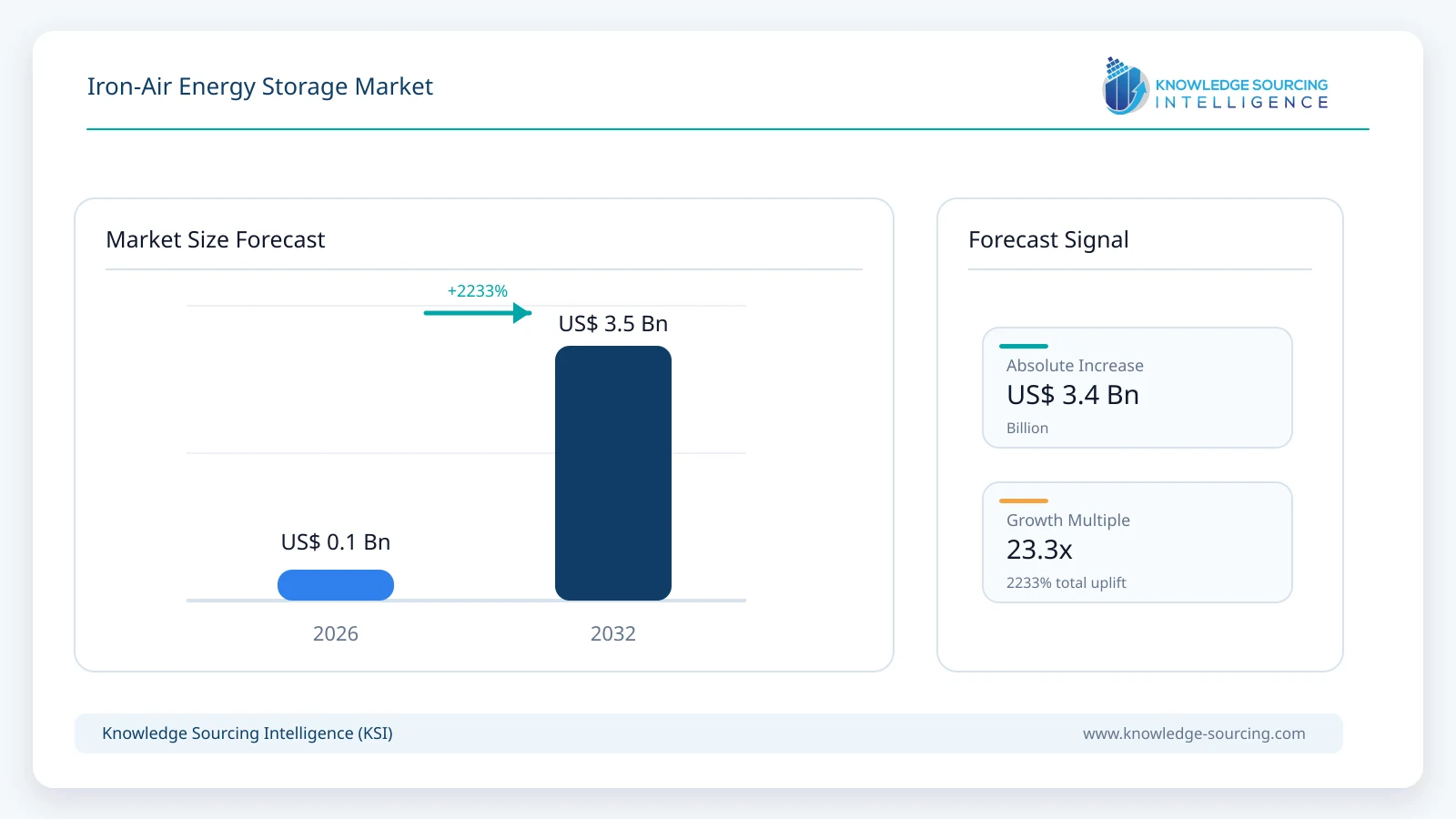
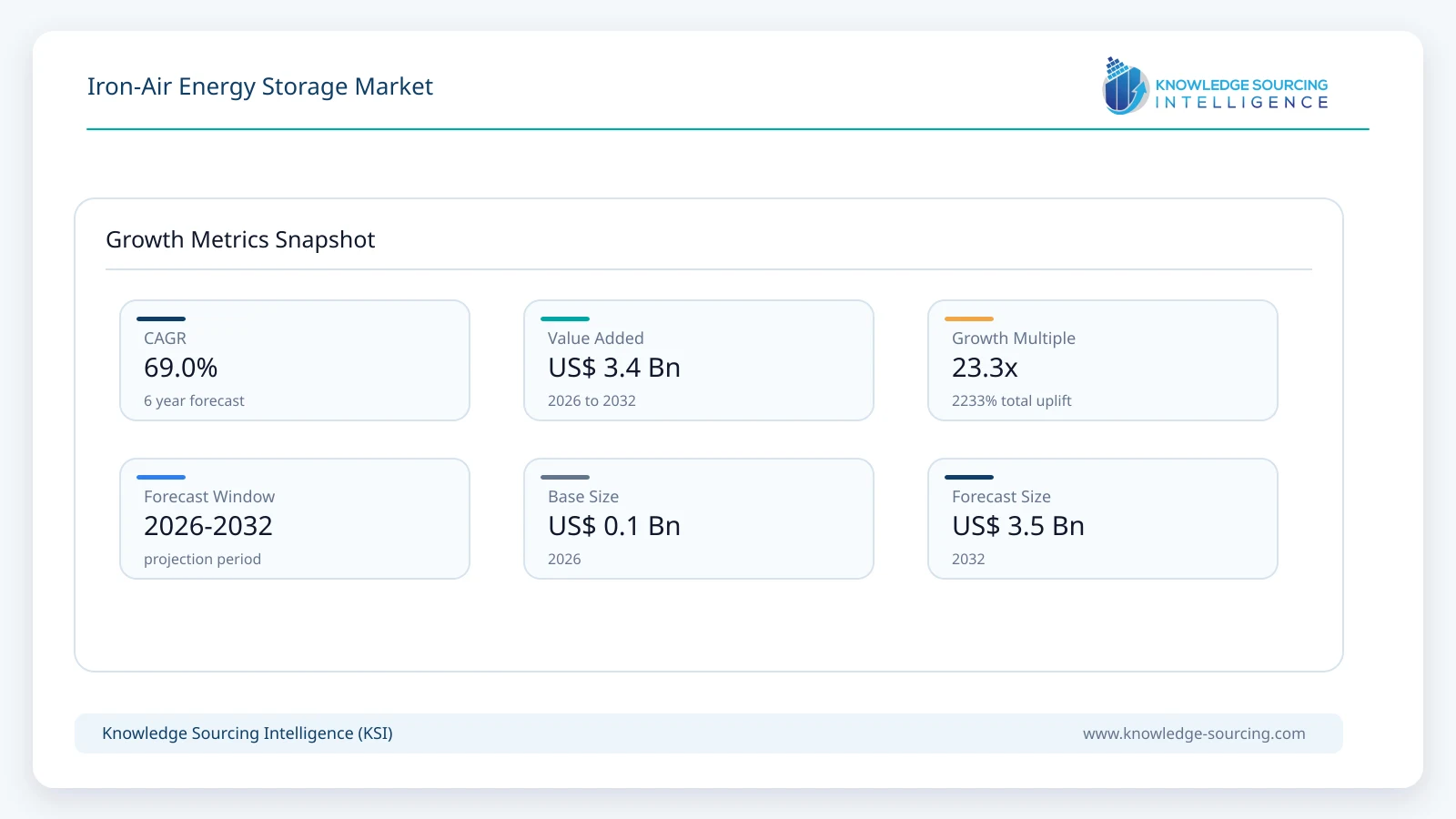
The Iron-Air Energy Storage Market is estimated at USD 0.15 billion in 2026 and is projected to reach USD 3.50 billion by 2032, representing a CAGR of 69.0% during the forecast period.
Key Highlights
• Commercial iron-air systems target multi-day storage durations of roughly 24 to 100 hours rather than short-duration cycling.
• Form Energy's reported project backlog reached approximately 80 GWh in 2026, indicating rapid movement beyond pilot-scale demand.
• AI data centers are emerging as a new demand source alongside utilities and renewable-energy developers.
• Iron, water and air reduce exposure to critical-mineral supply chains and eliminate conventional lithium-ion thermal-runaway risk.
• North America remains the leading commercial market, while Europe is moving from pilot validation toward contracted deployment.
Market Overview
Iron-air batteries are designed around a fundamentally different duty cycle from lithium-ion battery energy storage. Lithium-ion remains well suited to high-efficiency, high-power applications over a few hours, while iron-air is intended to discharge over one to several days during periods of prolonged renewable shortfall, grid stress or unusually high demand. This makes the technology relevant to systems with high wind and solar penetration, where the reliability problem can extend beyond the evening peak and last through multi-day weather events.
The electrochemical process relies on reversible rusting. During discharge, oxygen from ambient air enters the battery and reacts with iron at the negative electrode, releasing electrons into the external circuit. During charging, the iron oxide is reduced back to metallic iron and oxygen is released. An aqueous electrolyte carries ionic charge inside the cell. The chemistry uses abundant, low-cost materials and is inherently nonflammable, but the energy density is much lower than lithium-ion, making iron-air a stationary infrastructure technology rather than a solution for vehicles or space-constrained applications.
Commercial systems are deployed as large modular blocks connected to power-conversion systems and grid controls. The product economics depend heavily on the cost of the battery enclosure, iron electrode manufacturing, air-electrode durability, balance-of-system design, site preparation and the ability to operate repeatedly over long durations. As deployments scale from hundreds of megawatt-hours into tens of gigawatt-hours, manufacturing automation and project standardization become increasingly important.
Market Drivers
Renewable grids require storage across multi-day weather events
High-renewable electricity systems can experience extended periods of low wind or solar generation that cannot be covered economically by four-hour storage alone. Iron-air batteries are designed for precisely this gap. Form Energy's first commercial product is configured for up to 100 hours of discharge, while Ore Energy is developing systems for approximately 24 to 100 hours. The duration allows utilities to shift energy across several days and maintain capacity during prolonged weather-driven shortfalls.
Large data-center loads are creating a new multi-day storage use case
Rapid AI infrastructure growth is increasing the value of firm power that can be deployed faster than new transmission or conventional generation. Form Energy's 12 GWh agreement with Crusoe, beginning in 2027, demonstrates that multi-day storage is moving beyond renewable integration into data-center power strategy. The 30 GWh Xcel-Google project in Minnesota further links iron-air energy storage with large digital infrastructure loads and could materially expand the addressable market if similar procurement models are replicated.
Abundant materials reduce critical-mineral and fire-safety constraints
Iron-air batteries rely on iron, water and oxygen rather than lithium, nickel, cobalt or graphite. This lowers exposure to several constrained battery-material supply chains and supports domestic manufacturing in regions with established steel and industrial infrastructure. The aqueous chemistry is also nonflammable, reducing the thermal-runaway concern associated with dense lithium-ion installations. These characteristics are particularly relevant for very large energy-capacity projects located near communities, industrial sites or data centers.
Manufacturing scale-up is shifting the market from demonstration to delivery
Commercial growth depends on moving from laboratory cells and pilot systems to repeatable high-volume production. Form Energy is ramping Form Factory 1 in West Virginia and has secured substantial equity and debt financing to support manufacturing and working capital. In August 2026, the company raised USD 750 million in Series G financing and reported an approximately 80 GWh backlog; in September 2026 it closed a USD 270 million credit facility. Ore Energy raised USD 43 million in August 2026 as it advances European production plans.
Restraints and Adoption Challenges
Iron-air remains an early commercial technology with a limited operating history at grid scale. Utilities and project financiers need evidence on degradation, maintenance, air-electrode life, system availability and performance across thousands of multi-day cycles. The chemistry also has lower power and energy density than lithium-ion, so projects require more land and material for a given megawatt rating. Round-trip efficiency is lower than short-duration lithium-ion storage, making iron-air most competitive when duration and capacity value outweigh energy-loss penalties. The current supplier base is also narrow, which can increase procurement concentration and bankability risk until more manufacturers achieve commercial scale.
Segment Analysis
By Application
Utility-scale renewable firming and grid capacity represent the primary application because the technology is designed to cover extended periods of low renewable output. Large utility projects can use iron-air storage as a capacity resource, charge during periods of surplus generation and discharge during weather-driven shortages, congestion events or conventional-plant retirements. The scale of announced projects in Minnesota and Ireland shows that utilities are beginning to evaluate iron-air alongside other capacity resources rather than only as a demonstration technology.
Data centers and other large energy-intensive loads are the fastest-emerging application. These customers increasingly need firm capacity without waiting for years of transmission expansion. Multi-day storage can be paired with renewable generation and grid supply to increase available capacity at a site while reducing dependence on fossil backup. Industrial microgrids, remote grids and renewable-energy developers are additional future opportunities, although these markets remain less developed than utility and data-center deployments.
System / Application Layer | Role in Iron-Air Deployment | Commercial Importance | Direction |
Iron-air cell and module | Stores energy through reversible iron oxidation | Core electrochemical value | Scaling from pilot to high-volume production |
Battery enclosure / block | Houses modules, air handling and controls | Major installed-system component | Increasing standardization as project size grows |
Power conversion system | Converts DC battery output to grid-compatible AC | Required for every grid installation | Higher power blocks for utility-scale projects |
Utility renewable firming | Shifts wind and solar energy across multiple days | Primary current application | Largest commercial deployment pipeline |
Grid capacity / resilience | Provides capacity during extended grid stress | High strategic value | Growing with thermal-plant retirements |
AI / data-center power | Supports large new loads with multi-day firming | Emerging high-value application | Fastest new demand channel |
Commercial Deployment Indicators
Project / Indicator | Current Evidence | Market Significance |
Form Energy project backlog | Approximately 80 GWh reported in August 2026, up from roughly 20 GWh earlier in the year. | Demonstrates rapid conversion of multi-day storage interest into contracted pipeline. |
Xcel Energy / Google | 300 MW / 30 GWh iron-air project announced in Minnesota in 2026. | Represents a step change in project scale and links iron-air storage to data-center load growth. |
Crusoe agreement | 12 GWh strategic capacity agreement with deliveries beginning in 2027. | Creates a dedicated AI-data-center demand channel. |
FuturEnergy Ireland | 10 MW / 1,000 MWh project planned for the northwest of Ireland, targeted for 2029. | First announced international deployment for Form Energy. |
Ore Energy / Budget Thuis | 1 GWh agreement in the Netherlands, beginning with 400 MWh planned for 2028. | Shows a second commercial supplier moving into contracted European deployment. |
Ore Energy / EDF R&D | 100-hour grid-connected pilot completed in France in February 2026. | Adds real-world operating evidence for a European iron-air platform. |
Regional Opportunity
North America
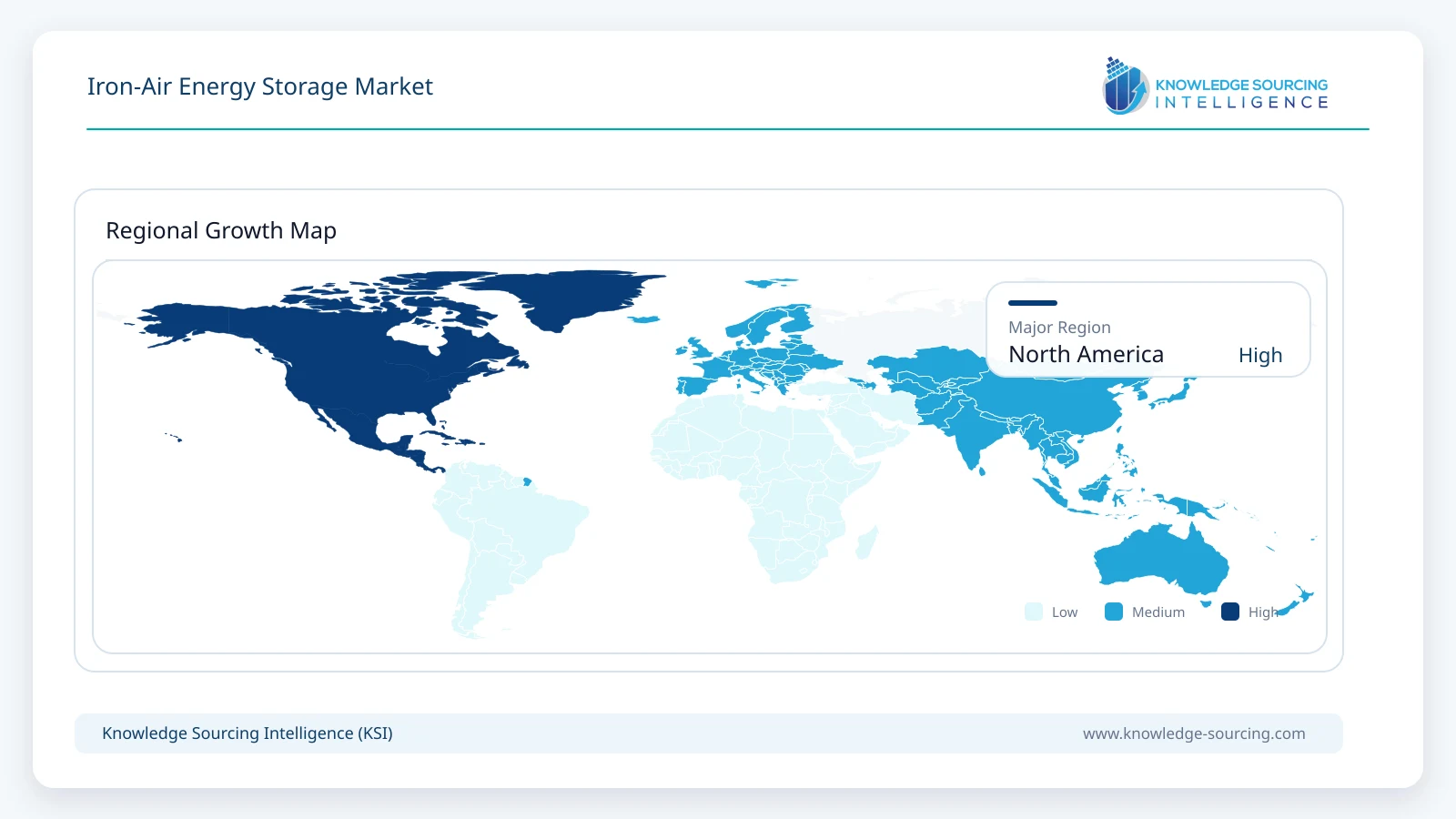
North America is the leading commercial market for iron Air Energy storage because it combines the first high-volume manufacturing base, the largest announced project pipeline and strong demand for new firm capacity from utilities and data centers. Form Energy's manufacturing operations in Weirton, West Virginia provide the region with a domestic supply base, while utility procurement in Minnesota, Colorado and other states is establishing the technology's first commercial reference projects.
The United States is also where iron-air is moving to very large project sizes. Form Energy reported an approximately 80 GWh backlog in August 2026. The 300 MW / 30 GWh Xcel Energy project associated with Google's Minnesota data-center development is substantially larger than previous pilot-scale installations and indicates that customers are beginning to procure multi-day storage as core grid infrastructure. The 12 GWh Crusoe agreement adds a second large commercial channel focused specifically on AI infrastructure.
Manufacturing finance is another regional advantage. Form Energy raised USD 750 million in Series G equity financing in August 2026 and closed a USD 270 million credit facility in September 2026 to support manufacturing scale-up and working capital. Its West Virginia factory is being expanded as commercial deliveries increase. This combination of project commitments, domestic production and financing gives North America the strongest near-term commercialization base.
Europe is the next most active region. Ore Energy completed a grid-connected 100-hour pilot at EDF R&D in France and signed a 1 GWh agreement with Budget Thuis in the Netherlands, while Form Energy announced its first international 1 GWh deployment with FuturEnergy Ireland. Asia Pacific has strong long-duration-storage demand potential, but the publicly announced iron-air commercial pipeline remains smaller than in North America and Europe.
Competitive Landscape
The commercial supplier base remains concentrated. Form Energy is the most advanced iron-air company by manufacturing scale and contracted project pipeline. Its first commercial product is designed for 100-hour storage, and the company is moving from pilot delivery into utility, data-center and international projects. Its manufacturing expansion, large financing rounds and approximately 80 GWh backlog create a substantial first-mover position.
Ore Energy is the leading emerging European specialist. The company uses iron, water and air in a modular long-duration battery design, completed a 100-hour grid-connected pilot at EDF R&D in 2026 and has secured a 1 GWh commercial agreement with Budget Thuis. Utilities, data-center customers, materials suppliers, investors and EPC partners are important to project delivery, but they are treated as ecosystem participants rather than competing iron-air technology suppliers.
Key Market Participants: Form Energy; Ore Energy. The short list reflects the very small number of active companies with clearly identifiable iron-air battery technology, current development activity and a commercial deployment pathway.
Recent Developments
• September 2026: Form Energy closed a USD 270 million credit facility to support manufacturing scale-up and working capital for iron-air battery systems.
• August 2026: Form Energy raised USD 750 million in Series G financing and reported that its backlog had expanded to approximately 80 GWh.
• August 2026: Ore Energy raised USD 43 million in Series A funding to accelerate scale-up of its European iron-air technology.
• June 2026: Ore Energy and Budget Thuis announced a 1 GWh iron-air storage agreement in the Netherlands, beginning with a 400 MWh phase planned for 2028.
• March 2026: Form Energy and Crusoe announced a 12 GWh strategic capacity agreement for AI data centers, with deliveries beginning in 2027.
• March 2026: Form Energy and FuturEnergy Ireland announced a 10 MW / 1,000 MWh iron-air project targeted to come online in 2029.
• February 2026: Ore Energy completed a 100-hour grid-connected iron-air pilot at EDF R&D in France.
• February 2026: Form Energy and Xcel Energy announced plans for a 300 MW / 30 GWh iron-air project associated with a new Google data center in Minnesota.
Iron-Air Energy Storage Market Scope:
| Report Metric | Details |
|---|---|
| Total Market Size in 2026 | USD 0.15 billion |
| Total Market Size in 2032 | USD 3.50 billion |
| Forecast Unit | USD Billion |
| Growth Rate | 69.0% |
| Study Period | 2021 to 2032 |
| Historical Data | 2021 to 2024 |
| Base Year | 2025 |
| Forecast Period | 2026 – 2032 |
| Segmentation | System Component, Storage Duration, Application, Customer Type, Project Scale, Geography |
Market Segmentation
By System Component
Iron Electrodes
Air Electrodes
Electrolyte and Cell Components
Modules and Battery Enclosures
Power Conversion and Controls
Balance of System
By Storage Duration
24-48 Hours
48-100 Hours
100 Hours and Above
By Application
Renewable Energy Firming
Grid Capacity and Reliability
Data Centers and AI Infrastructure
Thermal-Plant Replacement Support
Industrial and Remote Power Systems
By Customer Type
Investor-Owned Utilities
Public and Cooperative Utilities
Renewable Energy Developers
Data-Center Operators
Commercial and Industrial Users
By Project Scale
Below 100 MWh
100-500 MWh
500 MWh-1 GWh
Above 1 GWh
By Geography
North America
United States
Canada
Europe
Netherlands
Ireland
France
Rest of Europe
Asia Pacific
Rest of World
Table of Contents
1. EXECUTIVE SUMMARY
1.1. Market Opportunity and Key Findings
1.2. Multi-Day Energy Storage Outlook
1.3. Commercialization and Manufacturing Scale-Up
2. MARKET OVERVIEW
2.1. Iron-Air Battery Operating Principle
2.2. Reversible Iron Oxidation and Reduction
2.3. Air Electrode and Aqueous Electrolyte
2.4. Module, Enclosure and System Architecture
2.5. Comparison with Short-Duration Battery Storage
3. MARKET SIZE AND FORECAST, 2026-2032
3.1. Global Market Revenue
3.2. Annual Growth Analysis
3.3. Equipment, Integration and Lifecycle Revenue
4. MARKET BY SYSTEM COMPONENT
4.1. Iron Electrodes
4.2. Air Electrodes
4.3. Electrolyte and Cell Components
4.4. Modules and Battery Enclosures
4.5. Power Conversion and Controls
4.6. Balance of System
5. MARKET BY STORAGE DURATION
5.1. 24-48 Hours
5.2. 48-100 Hours
5.3. 100 Hours and Above
6. MARKET BY APPLICATION
6.1. Renewable Energy Firming
6.2. Grid Capacity and Reliability
6.3. Data Centers and AI Infrastructure
6.4. Thermal-Plant Replacement Support
6.5. Industrial and Remote Power Systems
7. MARKET BY CUSTOMER TYPE
7.1. Investor-Owned Utilities
7.2. Public and Cooperative Utilities
7.3. Renewable Energy Developers
7.4. Data-Center Operators
7.5. Commercial and Industrial Users
8. MARKET BY PROJECT SCALE
8.1. Below 100 MWh
8.2. 100-500 MWh
8.3. 500 MWh-1 GWh
8.4. Above 1 GWh
9. REGIONAL MARKET
9.1. North America
9.1.1. United States
9.1.2. Canada
9.2. Europe
9.2.1. Netherlands
9.2.2. Ireland
9.2.3. France
9.2.4. Rest of Europe
9.3. Asia Pacific
9.4. Rest of World
10. MARKET DYNAMICS
10.1. Drivers
10.1.1. Multi-Day Renewable Variability
10.1.2. Data-Center and AI Power Demand
10.1.3. Abundant Raw-Material Supply
10.1.4. Commercial Manufacturing Scale-Up
10.2. Restraints
10.2.1. Limited Commercial Operating History
10.2.2. Lower Round-Trip Efficiency
10.2.3. Large Physical Footprint
10.2.4. Supplier Concentration and Bankability
11. COMPETITIVE LANDSCAPE
11.1. Commercial Iron-Air System Suppliers
11.2. Emerging European Suppliers
11.3. Iron and Materials Ecosystem
11.4. EPC and Power-Conversion Partners
11.5. Utility and Data-Center Procurement Models
12. COMPANY PROFILES
13. RECENT DEVELOPMENTS
14. APPENDIX
Navigate
Trusted by the world's leading organizations











