
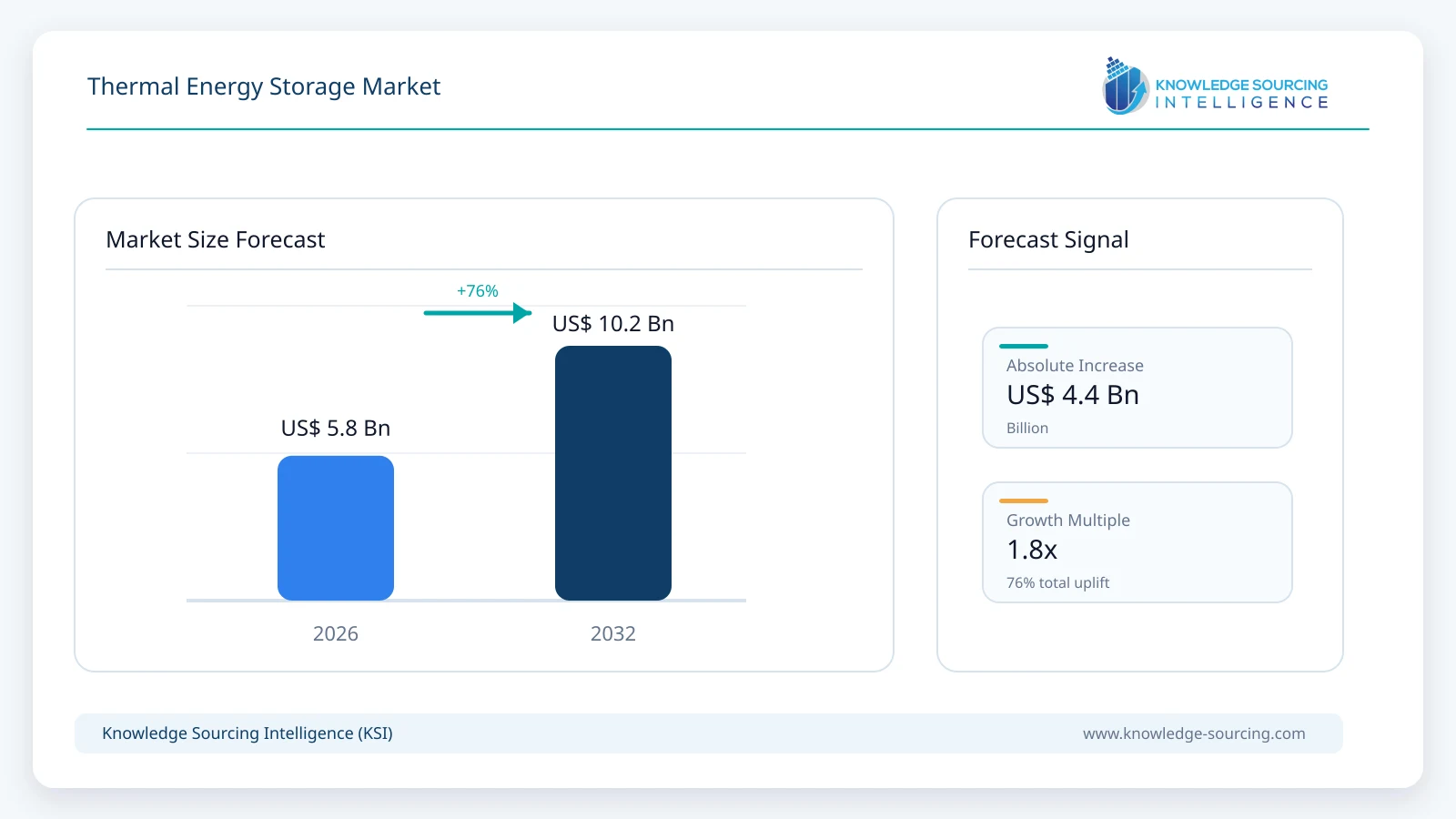
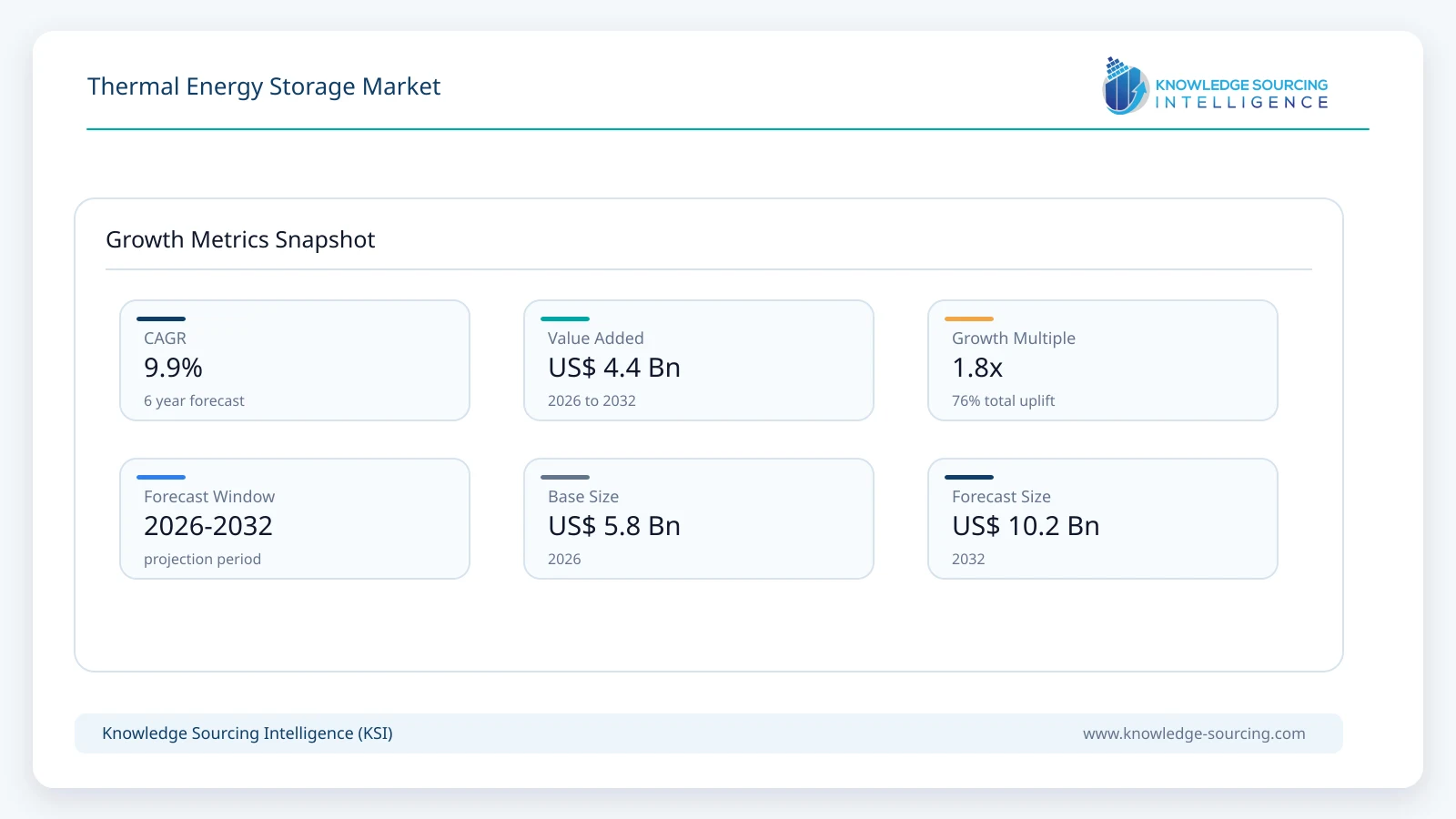
The Thermal Energy Storage Market is estimated at USD 5.80 billion in 2026 and is projected to reach USD 10.20 billion by 2032, representing a CAGR of 9.9% during 2026-2032.
Highlights:
- 1Sensible-heat storage accounts for approximately 72% of 2026 market revenue due to water, molten-salt and solid-media deployment.
- 2Industrial process-heat storage is the fastest-growing application, expanding at an estimated 13.4% CAGR through 2032.
- 3Thermal batteries increasingly convert low-price renewable electricity into continuous steam and high-temperature industrial heat.
- 4Molten-salt storage remains central to concentrated solar power and is expanding with China's new CSP construction cycle.
- 5Asia Pacific represents the largest regional opportunity, supported by China CSP, industrial heat electrification and large cooling demand.
Market Overview
Thermal energy storage can be divided into sensible, latent and thermochemical systems. Sensible storage raises or lowers the temperature of a material without changing its phase. Water, molten salts, rocks, concrete, ceramic media, refractory brick and thermal oils are widely used because they are commercially proven and relatively inexpensive. Latent storage uses the energy absorbed or released when a material changes phase, usually through melting and solidification. Phase-change materials can provide higher volumetric energy density and relatively constant discharge temperature, making them attractive for buildings, cold chains and compact industrial applications.
Thermochemical storage uses reversible chemical or sorption reactions to store thermal energy. It can achieve higher energy density and much lower standby losses than sensible or latent systems, but commercial deployment remains limited because materials, reactors and cyclic stability are more complex. The category is still dominated economically by sensible heat: water tanks underpin district heating and HVAC storage, molten salt is the established storage medium in concentrated solar power, and industrial thermal batteries increasingly use brick, concrete, ceramic or salt-based media.
A major market shift is the electrification of industrial heat. The International Energy Agency notes that thermal storage can connect low-cost variable renewable electricity with continuous industrial heat demand and that storage built from materials such as sand, cement and bricks can be significantly cheaper per kilowatt-hour than chemical batteries. This is creating a new commercial layer above traditional building and CSP applications, with industrial systems now routinely entering the 10-100 MWh range.
Market Drivers
Industrial heat electrification creates a large new storage application
Industry consumes large amounts of energy as heat, and many processes need steam or thermal energy continuously even when electricity prices and renewable output vary by hour. TES allows a factory to charge during low-price electricity periods and discharge heat throughout the production day. Rondo, ENERGYNEST, Kyoto Group and Kraftblock are all deploying systems that decouple electricity purchase from heat consumption. The IEA identifies thermal storage as a key enabling technology for greater use of renewable electricity in industrial heat.
Renewable curtailment and electricity-price volatility improve storage economics
Wind and solar systems increasingly create hours of low or negative electricity prices followed by high-price periods. Electrified thermal storage can absorb electricity during the low-cost window and continue providing heat after the price rises. This creates a direct operating-cost benefit for industrial users and district heating networks. Thermal storage can also participate in demand response and balancing markets because charging load can be shifted rapidly without interrupting heat delivery to the customer.
Concentrated solar power continues to add large molten-salt storage capacity
Molten-salt storage remains one of the largest established high-temperature TES applications. China is currently the most active CSP construction market, with multiple projects combining 50-350 MW solar-thermal plants with eight to sixteen hours of storage. The 100 MW Hami linear-Fresnel project entered trial operation in July 2026 with eight hours of molten-salt storage, while new projects in Qinghai, Tibet, Jilin and other provinces continue to add storage tanks, salt inventory, heat exchangers and steam-generation equipment.
Buildings and district energy need flexible heating and cooling loads
Thermal storage has long been used to shift cooling and heating demand away from grid peaks. Chilled-water tanks and ice storage allow large buildings, campuses and data centers to run chillers during lower-cost hours, while hot-water tanks support district heating networks and heat pumps. The U.S. Department of Energy continues to fund next-generation building TES, including phase-change and thermochemical materials, because the technology can provide load shifting without converting stored heat back into electricity.
Restraints and Adoption Challenges
TES economics depend heavily on temperature, storage duration, charging source and the customer's heat profile. Large water and molten-salt tanks require space, while high-temperature systems need insulation, refractory materials and careful control of thermal expansion. Molten salts can freeze if temperature falls too low and can create corrosion challenges at elevated temperatures. Phase-change materials can suffer from phase segregation, limited thermal conductivity and cycling degradation. Industrial projects also require integration into steam, thermal-oil or hot-air networks without disrupting production. In electricity-to-electricity applications, reconversion losses can make TES less attractive than direct thermal use unless the project also values long duration or grid stability.
Segment Analysis
By Storage Technology
Sensible-heat storage remains the largest technology category. Based on the 2026 market estimate, the segment represents approximately USD 4.2 billion in annual revenue. Commercial systems include hot and chilled water, ice-assisted systems, molten salts, thermal oils, rocks, concrete, ceramic media and refractory brick. These technologies dominate because they are based on low-cost materials, established engineering practices and long-duration field experience.
Latent-heat storage is smaller but commercially established in building cooling, cold chains and selected industrial applications. Thermochemical storage is the fastest technology-development category, but its 2032 commercial value is still expected to remain below USD 1 billion because most systems are at demonstration or early commercialization stage. The principal advantage is high energy density with very low standby heat loss, which makes thermochemical storage attractive where space or multi-day storage matters.
Technology | Typical Storage Medium | Primary Applications | Commercial Maturity |
Sensible heat | Water, molten salt, concrete, rocks, ceramics, brick, thermal oil | CSP, industry, district energy, HVAC | Highest commercial maturity and installed base |
Latent heat / PCM | Paraffins, salt hydrates, eutectics and specialty PCMs | Buildings, cooling, cold chain, process buffering | Commercial in selected temperature ranges |
Thermochemical | Sorption pairs and reversible chemical systems | Compact long-duration heat storage | Pilot and early-commercial stage |
Ice / chilled water | Ice or chilled water | Commercial buildings, campuses, data centers | Long-established demand-shifting technology |
Molten salt | Nitrate and emerging higher-temperature salt mixtures | CSP, industrial steam, district heat | Mature in CSP; expanding in industrial heat |
Solid-media thermal battery | Refractory brick, ceramic, concrete and recycled minerals | Industrial steam and high-temperature heat | Fast-expanding commercial category |
Application and Deployment Indicators
Indicator | Current Evidence | Market Significance |
Rondo / Covestro | 100 MWh heat battery under construction in Germany, scheduled for commissioning by end-2026. | Demonstrates 100 MWh-scale industrial thermal batteries moving into chemical production. |
ENERGYNEST / Peter Greven | 30 MWh TES with 8 MW electric steam generation announced September 22, 2026. | Shows repeat industrial deployment and larger standardized systems. |
ENERGYNEST / LEONHARD KURZ | 12 MWh thermal-storage plant commissioned September 2, 2026. | Adds operating evidence for solid-state industrial TES. |
Kraftblock / Tata Steel | 20 MWh high-temperature storage completed one year of operation at Jamshedpur in 2026. | Validates waste-heat recovery and reuse in heavy industry. |
Kyoto / KALL Ingredients | 56 MWh molten-salt Heatcube operating in Hungary. | Demonstrates thermal storage combined with industrial steam and balancing-market participation. |
China CSP pipeline | 100 MW Hami CSP with eight-hour molten-salt storage entered trial operation in July 2026; larger projects are under construction. | Maintains a large established market for tanks, salts and heat-transfer equipment. |
Regional Opportunity
Asia Pacific
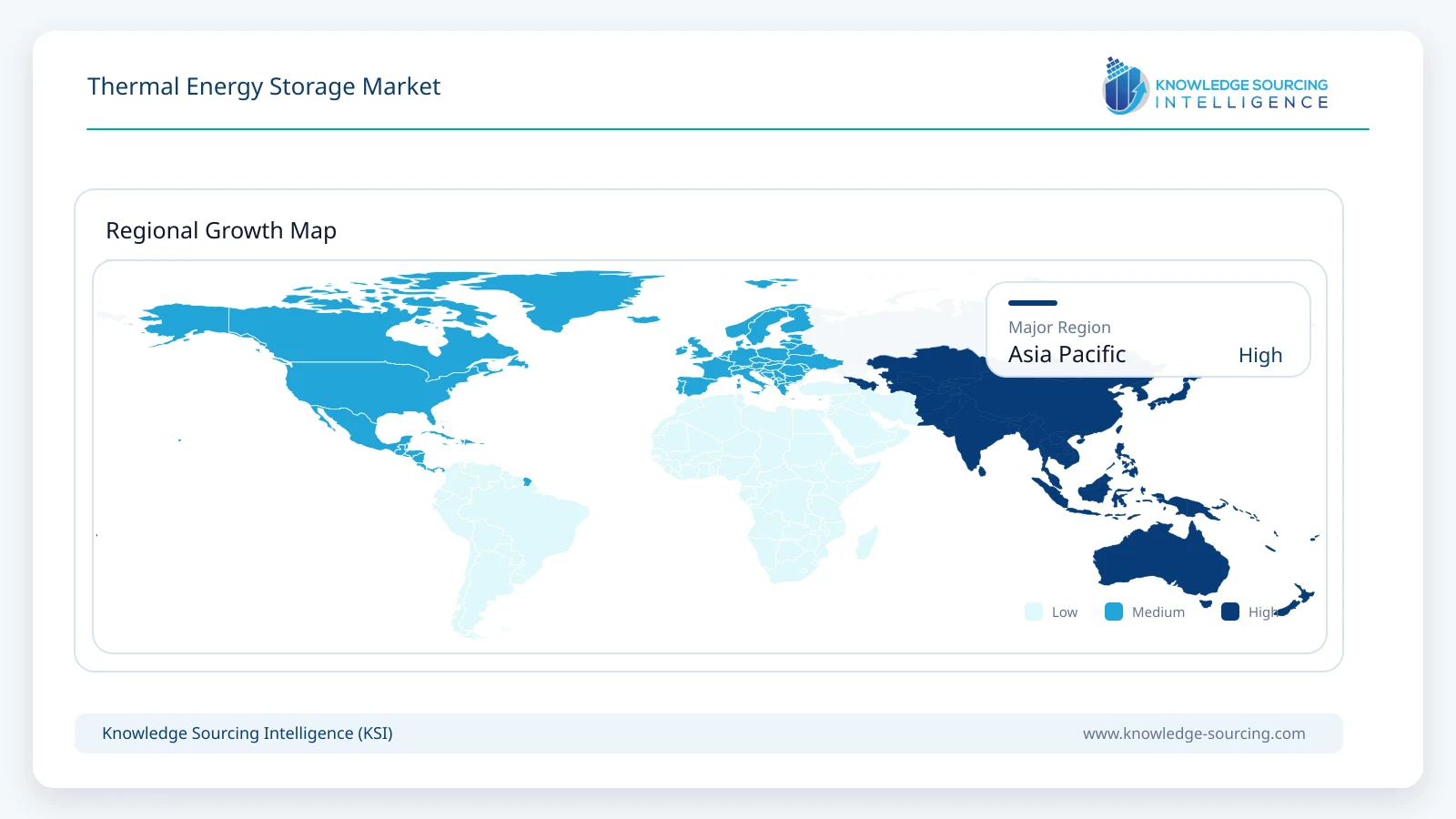
Asia Pacific is the largest regional opportunity for thermal energy storage because the region combines the world's most active concentrated solar power construction market, rapid industrial heat growth, extensive district-energy development and strong demand for cooling. China is particularly important. Multiple CSP projects under construction in 2026 include eight- to sixteen-hour molten-salt storage, creating significant demand for storage tanks, salt inventory, heat exchangers, pumps, steam-generation equipment and controls.
China also leads global growth in industrial electrification. The IEA expects China to account for more than half of global growth in renewable electricity used for industrial process heat through 2030. Thermal storage can increase the value of this electrification by allowing factories to shift charging toward low-cost renewable electricity hours while maintaining continuous steam or process heat. The opportunity extends beyond high-temperature industry to district heating, commercial cooling and large campuses.
India is emerging as another important industrial TES market. Kraftblock's 20 MWh system at Tata Steel's Jamshedpur plant has demonstrated high-temperature waste-heat capture and reuse in steelmaking, while the country's expanding renewable power base increases the future value of flexible process heat. Japan, South Korea and Southeast Asia contribute through manufacturing, commercial-building cooling and industrial decarbonization. Rondo's 33 MWh-class thermal battery in Thailand and other regional projects demonstrate that industrial heat batteries are moving beyond Europe and North America.
Europe remains the most active region for new industrial thermal-battery business models. Germany, Hungary, Denmark and other markets are deploying molten-salt, concrete and brick-based systems and increasingly using heat-as-a-service contracts. North America has a mature building-cooling TES base and a growing industrial-heat market, including Rondo's 100 MWh operating project in California.
Competitive Landscape
The market spans long-established HVAC thermal-storage providers and a new generation of industrial thermal-battery companies. Rondo Energy, Kyoto Group, ENERGYNEST, Kraftblock, Antora Energy and BrenX (formerly Brenmiller Energy) all market dedicated thermal-battery platforms for industrial heat or heat-and-power applications. John Cockerill also offers integrated molten-salt and solid-state thermal energy storage systems for industrial and power applications.
Building and cooling applications are served by Trane (including the CALMAC IceBank portfolio), Baltimore Aircoil Company, Carrier, DN Tanks and Steffes, each of which currently markets a dedicated thermal-storage product or system. Equipment-only suppliers, general CSP developers, heat-exchanger vendors and project customers are not counted as core TES competitors unless they sell a defined storage product or integrated TES solution. Aalborg CSP is also excluded from the key list because its low-temperature division and pit-storage activities transferred to Aalborg hc systems in June 2026, creating a material entity and scope change.
Key Market Participants: Rondo Energy, Kyoto Group, ENERGYNEST, Kraftblock, Antora Energy, BrenX (formerly Brenmiller Energy), John Cockerill, Trane (CALMAC), Baltimore Aircoil Company, Carrier, DN Tanks, Steffes. This list separates active TES product and system suppliers from customers, EPC partners, component suppliers and adjacent project developers.
Recent Developments
September 2026: ENERGYNEST announced a 30 MWh thermal-storage system with 8 MW of electric steam generation for Peter Greven in Germany.
September 2026: LEONHARD KURZ and ENERGYNEST commissioned a 12 MWh power-to-heat plant with integrated thermal storage.
July 2026: China's 100 MW Hami linear-Fresnel CSP project entered commercial trial operation with eight hours of molten-salt thermal storage.
April 2026: Kraftblock and Tata Steel marked one year of operation of their 20 MWh high-temperature thermal-storage system at Jamshedpur.
January 2026: Rondo Energy and Covestro broke ground on a 100 MWh heat battery at Brunsbüttel, Germany, with commissioning planned by year-end.
March 2026: The U.S. Department of Energy advanced a pressurized-water thermal-storage demonstration paired with an electric boiler for building heat.
Thermal Energy Storage Market Scope:
| Report Metric | Details |
|---|---|
| Total Market Size in 2026 | USD 5.80 billion |
| Total Market Size in 2032 | USD 10.20 billion |
| Forecast Unit | Billion |
| Growth Rate | 9.9% |
| Study Period | 2021 to 2032 |
| Historical Data | 2021 to 2024 |
| Base Year | 2025 |
| Forecast Period | 2026 – 2032 |
| Segmentation | Storage Technology, Storage Medium, Temperature Range, Application, Energy Source, Geography |
| Companies |
|
Market Segmentation
By Storage Technology
Sensible Heat Storage
Latent Heat / Phase-Change Storage
Thermochemical Energy Storage
By Storage Medium
Water and Ice
Molten Salt
Concrete and Cementitious Media
Refractory Brick and Ceramic Media
Rocks, Sand and Recycled Mineral Media
Phase-Change Materials
Thermochemical Materials
By Temperature Range
Below 50°C
50-150°C
150-400°C
400-700°C
Above 700°C
By Application
Industrial Process Heat and Steam
Concentrated Solar Power
District Heating and Cooling
Commercial Building HVAC
Data Centers and Campuses
Cold Chain and Refrigeration
Power Generation and Grid Services
By Energy Source
Renewable Electricity
Concentrated Solar Thermal
Industrial Waste Heat
Heat Pumps and Electric Boilers
Conventional Heat Recovery
By Geography
Asia Pacific
China
India
Japan
South Korea
Southeast Asia
Europe
Germany
Nordic Countries
Rest of Europe
North America
United States
Canada
Middle East and Africa
South America
Table of Contents
1. EXECUTIVE SUMMARY
1.1. Market Opportunity and Key Findings
1.2. Thermal Storage Technology Outlook
1.3. Industrial Heat and Grid Flexibility
2. MARKET OVERVIEW
2.1. Thermal Energy Storage Operating Principles
2.2. Sensible Heat Storage
2.3. Latent Heat and Phase-Change Storage
2.4. Thermochemical Storage
2.5. Thermal Storage for Heating versus Cooling
2.6. Power-to-Heat and Heat-to-Power Integration
3. MARKET SIZE AND FORECAST, 2026-2032
3.1. Global Market Revenue
3.2. Annual Growth Analysis
3.3. Equipment, Media, EPC and Service Revenue
4. MARKET BY STORAGE TECHNOLOGY
4.1. Sensible Heat Storage
4.2. Latent Heat / Phase-Change Storage
4.3. Thermochemical Energy Storage
5. MARKET BY STORAGE MEDIUM
5.1. Water and Ice
5.2. Molten Salt
5.3. Concrete and Cementitious Media
5.4. Refractory Brick and Ceramic Media
5.5. Rocks, Sand and Recycled Mineral Media
5.6. Phase-Change Materials
5.7. Thermochemical Materials
6. MARKET BY TEMPERATURE RANGE
6.1. Below 50°C
6.2. 50-150°C
6.3. 150-400°C
6.4. 400-700°C
6.5. Above 700°C
7. MARKET BY APPLICATION
7.1. Industrial Process Heat and Steam
7.2. Concentrated Solar Power
7.3. District Heating and Cooling
7.4. Commercial Building HVAC
7.5. Data Centers and Campuses
7.6. Cold Chain and Refrigeration
7.7. Power Generation and Grid Services
8. MARKET BY ENERGY SOURCE
8.1. Renewable Electricity
8.2. Concentrated Solar Thermal
8.3. Industrial Waste Heat
8.4. Heat Pumps and Electric Boilers
8.5. Conventional Heat Recovery
9. REGIONAL MARKET
9.1. Asia Pacific
9.1.1. China
9.1.2. India
9.1.3. Japan
9.1.4. South Korea
9.1.5. Southeast Asia
9.2. Europe
9.2.1. Germany
9.2.2. Nordic Countries
9.2.3. Rest of Europe
9.3. North America
9.3.1. United States
9.3.2. Canada
9.4. Middle East and Africa
9.5. South America
10. MARKET DYNAMICS
10.1. Drivers
10.1.1. Industrial Heat Electrification
10.1.2. Renewable Curtailment and Price Volatility
10.1.3. CSP Molten-Salt Storage Expansion
10.1.4. Building and District-Energy Flexibility
10.2. Restraints
10.2.1. Site-Specific Thermal Integration
10.2.2. High-Temperature Materials and Corrosion
10.2.3. Storage Footprint and Heat Loss
10.2.4. Electricity-to-Electricity Conversion Losses
11. COMPETITIVE LANDSCAPE
11.1. Industrial Thermal Battery Suppliers
11.2. Molten-Salt and CSP Storage Providers
11.3. HVAC and Chilled-Water Storage Suppliers
11.4. Phase-Change and Thermochemical Technology Developers
11.5. Heat-as-a-Service and Energy-as-a-Service Models
12. COMPANY PROFILES
12.1. Rondo Energy
12.2. Kyoto Group
12.3. ENERGYNEST
12.4. Kraftblock
12.5. Antora Energy
12.6. BrenX (formerly Brenmiller Energy)
12.7. John Cockerill
12.8. Trane (CALMAC)
12.9. Baltimore Aircoil Company
12.10. Carrier
12.11. DN Tanks
12.12. Steffes
13. RECENT DEVELOPMENTS
14. APPENDIX
Navigate
Trusted by the world's leading organizations











