
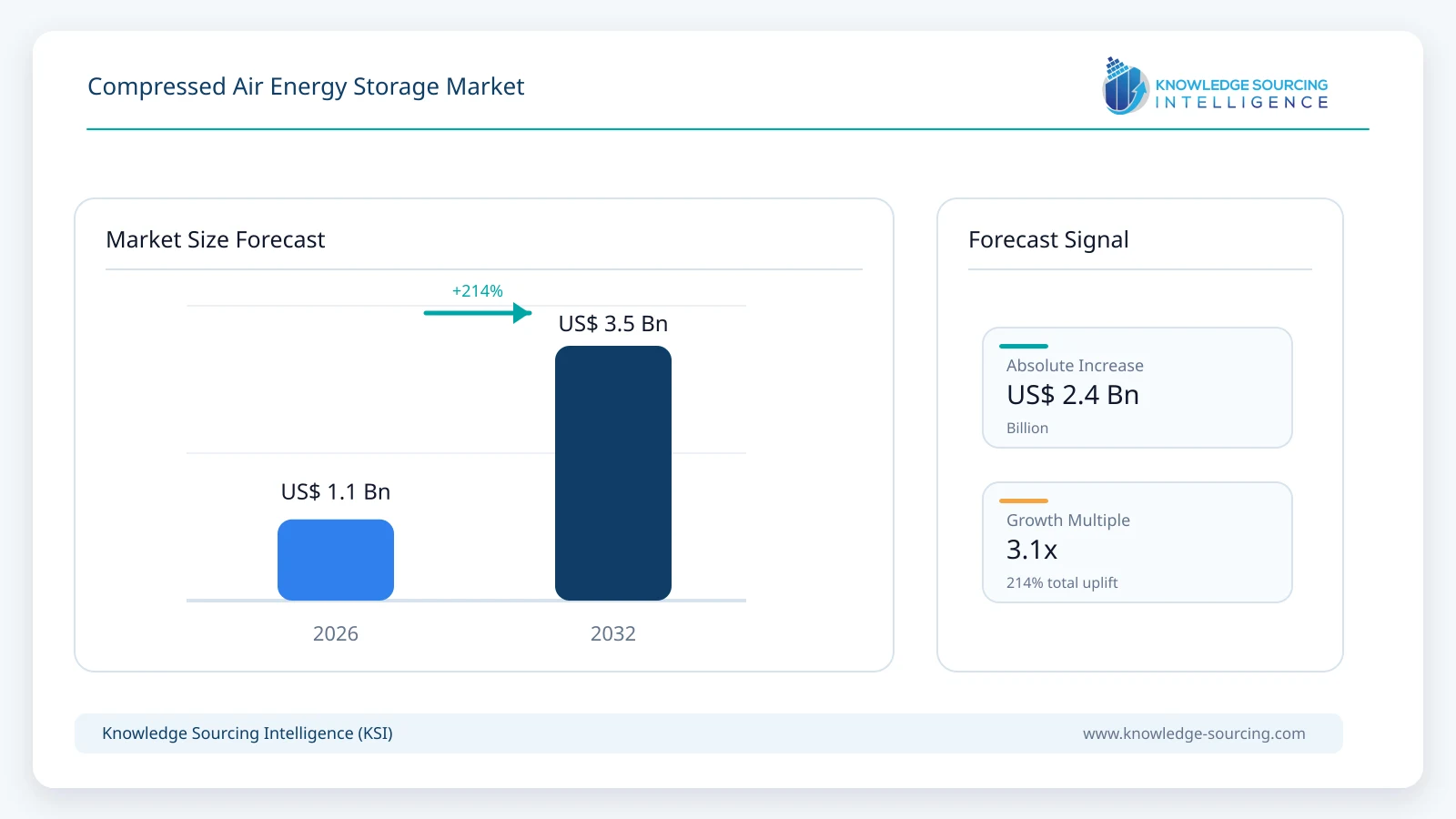
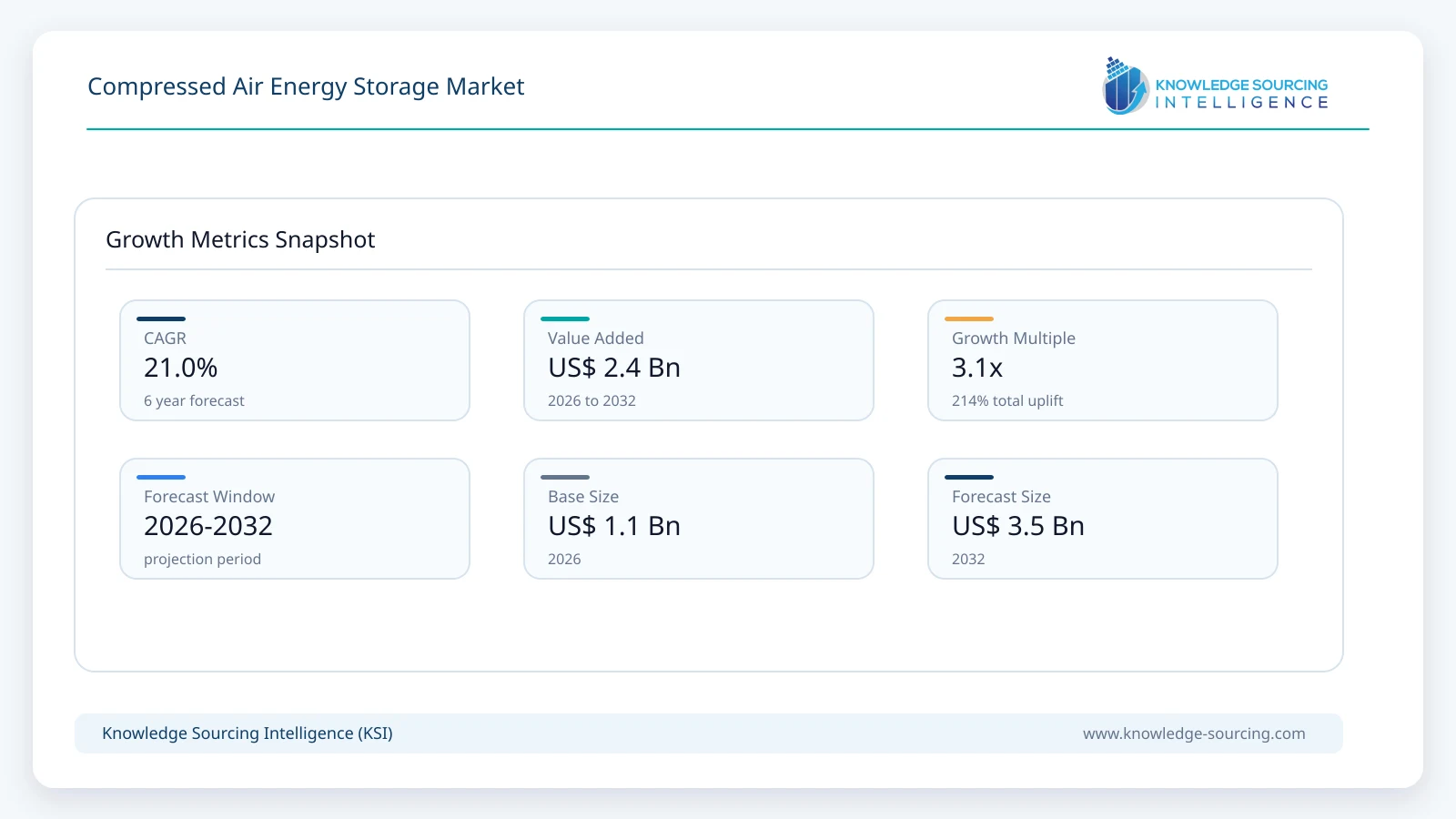
The Compressed Air Energy Storage Market is estimated at USD 1.10 billion in 2026 and is projected to reach USD 3.45 billion by 2032, representing a CAGR of 21.0% during the forecast period.
Key Highlights
• Advanced and adiabatic CAES architectures are estimated to account for approximately 58% of 2026 market revenue as new projects move away from fuel-dependent legacy cycles.
• China has moved CAES into 300 MW-class commercial operation and is developing several larger projects, making Asia Pacific the largest near-term deployment region.
• Hydrostor is progressing 500 MW/4,000 MWh Willow Rock with permitting, offtake and financing milestones during 2025-2026.
• Very-long-duration projects are widening the addressable use case, including Cache Power's 48-hour-plus project and Airengy's multi-day cavern-based development pathway.
• The competitive landscape remains relatively concentrated; only eight companies pass the current KSI validation gate as direct CAES suppliers or active project/technology developers.
Revenue includes CAES process equipment, compression and expansion trains, thermal storage systems, cavern and reservoir integration, plant engineering, project integration and directly associated lifecycle services. Growth is concentrated in advanced and adiabatic architectures because new projects increasingly target fuel-free operation, higher efficiency and multi-hour renewable integration.
Market Overview
CAES performance depends on how compression heat is managed and where the air is stored. Traditional diabatic systems cool the compressed air before storage and use fuel to reheat it during discharge. Adiabatic systems capture compression heat in a thermal store and return that heat to the air before expansion, allowing the power cycle to operate without supplementary combustion. Advanced variants combine near-isothermal compression, water-based heat management, engineered rock caverns or liquid-piston arrangements to improve siting flexibility and efficiency. Siemens Energy currently offers both diabatic and adiabatic compressed air energy storage configurations, while Hydrostor, Chinese advanced-CAES developers and emerging modular suppliers pursue different approaches to heat recovery and storage pressure management.
Storage geology remains an important economic variable. Solution-mined salt caverns are attractive because they can provide large volumes, low leakage and high cycling capability, but suitable formations are geographically constrained and cavern development takes time. Hydrostor instead uses purpose-built underground caverns with hydrostatic compensation, while some emerging systems target above-ground or modular pressure vessels. As projects move beyond first-of-a-kind deployment, the market is likely to separate into very large cavern-based plants for bulk grid storage and smaller engineered systems for industrial sites, islands and constrained grids.
Market Drivers
Grid operators need storage durations beyond conventional battery portfolios
Rapid growth in wind, solar and data-centre demand increases the number of hours in which electricity supply and demand can diverge. Four-hour batteries remain effective for intraday balancing, but grids with deeper renewable penetration also require resources that can cover long evening ramps, multi-hour transmission constraints and periods of low renewable output. CAES can scale energy capacity by increasing cavern or reservoir volume while keeping much of the power equipment unchanged. Hydrostor's Willow Rock is designed for eight hours, Storelectric's TeesCAES targets 30 hours, and Cache Power is developing more than 48 hours of storage, showing how the technology is moving into duration bands that are difficult to serve economically with conventional lithium-ion systems.
Commercial 300 MW-class projects reduce technology risk
Large projects in China have materially changed the evidence base for Compressed Air Energy Storage. China Energy Engineering Corporation reported full-capacity commercial operation of its 300 MW Nengchu-1 plant in January 2025 using a non-supplementary-combustion advanced CAES design. Zhongchu Guoneng has completed both a 100 MW demonstration in Zhangjiakou and a 300 MW demonstration in Feicheng, with additional projects planned or under construction. In June 2026, a China Energy Engineering subsidiary reported winning the EPC contract for a 1,050 MW project in Inner Mongolia comprising three 350 MW units. These projects support larger equipment trains, repeatable engineering packages and a more mature domestic supply chain.
Long asset life and mechanical equipment support infrastructure-style ownership
CAES uses compressors, turbines, generators, heat exchangers, pressure systems and underground storage structures that can be maintained and refurbished over long operating lives. Siemens Energy is currently modernising the 110 MW McIntosh CAES plant for PowerSouth with the objective of extending operation for approximately three decades. Hydrostor designs its A-CAES projects around 50-year-plus asset lives. This infrastructure profile can be attractive to utilities and long-term asset owners where the revenue model rewards dependable capacity over decades rather than rapid technology turnover.
Curtailment and transmission congestion improve the value of bulk storage
Large CAES facilities can absorb substantial blocks of renewable output during periods when transmission is constrained or wholesale prices are weak. Siemens Energy positions CAES specifically for absorbing renewable electricity that would otherwise be curtailed, while Hydrostor links its projects to renewable integration and transmission optimisation. China's new plants are similarly being developed in regions with rapidly expanding wind and solar fleets. The economic value therefore extends beyond energy arbitrage to capacity, reserve, congestion relief, renewable firming and deferred grid investment.
Restraints and Adoption Challenges
CAES projects have long development cycles and require more site-specific engineering than containerised batteries. Geological characterisation, cavern permitting, compression and expansion equipment, thermal systems, electrical interconnection and civil works must be coordinated before construction. Salt-cavern projects depend on suitable geology, while engineered-cavern systems require major underground excavation. These requirements can increase development risk and make project schedules sensitive to permitting, subsurface conditions and local infrastructure.
Efficiency and plant complexity also vary substantially by architecture. Legacy diabatic plants use fuel during discharge, while modern adiabatic systems must store and recover heat effectively to avoid that requirement. First-of-a-kind projects can face cost uncertainty because large CAES plants combine equipment from several industrial supply chains rather than a single standardised battery block. Project finance will therefore depend on contracted capacity payments, tolling or offtake arrangements, demonstrated availability and credible long-term service plans. Competition from lithium-ion, pumped hydro, flow batteries and other long-duration technologies remains significant, particularly where CAES geology is unavailable or storage duration is below eight hours.
Segment Analysis
By Technology Architecture
Advanced and adiabatic CAES is the main growth segment as new projects seek fuel-free operation and higher round-trip efficiency. This category includes thermal-storage-assisted adiabatic systems, hydrostatically compensated advanced CAES and newer non-supplementary-combustion Chinese designs. The segment is projected to expand at approximately 23.8% CAGR during 2026-2032 as large projects move from demonstration into repeat deployment. Diabatic CAES remains commercially relevant through the Huntorf and McIntosh installed base and can still be attractive where natural-gas infrastructure already exists, but most greenfield utility-scale development is moving toward lower-emission architectures.
Isothermal and hybrid thermo-mechanical approaches represent a smaller but strategically important development category. Airengy combines compressed-air storage in caverns with a proprietary hydraulic energy-conversion system, while Keep Energy Systems stores electricity as both compressed air and heat using repurposed engine architectures. These systems remain pilot or pre-commercial and should not be compared directly with operating 100-300 MW plants, but they may expand CAES into modular or multi-day applications if current demonstrations scale successfully.
Technology | Heat Management | Fuel Requirement | Typical Commercial Direction | 2026-2032 Outlook |
Diabatic CAES | Compression heat rejected; air reheated before expansion | Natural gas or other fuel typically required | Legacy salt-cavern plants; modernisation and selected new projects | Stable installed base; slower greenfield growth |
Adiabatic / Advanced CAES | Compression heat captured and reused, or advanced thermal integration | No supplementary combustion in leading new designs | Utility-scale 8-30+ hour storage | Largest and fastest-growing commercial category |
Hydrostatically compensated A-CAES | Heat stored separately; water pressure maintains cavern pressure | No supplementary fuel | Large engineered underground caverns | Late-stage commercial project pipeline |
Isothermal / hydraulic CAES | Heat transfer managed during compression and expansion | Designed for fuel-free operation | Cavern-based multi-day storage | Pilot and pre-commercial scale-up |
Hybrid thermo-mechanical CAES | Compressed air combined with thermal storage | Fuel-free design | Modular 5-20 hour applications | Prototype and demonstration stage |
Project and Deployment Indicators
Project / Asset | Developer / Operator | Scale | Duration / Energy | Current Position |
Nengchu-1, Hubei, China | China Energy Engineering Corporation | 300 MW | Large-scale CAES | Commercial operation since January 2025 |
Feicheng Advanced CAES, Shandong, China | Zhongchu Guoneng | 300 MW | 1,800 MWh class project | Completed advanced-CAES demonstration / commercial engineering reference |
Willow Rock, California, USA | Hydrostor | 500 MW | 4,000 MWh / 8+ hours | Late-stage development; permit and 2026 offtake milestones |
Marguerite Lake Phase 1, Alberta, Canada | Cache Power | 320 MW | 15,360 MWh / 48+ hours | Development; major approvals in place; Q1 2030 target operation |
TeesCAES, Teesside, UK | Storelectric | 50 MW | 30 hours | Development; included in Ofgem 2026 minded-to support list |
AirBattery Romania | Airengy Tech | Up to 25 MW | Up to 5 GWh | Pre-commercial development; 250 kW operating reference in Israel |
Huntorf, Germany | Uniper | 321 MW | Salt-cavern diabatic CAES | Operating legacy asset; ecosystem benchmark |
McIntosh, Alabama, USA | PowerSouth / Siemens Energy service scope | 110 MW | Salt-cavern diabatic CAES | Modernisation to restore and extend commercial operation |
Regional Opportunity
Asia Pacific
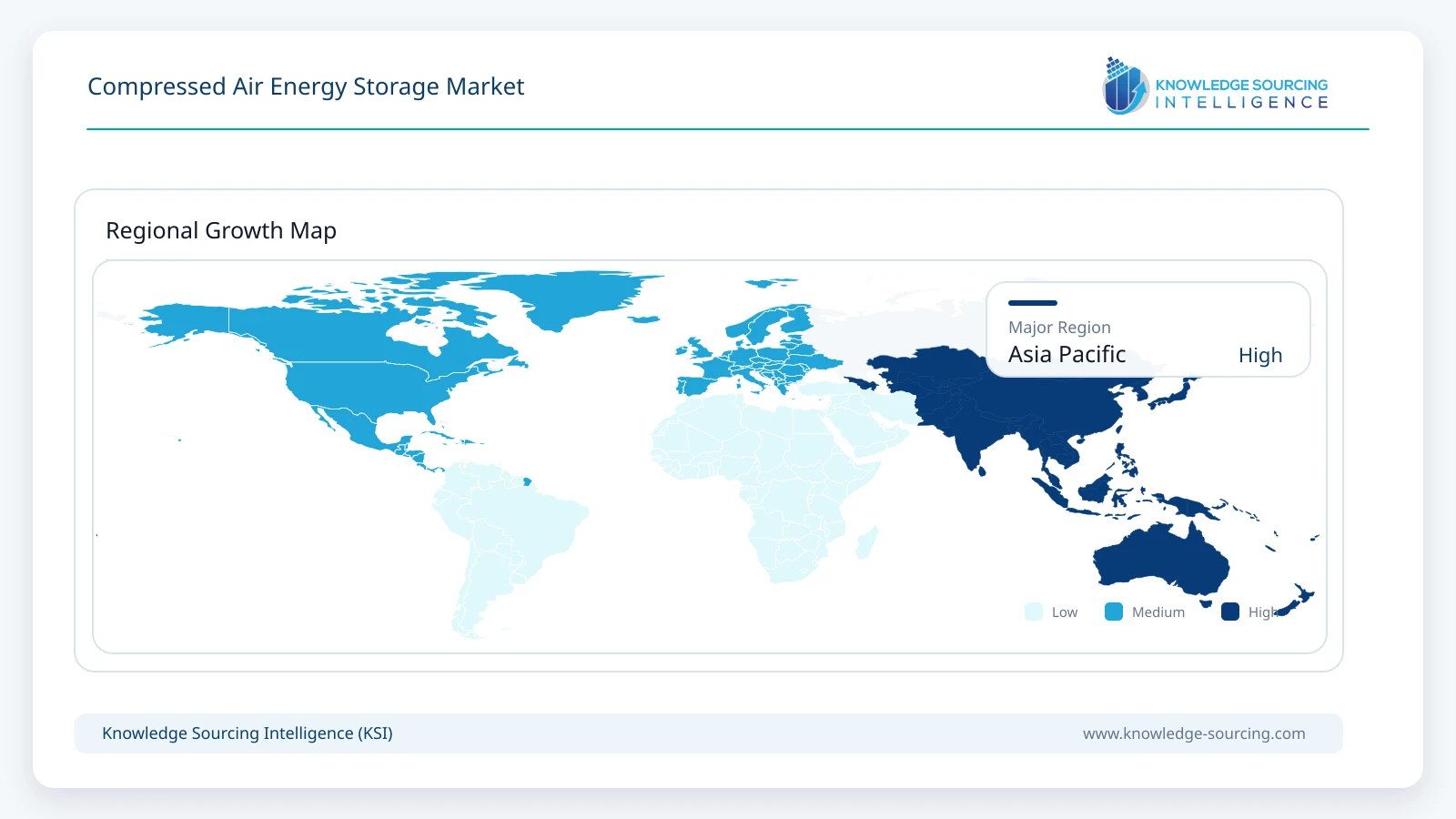
Asia Pacific is the largest near-term opportunity because China has moved advanced CAES into commercial 300 MW-class operation and is building a domestic equipment and project-development ecosystem. The Nengchu-1 project in Hubei began commercial operation in January 2025, while Zhongchu Guoneng reports completed 100 MW and 300 MW advanced CAES plants and more than 5,000 MW of projects under construction or in planning. In June 2026, a China Energy Engineering subsidiary announced an EPC win for a 1,050 MW / 4,200 MWh project in Inner Mongolia using three 350 MW non-supplementary-combustion units and engineered underground caverns. The combination of renewable build-out, regional curtailment, large state-backed infrastructure programmes and an increasingly localised turbomachinery supply chain supports continued deployment.
Australia also contributes to the regional opportunity through Hydrostor's Silver City project in New South Wales, which has continued to progress through financing and grid-connection milestones. Japan, South Korea and India have smaller near-term CAES pipelines but possess relevant compressor, turbine, thermal-equipment, EPC and power-system capabilities. Their adoption will depend on local geology, duration requirements and the economics of alternative storage technologies. North America is the second major development cluster through Hydrostor and Cache Power, while Europe combines the operating Huntorf asset with Storelectric's TeesCAES, Siemens Energy's CAES supply capability, and new pre-commercial cavern programmes from Airengy.
Competitive Landscape
The CAES competitive landscape is narrower than general long-duration energy storage because a company must combine exact CAES technology, project-development capability or dedicated CAES equipment supply with current activity. Eight companies meet the current KSI validation gate. China Energy Engineering Corporation and Zhongchu Guoneng have the strongest recent evidence at operating 100-300 MW scale. Hydrostor has the most advanced non-Chinese A-CAES project pipeline, while Siemens Energy provides complete surface-plant CAES engineering, turbomachinery and lifecycle service capability. Cache Power and Storelectric are active project developers with large permitted or policy-supported projects, while Airengy Tech and Keep Energy Systems remain pilot or pre-commercial technology developers.
Utilities and project partners are separated from competitors. Uniper and PowerSouth are important CAES asset operators but are not included as technology suppliers. Hatch, EllisDon, Hitachi Energy, Nobian and other engineering, construction, grid-infrastructure or cavern partners are treated as ecosystem participants unless they directly supply or develop the CAES system. Corre Energy is not retained as a current competitor because its UK entity entered administration in May 2025, and older inactive or liquidating CAES developers are likewise excluded rather than used to inflate the company list.
Key Market Participant | Exact CAES Role | Commercial Status | Current Validation Evidence |
Hydrostor Inc. | Advanced compressed Air Energy storage developer and operator using hydrostatically compensated underground caverns | Commercial supplier / project developer | 500 MW/4,000 MWh Willow Rock late-stage project; 2026 offtakes, financing and Silver City grid progress |
Zhongchu Guoneng (Beijing) Technology Co., Ltd. | Advanced CAES R&D, design, core equipment, engineering, investment and operation | Commercial technology developer / integrator | Institute of Engineering Thermophysics confirms completed 100 MW and 300 MW projects and >5,000 MW pipeline |
China Energy Engineering Corporation Limited | Large-scale advanced CAES technology development, investment, EPC and system integration | Commercial technology developer / integrator | 300 MW Nengchu-1 entered commercial operation in 2025; 1,050 MW project EPC win reported June 2026 |
Siemens Energy AG | CAES surface plant, compressor and expansion trains, EPC/start-up and lifecycle service | Commercial equipment / solution supplier | Current CAES product portfolio and 2025 PowerSouth McIntosh modernisation order |
Cache Power Corp. | Developer of cavern-based utility-scale CAES in Alberta | Development-stage project developer | 320 MW / 15,360 MWh Phase 1 with approvals, transmission process and 2025-2026 project activity |
Storelectric Ltd. | Salt-cavern CAES project development for long-duration grid storage | Development-stage project developer | 50 MW / 30-hour TeesCAES progressed through UK LDES support process; Teesside site acquisition completed July 2026 |
Airengy Tech Ltd. | AirBattery compressed-air power plant technology using underground caverns and hydraulic conversion | Pilot / pre-commercial developer | Renamed from Augwind in February 2026; 250 kW operating plant plus 2026 Denmark and Romania development agreements |
Keep Energy Systems | Modular thermo-mechanical storage combining compressed air and heat | Pilot / demonstration-stage developer | Operational Nottingham prototype; UK-funded demonstrator and 5-20 hour product development active in 2026 |
Ecosystem participants: Uniper and PowerSouth Energy Cooperative are operating-asset owners; Hatch and EllisDon are project execution partners; Hitachi Energy supplies grid infrastructure; Nobian provides cavern-development context for Airengy. These companies are not counted as core competitors solely because of those roles.
Recent Developments
• September 2026: Hydrostor reported grid-connection approval for the Silver City Energy Storage Centre in New South Wales, continuing development of its A-CAES portfolio.
• September 2026: The Alberta Electric System Operator advanced consideration of the transmission connection for Cache Power's Marguerite Lake CAES project.
• August 2026: Hydrostor secured USD 230 million to progress advanced compressed air energy storage projects and signed an additional 60 MW Willow Rock offtake agreement with Clean Energy Alliance.
• July 2026: Storelectric completed acquisition of its Teesside site for long-duration storage projects after TeesCAES, a 50 MW 30-hour CAES project, was included in Ofgem's minded-to decision list.
• July 2026: Airengy and Nobian began evaluating AirBattery compressed-air storage in a Danish salt cavern, adding to Airengy's European project-development programme.
• June 2026: A China Energy Engineering subsidiary reported winning the EPC contract for a 1,050 MW / 4,200 MWh compressed air energy storage project in Inner Mongolia.
• January 2025: China Energy Engineering Corporation reported that the 300 MW Nengchu-1 advanced CAES plant in Hubei entered commercial operation.
Compressed Air Energy Storage Market Scope:
| Report Metric | Details |
|---|---|
| Total Market Size in 2026 | USD 1.10 billion |
| Total Market Size in 2032 | USD 3.45 billion |
| Forecast Unit | USD Billion |
| Growth Rate | 21.0% |
| Study Period | 2021 to 2032 |
| Historical Data | 2021 to 2024 |
| Base Year | 2025 |
| Forecast Period | 2026 – 2032 |
| Segmentation | Technology Architecture, Storage Reservoir, Storage Duration, Application, End User, Geography |
| Companies |
|
Market Segmentation
By Technology Architecture
Diabatic CAES
Adiabatic CAES
Advanced / Non-Supplementary-Combustion CAES
Hydrostatically Compensated A-CAES
Isothermal and Hybrid Thermo-Mechanical CAES
By Storage Reservoir
Salt Caverns
Mined and Engineered Rock Caverns
Above-Ground Pressure Storage
Other Geological Reservoirs
By Storage Duration
4-8 Hours
Above 8-24 Hours
Above 24 Hours
By Application
Renewable Energy Firming and Curtailment Reduction
Capacity and Peak Shifting
Transmission Congestion Management
Ancillary Services and Grid Reserves
Industrial and Remote Grid Storage
By End User
Utilities and Independent Power Producers
Renewable Energy Developers
Grid and Transmission Operators
Industrial Energy Users
By Geography
Asia Pacific
China
Australia
Japan
South Korea
India
North America
United States
Canada
Europe
Germany
United Kingdom
Rest of Europe
Rest of World
Table of Contents
1. EXECUTIVE SUMMARY
1.1. Market Opportunity and Key Findings
1.2. Commercialisation and Deployment Outlook
1.3. Long-Duration Grid Storage Role
2. MARKET OVERVIEW
2.1. Compressed Air Energy Storage Fundamentals
2.2. Compression, Storage and Expansion Cycle
2.3. Thermal Management and Round-Trip Efficiency
2.4. Underground Caverns and Engineered Storage Reservoirs
3. MARKET SIZE AND FORECAST, 2026-2032
3.1. Global Market Revenue
3.2. Annual Growth Analysis
3.3. Project Pipeline and Revenue Timing
4. MARKET BY TECHNOLOGY ARCHITECTURE
4.1. Diabatic CAES
4.2. Adiabatic CAES
4.3. Advanced / Non-Supplementary-Combustion CAES
4.4. Hydrostatically Compensated A-CAES
4.5. Isothermal and Hybrid Thermo-Mechanical CAES
5. MARKET BY STORAGE RESERVOIR
5.1. Salt Caverns
5.2. Mined and Engineered Rock Caverns
5.3. Above-Ground Pressure Storage
5.4. Other Geological Reservoirs
6. MARKET BY STORAGE DURATION
6.1. 4-8 Hours
6.2. Above 8-24 Hours
6.3. Above 24 Hours
7. MARKET BY APPLICATION
7.1. Renewable Energy Firming and Curtailment Reduction
7.2. Capacity and Peak Shifting
7.3. Transmission Congestion Management
7.4. Ancillary Services and Grid Reserves
7.5. Industrial and Remote Grid Storage
8. MARKET BY END USER
8.1. Utilities and Independent Power Producers
8.2. Renewable Energy Developers
8.3. Grid and Transmission Operators
8.4. Industrial Energy Users
9. REGIONAL MARKET
9.1. Asia Pacific
9.1.1. China
9.1.2. Australia
9.1.3. Japan
9.1.4. South Korea
9.1.5. India
9.2. North America
9.2.1. United States
9.2.2. Canada
9.3. Europe
9.3.1. Germany
9.3.2. United Kingdom
9.3.3. Rest of Europe
9.4. Rest of World
10. MARKET DYNAMICS
10.1. Drivers
10.1.1. Need for Multi-Hour and Multi-Day Grid Storage
10.1.2. Commercial 300 MW-Class CAES Deployment
10.1.3. Long Asset Life and Infrastructure-Style Ownership
10.1.4. Renewable Curtailment and Transmission Constraints
10.2. Restraints
10.2.1. Geology and Site-Specific Development Requirements
10.2.2. Long Permitting and Construction Cycles
10.2.3. First-of-a-Kind Project Cost and Finance Risk
10.2.4. Competition from Batteries, Pumped Hydro and Other LDES Technologies
11. COMPETITIVE LANDSCAPE
11.1. Utility-Scale Advanced CAES Developers
11.2. CAES Equipment and Surface-Plant Suppliers
11.3. Development-Stage and Pilot Technology Companies
11.4. Ecosystem Partners and Asset Operators
12. COMPANY PROFILES
12.1. Hydrostor Inc.
12.2. Zhongchu Guoneng (Beijing) Technology Co., Ltd.
12.3. China Energy Engineering Corporation Limited
12.4. Siemens Energy AG
12.5. Cache Power Corp.
12.6. Storelectric Ltd.
12.7. Airengy Tech Ltd.
12.8. Keep Energy Systems
13. RECENT DEVELOPMENTS
14. APPENDIX
Navigate
Trusted by the world's leading organizations











