
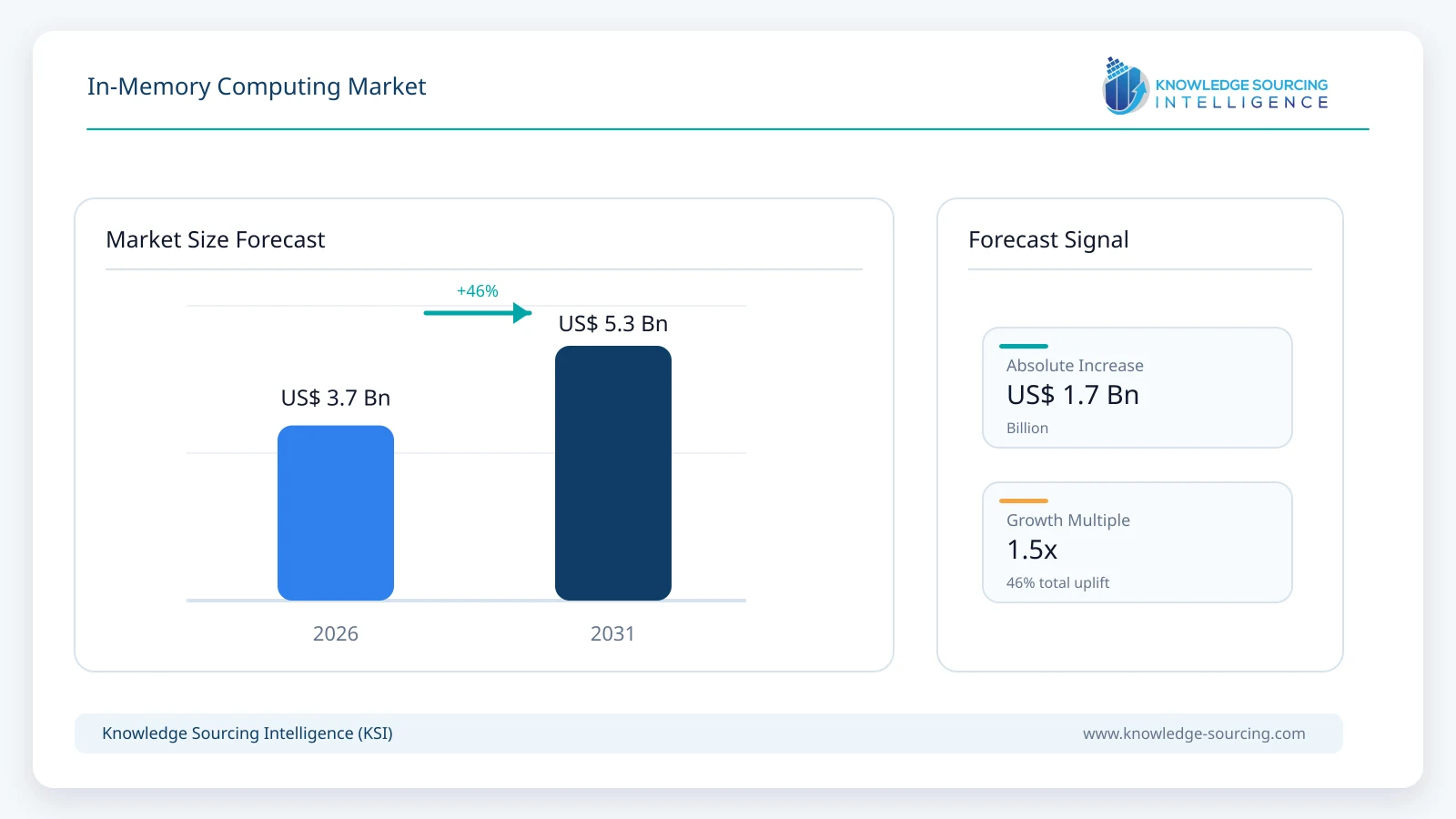
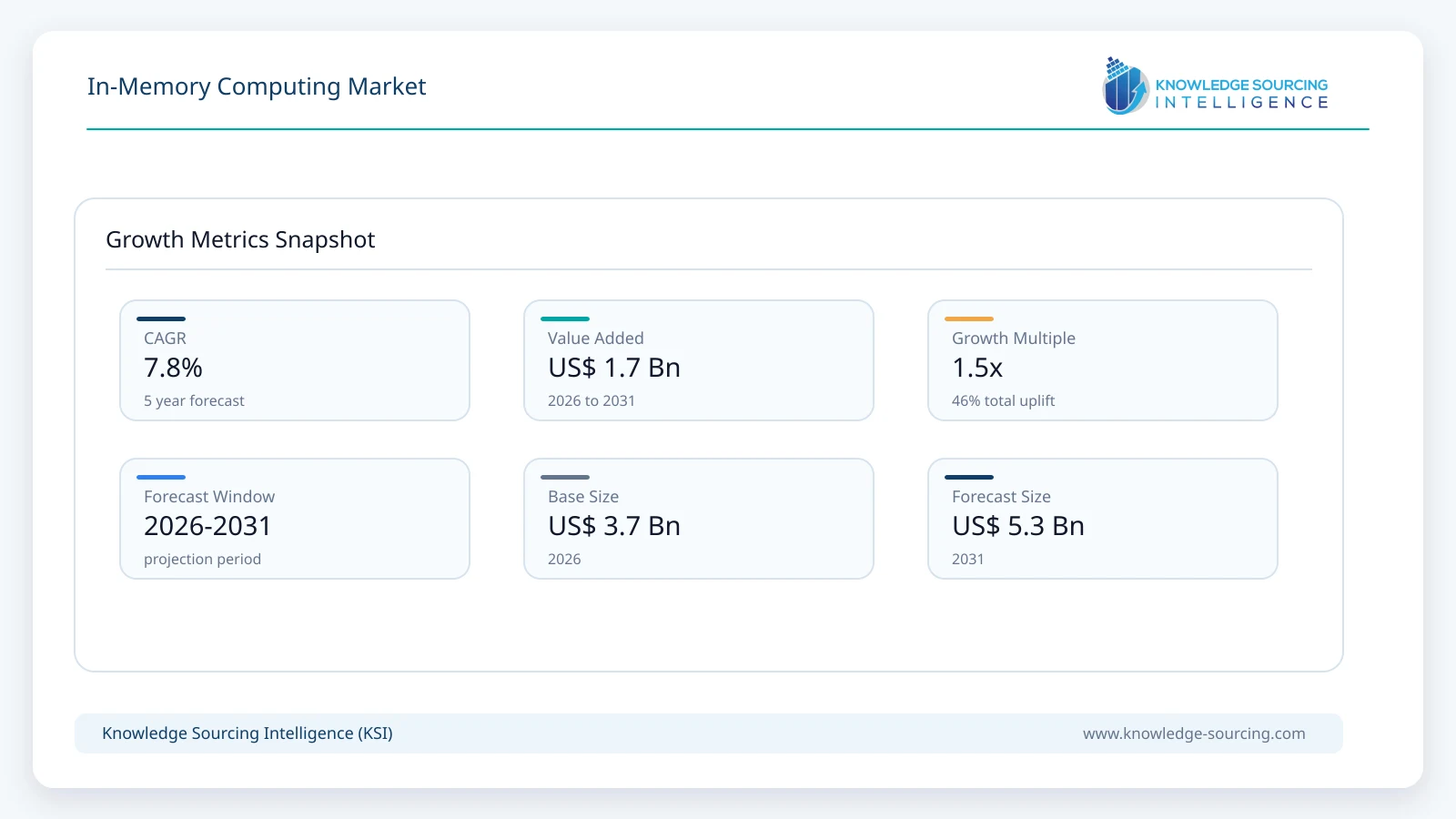
The In-Memory Computing Market is projected to increase from USD 3.67 billion in 2026 to USD 5.34 billion in 2031, growing at a CAGR of 7.8% during the forecast period.
Highlights:
- 1Compute Express Link (CXL) technology, which lets memory be disaggregated into clusters and attached to a server, has started to make in-memory infrastructure a much more flexible choice for capacity additions than traditional server-bound memory architectures.
- 2Cloud hyperscalers provide in-memory computing services on demand, which scale automatically as needed, allowing enterprise grade-real-time processing to be extended to mid-market businesses for the first time that have not had the budget to implement such functionality.
- 3Memory resident architectures are a key growth enabler for AI workloads because modern latency and throughput needs for large-language-model inference and vector-database applications are driving the use of AI workloads.
- 4Sovereign AI regulations are driving edge deployment of in-memory computing in an ever-growing number of jurisdictions, while latency-critical inference must now happen across the country, instead of in a single cloud region.
Market Dynamics
Market Drivers
As the adoption of AI workloads has surged, enterprises are transforming their data architectures to be more memory-resident, as the large-language-model inference and vector-database applications demand the throughput and sub-millisecond latency that disk-based systems can no longer afford to provide.
The downward trend in prices for persistent-memory and storage-class-memory are allowing organizations to store larger and larger sets of working data in memory, further extending the use of in-memory architectures for any practical application.
Capacity additions to in-memory infrastructure are almost frictionless owing to Compute Express Link (CXL) enabled disaggregated memory clusters that eliminate a historical constraint that had made it expensive and rigid to scale in-memory workloads by upgrading memory in the server.
Market Restraints & Opportunities
Volatile DRAM volatility can impact the total cost of ownership, and prevent large-scale in-memory infrastructure refreshes, especially for hyperscale operators that operate vast amounts of memory across their data-centers around the world.
However, the emergence of cloud-based services that run in in-memory servers without requiring a dedicated hardware server has significantly reduced the capital-investment hurdle that previously kept in-memory computing in its early stages to the largest and more well-resourced organisations, providing vendors with a viable opportunity to target mid-market and edge-deployment customers.
Key Developments
October 2026: GIGABYTE announced the launch of a new 64GB unified memory version of GIGABYTE AI TOP ATOM, expanding its existing 128GB offering.
September 2026: Micron Technology, Inc., announced a major milestone in memory innovation with the successful demonstration of the world's first 512GB DDR5 module on multiple server platforms.
August 2026: NEO Semiconductor, a leading innovator in advanced AI and memory technologies, announced the launch of NEO.AI, its next-generation AI memory platform designed to solve the two most significant memory bottlenecks limiting future artificial intelligence systems: on-chip memory (AI cache) and HBM capacity.
July 2026: NVIDIA and SK hynix announced a multiyear technology partnership to advance next-generation memory for the global AI factory buildout and accelerate semiconductor design and manufacturing.
In-Memory Computing Market Segmentation
The market is segmented by offering, deployment mode, organization size, application, end-user industry, and geography.
By Offering
Software
Software platforms make up the biggest piece of the market revenue pie, including applications-development platforms, analytics engines, and in-memory databases that comprise the technical underpinning for memory-resident data processing.
SAP SE provides enterprise resource-planning (ERP) and real-time analytics applications with SAP HANA, one of the world's top in-memory databases and analytics platforms.
Oracle Corporation provides in-memory database and analytics features throughout its wide range of database and cloud products.
By Deployment Mode
On-Premises
Software platforms make up the biggest piece of the market revenue pie, including applications-development platforms, analytics engines, and in-memory databases that comprise the technical underpinning for memory-resident data processing.
SAP SE provides enterprise resource-planning (ERP) and real-time analytics applications with SAP HANA, one of the world's top in-memory databases and analytics platforms.
Oracle Corporation provides in-memory database and analytics features throughout its wide range of database and cloud products.
By Application
Real-Time Analytics & Transaction Processing
The biggest and most mature use cases are real-time analytics and transactions, including fraud detection and algorithmic trading and dynamic pricing, where sub-millisecond data access is a critical requirement.
Amazon Web Services, Inc. provides in-memory database and caching services to help enterprise customers with real-time analytics and transaction-processing workloads.
Regional Analysis
North America Market Analysis
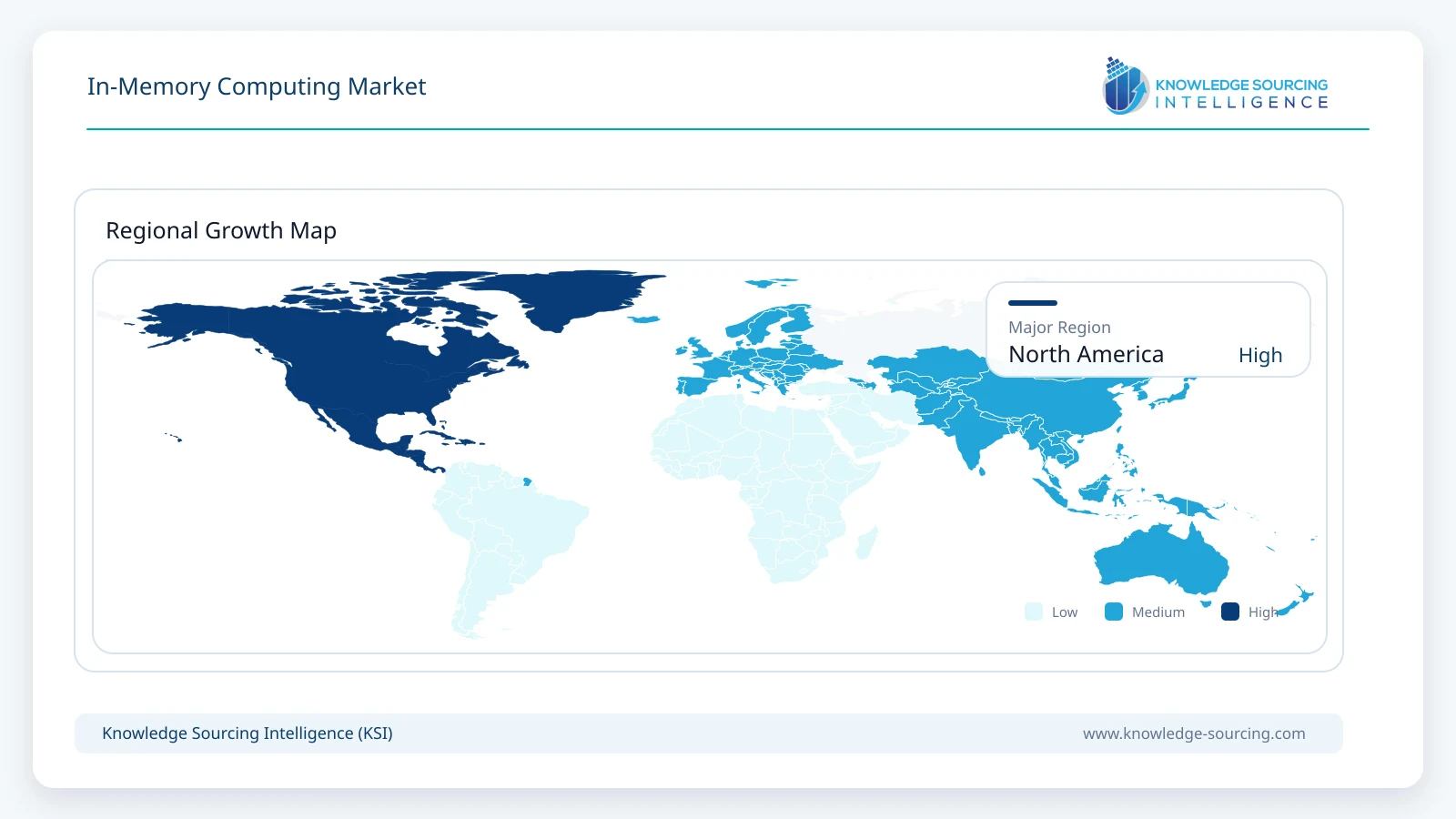
North America is anticipated to contribute the largest share of 2026, supported by a dense concentration of cloud hyperscalers, financial-services firms and technology companies that were among the earliest adopters of memory-resident data processing architectures.
Europe Market Analysis
Europe's market is progressing well, with high levels of enterprise adoption within the financial services and manufacturing sectors, as well as increased adoption for edge deployment due to the EU digital-infrastructure policy's emphasis on data sovereignty and latency.
Asia-Pacific Market Analysis
Asia-Pacific is forecast to register the fastest regional growth, fueled by the rapid expansion of digital-infrastructure, the increasing investment in AI and the continued growth of enterprise adoption of real-time analytics in China, India, Japan and South Korea.
Middle East and Africa Market Analysis
In-middle East and Africa, in-memory computing is an emerging investment opportunity as part of digitalization in financial services and sovereign AI infrastructure projects within the Gulf nations.
South America Market Analysis
South America is a developing region for in-memory computing, with financial-services and telecom providers in Brazil slowly migrating to memory-resident architectures for real-time analytics and fraud-detection use cases.
List of Companies
SAP SE
Oracle Corporation
Microsoft Corporation
International Business Machines Corporation
Amazon Web Services, Inc.
Google LLC (Alphabet Inc.)
TIBCO Software Inc.
Hazelcast, Inc.
GridGain Systems, Inc.
Redis Ltd.
Competitive Landscape
SAP SE
SAP supplies SAP HANA, a leading in-memory database and analytics platform widely deployed across enterprise resource-planning, supply-chain and real-time analytics applications, positioning SAP as a foundational vendor in the enterprise in-memory computing market.
Oracle Corporation
Oracle offers in-memory database and analytics capabilities integrated across its broader database and cloud infrastructure portfolio, targeting large enterprise customers requiring high-performance transaction processing and analytics at scale.
GridGain Systems, Inc.
GridGain provides an in-memory computing platform capable of delivering up to 1,000-times speed-ups over disk-based systems while retaining ANSI SQL-99 support, targeting enterprise customers seeking hybrid transactional-analytical processing capability.
Analyst View
The In-Memory Computing market is transitioning from a specialized, high-cost technology deployed primarily by the largest financial institutions and technology companies into mainstream enterprise infrastructure, driven overwhelmingly by the convergence of AI-driven workloads, declining persistent-memory pricing, and the flexibility unlocked by CXL-enabled memory disaggregation.
The emergence of serverless, cloud-delivered in-memory services is proving to be the market's most democratizing development, extending real-time processing capability once reserved for the largest organizations to mid-market enterprises with comparatively modest infrastructure budgets. North America currently leads in adoption maturity and revenue share, while Asia-Pacific's rapid digital-infrastructure expansion is positioning the region as the fastest-growing market over the forecast period. AI inference and vector-database workloads are emerging as the market's most consequential new growth vector, as the throughput and latency demands of modern AI applications increasingly require memory-resident data architectures that disk-based systems cannot economically match. Vendors that combine robust hybrid transactional-analytical processing capability with flexible cloud, on-premises and edge deployment options are best positioned to capture the next phase of market growth.
In-Memory Computing Market Scope:
| Report Metric | Details |
|---|---|
| Total Market Size in 2026 | USD 3.67 billion |
| Total Market Size in 2031 | 5.34 billion |
| Forecast Unit | USD Billion |
| Growth Rate | 7.8% |
| Study Period | 2021 to 2031 |
| Historical Data | 2021 to 2024 |
| Base Year | 2025 |
| Forecast Period | 2026 – 2031 |
| Segmentation | Offering, Deployment Mode, Application, Geography |
| Companies |
|
Market Segmentation
By Offering
Software
Hardware
Services
By Deployment Mode
On-Premises
Cloud
Hybrid
By Application
Real-Time Analytics & Transaction Processing
AI & Machine Learning Inference
Fraud Detection & Risk Management
Others
By Geography
North America
USA
Canada
Mexico
South America
Brazil
Others
Europe
Germany
France
United Kingdom
Others
Middle East and Africa
UAE
Saudi Arabia
Others
Asia Pacific
China
India
Japan
Others
Table of Contents
1. EXECUTIVE SUMMARY
2. MARKET SNAPSHOT
2.1. Market Overview
2.2. Market Definition
2.3. Scope of the Study
2.4. Market Segmentation
3. BUSINESS LANDSCAPE
3.1. Market Drivers
3.2. Market Restraints
3.3. Market Opportunities
3.4. Porter's Five Forces Analysis
3.5. Industry Value Chain Analysis
3.6. Policies and Regulations (Sovereign AI & Data Residency)
3.7. Strategic Recommendations
4. TECHNOLOGICAL OUTLOOK
4.1. Compute Express Link (CXL) & Memory Disaggregation
4.2. Persistent & Storage-Class Memory
4.3. Hybrid Transactional-Analytical Processing (HTAP)
4.4. In-Memory Computing for AI Inference
5. IN-MEMORY COMPUTING MARKET BY OFFERING
5.1. Introduction
5.2. Software
5.3. Hardware
5.4. Services
6. IN-MEMORY COMPUTING MARKET BY DEPLOYMENT MODE
6.1. Introduction
6.2. On-Premises
6.3. Cloud
6.4. Hybrid
7. IN-MEMORY COMPUTING MARKET BY APPLICATION
7.1. Introduction
7.2. Real-Time Analytics & Transaction Processing
7.3. AI & Machine Learning Inference
7.4. Fraud Detection & Risk Management
7.5. Others
8. IN-MEMORY COMPUTING MARKET BY GEOGRAPHY
8.1. Introduction
8.2. North America
8.2.1. USA
8.2.2. Canada
8.2.3. Mexico
8.3. South America
8.3.1. Brazil
8.3.2. Others
8.4. Europe
8.4.1. Germany
8.4.2. France
8.4.3. United Kingdom
8.4.4. Others
8.5. Middle East and Africa
8.5.1. UAE
8.5.2. Saudi Arabia
8.5.3. Others
8.6. Asia Pacific
8.6.1. China
8.6.2. India
8.6.3. Japan
8.6.4. Others
9. COMPETITIVE ENVIRONMENT AND ANALYSIS
9.1. Major Players and Strategy Analysis
9.2. Market Share Analysis
9.3. Mergers, Acquisitions, Agreements, and Collaborations
9.4. Competitive Dashboard
10. COMPANY PROFILES
10.1. SAP SE
10.2. Oracle Corporation
10.3. Microsoft Corporation
10.4. International Business Machines Corporation
10.5. Amazon Web Services, Inc.
10.6. Google LLC (Alphabet Inc.)
10.7. TIBCO Software Inc.
10.8. Hazelcast, Inc.
10.9. GridGain Systems, Inc.
10.10. Redis Ltd.
11. APPENDIX
11.1. Currency
11.2. Assumptions
11.3. Base and Forecast Years Timeline
11.4. Key Benefits for the Stakeholders
11.5. Research Methodology
11.6. Abbreviations
Navigate
Trusted by the world's leading organizations











