
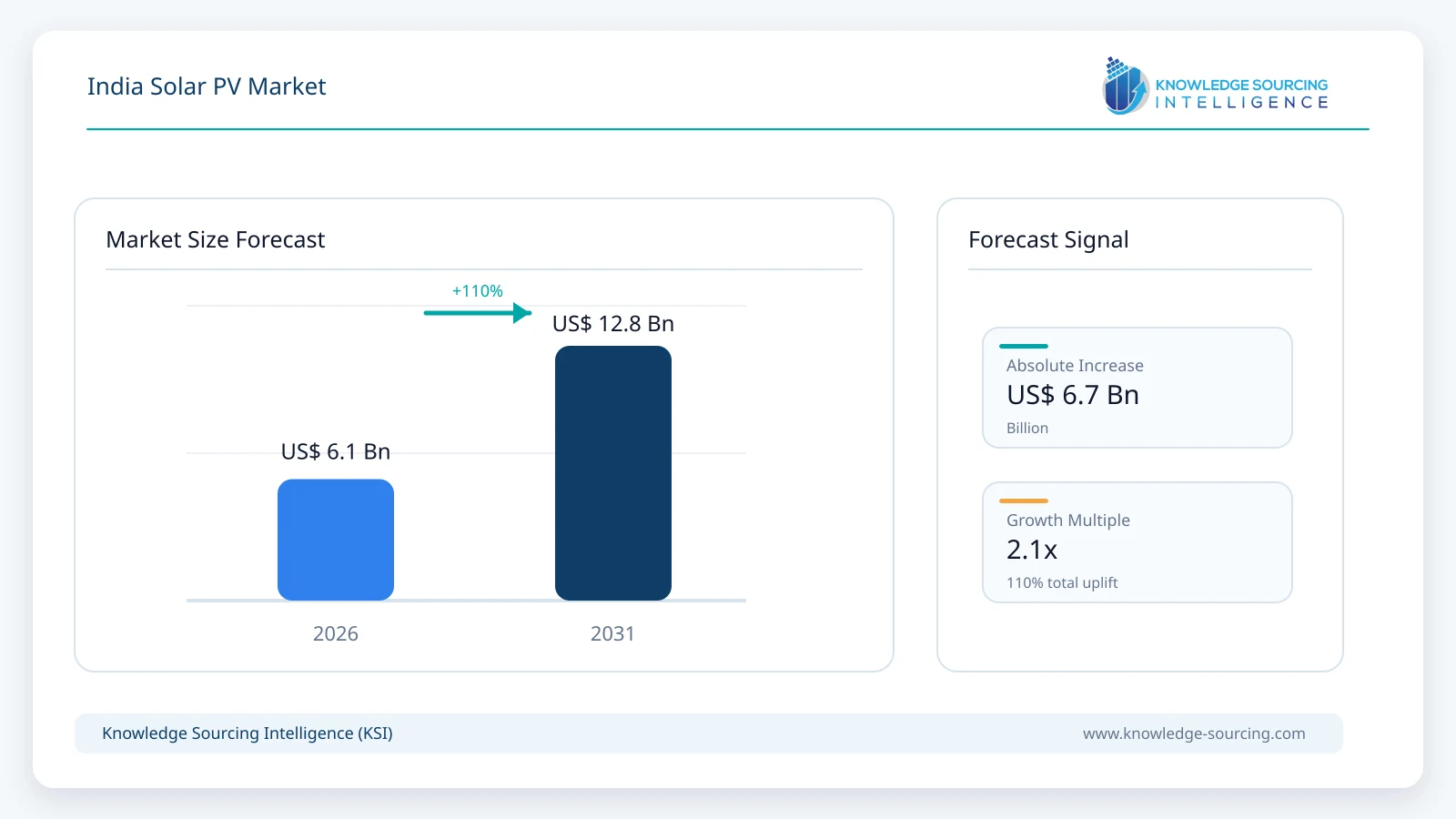
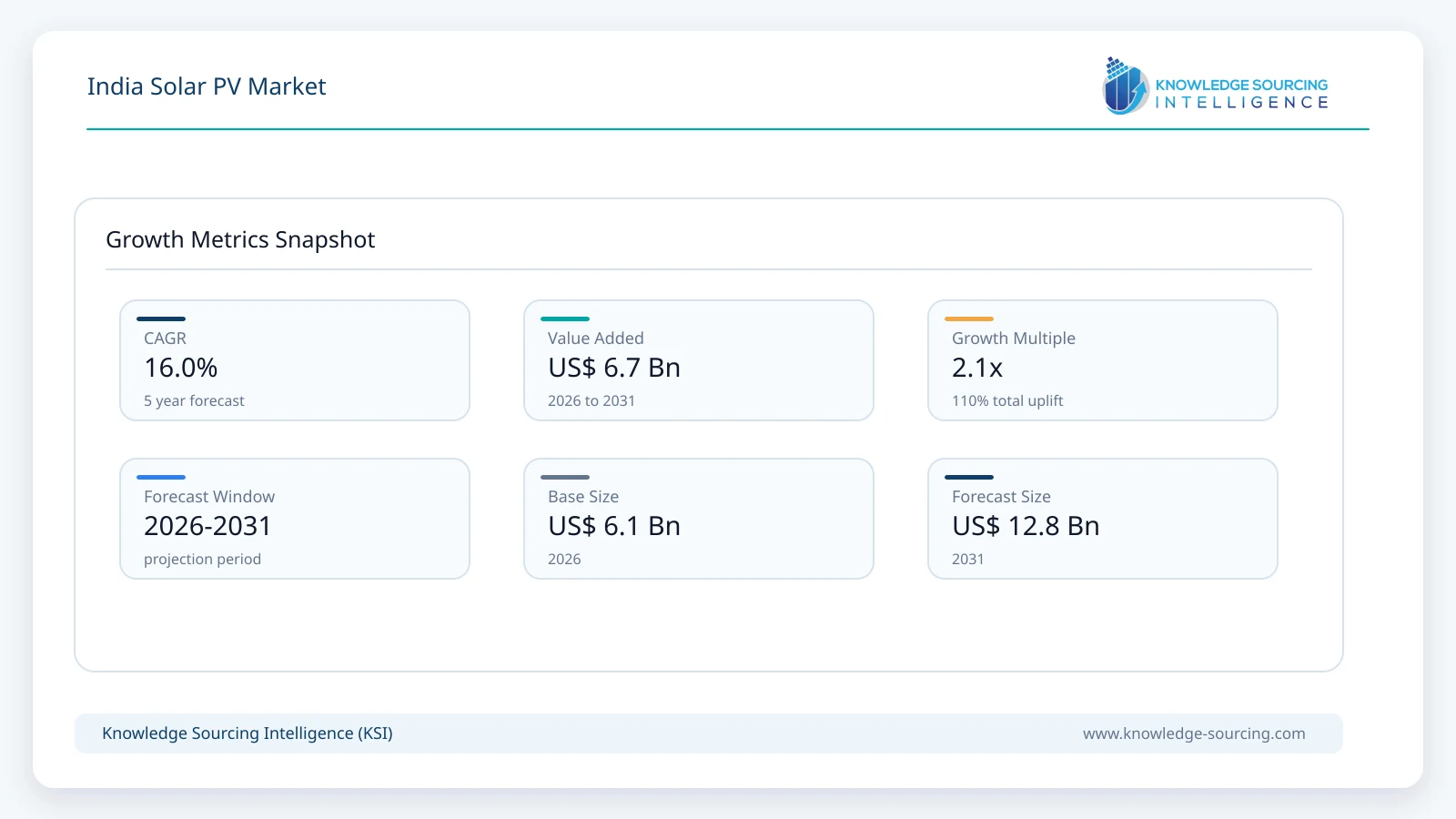
The India solar PV market is estimated at USD 6.10 billion in 2026 and is projected to reach USD 12.80 billion by 2031 at a CAGR of 16.0% during the forecast period.
Highlights:
- 1Monocrystalline technology accounts for about 91% of India solar PV demand in 2026.
- 2Rooftop solar is projected to expand at approximately 18.5% annually through 2031.
- 3Utility applications represent about 61% of market revenue in 2026, remaining the largest end-user.
- 4Domestic module manufacturing capacity reached about 172 GW by March 2026, strengthening supply security.
- 5India added a record 44.61 GW of solar capacity during FY2025-26.
- 6ALMM cell requirements are accelerating local cell investment and supplier qualification across the value chain.
Market Overview
India's solar PV sector has shifted from a market shaped mainly by utility auctions and imported modules to one in which domestic manufacturing, distributed solar and procurement compliance increasingly influence competitive positioning. MNRE reported 110.43 GW of utility-scale solar, 25.73 GW of rooftop solar and 14.10 GW of KUSUM and off-grid capacity as of 31 March 2026. The composition matters commercially because each segment has different purchasing criteria. Utility developers prioritize bankability, energy yield, delivery certainty and tariff economics, while rooftop buyers place greater emphasis on installer reach, financing, warranties and service quality.
Government support is now working on both sides of the market. Demand is supported through utility procurement, PM Surya Ghar, PM-KUSUM, open-access rules and renewable-consumption obligations. Supply-side policy is tightening domestic-content and quality requirements through the Approved List of Models and Manufacturers and the Production Linked Incentive scheme for high-efficiency modules. From 1 June 2026, ALMM List-II requirements for solar cells became applicable to specified projects, with only limited transition relief for eligible net-metering and open-access projects. MNRE has also announced ALMM coverage for ingots and wafers from June 2028, signalling a gradual movement toward deeper localization.
The market is also becoming more technology-intensive. Mono PERC remains widely deployed, but N-type TOPCon has become the principal expansion platform for new manufacturing lines because it offers higher conversion efficiency and better long-term energy yield. Large-wafer formats, bifacial modules, glass-glass construction, automated inspection and digital traceability are gaining commercial importance. Thin-film CdTe retains a smaller but strategically relevant position in utility projects, while conventional polycrystalline technology continues to lose share in new installations.
Market Drivers
Record Installation Activity Is Sustaining a Large Domestic Demand Base
The strongest immediate driver is the scale of annual capacity additions. India added 44.61 GW of solar in FY2025-26, nearly double the prior year's addition, taking cumulative capacity to 150.26 GW by March 2026. By July 2026, solar capacity had increased further to 164.59 GW. This pace creates recurring demand for modules, inverters, mounting systems and associated PV equipment even as average equipment prices fluctuate. SECI's existing awarded and under-implementation portfolio also provides visibility beyond individual state programs, while the national 500 GW non-fossil-fuel capacity objective continues to support a multi-year project pipeline.
Rooftop and Distributed Solar Are Broadening the Market Beyond Utility Projects
Distributed solar is becoming a material second growth engine. MNRE reported 16.31 GW of distributed solar additions in FY2025-26, including 8.71 GW of rooftop solar and 7.67 GW under KUSUM. PM Surya Ghar has increased residential adoption through central financial assistance, digital application workflows, and greater installer participation. By August 2026, more than 51 lakh households were benefiting from the scheme, and approximately 14.8 GW had been commissioned under it. This broadens market participation toward residential installers, financing partners, local distributors and service networks rather than concentrating demand only among large utility developers.
Localization Rules Are Pulling Investment Into Cells, Wafers and Higher-Efficiency Modules
ALMM and PLI measures are changing the supplier landscape. India has moved from limited module-assembly capacity to a large domestic manufacturing base, with approximately 172 GW of module capacity by March 2026. Cell manufacturing remains smaller, which makes the implementation of ALMM List-II strategically important because it creates a stronger demand signal for locally produced cells. Manufacturers are responding through TOPCon cell lines and backward-integration projects. Tata Power approved a roughly INR 6,500 crore investment for a 10 GW ingot and wafer facility, while other manufacturers are adding cell and module lines across Tamil Nadu, Gujarat, Odisha, Maharashtra, and other manufacturing clusters.
Market Restraints and Challenges
Upstream Import Dependence and Rapid Capacity Expansion Can Create Margin Pressure
The rapid increase in module capacity does not mean the entire value chain is localized. India still depends materially on imported polysilicon, wafers and selected production inputs, exposing manufacturers to trade measures, currency movements and global oversupply cycles. At the same time, module capacity has expanded faster than domestic cell and upstream capacity. This can create periods of excess module supply, aggressive pricing and lower utilization for less efficient plants. Suppliers therefore need scale, technology upgrades and backward integration rather than capacity additions alone to protect margins.
Grid Readiness, Land and Project Execution Remain Constraints on Utility Deployment
Utility-scale growth depends on transmission availability, land aggregation and timely project commissioning. Solar-resource-rich states often require major interstate evacuation infrastructure, while project economics can be affected by delays in connectivity approvals and land acquisition. The issue becomes more important as solar's share of installed capacity rises and the power system requires greater flexibility. Storage and hybrid procurement can reduce intermittency, but they also increase project complexity and capital requirements. These factors can shift commissioning schedules even when module demand and tender activity remain strong.
Technology and Market Trends
N-type TOPCon is becoming the dominant direction for new domestic manufacturing investment. The technology combines higher conversion efficiency with compatibility with existing crystalline-silicon production ecosystems, making it attractive for both utility and rooftop applications. Manufacturers are also moving toward G12 and G12R wafer formats, bifacial architecture and glass-glass modules to improve output per square metre and lifecycle performance. Automated optical inspection, AI-supported defect detection and digital production monitoring are being incorporated into new factories to improve yield and traceability.
A second trend is the convergence of solar with storage and digital energy management. Residential and C&I customers increasingly evaluate solar alongside battery systems, while utility procurement is moving toward hybrid, firm and dispatchable renewable-energy structures. This does not make batteries part of the solar PV market definition, but it changes module and system requirements because project developers increasingly optimize solar generation for dispatchability and time-of-day value rather than annual energy output alone.
Segment Analysis
By Technology: Monocrystalline
Monocrystalline PV remains the principal technology in India and represents approximately USD 5.55 billion of market revenue in 2026. The segment benefits from the rapid migration from conventional mono PERC toward N-type TOPCon and other higher-efficiency architectures. Higher wattage per module, improved temperature performance and greater compatibility with bifacial designs make monocrystalline products particularly suitable for land-constrained utility projects and rooftops. New Indian manufacturing lines are therefore overwhelmingly oriented toward monocrystalline wafers and cells, reinforcing the segment's leadership through 2031.
By Installation Type: Ground-Mounted
Ground-mounted installations remain the largest installation category because utility parks, open-access projects, KUSUM-linked generation and large C&I systems account for most annual capacity. The category is supported by central and state tenders, solar parks, interstate transmission development and corporate renewable procurement. Rooftop solar, however, is growing faster from a smaller base; its 2026 market value is estimated at approximately USD 1.15 billion as residential subsidies and C&I electricity-cost savings expand adoption. Floating solar remains niche but is receiving targeted policy support where land availability is constrained.
By End-User: Utility
Utility customers account for an estimated USD 3.72 billion of India solar PV revenue in 2026. The segment is characterized by large procurement volumes, competitive bidding and strong emphasis on module bankability, long-term degradation, domestic-content compliance and delivery schedules. Utility developers increasingly prefer suppliers capable of guaranteeing multi-gigawatt availability and consistent technology platforms across project phases. Over the forecast period, the segment remains the largest revenue pool, although residential and C&I demand gradually reduce its share of the total market.
Competitive Environment
Competition spans integrated manufacturers, specialist module producers, project developers and EPC companies. Waaree Energies, Tata Power Solar, Adani Solar, Vikram Solar, Premier Energies, First Solar India, Goldi Solar, Saatvik Green Energy, Emmvee, RenewSys and Rayzon Solar compete through manufacturing scale, technology, ALMM eligibility and distribution reach. Developers including Adani Green Energy, ReNew, NTPC Green Energy, Tata Power Renewable Energy, ACME Solar and Avaada influence procurement volumes through large project pipelines, while Sterling and Wilson Renewable Energy and Jakson Green compete through EPC and integrated project execution.
Scale alone is becoming less sufficient as domestic module capacity expands. Competitive advantage increasingly depends on cell integration, high-efficiency technology, quality consistency, working-capital discipline, access to utility and C&I customers and the ability to maintain utilization during periods of price pressure. Rooftop competition is more fragmented and service-intensive, favoring companies with financing partnerships, installer networks, standardized system packages and after-sales coverage. The implementation of ALMM List-II raises the value of domestic cell capability and is likely to accelerate consolidation around manufacturers able to meet both cost and compliance requirements.
Recent Developments
August 2026: Saatvik applied for ALMM List-II enlistment for its 2.4 GW Odisha N-TOPCon solar-cell facility.
July 2026: Vikram Solar commissioned its Gangaikondan module facility in Tamil Nadu and rolled out the first module.
July 2026: Tata Power launched a Haryana rooftop program targeting 500 MWp across 100,000 homes over three years.
May 2026: Tata Power approved roughly INR 6,500 crore for a 10 GW ingot-and-wafer manufacturing facility.
March 2026: MNRE extended the ALMM framework to ingots and wafers, effective from 1 June 2028.
Market Outlook
India's solar PV market is expected to remain one of the fastest-expanding parts of the country's power-equipment ecosystem through 2031. Growth will come from a broader set of demand pools than in the previous phase of the market: utility procurement remains central, but residential rooftops, C&I open access, agricultural solarization and emerging green-hydrogen demand reduce dependence on a single installation channel. At the same time, domestic manufacturing policy is likely to shift value creation upstream from module assembly toward cells, wafers and eventually ingots.
The most important commercial change is that the market is moving from volume scarcity to execution and technology competition. With module manufacturing capacity already well above annual domestic installations, suppliers will increasingly compete on conversion efficiency, product reliability, cell sourcing, manufacturing yield and balance-sheet resilience. Manufacturers with integrated cell and module operations should be better positioned to manage ALMM requirements, while developers with transmission access and strong procurement capabilities should retain an advantage in utility-scale deployment. The market is therefore projected to reach USD 12.80 billion by 2031, with growth remaining strong but gradually moderating as equipment costs and manufacturing productivity improve.
India Solar PV Market Scope:
| Report Metric | Details |
|---|---|
| Total Market Size in 2026 | USD 6.10 billion |
| Total Market Size in 2031 | USD 12.80 billion |
| Forecast Unit | Billion |
| Growth Rate | 16.0% |
| Study Period | 2021 to 2031 |
| Historical Data | 2021 to 2024 |
| Base Year | 2025 |
| Forecast Period | 2026 – 2031 |
| Segmentation | Technology, Installation Type, End-User |
| Companies |
|
Market Segmentation
By Technology
Monocrystalline
Polycrystalline
Thin-film
By Installation Type
Ground-mounted
Rooftop
Floating Solar PV
By End-user
Utility
Commercial and Industrial (C&I)
Residential
Table of Contents
1. EXECUTIVE SUMMARY
2. MARKET SNAPSHOT
2.1. Market Overview
2.2. Market Definition
2.3. Scope of the Study
2.4. Market Segmentation
3. BUSINESS LANDSCAPE
3.1. Market Drivers
3.1.1. Record Installation Activity Is Sustaining a Large Domestic Demand Base
3.1.2. Rooftop and Distributed Solar Are Broadening the Market Beyond Utility Projects
3.1.3. Localization Rules Are Pulling Investment Into Cells, Wafers and Higher-Efficiency Modules
3.2. Market Restraints
3.2.1. Upstream Import Dependence and Rapid Capacity Expansion Can Create Margin Pressure
3.2.2. Grid Readiness, Land and Project Execution Remain Constraints on Utility Deployment
3.3. Market Opportunities
3.4. Porter's Five Forces Analysis
3.5. Industry Value Chain Analysis
3.6. Policies and Regulations
3.7. Strategic Recommendations
4. TECHNOLOGICAL OUTLOOK
4.1. N-Type TOPCon and High-Efficiency Crystalline Silicon
4.2. Bifacial, Glass-Glass and Large-Wafer Module Platforms
4.3. Digital Manufacturing, Monitoring and Storage-Ready PV Systems
5. INDIA SOLAR PV MARKET BY TECHNOLOGY
5.1. Introduction
5.2. Monocrystalline
5.3. Polycrystalline
5.4. Thin-film
6. INDIA SOLAR PV MARKET BY INSTALLATION TYPE
6.1. Introduction
6.2. Ground-mounted
6.3. Rooftop
6.4. Floating Solar PV
7. INDIA SOLAR PV MARKET BY END-USER
7.1. Introduction
7.2. Utility
7.3. Commercial and Industrial (C&I)
7.4. Residential
8. COMPETITIVE ENVIRONMENT AND ANALYSIS
8.1. Major Players and Strategy Analysis
8.2. Market Share Analysis
8.3. Mergers, Acquisitions, Agreements and Collaborations
8.4. Competitive Dashboard
9. COMPANY PROFILES
9.1. Waaree Energies Limited
9.2. Tata Power Solar Systems Limited
9.3. Adani Solar
9.4. Vikram Solar Limited
9.5. Premier Energies Limited
9.6. First Solar India
9.7. ReNew Energy Global Plc
9.8. Adani Green Energy Limited
9.9. NTPC Green Energy Limited
9.10. Tata Power Renewable Energy Limited
9.11. Sterling and Wilson Renewable Energy Limited
9.12. Avaada Group / Avaada Electro
9.13. Jakson Green
9.14. Goldi Solar Pvt. Ltd.
9.15. Saatvik Green Energy Limited
9.16. Emmvee Group
9.17. RenewSys India Pvt. Ltd.
9.18. Rayzon Solar
9.19. ACME Solar Holdings Limited
9.20. KPI Green Energy Limited
10. APPENDIX
10.1. Currency
10.2. Assumptions
10.3. Base and Forecast Years Timeline
10.4. Key Benefits for Stakeholders
10.5. Research Methodology
10.6. Abbreviations
Navigate
Trusted by the world's leading organizations











