
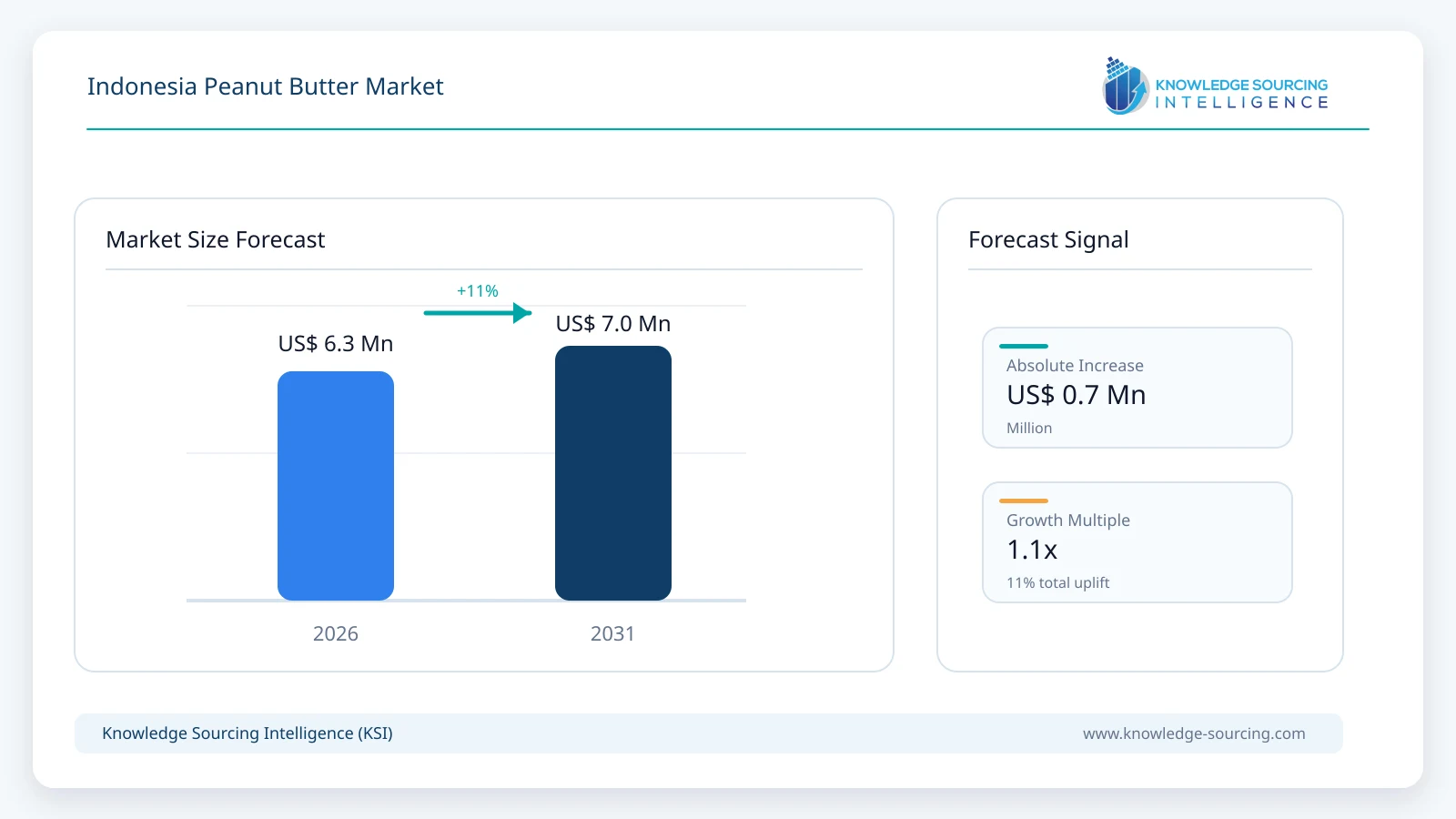
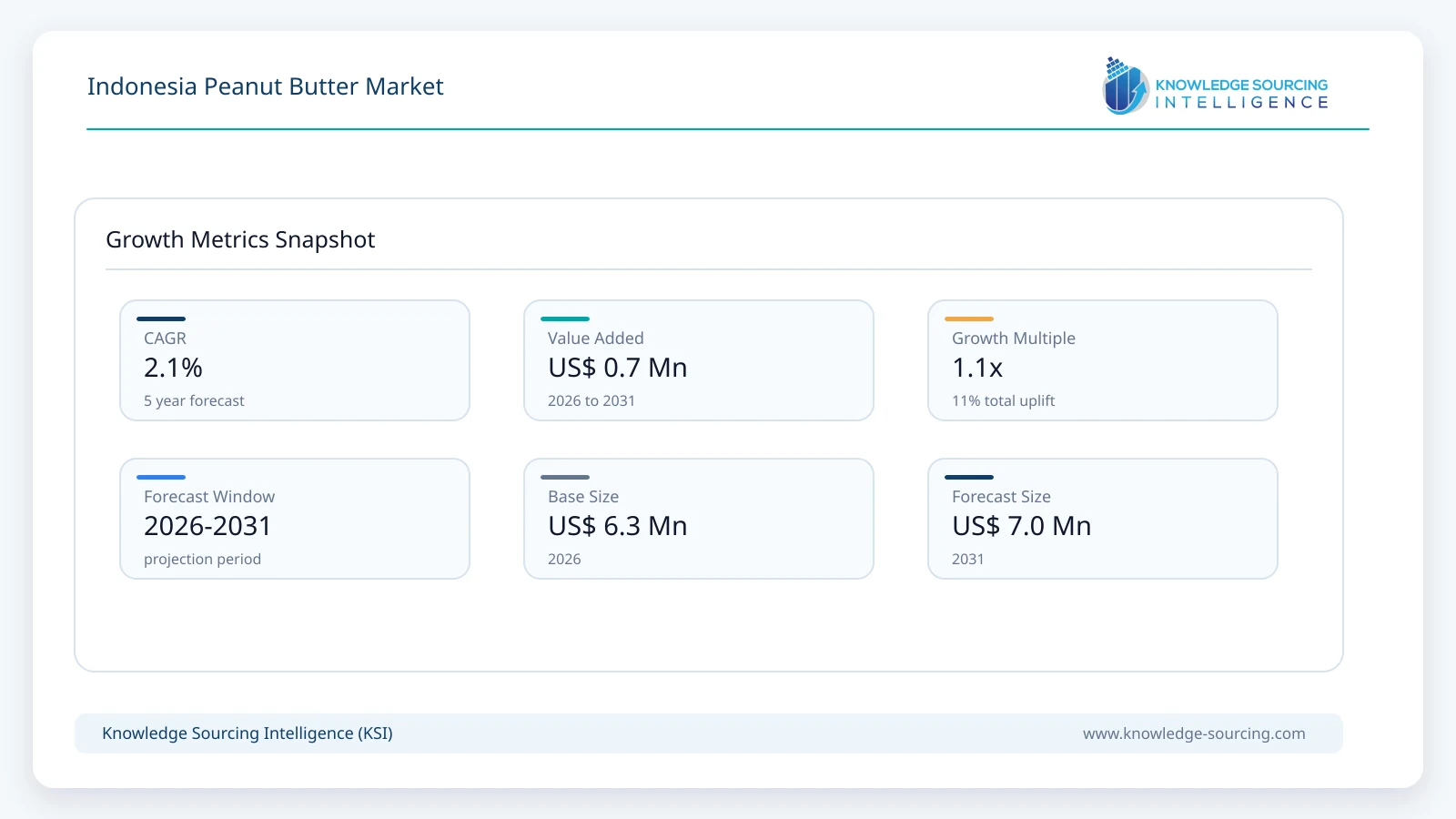
The Indonesian peanut butter market is projected to grow at a CAGR of 2.1% during the forecast period, reaching a market size of USD 7.02 million in 2031 from USD 6.32 million in 2026.
Highlights:
- 1Halal Certification MandatesThe Indonesian government is enforcing mandatory Halal certification for all food products, with the deadline for foreign and medium-to-large local enterprises set for October 2024 and extended transition periods for others until 2026. This regulation is forcing international brands to reorganize their global supply chains to ensure compliance, thereby stabilizing domestic trust in imported peanut butter brands.
- 2Urban Protein ShiftRising awareness of metabolic health is accelerating the transition from high-carbohydrate traditional breakfasts to protein-dense alternatives like peanut butter. This shift is driving demand for "Natural" and "No Added Sugar" variants among urban professionals who are seeking functional nutrition to mitigate the effects of sedentary lifestyles.
- 3E-commerce PenetrationThe rapid expansion of digital retail platforms is decentralizing product availability beyond tier-1 cities like Jakarta and Surabaya. Artisanal and niche international brands are utilizing online marketplaces to bypass traditional brick-and-mortar entry barriers, directly challenging the dominance of long-standing supermarket brands.
- 4Artisanal PremiumizationConsumer interest in "Bali-made" and small-batch products is fostering a new segment of premium, locally sourced peanut butters. This trend is creating a structural niche for brands that emphasize transparency, local sourcing, and minimal processing, which appeals to a growing demographic of eco-conscious and health-oriented buyers.
The Indonesian peanut butter market operates as a vital segment of the broader spreads and condiments industry, characterized by a deep dependency on both localized peanut production and strategic imports to satisfy urban demand. Structural demand drivers revolve around the "westernization" of Indonesian breakfast habits and the expanding middle-class preference for ready-to-consume, shelf-stable protein sources. Regulatory influence from the Badan Pengawas Obat dan Makanan (BPOM) and mandatory Halal certification mandates heavily dictate market entry and product formulation standards for both local and foreign players. Strategic importance resides in the sector's role within the national food security framework, as peanuts remain a key agricultural commodity for rural employment and industrial processing.
Market Dynamics
Drivers
Westernization of Diet: Young Indonesian consumers are adopting global dietary trends, which increases the frequency of peanut butter consumption as a bread spread and smoothie additive.
Rising Disposable Income: Growing household wealth is enabling a shift toward branded packaged foods, supporting the transition from loose, unbranded peanut products to certified, high-quality jars.
Retail Infrastructure Growth: The proliferation of modern trade outlets, such as hypermarkets and convenience stores, is improving the physical accessibility of diverse peanut butter stock-keeping units (SKUs).
Health and Wellness Awareness: Increased public focus on plant-based proteins is positioning peanut butter as a cost-effective alternative to animal proteins, particularly among the growing fitness-conscious population.
Restraints and Opportunities
Regulatory Compliance Costs: Stringent BPOM registration and Halal certification requirements act as a barrier for smaller international brands, though they provide a competitive moat for established players.
Price Sensitivity in Rural Areas: High logistical costs to remote islands maintain peanut butter as a premium product, limiting its penetration in lower-income rural markets.
Opportunity in Plant-Based Innovation: The expansion of the plant-based milk and meat sectors is creating cross-category opportunities for peanut butter as a primary flavoring and thickening agent in vegan industrial food production.
Opportunity in Functional Fortification: Demand is emerging for peanut butter fortified with micronutrients such as Vitamin D or probiotics, catering to specific health concerns like immunity and digestive health.
Supply Chain Analysis
The supply chain for peanut butter in Indonesia originates with a combination of domestic groundnut farming and high-volume imports from major producers like the United States, China, and India to bridge the local supply-demand gap. Local production of peanuts in Indonesia has historically faced challenges, with reports indicating a significant production decrease of approximately 25.8% in 2021 compared to 2020 levels. This shortfall is compelling processors to rely more heavily on international suppliers to maintain consistent manufacturing throughput.
Once the raw materials are secured, large-scale manufacturers like Hormel Foods and The J.M. Smucker Company utilize highly automated grinding and emulsification facilities to produce shelf-stable products. These goods then move through a complex distribution network involving specialized importers, local distributors like PT David Roy Indonesia, and third-party logistics providers. Final delivery occurs through a dual-channel system: modern trade (hypermarkets and supermarkets) for urban mass consumption and digital marketplaces for niche or premium brands. The mandatory Halal certification process now serves as a critical regulatory checkpoint in this chain, requiring strict segregation of ingredients and equipment to maintain compliance.
Government Regulations
Regulation | Impact on the Peanut Butter Market |
BPOM Registration | All packaged food products must obtain a distribution permit (ML for imports, MD for local) to ensure food safety standards are met before entering the retail market. |
Mandatory Halal (Law 33/2014) | Products must be Halal-certified by BPJPH; the enforcement deadline for food products from abroad was extended to October 17, 2026, to allow for supply chain adjustments. |
Import Quotas and Tariffs | The government manages groundnut imports through quotas to protect local farmers, which can fluctuate raw material costs for domestic peanut butter manufacturers. |
Labeling Requirements | Strict rules on nutritional labeling, including sugar and fat content, are being enforced to address rising obesity rates in the Indonesian population. |
Key Developments
Early 2025: Indonesian nuts producer Gunanusa Eramandiri announced plans to expand into peanut-based jams and spreads under its John Farmer brand, aiming to diversify its product lines and capture increasing domestic and regional demand for nut-based spreads. The move followed direct customer requests and aligned with the company's broader strategy of expanding beyond its core nuts business into value-added natural food products.
Mandatory Halal Extension (October 2024): The Indonesian government updated Government Regulation No. 42 of 2024, extending the mandatory Halal certification deadline for certain foreign food product categories to October 17, 2026, providing international peanut butter exporters crucial time to finalize compliance standards.
Market Segmentation
By Product
The peanut butter market in Indonesia is bifurcated by texture into creamy and chunky segments, with creamy variants maintaining a dominant position in the residential sector. Creamy peanut butter serves as the primary choice for families with young children due to its smooth spreadability on traditional white bread. Manufacturers are increasingly introducing creamy SKUs with reduced sodium and sugar to appeal to health-conscious parents. Demand for chunky peanut butter is growing among adult demographics who prefer a more "authentic" and textural eating experience. This segment is particularly popular in the high-end cafe and bakery sectors, where the added crunch of peanut fragments enhances the sensory profile of premium pastries and desserts.
By Type
The distinction between processed and natural peanut butter is becoming a primary driver of market value as consumer preferences evolve. Processed peanut butter, containing stabilizers like hydrogenated oils and added sugars, represents the bulk of the volume due to its long shelf life and consistent flavor. However, demand is rapidly shifting toward natural peanut butter, which typically contains only peanuts and a trace amount of salt. Urban consumers are increasingly scrutinizing ingredient lists for palm oil and refined sugars, leading to a surge in sales for "pure" variants. This transition is pressuring multinational legacy brands to introduce "clean" product lines that mirror the simplicity of artisanal offerings.
By End-User
Residential consumers constitute the largest end-user segment, driven by the increasing frequency of at-home breakfast and snacking occasions. The "Westernization" of the Indonesian morning meal is replacing traditional rice-based dishes with bread and spreads in major cities. Simultaneously, the foodservice segment is expanding as quick-service restaurants (QSRs) and specialty coffee shops incorporate peanut butter into their seasonal menus. Commercial demand is rising for bulk-packaged peanut butter to be used in satay sauces, high-protein smoothies, and complex confectionery applications. This segment requires products with high thermal stability and consistent flavor profiles to meet industrial kitchen standards.
Company List
Hormel Foods Corporation
The J.M. Smucker Company
Bali Buda
Dale's Farm (PT David Roy Indonesia)
Fix & Fogg
Pic's Peanut Butter
PT Dua Kelinci
PB2 Foods, Inc.
Company Profiles
Hormel Foods Corporation (Skippy)
Hormel Foods Corporation is strategically distinct due to its global dominance in the peanut butter category through the Skippy brand, which maintains a significant shelf presence across Indonesia's modern trade. The company is actively modernizing its portfolio, evidenced by the strategic divestiture of the Justin’s, LLC business in early 2026 to focus on high-growth, protein-centric categories. In the Indonesian market, Skippy leverages a well-established distribution network to maintain high volume across both creamy and chunky segments. The company's international division is showing resilience, driven by branded exports and multinational business performance.
Bali Buda
Bali Buda is strategically distinct as a pioneer of the "Natural and Organic" movement in the Indonesian spreads market. Based in Bali, the company focuses on artisanal, small-batch production that avoids synthetic stabilizers and refined sugars, directly addressing the growing demand for clean-label products. Their products are deeply integrated into the local wellness ecosystem, serving as a benchmark for high-quality, locally sourced Indonesian peanut butter. By emphasizing transparency and health-centric formulations, Bali Buda captures a premium segment of the market that is less sensitive to price fluctuations and more focused on nutritional integrity.
Dale’s Farm (PT David Roy Indonesia)
Dale’s Farm, managed by PT David Roy Indonesia, is strategically distinct for its localized approach to high-quality processed peanut butter. The brand bridges the gap between mass-market affordability and the quality expectations of the rising middle class. By utilizing an extensive domestic distribution network, Dale’s Farm ensures its products are available in both major hypermarkets and smaller convenience stores. Their competitive advantage lies in their deep understanding of the Indonesian palette and their ability to navigate the complex local regulatory environment, including BPOM and Halal certification, more efficiently than new international entrants.
Analyst View
The Indonesian peanut butter market is entering a phase of structural realignment where health-centric premiumization and regulatory compliance are the primary determinants of competitive success. Manufacturers that prioritize Halal-certified, clean-label formulations will outperform legacy brands as urban consumers increasingly demand functional nutrition over traditional calorie-dense spreads.
Indonesia Peanut Butter Market Scope
| Report Metric | Details |
|---|---|
| Total Market Size in 2026 | USD 6.32 million |
| Total Market Size in 2031 | USD 7.02 million |
| Forecast Unit | Million |
| Growth Rate | 2.1% |
| Study Period | 2021 to 2031 |
| Historical Data | 2021 to 2024 |
| Base Year | 2025 |
| Forecast Period | 2026 – 2031 |
| Segmentation | Type, Product, Packaging Type, End-User, Distribution Channel |
| Companies |
|
Market Segmentation
By Type
- Processed Peanut Butter
- Natural Peanut Butter
By Product
- Chunky Peanut Butter
- Creamy Peanut Butter
By Packaging Type
- Jars
- Pouches
- Others
By End-User
- Foodservice
- Residential
By Distribution Channel
- Online
- Offline
- Supermarkets/Hypermarkets
- Convenience Stores
- Specialty Stores
- Others
Table of Contents
1. INTRODUCTION
1.1. Market Overview
1.3. Market Definition
1.4. Market Segmentation
2. RESEARCH METHODOLOGY
2.1. Research Data
2.2. Assumptions
3. EXECUTIVE SUMMARY
3.1. Research Highlights
4. MARKET DYNAMICS
4.1. Market Drivers
4.2. Market Restraints
4.3. Porter’s Five Force Analysis
4.3.1. Bargaining Power of Suppliers
4.3.2. Bargaining Power of Buyers
4.3.3. Threat of New Entrants
4.3.4. Threat of Substitutes
4.3.5. Competitive Rivalry in the Industry
4.4. Industry Value Chain Analysis
5. INDONESIA PEANUT BUTTER MARKET, BY TYPE
5.1. Introduction
5.2. Processed Peanut Butter
5.3. Natural Peanut Butter
6. INDONESIA PEANUT BUTTER MARKET, BY PRODUCT
6.1. Introduction
6.2. Chunky Peanut Butter
6.3. Creamy Peanut Butter
7. INDONESIA PEANUT BUTTER MARKET, BY PACKAGING TYPE
7.1. Introduction
7.2. Jars
7.3. Pouches
7.4. Others
8. INDONESIA PEANUT BUTTER MARKET, BY END-USER
8.1. Introduction
8.2. Foodservice
8.3. Residential
9. INDONESIA PEANUT BUTTER MARKET, BY DISTRIBUTION CHANNEL
9.1. Introduction
9.2. Online
9.3. Offline
9.3.1. Supermarkets/Hypermarkets
9.3.2. Convenience Stores
9.3.3. Specialty Stores
9.3.4. Others
10. COMPETITIVE ENVIRONMENT AND ANALYSIS
10.1. Major Players and Strategy Analysis
10.2. Emerging Players and Market Lucrativeness
10.3. Mergers, Acquisitions, Agreements, and Collaborations
10.4. Vendor Competitiveness Matrix
11. COMPANY PROFILES
11.1. Hormel Foods Corporation
11.2. The J.M. Smucker Company
11.3. Bali Buda
11.4. Dale's Farm (PT David Roy Indonesia)
11.5. Fix & Fogg
11.6. Pic's Peanut Butter
11.7. PT Dua Kelinci
11.8. PB2 Foods, Inc.
Navigate
Trusted by the world's leading organizations











