
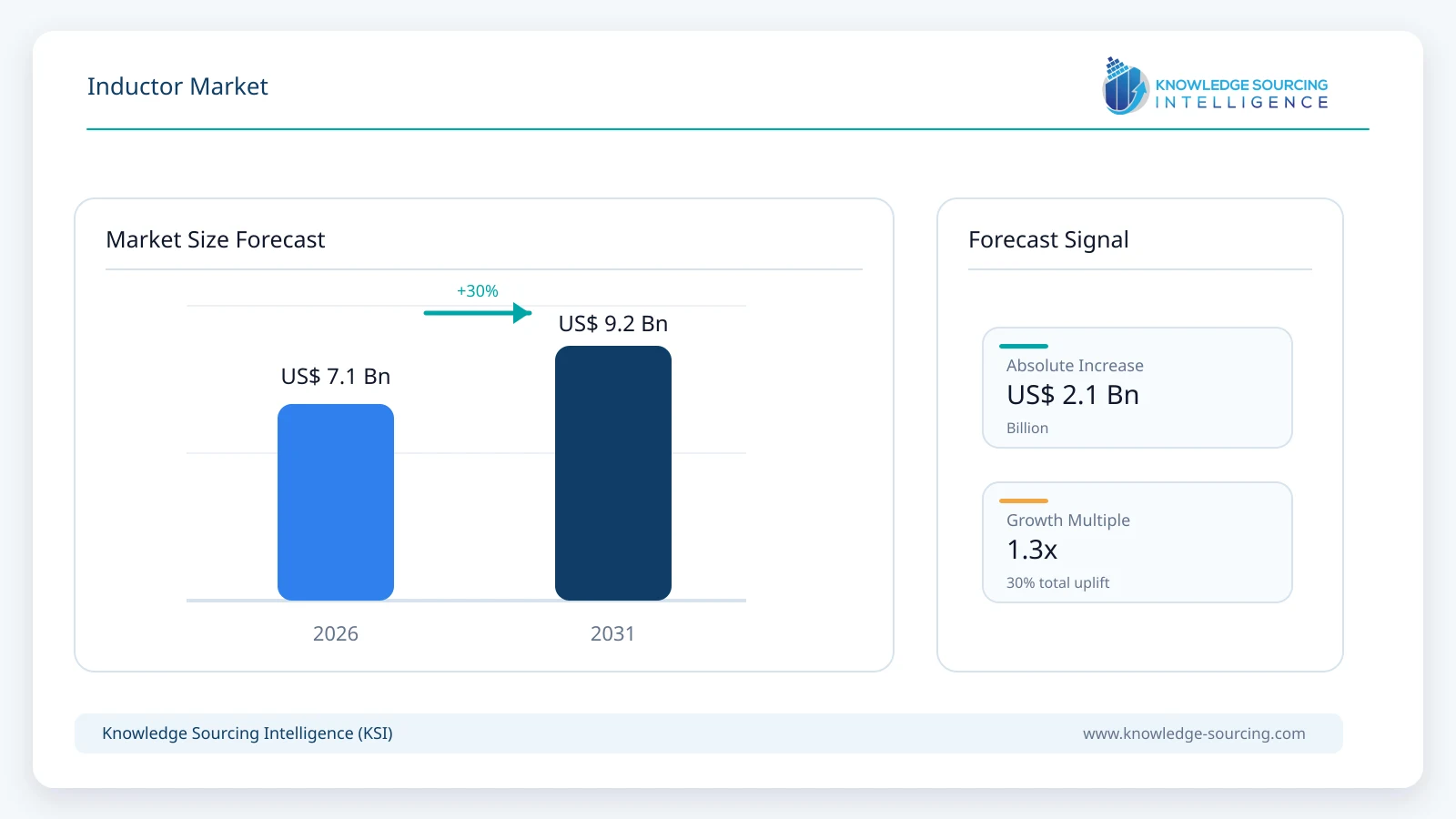
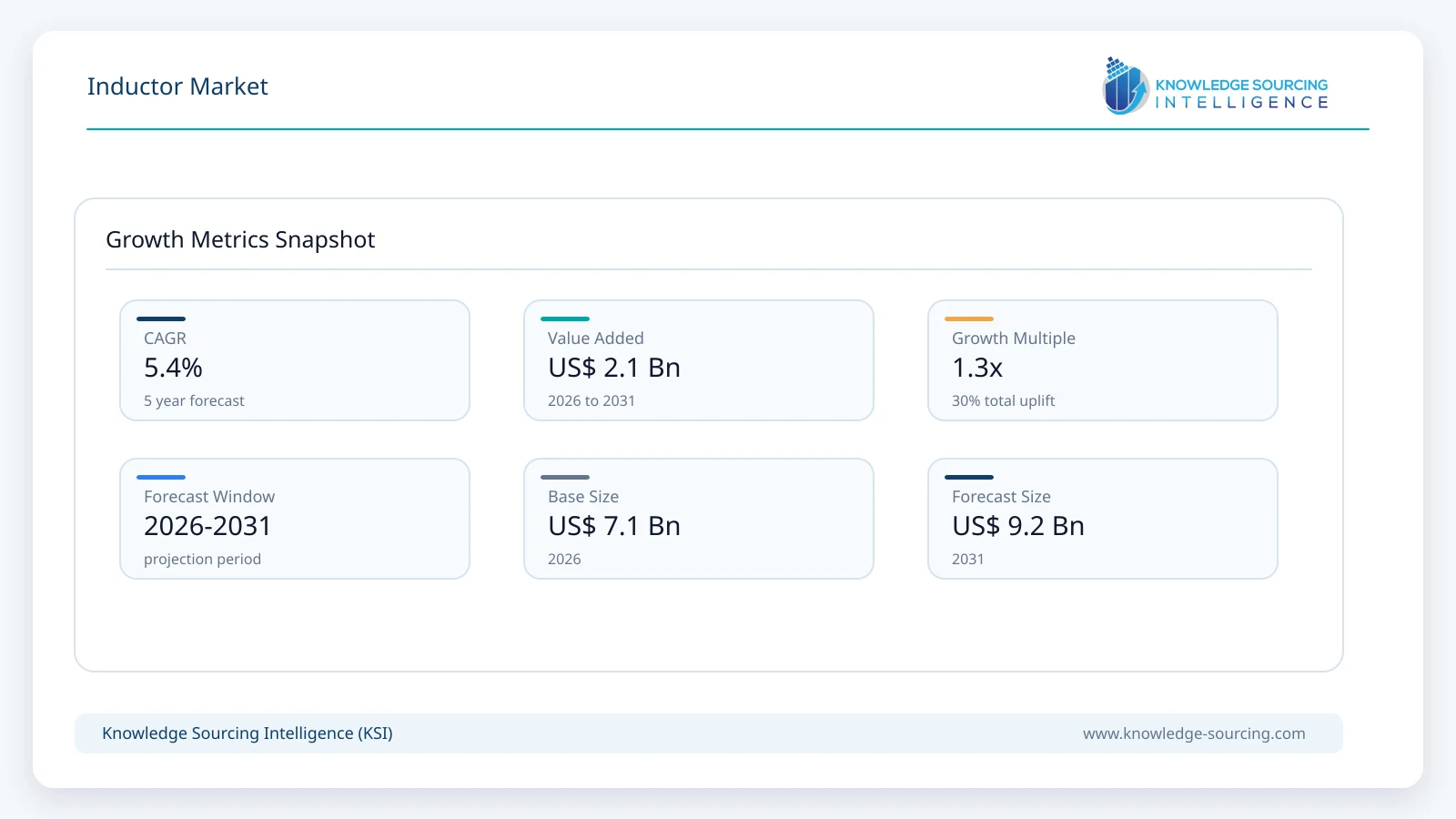
The Global Inductor Market is expected to reach USD 9.2 billion in 2031, growing at a CAGR of 5.4% between 2026 and 2031, from USD 7.1 billion in 2026.
Highlights:
- 1Inductor performance is optimized through directional orientation markings to ensure consistent inductance values regardless of mounting direction.
- 2Shielded inductor designs effectively reduce electromagnetic interference in close-proximity component placements.
- 3High-current inductor development addresses severe temperature fluctuations in automotive power circuits.
- 4Shielded power inductors support stable operation in V2X and AI-driven data center infrastructures.
Market Overview
The global inductor market is expanding consistently, driven by continued transformation of the automotive industry, telecommunications infrastructure, industrial equipment, renewable-energy systems, and high-density electronic devices. In response to the evolving application requirements, manufacturers are developing smaller, higher-current, lower-loss, and application-specific implementations of inductors.
The global expansion of semiconductor manufacturing capacity is strengthening the broader electronic component ecosystem. According to Semiconductor Equipment and Materials International (SEMI), an estimated 18 new semiconductor fabrication projects, including fifteen 300-mm and three 200-mm facilities, will start construction in 2025, with operations anticipated to commence during 2026-2027.
Semiconductor capacity demand is increasing across AI, HPC, automotive, IoT, and power-electronics applications. SEMI estimated that the total global semiconductor capacity reached 33.6 million wafers per month in 2025, representing a 6.6% year-on-year rise, increasing the manufacturing base of electronic systems embedding passive components like inductors.
The renewable-energy deployment is promoting the need for power-electronic components. The total renewable capacity additions worldwide in 2025 reached a record 800 GW, with solar PV accounting for over three-quarters of new capacity. This leads to the deployment of power-conversion and filtering equipment that uses inductors.
Miniaturization is still a major direction of product development. In January 2025, Murata introduced a chip inductor of 0.16 × 0.08 mm size, which is about 75% lower volume than its previous industrial standard 008004-size product, targeting increasingly miniaturised mobile electronics.
Inductor manufacturers are expanding across multiple application types, including industrial, telecom, automotive, and computing. For instance, in October 2025, Vishay launched more than 2,000 new SKUs in the past six months and nearly 100 series featuring wireless-charging inductors, common-mode chokes, high-current ferrite impedance beads and TLVR inductors.
Taiwan continues to be a key manufacturing base in the electronics supply chain, as evidenced by the Ministry of Finance reporting that Taiwan's total exports amounted to USD 640.7 billion in 2025, marking a 34.9% year-on-year increase due to strong AI-driven demand and its semiconductor and ICT sectors.
Recent products launched demonstrate a trend towards more highly integrated and high-current power delivery solutions. In February 2026, TDK introduced its FS1525 µPOL power module, combining MOSFETs, inductors, and control in a three-dimensional approach up to 25 A per module and up to 200 A when stacked, working with AI servers, edge computing, and data centers.
Key Takeaways
Wirewound inductors represent about 37% of global market value in 2026. This highlights the segment’s large share, enabled by their widespread adoption in automotive electronics, industrial systems, and power-conversion applications.
Automotives segment is estimated to account for around 27% of global inductor demand by 2026. It has higher inductor requirements due to increasing vehicle electrification, advanced electronics, and ADAS integration.
Power Conversion & Voltage Regulation accounts for approximately 32% of market value in 2026. This is a key application for inductors driven by the growing requirements around power delivery and voltage management.
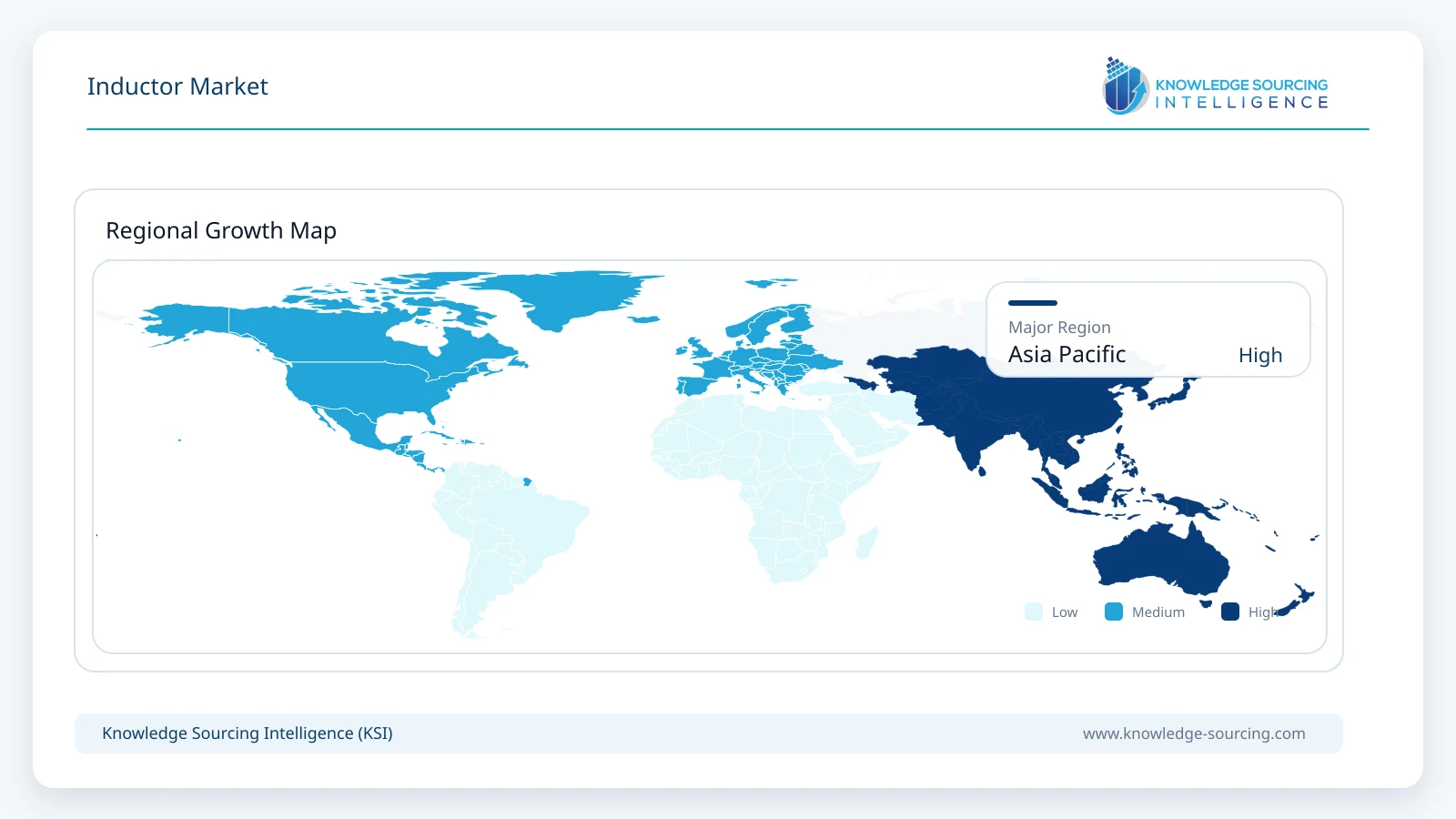
In 2026, Asia Pacific will comprise around 58% of the global market value. This region has a well-established electronics and semiconductor presence, along with a strong automotive supply chain, which drives demand for inductors.
China is estimated to hold about 22% of worldwide market value by 2026. This significant growth is supported by the large EV manufacturing base, consumer electronics production, and industrial automation, coupled with growth in the domestic data-center infrastructure.
Market Drivers
Rising Demand for Power Management in Consumer Electronics and Computing Devices
The rising use of multiple processors along with their AI-enabled functions, high-speed connectivity, displays, and dense batteries is driving power requirements in electronic devices. This need is driving demand for efficient power conversion, filtering, voltage regulation, and thermal management, favoring the emergence of inductors used in power-management circuits.
Global semiconductor sales increased by 26.2% Year-on-Year (YoY) to USD 795.6 billion in 2025, with more than 60% YoY expansion of computer applications reflecting growing demand for computing and data-center hardware requiring ever-more complex power-management components.
AI and high-performance computing (HPC) induce power demands in devices and systems. According to the International Energy Agency (IEA), global electricity consumption by data centers rose 17% in 2025, whereas electricity consumption from AI-focused data centres increased by 50%, putting even higher demands on power-delivery systems and power-conversion solutions.
Power density in the data center is increasing rapidly. As per the IEA, power density on AI servers increased elevenfold from 2020–2025 and could grow another fourfold by 2027. It amplifies the need for small, high-current power-management components like inductors in voltage-regulation circuits.
Major technology companies' investments bolstering demand for computing infrastructure. In 2025, companies like Meta, Amazon, Alphabet, and Microsoft spent $320 billion on data centers and AI, compared to $230 billion in 2024, supporting continued expansion of large-scale HPC infrastructure.
Consumer computing is still a high-volume application base. IDC reports that in 2025, global PC shipments were around 274 million units, representing a 4.1% YOY increase. Thus, overall demand will continue to be fueled by power-management components across laptops, desktops, and portable computing devices.
Automotive Electrification Increases Inductor Content
Electric and hybrid vehicles require inductors across low-voltage and high-voltage DC-DC converters, onboard electronics, battery-management systems, ADAS, infotainment and communication networks. Even conventional vehicles are adding electronic systems, so the increase in component content extends beyond BEVs alone. TDK reported higher inductive-device sales to the automotive market during FY2026, while Murata and Sumida continue to launch automotive-qualified products for higher current and temperature ranges. The combination of unit growth and more demanding specifications gives automotive suppliers a relatively resilient revenue pool.
Industrial Power Conversion Adds High-Reliability Demand
Factory automation, renewable-energy systems, robotics, motor drives and industrial power supplies require inductors for filtering, current smoothing and voltage conversion. These applications operate for longer duty cycles than most consumer devices and frequently face higher temperatures, vibration or electrical noise. Suppliers serving this segment compete on reliability and customized electrical characteristics as much as on size, and industrial customers are less likely to switch qualified components solely for a small price reduction.
Market Restraints and Challenges
Pricing Pressure Persists in High-Volume Electronics
Inductors used in smartphones, consumer electronics, and standard power supplies face intense price competition because large buyers source across multiple qualified vendors and redesign products frequently. TDK noted that inductive-device profitability was affected by product mix even as automotive and industrial sales increased during FY2026. Manufacturers must offset this pressure through automation, yield improvement, and a greater proportion of automotive, data-center and industrial products where specification and qualification matter more than absolute unit price.
Material and Qualification Requirements Extend Development Cycles
Inductor performance depends on copper, ferrite, metal powders, ceramic materials, and manufacturing precision. High-current designs must balance DC resistance, core loss, saturation behavior, and temperature rise within increasingly small packages. Automotive and aerospace applications add reliability testing and long qualification cycles, while changes in magnetic material formulations can require fresh customer validation. These requirements raise development costs and make rapid supplier substitution more difficult in high-reliability segments.
Major Segment Analysis
By Construction Type: Wirewound Inductors
By construction type, the Inductor market is segmented into wirewound inductors, multilayer inductors, thin-film inductors, molded and metal-composite inductors, and others. Wirewound inductors are expected to maintain a significant share, supported by their high current-handling capability, low resistance, and suitability for power-management and automotive applications.
The increasing demand for compact electronic components, higher power density, improved thermal performance, and greater operating efficiency is encouraging manufacturers to advance multilayer, thin-film, and molded inductor technologies across automotive, consumer electronics, telecommunications, computing, and industrial applications.
The wirewound inductors segment is expected to account for USD 3.35 billion by 2031, driven by rising demand for high-current, compact, and reliable inductive components across automotive electronics, telecommunications, consumer electronics, and power-management applications.
The continued electrification of vehicles is expanding the application scope of wirewound inductors. Global electric-car sales exceeded 23 million units in 2026, according to the International Energy Agency (IEA). Electric vehicles use inductive components across DC-DC converters, onboard chargers, battery-management systems, and other power-electronic circuits, supporting demand for automotive-grade wirewound inductors.
India's expanding electronics manufacturing industry is creating additional demand for inductive components. The Government of India reported electronics production of approximately ?13.11 lakh crore in 2025–26, while electronics exports reached around ?4.24 lakh crore. The growing adoption of mobile devices, consumer electronics, and electronic components is increasing the application base for inductors used in power management, filtering, and EMI suppression.
Automotive component manufacturers are developing higher-current and higher-temperature wirewound inductors for demanding vehicle applications. Panasonic's automotive power-inductor portfolio includes components designed for DC-DC converters and ECU power circuits, incorporating high-temperature capability, low DC resistance, and vibration resistance. These developments reflect the increasing electrical and thermal requirements of automotive electronics.
The expansion of AI and data-center infrastructure is increasing requirements for high-current, compact power-management components. India's data-center capacity reached approximately 1,500 MW in 2025, while the country's AI-compute infrastructure had onboarded approximately 38,231 GPUs through supported providers. Increasing computing power density is supporting demand for advanced power-delivery components, including high-current inductive technologies.
AI applications are driving innovation toward higher-current and higher-density magnetic components. TDK introduced its µPOL power module in 2026 with integrated inductors and power-management circuitry, supporting up to 25 A per module and up to 200 A using multiple modules. The company identifies AI servers, edge computing, and data centers as key applications.
Miniaturization and improved electrical efficiency remain key product-development priorities. Manufacturers such as TDK and Panasonic are developing wirewound power inductors with lower DC resistance, higher current capability, compact dimensions, and improved thermal performance, allowing designers to achieve greater power density while reducing PCB space and energy losses.
Automotive electronics beyond the powertrain are creating additional application opportunities. Murata expanded its automotive-grade power-inductor portfolio in 2026 for applications including advanced driver-assistance systems (ADAS), in-vehicle infotainment (IVI), and other automotive power circuits, highlighting the increasing use of inductive components as vehicle electronic content rises.
By End-User Industry: Automotive
Automotive applications are forecast to reach approximately USD 2.65 billion by 2031 as electronic content per vehicle rises and electrified powertrains increase the number of conversion and filtering circuits. Inductors are used in DC-DC converters, ADAS modules, infotainment, lighting, battery-support electronics, communication networks and numerous low-voltage control systems. Qualification standards, temperature requirements, and long vehicle production cycles favor established component suppliers with consistent manufacturing and global support. Murata, TDK, TAIYO YUDEN, Sumida and Vishay have all expanded automotive-grade inductor portfolios.
By Application: DC-DC Conversion and Voltage Regulation
DC-DC conversion and voltage regulation are expected to account for approximately USD 3.05 billion by 2031, supported by the continued proliferation of voltage rails in vehicles, computing systems, industrial equipment and consumer electronics. AI servers create particularly demanding conditions because very large currents must be delivered close to processors at low voltages, while EVs require efficient voltage conversion between batteries and auxiliary electronic systems. This segment favors power inductors with low DC resistance, high saturation current and compact dimensions, accelerating adoption of metal-composite and thin-film technologies.
Geographical Outlook
Asia Pacific: China
The Chinese inductor market is projected to approach USD 2.10 billion by 2031, driven by rising demand for electronic components across consumer electronics, automotive, telecommunications, and industrial applications.
Trends and Insights
Rapid expansion of China's electronic information manufacturing industry is creating a broad downstream demand base for inductors. In 2025, China's electronic information manufacturing industry recorded a 10.6% year-on-year increase in value added, while integrated-circuit production reached 484.3 billion units, representing a 10.9% increase from 2024. The scale of semiconductor, communication, computing, and electronic-device manufacturing supports demand for inductors used in power management, filtering, signal processing, and electromagnetic interference control.
Automotive electronics is also driving product development toward higher-reliability inductors. TDK's China operations list SMD power inductors for applications including automotive onboard chargers, DC/DC converters, car navigation, displays, and automotive electronics. At the same time, its automotive-grade portfolio includes components designed for high-current and elevated-temperature applications. This indicates increasing availability of locally manufactured and supplied inductors for automotive power-management applications.
China's expanding 5G infrastructure is supporting demand for inductors used in communication equipment and power-management systems. The number of 5G base stations reached 4.838 million at the end of 2025, representing 37.6% of total mobile base stations.
The country's transition toward intelligent manufacturing is increasing the electronics content of industrial equipment. By early 2025, China had established more than 30,000 basic-level smart factories, 1,200 advanced-level smart factories and 230 excellence-level smart factories. The Ministry of Industry and Information Technology reported that excellence-level factories had implemented applications including AI-powered quality inspection, smart warehousing and digital R&D. These developments support demand for inductors in industrial automation equipment, motor drives, power supplies, sensors and control systems.
Government initiatives focused on AI-enabled manufacturing and electronic-component modernization are likely to encourage higher-performance component adoption. China's 2026 “AI + Manufacturing” initiative specifically calls for advances in intelligent electronic-component design, high-precision simulation and quality-control technologies, while promoting flexible manufacturing and AI-enabled optimization of electronic-component production and testing. This direction is relevant to the development of smaller, higher-current, high-frequency and higher-reliability inductors.
Power-grid modernization and distributed energy infrastructure are creating additional applications for power-electronic components. China's National Energy Administration has called for greater investment in grid upgrades, intelligent and digital distribution networks, smart microgrids and distributed energy-storage systems. These systems require power conversion and control equipment, providing an additional downstream application base for power inductors and related magnetic components.
Competitive Environment Analysis and Company Profiles
The global inductor market combines large diversified passive-component manufacturers with focused magnetic-component specialists. TDK, Murata and TAIYO YUDEN benefit from materials expertise, high-volume Asian manufacturing and established relationships with automotive and electronics customers. TDK's Passive Components segment generated JPY 593.2 billion in FY2026, with inductive-device sales increasing to automotive and industrial-equipment customers, while the company is accelerating thin-film inductor development for AI power delivery. TAIYO YUDEN has identified inductors as a second core business after multilayer ceramic capacitors and continues to prioritize metal power inductors.
Specialists remain important because inductor design often requires application-specific magnetic structures. Coilcraft has a broad power and RF portfolio, Sumida has strong positions in automotive and power magnetics, and Vishay continues to expand high-current molded products. YAGEO Group participates through Chilisin and Pulse Electronics, while Würth Elektronik, Bourns, Abracon and KYOCERA AVX serve a broad range of industrial, automotive and communications applications. Shenzhen Sunlord and other Asian suppliers add strong competition in high-volume and increasingly higher-specification products.
The competitive advantage is shifting toward suppliers that can offer several magnetic technologies rather than one legacy construction. Customers increasingly select between wirewound, multilayer, thin-film and molded metal-composite designs based on board space, current density, frequency, losses and thermal limits. Companies that can support simulation, rapid sampling, automotive qualification and long-term supply are better positioned in higher-value programmes.
TDK Corporation’s strategy in the inductor market centers on leveraging its core expertise in material science, specifically advanced ferrite and metallic magnetic powder materials to lead high-growth, high-value sectors. Rather than competing solely on volume in commodity markets, TDK focuses on portfolio improvement by targeting automotive electrification (EVs, ADAS), industrial automation, and miniaturized consumer tech (wearables and 5G/6G hardware).
The company integrates thin-film, multilayer, and wire-winding processing technologies to create inductors that deliver higher energy efficiency, lower power loss, ultra-compact footprints, and high heat resistance. By expanding custom magnetic solutions and high-reliability automotive-grade products (AEC-Q200), TDK aims to maintain high profit margins while embedding its components directly into next-generation power supply architectures.
Key Developments
September 2026: Sumida launched the AEC-Q200-qualified WMT0730T150/DS SMD metal inductor for high-reliability automotive applications, combining high rated current with low DC resistance.
September 2026: Murata expanded its automotive-grade metal power inductor portfolio for ADAS, infotainment and other vehicle power circuits, broadening design options for higher-current applications.
August 2026: Vishay introduced new molded inductors designed to improve shock and vibration resistance while increasing performance and saturation-current capability.
May 2026: TDK said it would accelerate thin-film inductor capacity for AI data-center power delivery as demand grows for low-voltage, high-current components near CPUs and GPUs.
April 2026: TAIYO YUDEN began mass production of nine new MCOIL multilayer metal power inductors for smartphones and wearables, reducing footprint while maintaining current performance.
2025: TDK Corporation announced that it expanded the BCL3520FT series of small power inductors for automotive power circuits. Mass production of the product series began in December 2025.
Market Outlook
Through 2031, value growth will come less from conventional consumer-electronics volume and more from changes in the electrical requirements of computing, vehicles and industrial systems. AI accelerators are pushing current density higher, automotive platforms are demanding stronger reliability and thermal performance, and industrial power conversion is creating sustained demand for larger or more rugged magnetic components.
The product mix should continue moving toward metal-composite, multilayer metal and thin-film technologies where conventional ferrite solutions cannot meet the combination of footprint and current requirements. Wirewound products will retain the largest overall position because of their broad flexibility, but the highest growth opportunities will sit in compact high-current designs and automotive-qualified components.
Asia Pacific will remain the center of production and consumption, though India and Southeast Asia should capture a greater share of electronics assembly as manufacturers diversify supply chains. Competitive differentiation will increasingly depend on magnetic-material expertise, automated manufacturing, application engineering and the ability to qualify products quickly for automotive and high-performance computing platforms.
Inductor Market Scope:
| Report Metric | Details |
|---|---|
| Total Market Size in 2026 | USD 7.1 billion |
| Total Market Size in 2031 | USD 9.2 billion |
| Forecast Unit | Billion |
| Growth Rate | 5.4% |
| Study Period | 2021 to 2031 |
| Historical Data | 2021 to 2024 |
| Base Year | 2025 |
| Forecast Period | 2026 – 2031 |
| Segmentation | Construction Type, Core Type, Application, End User Industry, Geography |
| Companies |
|
Market Segmentation
By Construction Type
Wirewound Inductors
Multilayer Inductors
Thin-Film Inductors
Molded and Metal-Composite Inductors
Others
By Core Type
Ferrite Core
Powdered Iron Core
Air Core
Others
By Application
Power Conversion and Voltage Regulation
Power Supply Filtering
EMI/RFI Filtering and Common-Mode Suppression
RF and Signal Circuits
Wireless Charging
Others
By End User Industry
Automotive
Consumer Electronics
Telecommunications
Industrial Electronics
Data Centers and Computing
Aerospace and Defense
Medical Electronics
Others
By Geography
North America
United States
Canada
Mexico
South America
Brazil
Argentina
Others
Europe
Germany
United Kingdom
France
Italy
Spain
Others
Middle East and Africa
Saudi Arabia
UAE
Israel
South Africa
Others
Asia Pacific
China
Japan
India
South Korea
Taiwan
Indonesia
Thailand
Vietnam
Others
Table of Contents
1. EXECUTIVE SUMMARY
2. MARKET SNAPSHOT
2.1. Market Overview
2.2. Market Definition
2.3. Scope of the Study
2.4. Market Segmentation
3. MARKET DYNAMICS
3.1. Market Drivers
3.2. Market Restraints
3.3. Market Opportunities
3.4. Porter’s Five Forces Analysis
3.5. Industry Value Chain Analysis
4. BUSINESS LANDSCAPE
4.1. Regulatory & Standards Landscape
4.2. Inductor Manufacturing & Component Ecosystem
4.3. Raw Material & Magnetic Component Supply Chain
4.4. Import/Export Analysis
4.5. Strategic Recommendation
5. TECHNOLOGICAL OUTLOOK
5.1. Miniaturization and High-Current Inductor Technologies
5.2. Metal-Composite, Molded and Integrated Magnetic Inductor Technologies
5.3. Thin-Film Inductors for AI, Data Center and High-Density Power Delivery Technologies
5.4. Automotive-Grade Inductor Technologies
6. GLOBAL INDUCTOR MARKET BY CONSTRUCTION TYPE (2021-2031)
6.1. Introduction
6.2. Wirewound Inductors
6.3. Multilayer Inductors
6.4. Thin-Film Inductors
6.5. Molded and Metal-Composite Inductors
6.6. Others
7. GLOBAL INDUCTOR MARKET BY CORE TYPE (2021-2031)
7.1. Introduction
7.2. Ferrite Core
7.3. Powdered Iron Core
7.4. Air Core
7.5. Others
8. GLOBAL INDUCTOR MARKET BY APPLICATION (2021-2031)
8.1. Introduction
8.2. Power Conversion and Voltage Regulation
8.3. Power Supply Filtering
8.4. EMI/RFI Filtering and Common-Mode Suppression
8.5. RF and Signal Circuits
8.6. Wireless Charging
8.7. Others
9. GLOBAL INDUCTOR MARKET BY END USER INDUSTRY (2021-2031)
9.1. Introduction
9.2. Automotive
9.3. Consumer Electronics
9.4. Telecommunications
9.5. Industrial Electronics
9.6. Data Centers and Computing
9.7. Aerospace and Defense
9.8. Medical Electronics
9.9. Others
10. GLOBAL INDUCTOR MARKET BY GEOGRAPHY (2021-2031)
10.1. Introduction
10.2. North America
10.2.1. By Construction Type
10.2.2. By Core Type
10.2.3. By Application
10.2.4. By End User Industry
10.2.5. By Country
10.2.5.1. United States
10.2.5.2. Canada
10.2.5.3. Mexico
10.3. South America
10.3.1. By Construction Type
10.3.2. By Core Type
10.3.3. By Application
10.3.4. By End User Industry
10.3.5. By Country
10.3.5.1. Brazil
10.3.5.2. Argentina
10.3.5.3. Others
10.4. Europe
10.4.1. By Construction Type
10.4.2. By Core Type
10.4.3. By Application
10.4.4. By End User Industry
10.4.5. By Country
10.4.5.1. Germany
10.4.5.2. United Kingdom
10.4.5.3. France
10.4.5.4. Italy
10.4.5.5. Spain
10.4.5.6. Others
10.5. Middle East and Africa
10.5.1. By Construction Type
10.5.2. By Core Type
10.5.3. By Application
10.5.4. By End User Industry
10.5.5. By Country
10.5.5.1. Saudi Arabia
10.5.5.2. UAE
10.5.5.3. Israel
10.5.5.4. South Africa
10.5.5.5. Others
10.6. Asia Pacific
10.6.1. By Construction Type
10.6.2. By Core Type
10.6.3. By Application
10.6.4. By End User Industry
10.6.5. By Country
10.6.5.1. China
10.6.5.2. Japan
10.6.5.3. India
10.6.5.4. South Korea
10.6.5.5. Taiwan
10.6.5.6. Indonesia
10.6.5.7. Thailand
10.6.5.8. Vietnam
10.6.5.9. Others
11. COMPETITIVE ENVIRONMENT AND ANALYSIS
11.1. Major Players and Strategy Analysis
11.2. Market Share Analysis
11.3. Mergers, Acquisitions, Agreements, and Collaborations
11.4. Competitive Dashboard
12. COMPANY PROFILES
12.1. TDK Corporation
12.2. Murata Manufacturing Co., Ltd.
12.3. TAIYO YUDEN CO., LTD.
12.4. Vishay Intertechnology, Inc.
12.5. Sumida Corporation
12.6. Coilcraft, Inc.
12.7. YAGEO CORPORATION
12.8. KYOCERA AVX Components Corporation
12.9. Bourns, Inc.
12.10. Würth Elektronik eiSos GmbH & Co. KG
12.11. Abracon LLC
12.12. Shenzhen Sunlord Electronics Co., Ltd.
12.13. Cyntec Co., Ltd.
12.14. Panasonic Industry Co., Ltd.
12.15. Samsung Electro-Mechanics Co., Ltd.
13. RESEARCH METHODOLOGY
14. LIST OF FIGURES
15. LIST OF TABLES
Navigate
Trusted by the world's leading organizations











