
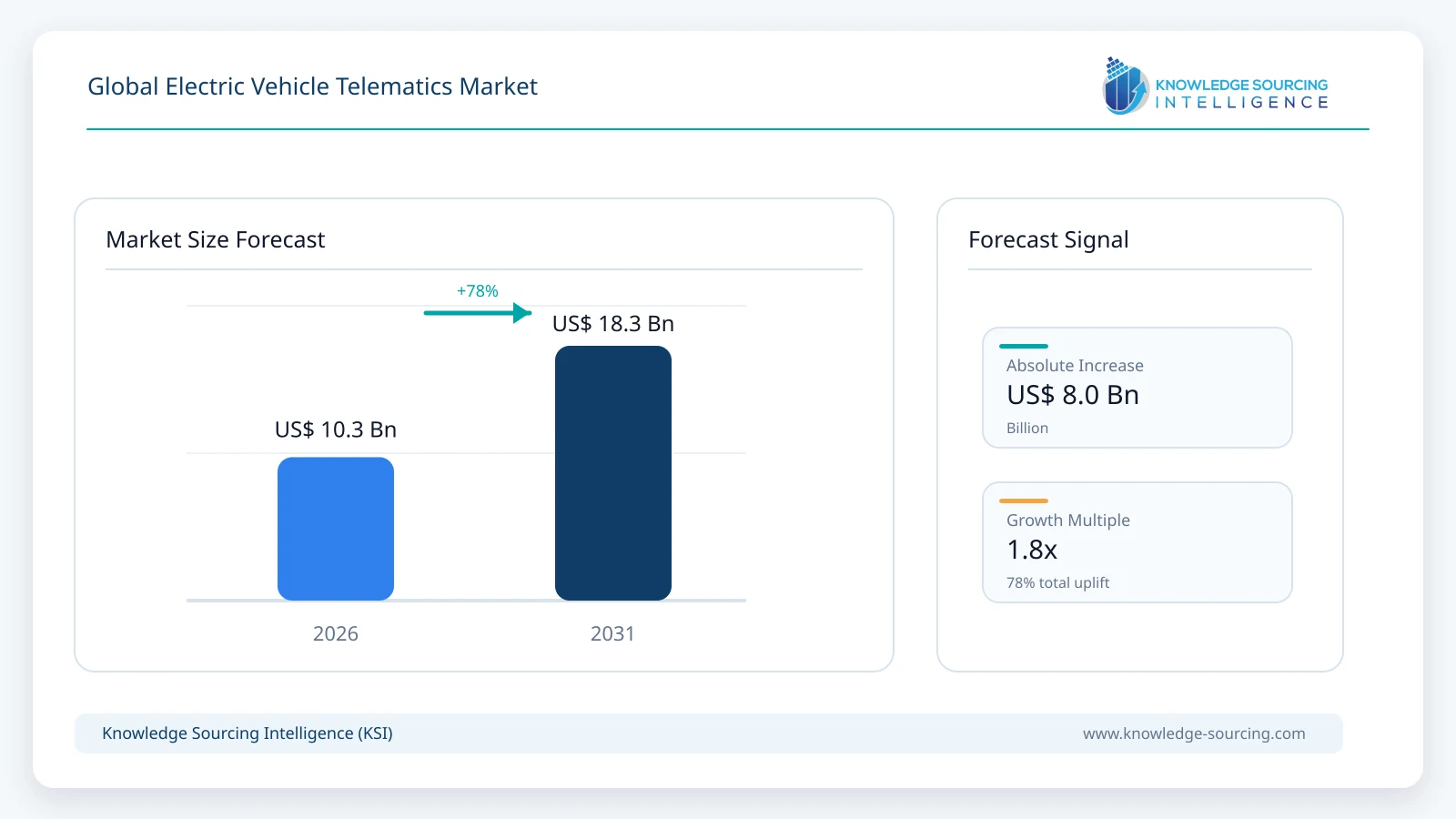
The Global Electric Vehicle Telematics Market is forecast to grow at a CAGR of 12.2%, reaching USD 18.3 billion in 2031 from USD 10.3 billion in 2026.
Highlights:
- 1EV adoption is expanding the addressable telematics baseGlobal electric car sales exceeded 20 million in 2025, representing about one-quarter of new car sales worldwide, while the International Energy Agency expects global electric car sales to reach around 23 million in 2026. The expanding connected EV fleet is increasing demand for vehicle monitoring, battery information, route optimization, charging intelligence, diagnostics, and fleet-management services.
- 2Hardware remains a critical solution layerTelematics hardware connects vehicles with cloud platforms and enables the collection of location, vehicle-health, battery, energy, and driving data. Embedded OEM telematics and increasingly hardware-free integrations are expanding deployment opportunities across passenger and commercial EV fleets.
- 3BEVs represent the strongest vehicle-type opportunityBattery electric vehicles are the largest and most established category within the electric car market. Their reliance on battery state-of-charge, charging availability, range management, and energy-efficiency information creates strong requirements for connected telematics capabilities.
- 4Asia Pacific remains the central EV growth engineChina continues to dominate global electric car sales, while electric vehicle adoption is also accelerating across India and other Asia Pacific markets. The scale of EV production, sales, charging infrastructure, and connected mobility development supports sustained demand for telematics.
- 5AI is changing telematics from tracking to intelligenceLeading telematics providers are increasingly applying artificial intelligence to vehicle and fleet data to support predictive maintenance, operational optimization, automated insights, safety monitoring, and more proactive fleet management.
The electric vehicle telematics market comprises connected technologies that collect, transmit, process, and analyze vehicle and operational data. These solutions combine communication technologies, positioning systems, onboard vehicle data, cloud platforms, sensors, software, and analytics to provide visibility into vehicle location, battery condition, energy consumption, driving behavior, vehicle health, charging activity, and fleet performance. In electric vehicles, telematics has a particularly important role because vehicle operators need information that extends beyond conventional location tracking. Battery state of charge, estimated range, charging status, energy consumption, regenerative braking behavior, route conditions, and charging infrastructure availability can all influence vehicle utilization and operating economics.
The market is therefore developing alongside the broader expansion of electric vehicles, connected mobility, cloud computing, and intelligent transportation systems. The International Energy Agency reported that global electric car sales exceeded 20 million in 2025, increasing by 20% from 2024 and raising the electric share of new car sales to approximately 25%. The IEA's 2026 outlook further indicates that global electric car sales could reach about 23 million in 2026, equivalent to around 28% of total car sales. This expanding installed base creates a larger pool of vehicles requiring connected services throughout their operating life.
Telematics platforms typically combine vehicle connectivity, GPS positioning, cellular communications, onboard diagnostics, cloud software, and analytics. In commercial applications, these systems can help fleet operators monitor vehicle utilization, optimize routes, reduce unnecessary energy consumption, schedule maintenance, monitor driver behavior, and coordinate charging. For private EV users, telematics can support remote vehicle monitoring, charging-status information, navigation, emergency assistance, vehicle diagnostics, and connected mobile applications.
The evolution of EV telematics is also being shaped by the shift from aftermarket devices toward embedded and cloud-connected solutions. In March 2026, Geotab announced a hardware-free native telematics integration with Hyundai for supported vehicles in Europe. The integration enables vehicle data to reach the MyGeotab platform without additional aftermarket hardware or installation, demonstrating how OEM-embedded connectivity can reduce deployment friction for fleet operators.
The development of AI is another important structural change. Traditional telematics systems primarily presented vehicle information through dashboards and reports. Modern platforms increasingly analyze large volumes of connected vehicle data to identify operational patterns and recommend or automate actions. Geotab highlighted this transition at Geotab Connect 2026, describing a move from conventional vehicle tracking toward AI-enabled digital representations of fleet operations. This trend is expected to increase the value of telematics data and support higher-value software and analytics services.
Government support for electric mobility is also increasing the potential customer base for telematics. In India, the Ministry of Heavy Industries reported in March 2026 that 19.68 lakh electric vehicles were registered during FY 2024-25, compared with 16.81 lakh in FY 2023-24. EV penetration increased from 6.82% to 7.50% over the same period. The PM E-DRIVE programme has also supported the deployment of electric vehicles and charging infrastructure, strengthening the ecosystem in which connected vehicle technologies can expand.
The electric vehicle telematics market is therefore moving beyond basic vehicle tracking. The next stage of market development is expected to focus on connected battery intelligence, predictive maintenance, charging optimization, fleet electrification planning, AI-based analytics, integrated OEM connectivity, cybersecurity, and software-defined vehicle capabilities.
Under the solution segment, hardware is expected to maintain a significant position because connected devices, communication modules, sensors, and vehicle interfaces form the foundation for collecting and transmitting telematics data. However, software and services are becoming increasingly important as operators seek actionable insights rather than raw vehicle information. Under the vehicle-type segment, battery electric vehicles (BEVs) are expected to represent a major growth opportunity due to their increasing global adoption and their dependence on detailed battery, charging, and energy-management information.
Electric Vehicle Telematics Market Drivers:
Growing production and adoption of EVs across the globe
One of the strongest drivers for the electric vehicle telematics market is the rapid expansion of electric vehicle adoption. A larger EV fleet directly increases the number of vehicles that can be connected to telematics platforms. At the same time, EVs generate operational data that is particularly valuable for drivers, fleet managers, manufacturers, insurers, charging providers, and mobility operators.
The International Energy Agency's Global EV Outlook 2026 reported that electric car sales exceeded 20 million globally in 2025, representing around one in four new cars sold. Electric car sales increased by 20% compared with 2024. The IEA expects global electric car sales to reach approximately 23 million in 2026, representing about 28% of total car sales. These figures demonstrate that telematics providers are addressing a rapidly expanding connected vehicle population rather than a niche automotive segment.
China remains the largest electric car market. The IEA reported that more than 13 million electric cars were sold in China during 2025, representing around 60% of global electric car sales. Electric vehicles accounted for close to 55% of new car sales in China. This large vehicle base provides a substantial environment for telematics providers, OEMs, fleet platforms, navigation companies, and charging-management technology developers.
Growth is also spreading beyond the largest markets. According to the IEA, electric car sales outside China, Europe, and the United States reached nearly 2 million in 2025, up from approximately 1.3 million in 2024. Electric car sales in emerging markets and developing economies other than China increased by around 80% in 2025. Southeast Asia recorded particularly strong growth. Such geographical diversification creates new opportunities for telematics platforms that can support mixed fleets, regional navigation, charging availability, and cross-border logistics.
Expansion of connected and software-defined vehicles
The transition toward software-defined vehicles is increasing the strategic importance of telematics. Vehicles are increasingly designed as connected computing platforms in which data from sensors, powertrain systems, driver-assistance systems, batteries, and communication modules can be analyzed through software. Telematics acts as an important connectivity layer between the vehicle, cloud platforms, fleet operators, and other mobility services.
Modern telematics platforms can provide continuous vehicle information instead of relying solely on periodic maintenance visits. This allows fleet operators to identify potential problems earlier, compare vehicle performance, monitor utilization, and make decisions based on actual operating conditions. For EV fleets, such capabilities can be particularly useful because battery utilization and charging behavior directly influence vehicle availability and operating costs.
In March 2026, Geotab and Hyundai announced a native telematics integration for supported Hyundai vehicles in Europe. According to Geotab, the solution provides access to EV insights, GPS information, and proactive maintenance capabilities through OEM-embedded connectivity without the need for additional hardware installation. This development illustrates the market's movement toward seamless OEM-integrated telematics.
Electric Vehicle Telematics Market Major Segment Analysis:
Hardware segment is expected to retain a significant market position
Hardware remains fundamental to the electric vehicle telematics ecosystem because it provides the physical interface for collecting and communicating vehicle data. Telematics hardware can include communication modules, GPS receivers, vehicle interfaces, sensors, antennas, control units, and other connected components. These devices enable information from the vehicle to be transmitted to cloud-based platforms for analysis and visualization.
The hardware segment is also evolving. Traditional aftermarket telematics devices are increasingly being complemented by OEM-embedded connectivity. This transition can reduce installation requirements and support more consistent data access across fleets. Hardware suppliers therefore face increasing requirements for secure communications, broader vehicle compatibility, low-power operation, accurate positioning, and integration with modern vehicle architectures.
For EVs, hardware must support data related to battery condition, state of charge, energy consumption, charging activity, vehicle location, and vehicle health. As electric commercial fleets increase, the requirement for durable hardware capable of operating across demanding environments is expected to rise. Fleet operators may also require hardware that can operate across mixed vehicle populations, allowing EVs and internal-combustion vehicles to be managed through a single platform during the transition to electrification.
Geotab's current vehicle telematics offering illustrates this evolution. The company supports its own telematics devices, OEM-embedded connectivity, third-party telematics devices, and mixed-fleet configurations. This broad connectivity model reflects the growing importance of interoperability within the telematics market.
Battery Electric Vehicles segment represents a major growth opportunity
Battery electric vehicles are expected to remain a key growth category within the vehicle-type segmentation. Unlike conventional vehicles, BEVs require continuous management of battery energy, charging availability, estimated range, and energy efficiency. Telematics can transform these data points into operational information for drivers and fleet managers.
For commercial BEV fleets, telematics can help determine whether a vehicle has sufficient range for a planned route, identify charging requirements, monitor energy consumption, and coordinate vehicle availability. When combined with route and traffic information, telematics can also help operators select routes that balance travel time, energy consumption, and charging requirements.
The increasing availability of BEV models is reinforcing this opportunity. The IEA estimates that the number of electric car models could exceed 1,100 globally in 2026 based on recent manufacturer announcements. Around 150 new electric models have been announced for release during 2026. A larger selection of electric models is expected to encourage adoption across passenger and commercial applications and consequently expand the market for connected vehicle technologies.
BEV telematics also creates opportunities for predictive maintenance. Battery performance, charging behavior, temperature, energy consumption, and vehicle operating patterns can be analyzed to identify unusual conditions. These capabilities can help fleet operators reduce downtime and improve asset utilization. As batteries represent one of the most valuable components of an EV, monitoring their condition can become increasingly important for fleet lifecycle management and residual-value assessment.
The BEV opportunity is particularly relevant to commercial fleets. Electric buses, delivery vehicles, service fleets, and logistics vehicles operate under predictable routes and high utilization levels. Telematics can therefore be used to combine vehicle data with route schedules and charging plans, enabling more efficient fleet operations.
Electric Vehicle Telematics Market Major Challenges:
Data privacy, cybersecurity, and interoperability concerns
Privacy and cybersecurity remain significant challenges for the electric vehicle telematics market. Connected vehicles can generate large volumes of information about location, driving behavior, vehicle usage, charging patterns, and fleet operations. If this information is inadequately protected, unauthorized access can create financial, operational, privacy, and safety risks.
The issue becomes more complex as telematics platforms connect multiple stakeholders. A modern connected EV may exchange information with an OEM, telematics provider, fleet-management platform, charging provider, navigation service, insurer, mobile application, and cloud infrastructure. Each connection can introduce additional requirements for authentication, access control, encryption, data governance, and cybersecurity monitoring.
Interoperability is another challenge. Fleets may operate vehicles from multiple manufacturers, different generations of telematics hardware, and different communication architectures. Operators increasingly prefer unified platforms capable of combining information from OEM-embedded systems, aftermarket devices, and third-party data sources. The ability to normalize vehicle data without compromising accuracy or security will therefore remain important for technology providers.
Regulatory requirements can also increase implementation complexity. Data protection and vehicle cybersecurity rules differ between regions, creating additional compliance requirements for global telematics providers. Companies operating across North America, Europe, Asia Pacific, and other regions need to account for local requirements governing data processing, storage, transfer, consent, and cybersecurity.
Electric Vehicle Telematics Market Geographical Outlook:
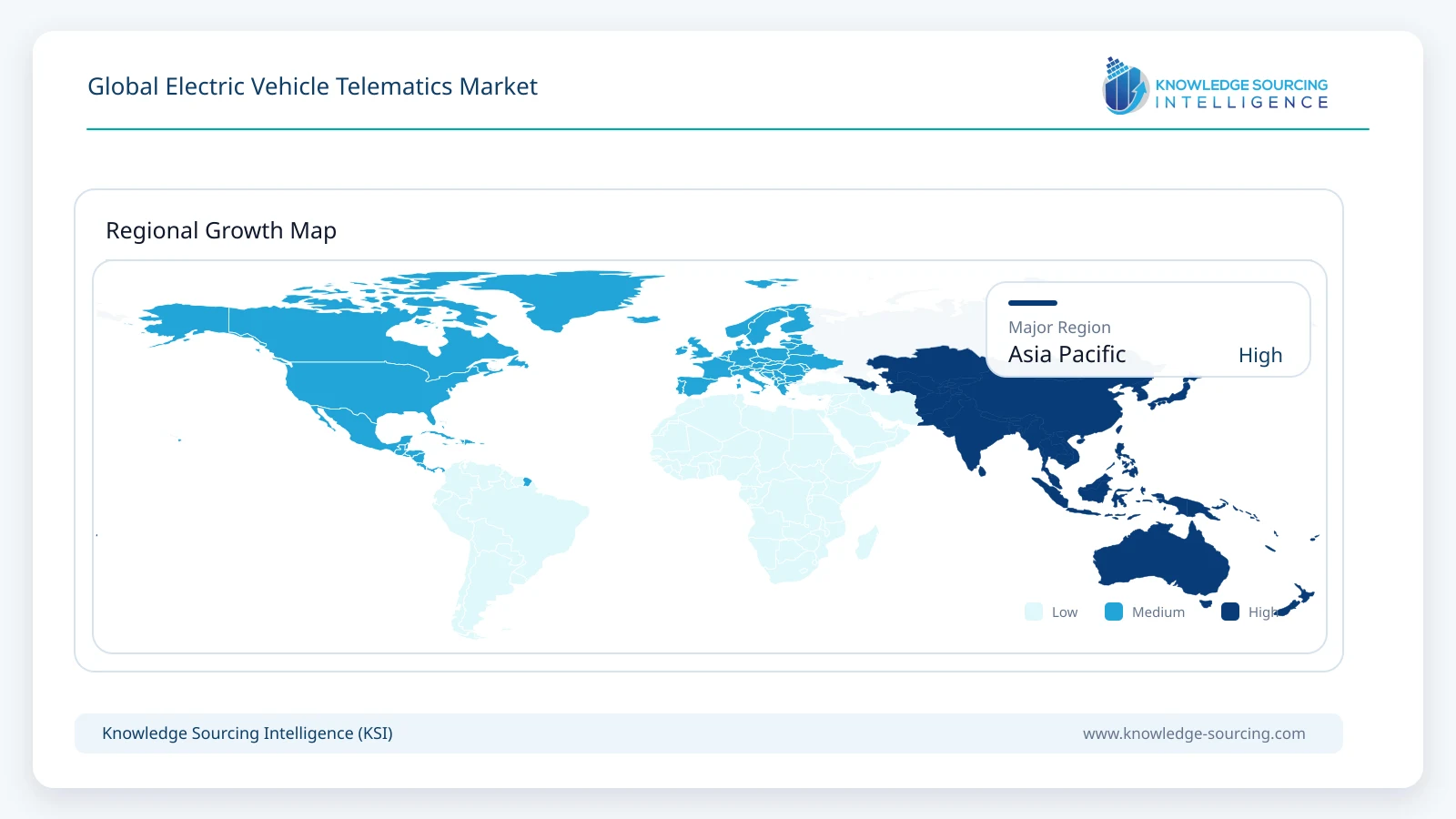
Asia Pacific is expected to remain a major regional market for Electric Vehicle Telematics.
Asia Pacific is expected to remain a leading region because it combines high EV production, large vehicle markets, expanding charging infrastructure, growing connected mobility ecosystems, and strong investments in automotive software. China represents the region's largest EV market, while India, Japan, and South Korea are also developing their electric and connected mobility ecosystems.
China's scale is particularly significant. The IEA reported that more than 13 million electric cars were sold in China in 2025, accounting for approximately 55% of new car sales. An estimated 44 million electric cars were on Chinese roads at the end of 2025. This large installed base creates substantial demand potential for telematics, connected navigation, fleet-management software, battery analytics, and charging-related services.
India is another important growth market. The Ministry of Heavy Industries reported in March 2026 that 19.68 lakh electric vehicles were registered in FY 2024-25, compared with 16.81 lakh in FY 2023-24. EV penetration increased from 6.82% to 7.50%. Government initiatives are also supporting electric mobility infrastructure. The PM E-DRIVE scheme includes an allocation of Rs. 2,000 crore for public charging infrastructure and supports multiple EV categories, including electric two-wheelers, three-wheelers, e-ambulances, and e-trucks.
As of January 27, 2026, the Ministry of Heavy Industries reported that 22.12 lakh EVs had been sold under the PM E-DRIVE scheme, including 19.19 lakh electric two-wheelers and 2.93 lakh electric three-wheelers. The scheme also provides for 14,028 electric buses through an allocation of Rs. 4,391 crore. Such policy-backed deployment can expand the requirement for fleet connectivity, vehicle monitoring, route planning, and operational analytics.
Europe is also expected to remain an important market. UK government statistics published in April 2026 show that 473,000 zero-emission cars were registered for the first time in 2025, representing 23% of new car registrations. Zero-emission light goods vehicle registrations reached approximately 31,000, accounting for 9% of new registrations. These developments are relevant to telematics because commercial electrification creates demand for range monitoring, charging planning, route optimization, and vehicle utilization management.
North America is expected to remain a technologically advanced telematics market because of its mature fleet-management industry, high adoption of connected vehicles, established commercial transportation sector, and growing integration of EVs into corporate and public fleets. The region also has strong demand for safety analytics, predictive maintenance, insurance telematics, driver monitoring, and operational intelligence.
South America and the Middle East and Africa are expected to provide emerging opportunities as electric mobility expands from relatively small bases. Urbanization, fleet modernization, public transport electrification, and the development of charging infrastructure can gradually increase demand for connected vehicle solutions. The pace of adoption is likely to vary considerably between individual countries because of differences in vehicle affordability, charging infrastructure, government policy, and telecommunications coverage.
Electric Vehicle Telematics Market Players and Products:
Geotab Inc. is a major connected vehicle and fleet-management technology provider with solutions covering vehicle telematics, fleet analytics, EV management, and connected vehicle data. Its platform supports multiple connectivity approaches, including dedicated telematics devices, OEM-embedded connectivity, third-party devices, and mixed fleets. The company's EV capabilities include information related to battery state of charge, vehicle efficiency, charging, and fleet performance.
In 2026, Geotab emphasized the transition of telematics toward AI-driven fleet intelligence. At Geotab Connect 2026, the company highlighted the use of connected data from vehicles, assets, video, and infrastructure to develop more comprehensive digital representations of fleet operations. This positioning supports the broader industry movement from basic vehicle tracking toward predictive and prescriptive analytics.
Electra EV is an Indian EV powertrain and technology company offering electric mobility solutions covering powertrain systems, battery systems, vehicle control units, onboard chargers, and related technologies. Its participation in the EV ecosystem makes it relevant to the broader connected-EV value chain, particularly where telematics and vehicle-control information support electric powertrain monitoring and operational management.
Robert Bosch GmbH continues to develop connected and software-driven mobility technologies. At CES 2026, Bosch highlighted software-based mobility, fleet services, vehicle motion management, predictive technologies, and AI-enabled solutions. Bosch's broader connected mobility approach combines vehicle technology, cloud services, software, and data, supporting the development of intelligent connected vehicles and fleet applications.
Continental AG operates across automotive technologies, electrification, connected mobility, and digital solutions. In May 2026, Continental published a white paper focused on digital tire management for fleet reliability, highlighting how digital monitoring can support preventive maintenance, reliability, and reduced unplanned downtime. Such digital fleet-management capabilities complement EV telematics by extending vehicle monitoring beyond basic location data.
TomTom International BV provides location technology, mapping, routing, traffic information, and mobility data relevant to connected vehicles and electric fleets. In July 2026, TomTom announced a partnership with Transit Technologies focused on enhancing fleet and logistics operations. The company's 2026 communications also emphasized the importance of high-quality location data for intelligent systems, electric vehicles, and automated driving.
Electric Vehicle Telematics Market Key Developments:
July 2026: TomTom announced a partnership with Transit Technologies to enhance fleet and logistics operations. The development reinforces the importance of location intelligence, mapping, routing, and real-time mobility data in increasingly connected fleet environments.
June 2026: Geotab and Toyota Connected established a strategic global alliance to integrate advanced connected mobility data, expanding unified telematics capabilities for next-generation electric and connected vehicle fleets.
May 2026: Continental published a fleet-focused white paper on digital tire management, highlighting digital monitoring as a tool for preventive maintenance, reliability, and reducing unplanned downtime. The development reflects the expansion of telematics-related fleet intelligence from vehicle location into predictive maintenance and operational reliability.
March 2026: Geotab and Hyundai announced the launch of a hardware-free native telematics integration for supported Hyundai vehicles in Europe. The solution uses OEM-embedded telematics to provide access to EV insights, GPS data, and proactive maintenance information through the MyGeotab platform, eliminating the requirement for additional aftermarket hardware installation.
February 2026: Geotab used Geotab Connect 2026 to outline its AI-focused direction for telematics, emphasizing connected vehicle, asset, video, and infrastructure data as the foundation for more comprehensive fleet intelligence and digital representations of operational activity.
January 2026: Bosch presented software-driven mobility and connected vehicle technologies at CES 2026, including vehicle motion management, fleet services, software-driven mobility, predictive technologies, and AI-enabled solutions. The development highlights the growing convergence between vehicle connectivity, software, and intelligent mobility.
List of Top Electric Vehicle Telematics Companies:
Airbiquity Inc. (Karma Automotive)
Geotab Inc.
Azuga, Inc.
ERM Advanced Telematics
Trimble, Inc.
Continental AG
Agero, Inc.
Robert Bosch GmbH
TomTom International BV
Intellicar
Sawatch Labs
Electra EV
Samin TekMindz India Pvt. Ltd.
Electric Vehicle Telematics Market Scope
| Report Metric | Details |
|---|---|
| Total Market Size in 2026 | USD 10.3 billion |
| Total Market Size in 2031 | USD 18.3 billion |
| Forecast Unit | Billion |
| Growth Rate | 12.2% |
| Study Period | 2021 to 2031 |
| Historical Data | 2021 to 2024 |
| Base Year | 2025 |
| Forecast Period | 2026 – 2031 |
| Segmentation | Solution, Vehicle Type, Vehicle Weight, Geography |
| Companies |
|
Market Segmentation
By Solution
- Hardware
- Software
- Services
By Vehicle Type
- Battery Electric Vehicles (BEVs)
- Plug-In Hybrid Electric Vehicles (PHEVs)
- Hybrid Electric Vehicles (HEVs)
By Vehicle Weight
- Light
- Heavy
By Geography
- North America
- United States
- Canada
- Mexico
- South America
- Brazil
- Argentina
- Others
- Europe
- United Kingdom
- Germany
- France
- Spain
- Others
- Middle East and Africa
- Saudi Arabia
- Israel
- Others
- Asia Pacific
- Japan
- China
- India
- South Korea
- Others
Table of Contents
1. INTRODUCTION
1.1. Market Overview
1.2. Market Definition
1.3. Scope of the Study
1.4. Market Segmentation
1.5. Currency
1.6. Assumptions
1.7. Base and Forecast Years Timeline
1.8. Key Benefits for Stakeholders
2. RESEARCH METHODOLOGY
2.1. Research Design
2.2. Research Process
3. EXECUTIVE SUMMARY
3.1. Key Findings
4. MARKET DYNAMICS
4.1. Market Drivers
4.2. Market Restraints
4.3. Porter’s Five Forces Analysis
4.3.1. Bargaining Power of Suppliers
4.3.2. Bargaining Power of Buyers
4.3.3. Threat of New Entrants
4.3.4. Threat of Substitutes
4.3.5. Competitive Rivalry in the Industry
4.4. Industry Value Chain Analysis
4.5. Analyst View
5. ELECTRIC VEHICLE TELEMATICS MARKET BY SOLUTION
5.1. Introduction
5.2. Hardware
5.3. Software
5.4. Services
6. ELECTRIC VEHICLE TELEMATICS MARKET BY VEHICLE TYPE
6.1. Introduction
6.2. Battery Electric Vehicles (BEVs)
6.3. Plug-In Hybrid Electric Vehicles (PHEVs)
6.4. Hybrid Electric Vehicles (HEVs)
7. ELECTRIC VEHICLE TELEMATICS MARKET BY VEHICLE WEIGHT
7.1. Introduction
7.2. Light
7.3. Heavy
8. ELECTRIC VEHICLE TELEMATICS MARKET BY GEOGRAPHY
8.1. Introduction
8.2. North America
8.2.1. By Solution
8.2.2. By Vehicle Type
8.2.3. By Vehicle Weight
8.2.4. By Country
8.2.4.1. United States
8.2.4.2. Canada
8.2.4.3. Mexico
8.3. South America
8.3.1. By Solution
8.3.2. By Vehicle Type
8.3.3. By Vehicle Weight
8.3.4. By Country
8.3.4.1. Brazil
8.3.4.2. Argentina
8.3.4.3. Others
8.4. Europe
8.4.1. By Solution
8.4.2. By Vehicle Type
8.4.3. By Vehicle Weight
8.4.4. By Country
8.4.4.1. United Kingdom
8.4.4.2. Germany
8.4.4.3. France
8.4.4.4. Spain
8.4.4.5. Others
8.5. Middle East and Africa
8.5.1. By Solution
8.5.2. By Vehicle Type
8.5.3. By Vehicle Weight
8.5.4. By Country
8.5.4.1. Saudi Arabia
8.5.4.2. Israel
8.5.4.3. Others
8.6. Asia Pacific
8.6.1. By Solution
8.6.2. By Vehicle Type
8.6.3. By Vehicle Weight
8.6.4. By Country
8.6.4.1. Japan
8.6.4.2. China
8.6.4.3. India
8.6.4.4. South Korea
8.6.4.5. Others
9. COMPETITIVE ENVIRONMENT AND ANALYSIS
9.1. Major Players and Strategy Analysis
9.2. Market Share Analysis
9.3. Mergers, Acquisitions, Agreements, and Collaborations
9.4. Competitive Dashboard
10. COMPANY PROFILES
10.1. Airbiquity Inc. (Karma Automotive)
10.2. Geotab Inc.
10.3. Azuga, Inc.
10.4. ERM Advanced Telematics
10.5. Trimble, Inc.
10.6. Continental AG
10.7. Agero, Inc.
10.8. Robert Bosch GmbH
10.9. TomTom International BV
10.10. Intellicar
10.11. Sawatch Labs
10.12. Electra EV
10.13. Samin TekMindz India Pvt. Ltd
Navigate
Trusted by the world's leading organizations











