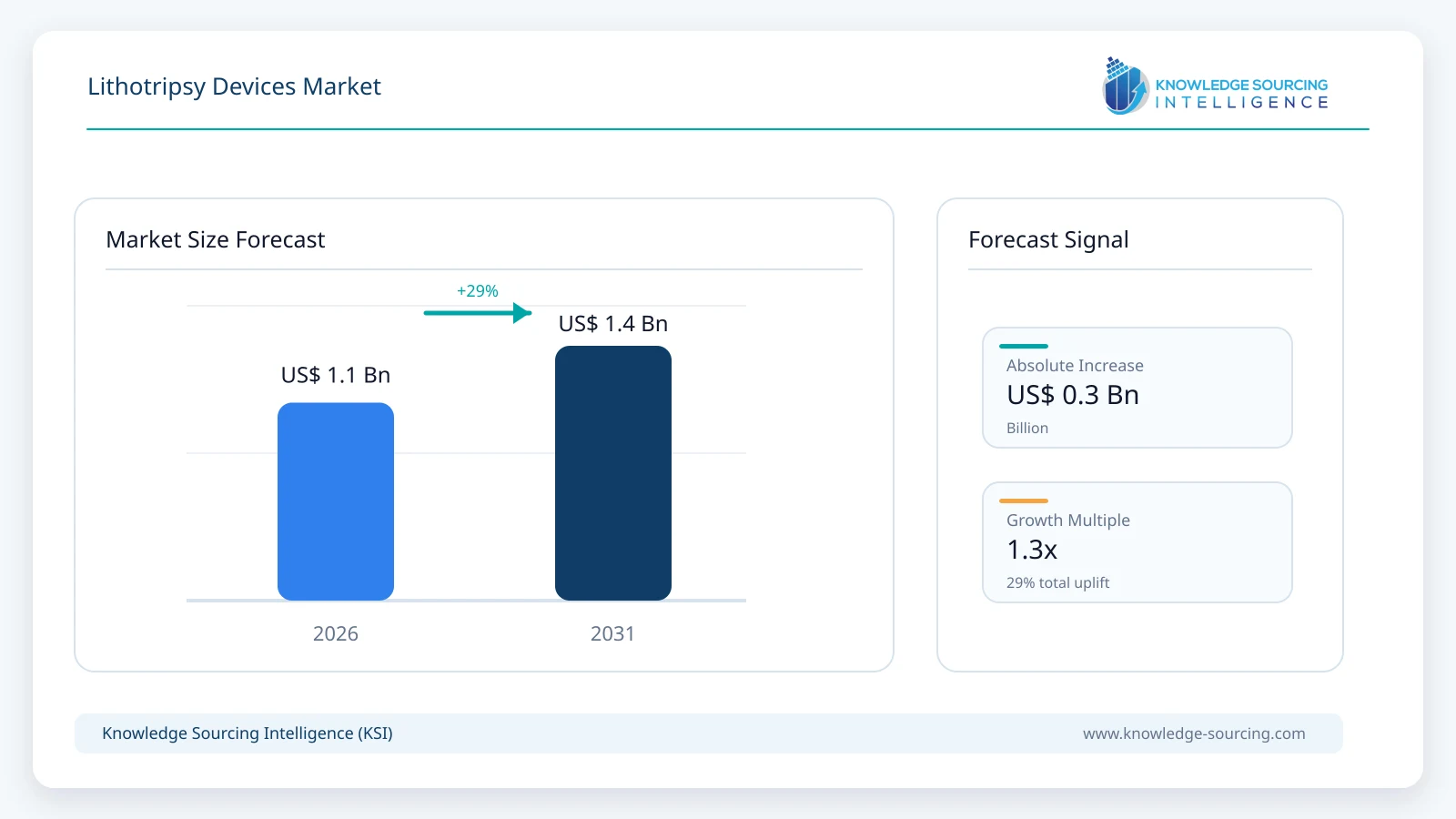
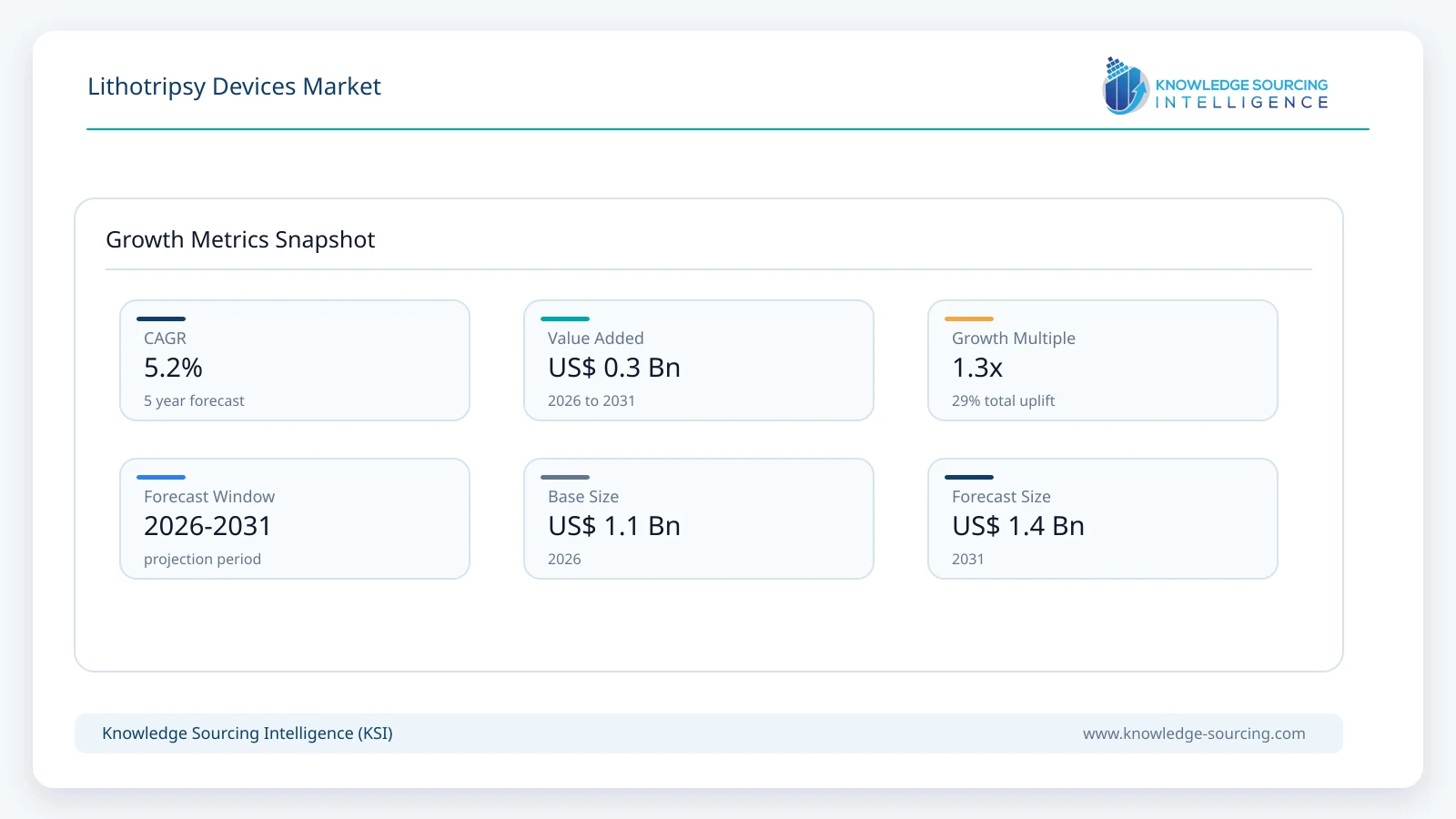
The global lithotripsy devices market is estimated at USD 1.08 billion in 2026 and is projected to reach USD 1.39 billion by 2031, growing at a CAGR of 5.2% across 2026-2031.
Highlights:
- 1Intracorporeal laser lithotripsy accounts for approximately 53% of global 2026 device revenue.
- 2Thulium-fiber systems are expanding alongside established holmium-YAG platforms in endourology.
- 3Shock-wave lithotripsy remains clinically relevant for selected small renal and ureteral stones.
- 4North America leads value demand, while Asia Pacific posts faster equipment-installation growth.
- 5Cardiovascular intravascular lithotripsy is explicitly excluded from this urinary-stone equipment market.
Growth is being shaped by a gradual shift from stand-alone shock-wave treatment toward endoscopic stone management, particularly flexible ureteroscopy paired with higher-performance laser systems. Extracorporeal shock wave lithotripsy remains important because it is non-invasive and suitable for selected renal and ureteral stones, but intracorporeal technologies capture increasing value through higher procedure intensity, laser-console upgrades, fibers, probes, suction-enabled systems, and operating-room integration. The resulting market is a mixed replacement and technology-upgrade opportunity rather than a simple procedure-volume market.
Market Drivers
Persistent kidney-stone burden sustains procedural demand
Urinary stone disease is common and recurrent, creating a durable clinical requirement for stone-fragmentation equipment. NIDDK estimates indicate that kidney stones affect roughly 11% of men and 6% of women in the United States during their lifetime. Recurrence is clinically important, and treatment pathways commonly include shock-wave lithotripsy, ureteroscopy with laser fragmentation, or percutaneous nephrolithotomy depending on stone size, location, composition, anatomy, and prior treatment response. This recurring patient base supports both replacement of installed lithotripters and expansion of flexible endourology capacity in hospitals and ambulatory surgical centers.
Endourology upgrades are increasing laser-platform value
Laser lithotripsy has become a core component of modern ureteroscopic stone management. Olympus reported continued sales growth for its SOLTIVE SuperPulsed Laser System in fiscal 2025 and described the platform as the leading thulium-fiber lithotripsy system in its launched regions. Boston Scientific continues to commercialize its Lumenis Pulse 120H platform with MOSES pulse modulation, while Quanta System, KARL STORZ, LISA Laser Products, and other vendors maintain active urology-laser portfolios. The competitive focus is moving toward higher ablation efficiency, reduced retropulsion, smaller fibers, pulse shaping, digital feedback, and platforms that can serve both stone and soft-tissue procedures.
Combined fragmentation and suction systems improve workflow
Intracorporeal ultrasonic and ballistic systems remain relevant in percutaneous and high-burden stone procedures, especially where simultaneous fragmentation and evacuation can shorten stone-clearance workflow. EMS markets the Swiss LithoClast Trilogy platform combining ballistic and ultrasonic energy with suction, while Olympus supports ultrasonic and pneumatic stone-management technologies alongside laser systems. These platforms are smaller in unit volume than mainstream laser consoles but retain value in complex stone procedures and contribute to recurring probe and accessory demand.
Market Restraints
Long capital-equipment replacement cycles limit annual console demand in mature hospital markets.
Treatment choice depends on stone characteristics, anatomy, local expertise, and reimbursement economics.
High-performance laser systems compete for budgets with endoscopes, imaging, and disposable-accessory upgrades.
Lower-cost regional suppliers intensify pricing pressure in conventional extracorporeal shock-wave systems.
Global Lithotripsy Devices Market Segment Analysis
By Modality
Intracorporeal laser lithotripsy is the largest value segment because modern ureteroscopy increasingly pairs reusable or single-use ureteroscopes with holmium:YAG or thulium-fiber energy. The segment is expected to expand at roughly 6.4% annually through 2031, faster than the overall market, supported by console upgrades and higher-value fiber consumption. Extracorporeal shock-wave lithotripsy remains a meaningful installed-base market, particularly where non-invasive outpatient treatment is preferred. Ultrasonic, pneumatic, ballistic, and combination systems serve percutaneous and complex stone-removal workflows and provide an additional equipment and consumables layer.
By Application and End User
Kidney and ureteral stones dominate device utilization, with bladder stones forming a smaller urological application and biliary or pancreatic stones representing selected endoscopic uses for intracorporeal systems. Hospitals remain the largest end-user group because they concentrate operating rooms, imaging, anesthesia, and complex percutaneous procedures. Ambulatory surgery centers and specialist urology centers are gaining relevance in markets where ureteroscopy and selected shock-wave procedures can be performed efficiently outside large tertiary hospitals.
Regional Analysis
North America represents the largest value pool because of high ureteroscopy utilization, strong adoption of premium laser platforms, and a large ambulatory-surgery infrastructure.
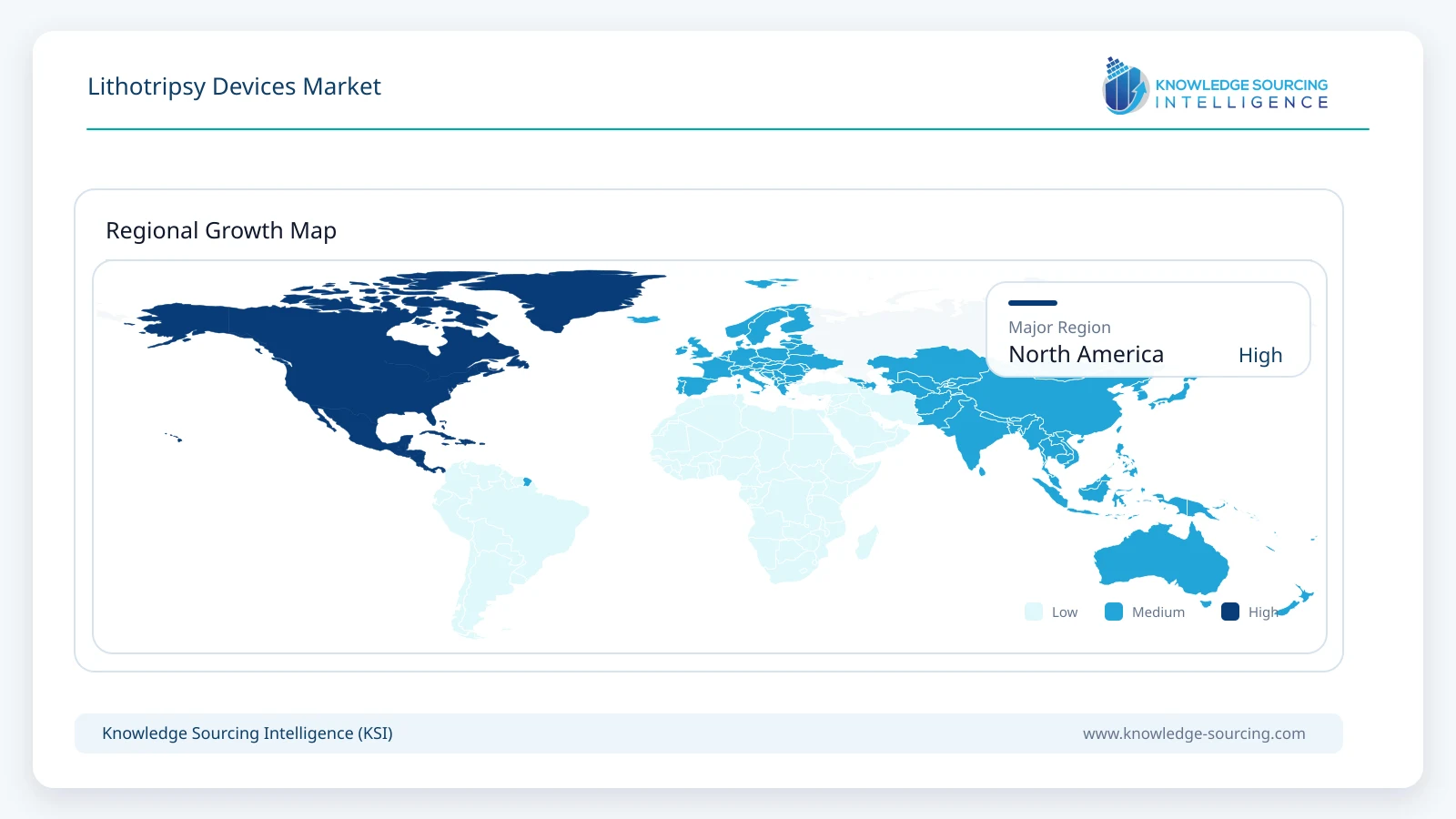
Europe maintains a broad installed base of shock-wave and laser equipment, supported by established German, Swiss, Italian, and other European manufacturers. Asia Pacific is expected to grow fastest as China and India expand urology capacity and domestic manufacturers increase product sophistication. Latin America and the Middle East and Africa remain selective capital-equipment markets, with procurement weighted toward high-throughput tertiary centers and cost-effective shock-wave systems.
Competitive Environment
Competition is divided between diversified endourology suppliers and focused lithotripsy specialists. Boston Scientific and Olympus compete across laser platforms, fibers, stone retrieval, and broader urology workflows. Dornier MedTech and STORZ Medical remain strongly associated with extracorporeal shock-wave systems, while EMS, Quanta System, KARL STORZ, Richard Wolf, Medispec, Potent Medical, Allengers, and other specialists compete by modality and geography. Product differentiation increasingly depends on pulse control, treatment efficiency, integrated suction, service support, energy-source flexibility, regulatory coverage, and the ability to support complete stone-management pathways.
Recent Developments
May 2025: Olympus reported more than 10% fiscal-year growth for SOLTIVE in launched regions and continued geographic expansion of the thulium-fiber platform.
2025-2026: Boston Scientific continued commercialization of the Lumenis Pulse 120H system with MOSES 2.0 technology and a broad lithotripsy fiber portfolio.
June 2026: STORZ Medical highlighted current evidence supporting optimized shock-wave delivery and ongoing relevance of extracorporeal lithotripsy in selected renal stones.
Market Outlook
Through 2031, value growth is expected to concentrate in laser lithotripsy, upgraded pulse-control systems, higher-power compact platforms, and integrated fragmentation-suction workflows. Extracorporeal shock-wave lithotripsy will remain an important option rather than disappearing, but its growth profile is likely to trail endoscopic technologies. Vendors with broad regulatory coverage, strong clinical training, fibers and probes that create recurring revenue, and complete stone-management portfolios are positioned to capture a greater share of equipment refresh cycles.
Global Lithotripsy Devices Market Scope:
| Report Metric | Details |
|---|---|
| Total Market Size in 2026 | USD 1.08 billion |
| Total Market Size in 2031 | USD 1.39 billion |
| Forecast Unit | Billion |
| Growth Rate | 5.2% |
| Study Period | 2021 to 2031 |
| Historical Data | 2021 to 2024 |
| Base Year | 2025 |
| Forecast Period | 2026 – 2031 |
| Segmentation | Modality, Application, End User, Geography |
| Companies |
|
Market Segmentation
By Modality
Extracorporeal Shock-Wave Lithotripsy Systems
Intracorporeal Laser Lithotripsy Systems
Holmium:YAG
Thulium-Fiber Laser
Ultrasonic, Pneumatic and Ballistic Lithotripters
Combination Fragmentation and Suction Systems
By Application
Kidney and Ureteral Stones
Bladder Stones
Biliary and Pancreatic Stones
By End User
Hospitals
Ambulatory Surgery Centers
Urology and Specialist Centers
By Geography
North America
South America
Europe
Middle East and Africa
Asia Pacific
Table of Contents
1. INTRODUCTION
1.1 Market Definition and Scope
1.2 Inclusion and Exclusion Criteria
1.3 Study Period and Currency
2. RESEARCH METHODOLOGY
2.1 Research Design
2.2 Market Estimation and Validation
3. EXECUTIVE SUMMARY
4. MARKET DYNAMICS
4.1 Market Drivers
4.2 Market Restraints
4.3 Market Opportunities
4.4 Technology Trends
5. LITHOTRIPSY DEVICES MARKET BY MODALITY
5.1 Extracorporeal Shock-Wave Lithotripsy Systems
5.2 Intracorporeal Laser Lithotripsy Systems
5.2.1 Holmium:YAG
5.2.2 Thulium-Fiber Laser
5.3 Ultrasonic, Pneumatic and Ballistic Lithotripters
5.4 Combination Fragmentation and Suction Systems
6. LITHOTRIPSY DEVICES MARKET BY APPLICATION
6.1 Kidney and Ureteral Stones
6.2 Bladder Stones
6.3 Biliary and Pancreatic Stones
7. LITHOTRIPSY DEVICES MARKET BY END USER
7.1 Hospitals
7.2 Ambulatory Surgery Centers
7.3 Urology and Specialist Centers
8. LITHOTRIPSY DEVICES MARKET BY GEOGRAPHY
8.1 North America
8.2 South America
8.3 Europe
8.4 Middle East and Africa
8.5 Asia Pacific
9. COMPETITIVE ENVIRONMENT
10. COMPANY PROFILES
10.1 Boston Scientific Corporation
10.2 Olympus Corporation
10.3 Dornier MedTech GmbH
10.4 STORZ MEDICAL AG
10.5 EMS Electro Medical Systems S.A.
10.6 Quanta System S.p.A.
10.7 KARL STORZ SE & Co. KG
10.8 Richard Wolf GmbH
10.9 Medispec Ltd.
10.10 DirexGroup
10.11 Potent Medical
10.12 Allengers Medical Systems Ltd.
10.13 Shenzhen Hyde Medical Equipment Co., Ltd.
10.14 JenaSurgical GmbH
10.15 LISA Laser Products GmbH
Navigate
Trusted by the world's leading organizations