
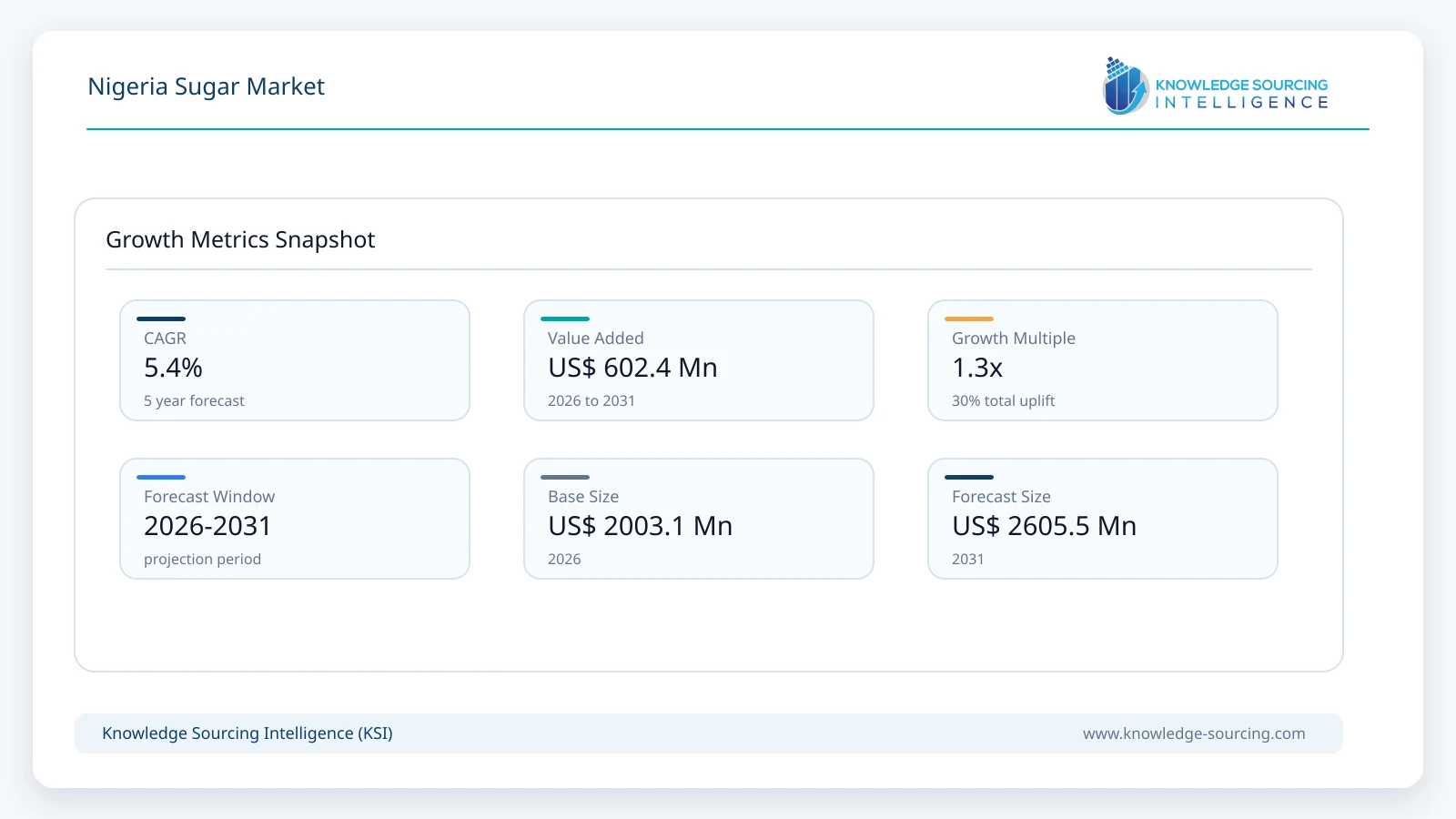
The Nigeria sugar market is forecast to grow at a CAGR of 5.4%, reaching USD 2,605.5 million in 2031 from USD 2,003.1 million in 2026.
Highlights:
- 1Nigeria's sugar market is forecast to reach USD 2,605.5 million by 2031, supported by household use and demand from food and beverage manufacturers.
- 2Industrial users account for approximately 80% of sugar consumption, while household use represents less than 20%, according to USDA Foreign Agricultural Service reporting.
- 3Soft drinks represent the largest industrial sugar-use category, followed by other food and beverages, bakery and confectionery products, and pharmaceuticals.
- 4Domestic sugar production remains constrained by limited industrial cane supply, land access, farm productivity, and the gap between installed refining capacity and actual output.
- 5Nigeria's sugar policy links raw sugar import allocations to backward integration commitments, encouraging refiners to develop local sugarcane estates and processing operations.
- 6Brazil supplies more than 97% of Nigeria's raw sugar imports, leaving refiners exposed to international prices, freight costs, foreign exchange access, and trade policy.
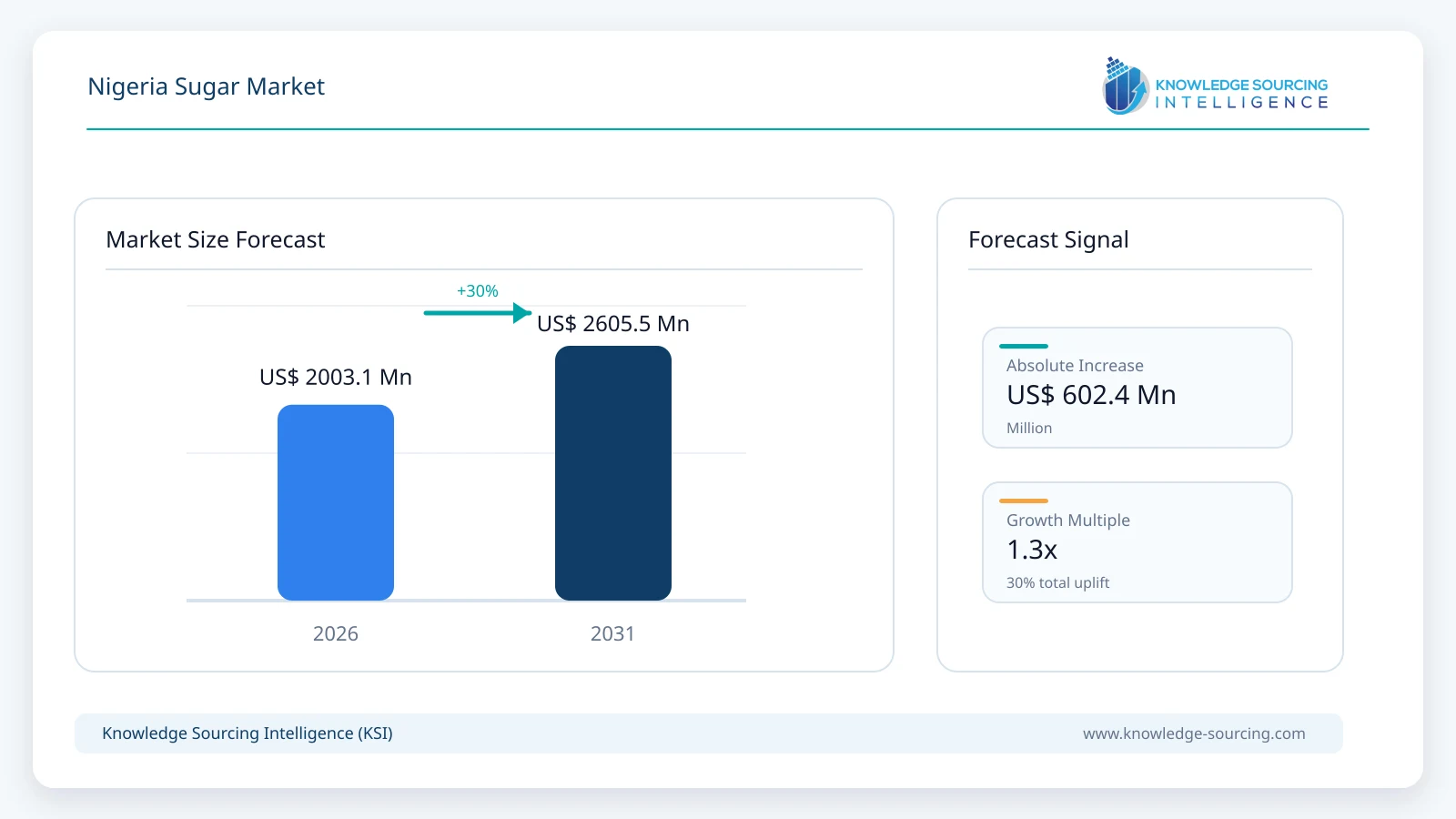
Nigeria's sugar market serves households, beverage producers, bakeries, confectionery manufacturers, pharmaceutical companies, and other industrial users. Demand depends on population needs, packaged food production, beverage consumption, and the supply of refined sugar through domestic mills and imports. Local producers compete on price, distribution, refining capacity, and access to raw sugarcane. The industry's commercial outlook also depends on Nigeria's drive to expand domestic sugar production, reduce import dependence, and improve the performance of integrated sugar estates.
Domestic sugarcane cultivation and refining capacity will play a significant role in determining how much local producers can supply to meet domestic demand. Import costs, foreign exchange availability, infrastructure quality, and the ability to maintain consistent factory output will remain important factors influencing pricing, production efficiency, and investment decisions. Strengthening local processing capabilities and improving supply chain reliability can help reduce dependence on imported sugar while supporting stable market availability. Additionally, fluctuations in agricultural input costs, energy prices, and transportation expenses may affect refining operations and distribution networks. These factors will shape competition between domestic producers and importers, influencing procurement strategies, capacity expansion, and the overall development of the sugar industry.
Key Market Indicators
Indicator | Latest Evidence | Commercial Meaning |
|---|---|---|
Annual sugar consumption | 1.7 million metric tonnes forecast for MY 2025/26 | Food manufacturers and households sustain demand that domestic producers cannot yet fully supply. |
Domestic sugar production | 105,000 metric tonnes forecast for MY 2025/26 | Limited local output leaves the market dependent on imported raw sugar. |
Sugarcane area harvested | 100,000 hectares forecast for MY 2025/26 | Estate expansion and higher cane yields will affect local sugar availability. |
Industrial share of consumption | Approximately 80% | Refiners depend heavily on industrial buyers, especially beverage and food manufacturers. |
Raw sugar import source | Brazil: more than 97% of imports | Concentrated sourcing increases exposure to global supply conditions and shipping costs. |
Sugar Master Plan target | Self-sufficiency target year: 2033 | Long-term policy support is tied to local cane production and domestic processing investment. |
Market Drivers
Industrial demand from beverages and processed foods
Beverage producers, bakeries, confectionery manufacturers, and packaged-food companies account for much of Nigeria's industrial sugar use. According to the USDA Foreign Agricultural Service's April 2025 Sugar Annual, industrial applications represented approximately 80% of national consumption, with soft drinks the largest industrial use category. Sugar supports sweetness, flavour balance, fermentation, colour development, and product texture, depending on the formulation. Manufacturers therefore need a steady supply of refined sugar that meets their production and quality specifications.
Industrial purchasing also differs from household buying. Large beverage plants require bulk deliveries and predictable prices, while smaller bakeries and retailers often buy through distributors. Refiners that can maintain dependable deliveries, suitable packaging, and consistent quality are better placed to retain industrial accounts. Demand can weaken when food inflation reduces consumer spending or when manufacturers reformulate products to control costs.
Sugarcane estate development and domestic processing
Nigeria's Sugar Master Plan links industry support to domestic cane cultivation and processing. The programme encourages refiners to develop estates, work with outgrower farmers, and expand local production. According to USDA estimates published in April 2025, harvested sugarcane area was forecast to reach 100,000 hectares in marketing year 2025/26. This expansion could improve local feedstock supply, although land preparation, irrigation, farm security, and crop yields will determine how much additional cane reaches factories.
The commercial objective is to reduce reliance on imported raw sugar while developing local production capacity. Dangote Sugar Refinery Plc, BUA Foods Plc, and Flour Mills of Nigeria Plc have invested in integrated operations or sugarcane projects. Their returns depend on more than installed refinery capacity. Estate productivity, the quality of cane, transport from farms, milling performance, and the recovery of sugar from cane all affect the amount and cost of saleable output.
Domestic distribution and access to refined sugar
Sugar reaches Nigerian customers through wholesalers, food-service suppliers, traditional retailers, supermarkets, and industrial distribution networks. Bulk customers may buy directly from refiners, while households and small businesses often purchase packaged sugar through shops and local distributors. Availability across these channels affects the cost and convenience of buying sugar, particularly in areas far from refining and packaging centres.
Distribution economics also influence product choice. Industrial customers often need large volumes of standard refined sugar, whereas households may prefer smaller packs or different sugar types. Suppliers must balance transport costs, stock levels, pack sizes, and retailer margins. Online channels may widen access to packaged products, but their commercial value depends on delivery costs, order size, and the strength of existing retail networks.
Policy-backed investment in local sugar production
Government support provides a direct incentive for investment in Nigerian sugar estates and processing plants. In August 2026, the National Sugar Development Council announced an investment framework that included a financing partnership with SINOMACH of China and a Sugar Project Acceleration Fund established with the Bank of Industry. The initiative aims to prepare bankable projects and improve financing access for new and expanded sugar operations.
These measures could help projects move from land acquisition and planning into construction and production. Their effect will depend on the timely release of finance, access to suitable land, infrastructure, community relations, and execution by project operators. Investment announcements alone do not guarantee additional sugar output. Commercial progress will be clearer when projects achieve defined construction milestones, plant commissioning, and reliable cane supply.
Market Restraints and Challenges
Dependence on imported raw sugar
Nigeria's domestic refining industry relies heavily on imported raw sugar. USDA's April 2025 report forecast raw sugar imports of 1.9 million metric tonnes for marketing year 2025/26, compared with domestic sugar production of 105,000 metric tonnes. These were forecasts, not confirmed final results, but they show the scale of the supply gap facing local producers.
Import dependence exposes refiners to world sugar prices, shipping costs, foreign exchange access, and port delays. The USDA report also identified Brazil as the source of more than 97% of Nigeria's raw sugar imports. This concentration can leave refiners vulnerable to changes in Brazilian export supply or international freight conditions. Diversifying supply sources may reduce exposure, but alternative origins must meet quality needs and remain competitive after tariffs and transport costs.
Limited industrial cane supply and estate productivity
Refineries need sufficient raw sugar or locally grown cane to use their installed capacity efficiently. Domestic cane projects face constraints linked to irrigation, farm inputs, land access, crop management, transport, and relations with host communities. USDA reporting identifies insecurity, communal hostilities, and land ownership disputes as challenges to plans for expanding cane cultivation.
These issues can delay planting, reduce harvested volumes, or raise the cost of supplying mills. Cane is also a perishable industrial feedstock whose harvest and delivery must align with factory operations. Refiners that expand processing capacity before securing reliable cane supply risk leaving assets underused. Long-term farm planning, outgrower agreements, irrigation investment, and stronger field management are therefore central to improving domestic production.
Foreign exchange and operating-cost pressure
Refiners that import raw sugar must fund international purchases and associated freight, duties, and local handling. When access to foreign currency tightens or the naira weakens, the local cost of imported feedstock rises. Energy, fuel, transport, packaging, and finance costs can add further pressure, particularly when buyers resist higher selling prices.
The USDA's April 2025 assessment linked lower sugar imports in 2024 to high operating costs and difficulty obtaining foreign exchange.
Refiners can manage some of this exposure through inventory planning, operating efficiency, working-capital control, and more reliable local sourcing. However, large import requirements mean currency and commodity-price risk will remain important until domestic cane production supplies a greater share of refinery needs.
Food affordability and sugar-related policy
Sugar demand depends on the purchasing power of households and the sales performance of food manufacturers. When food prices rise, consumers may reduce purchases of sweetened products or shift toward cheaper brands and smaller packs. Bakeries and confectionery producers may also adjust recipes, output, or selling prices when sugar costs rise.
Public health policy adds another consideration for beverage manufacturers. Nigeria introduced a specific excise duty on sugar-sweetened non-alcoholic and carbonated drinks in 2022. The duty affects beverage economics rather than all sugar sales directly, but it can influence the cost and pricing of products that use sugar as an ingredient.
Future changes to the tax framework could affect product formulation, retail prices, and sugar purchasing by beverage companies.
Major Segment Analysis
Food and Beverages
Food and beverages represent the most commercially important application group within Nigeria's sugar market because manufacturers use sugar across drinks, bakery products, confectionery, and packaged foods. USDA reporting identifies soft drinks as the largest industrial use category, followed by other food and beverages, bakery and confectionery products, and pharmaceuticals. Industrial demand is therefore central to refining economics and to the ability of local suppliers to secure regular high-volume sales.
Beverage manufacturers tend to value dependable bulk supply, consistent quality, and predictable delivered prices. Bakeries and confectionery producers may place greater emphasis on the sugar's performance in recipes, including sweetness, colour, texture, and crystallisation. Buyers also differ in storage capacity and the size of orders they can finance. Refiners and distributors must serve these requirements without allowing delivery costs or inventory needs to erode margins.
Domestic supply constraints create both an opportunity and a risk for this segment. More reliable local refining and cane production could reduce exposure to imported supply, but industrial buyers will continue to compare price and reliability across available suppliers. Demand may also respond to food inflation, beverage taxes, and changes in product formulation. Suppliers that combine consistent quality with dependable distribution are better positioned to retain customers as the industry expands domestic production.
Regional Analysis
Northern Nigeria
Northern states such as Adamawa, Niger, Kaduna, Kano, and Kwara are relevant to sugarcane cultivation and estate development. The USDA identifies several of these states as sugarcane-producing areas, while established projects in Adamawa and Niger link farming with industrial processing. Agricultural conditions, irrigation access, road infrastructure, and security affect how efficiently cane reaches mills.
For producers, the key regional issue is not simply the availability of suitable land. Commercial cane production also needs reliable water, farm inputs, skilled labour, and clear arrangements with local communities. Where these conditions are weak, estate expansion may not translate into higher factory output. Outgrower programmes can broaden the supply base, provided farmers have access to inputs, technical support, and dependable offtake arrangements.
Lagos and the southern industrial corridor
Lagos is central to the market because major sugar refining and distribution operations are located there. Port access supports the receipt of imported raw sugar, while proximity to food manufacturers, wholesalers, and transport networks helps refiners serve industrial customers. BUA Foods also operates a refinery in Port Harcourt, extending its processing footprint beyond Lagos.
These locations offer access to established industrial demand, but they also expose refiners to port congestion, transport costs, power supply issues, and the need to move sugar inland. Refining operations must coordinate imported feedstock, processing schedules, packaging, and delivery to customers. The regional advantage therefore depends on efficient logistics and reliable factory operations, not location alone.
Central Nigeria and emerging estate projects
Niger, Kwara, Nasarawa, and nearby areas are relevant to the development of integrated sugar estates. Projects in these states aim to connect cane farming with processing capacity and reduce the gap between domestic production and demand. The commercial viability of each project depends on land development, water supply, farm productivity, financing, and the ability to operate mills at suitable utilisation levels.
Investors must also account for community engagement and the time required to bring agricultural projects to commercial output. New estates may need several production cycles before they can supply factories consistently. Regional comparisons should therefore focus on verified production, processing milestones, and access to infrastructure rather than assume that every announced project will deliver its planned capacity.
Competitive Landscape
Nigeria's sugar industry is concentrated around a small group of refiners with established distribution networks and investments in domestic cane production. Dangote Sugar Refinery Plc, BUA Foods Plc, and Flour Mills of Nigeria Plc, through Golden Sugar Company, operate within a policy framework that links raw sugar import access to backward integration commitments. Their ability to secure raw materials, operate refineries efficiently, and develop estates affects their cost position and supply reliability.
Dangote Sugar's operations include the Savannah Sugar estate in Adamawa and other planned or developing cane projects. BUA Foods combines refining assets with the development of its Lafiagi estate. Flour Mills of Nigeria operates Golden Sugar Company and the Sunti Golden Sugar Estate in Niger State. These integrated strategies aim to increase local cane supply, although project execution and actual output remain critical measures of progress.
Savannah Sugar Company, Sunti Golden Sugar Estate, and Bacita Sugar Company also matter to the domestic production base. Their contribution depends on estate performance, access to capital, mill condition, and the availability of suitable cane. Bacita's longer-term commercial role will depend on investment and the restoration or expansion of production operations. Differences in project maturity mean that stated capacity should not be treated as equivalent to current output.
The competitive advantage of established refiners comes from their processing assets, customer relationships, distribution access, and ability to secure raw sugar import allocations. New entrants face barriers in financing estates, obtaining approvals, building infrastructure, and developing supply relationships with industrial buyers. Competition is also shaped by policy: import allocation rules can influence access to feedstock, while domestic cane production can affect the ability to qualify for permitted imports.
Recent Developments
September 2026: The National Sugar Development Council reported a sugarcane training programme for 15 young agricultural professionals at BUA's Lafiagi estate and the Nigeria Sugar Institute. The programme covered field operations and laboratory work, addressing the technical skills needed to improve cane cultivation and estate productivity.
August 2026: The National Sugar Development Council announced a $1 billion investment pipeline and a ?10 billion Sugar Project Acceleration Fund. The framework is intended to prepare bankable projects, support financing, and tighten monitoring of backward integration commitments. Its market effect will depend on project delivery and additional domestic sugar output.
February 2026: BUA Group signed a memorandum of understanding with AD Ports Group and MAIR Group. The proposed collaboration covers sugar refining, agro-industrial development, and integrated logistics. If translated into projects, the partnership could improve supply-chain coordination and support the development of BUA's sugar operations.
Regulatory and Policy Environment
Nigeria Sugar Master Plan and backward integration
The Nigeria Sugar Master Plan seeks to reduce import dependence by linking refinery operations with domestic sugarcane production. Under the Backward Integration Programme, participating refiners must demonstrate progress on local production commitments to qualify for raw sugar import allocations. The government extended the plan to 2033, giving operators a longer period to develop estates and processing facilities.
The framework affects investment planning, feedstock access, and competitive conditions. Import quotas are not simply a purchasing entitlement; they are linked to the operator's performance against approved commitments. Companies must therefore manage agricultural investment and refining operations together. Weak estate performance can restrict access to imported raw sugar, while delays in local projects may affect the use of refinery capacity.
Import duties and market access
Nigeria restricts imports of refined sugar in retail packs and uses a controlled system for raw sugar imports by approved refiners. USDA reporting describes a duty and levy structure for eligible raw sugar imports, along with requirements tied to backward integration plans. The rules aim to protect local investment and encourage domestic production, but they also shape the cost structure of refiners and downstream buyers.
Importers and industrial buyers need to track policy changes, quota approvals, customs procedures, and applicable duties. Manufacturers that rely on sugar must account for the risk that changes in import access or landed cost can affect supply and pricing. For domestic producers, the same rules can provide protection from some forms of import competition, but long-term benefits depend on whether local production becomes more efficient.
Food safety, labelling, and public health
Sugar sold for food use must meet applicable Nigerian food safety and labelling rules. NAFDAC's food labelling guidance covers required product information, while relevant standards and regulations govern the sale of food products and permitted ingredients. Companies must ensure that packaged products carry accurate descriptions and comply with applicable labelling obligations.
Public health measures also affect the downstream market. The sugar-sweetened beverage excise duty adds a cost to specified drinks, which may influence pricing and demand among beverage producers. Any future changes to the tax structure could increase the incentive to review sugar content or product mix. Sugar suppliers should monitor these developments because beverage demand is an important source of industrial sales.
Outlook and Strategic Implications
Nigeria's sugar market is expected to expand through 2031, supported by demand from households and industrial users. The pace of development will depend on consumer purchasing power, food and beverage production, international sugar prices, and the performance of domestic refining and farming projects. The supplied forecast provides the market's expected financial trajectory, but actual outcomes will depend on how effectively supply constraints are addressed.
Domestic production remains the central strategic issue. Expanding cane cultivation, improving yields, securing irrigation, training agricultural workers, and bringing projects into operation could reduce import dependence over time. However, estate development requires patient capital and effective coordination among refiners, farmers, local communities, financiers, and government agencies. Project announcements should be assessed against milestones in land preparation, planting, harvesting, milling, and refined sugar output.
The main commercial priorities are:
For refiners: Improve refinery utilisation, secure dependable raw sugar supplies, and link capacity expansion to measurable progress in domestic cane production.
For industrial buyers: Diversify sourcing where practical, monitor delivered costs, and maintain product specifications that support consistent production.
For investors: Assess project execution, irrigation, estate productivity, import allocation rules, and the time needed to reach commercial output.
For distributors: Strengthen delivery networks and inventory planning to serve both high-volume industrial customers and smaller retail buyers.
For policymakers: Link import incentives to verifiable production outcomes while addressing infrastructure, financing, skills, and community issues that limit local supply.
The industry's commercial prospects will ultimately depend on whether Nigeria can convert refining capacity and agricultural investment into reliable domestic output. Efficient operations, stronger cane supply, predictable rules, and access to industrial customers will determine how well local producers compete with imported sugar and capture value within the Nigerian economy.
Nigeria Sugar Market Scope:
| Report Metric | Details |
|---|---|
| Total Market Size in 2026 | USD 2,003.1 million |
| Total Market Size in 2031 | USD 2,605.5 million |
| Forecast Unit | Million |
| Growth Rate | 5.4% |
| Study Period | 2021 to 2031 |
| Historical Data | 2021 to 2024 |
| Base Year | 2025 |
| Forecast Period | 2026 – 2031 |
| Segmentation | Type, Crop, Form, Distribution Channel |
| Companies |
|
| Customization Scope | 15% Free Customization included with purchase — Request Custom Breakdown → |
| Sample & Data Access | PDF Sample, Excel Databook & Analyst Briefing — Download Free Sample → |
Market Segmentation
By Type
White Sugar
Brown Sugar
Confectioners’ Sugar
Raw Sugar
Other Types
By Crop
Sugarcane
Sugar Beet
By Form
Solid
Liquid
By Distribution Channel
Offline
Online
By Application
Sweetener
Preservative
Texture Modifier
Flavoring and Coloring Agent
Bulking Agent
Other Applications
By Industry Vertical
Food and Beverages
Pharmaceuticals
Personal Care and Other Industrial Applications
Table of Contents
1. INTRODUCTION
1.1. Market Overview
1.2. Market Definition
1.3. Scope of the Study
1.4. Currency
1.5. Base and Forecast Years Timeline
1.6. Market Segmentation
1.7. Key Benefits for Stakeholders
2. RESEARCH METHODOLOGY
3. EXECUTIVE SUMMARY
3.1. Key Findings of the Study
4. MARKET DYNAMICS
4.1. Market Drivers
4.1.1. Rising Demand for Sugar and Sugar-Based Products
4.1.2. Government Initiatives to Expand Domestic Sugar Production
4.1.3. Investments in Sugar Refining and Backward Integration Projects
4.1.4. Growth in Food and Beverage Manufacturing
4.1.5. Expansion of Retail and Distribution Networks
4.2. Market Restraints
4.2.1. Dependence on Imported Raw Sugar
4.2.2. Limited Domestic Sugarcane Production and Processing Capacity
4.2.3. Infrastructure, Irrigation, and Energy Constraints
4.2.4. Foreign Exchange and Raw Material Cost Volatility
4.3. Market Opportunities
4.3.1. Development of Integrated Sugarcane Estates
4.3.2. Expansion of Domestic Sugar Processing Capacity
4.3.3. Value Addition Through Sugarcane By-Products
4.4. Porter’s Five Forces Analysis
4.4.1. Bargaining Power of Suppliers
4.4.2. Bargaining Power of Buyers
4.4.3. Threat of New Entrants
4.4.4. Threat of Substitutes
4.4.5. Competitive Rivalry in the Industry
4.5. Industry Value Chain Analysis
4.6. Policies and Regulations
5. NIGERIA SUGAR MARKET BY TYPE
5.1. Introduction
5.2. White Sugar
5.3. Brown Sugar
5.4. Confectioners’ Sugar
5.5. Raw Sugar
5.6. Other Types
6. NIGERIA SUGAR MARKET BY CROP
6.1. Introduction
6.2. Sugarcane
6.3. Sugar Beet
7. NIGERIA SUGAR MARKET BY FORM
7.1. Introduction
7.2. Solid
7.3. Liquid
8. NIGERIA SUGAR MARKET BY DISTRIBUTION CHANNEL
8.1. Introduction
8.2. Offline
8.3. Online
9. NIGERIA SUGAR MARKET BY APPLICATION
9.1. Introduction
9.2. Sweetener
9.3. Preservative
9.4. Texture Modifier
9.5. Flavoring and Coloring Agent
9.6. Bulking Agent
9.7. Other Applications
10. NIGERIA SUGAR MARKET BY INDUSTRY VERTICAL
10.1. Introduction
10.2. Food and Beverages
10.3. Pharmaceuticals
10.4. Personal Care and Other Industrial Applications
11. COMPETITIVE ENVIRONMENT AND ANALYSIS
11.1. Major Players and Strategy Analysis
11.2. Emerging Players and Market Opportunities
11.3. Mergers, Acquisitions, Agreements, and Collaborations
11.4. Vendor Competitiveness Matrix
11.5. Competitive Positioning of Domestic Sugar Refiners
12. COMPANY PROFILES
12.1. Dangote Sugar Refinery Plc
12.1.1. Overview
12.1.2. Products and Services
12.1.3. Sugar Refining and Backward Integration Operations
12.1.4. Key Developments
12.2. BUA Foods Plc
12.2.1. Overview
12.2.2. Products and Services
12.2.3. Sugar Refining and Backward Integration Operations
12.2.4. Key Developments
12.3. Flour Mills of Nigeria Plc
12.3.1. Overview
12.3.2. Products and Services
12.3.3. Golden Sugar Company and Integrated Operations
12.3.4. Key Developments
12.4. Savannah Sugar Company
12.4.1. Overview
12.4.2. Products and Services
12.4.3. Sugarcane Cultivation and Processing Operations
12.5. Sunti Golden Sugar Estate
12.5.1. Overview
12.5.2. Products and Services
12.5.3. Sugarcane Cultivation and Processing Operations
12.6. Bacita Sugar Company
12.6.1. Overview
12.6.2. Products and Services
12.6.3. Sugar Estate and Production Operations
13. APPENDIX
13.1. Currency
13.2. Assumptions
13.3. Base and Forecast Years Timeline
13.4. Key Benefits for Stakeholders
13.5. Research Methodology
13.6. Abbreviations
14. LIST OF TABLES
15. LIST OF FIGURES





Frequently asked questions
What is the projected market size of Nigeria's sugar market by 2031?
Nigeria's sugar market will reach USD 2,605.5 million by 2031.
What is the forecast CAGR for Nigeria's sugar market (2026-2031)?
The Nigeria Sugar Market is forecast to grow at a CAGR of 5.4%.
Which industries drive the most sugar consumption in Nigeria?
Industrial users, especially soft drinks, account for 80% of consumption.
What are the key constraints for domestic sugar production in Nigeria?
Limited cane supply, land access, and farm productivity constrain output.
Who is Nigeria's primary raw sugar import supplier?
Brazil supplies over 97% of Nigeria's raw sugar imports.
What is the annual sugar consumption forecast for Nigeria (MY 2025/26)?
Annual sugar consumption is 1.7 million metric tonnes for MY 2025/26.
Cite this report
Knowledge Sourcing Intelligence. (Oct 2026). Nigeria Sugar Market - Strategic Insights and Forecasts (2026-2031). https://www.knowledge-sourcing.com/report/nigeria-sugar-market