
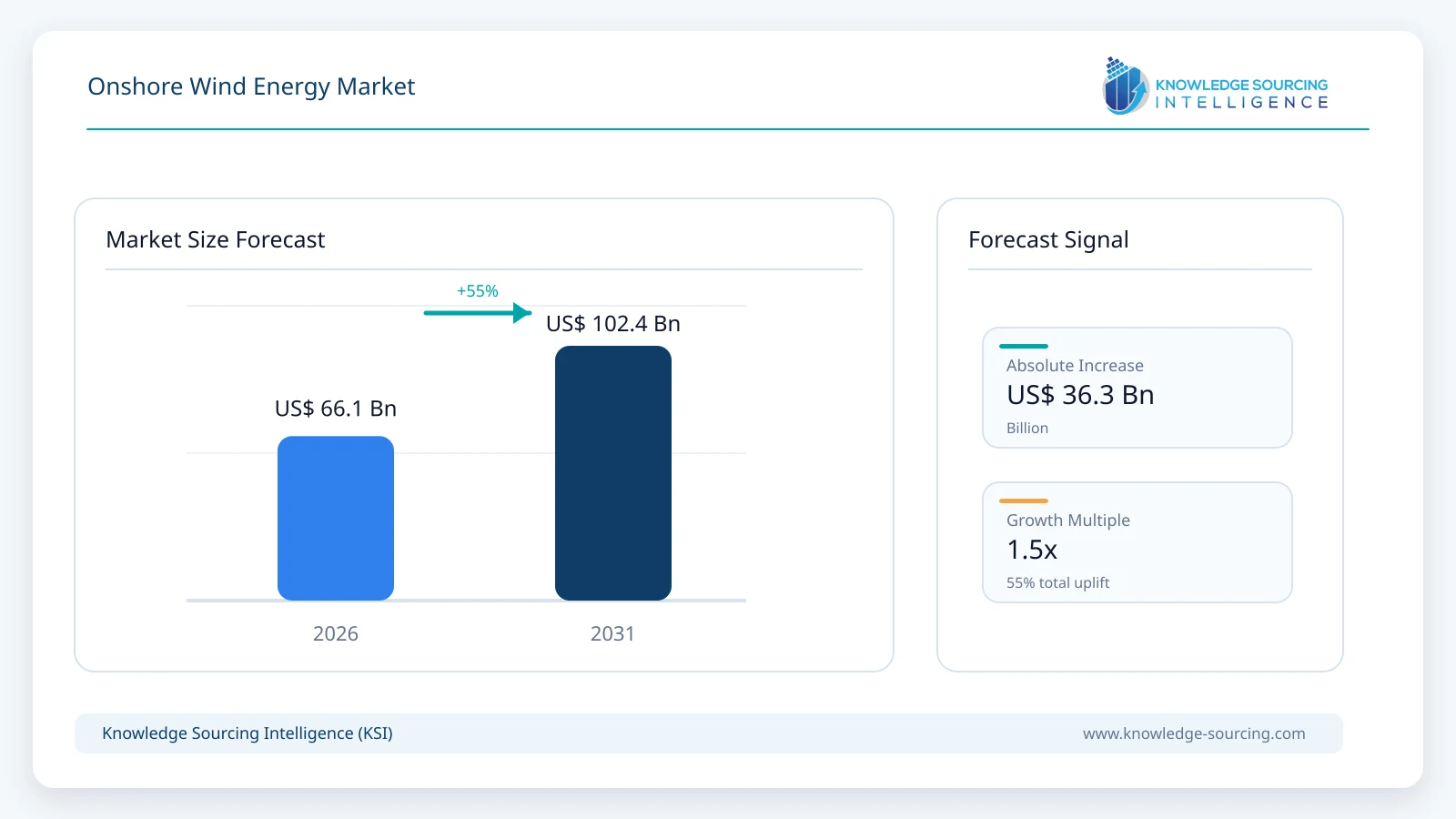
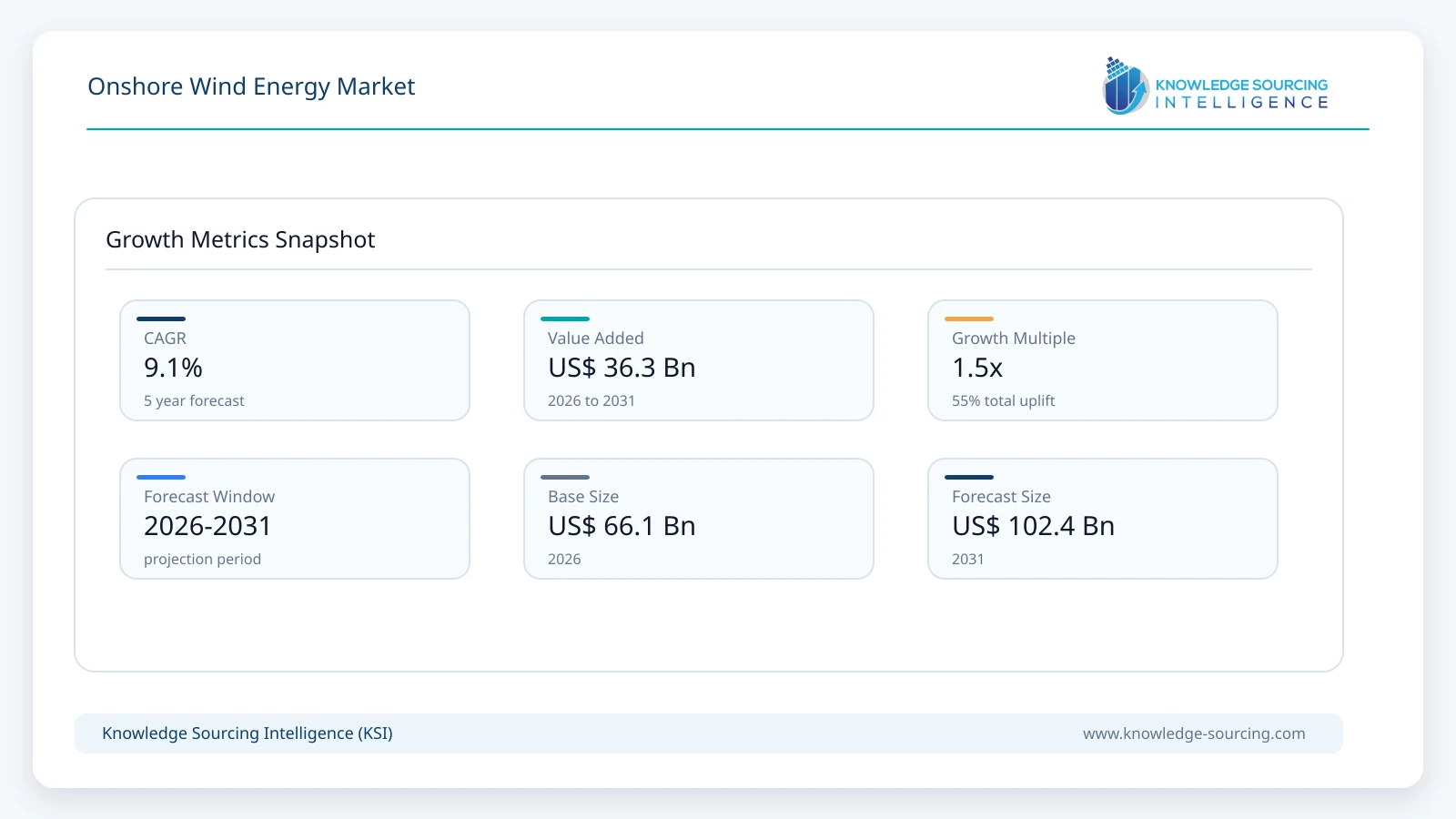
The Onshore Wind Energy Market is projected to increase from USD 66.12 billion in 2026 to USD 102.43 billion by 2031, at a CAGR of 9.1%.
Highlights:
- 1An increase in renewable electric power generating capability will support additional onshore wind generation facilities and related transmission systems investments.
- 2Turbine producers are designing bigger-capacity models that feature larger rotor sizes to enhance energy collection and the output from a particular development.
- 3Repowering and component replacements will create additional demand above the already generated demand by the construction of new projects.
- 4The use of digital monitoring, predictive maintenance, and service contracts has become more prevalent as a means of improving the availability and life-cycle performance of turbines.
Onshore wind energy is electricity produced by wind turbines located on land. Wind turbines use the kinetic energy of the moving air to turn a rotor, which produces mechanical energy. A generator converts that mechanical energy into electrical energy. Most onshore wind projects involve multiple wind turbines arranged in what is called a wind farm. The turbines are electrically connected through various components of the electrical system such as transformers, collection cables, substations, and transmission lines.
The wind turbine market consists of three main segments: wind turbines, the electrical infrastructure required to connect them to the power grid, and the operations & maintenance (O&M) systems used to operate and maintain them. The wind turbine segment includes the individual components that make up a wind turbine, such as blades, tower, nacelle, generator, gearbox/direct-drive system, power converter, pitch system, and yaw mechanism. The electrical infrastructure segment includes the individual components that provide electrical connections between the wind turbine and the electric utility grid, such as cable, switchgear, substation, protection system, and grid connection equipment. The O&M systems segment includes the individual components that enable operators to perform routine maintenance on their wind turbines, scheduled service, component replacement, remote diagnostic capabilities, spare parts inventory, and asset performance management.
Onshore wind projects can be built as a brand-new greenfield installation, an expansion on a pre-existing brownfield site, a replacement of old wind turbines with new ones that generate more power from existing wind resources and project area, or a partial replacement of worn-out parts of the original project. Greenfield installations create new wind generation capacity where there was no previous development of this type of energy. Repowering replaces aging wind turbines with newer ones to take advantage of the same wind resources and project areas to generate more electrical output.
The Global Wind Energy Council (GWEC) reported that during 2025, there was an addition of about 165 gigawatts (GW) of new wind energy capacity installed globally. As a result of this installation activity, the world's total wind energy capacity increased to about 1,299 GW. The data provided above represents the growth of the overall wind industry as opposed to the size of the onshore market alone.
Market Dynamics
Market Drivers
Growth of investments in new renewable electricity generation: Governments, utility companies, and other organizations that purchase electricity are investing in new renewable energy generation to help increase the diversity of their energy sources and decrease the amount of greenhouse gas emitted from the energy sector. On-shore wind will likely continue to be one of the best options for large-scale utility renewable energy projects, as on-shore wind projects can be built on many different types of land. Additionally, on-shore wind projects can provide long-term procurement of electricity through power-purchase agreements and competitive renewable energy bidding processes. The number of new wind installation projects globally reported by GWEC illustrates the continued expansion of the wind industry, although this reporting includes both on-shore and off-shore installations.
Rising electricity demand and the necessity of increasing electricity production capacity: Electricity usage continues to rise as industries electrify, more data centers are developed, transportation systems are electrified, and more energy-consuming air conditioning is used. This creates a need to create more electricity production capacity to satisfy the rising demand for electricity without compromising the reliability of the grid system. Onshore wind projects provide a way to add electricity production capacity in areas that have good wind resources, available land for wind farms, access to the electrical grid, and financially viable project opportunities. When onshore wind projects are developed in conjunction with improvements to the electrical grid system, storage technologies, and other flexible resources, their contribution to regional electricity production portfolios is further enhanced.
Improvements in wind turbines: Manufacturers have developed several ways to improve the performance of their turbines. Those ways are to increase the size of the turbine's rotor diameter, raise the height of the turbine's tower, enhance the aerodynamics of the turbine's blades, use more sophisticated power electronics in the turbine, and develop better control systems for the turbine. These advancements enable manufacturers to create turbines that are able to work well in a variety of different types of winds. Turbines developed specifically for use in low-to-medium wind environments will allow developers to build successful projects at locations where previous types of turbines were unable to operate effectively. Manufacturers who produce large-scale utility-grade onshore turbines include Vestas, Nordex, GE Vernova, and Suzlon.
Repowering and updating old wind farms: Older wind farms may use wind turbine models that produce less power, have less advanced controls, or have components that are hard to find. Repowering can replace older machines with newer wind turbines to potentially increase energy production at existing sites. Partial repowering, which includes replacing blades, generators, gearboxes, converters, and control systems, can help keep existing assets working longer. Repowering creates opportunities for wind turbine manufacturers, component suppliers, engineering firms, and companies providing ongoing maintenance services.
Market Restraints & Opportunities
The development of wind power involves expenditures for turbine manufacturing, foundation installation, road construction, electrical system installations, grid interconnection, land acquisition, and construction. Elevated interest rates, equipment costs, and financing risk may reduce the profitability of the project, especially when the price paid for the generated electricity or auction tariff does not cover the cost of developing the project.
The availability of suitable wind resources is not always correlated with the capacity of existing transmission systems. Grid connection delays, environmental approval processes, land use permitting, and community consultation can all cause a delay in the completion of projects. Therefore, both transmission system expansion and improved coordination during the planning phase will be necessary to transform proposed developments into operational facilities.
Aging turbines in the fleet generate a need for replacement parts, performance improvements, digital monitoring, and maintenance agreements. Manufacturers and service providers have the ability to assist asset owners through condition-based maintenance, remote failure detection, spare part planning, and turbine upgrades. Repowering is another option for developers to produce more electricity from existing locations with the potential for development of additional generating capacity, provided that permitting, grid capacity, and site-specific feasibility are met.
With the increasing demand for electricity and growing use of renewable energy procurement, there is an opportunity to expand wind power generation in many countries. Countries with large-scale wind power projects include India, China, Brazil, among others. These countries offer potential markets for turbine manufacturers, component suppliers, EPC contractors, and O&M service providers. A country's ability to develop its wind power capacity will depend on a number of factors such as governmental policy, available financing options, transmission infrastructure improvements, and the suitability of wind resources within the country.
Key Developments
September 2026: GE Vernova announced that it has entered into a contract to provide 16 turbines with a capacity of 6.1 MW each for the 96 MW Cleansaid Wind Farm in Scotland, along with a 20-year service contract. This announcement emphasizes how turbine provision and long-term service agreements can be used to support onshore wind developments.
June 2026: GE Vernova released an update on a 100 MW project for Powerica in Gujarat, using 28 of its 3.8 MW, 154-meter-rotor turbines. This press release additionally provided updates on manufacturing and certification processes affecting the Indian wind turbine supply chain.
January 2026: Nordex announced that it had received orders for about 10.2 GW of turbine capacity during 2025. This was up from 8.3 GW in 2024, which was a 22.5% increase. Nordex noted that the majority of orders were for turbines in the 6–7 MW size category.
Onshore Wind Energy Market Segmentation
The market is segmented by component, turbine type, installation type, end user, and geography.
By Component
Turbine
The turbine segment of the onshore wind energy industry represents one of the most critical aspects of this type of energy production. This is due to the fact that turbines are able to take the energy created by the wind and produce electrical power from it. Additionally, turbines make up a significant portion of the overall equipment required for each project. A turbine is typically comprised of several components, including: blade, tower, nacelle, generator, power conversion equipment, control systems, and mechanical drive components.
The selection of the best turbine for each location depends on factors such as: wind speed, turbulence, site elevation, transport limitations, local grid requirements, and economic considerations of the project. Larger rotor diameters can capture more of the available wind energy. Platforms with higher capacities will require fewer turbines to achieve a specific level of project capacity when working within certain operational parameters. Therefore, the most appropriate turbine design for each site cannot be identified based solely on its nominal power rating.
Wind turbine manufacturers including Vestas, Nordex, GE Vernova, Enercon, Envision, Mingyang, Windey, Dongfang Electric and Suzlon provide different types of wind turbine platforms for use in onshore wind farms. The choice of a manufacturer is dependent upon whether the product has been certified technically, when the product can be delivered, the level of service provided by the manufacturer, how the purchase of the product will be financed, and if it meets all the regulatory requirements of the location where the product will be installed.
By Installation Type
New-Build Greenfield Projects
The new-build greenfield projects segment is an important part of the wind industry, as they provide new wind-generation capacity to locations where new wind farms are developed. Typically, new-build greenfield projects include wind resource assessments, land agreement negotiations, obtaining environmental and planning approval, selecting turbines, undertaking civil works, developing electrical infrastructure, arranging grid connection, commissioning, and planning for operation.
Opportunities exist for turbine manufacturers, engineering & construction contractors, component suppliers, transmission equipment providers, and O&M service providers to develop greenfield projects. The success of these projects is dependent upon the quality of the wind resource, the availability of land, the existence of a grid connection, permitting requirements, project capital cost, and offtake contracts.
The segment will support the creation of new supply chain systems and localized production facilities in countries that implement domestic content requirements or incentive programs. Although projects are on track to be commissioned, they may be delayed due to permitting issues, financial constraints, grid availability problems, and delays during construction.
By End User
Electric Utilities and Distribution Companies
The electric companies and distribution organizations segment is the main end user, as these entities procure renewable power, establish power generation facilities, and maintain a portfolio of power sources. Some electric companies directly control and operate their own wind farms, whereas others buy their power via long-term contracts with wind farm developers.
Onshore wind farms assist electric companies with diversifying the types of electricity being produced, as well as meeting their obligations for buying renewable energy. Additionally, to integrate onshore wind farms into an electric network, there must be proper forecasting, balancing mechanisms, transmission capacity, grid-code compliance, and coordination with other types of electricity producers.
Regional Analysis
North America Market Analysis
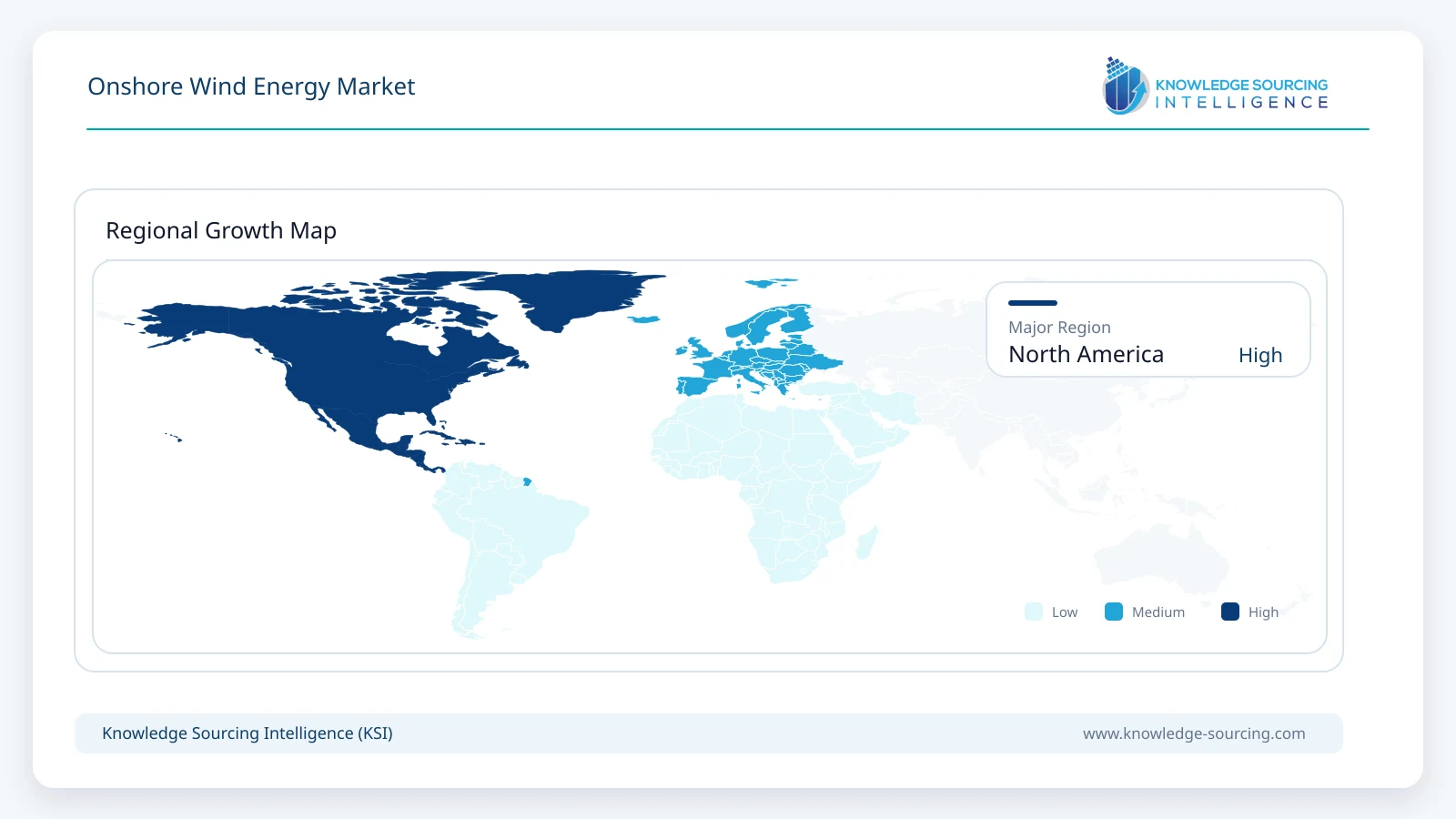
North America is a mature market for onshore wind development. There are many factors that support this, including large-scale utility renewable energy generation, corporate electricity purchasing, and the existence of adequate wind resources throughout the continent. In the U.S., there is a significant amount of wind-generation capacity, and project activity is influenced by a number of factors, including federal and state policies, tax incentives, electricity demand, and the availability of regional transmission capacity. Canada has potential for onshore wind development in provinces where there are adequate wind resources and renewable energy procurement requirements.
South America Market Analysis
The opportunity for development of onshore wind is slowly rising in South America. Onshore wind can be developed by utilizing renewable energy, diversifying the sources used to produce electricity, and private sector procurement of electricity. Brazil has a very strong presence in this market, as well as having a large amount of wind resource available to it, particularly in the northeastern part of the country. Wind-generated electricity is complementary to the current electricity supply in the region and provides additional options for the generation portfolio.
Europe Market Analysis
The onshore wind energy market in Europe has been developed as a result of several factors, including target-driven renewable energy development, reducing emissions from power generation, improving national energy security, and upgrading current wind turbine fleets. There are a number of countries with operational wind farms that will require replacement of old wind turbines, repowering of those wind farms, replacement of worn-out parts of the turbines, as well as ongoing maintenance for the duration of the life of the turbine.
Middle East and Africa Market Analysis
Onshore wind development in the Middle East and Africa is rising due to the existence of areas with adequate wind resources, as well as an increasing demand for electricity. Several factors may facilitate the installation of onshore wind farms, including government initiatives to promote the use of renewable energy, diversifying the sources of electricity, and implementing large-scale energy infrastructure projects. In addition, some countries are considering investing in hybrid systems that combine wind power, solar power, battery storage, and transmission.
Asia Pacific Market Analysis
Asia Pacific is one of the main regions where onshore wind holds a significant share. This development is primarily driven by China, with additional support from India and many other countries. Asia Pacific is a very strong area for onshore wind because there is a large amount of electricity required, industry is growing, investment in renewable energy is rising, and there are many companies that build turbines. China has a large number of suppliers that provide parts for building turbines. Meanwhile, India is an attractive market because it has a lot of potential to develop their own wind resources, along with renewable procurement and domestic manufacturing.
List of Companies
Vestas Wind Systems A/S
GE Vernova
Nordex SE
Siemens Energy AG
Envision Group
Enercon Global GmbH
Mingyang Smart Energy Group
Suzlon Energy Ltd.
Windey Energy Technology Group Co., Ltd
Dongfang Electric Wind Power Co., Ltd.
Vestas Wind Systems A/S
Vestas Wind Systems produces, installs, and maintains onshore and offshore wind turbines. The company has a range of turbine platforms that can be used onshore depending on the site's wind conditions and project specifications. In addition to producing, installing, and maintaining wind turbines, Vestas offers a number of other services including spare parts, monitoring, maintenance, and life cycle services to wind farm owners and operators. These additional services help to establish long-term relationships with customers after their first purchase of a wind turbine.
GE Vernova
GE Vernova sells onshore wind turbines, electric power equipment, and other related services. Their onshore products are composed of various sizes of turbine platforms developed specifically for large-scale projects, and each model can be chosen based on the wind speed and the specific needs of the project. Additionally, the company offers customers service contracts and maintenance assistance to aid them in managing turbine uptime and performance.
Nordex SE
Nordex manufactures and provides onshore wind turbine systems, specifically developed to operate efficiently in low to moderate wind speeds. Nordex offers a range of turbine models with varying rotor sizes and power output ratings based upon local site conditions. Nordex provides support services such as installation, startup testing, maintenance, and service.
Analyst View
Onshore wind energy continues to grow due to expanding renewable capacity, improved turbine technologies, and upgrading existing wind farms. Although new-build projects remain critical for increasing generation capacity, both repowering and life cycle services provide additional growth opportunities within mature fleets. Factors such as grid access, permitting, financing, and cost of equipment will continue to impact the viability of each project.
Onshore Wind Energy Market Scope:
| Report Metric | Details |
|---|---|
| Total Market Size in 2026 | USD 66.12 billion |
| Total Market Size in 2031 | USD 102.43 billion |
| Forecast Unit | USD Billion |
| Growth Rate | 9.1% |
| Study Period | 2021 to 2031 |
| Historical Data | 2021 to 2024 |
| Base Year | 2025 |
| Forecast Period | 2026 – 2031 |
| Segmentation | Component, Turbine Type, Installation Type, End User, Geography |
| Companies |
|
Market Segmentation
By Component
Turbine
Rotor Blade
Rotor Hub
Nacelle
Gearbox
Tower
Transformer & Others
Electrical Infrastructure
Operations & Maintenance (O&M) Systems
By Turbine Type
Horizontal-Axis Wind Turbines (HAWT)
Vertical-Axis Wind Turbines (VAWT)
By Installation Type
New-Build Greenfield Projects
Brownfield Capacity Expansion
Repowering Projects
Partial Repowering / Component Replacement
Others
By End User
Electric Utilities and Distribution Companies
Independent Power Producers (IPPs)
Commercial Enterprises
Industrial Manufacturers
Others
By Geography
North America
USA
Canada
Mexico
South America
Brazil
Argentina
Others
Europe
United Kingdom
Germany
France
Italy
Others
Middle East and Africa
Saudi Arabia
UAE
Others
Asia Pacific
China
Japan
India
South Korea
Australia
Others
Table of Contents
1. EXECUTIVE SUMMARY
2. MARKET SNAPSHOT
2.1. Market Overview
2.2. Market Definition
2.3. Scope of the Study
2.4. Market Segmentation
3. MARKET DYNAMICS
3.1. Market Drivers
3.2. Market Restraints
3.3. Market Opportunities
3.4. Porter’s Five Forces Analysis
3.5. Industry Value Chain Analysis
4. BUSINESS LANDSCAPE
4.1. Regulatory, Wind Energy Policies & Grid Connection Standards Landscape
4.2. Wind Turbine Manufacturing & Component Ecosystem
4.3. Raw Material, Equipment & Onshore Wind Energy Supply Chain Analysis
4.4. Import/Export Analysis
4.5. Strategic Recommendations
5. TECHNOLOGICAL OUTLOOK
5.1. Advanced High-Capacity & High-Efficiency Onshore Wind Turbine Technologies
5.2. Advanced Rotor Blade, Aerodynamic & Wind Energy Conversion Technologies
5.3. Advanced Wind Turbine Tower, Foundation & Structural Technologies
5.4. Grid Integration, Energy Storage & Wind-Solar Hybrid Technologies
5.5. Digitalized, Smart & Condition-Monitored Onshore Wind Infrastructure
6. ONSHORE WIND ENERGY MARKET BY COMPONENT
6.1. Introduction
6.2. Turbine
6.2.1. Rotor Blade
6.2.2. Rotor Hub
6.2.3. Nacelle
6.2.4.. Gearbox
6.2.5. Tower
6.2.6. Transformer & Others
6.3. Electrical Infrastructure
6.4.Operations & Maintenance (O&M) Systems
7. ONSHORE WIND ENERGY MARKET BY TURBINE TYPE
7.1. Introduction
7.2. Horizontal-Axis Wind Turbines (HAWT)
7.3. Vertical-Axis Wind Turbines (VAWT)
8. ONSHORE WIND ENERGY MARKET BY INSTALLATION TYPE
8.1. Introduction
8.2. New-Build Greenfield Projects
8.3. Brownfield Capacity Expansion
8.4. Repowering Projects
8.5. Partial Repowering / Component Replacement
8.6. Others
9. ONSHORE WIND ENERGY MARKET BY END USER
9.1. Introduction
9.2. Electric Utilities and Distribution Companies
9.3. Independent Power Producers (IPPs)
9.4. Commercial Enterprises
9.5. Industrial Manufacturers
9.6. Others
10. ONSHORE WIND ENERGY MARKET BY GEOGRAPHY
10.1. Introduction
10.2. North America
10.2.1. USA
10.2.2. Canada
10.2.3. Mexico
10.3. South America
10.3.1. Brazil
10.3.2. Argentina
10.3.3. Others
10.4. Europe
10.4.1. United Kingdom
10.4.2. Germany
10.4.3. France
10.4.4. Italy
10.4.5. Others
10.5. Middle East and Africa
10.5.1. Saudi Arabia
10.5.2. UAE
10.5.3. Others
10.6. Asia Pacific
10.6.1. China
10.6.2. Japan
10.6.3. India
10.6.4. South Korea
10.6.5. Australia
10.6.6. Others
11. COMPETITIVE ENVIRONMENT AND ANALYSIS
11.1. Major Players and Strategy Analysis
11.2. Market Share Analysis
11.3. Mergers, Acquisitions, Agreements, and Collaborations
11.4. Competitive Dashboard
12. COMPANY PROFILES
12.1. Vestas Wind Systems A/S
12.2. GE Vernova
12.3. Nordex SE
12.4. Siemens Energy AG
12.5. Envision Group
12.6. Enercon Global GmbH
12.7. Mingyang Smart Energy Group
12.8. Suzlon Energy Ltd.
12.9. Windey Energy Technology Group Co., Ltd
12.10. Dongfang Electric Wind Power Co., Ltd.
13. APPENDIX
13.1. Currency
13.2. Assumptions
13.3. Base and Forecast Years Timeline
13.4. Key benefits for the stakeholders
13.5. Research Methodology
13.6. Abbreviations
Navigate
Trusted by the world's leading organizations











