
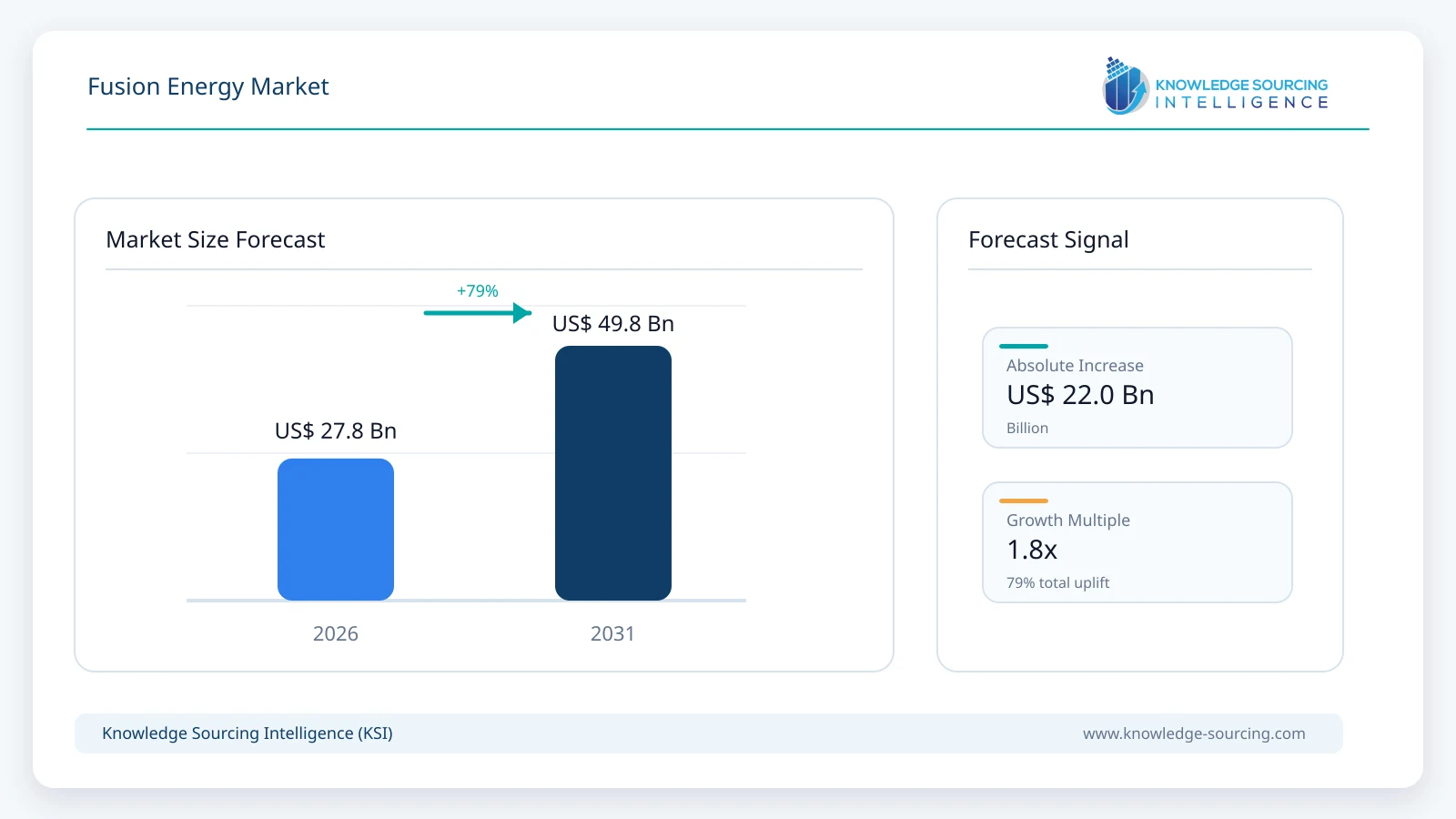
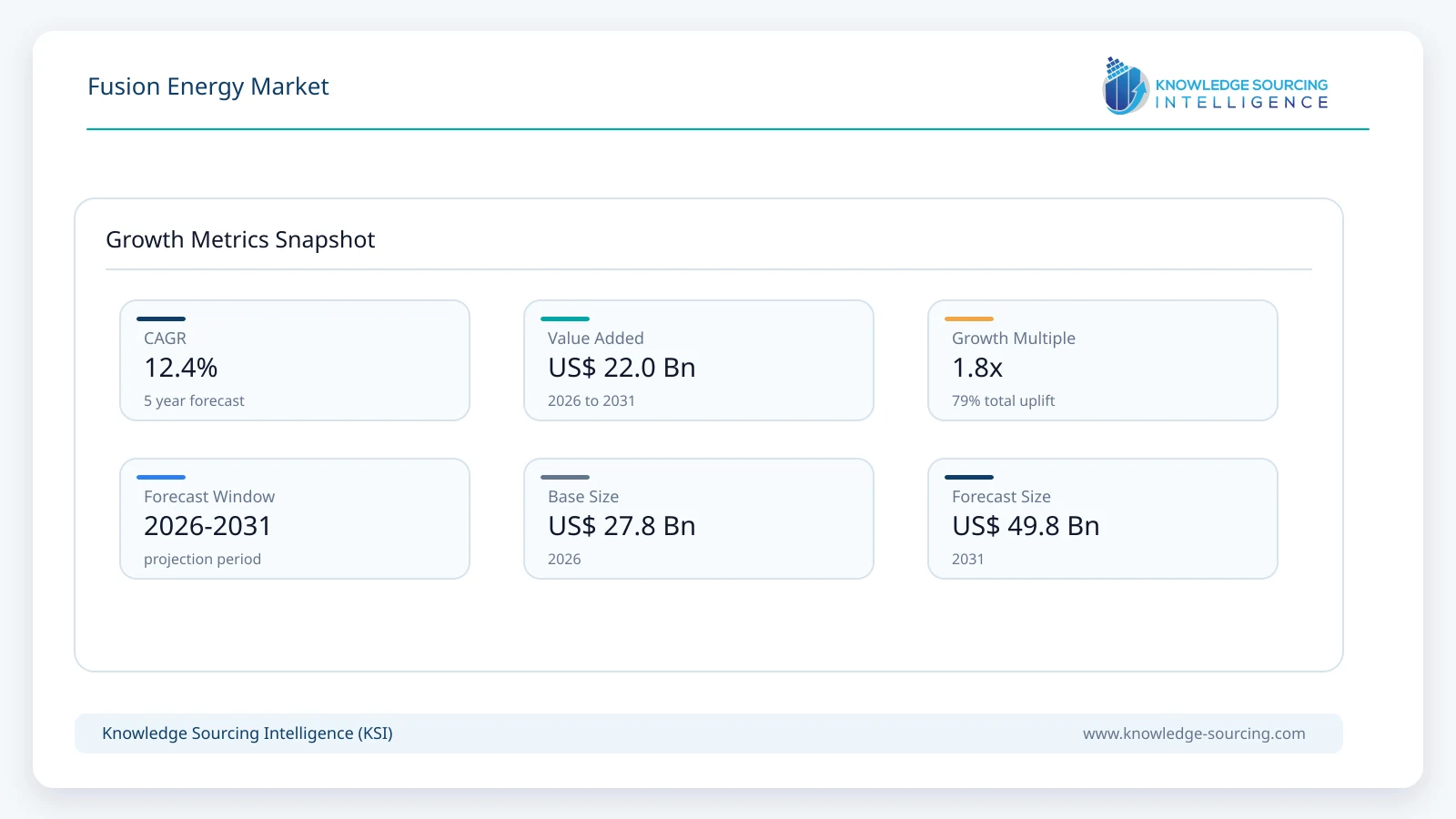
The Fusion Energy Market is projected to grow from USD 27.78 billion in 2026 to USD 49.80 billion by 2031, at a CAGR of 12.4% during forecast period.
Highlights:
- 1The development of magnetic confinement is an ongoing process with significant development activities by both public and private sectors in tokamaks and stellarators.
- 2Inertial confinement is progressing with the use of lasers and targets. Progress with target compression, ignition, laser efficiency, and repeatability will be critical to the ultimate development of a power plant.
- 3Fusion energy startups are seeking funding from investors to develop prototype devices, establish production capabilities, and ultimately create an operational prototype.
- 4Electricity generation is currently the main long-term application. Fusion power plants are being created mostly for electricity; however, there is still no well-developed industry for commercial electricity production.
Fusion energy technologies attempt to generate power through the combination of lightweight atoms' nuclei under extreme conditions. The fuel for the reaction is converted into a gas-like substance called plasma. In plasma, all electrons have been stripped from the atoms' nuclei. For fusion reactions to take place at useful speeds, the plasma must meet certain temperature, density, and containment requirements.
In magnetically-confined systems, very strong magnetic fields can hold the hot plasma off of the reaction chamber walls for enough time. Two major types of magnetically-confined systems include tokamaks and stellarators. For an inertially-confined system, a tiny amount of fuel is squeezed down very quickly by a high energy device, usually a laser, to create the appropriate conditions. There are other types of systems that use some of the same methods as magnetically-confined systems, plasma compression and different types of devices.
Developing a viable power plant based on fusion energy will go far beyond simply creating a fusion reaction. The viability of such a facility will depend upon developing an integrated system that will allow for continuous operations, control both thermal and particle exhaust, process the fuel required for the reaction, resist the effects of neutron and thermal exposure, extract usable energy from the reaction, and produce electrical energy or process heat for industry. While demonstrating a net energy gain from a single fuel target or plasma alone does not provide evidence that a complete facility will be able to produce a net amount of electrical energy.
Market Dynamics
Market Drivers
Public-private partnerships and increased government spending: Fusion technology is a complex field that requires a significant amount of time for basic research, a large number of expensive experimental facilities, specialized engineers, and testing of technologies that will not initially provide any commercial benefits. Governments are providing funding for fundamental scientific research, joint research facilities, university-based collaborations, and private sector development milestones. For example, in June 2026, the United States Department of Energy released its Fusion Science and Technology Roadmap to guide research, facility development, workforce training, and commercialization activities. Similarly, the United Kingdom has stated it plans to invest more than £2.5 billion in fusion during the next five years. This investment includes funding for research facilities, technology development, and the STEP program.
Development of advanced high-temperature superconducting magnets and magnetic confinement systems: High-temperature superconducting magnets have the potential to generate high-strength magnetic fields, which will assist with confining the plasma, possibly allowing for smaller, more efficient fusion reactors. Several companies such as CFS and Tokamak Energy are currently working on developing magnetic confinement systems and magnet technology to enhance the overall performance of the reactor, as well as the ease of construction.
Increased need for reliable, low-emission energy: The growing demand for reliable, low-emission electricity for data centers, electrification, industrial activity, among others has increased the level of interest in new types of reliable electricity. Fusion may offer the ability to produce reliable electricity independently of the weather; this will require the development of a commercially viable plant. As such, the potential for fusion to generate reliable electricity has attracted investment from technology developers, energy companies, governments and industrial partners.
Market Restraints & Opportunities
Fusion systems will need to create and maintain appropriate plasma conditions. In addition, they will have to deal with instability management, heat exhaust, particle control, and component loading. Even if there was a positive outcome in an experiment, that does not mean a machine could be operated on a continuous or repetitive basis for a commercial application.
The development of pilot plants for fusion energy will provide a link from the current generation of experimental fusion devices to full-scale, commercial power plants. Pilot plants will also allow the participation of various types of businesses including engineering contractors, component manufacturers, superconducting magnet suppliers, instrumentation companies, and those involved with integrating power plant components.
Key Developments
October 2026: General Fusion and the UK Atomic Energy Authority reported that the General Fusion Lawson Machine 26 program had achieved electron temperatures greater than 12 million degrees Celsius, or >1 keV.
September 2026: First Light Fusion demonstrated the fuel-compression principle that is the basis for their FLARE inertial fusion system.
July 2026: CFS reported a new equity funding round, bringing their total capital invested to US$4 billion. CFS is working on the SPARC tokamak demo project and the proposed ARC commercial power generation facility.
Fusion Energy Market Segmentation
The market is segmented by component, fusion method, application, end user, and geography.
By Fusion Method
Magnetic Confinement Fusion (MCF)
Magnetic Confinement Fusion (MCF) represents a large part of fusion development, as it contains many existing types of experimental methods such as tokamaks and stellarators and some smaller and different magnetic configurations. MCF uses strong magnetic fields to contain hot plasmas and prevent them from touching the walls of the reactor.
The tokamak uses two types of magnetic fields to hold the plasma together inside a ring-shaped container called a toroidal chamber, whereas the stellarator uses more complicated 3-D magnetic fields which help keep the plasma stable. Both approaches require several advances, including plasma heating systems, exhaust management, powerful magnets, materials for use within the fusion reactors, and complete designs of fusion power plants.
Commonwealth Fusion Systems is working on its SPARC tokamak, an experimental system designed to verify its use of high magnetic fields. Meanwhile, Type One Energy and Proxima Fusion are working on systems that employ stellarators. Likewise, Helion and TAE Technologies employ field-reversed configurations. Although all four of these organizations are employing magnetic-confinement methods to achieve fusion energy, each organization's approach to designing and operating their machines differs significantly.
By Application
Electricity Generation
The primary long-term purpose of fusion developers is electricity generation. A commercial fusion power plant will be required to create fusion energy, extract useful heat or energy, transform this into electricity, and supply the generated electricity to the grid.
Most of today's development programs focus on demonstrating the entire system, along with the ability to create fusion reactions. Some of the major technical requirements for these systems will be the ability to operate repeatedly, reliably remove generated heat, manage the fuel cycle, ensure the long-term viability of components, allow for easy maintenance access, and have an economically feasible operating model.
Several companies such as CFS, Helion, Type One Energy, and Proxima Fusion have reported plans to build future power plants or fusion systems that will connect to the grid. All of these companies have estimated when they can complete the construction of their first commercial fusion plant, and other details are dependent on technical success, regulatory approval, and financing.
By End User
Public and Government Research Institutions
The public and government research institutions segment is a significant consumer of fusion-related equipment, laboratory equipment, engineering services, and research facilities. Publicly funded and government-run research organizations support or perform research in areas such as plasma physics, materials science, magnetics, lasers, fuel cycle technology, diagnostic development, and reactor design.
Government-funded programs can assist in funding long-term research that cannot be financially supported solely by private investments. Additionally, these government-funded programs can offer access to shared resources, technical support, and research collaborative opportunities that enable private companies to develop their technological programs.
Regional Analysis
North America
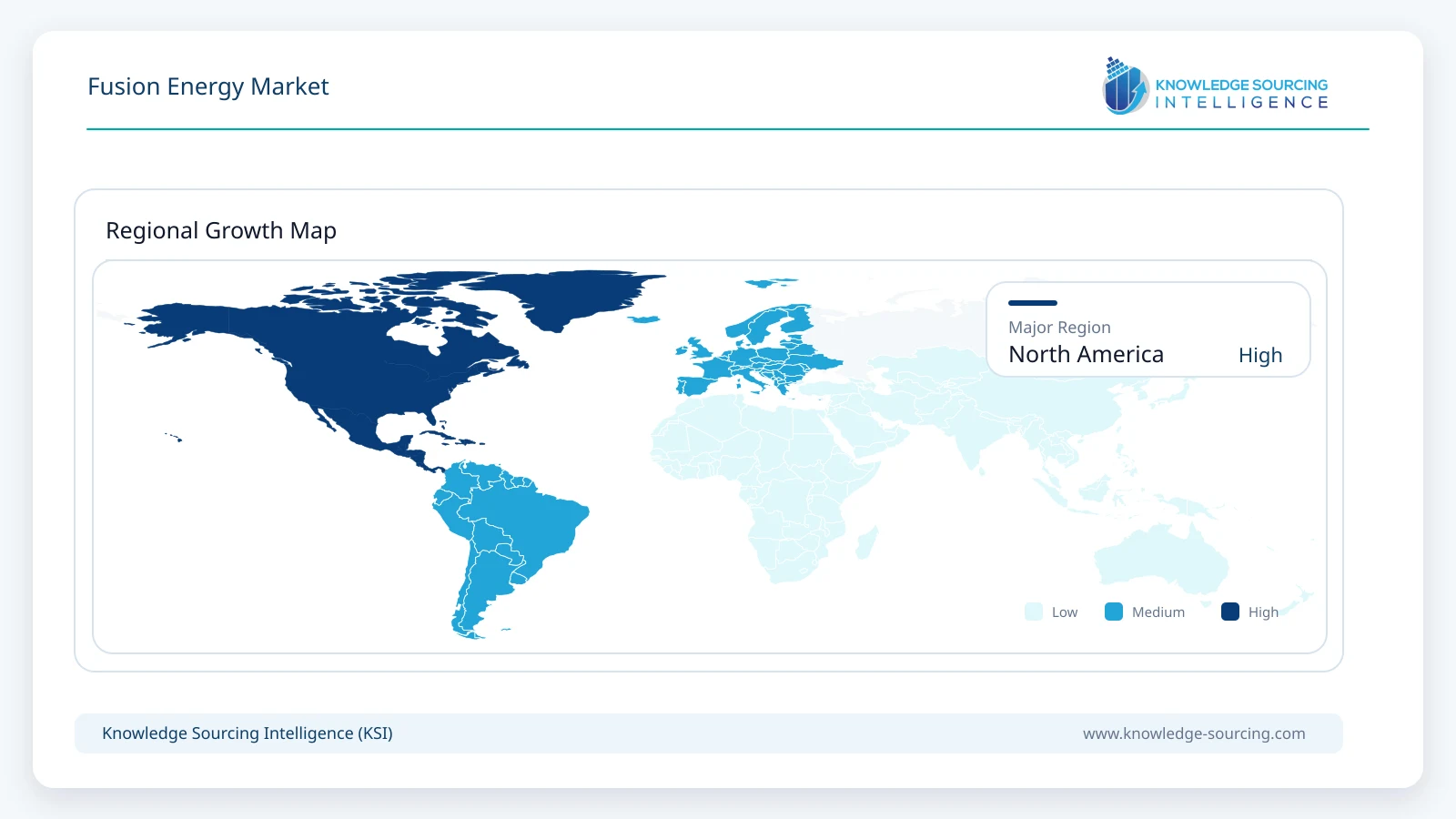
North America represents a key area for advancing fusion energy due to the existence of its many national laboratories, research-focused universities, private fusion-related businesses, governmental funding initiatives, and availability of private capital. There are numerous developers in the United States working on different approaches to fusion, including tokamaks, field-reversed configurations, inertial fusion, and magnetized target fusion.
South America
South America possesses academic and scientific capabilities in relation to plasma physics, nuclear sciences, materials science, and engineering. Participation from the region could occur via university collaborations, international scientific programs, collaborative scientific efforts, and provision of specialized engineering or manufacturing services.
Europe
The region of Europe is a center for the development of fusion technology, both through research and commercialization. National laboratories, university departments, specialized engineering firms, and publicly funded programs contribute to this. The region is actively involved in developing two types of fusion technologies, such as magnetic confinement technology and inertial confinement technology. Private sector companies are collaborating with established scientific organizations to develop these technologies.
Middle East and Africa
The Middle East and Africa is participating in the area of fusion energy via scientific cooperation, engineering, advanced manufacturing, and planning for the development of future energy systems. Regional near-term engagement in the area will be driven by research partnerships, investments made in technology, and involvement in international programs rather than through commercial generation of electricity from fusion.
Asia Pacific
Asia Pacific possesses a major base of fusion research activity, which includes several large-scale experimental facilities, national research programs, university-based research, and highly developed engineering capacity. Some of the nations involved in fusion research and technology development include China, Japan, South Korea, and India. This regional capability encompasses areas such as plasma physics, superconducting magnets, materials science, high-performance computing, laser technology, and nuclear engineering.
List of Companies
Commonwealth Fusion Systems (CFS)
Helion
TAE Technologies, Inc.
General Fusion
Tokamak Energy
Type One Energy
First Light Fusion Ltd.
Proxima Fusion
Focused Energy
Marvel Fusion
Commonwealth Fusion Systems (CFS)
Commonwealth Fusion Systems has been working on a magnetic-confinement fusion system based upon a high-field tokamak and high-temperature superconducting magnets. The company's first device, SPARC, is designed to utilize the plasma system level for the creation of net fusion energy. After SPARC is demonstrated, CFS intends to build its second device, ARC, which is expected to advance fusion technology toward becoming commercially viable as an electrical source.
Helion
Helion is currently working on the development of a pulsed fusion system that utilizes field-reversed configuration plasma. This method uses an innovative approach to form, accelerate, merge, and compress plasma, and is designed so that electricity can be recovered from the changes in the magnetic field. Helion is currently building its Orion facility in Washington State and has also announced a plan for a future electricity-supply contract with Microsoft.
TAE Technologies, Inc.
TAE Technologies is developing an advanced beam-driven field-reversed configuration approach for fusion. TAE's technology program includes plasma confinement, neutral beam injection, plasma control, and fuel cycle research. TAE has investigated several fusion fuel cycles such as hydrogen-boron, deuterium-helium-3, and deuterium-tritium.
Analyst View
The fusion energy market is moving away from the basic research and testing of prototype equipment towards the integration of demonstration and pilot plants. This transition is being supported by government funding, private investments, superconducting magnets, advanced lasers, computational models, and innovative engineering solutions. Nevertheless, the industry as a whole is still in its initial stage in terms of being able to generate a commercially viable power source; nor has any one specific reactor design emerged as the dominant technology for generating power on a large scale.
Fusion Energy Market Scope:
| Report Metric | Details |
|---|---|
| Total Market Size in 2026 | USD 27.78 billion |
| Total Market Size in 2031 | USD 49.80 billion |
| Forecast Unit | USD Billion |
| Growth Rate | 12.4% |
| Study Period | 2021 to 2031 |
| Historical Data | 2021 to 2024 |
| Base Year | 2025 |
| Forecast Period | 2026 – 2031 |
| Segmentation | Component, Fusion Method, Application, End User, Geography |
| Companies |
|
Market Segmentation
By Component
Magnets and Magnet Systems
Vacuum Vessels and Vacuum Systems
Plasma Heating Systems
Others
By Fusion Method
Magnetic Confinement Fusion (MCF)
Inertial Confinement Fusion (ICF)
Field-Reversed Configuration (FRC)
Others
By Application
Electricity Generation
Industrial Heat Generation
Hydrogen Production
District Heating
Others
By End User
Public and Government Research Institutions
National Laboratories
Universities and Academic Research Institutions
Others
By Geography
North America
United States
Canada
Mexico
South America
Brazil
Argentina
Others
Europe
United Kingdom
Germany
France
Italy
Others
Middle East and Africa
Saudi Arabia
UAE
Others
Asia Pacific
China
Japan
India
South Korea
Australia
Others
Table of Contents
1. EXECUTIVE SUMMARY
2. MARKET SNAPSHOT
2.1. Market Overview
2.2. Market Definition
2.3. Scope of the Study
2.4. Market Segmentation
3. MARKET DYNAMICS
3.1. Market Drivers
3.2. Market Restraints
3.3. Market Opportunities
3.4. Porter’s Five Forces Analysis
3.5. Industry Value Chain Analysis
4. BUSINESS LANDSCAPE
4.1. Regulatory, Licensing, Safety & Fusion Facility Standards Landscape
4.2. Fusion Reactor Manufacturing & Component Ecosystem
4.3. Raw Materials, Specialized Equipment & Fusion Technology Supply Chain Analysis
4.4. Import/Export Analysis
4.5. Strategic Recommendations
5. TECHNOLOGICAL OUTLOOK
5.1. Advanced Fusion Confinement & Plasma-Control Technologies
5.2. High-Temperature Superconducting Magnets & Advanced Magnetic-Confinement Technologies
5.3. Advanced Fusion Reactor Design, Materials & Structural Technologies
5.4. Tritium Breeding, Fuel-Cycle & Advanced Fuel-Handling Technologies
5.5. Advanced Plasma Heating, Current-Drive & Energy-Delivery Technologies
6. FUSION ENERGY MARKET BY COMPONENT
6.1. Introduction
6.2. Magnets and Magnet Systems
6.3. Vacuum Vessels and Vacuum Systems
6.4. Plasma Heating Systems
6.5. Others
7. FUSION ENERGY MARKET BY FUSION METHOD
7.1. Introduction
7.2. Magnetic Confinement Fusion (MCF)
7.3. Inertial Confinement Fusion (ICF)
7.4. Field-Reversed Configuration (FRC)
7.5. Others
8. FUSION ENERGY MARKET BY APPLICATION
8.1. Introduction
8.2. Electricity Generation
8.3. Industrial Heat Generation
8.4. Hydrogen Production
8.5. District Heating
8.6. Others
9. FUSION ENERGY MARKET BY END USER
9.1. Introduction
9.2. Public and Government Research Institutions
9.3. National Laboratories
9.4. Universities and Academic Research Institutions
9.5. Others
10. FUSION ENERGY MARKET BY GEOGRAPHY
10.1. Introduction
10.2. North America
10.2.1. USA
10.2.2. Canada
10.2.3. Mexico
10.3. South America
10.3.1. Brazil
10.3.2. Argentina
10.3.3. Others
10.4. Europe
10.4.1. United Kingdom
10.4.2. Germany
10.4.3. France
10.4.4. Italy
10.4.5. Others
10.5. Middle East and Africa
10.5.1. Saudi Arabia
10.5.2. UAE
10.5.3. Others
10.6. Asia Pacific
10.6.1. China
10.6.2. Japan
10.6.3. India
10.6.4. South Korea
10.6.5. Australia
10.6.6. Others
11. COMPETITIVE ENVIRONMENT AND ANALYSIS
11.1. Major Players and Strategy Analysis
11.2. Market Share Analysis
11.3. Mergers, Acquisitions, Agreements, and Collaborations
11.4. Competitive Dashboard
12. COMPANY PROFILES
12.1. Commonwealth Fusion Systems (CFS)
12.2. Helion
12.3. TAE Technologies, Inc.
12.4. General Fusion
12.5. Tokamak Energy
12.6. Type One Energy
12.7. First Light Fusion Ltd.
12.8. Proxima Fusion
12.9. Focused Energy
12.10. Marvel Fusion
13. APPENDIX
13.1. Currency
13.2. Assumptions
13.3. Base and Forecast Years Timeline
13.4. Key benefits for the stakeholders
13.5. Research Methodology
13.6. Abbreviations
Navigate
Trusted by the world's leading organizations











