
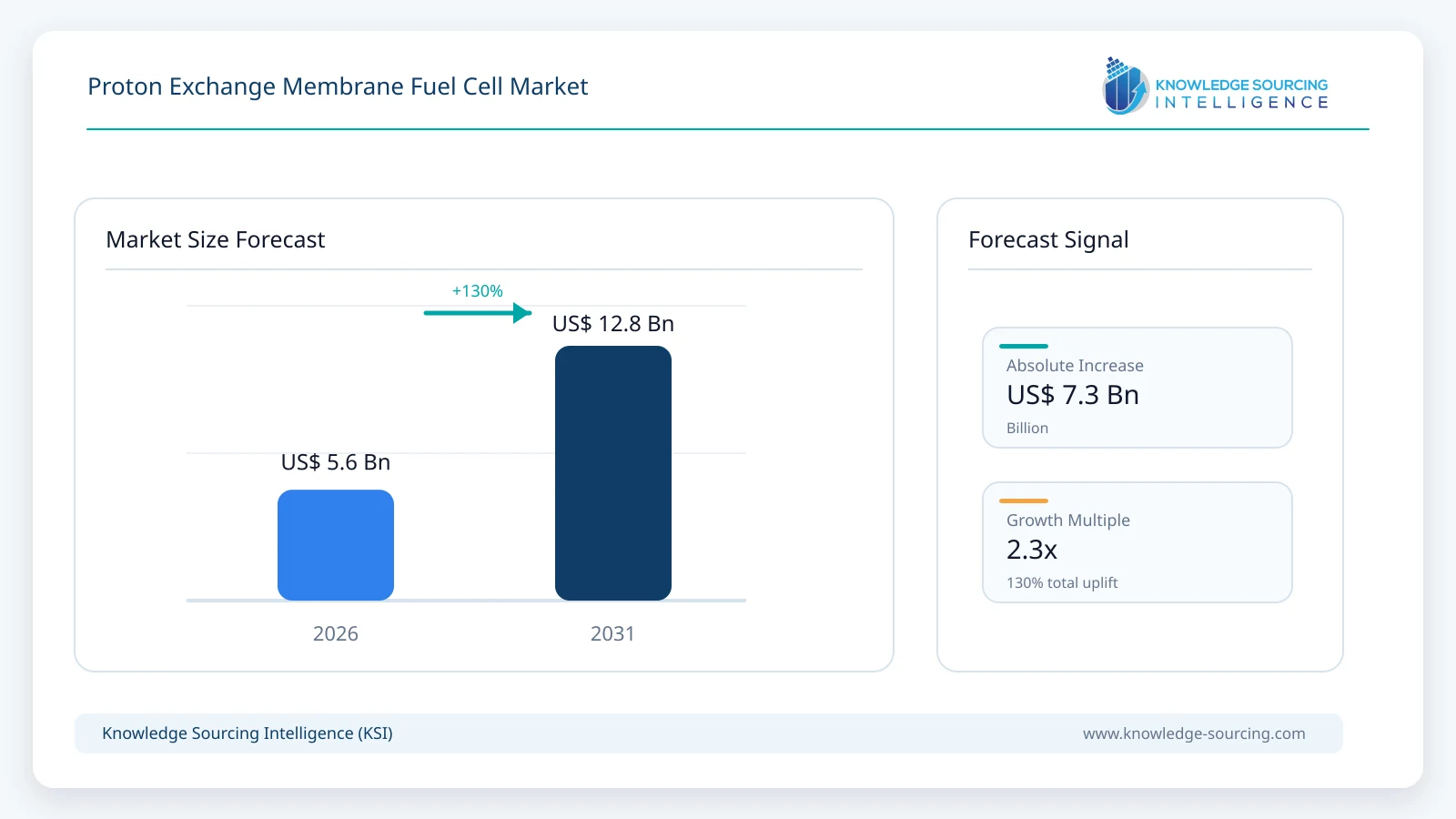
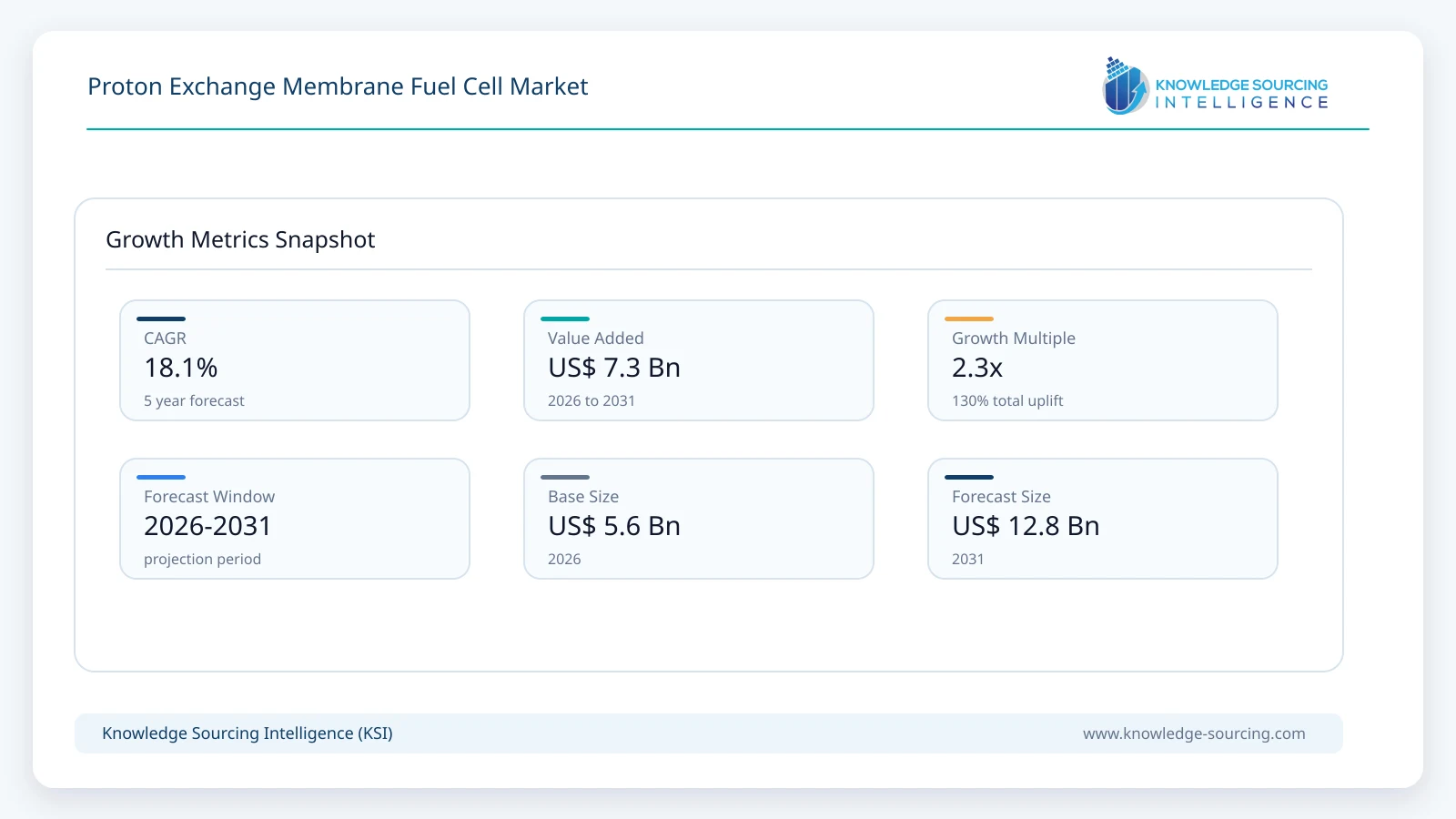
The Proton Exchange Membrane Fuel Cell Market is forecast to grow at a CAGR of 18.1%, reaching USD 12.85 billion in 2031 from USD 5.59 billion in 2026.
Highlights:
- 1PEM fuel cells are utilized in passenger vehicles, buses, heavy-duty trucks, as well as commercial mobility due to their high power density, fast refueling, and long operational ranges.
- 2Truck and bus manufacturers are focusing on fuel-cell powertrains for long-distance, high-utilization, and heavy payload applications, in which battery weight and downtime for charging can restrict suitability.
- 3Hydrogen fuel cells are used by warehouses and distribution centers since they can refuel forklifts quickly and retain power during long-running shifts.
- 4PEM fuel cells are being considered to an increasing degree for distributed power, microgrids, telecom backup, mission-critical facilities, and data centers as sources of resilient low-emission electricity.
The PEM fuel cell market is emerging to meet the demand for clean sources of electricity generation that can run outside of normal internal combustion engines. They work at relatively low temperatures and generate electricity very quickly, which makes them suitable for mobile applications.
Toyota has consistently progressed the development of its third-generation fuel-cell system, with targets focused on enhanced durability and increased range at lower costs. Its third-generation system is designed for use in passenger vehicles, as well as commercial applications.
The stationary segment is evolving into distributed generation, backup power, microgrids, telecom infrastructure, and data-center applications. Hydrogen fuel cells can serve as cleaner replacements for diesel generators because they reduce local emissions and, when operated with clean hydrogen and clean electricity,
Consequently, the market ecosystem encompasses fuel-cell stacks and membrane electrode assemblies (MEAs), bipolar plates, hydrogen storage, air-management systems, thermal management solutions, power electronics components, and control systems, as well as fueling infrastructure and servicing networks.
Market Dynamics
Market Drivers
Growing Demand for Zero-Emission Transportation: Hydrogen-powered PEM fuel cells are easily applied in the transportation sector, the main driving force for PEM fuel-cell deployment because they have the essential capability to deliver electric propulsion without tailpipe carbon dioxide emissions. Factors including range, payload, refueling time, and vehicle utilization are now being used to assess passenger cars, buses, trucks, and commercial vehicles. The deployment is also tied to the increasing availability of hydrogen-refueling infrastructure, although the lack thereof varies greatly among countries.
Need for Quick Refueling and High-Uptake: Instead of plug-in vehicles that need to be connected to charging equipment for long periods, fuel-cell vehicles can refuel using hydrogen. This feature can be very useful for taxis, buses, trucks, warehouse vehicles, fleet vehicles, etc running multiple shifts. As a result, centralized hydrogen infrastructure is able to be used for the rapid refueling of vehicles within material-handling facilities without causing interruption in warehouse employment.
Stationary Power Resilience is in Increasing Demand: This is leading organizations to diversify backup-power systems due to power outages, grid congestion, heavy weather events, and rising electricity demand. PEM fuel cells can produce electricity only while hydrogen is available, making these devices great candidates for both backup and distributed-power applications.
Technological Improvements in Fuel-Cell Stacks: Manufacturers are lowering platinum loading and increasing power density, while enhancing membrane durability, improving water management, and changing air management to make it more efficient. These advancements allow for smaller systems and material input while increasing useful electrical output.
Market Restraints & Opportunities
One of the biggest limitations is the high cost of the PEM fuel-cell systems compared to standard internal-combustion powertrains and, in some cases, battery-electric systems.
Overall system costs are accounted for by platinum-group-metal catalysts, specialized membranes, bipolar plates, hydrogen storage systems, compressors, humidifiers, cooling systems, and power electronics.
These limitations are opening the door for many companies developing higher power-density stacks, lower platinum loading, tougher membranes, superior bipolar plates, new humidification methods, better thermal management strategies, smaller compressors, and integrated fuel-cell systems.
A further substantial opportunity is the development of fuel-cell hybrid systems, in which a PEM fuel-cell stack operates along with a battery. The fuel cell supplies continuous power, while the battery takes off-peak power comes for optimizing the sizing of the stack and improving total efficiency.
Key Developments
February 2026: VTT Research introduced the MiNaMi project to develop Europe’s first megawatt-scale PEM fuel-cell system intended for maritime implementation. The Horizon Europe project brought together nine industrial and academic partners to connect multiple 225 kW modules into a marine prototype in a four-year program valued at €7 million.
May 2025: The Horizon Europe-funded ECOPEM project officially started to develop non-fluorinated parts for PEM fuel cells and water electrolysers. The consortium sought to replace both fluorinated materials with non-fluorinated or less persistent alternatives without compromising performance, durability, and cost-competitiveness.
Market Segmentation
The market is segmented by type, component, application, end user, and geography.
By Type: Low-Temperature PEM Fuel Cells
The low-temperature PEM fuel cells segment is the major share as they are already commercially established in a full range of transportation and material-handling applications.
The systems are generally designed to run at comparably low temperatures, permitting rapid start-up characteristics; as such, they can provide power in applications where vehicles need to start and stop rapidly or subject themselves to different load scenarios quickly.
Low-temperature PEM fuel cells utilized polymer electrolyte membranes and typically needed to be carefully managed for both water and thermal management.
Some manufacturers and automakers target extending stack durability, lowering catalyst loadings, and improving cold-start performance while also trying to increase power density.
A major example of low-temperature PEM systems is those developed by Toyota for vehicle and commercial applications. The company states its third-generation system is designed to enhance durability and driving range while remaining a cost-competitive option.
Transportation already is a large part of current commercial PEM fuel-cell deployment, and this segment should remain dominant.
By Application: Transportation
The transportation application segment is projected to be the leading segment in the global PEM fuel cell market due to long range, short refueling time, high power density, and zero tailpipe emissions.
The commercial vehicle segment, which consists of buses and heavy-duty trucks transforming into a moat for growth applications. This is attractive in long-distance operations as it allows the trucks to maintain a high payload level without the need for extremely large battery packs.
At Daimler Truck, the in-house fuel-cell technology is being designed more for long-haul transport use, while Hyundai's HTWO ecosystem focuses on hydrogen-powered commercial vehicles.
It has also been rapidly extending that application beyond just road vehicles, into rail installations, maritime, aviation-support equipment, and other emerging mobility applications.
Regional Analysis
North America Market Analysis
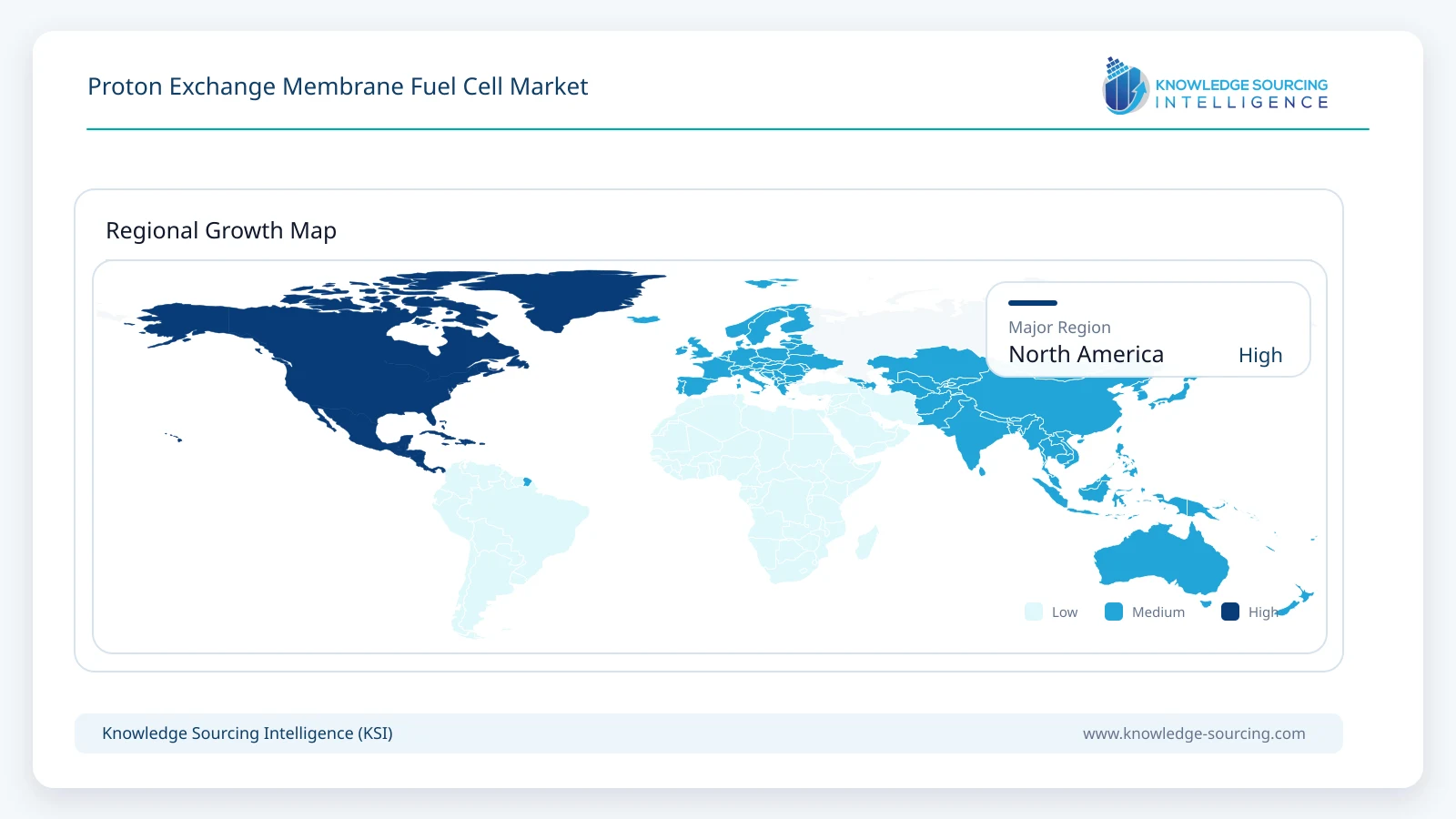
The North America region PEM fuel-cell market is driven by hydrogen investment, clean-energy policies, and transportation decarbonization initiatives. The US continues to be the biggest regional market, with new applications around hydrogen hubs, heavy-duty mobility, material handling, stationary generation, and backup power.
South America Market Analysis
South America also represents a growing PEM fuel-cell market backed up by renewable-energy resources and an increased interest in producing hydrogen. Chile is one of the biggest opportunities due to its high solar and wind resources and renewable hydrogen and hydrogen derivative production strategy.
Europe Market Analysis
Europe is one of the most developed PEM fuel-cell markets due to strict vehicle-emission regulations, hydrogen strategies, and industrial decarbonization programs. Germany, France, the Netherlands, the UK, and Nordic countries all have fledgling hydrogen applications in transportation as well as industrial power and backup generation.
Middle East and Africa Market Analysis
The Middle East & Africa region is a developing market for PEM fuel cells and installation, due to considerable-sized renewable-hydrogen projects and ambitious hydrogen commercialisation plans. In Saudi Arabia, the UAE, and Oman, major renewables-based hydrogen projects are under development that allow for all possible downstream fuel-cell and hydrogen-derived fuel applications.
Asia Pacific Market Analysis
Asia Pacific is anticipated to remain one of the largest and fastest-growing PEM fuel-cell markets due to strong demand for automotive manufacturing in Japan, South Korea, and China. The supportive hydrogen policies across ASEAN nations, the deployment of commercial vehicles such as passenger buses using low-cost hydrogen, and the development of domestic fuel-cell technology. Japan has been a major technology market, with Toyota, Honda, and Panasonic all developing fuel-cell vehicles, stacks, and stationary systems.
List of Companies
Toyota Motor Corporation
Honda Motor
Hyundai
Daimler Truck AG
Plug Power Inc.
Cummins Inc.
Panasonic Corporation
Horizon Fuel Cell Technologies
Freudenberg Group
ElringKlinger
Toyota Motor Corporation
Toyota is one of the leading car companies in PEM fuel cell technology with its Toyota Fuel Cell System. Its Mirai passenger vehicle, along with its technology focused on commercial vehicles, has been equipped with fuel-cell technology.
Honda Motor
Honda developed PEM Fuel-cell technology for passenger and commercial mobility. The company's CR-V e:FCEV centers on a plug-in battery with a hydrogen fuel-cell system, showing off a hybrid fuel-cell architecture that allows drivers to mix hydrogen-powered driving with charging from outside the vehicle.
Hyundai
The NEXO passenger vehicle and hydrogen-powered commercial vehicles have allowed Hyundai to form a solid foothold in fuel-cell mobility. Hyundai is utilising its HTWO exploration to go beyond short-term vehicle manufacturing and enter fields like hydrogen production, storage, transportation, utilization, and fuel-cell systems.
Analyst View
The proton exchange membrane fuel cell market is moving from early passenger-vehicle commercialisation towards widespread use in heavy-duty transport, material handling and stationary power. Low-temperature PEM fuel cells are likely to maintain their dominance given the existence of automotive supply chains, a fast start-up time, and good power density. Additionally, transportation will continue to account for the greatest demand, especially for heavy trucks, buses, and high-utilization fleets with strong long-term opportunities as hydrogen infrastructure develops. Toyota, Hyundai, Honda, Daimler Truck, and Cummins are progressing vehicle platforms; Plug Power is fortifying material-handling and stationary applications. Both Freudenberg and ElringKlinger are working mainly on stack components and critical fuel-cell materials at the component level. The region of Asia Pacific, with the technology leadership in Japan and South Korea, combined with commercial- vehicle deployment programs in China as well as India's emerging hydrogen ecosystem, will continue to be a major growth engine for both fuel-cell vehicles (FCVs) and significant commercialization of light-duty FCVs.
Proton Exchange Membrane Fuel Cell Market Scope:
| Report Metric | Details |
|---|---|
| Total Market Size in 2026 | USD 5.59 billion |
| Total Market Size in 2031 | USD 12.85 billion |
| Forecast Unit | USD Billion |
| Growth Rate | 18.1% |
| Study Period | 2021 to 2031 |
| Historical Data | 2021 to 2024 |
| Base Year | 2025 |
| Forecast Period | 2026 – 2031 |
| Segmentation | Type, Component, Application, End User, Geography |
| Companies |
|
Market Segmentation
By Type
Low-Temperature PEM Fuel Cells
High-Temperature PEM Fuel Cells
By Component
Membrane Electrode Assembly (MEA)
Proton Exchange Membrane
Catalyst Layer
Gas Diffusion Layer
Bipolar Plates
Air Supply System
Others
By Application
Transportation
Material Handling
Stationary Power
Other Emerging Applications
By End User
Automotive & Transportation
Utilities & Power Generation
Logistics & Warehousing Companies
Defense & Aerospace
Commercial & Industrial Facilities
Others
By Geography
North America
USA
Canada
Mexico
South America
Brazil
Argentina
Others
Europe
United Kingdom
Germany
France
Others
Middle East and Africa
Saudi Arabia
UAE
Others
Asia Pacific
China
Japan
India
South Korea
Others
Table of Contents
1. EXECUTIVE SUMMARY
2. MARKET SNAPSHOT
2.1. Market Overview
2.2. Market Definition
2.3. Scope of the Study
2.4. Market Segmentation
3. MARKET DYNAMIC
3.1. Market Drivers
3.2. Market Restraints
3.3. Market Opportunities
3.4. Porter’s Five Forces Analysis
3.5. Industry Value Chain Analysis
4. BUSINESS LANDSCAPE
4.1. Hydrogen Mobility, Fuel Cell & Emission Regulations Landscape
4.2. Government Incentives, Hydrogen Policy & Infrastructure Investment Landscape
4.3. Fuel Cell Manufacturing Capacity & Project Pipeline Landscape
4.4. Input–Output Analysis
4.5. Strategic Recommendations
5. TECHNOLOGICAL OUTLOOK
5.1. Membrane Electrode Assembly, Catalyst & Proton Exchange Membrane Technologies
5.2. Bipolar Plate, Gas Diffusion Layer & Stack Architecture Technologies
5.3. High-Power-Density, Durability & Thermal/Water Management Technologies
5.4. Fuel Cell System Integration, Power Electronics & Digital Monitoring Technologies
6. PROTON EXCHANGE MEMBRANE FUEL CELL MARKET BY TYPE
6.1. Introduction
6.2. Low-Temperature PEM Fuel Cells
6.3. High-Temperature PEM Fuel Cells
7. PROTON EXCHANGE MEMBRANE FUEL CELL MARKET BY COMPONENT
7.1. Introduction
7.2. Membrane Electrode Assembly (MEA)
7.2.1. Proton Exchange Membrane
7.2.2. Catalyst Layer
7.2.3. Gas Diffusion Layer
7.3. Bipolar Plates
7.4. Air Supply System
7.5. Others
8. PROTON EXCHANGE MEMBRANE FUEL CELL MARKET BY APPLICATION
8.1. Introduction
8.2. Transportation
8.3. Material Handling
8.4. Stationary Power
8.5. Other Emerging Applications
9. PROTON EXCHANGE MEMBRANE FUEL CELL MARKET BY END USER
9.1. Introduction
14.2. Automotive & Transportation
14.3. Utilities & Power Generation
14.4. Logistics & Warehousing Companies
14.5. Defense & Aerospace
14.6. Commercial & Industrial Facilities
14.7. Others
10. PROTON EXCHANGE MEMBRANE FUEL CELL MARKET BY GEOGRAPHY
10.1. Introduction
10.2. North America
10.2.1. USA
10.2.2. Canada
10.2.3. Mexico
10.3. South America
10.3.1. Brazil
10.3.2. Argentina
10.3.3. Others
10.4. Europe
10.4.1. United Kingdom
10.4.2. Germany
10.4.3. France
10.4.4. Others
10.5. Middle East and Africa
10.5.1. Saudi Arabia
10.5.2. UAE
10.5.3. Others
10.6. Asia Pacific
10.6.1. China
10.6.2. Japan
10.6.3. India
10.6.4. South Korea
10.6.5. Others
11. COMPETITIVE ENVIRONMENT AND ANALYSIS
11.1. Major Players and Strategy Analysis
11.2. Market Share Analysis
11.3. Mergers, Acquisitions, Agreements, and Collaborations
11.4. Competitive Dashboard
12. COMPANY PROFILES
12.1. Toyota Motor Corporation
12.2. Honda Motor
12.3. Hyundai
12.4. Daimler Truck AG
12.5. Plug Power Inc.
12.6. Cummins Inc.
12.7. Panasonic Corporation
12.8. Horizon Fuel Cell Technologies
12.9. Freudenberg Group
12.10. ElringKlinger
13. APPENDIX
13.1. Currency
13.2. Assumptions
13.3. Base and Forecast Years Timeline
13.4. Key benefits for the stakeholders
13.5. Research Methodology
13.6. Abbreviations
Navigate
Trusted by the world's leading organizations











