
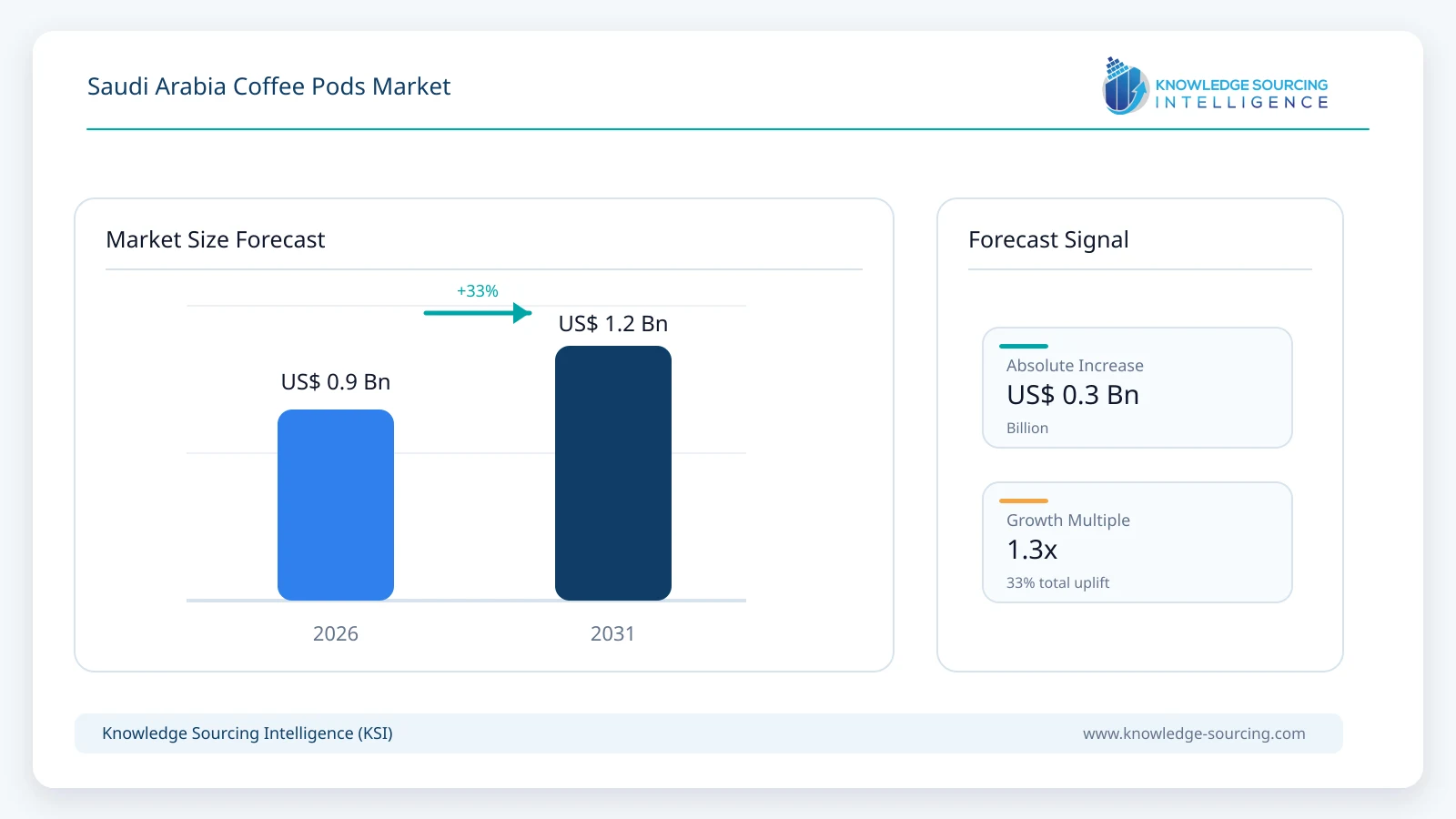
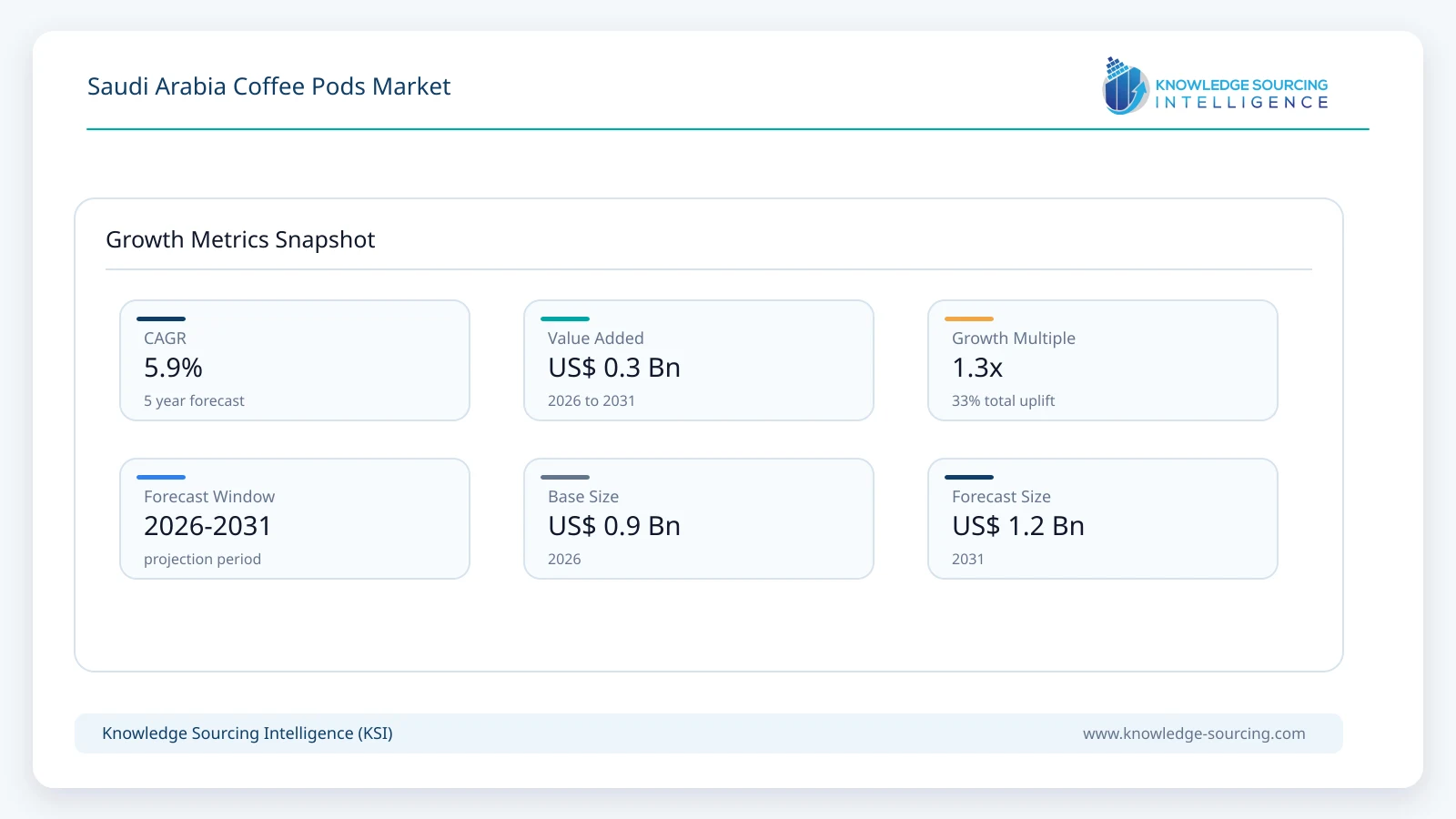
The Saudi Arabia Coffee Pods market is forecast to grow at a CAGR of 5.9%, reaching USD 1.2 billion in 2031 from USD 0.9 billion in 2026.
Highlights:
- 1The Saudi Arabia coffee pods market is expanding steadily and is projected to reach USD 1.2 billion by 2031, advancing at a CAGR of 5.9%.
- 2Hard pods are capturing the majority share as urban consumers increasingly prefer consistent café-style espresso convenience at home and offices.
- 3Online channels are rapidly gaining share through e-commerce platforms, brand sites and quick-delivery apps, especially among younger buyers in major cities.
- 4Flavoured pods are steadily increasing their presence while regular variants retain the dominant portion, and decaffeinated options remain a small but growing segment.
- 5Riyadh and Jeddah are leading regional demand as urban youth with rising disposable incomes drive premium and specialty pod consumption.
- 6Domestic coffee development initiatives are continuously strengthening local sourcing and supply chains that support future pod production growth.
Saudi Arabia’s coffee pod market is increasingly supported by the Kingdom’s efforts to modernize and scale its domestic coffee ecosystem while preserving its long-standing Arabica heritage. The main coffee-growing areas include the mountainous regions of Jazan, Al-Baha and Asir, where Saudi Khawlani coffee has been cultivated for generations. The Public Investment Fund established the Saudi Coffee Company in 2022 to strengthen the national coffee value chain, with a planned SAR 1.2 billion investment over 10 years aimed at increasing domestic coffee production from around 300 tons to 2,500 tons annually.
Recent developments indicate that this strategy is moving beyond cultivation toward processing, product development, skills development, and international commercialization. In February 2025, Saudi Coffee Company signed seven strategic MoUs at the PIF Private Sector Forum, covering research and innovation, coffee processing, soil and fertilizer development, product development, sourcing, distribution and infrastructure. The agreements included collaboration with Shahia Food Company (Dunkin') on research, product development, and specialized training through the SCC Academy, while a partnership with Future Harvest explored freeze-drying technology to improve coffee preservation and processed-bean quality.
The company also expanded its focus on strengthening the wider coffee supply chain. Its agreement with Ma’aden addresses soil quality and specialized fertilizers for coffee farming, while partnerships involving Costa Coffee, Aani & Dani and Lawazem are intended to support local sourcing, product development, supply and distribution. These initiatives can contribute to a more developed domestic coffee ecosystem, supporting the availability of locally sourced coffee products across Saudi Arabia and creating a stronger foundation for premium and convenient formats, including coffee pods and other ready-to-brew products.
Market Overview:
The Saudi Arabia coffee pods market is segmented by:
Type: The Saudi Arabia coffee pods market can be segmented into Hard pods and soft Pods. Hard Pods: Hard pods are tightly packed, pre-measured portions of coffee that are typically designed to function in specific machines like Nespresso. In Saudi Arabia, hard pods are becoming a favourite among coffee drinkers because of their consistency in taste and convenience, while also attracting the premium coffee culture. Compared to other brewing methods, hard pods are for hyper convenience, where consumers want café-style espresso in the comfort of their home without the complexity of grinding coffee beans or handling coffee filters. The young, urban demographic with increased disposable income is contributing to the demand for hard pods at cafes, restaurants and supermarkets and beyond. International brands have the majority of market share in this space, although there are local initiatives in the works for deploying locally sourced Saudi-grown produce in pods.
Caffeine Content: This market can be segmented into Regular and Decaffeinated. Decaffeinated: Decaf pods are, of course, for health-focused coffee drinkers, including people who are caffeine-sensitive, but still want the flavour and ritual of coffee drinking. In Saudi Arabia, decaf pods are a minuscule part of the market, but this segment is slowly growing as health and wellness trends permeate the market and consumers begin to anticipate a healthier lifestyle.
By Flavour: The market can be segmented into Regular and Flavoured. Flavoured coffee pods – such as vanilla, caramel, hazelnut, and regional spice blends - are increasingly gaining prominence in Saudi Arabia. They are meeting consumer demands for variety, novelty, and a sense of indulgence that accompanies beverages other than traditional qahwa. Young consumers trending towards Western café culture have been the main participants in flavoured pods; flavoured pods also perform very well in online channels because it tends to be easier for consumers to experiment with new flavours through online shopping. Having retailer brands investigate regionally inspired flavours and pods (such as cardamom-flavoured pods) is a method for brand owners to pay homage to tradition in a contemporary format. This opens up a distinct growth opportunity in the interplay between flavoured coffee pods and the coffee culture of Saudi Arabia.
Distribution Channel: The market can be segmented in terms of Offline and Online. Online distribution channels have been experiencing strong growth in Saudi Arabia's coffee pods market. With the incorporation of e-commerce platforms, brand websites, and quick-delivery apps, consumers can explore what variety of pods are available and allows them to compare prices. Online sales also tend to be favoured by younger would-be buyers in large cities such as Riyadh and Jeddah, who have a habit of shopping electronically. The growth in online sales is also encouraging subscription models for coffee pods. Subscriptions combine convenience with savings. With the change in purchasing decisions, the coffee pod market is better stemming from e-commerce, which benefits from high internet penetration and a motivation towards e-commerce with the Saudi Arabia Vision 2030 digital transformation push; coffee pods are traversing households and offices in different ways.
Top Trends Shaping the Saudi Arabia Coffee Pods Market
Specialty & Convenience Hybrid
Consumers are continuing to show a preference for speciality coffee with interesting origins and flavours, while at the same time, they want speed and convenience by using pods and capsules. It's combining quality with the convenience of pods; it mirrors global trends and is in line with growing café culture in Saudi ArabiaSustainable, Premium Consumption
Younger Saudis are interested in organic, ethical, and environmentally friendly products. The interest in coffee pods that are made using sustainable materials or offer premium or responsibly sourced blends is resonating very well.
Growth Drivers vs. Challenges
Drivers:
Urban Youth Embrace & Disposable Income: Young, urban Saudis, especially millennials and Gen Z, are leading the charge with respect to coffee consumption. Their disposable incomes are growing, and they are willing to pay for a premium experience. They are drawn to international chains, speciality coffee outlets and innovative new pod products, as well as being cosmopolitan consumers. Beyond their taste and enjoyment for the product are attributes of status and newness. As this segment is willing to experiment with coffee to be a first adopter of flavoured, designer and/or capsule-based coffee. When you consider the urbanisation of the Saudi market and café culture in metropolitan areas like Riyadh and Jeddah, both consumption and experimentation, this would provide the impetus for expansion of the coffee pods segment through the channels of retail, online and lifestyle.
Government Vision & Domestic Coffee Development: Saudi Arabia's Vision 2030 will be a transformative program. The government is making investments into local coffee agriculture, establishing model coffee farms in Jazan, and holding public events based on coffee heritage. This is raising awareness of coffee, pride in Saudi coffee, and supporting the development of domestic supply chains. This creates an opportunity to develop quality, Saudi-grown coffee beans used for pod production, which allows us to further expand the ecosystem, from local to consumer.
Challenges:
Environmental Concerns: Single-use coffee pods have received increased criticism for their waste and poor recyclability. There is mounting recycling backlash in light of increasing support and consumption. The industry's growing critics, both regulators and consumers, continue to demand compostable or reusable solutions for single-use coffee pods, which continue to place pressure on brands to rethink components and supply chain delivery methods.
Key Developments
July 2026: Nestlé Nespresso updated its Middle East & Africa mobile app, confirming availability in Saudi Arabia and enabling customers to order Nespresso coffee capsules, machines and accessories while receiving updates on new product launches.
June 2026: Saudi Coffee Company advanced its third Saudi Sip of Excellence competition, introducing five Saudi judges for the first time and strengthening local specialty-coffee expertise, quality and access to domestic and international markets.
April 2026: Nespresso launched its new Vertuo World experience with Dua Lipa as global brand ambassador, expanding the Vertuo coffee platform and introducing consumers to new coffee experiences and capsule-led occasions.
Saudi Arabia Coffee Pods Market Scope:
| Report Metric | Details |
|---|---|
| Total Market Size in 2026 | USD 0.9 billion |
| Total Market Size in 2031 | USD 1.2 billion |
| Forecast Unit | USD Billion |
| Growth Rate | 5.9% |
| Study Period | 2021 to 2031 |
| Historical Data | 2021 to 2024 |
| Base Year | 2025 |
| Forecast Period | 2026 – 2031 |
| Segmentation | Type, Caffeine Content, Flavour, Distribution Channel |
| Companies |
|
Market Segmentation
By Type
By Caffeine Content
By Flavour
By Distribution Channel
Table of Contents
1. EXECUTIVE SUMMARY
2. MARKET SNAPSHOT
2.1. Market Overview
2.2. Market Definition
2.3. Scope of the Study
2.4. Market Segmentation
3. BUSINESS LANDSCAPE
3.1. Market Drivers
3.2. Market Restraints
3.3. Market Opportunities
3.4. Porter’s Five Forces Analysis
3.5. Industry Value Chain Analysis
3.6. Policies and Regulations
3.7. Strategic Recommendations
4. TECHNOLOGICAL OUTLOOK
5. Saudi Arabia Coffee Pods Market BY TYPE
5.1. Introduction
5.2. Hard Pods
5.3. Soft Pods
6. Saudi Arabia Coffee Pods Market BY CAFFEINE CONTENT
6.1. Introduction
6.2. Regular
6.3. Decaffeinated
7. Saudi Arabia Coffee Pods Market BY flavour
7.1. Introduction
7.2. Regular
7.3. Flavored
8. Saudi Arabia Coffee Pods Market BY distribution channel
8.1. Introduction
8.2. Offline
8.3. Online
9. COMPETITIVE ENVIRONMENT AND ANALYSIS
9.1. Major Players and Strategy Analysis
9.2. Market Share Analysis
9.3. Mergers, Acquisitions, Agreements, and Collaborations
9.4. Competitive Dashboard
10. COMPANY PROFILES
10.1. Saudi Coffee Company
10.2. Nestlé / Nespresso
10.3. Barn’s Café
10.4. Costa Coffee
10.5. Tawazun Al Khalijia (Karoma Caffè)
10.6. Al Hussam Commercial (Saudi Coffee Capsule)
10.7. Starbucks
10.8. Dunkin’
10.9. Jacobs Douwe Egberts (JDE Peet’s)
10.10. Luigi Lavazza
10.11. Melitta
10.12. Zino Davidoff
11. APPENDIX
11.1. Currency
11.2. Assumptions
11.3. Base and Forecast Years Timeline
11.4. Key benefits for the stakeholders
11.5. Research Methodology
11.6. Abbreviations
Navigate
Trusted by the world's leading organizations











