
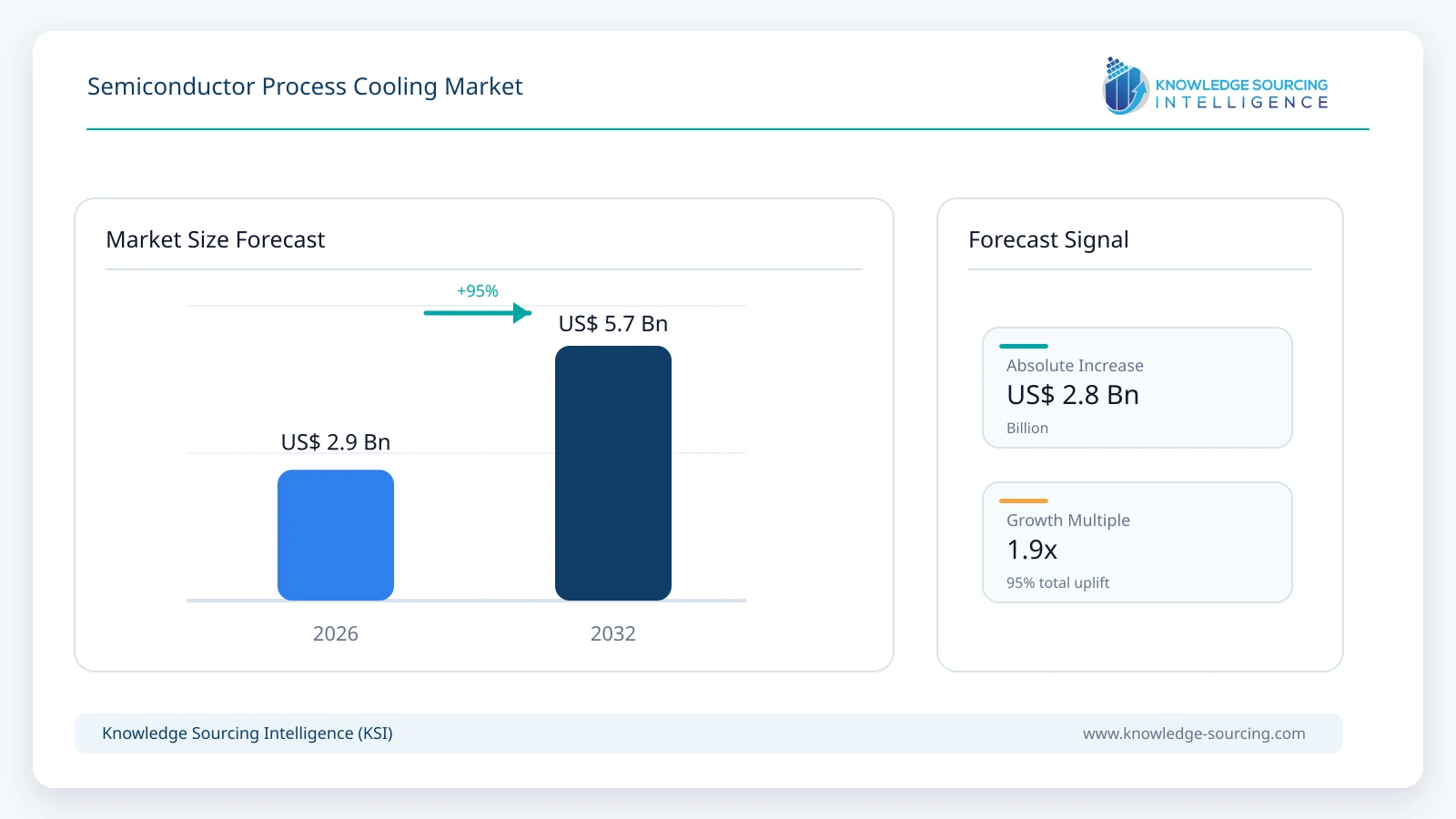
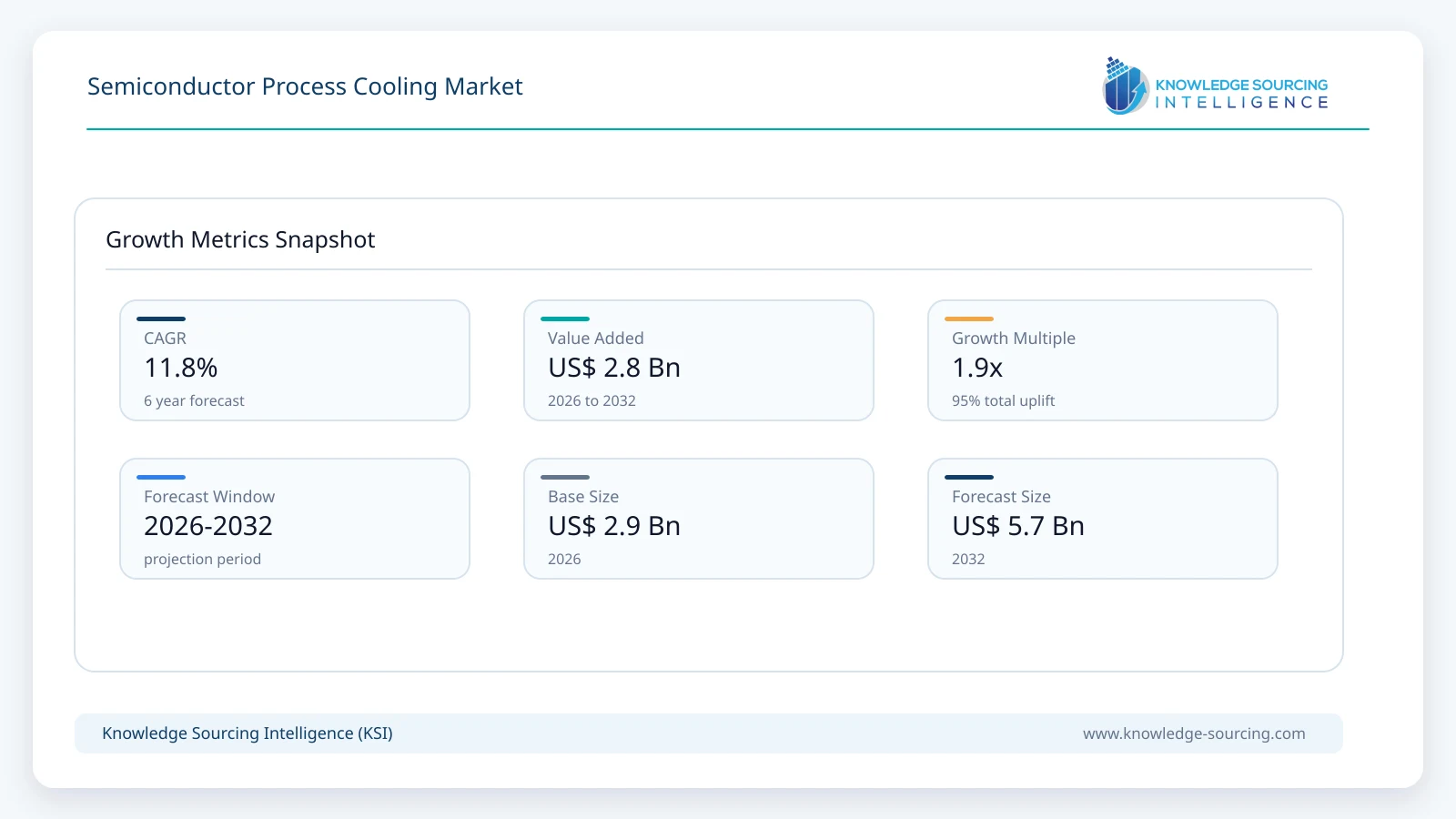
The Semiconductor Process Cooling Market is estimated at USD 2.90 billion in 2026 and is projected to reach USD 5.65 billion by 2032, representing a CAGR of 11.8% during 2026-2032.
Highlights:
- 1Tool-specific refrigerated chillers remain essential for etch, deposition, lithography and other temperature-sensitive semiconductor processes.
- 2Ultra-low-temperature cooling demand increases as advanced etch processes move toward deeper features, higher aspect ratios and tighter process windows.
- 3Low-GWP refrigerants, natural CO2 systems and thermoelectric cooling are gaining development priority as global refrigerant rules tighten.
- 4Facility process-cooling-water integration is expanding where tools can reject heat without full refrigeration, reducing fab energy consumption.
- 5Asia Pacific remains the largest opportunity because Taiwan, South Korea, Japan and China combine the largest installed fab base with strong domestic chiller suppliers.
Market Overview
Process cooling operates at two connected levels inside a semiconductor fab. Facility process-cooling-water systems circulate water through heat exchangers and tool interfaces at temperatures that can often be maintained with cooling towers, mixed-mode systems or centralized chilled water. Tool-level chillers then provide the much tighter temperature control required by individual process modules. These units may use water, water-glycol mixtures, dielectric fluids or specialty heat-transfer fluids and can include refrigeration, heating, pumping, filtration and closed-loop controls in a compact package located beside or beneath the process tool.
The temperature requirement depends on the process. Lithography and coating/develop systems need extremely stable thermal and humidity conditions because small variations can affect overlay and resist behavior. Plasma etch tools can generate rapidly changing heat loads at the wafer chuck and chamber, requiring chillers with fast response and, increasingly, sub-zero or ultra-low-temperature capability. Deposition, ion implantation, cleaning and chemical mechanical planarization require temperature stability to maintain film properties, reaction rates, slurry behavior and equipment reliability. Probe test and reliability testing add another demand layer because semiconductor devices are characterized across controlled temperature ranges.
Energy efficiency is becoming a design constraint. Semiconductor fabrication equipment already uses process chillers to move tool heat into facility cooling loops, while facility chilled-water and process-cooling-water systems are major electricity consumers. SEMI S23 encourages tower-cooled and dual-cooled process-cooling-water architectures where climatic conditions permit. At tool level, inverter compressors, thermoelectric systems, variable-speed pumps, heat recovery and predictive controls are being used to reduce refrigeration energy without compromising process stability.
Market Drivers
Advanced etch and deposition processes require wider temperature ranges
Logic scaling, gate-all-around architectures, high-layer-count NAND and advanced patterning increase the number and difficulty of plasma etch and deposition steps. Chamber-wall, wafer-chuck and coolant temperatures can influence reaction selectivity, sidewall profile and uniformity. Shinwa Controls positions its ultra-low-temperature Proteus chillers for sub -70°C operation as logic moves beyond 3 nm and NAND exceeds 200 layers. Similar requirements support higher-value multi-stage refrigeration, low-temperature pumps and specialty-fluid compatibility.
Transient heat loads increase demand for fast, precise tool-side control
Modern process recipes can change power and heat generation rapidly. Cooling systems therefore need to respond without overshoot, drift or long stabilization periods. Multi-channel architectures are gaining relevance because one semiconductor tool may require independent thermal loops for chamber walls, electrostatic chucks, optical subsystems or chemicals. Ferrotec's 2026 four-channel cleaning chiller illustrates this shift toward independent temperature zones and tighter integration with tool controls.
Refrigerant regulation is accelerating low-GWP redesign
Semiconductor process chillers frequently operate below the temperature ranges served by ordinary industrial refrigeration. This has historically favored refrigerants with higher global warming potential. European and U.S. restrictions are now pushing suppliers toward lower-GWP blends, natural refrigerants and non-refrigeration alternatives. The European Commission's 2026 temporary exemption for some semiconductor chillers confirms both the urgency of the transition and the technical difficulty of replacing existing refrigerants in deep-sub-zero applications.
Fab energy reduction favors hybrid process-cooling architectures
Not every process requires compressor-based refrigeration at all times. Facility process-cooling-water systems can remove heat more efficiently when supply temperatures are compatible with cooling towers or mixed-mode cooling. SEMI S23 formalized chiller-cooled, tower-cooled and dual-cooled process-cooling-water concepts, while TSMC has demonstrated the value of optimizing chilled-water and process-cooling loops. This creates demand for heat exchangers, controls and tool interfaces that allow fabs to shift heat rejection toward the lowest-energy cooling source available.
Restraints and Adoption Challenges
The main challenge is balancing temperature range, stability, heat-load response, footprint, reliability and refrigerant compliance. Deep-sub-zero systems can require complex multi-stage refrigeration and specialized heat-transfer fluids. Low-GWP alternatives may introduce pressure, flammability, material-compatibility or efficiency constraints. Semiconductor tools also demand very high uptime, so new refrigerants and cooling architectures require extensive qualification before adoption. Retrofitting existing fabs can be difficult because process tools are tightly integrated with facility water, exhaust and electrical services. In addition, aggressive energy reduction cannot compromise the thermal stability needed for process control and yield.
Segment Analysis
By Cooling Architecture
Refrigerated process chillers remain the core commercial category because they provide independent temperature control across etch, deposition, lithography, cleaning and test equipment. Compressor systems cover the widest combination of temperature and cooling-capacity requirements, from near-ambient duty to ultra-low-temperature operation. Thermoelectric chillers are used where lower maintenance, compact size and precise control are more important than very high cooling capacity, while liquid-to-liquid heat exchangers provide an efficient option when facility process-cooling water can meet the required temperature range.
Facility-integrated process-cooling-water interfaces and dual-cooled architectures are becoming more important as fabs pursue energy reduction. Rather than refrigerating every thermal load, these systems transfer heat from tool-side loops to facility water and use refrigeration only where temperature or climate conditions require it. Heat recovery is also gaining relevance as semiconductor sites seek to reuse cooling-water heat in cleanroom or utility systems.
Cooling Architecture | Typical Temperature Role | Primary Semiconductor Applications | Commercial Direction |
Standard compressor chiller | Near-ambient to moderate sub-zero | Cleaning, CMP, deposition, lithography support, test | Largest installed category |
Ultra-low-temperature chiller | Deep sub-zero, including below -50°C | Advanced plasma etch, specialty deposition, R&D | Fast-growing high-value category |
Thermoelectric chiller | Precise moderate-load control | Etch, test, metrology, compact OEM integration | Growing where maintenance and precision dominate |
Liquid-to-liquid heat exchanger | Facility-water temperature range | Tool cooling, DI-water isolation, utility interfaces | Expanding for energy-efficient heat rejection |
Multi-channel temperature-control unit | Independent thermal zones | Cleaning, etch, chamber and chemical control | Increasing with tool complexity |
PCW / dual-cooled integration | Facility cooling-water range | Fab-wide process heat removal | Strategic energy-efficiency layer |
Market and Technology Indicators
Indicator | Current Evidence | Market Impact |
Four-channel process cooling | Ferrotec launched a four-channel semiconductor cleaning chiller in January 2026 with independent -10°C to +20°C control. | Supports multi-zone temperature control within increasingly complex tools. |
Low-GWP product transition | Step Science launched the SCS-105W Series in June 2026 with non-fluorocarbon and low-GWP options. | Shows refrigerant regulation moving directly into semiconductor chiller product design. |
EU semiconductor exemption | EU Regulation 2026/286 temporarily allows certain high-GWP semiconductor chillers through 2029 where alternatives are unavailable. | Confirms deep-sub-zero cooling remains technically difficult to decarbonize. |
CO2 semiconductor chiller | SEMICON Europa 2026 exhibitors presented R744 CO2 chillers for etch and CVD with ±0.1°C stability. | Creates a pathway toward natural-refrigerant systems in suitable temperature ranges. |
Ultra-low-temperature demand | Shinwa offers semiconductor chillers extending to sub -70°C for advanced logic and high-layer NAND etch. | Raises equipment value and engineering complexity per process tool. |
PCW energy optimization | SEMI S23 recognizes chiller-cooled, tower-cooled and dual-cooled process cooling water. | Encourages fabs to reduce refrigeration energy through hybrid heat-rejection architecture. |
Regional Opportunity
Asia Pacific
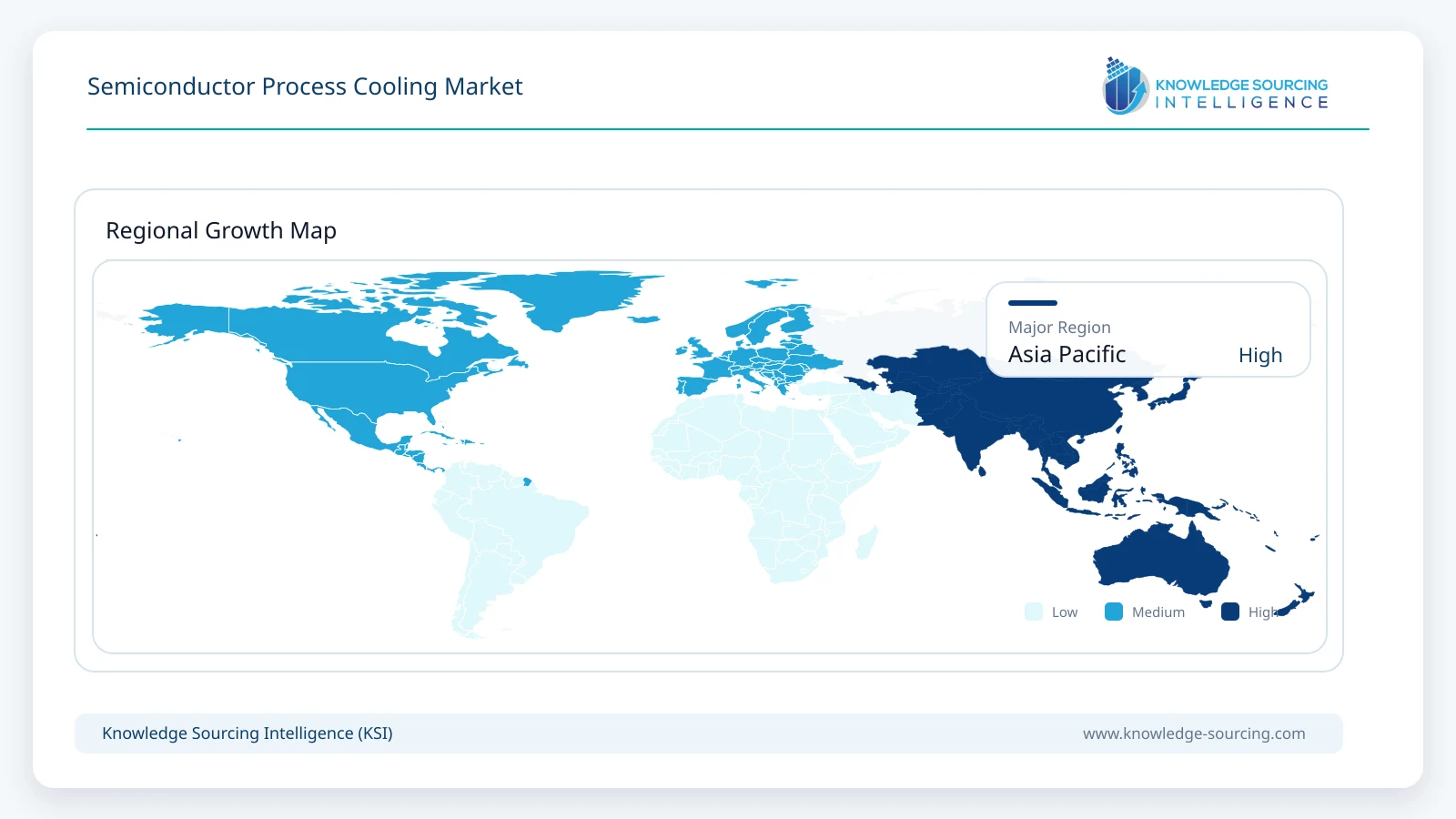
Asia Pacific is the largest market for semiconductor process cooling because the region contains the majority of global wafer fabrication, memory production and advanced packaging capacity. Taiwan, South Korea, Japan and China operate dense fab clusters where hundreds of etch, deposition, cleaning, lithography and test tools require independent temperature-control systems. Expansion in high-bandwidth memory, leading-edge logic and high-layer-count NAND also increases the share of tools requiring deep-sub-zero and high-dynamic-load cooling.
Japan is particularly important on the supply side. Shinwa Controls, Step Science, SMC and other Japanese precision-control companies serve semiconductor equipment manufacturers and fabs with chillers, temperature-control units, valves and process ambient-control products. Japanese process-tool makers also influence cooling specifications globally because chillers are often qualified together with OEM equipment rather than purchased independently by the fab. South Korea contributes through Samsung Electronics and SK hynix capacity expansion and through FST, which supplies compressor and thermoelectric chillers used with major semiconductor process-tool platforms.
Taiwan has one of the world's highest concentrations of advanced logic and packaging capacity. TSMC's long-running work on chilled-water and process-cooling energy optimization demonstrates the importance of cooling efficiency at fab scale. The region also benefits from a broad supplier base in thermal control, pumps, heat exchangers and facility integration. China adds both rapidly expanding domestic semiconductor production and a growing local chiller-manufacturing base, including suppliers targeting lithography, etch, CVD, PVD, cleaning, testing and packaging applications.
North America remains important through Intel, Micron, GlobalFoundries, Texas Instruments and new fab projects, as well as a strong base of semiconductor equipment OEMs that integrate cooling systems into process tools. Europe is smaller in manufacturing volume but strategically important because F-gas regulation is accelerating qualification of low-GWP and natural-refrigerant solutions for semiconductor production.
Competitive Landscape
The competitive landscape combines semiconductor-specialist chiller suppliers, broader precision-temperature-control companies and thermal-management providers. Shinwa Controls and FST are closely tied to semiconductor equipment applications across etch, lithography and testing. Ferrotec is expanding multi-channel semiconductor chillers, while Step Science competes in high-precision and energy-efficient process cooling. LNEYA targets semiconductor lithography, etch, chemical vapor deposition, physical vapor deposition, cleaning, testing and packaging with wide-temperature-range systems.
Mydax supplies precision refrigerated chillers and liquid-to-liquid heat exchangers for semiconductor fabrication and testing, including very low-temperature systems. SMC, LAUDA, JULABO and Huber participate through temperature-control equipment and recirculating systems, while Advanced Energy provides adjacent temperature-measurement and control technologies for etch and deposition. Competitive differentiation increasingly depends on temperature range, transient heat-load response, control stability, cooling capacity at low temperature, footprint, SEMI compliance, refrigerant strategy, fluid compatibility and global field-service support.
Major companies and ecosystem participants covered: Shinwa Controls, FST, Ferrotec, Step Science, LNEYA, Mydax, SMC Corporation, LAUDA, JULABO, Huber, Solid State Cooling Systems, Advanced Energy, Boyd, Daikin Industries and Mitsubishi Electric.
Recent Developments
June 2026: Step Science launched the SCS-105W Series semiconductor process chiller with inverter-based energy optimization and non-fluorocarbon or low-GWP refrigerant options.
February 2026: The European Commission adopted Regulation 2026/286, providing a temporary exemption through 2029 for specified semiconductor manufacturing chillers where compliant lower-GWP alternatives are not yet commercially available.
January 2026: Ferrotec introduced the FCCWQ011-7402 four-channel precision chiller for semiconductor cleaning equipment, providing independent temperature control across four loops.
2026: SEMICON Europa suppliers presented CO2-based R744 process chillers for semiconductor etch and CVD, reflecting industry movement toward natural refrigerants.
Semiconductor Process Cooling Market Scope
| Report Metric | Details |
|---|---|
| Total Market Size in 2026 | USD 2.90 billion |
| Total Market Size in 2032 | USD 5.65 billion |
| Forecast Unit | Billion |
| Growth Rate | 11.8% |
| Study Period | 2021 to 2032 |
| Historical Data | 2021 to 2024 |
| Base Year | 2025 |
| Forecast Period | 2026 – 2032 |
| Segmentation | Cooling Architecture, Temperature Range, Semiconductor Process, Cooling Medium, Installation Type, Geography |
| Companies |
|
Market Segmentation
By Cooling Architecture
Compressor-Based Process Chillers
Ultra-Low-Temperature Chillers
Thermoelectric Chillers
Liquid-to-Liquid Heat Exchangers
Multi-Channel Temperature-Control Units
Process-Cooling-Water Interfaces
By Temperature Range
Above 0°C
0°C to -30°C
-30°C to -50°C
Below -50°C
By Semiconductor Process
Etch
Deposition
Lithography and Coat/Develop
Cleaning and Wet Process
Ion Implantation and Annealing Support
CMP
Wafer Test and Inspection
By Cooling Medium
Water and DI Water
Water-Glycol Mixtures
Dielectric and Specialty Heat-Transfer Fluids
Refrigerant-Based Direct Cooling
By Installation Type
OEM-Integrated Chillers
Fab Retrofit and Replacement
Facility PCW Integration
Service and Maintenance
By Geography
Asia Pacific
Taiwan
South Korea
Japan
China
Southeast Asia
North America
United States
Europe
Rest of World
Table of Contents
1. EXECUTIVE SUMMARY
1.1. Market Opportunity and Key Findings
1.2. Semiconductor Process Thermal-Control Outlook
1.3. Refrigerant and Energy-Efficiency Transition
2. MARKET OVERVIEW
2.1. Fab Process-Cooling Architecture
2.2. Tool-Level Chillers and Temperature-Control Units
2.3. Process Cooling Water and Facility Integration
2.4. Ultra-Low-Temperature Cooling
2.5. Heat-Recovery and Energy-Efficient Cooling
3. MARKET SIZE AND FORECAST, 2026-2032
3.1. Global Market Revenue
3.2. Annual Growth Analysis
3.3. Equipment, Integration and Service Revenue
4. MARKET BY COOLING ARCHITECTURE
4.1. Compressor-Based Process Chillers
4.2. Ultra-Low-Temperature Chillers
4.3. Thermoelectric Chillers
4.4. Liquid-to-Liquid Heat Exchangers
4.5. Multi-Channel Temperature-Control Units
4.6. Process-Cooling-Water Interfaces
5. MARKET BY TEMPERATURE RANGE
5.1. Above 0°C
5.2. 0°C to -30°C
5.3. -30°C to -50°C
5.4. Below -50°C
6. MARKET BY SEMICONDUCTOR PROCESS
6.1. Etch
6.2. Deposition
6.3. Lithography and Coat/Develop
6.4. Cleaning and Wet Process
6.5. Ion Implantation and Annealing Support
6.6. CMP
6.7. Wafer Test and Inspection
7. MARKET BY COOLING MEDIUM
7.1. Water and DI Water
7.2. Water-Glycol Mixtures
7.3. Dielectric and Specialty Heat-Transfer Fluids
7.4. Refrigerant-Based Direct Cooling
8. MARKET BY INSTALLATION TYPE
8.1. OEM-Integrated Chillers
8.2. Fab Retrofit and Replacement
8.3. Facility PCW Integration
8.4. Service and Maintenance
9. REGIONAL MARKET
9.1. Asia Pacific
9.1.1. Taiwan
9.1.2. South Korea
9.1.3. Japan
9.1.4. China
9.1.5. Southeast Asia
9.2. North America
9.2.1. United States
9.3. Europe
9.4. Rest of World
10. MARKET DYNAMICS
10.1. Drivers
10.1.1. Advanced Etch and Deposition Thermal Requirements
10.1.2. Higher Dynamic Heat Loads
10.1.3. Low-GWP Refrigerant Transition
10.1.4. Fab Energy-Efficiency Requirements
10.2. Restraints
10.2.1. Deep-Sub-Zero Refrigerant Constraints
10.2.2. Qualification and Reliability Requirements
10.2.3. Retrofit Integration Complexity
10.2.4. Energy versus Temperature-Stability Trade-Off
11. COMPETITIVE LANDSCAPE
11.1. Market Structure and Competitive Intensity
11.2. Semiconductor-Specialist Chiller Suppliers
11.3. Precision Temperature-Control Platforms
11.4. Low-GWP and Natural-Refrigerant Strategies
11.5. OEM Qualification and Service Networks
12. COMPANY PROFILES
12.1. Shinwa Controls
12.2. FST
12.3. Ferrotec
12.4. Step Science
12.5. LNEYA
12.6. Mydax
12.7. SMC Corporation
12.8. LAUDA
12.9. JULABO
12.10. Huber
12.11. Solid State Cooling Systems
12.12. Advanced Energy
12.13. Boyd
12.14. Daikin Industries
12.15. Mitsubishi Electric
13. RECENT DEVELOPMENTS
14. Appendix
Navigate
Trusted by the world's leading organizations











