
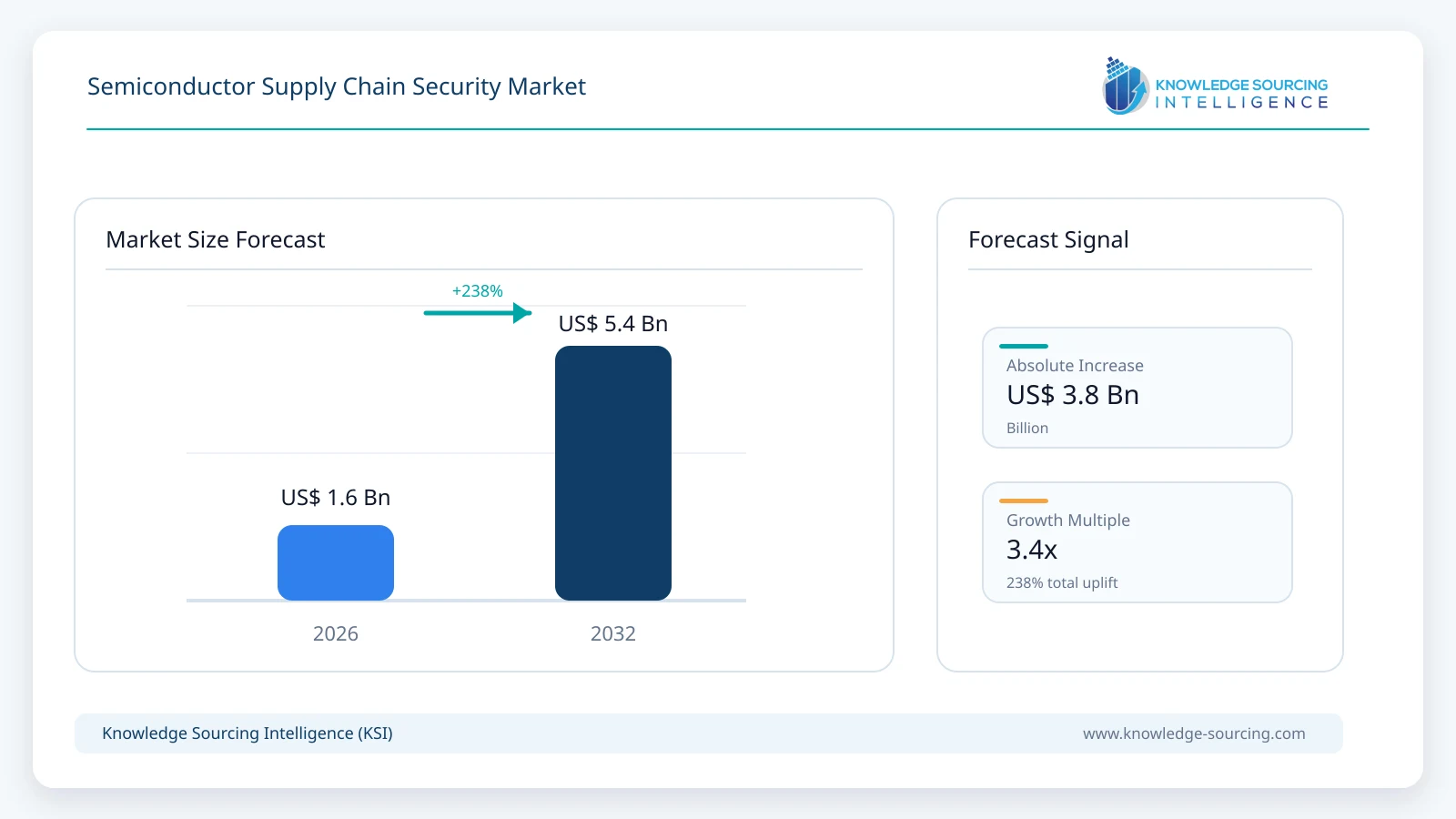
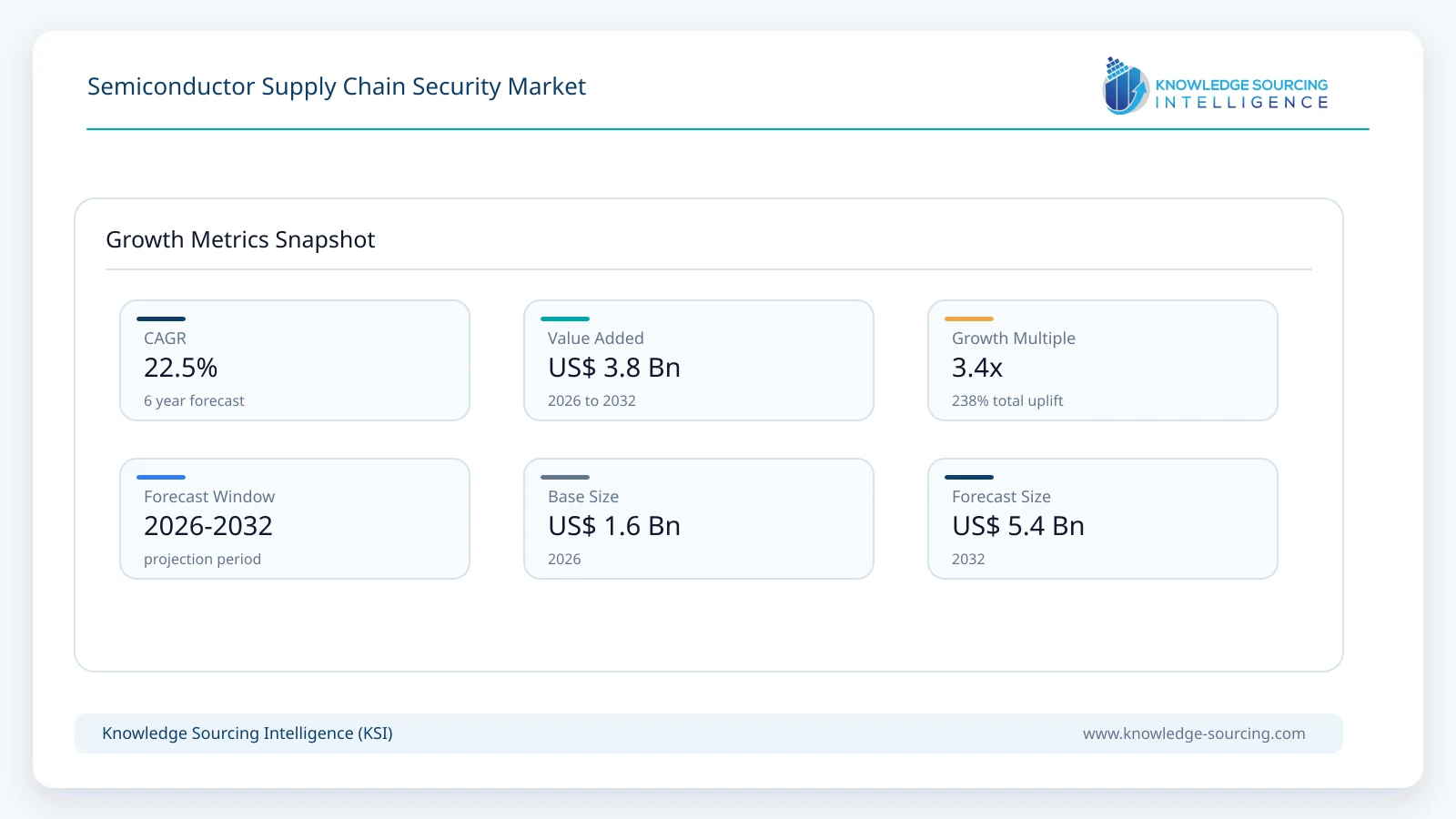
The Semiconductor Supply Chain Security Market is estimated at USD 1.60 billion in 2026 and is projected to reach USD 5.40 billion by 2032, representing a CAGR of 22.5% over 2026-2032.
Highlights:
- 1Supplier-risk intelligence and semiconductor traceability platforms form the largest 2026 revenue pool.
- 2Chip-level provenance and component-authentication technologies are the fastest-growing segment through 2032.
- 3NIST is moving semiconductor traceability from workshop consensus toward interoperable implementation frameworks.
- 4SEMI E187, E188 and E191 are expanding security requirements across semiconductor manufacturing equipment.
- 5Defense, aerospace, hyperscale and automotive buyers drive the highest assurance requirements.
Semiconductor supply-chain security spans several distinct control layers. The first is supplier and network visibility: companies map wafer suppliers, foundries, assembly and test partners, equipment vendors and critical-material sources to identify cyber, geopolitical and compliance exposure. The second is traceability: serialized device identities, manufacturing records and chain-of-custody data link an individual chip or package to production and logistics events. The third is authentication and assurance, where electrical, optical, physical or cryptographic techniques are used to determine whether a device is genuine, altered, recycled or maliciously substituted.
Standards are becoming more explicit. SEMI E142 provides a model for mapping semiconductor assets from wafers through multi-die packages and downstream assembly, while SEMI traceability initiatives are examining external chain-of-custody records. NIST's 2026 semiconductor traceability workshop brought together Google, Microsoft, IBM, Bosch, Stellantis, AMD, Intel, Micron, Qualcomm, Siemens EDA, Synopsys and Rambus, indicating that provenance is no longer limited to government or defense procurement. NIST's September 2026 meta-framework adds a common approach to linking traceability data while preserving selective disclosure of sensitive information.
Security also applies to semiconductor manufacturing equipment and software. Fab tools arrive with operating systems, remote-service interfaces and embedded computing that can create supply-chain cyber exposure before equipment enters production. SEMI E187 defines cybersecurity requirements for fab equipment, E188 addresses malware-free equipment delivery and integration, and E191 standardizes cybersecurity-status reporting. The result is a market that combines software platforms, chip-level assurance technologies, testing services and equipment-security controls rather than one isolated anti-counterfeit category.
Market Drivers
Semiconductor traceability is moving toward formalized industry implementation
NIST's January 2026 Semiconductor Traceability and Provenance Workshop identified traceability as the top priority emerging from earlier industry discussions and focused specifically on practical implementation. The September 2026 NIST traceability meta-framework provides an interoperable structure for linking pedigree and provenance information across manufacturing ecosystems. As standards mature, semiconductor suppliers and customers will need software, integration, identity and data-governance tools to create verifiable traceability without exposing proprietary process information.
Counterfeit and malicious-component risk is expanding beyond visual inspection
Traditional anti-counterfeit programs rely on documentation review, microscopy, X-ray, electrical testing and destructive physical analysis. Newer approaches seek non-invasive identification of counterfeit, recycled or maliciously modified components. The U.S. Department of Commerce's 2026 funding commitment to OBSIDIA Semiconductors demonstrates public demand for scalable semiconductor authentication. Defense, aerospace, critical infrastructure and high-value AI systems create particularly strong demand because one compromised component can affect system assurance far beyond the value of the chip itself.
Fab-equipment cybersecurity creates a new supplier-assurance requirement
Semiconductor factories contain highly networked process equipment with remote support, embedded operating systems and long service lives. SEMI's 2026 revision of E187 introduces tiered security levels, including requirements for supported operating systems, pre-shipment malware scanning, encrypted communications and stronger controls for externally connected equipment. These requirements create spending not only by fabs but also by equipment suppliers that must harden systems, provide security status information and maintain secure service processes throughout the installed lifecycle.
Geopolitical and regulatory complexity increases sub-tier visibility requirements
Semiconductor supply chains depend on specialized materials, equipment and manufacturing capabilities that can sit several tiers below the direct supplier. Trade controls, sanctions, export restrictions and cyber incidents can therefore affect a chip program through suppliers that the buyer does not directly contract. Platforms from Exiger, interos.ai and other risk-intelligence providers map deeper supplier relationships and combine cyber, restrictions, geopolitical and compliance indicators. Semiconductor companies increasingly need these tools to connect part-level exposure with business continuity and assurance decisions.
Restraints and Adoption Challenges
The main constraint is fragmentation. Device identity, wafer genealogy, assembly records, supplier-risk data, equipment cybersecurity and component testing often reside in different systems owned by companies that do not want to expose process or customer information. Traceability programs can therefore fail if they require broad disclosure rather than selective proof. Legacy semiconductor devices may also lack secure identities or serialized records, making retrofit difficult. Authentication technologies can add test cost and cycle time, while false positives can disrupt already constrained supply chains. Finally, many supply-chain risk platforms are horizontal products, so semiconductor buyers may resist paying for functionality that does not map directly to dies, packages, lots and equipment.
Semiconductor Supply Chain Security Market Segment Analysis
By Security Function
Supplier and sub-tier risk intelligence together with traceability/provenance platforms represent the largest revenue contribution in 2026 because these solutions are already used across semiconductor, defense and electronics procurement organizations. They map supplier relationships, track restrictions and cyber exposure, manage part or lot genealogy and create auditable evidence across multiple organizations.
Chip-level provenance, authentication and counterfeit-detection technologies are expected to grow fastest through 2032. The category starts from a smaller base but benefits from increased government funding, cryptographic identity, physical fingerprinting and non-invasive inspection techniques. Fab-equipment cybersecurity also grows strongly as SEMI E187 revisions and lifecycle reporting requirements convert previously voluntary hardening into procurement expectations.
Security Category | Revenue Contribution | Growth Direction | Primary Semiconductor Security Role |
Supplier and sub-tier risk intelligence | Largest | Strong | Map cyber, geopolitical, restriction and compliance exposure |
Traceability and provenance platforms | High | Very strong | Link die, lot, package and chain-of-custody records |
Counterfeit and malicious-component authentication | Growing | Fastest | Verify component authenticity and detect substitution or tampering |
Cryptographic device identity and attestation | Emerging | Very fast | Create verifiable chip identity and lifecycle trust |
Fab-equipment cybersecurity and supplier assurance | High | Very strong | Secure equipment delivery, operation, remote access and maintenance |
Assurance, audit and testing services | Established | Strong | Component testing, supplier audits and secure-procurement validation |
Market and Technology Indicators
Indicator | Revenue Contribution | Market Impact |
NIST semiconductor traceability program | NIST identified semiconductor traceability as a top industry priority and held a dedicated implementation workshop in January 2026. | Moves provenance from isolated programs toward ecosystem-wide deployment. |
NIST IR 8536 | The September 2026 framework defines interoperable traceability concepts with selective disclosure. | Supports cross-company traceability without requiring full data exposure. |
Hardware-security standards roadmap | NIST IR 8615 calls for cryptographic identities, attestation and verifiable semiconductor components. | Expands security from supplier monitoring into chip-level trust. |
SEMI E187 revision | SEMI is adding cumulative security levels and stronger supplier hardening requirements to fab-equipment cybersecurity. | Creates compliance and engineering demand across equipment vendors and fabs. |
Counterfeit-identification funding | Commerce announced up to USD 34 million for OBSIDIA semiconductor authentication R&D in July 2026. | Accelerates non-invasive provenance and malicious-component detection. |
End-to-end semiconductor traceability | Siemens promotes secure lifecycle traceability across design, manufacturing and downstream product data. | Shows lifecycle software vendors moving into semiconductor assurance workflows. |
Regional Opportunity
North America
North America is the largest early market for semiconductor supply-chain security because the United States combines large semiconductor design and cloud industries with defense, aerospace and critical-infrastructure buyers that impose high assurance requirements. NIST, the Department of Commerce and defense organizations are actively funding and standardizing semiconductor traceability, provenance and hardware assurance. These programs influence commercial procurement because the same chips and manufacturing networks serve hyperscale computing, automotive, medical and industrial customers.
The supplier ecosystem is also strong. Exiger and interos.ai provide multi-tier supply-chain risk intelligence used by government and major enterprises. Siemens offers semiconductor lifecycle and traceability platforms, while Synopsys and other EDA suppliers participate in semiconductor trust and provenance initiatives. Specialized authentication companies, testing laboratories and hardware-security vendors address counterfeit detection, secure identity and physical assurance. The region therefore captures software, services and hardware-security value even when much of physical semiconductor manufacturing occurs in Asia.
Public funding is pushing the market toward chip-level verification. The 2026 Commerce award proposal for OBSIDIA specifically targets non-invasive identification of counterfeit and malicious components to establish provenance in AI and advanced-electronics supply chains. NIST is simultaneously developing traceability structures that can link product history without forcing participants to reveal sensitive information. Together, these programs reduce adoption barriers for suppliers that need common technical interfaces and credible procurement incentives.
Asia Pacific is critical because Taiwan, South Korea, Japan, China, Malaysia and Singapore contain large shares of semiconductor fabrication, packaging, test and equipment manufacturing. SEMI cybersecurity standards are particularly relevant to this region's fabs and equipment suppliers. Europe contributes through semiconductor equipment, automotive electronics, industrial security and supply-chain compliance requirements, while defense-oriented assurance demand remains significant across allied markets.
Competitive Landscape
The competitive landscape is fragmented across supply-chain risk intelligence, lifecycle traceability, semiconductor cybersecurity and physical component assurance. Exiger and interos.ai compete in multi-tier supplier mapping, cyber-risk and compliance intelligence. Siemens combines lifecycle data management with semiconductor-specific traceability and provenance capabilities. EDA and hardware-security companies participate through device identity, secure design, attestation and trust technologies.
Authentication and test specialists occupy a different part of the market. OBSIDIA is developing non-invasive counterfeit and malicious-component identification, while specialist laboratories and secure-electronics suppliers use X-ray, microscopy, electrical test, physical analysis and serialization to establish authenticity. Rambus, Intrinsic ID and similar hardware-security vendors contribute technologies for device identity, root of trust and attestation that can support provenance architectures.
Semiconductor equipment cybersecurity adds another competitive layer. Equipment OEMs must comply with customer security requirements and SEMI standards, while security vendors provide vulnerability management, endpoint controls, secure remote access and audit support tailored to long-lived operational technology. Competitive advantage depends on semiconductor-specific data models, ability to map parts and lots rather than only suppliers, trusted evidence, interoperability and support for selective disclosure across companies.
Major companies and ecosystem participants covered: Exiger, interos.ai, Siemens, Synopsys, Rambus, Intrinsic ID, OBSIDIA Semiconductors, PDF Solutions, Cycuity, proteanTecs, SGS, Intertek, TÜV Rheinland, Keysight Technologies and Microchip Technology.
Recent Developments
September 2026: NIST published IR 8615 calling for cryptographic identity, attestation, verifiable components and lifecycle security across the semiconductor ecosystem.
August 2026: SEMI detailed a major revision of E187 introducing tiered security levels and stronger cybersecurity requirements for fab equipment and supplier support.
July 2026: The U.S. Department of Commerce announced a letter of intent for up to USD 34 million to OBSIDIA Semiconductors for counterfeit and malicious-component identification R&D.
May 2026: Siemens published an updated semiconductor traceability approach emphasizing evidence-based chain-of-custody and zero-trust semiconductor lifecycle controls.
April 2026: interos.ai launched its iQ platform to expand predictive sub-tier supplier-risk analysis and financial exposure quantification.
Semiconductor Supply Chain Security Market Scope:
| Report Metric | Details |
|---|---|
| Total Market Size in 2026 | USD 1.60 billion |
| Total Market Size in 2032 | USD 5.40 billion |
| Forecast Unit | USD Billion |
| Growth Rate | 22.5% |
| Study Period | 2021 to 2032 |
| Historical Data | 2021 to 2024 |
| Base Year | 2025 |
| Forecast Period | 2026 – 2032 |
| Segmentation | Security Function, Supply Chain Stage, Technology, Customer Type, Assurance Objective, Geography |
| Companies |
|
Market Segmentation
By Security Function
Supplier and Sub-Tier Risk Intelligence
Traceability and Provenance Platforms
Counterfeit and Malicious-Component Authentication
Cryptographic Device Identity and Attestation
Fab-Equipment Cybersecurity and Supplier Assurance
Assurance, Audit and Testing Services
By Supply Chain Stage
Semiconductor Design and IP
Wafer Fabrication
Assembly, Packaging and Test
Distribution and Logistics
System Integration and End-Use Procurement
By Technology
Digital Traceability and Serialization
Cryptographic Identity and Attestation
AI-Based Supplier and Risk Intelligence
Physical and Electrical Component Authentication
Blockchain and Distributed-Ledger Provenance
Equipment Cybersecurity and Secure Remote Support
By Customer Type
Fabless Semiconductor Companies
Foundries and Integrated Device Manufacturers
OSAT and Packaging Providers
Semiconductor Equipment Suppliers
Hyperscale, Automotive and Industrial OEMs
Defense, Aerospace and Government Buyers
By Assurance Objective
Counterfeit Prevention
Cyber and Tamper Risk
Trade and Supplier Compliance
Chain-of-Custody Verification
Product and Manufacturing Integrity
By Geography
North America
United States
Canada
Asia Pacific
Taiwan
South Korea
Japan
China and Southeast Asia
Europe
Rest of World
Table of Contents
1. EXECUTIVE SUMMARY
1.1. Market Opportunity and Key Findings
1.2. Semiconductor Security and Traceability Outlook
1.3. Principal Revenue Pools
2. MARKET OVERVIEW
2.1. Semiconductor Supply Chain Security Architecture
2.2. Supplier, Part and Lot-Level Risk Visibility
2.3. Traceability, Provenance and Chain of Custody
2.4. Counterfeit and Malicious-Component Authentication
2.5. Fab-Equipment and Manufacturing Cybersecurity
3. MARKET SIZE AND FORECAST, 2026-2032
3.1. Global Market Revenue
3.2. Annual Growth Analysis
3.3. Software, Hardware, Testing and Services Revenue
4. MARKET BY SECURITY FUNCTION
4.1. Supplier and Sub-Tier Risk Intelligence
4.2. Traceability and Provenance Platforms
4.3. Counterfeit and Malicious-Component Authentication
4.4. Cryptographic Device Identity and Attestation
4.5. Fab-Equipment Cybersecurity and Supplier Assurance
4.6. Assurance, Audit and Testing Services
5. MARKET BY SUPPLY CHAIN STAGE
5.1. Semiconductor Design and IP
5.2. Wafer Fabrication
5.3. Assembly, Packaging and Test
5.4. Distribution and Logistics
5.5. System Integration and End-Use Procurement
6. MARKET BY TECHNOLOGY
6.1. Digital Traceability and Serialization
6.2. Cryptographic Identity and Attestation
6.3. AI-Based Supplier and Risk Intelligence
6.4. Physical and Electrical Component Authentication
6.5. Blockchain and Distributed-Ledger Provenance
6.6. Equipment Cybersecurity and Secure Remote Support
7. MARKET BY CUSTOMER TYPE
7.1. Fabless Semiconductor Companies
7.2. Foundries and Integrated Device Manufacturers
7.3. OSAT and Packaging Providers
7.4. Semiconductor Equipment Suppliers
7.5. Hyperscale, Automotive and Industrial OEMs
7.6. Defense, Aerospace and Government Buyers
8. MARKET BY ASSURANCE OBJECTIVE
8.1. Counterfeit Prevention
8.2. Cyber and Tamper Risk
8.3. Trade and Supplier Compliance
8.4. Chain-of-Custody Verification
8.5. Product and Manufacturing Integrity
9. REGIONAL MARKET
9.1. North America
9.1.1. United States
9.1.2. Canada
9.2. Asia Pacific
9.2.1. Taiwan
9.2.2. South Korea
9.2.3. Japan
9.2.4. China and Southeast Asia
9.3. Europe
9.4. Rest of World
10. MARKET DYNAMICS
10.1. Drivers
10.1.1. Formalization of Semiconductor Traceability
10.1.2. Counterfeit and Malicious-Component Risk
10.1.3. Fab-Equipment Cybersecurity Requirements
10.1.4. Geopolitical and Regulatory Supply Chain Risk
10.2. Restraints
10.2.1. Fragmented Data and Proprietary Manufacturing Records
10.2.2. Legacy Components without Secure Identity
10.2.3. Authentication Cost and False-Positive Risk
10.2.4. Horizontal Platforms with Limited Semiconductor Granularity
11. COMPETITIVE LANDSCAPE
11.1. Market Structure and Competitive Intensity
11.2. Supply Chain Risk and Supplier-Intelligence Platforms
11.3. Traceability, Provenance and Lifecycle Security Platforms
11.4. Component Authentication and Hardware-Trust Technologies
11.5. Standards, Equipment and Assurance Ecosystem Partnerships
12. COMPANY PROFILES
12.1. Exiger
12.2. interos.ai
12.3. Siemens
12.4. Synopsys
12.5. Rambus
12.6. Intrinsic ID
12.7. OBSIDIA Semiconductors
12.8. PDF Solutions
12.9. Cycuity
12.10. proteanTecs
12.11. SGS
12.12. Intertek
12.13. TÜV Rheinland
12.14. Keysight Technologies
12.15. Microchip Technology
13. RECENT DEVELOPMENTS
14. APPENDIX
Navigate
Trusted by the world's leading organizations











