
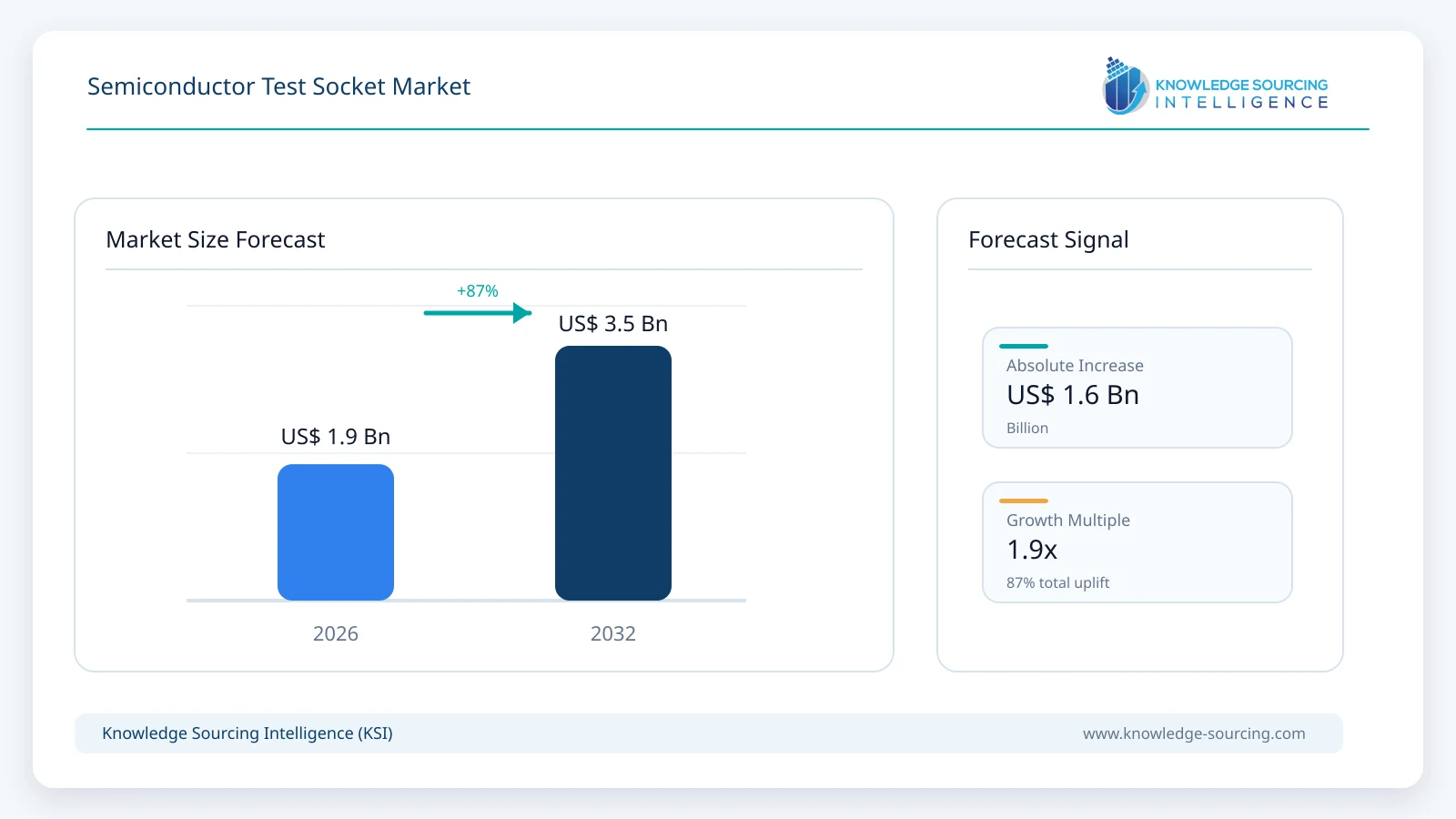
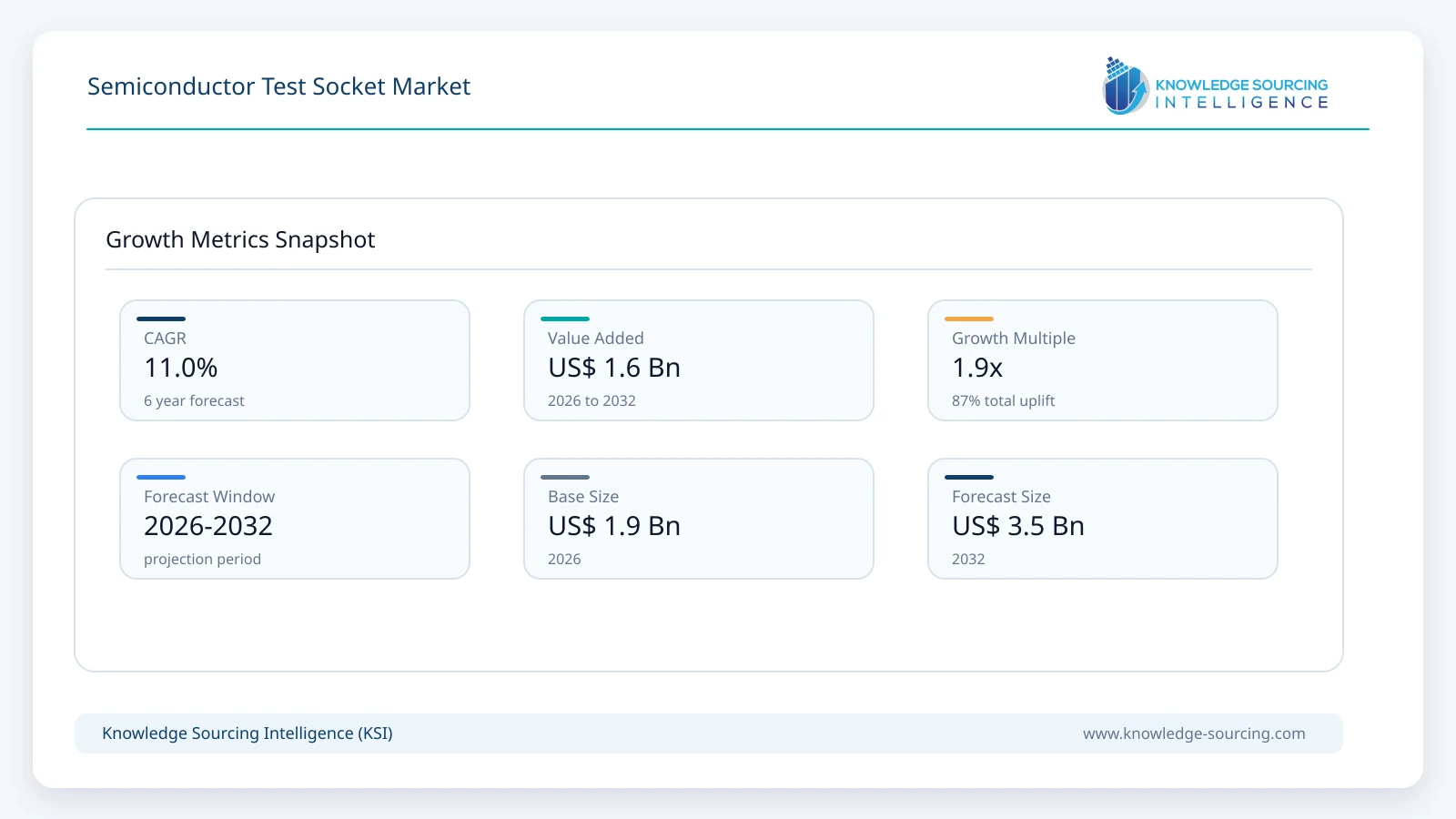
The Semiconductor Test Socket Market is estimated at USD 1.90 billion in 2026 and is projected to reach USD 3.55 billion by 2032, representing a CAGR of 11.0% during 2026-2032.
Highlights:
- 1AI and HPC packages are increasing socket pin count, current delivery, bandwidth and thermal-control requirements.
- 2Coaxial and impedance-controlled sockets gain importance as digital interfaces move toward 224 Gbps PAM4 and beyond.
- 3High-power burn-in sockets increasingly require integrated heat spreading, active air cooling or liquid cooling.
- 4Elastomer and spring-probe technologies remain complementary across fine-pitch, high-speed and high-volume production test.
- 5Asia Pacific remains the largest opportunity due to its concentration of OSAT, memory, foundry and socket manufacturing capacity.
Market Overview
Test sockets are inserted between the device under test and the test hardware so that a semiconductor package can be repeatedly contacted without soldering. In final test, the socket must maintain low and stable contact resistance at production throughput. In burn-in, the socket must survive hundreds or thousands of thermal cycles while maintaining mechanical pressure and electrical continuity. Engineering and system-level test sockets prioritize flexibility, signal quality and rapid package-change capability.
The electrical architecture varies by device. Spring-probe and pogo-pin sockets remain widely used because they provide compliance, repeatability and replaceable contacts. Elastomer sockets use conductive paths embedded in silicone or polymer structures and can provide very short signal paths and gentle contact to dense packages. Kelvin contactors separate current-force and voltage-sense paths for accurate low-resistance measurement in power semiconductors. Coaxial sockets provide controlled impedance and isolation for high-speed digital and radio-frequency devices.
Thermal and mechanical requirements are becoming equally important. Large AI processors, GPUs and accelerators can contain tens of thousands of contacts and dissipate hundreds of watts during test. Socket lids, stiffeners and thermal-control hardware must apply uniform force without damaging the package or test board. Burn-in platforms for next-generation processors may need liquid-cooled lids and high contact force, while fine-pitch mobile and RF devices require low-force contacting and alignment accuracy measured in tens of microns.
Market Drivers
AI and high-performance computing increase socket complexity
Next-generation AI accelerators, GPUs, CPUs and custom application-specific integrated circuits combine larger package sizes, more power pins and higher-speed interfaces. Smiths Interconnect's DaVinci Gen V was developed around these requirements and supports 224 Gbps PAM4 signaling, while Cohu's high-end contactors are designed for large arrays and high-frequency package test. As socket complexity rises, average selling value increases because the interface must combine signal integrity, power delivery, mechanical coplanarity and thermal management in one assembly.
Higher power density expands Kelvin and thermal-socket demand
Power management integrated circuits, automotive power devices, GaN and silicon-carbide devices require accurate high-current measurement and stable contact under elevated temperature. Kelvin socket architectures reduce measurement error by separating current and voltage paths. For high-power compute devices, burn-in sockets also require enhanced heat removal. Smiths Interconnect has described high-power burn-in concepts supporting very large packages, thousands of contacts and integrated liquid cooling, illustrating how socket design is becoming part of the thermal-test architecture.
Advanced packaging and fine pitch increase contact-density requirements
Ball-grid-array, land-grid-array, wafer-level chip-scale, fan-out and advanced system-in-package formats continue to reduce pitch while increasing I/O count. This places tighter requirements on probe diameter, alignment, coplanarity and contact-force uniformity. Yamaichi offers test and burn-in sockets down to 0.3 mm pitch for several package families, while Cohu's RF and mobility contactors extend into fine-pitch, high-frequency testing. High-density contact technology is therefore becoming a key differentiator.
Consumable replacement supports recurring revenue
Test sockets and their contacts experience mechanical wear, contamination and resistance drift after repeated insertions. They are also specific to package geometry and frequently redesigned when customers change device generation. Cohu classifies interface products such as test contactors, probe heads and probe pins within recurring revenue and notes that they are replaced frequently. This consumable nature makes socket demand less dependent on greenfield test-cell installations than capital equipment markets.
Restraints and Adoption Challenges
Socket suppliers must balance conflicting requirements: lower contact force, lower resistance, higher current capacity, wider bandwidth, longer mechanical life and lower cost. Large packages can require hundreds of pounds of total applied force, placing stress on load boards and package substrates. Fine-pitch sockets are sensitive to dimensional tolerance and contamination. High-frequency sockets need controlled impedance through the full signal path, and liquid-cooled thermal structures increase cost and maintenance complexity. Customization also creates short product cycles and engineering expense because each new semiconductor package can require a new socket design.
Segment Analysis
By Contact Technology
Spring-probe sockets remain the broadest commercial category because they combine compliance, serviceability and support for high-volume manufacturing across BGA, LGA, QFN and other packages. They are increasingly offered in coaxial, Kelvin and mixed-contact architectures so signal, power and sense pins can coexist within one socket. Elastomer sockets are particularly attractive where a short signal path, fine pitch and reduced package marking are important, while cantilever and stamped-contact designs retain roles in automotive, analog and burn-in applications.
The fastest value growth is occurring in high-speed coaxial and high-power thermal sockets. AI processors require controlled impedance at very high data rates, while high-current devices require low inductance and accurate voltage sensing. Large burn-in sockets add another layer because they must maintain thousands of contacts under elevated temperatures and significant cooling loads. These categories carry higher engineering content and are less commoditized than standard validation sockets.
Socket / Contact Type | Primary Strength | Typical Applications | Commercial Direction |
Spring-probe / pogo | Compliance, serviceability and broad package coverage | Final test, engineering, HVM package test | Largest installed category |
Elastomer | Short signal path, fine pitch and gentle package contact | High-speed logic, memory, validation | Growing in dense advanced packages |
Kelvin contact | Accurate low-resistance high-current measurement | Power ICs, automotive, SiC and GaN | Expanding with electrification and AI power |
Coaxial socket | Controlled impedance, low crosstalk and high bandwidth | AI processors, RF, networking and 6G | Fast-growing high-value category |
Burn-in socket | Thermal-cycle durability and long contact life | Reliability qualification and production burn-in | Rising in high-power compute |
Universal / quick-turn socket | Rapid engineering validation across package variants | R&D, characterization and failure analysis | Steady specialty demand |
Market and Technology Indicators
Indicator | Current Evidence | Market Impact |
224 Gbps socket capability | Smiths Interconnect's DaVinci Gen V supports up to 224 Gbps PAM4 and beyond 100 GHz RF performance. | Raises socket value for AI, networking and future communications devices. |
Large AI-package test | Cohu contactors support large-array packages and high-end digital interfaces, while Eclipse targets ultra-large-form-factor AI processors. | Drives larger sockets with higher force, thermal control and pin counts. |
High-power burn-in | Smiths highlighted burn-in concepts supporting up to 22,000 contacts and 2,000 W with liquid cooling at DesignCon 2026. | Moves test sockets into active thermal-management territory. |
LEENO socket growth | LEENO reported 2025 IC test socket revenue of KRW 243.9 billion versus KRW 171.8 billion in 2024. | Confirms strong demand for package-test consumables. |
ISC socket growth | ISC reported 2025 Test Socket and related product revenue of KRW 194.5 billion versus KRW 117.3 billion in 2024. | Shows rapid growth in elastomer and pogo-based socket demand. |
Fine-pitch validation | Yamaichi offers semiconductor sockets from 0.3 mm pitch across BGA, CSP, QFN, SON and LGA packages. | Supports continued miniaturization and package-density growth. |
Regional Opportunity
Asia Pacific
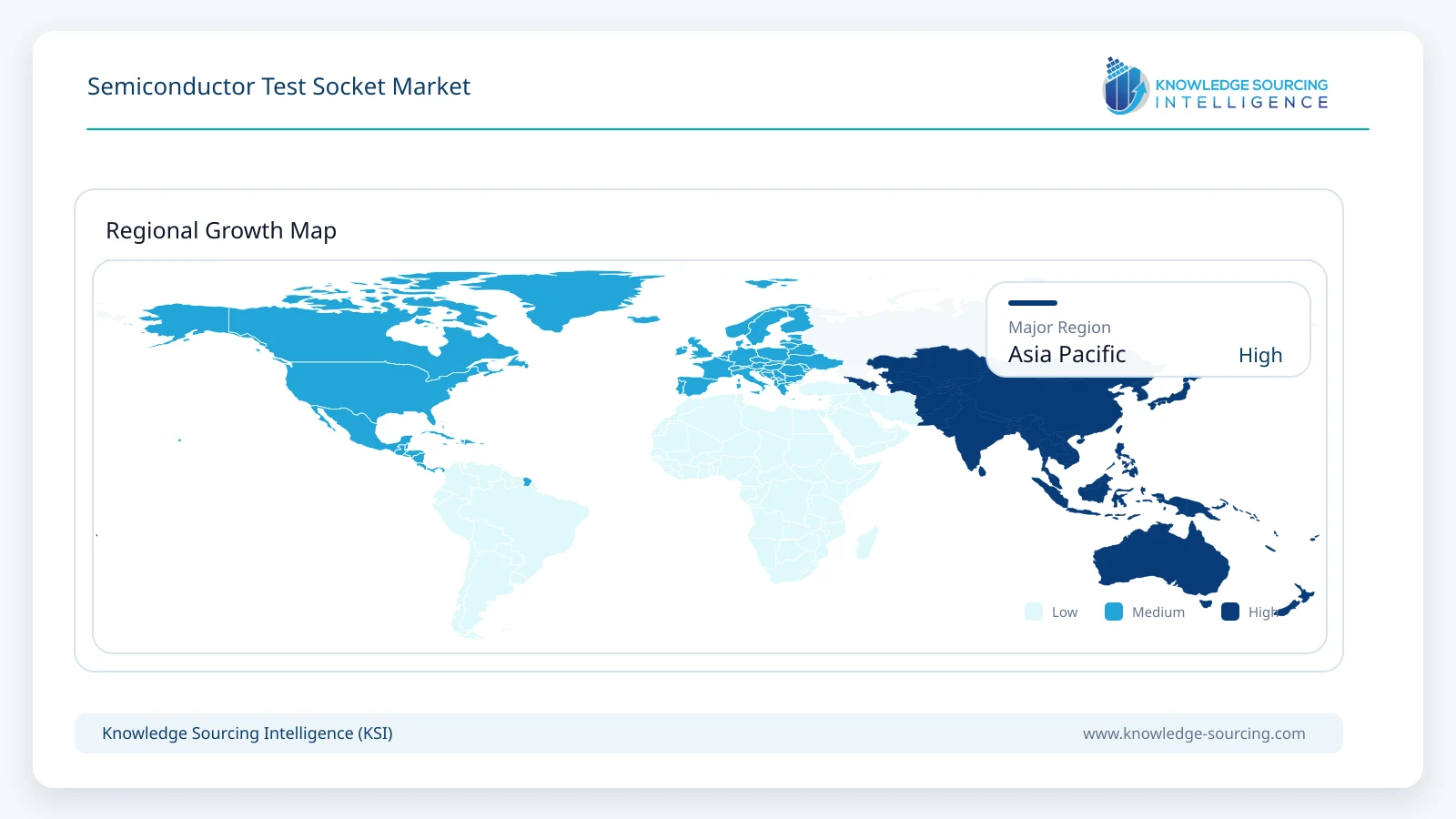
Asia Pacific is the largest semiconductor test socket market because it contains the majority of global outsourced semiconductor assembly and test, memory production, advanced packaging and high-volume device manufacturing. Taiwan, South Korea, China, Japan, Malaysia, the Philippines and Singapore host large test operations where sockets are consumed continuously as devices move through engineering qualification, final test, system-level test and burn-in.
South Korea is particularly important because it combines Samsung Electronics and SK hynix with specialist socket suppliers such as ISC and LEENO Industrial. Both companies reported substantial test-socket-related revenue in 2025, with results published in 2026. Korea's concentration in DRAM, high-bandwidth memory and advanced logic raises demand for fine-pitch, high-speed and thermally controlled interfaces. ISC's elastomer sockets add a differentiated contact technology alongside conventional pogo-pin products.
Japan is a major supply center through Yamaichi Electronics and Enplas, both of which offer broad test and burn-in socket portfolios. Their strength in precision molding, contact engineering and customized package fixtures supports automotive, consumer, industrial and high-reliability semiconductor applications. Taiwan contributes through its foundry and OSAT ecosystem, where advanced packaging and AI processor test create demand for high-pin-count and high-bandwidth contactors. Southeast Asia remains significant because Malaysia, the Philippines and Singapore host large-scale final-test and assembly operations.
North America is strategically important for AI and high-performance computing test-socket design, with Cohu and Smiths Interconnect serving advanced processor and RF customers. Europe is smaller in test volume but relevant in automotive, industrial, power-semiconductor and high-reliability applications.
Competitive Landscape
The competitive landscape includes global interface suppliers, specialist Asian socket manufacturers and customized engineering-socket providers. Cohu positions itself as a market leader in semiconductor test sockets and offers spring-probe, Kelvin, cantilever and coaxial contactors across high-speed digital, mobility, RF, automotive and power applications. Smiths Interconnect competes strongly in high-speed and high-power applications through DaVinci, H-Pin and burn-in socket families.
ISC and LEENO Industrial are major South Korean suppliers. ISC commercialized silicone-rubber elastomer sockets and also produces pogo-pin sockets, while LEENO combines proprietary test pins with customized IC test sockets. Yamaichi Electronics offers an extensive portfolio of burn-in, validation, universal and customized sockets, and Enplas provides full-custom and semi-custom final-test and burn-in solutions. Ironwood Electronics and Johnstech serve rapid-turn engineering, RF and custom-contact applications.
Major companies and ecosystem participants covered: Cohu, Smiths Interconnect, ISC, LEENO Industrial, Yamaichi Electronics, Enplas, Ironwood Electronics, Johnstech, TSE, Yokowo, Sensata Technologies, WinWay Technology, Ardent Concepts, Aries Electronics, Plastronics and regional custom socket manufacturers.
Recent Developments
February 2026: Smiths Interconnect showcased DaVinci Gen V at DesignCon 2026, targeting AI, enterprise data-center and high-speed semiconductor testing.
March 2026: Cohu announced a second multi-unit Eclipse order for next-generation AI datacenter processors, highlighting rising socket-force and thermal-control requirements.
March 2026: LEENO Industrial's 2025 filing reported IC test socket revenue of KRW 243.9 billion, up substantially from 2024.
March 2026: ISC reported 2025 Test Socket and related product revenue of KRW 194.5 billion, versus KRW 117.3 billion in 2024.
May 2026: Cohu announced approximately USD 5 million of orders for GaN power-device test systems used in AI datacenter power architectures, supporting high-current interface demand.
2026: Smiths Interconnect continued expansion of high-power burn-in socket solutions for next-generation SoCs, including active thermal-management options.
Semiconductor Test Socket Market Scope:
| Report Metric | Details |
|---|---|
| Total Market Size in 2026 | USD 1.90 billion |
| Total Market Size in 2032 | USD 3.55 billion |
| Forecast Unit | Billion |
| Growth Rate | 11.0% |
| Study Period | 2021 to 2032 |
| Historical Data | 2021 to 2024 |
| Base Year | 2025 |
| Forecast Period | 2026 – 2032 |
| Segmentation | Contact Technology, Test Stage, Device Application, Package Type, Performance Requirement, Geography |
| Companies |
|
Market Segmentation
By Contact Technology
Spring-Probe / Pogo-Pin Sockets
Elastomer Sockets
Kelvin Contact Sockets
Coaxial Test Sockets
Cantilever and Stamped-Contact Sockets
Hybrid Contact Architectures
By Test Stage
Engineering and Validation Test
Final Production Test
Burn-In and Reliability Test
System-Level Test
Failure Analysis
By Device Application
AI Accelerators and HPC Processors
Logic and Application Processors
DRAM and HBM
NAND and Storage Controllers
RF and Wireless Devices
Automotive and Power Semiconductors
MEMS and Sensors
By Package Type
BGA
LGA
QFN / DFN
WLCSP and Fan-Out Packages
SiP and Advanced Multi-Chip Packages
Specialty and Custom Packages
By Performance Requirement
High-Speed Digital
RF and mmWave
High Current / High Voltage
Fine Pitch / High Density
High-Temperature and Tri-Temperature Test
By Geography
Asia Pacific
South Korea
Taiwan
Japan
China
Malaysia, Philippines and Singapore
North America
Europe
Rest of World
Table of Contents
1. EXECUTIVE SUMMARY
1.1. Market Opportunity and Key Findings
1.2. Semiconductor Package-Test Interface Outlook
1.3. AI, HPC and High-Power Socket Requirements
2. MARKET OVERVIEW
2.1. Test Socket Function in Semiconductor Back-End Test
2.2. Final Test, Burn-In and System-Level Test
2.3. Contact Resistance, Signal Integrity and Mechanical Compliance
2.4. Thermal Control and High-Power Package Testing
2.5. Socket Wear, Cleaning and Replacement Cycles
3. MARKET SIZE AND FORECAST, 2026-2032
3.1. Global Market Revenue
3.2. Annual Growth Analysis
3.3. Socket, Contact and Lifecycle Replacement Revenue
4. MARKET BY CONTACT TECHNOLOGY
4.1. Spring-Probe / Pogo-Pin Sockets
4.2. Elastomer Sockets
4.3. Kelvin Contact Sockets
4.4. Coaxial Test Sockets
4.5. Cantilever and Stamped-Contact Sockets
4.6. Hybrid Contact Architectures
5. MARKET BY TEST STAGE
5.1. Engineering and Validation Test
5.2. Final Production Test
5.3. Burn-In and Reliability Test
5.4. System-Level Test
5.5. Failure Analysis
6. MARKET BY DEVICE APPLICATION
6.1. AI Accelerators and HPC Processors
6.2. Logic and Application Processors
6.3. DRAM and HBM
6.4. NAND and Storage Controllers
6.5. RF and Wireless Devices
6.6. Automotive and Power Semiconductors
6.7. MEMS and Sensors
7. MARKET BY PACKAGE TYPE
7.1. BGA
7.2. LGA
7.3. QFN / DFN
7.4. WLCSP and Fan-Out Packages
7.5. SiP and Advanced Multi-Chip Packages
7.6. Specialty and Custom Packages
8. MARKET BY PERFORMANCE REQUIREMENT
8.1. High-Speed Digital
8.2. RF and mmWave
8.3. High Current / High Voltage
8.4. Fine Pitch / High Density
8.5. High-Temperature and Tri-Temperature Test
9. REGIONAL MARKET
9.1. Asia Pacific
9.1.1. South Korea
9.1.2. Taiwan
9.1.3. Japan
9.1.4. China
9.1.5. Malaysia, Philippines and Singapore
9.2. North America
9.3. Europe
9.4. Rest of World
10. MARKET DYNAMICS
10.1. Drivers
10.1.1. AI and HPC Package Complexity
10.1.2. High-Power and Kelvin Test Requirements
10.1.3. Fine-Pitch Advanced Packaging
10.1.4. Recurring Socket Replacement
10.2. Restraints
10.2.1. Contact Force and Board Stress
10.2.2. Fine-Pitch Alignment Requirements
10.2.3. High-Frequency Impedance Control
10.2.4. Customization and Short Device Lifecycles
11. COMPETITIVE LANDSCAPE
11.1. Global Test-Interface Suppliers
11.2. Elastomer and Spring-Probe Specialists
11.3. High-Speed Coaxial Socket Platforms
11.4. High-Power Burn-In and Thermal Sockets
11.5. Quick-Turn and Engineering Socket Suppliers
12. COMPANY PROFILES
12.1. Cohu
12.2. Smiths Interconnect
12.3. ISC
12.4. LEENO Industrial
12.5. Yamaichi Electronics
12.6. Enplas
12.7. Ironwood Electronics
12.8. Johnstech
12.9. TSE
12.10. Yokowo
12.11. Sensata Technologies
12.12. WinWay Technology
12.13. Ardent Concepts
12.14. Aries Electronics
12.15. Plastronics
13. RECENT DEVELOPMENTS
14. APPENDIX
Navigate
Trusted by the world's leading organizations











