
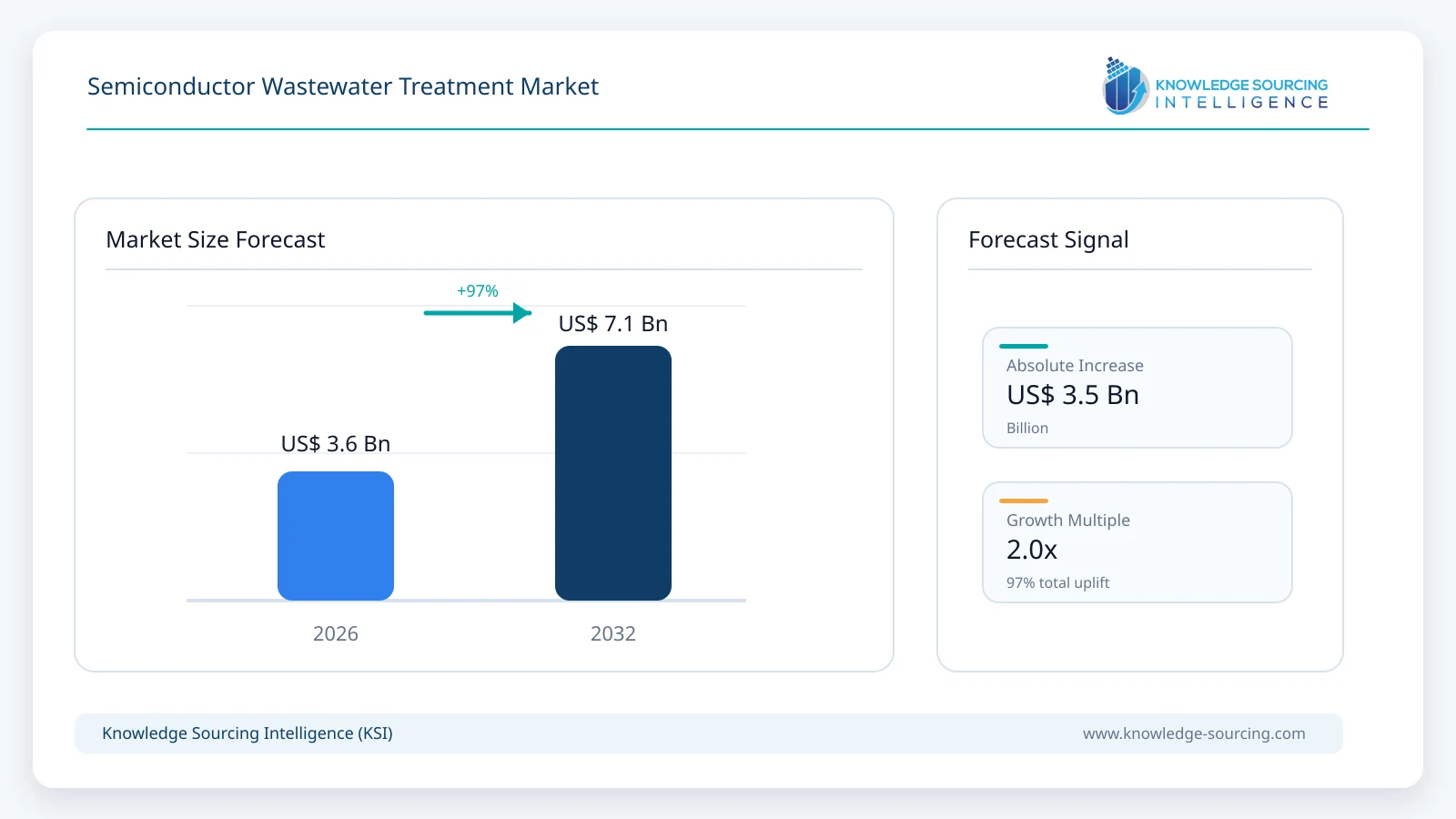
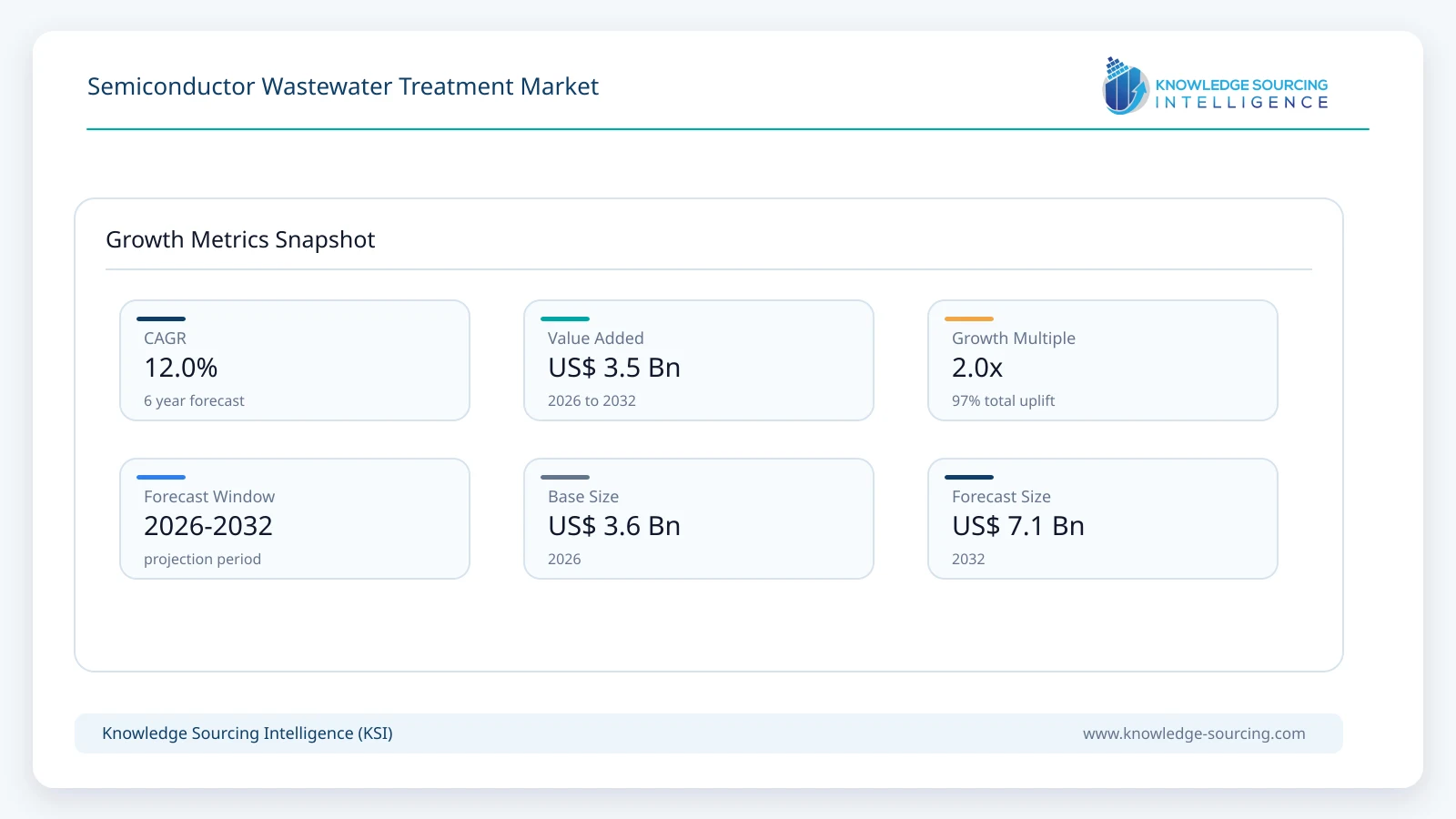
The Semiconductor Wastewater Treatment Market is estimated at USD 3.60 billion in 2026 and is projected to reach USD 7.10 billion by 2032, representing a CAGR of 12.0% during 2026-2032.
Highlights:
- 1Source-segregated treatment is becoming standard as fluoride, TMAH, CMP and metal-bearing streams require different treatment trains.
- 2Water reuse is shifting wastewater systems from end-of-pipe compliance infrastructure toward strategic fab-capacity infrastructure.
- 3Reverse osmosis, ion exchange and advanced membrane systems are increasingly paired with chemical and biological treatment for reuse.
- 4Near-zero-liquid-discharge systems gain relevance in water-stressed semiconductor clusters and large greenfield fabs.
- 5Asia Pacific remains the largest opportunity because it combines the highest concentration of semiconductor manufacturing with aggressive water-reuse targets.
Market Overview
Semiconductor wastewater treatment starts with segregation. Fabs can generate dozens of wastewater streams whose chemistry changes by process step, wafer technology and production mix. Fluoride-rich streams from wet etch and cleaning require precipitation, adsorption or selective separation. TMAH from photolithography and developer processes can require ion exchange, oxidation or biological treatment. CMP wastewater contains fine silica or metal particles that are difficult to remove without coagulation, filtration and membrane polishing. Metal-bearing streams require precipitation, ion exchange or electrochemical recovery. Organic streams may require biological treatment, advanced oxidation or activated carbon before final polishing.
The commercial system is therefore a network rather than one treatment plant. Collection and segregation piping directs wastewater toward dedicated pre-treatment modules. Chemical treatment removes acidity, fluoride and metals. Biological processes handle biodegradable organic loads, while ultrafiltration, reverse osmosis and ion exchange reduce dissolved contaminants when water is intended for reuse. Sludge, brine and concentrated waste streams require further dewatering, recovery or off-site disposal. Online sensors and control systems track pH, conductivity, total organic carbon and contaminant-specific indicators to maintain stable operation despite rapidly changing fab loads.
Reuse is changing system design. Historically, the main objective was to meet discharge permits. Advanced fabs increasingly design wastewater systems to recover a larger share of process water for cooling towers, scrubbers, utility systems and, after sufficient polishing, higher-quality internal reuse. TSMC, Samsung and Micron are all expanding water-recovery infrastructure, while equipment vendors are integrating high-recovery reverse osmosis, selective ion exchange and zero-liquid-discharge technologies. The result is a market where wastewater treatment, water security and fab expansion are increasingly linked.
Market Drivers
Advanced semiconductor processes generate more complex wastewater streams
Leading-edge logic, memory and advanced packaging use more cleaning, etching, polishing and specialty-chemical steps. This increases both wastewater volume and chemical diversity. A treatment system designed around a small number of conventional acidic or alkaline streams may not be adequate for TMAH, fluoride, copper, cobalt, silica, organics and emerging fluorinated contaminants. Fabs therefore invest in source segregation, dedicated treatment trains and tighter process monitoring as manufacturing complexity rises.
Water reuse is becoming part of fab-capacity planning
Water availability can constrain semiconductor expansion before electricity or land becomes limiting. Large fabs therefore treat wastewater recovery as a strategic utility rather than an environmental add-on. Micron is building new recycling and reuse facilities in Boise and Gujarat and plans similar infrastructure for New York. TSMC is expanding reclaimed-water substitution in Taiwan and designing its Arizona operation around high water reclamation. These projects increase spending on membrane systems, polishing, monitoring and concentrate management.
Stricter treatment of TMAH, fluoride and fluorinated compounds expands specialized demand
Semiconductor wastewater contains contaminants that are difficult to manage using standard industrial systems. TMAH can be toxic and resistant to several conventional treatment steps, while fluoride and hydrofluoric acid residues require controlled removal and sludge management. PFAS-related regulation also increases attention to fluorinated wastewater streams. This favors multi-stage treatment, selective resins, high-recovery membranes, advanced oxidation and contaminant-specific monitoring rather than generalized wastewater packages.
Circular recovery creates value beyond discharge compliance
Fabs increasingly seek to recover water, chemicals and selected metals from wastewater. TSMC has developed electronic-grade chemical recycling programs covering TMAH, isopropanol and other process chemicals, while Taiwan research is targeting fluoride concentration and resource recovery. These approaches can lower raw-material consumption and waste-hauling costs while improving water resilience, supporting investment in systems that separate and concentrate valuable streams rather than simply neutralize them.
Restraints and Adoption Challenges
The main challenge is variability. Wastewater chemistry can change rapidly with wafer starts, tool recipes, maintenance cycles and process transitions. High-recovery systems can experience scaling, membrane fouling and contaminant breakthrough if pretreatment is unstable. Zero-liquid-discharge systems also increase energy consumption and capital cost because concentrated brines require evaporation, crystallization or off-site handling. Space can be another constraint in existing fabs, where treatment upgrades must fit around operating production lines. In addition, segregating more streams improves treatment efficiency but increases piping, controls and operating complexity.
Segment Analysis
By Treatment Technology
Chemical precipitation, neutralization and coagulation remain foundational because acidic, fluoride and metal-bearing wastewater must often be stabilized before downstream treatment. These systems are relatively mature but continue to evolve through better chemical dosing, solids separation and selective recovery. Membrane-based treatment, including ultrafiltration and reverse osmosis, is expanding more rapidly in reclamation projects because it enables higher-quality recovered water and can be integrated with polishing loops.
Ion exchange is particularly important for difficult dissolved contaminants and high-purity reuse applications. TSMC's 2026 TMAH treatment improvement demonstrates how resin configuration and operating conditions can materially extend media life and reduce waste generation. Biological treatment remains relevant for organic-bearing streams, while advanced oxidation and activated carbon are used where compounds resist conventional biodegradation. Zero-liquid-discharge and near-zero-liquid-discharge systems combine several of these technologies to maximize water recovery while concentrating residual waste.
Wastewater Stream | Typical Contaminants | Primary Treatment Approaches | Commercial Importance |
Fluoride / HF streams | Fluoride, acids, dissolved salts | Neutralization, precipitation, selective separation, membranes | High due to wet etch and cleaning intensity |
TMAH / developer wastewater | TMAH, ammonium compounds, organics | Ion exchange, oxidation, biological treatment, RO | Rising with tighter discharge and recovery requirements |
CMP wastewater | Silica, abrasive particles, Cu and other metals | Coagulation, clarification, UF, membranes | Important in logic, memory and advanced packaging |
Metal-bearing streams | Cu, Co, Ni and other dissolved metals | Precipitation, ion exchange, electrochemical recovery | Supports both compliance and material recovery |
Organic wastewater | Solvents, photoresist residues, COD | Biological treatment, activated carbon, AOP | Requires stable treatment despite variable chemistry |
Reclamation concentrate | High dissolved solids and residual contaminants | High-recovery RO, evaporation, crystallization | Fast-growing in ZLD and near-ZLD projects |
Market and Technology Indicators
Indicator | Current Evidence | Market Impact |
Microelectronics water bookings | Veolia reported EUR 343 million of microelectronics water-technology bookings through July 2026. | Confirms strong project demand for integrated UPW, wastewater reclamation and ZLD systems. |
TMAH treatment optimization | TSMC reported extending cation-exchange resin life from 8 to 30 months at its Nanjing wastewater system. | Raises operating efficiency and supports broader deployment of contaminant-specific treatment. |
Micron water-reuse expansion | Micron is building new recycling/reuse infrastructure in Boise and Gujarat and plans facilities in New York. | Creates multi-site demand for reclamation, membranes and advanced wastewater systems. |
Fluoride resource recovery | Taiwan researchers reported membrane capacitive deionization for fluoride separation and concentration in 2026. | Supports movement from fluoride removal toward resource recovery. |
Samsung wastewater reuse | Samsung plans large-scale reclaimed-water supply for Giheung and Hwaseong and continues internal wastewater reuse. | Shows fab water security driving treatment and reuse infrastructure. |
Near-zero-liquid-discharge | TSMC Arizona targets approximately 90% water reclamation with an industrial water reclamation plant. | Supports high-recovery treatment, concentrate management and reuse systems in dry regions. |
Regional Opportunity
Asia Pacific
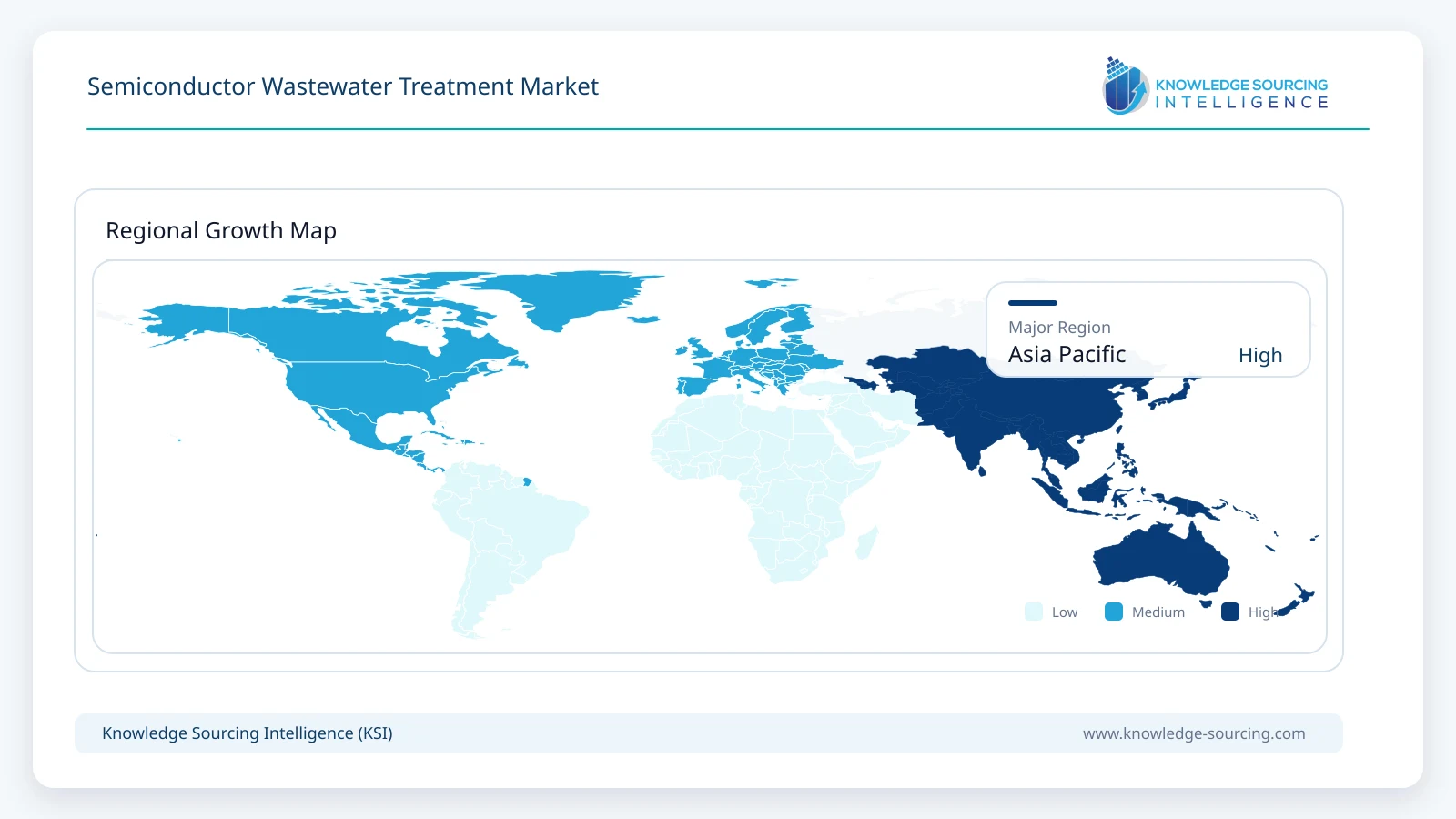
Asia Pacific is the largest market for semiconductor wastewater treatment because Taiwan, South Korea, China, Japan and Southeast Asia contain the highest concentration of wafer fabrication and advanced packaging capacity. The region combines large water demand with dense manufacturing clusters, stringent discharge requirements and growing competition for municipal water. As leading fabs expand advanced logic, high-bandwidth memory and packaging capacity, wastewater treatment is increasingly designed alongside new cleanroom and utility infrastructure rather than added after production starts.
Taiwan is particularly important because TSMC and the broader semiconductor supply chain are pursuing aggressive reclaimed-water strategies. TSMC has expanded use of municipal and industrial reclaimed water, is improving TMAH and chemical-waste treatment, and is strengthening supplier wastewater governance. Taiwan also remains an active development center for fluoride recovery and advanced separation technologies. These conditions create demand for both large centralized reclamation systems and highly specialized contaminant-treatment modules.
South Korea combines large Samsung Electronics and SK hynix manufacturing campuses with national water-management initiatives. Samsung recycles wastewater inside its manufacturing sites and is preparing to use approximately 120,000 tons per day of reclaimed municipal wastewater at its Giheung and Hwaseong operations from 2029. China adds a large installed base of memory, logic, display and packaging manufacturing, while Japan contributes strong equipment, membrane and water-treatment suppliers. Singapore is also significant because its semiconductor cluster depends on water reclamation and high-efficiency reuse; Veolia's 2026 bookings included a major semiconductor project in the country.
North America is expanding rapidly as new fabs in Arizona, Idaho, New York, Texas and other states move through construction and ramp-up. Water availability is particularly important in the U.S. Southwest, making high-recovery and near-zero-liquid-discharge systems attractive. Europe contributes through advanced logic and power-semiconductor projects, especially where strict water and chemical regulations favor high-performance treatment and recovery.
Competitive Landscape
The competitive landscape combines global water-technology companies, semiconductor-specialist engineering providers, membrane and separation suppliers, and regional system integrators. Veolia participates across ultrapure water, wastewater treatment, reclamation and zero-liquid-discharge systems and reported strong microelectronics bookings in 2026. Ovivo has a long semiconductor-water heritage spanning high-purity water and wastewater systems, while Organo and Kurita are deeply embedded in Asian semiconductor manufacturing through water treatment, chemicals and lifecycle services.
Ecolab's Nalco Water business competes in process-water management, chemical treatment and monitoring. Aquatech and Gradiant are positioned in high-recovery, membrane and zero-liquid-discharge applications, while Xylem, DuPont Water Solutions and Toray provide membranes, filtration and water-treatment technologies used within larger fab systems. METAWATER, Mitsubishi Chemical Aqua Solutions and regional engineering firms participate in treatment and reclamation projects, particularly in Japan and Asia. Competitive differentiation increasingly depends on contaminant-specific process knowledge, ability to guarantee recovery and discharge performance, digital monitoring, installed-service capability and integration with UPW and utility systems.
Major companies and ecosystem participants covered: Veolia Water Technologies, Ovivo, Organo Corporation, Kurita Water Industries, Ecolab / Nalco Water, Aquatech International, Gradiant, Xylem, DuPont Water Solutions, Toray Industries, METAWATER, Mitsubishi Chemical Aqua Solutions, H2O Innovation, Samsung E&A and Hitachi Aqua-Tech Engineering.
Recent Developments
July 2026: Veolia reported EUR 343 million in microelectronics water-technology bookings, including semiconductor projects combining wastewater reclamation and zero-liquid-discharge capabilities.
July 2026: TSMC reported a treatment-system optimization at its Nanjing fab that extended strong-acid cation-exchange resin life for TMAH wastewater from eight to 30 months.
July 2026: TSMC expanded supplier wastewater-governance programs, including direct review of high-risk suppliers and corrective-action tracking.
June 2026: Taiwan researchers announced an electrically driven membrane-capacitive-deionization approach for separation and concentration of fluoride in semiconductor wastewater.
June 2026: Samsung's 2026 sustainability reporting highlighted continued semiconductor-site water reuse and treatment programs, including large-scale reclaimed-water plans in Korea.
2026: Micron detailed ongoing construction of water recycling and reuse facilities in Boise and Gujarat, with additional infrastructure planned for its New York expansion.
Semiconductor Wastewater Treatment Market Scope
| Report Metric | Details |
|---|---|
| Total Market Size in 2026 | USD 3.60 billion |
| Total Market Size in 2032 | USD 7.10 billion |
| Forecast Unit | Billion |
| Growth Rate | 12.0% |
| Study Period | 2021 to 2032 |
| Historical Data | 2021 to 2024 |
| Base Year | 2025 |
| Forecast Period | 2026 – 2032 |
| Segmentation | Wastewater Stream, Treatment Technology, Treatment Objective, Fab Type, Service Model, Region |
| Companies |
|
Market Segmentation
By Wastewater Stream
Fluoride and Acid Wastewater
TMAH and Developer Wastewater
CMP Wastewater
Metal-Bearing Wastewater
Organic and High-COD Wastewater
Reclamation Concentrate and Brine
By Treatment Technology
Neutralization, Precipitation and Coagulation
Biological Treatment
Ion Exchange and Adsorption
Ultrafiltration and Membrane Filtration
Reverse Osmosis and High-Recovery Membranes
Advanced Oxidation
Evaporation, Crystallization and ZLD
By Treatment Objective
Regulatory Discharge Compliance
Internal Water Reuse
High-Recovery Reclamation
Chemical and Material Recovery
Near-Zero and Zero Liquid Discharge
By Fab Type
Logic and Foundry Fabs
Memory Fabs
Power Semiconductor Fabs
Compound Semiconductor Fabs
Advanced Packaging and OSAT Facilities
By Service Model
New-Build Treatment Systems
Retrofit and Capacity Expansion
Operations and Maintenance
Treatment Chemicals, Media and Consumables
By Geography
Asia Pacific
Taiwan
South Korea
China
Japan
Singapore and Southeast Asia
North America
United States
Europe
Rest of World
Table of Contents
1. EXECUTIVE SUMMARY
1.1. Market Opportunity and Key Findings
1.2. Semiconductor Wastewater Complexity Outlook
1.3. Water Reuse and Circularity Trends
2. MARKET OVERVIEW
2.1. Semiconductor Wastewater Generation
2.2. Source Segregation and Collection Architecture
2.3. Fluoride, TMAH, CMP and Metal-Bearing Waste Streams
2.4. Treatment, Reclamation and Concentrate Management
2.5. Integration with Fab Water and Utility Systems
3. MARKET SIZE AND FORECAST, 2026-2032
3.1. Global Market Revenue
3.2. Annual Growth Analysis
3.3. Treatment Equipment, Systems and Service Revenue
4. MARKET BY WASTEWATER STREAM
4.1. Fluoride and Acid Wastewater
4.2. TMAH and Developer Wastewater
4.3. CMP Wastewater
4.4. Metal-Bearing Wastewater
4.5. Organic and High-COD Wastewater
4.6. Reclamation Concentrate and Brine
5. MARKET BY TREATMENT TECHNOLOGY
5.1. Neutralization, Precipitation and Coagulation
5.2. Biological Treatment
5.3. Ion Exchange and Adsorption
5.4. Ultrafiltration and Membrane Filtration
5.5. Reverse Osmosis and High-Recovery Membranes
5.6. Advanced Oxidation
5.7. Evaporation, Crystallization and ZLD
6. MARKET BY TREATMENT OBJECTIVE
6.1. Regulatory Discharge Compliance
6.2. Internal Water Reuse
6.3. High-Recovery Reclamation
6.4. Chemical and Material Recovery
6.5. Near-Zero and Zero Liquid Discharge
7. MARKET BY FAB TYPE
7.1. Logic and Foundry Fabs
7.2. Memory Fabs
7.3. Power Semiconductor Fabs
7.4. Compound Semiconductor Fabs
7.5. Advanced Packaging and OSAT Facilities
8. MARKET BY SERVICE MODEL
8.1. New-Build Treatment Systems
8.2. Retrofit and Capacity Expansion
8.3. Operations and Maintenance
8.4. Treatment Chemicals, Media and Consumables
9. REGIONAL MARKET
9.1. Asia Pacific
9.1.1. Taiwan
9.1.2. South Korea
9.1.3. China
9.1.4. Japan
9.1.5. Singapore and Southeast Asia
9.2. North America
9.2.1. United States
9.3. Europe
9.4. Rest of World
10. MARKET DYNAMICS
10.1. Drivers
10.1.1. Advanced-Process Wastewater Complexity
10.1.2. Fab Water-Reuse Requirements
10.1.3. TMAH, Fluoride and PFAS Treatment Requirements
10.1.4. Circular Recovery of Water and Chemicals
10.2. Restraints
10.2.1. Variable Wastewater Chemistry
10.2.2. Membrane Fouling and Scaling
10.2.3. ZLD Energy and Capital Cost
10.2.4. Space and Integration Constraints in Existing Fabs
11. COMPETITIVE LANDSCAPE
11.1. Market Structure and Competitive Intensity
11.2. Integrated Semiconductor Water-System Providers
11.3. Membrane and Separation Technology Suppliers
11.4. ZLD and High-Recovery Specialists
11.5. Service, Monitoring and Lifecycle Support
12. COMPANY PROFILES
12.1. Veolia Water Technologies
12.2. Ovivo
12.3. Organo Corporation
12.4. Kurita Water Industries
12.5. Ecolab
12.6. Aquatech International
12.7. Gradiant
12.8. Xylem
12.9. DuPont Water Solutions
12.10. Toray Industries
12.11. METAWATER
12.12. Mitsubishi Chemical Aqua Solutions
12.13. H2O Innovation
12.14. Samsung E&A
12.15. Hitachi Aqua-Tech Engineering
13. RECENT DEVELOPMENTS
14. APPENDIX
Navigate
Trusted by the world's leading organizations











