
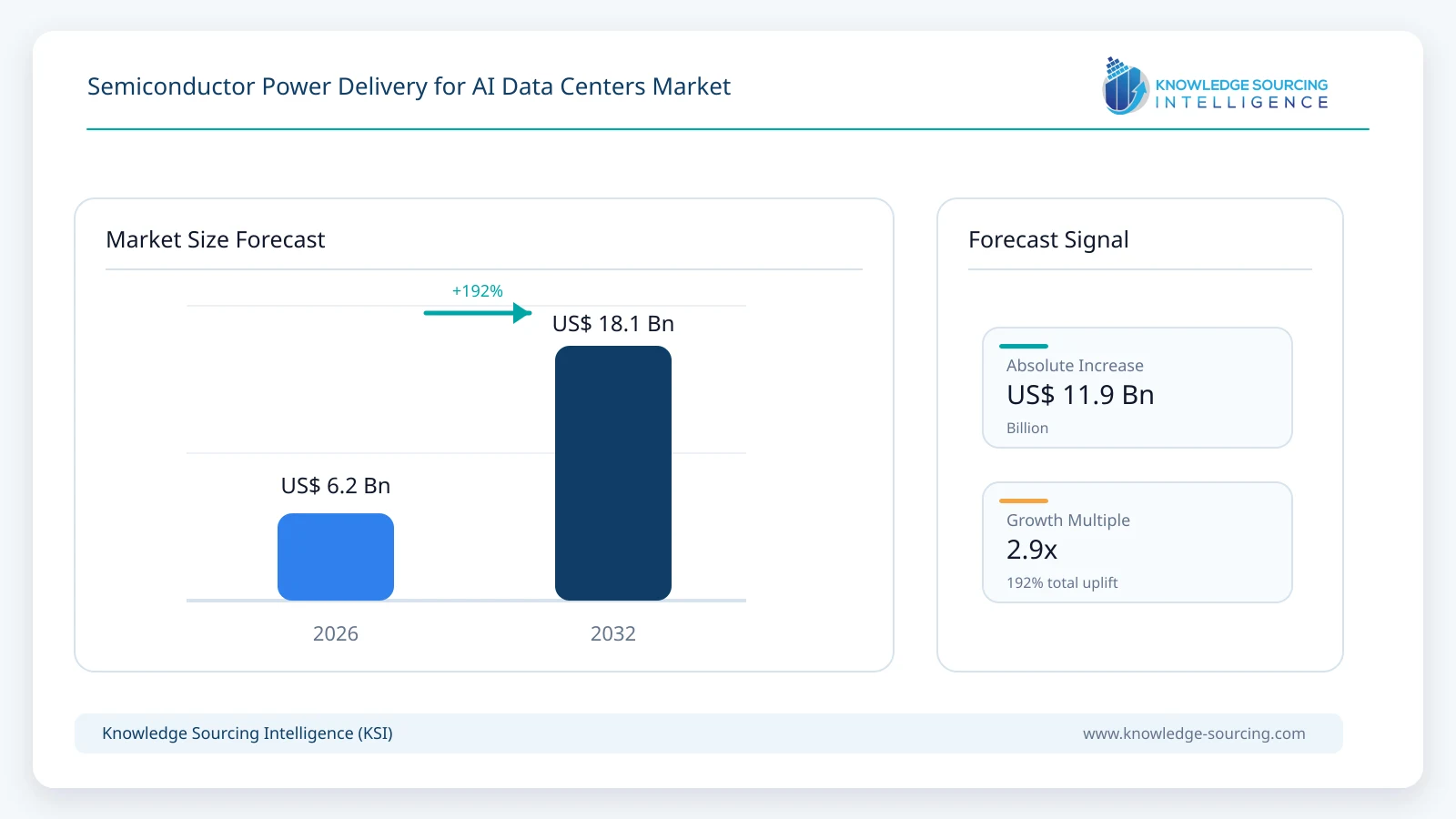
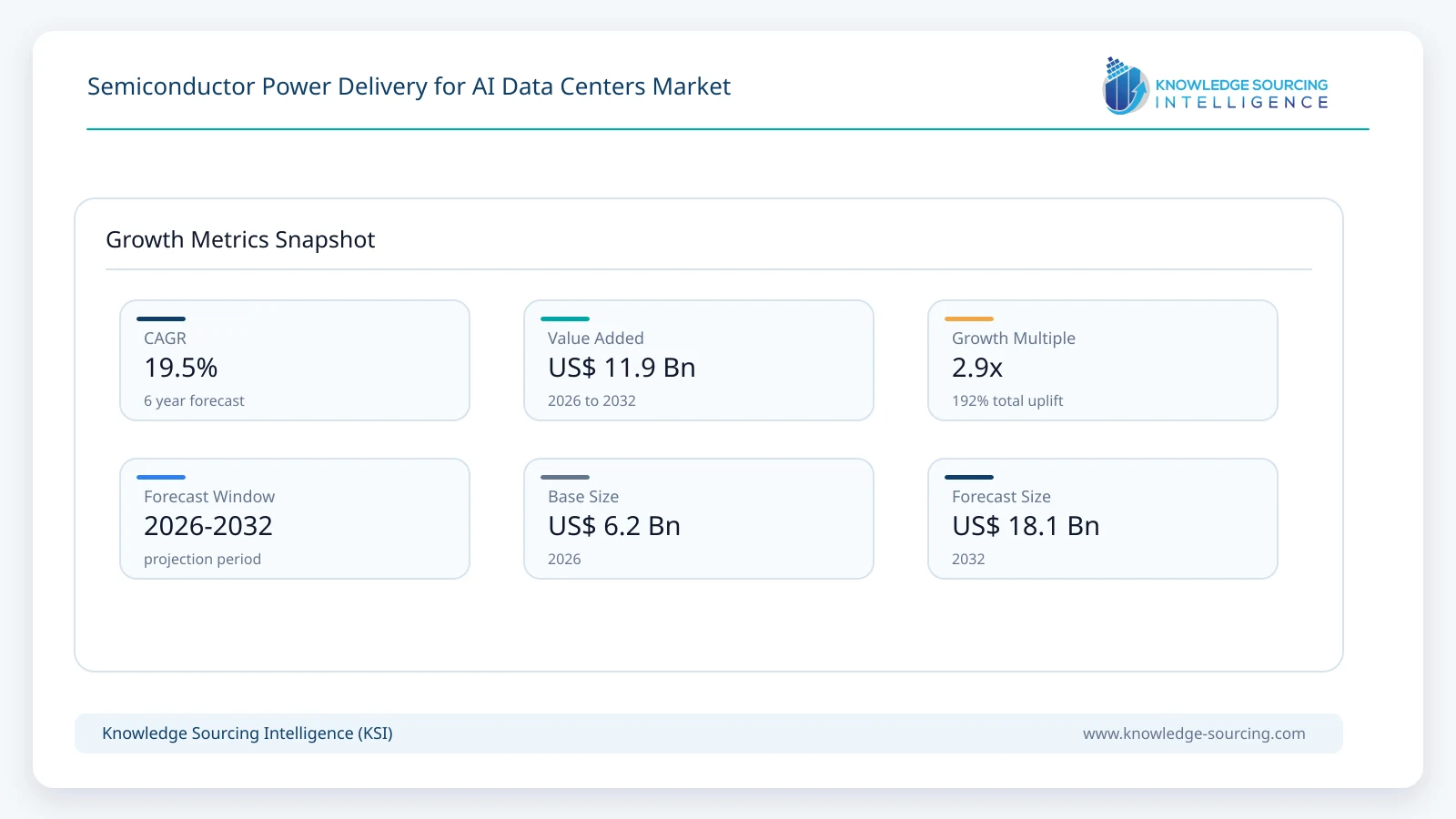
The Semiconductor Power Delivery for AI Data Centers Market is estimated at USD 6.20 billion in 2026 and is projected to reach USD 18.10 billion by 2032, representing a CAGR of 19.5% during 2026-2032.
Highlights:
- 1Point-of-load regulation remains the largest semiconductor revenue pool near AI processors in 2026.
- 2Gallium nitride grows rapidly as higher-frequency conversion improves density across intermediate power stages.
- 3Silicon carbide gains content as 800 VDC pushes high-voltage conversion deeper into AI infrastructure.
- 4Vertical power delivery becomes critical as accelerator currents exceed practical lateral-board distribution limits.
- 5North America leads demand through hyperscaler, neocloud and accelerated-computing infrastructure deployment.
Market Overview
AI power delivery spans several voltage domains. Traditional servers typically convert facility alternating current (AC) into a 12 V or 48-54 V rack or board bus before multiphase regulators step the voltage down to processor rails below 1 V. AI accelerators push this architecture harder because thousands of amperes may be required close to the processor while the rack itself can draw hundreds of kilowatts. Every conversion stage, connector and length of copper adds loss, heat and physical volume. As rack density rises, semiconductor efficiency and current density therefore have a direct effect on usable compute density.
The industry is now introducing 800 VDC distribution to reduce current and copper requirements at the rack level. In these architectures, higher-voltage semiconductor switches and protection devices manage the 800 V path, while high-ratio DC-DC stages create 50 V, 12 V or lower intermediate rails before the final processor regulation stage. Texas Instruments demonstrated an 800 VDC architecture using only two major conversion stages from the high-voltage bus to processor power, while STMicroelectronics has demonstrated compact 800 V-to-50 V and lower-voltage power-delivery boards. These architectures increase the value of SiC and GaN devices alongside digital control, isolation and sensing.
The final centimeters between the voltage regulator and accelerator are becoming equally important. Conventional lateral power delivery forces very high current across printed-circuit-board planes, raising conduction loss and consuming board area. Multiphase smart power stages continue to increase output current and switching frequency, but vertical power delivery and integrated voltage regulation move conversion closer to or beneath the processor package. This reduces the current path and supports higher current density, making processor-adjacent power delivery one of the fastest-moving areas of the market.
Market Drivers
AI rack power is moving toward megawatt-class designs
Rack power is rising much faster than in conventional cloud infrastructure because accelerator count, networking bandwidth and memory content are increasing together. Renesas describes current AI racks at roughly 50-300 kW with the industry moving toward 1 MW-class systems, while Texas Instruments has highlighted the copper and distribution limitations of scaling 48 V architectures to those levels. Higher rack power increases semiconductor content in front-end conversion, hot-swap protection, intermediate bus conversion and point-of-load regulation. It also raises the commercial value of small efficiency improvements because every fraction of a percentage point can translate into substantial heat and energy at cluster scale.
800 VDC increases high-voltage semiconductor content
The move from 48-54 V distribution toward 800 VDC changes both device voltage ratings and topology. Silicon carbide becomes more relevant in high-voltage switching and protection, while gallium nitride supports high-frequency, high-density conversion closer to the rack and compute tray. Semiconductor suppliers are developing 800 V hot-swap devices, gate drivers, isolated sensing, high-ratio intermediate converters and protection functions as a coordinated architecture rather than individual parts. The transition also extends semiconductor content into functions that were historically dominated by electromechanical components.
Processor current density is driving multiphase and vertical power delivery
AI accelerators operate at low core voltage but require extremely high current and rapid response to workload changes. Digital multiphase controllers, smart power stages and telemetry are therefore becoming more sophisticated, with higher phase counts and tighter current balancing. Vicor is commercializing power-on-package and vertical power-delivery approaches, while Renesas and Infineon are expanding digital multiphase and smart power-stage capabilities. As accelerator power rises, moving conversion closer to the package can reduce printed-circuit-board losses and free board area for memory, networking and signal-routing requirements.
Efficiency and power density increasingly determine deployable compute
AI infrastructure is frequently constrained by available electrical capacity rather than floor space alone. More efficient semiconductor conversion allows a larger share of incoming power to reach processors while reducing heat that must be removed by the cooling system. STMicroelectronics has demonstrated a 12 kW GaN-based converter operating above 98% efficiency in a compact 800 V-to-50 V implementation, illustrating the direction of power-density improvement. This creates demand for devices that combine low switching loss, high-frequency operation, integrated protection and reliable operation under continuously high utilization.
Restraints and Adoption Challenges
The market faces a difficult balance between efficiency, device cost, switching frequency, thermal management, control complexity and qualification risk. Wide-bandgap devices can improve power density but require optimized gate drive, packaging, isolation and protection. The emerging 800 VDC architecture also introduces new fault-management and serviceability requirements, while operators must support large installed bases built around AC and 48-54 V systems. Processor-adjacent power creates additional mechanical and thermal integration challenges because regulators compete for space near high-value accelerator packages. Rapid architecture change can also shorten product cycles, forcing semiconductor vendors to qualify new voltage classes and packaging formats while maintaining supply continuity.
Segment Analysis
By Power Delivery Function
Processor point-of-load regulation represents the largest revenue contribution in 2026 because every accelerator, CPU, memory subsystem and networking ASIC requires precise low-voltage rails. Digital multiphase controllers and smart power stages carry particularly high content around GPUs and custom AI accelerators, where current demand, transient response and telemetry requirements are substantially above those of standard servers.
High-voltage distribution and intermediate conversion are expected to grow fastest through 2032 as 800 VDC expands from power sidecars and power racks into native compute-tray architectures. The fastest percentage growth comes from GaN- and SiC-intensive conversion, solid-state protection and high-ratio DC-DC stages. Vertical power delivery also grows rapidly from a smaller base as processor power rises beyond what conventional lateral board delivery can handle efficiently.
Power Delivery Category | Revenue Contribution | Growth Direction | Primary AI Data Center Application |
Point-of-load controllers and smart power stages | Largest | Strong | Sub-1 V regulation for GPUs, CPUs, ASICs and memory |
Intermediate bus conversion semiconductors | High | Very strong | 48/54 V or 800 V conversion to board-level intermediate rails |
High-voltage AC/DC and 800 VDC power devices | Growing | Very strong | Front-end conversion, power shelves and high-voltage distribution |
Hot-swap, eFuse and solid-state protection ICs | Growing | Very strong | Inrush control, fault isolation and high-voltage rack protection |
Gate drivers, isolation and sensing ICs | Established | Strong | Control, telemetry and safe switching across conversion stages |
Vertical / package-adjacent power delivery | Emerging | Fastest | High-current delivery directly beside or beneath AI processors |
Market and Technology Indicators
Indicator | Commercial / Technical Evidence | Market Impact |
Semiconductor content per installed AI power | Infineon indicates roughly USD 100-250 of AI power semiconductor content per kW, with an average near USD 175/kW in 2026. | Links AI compute power growth directly to semiconductor revenue opportunity. |
800 VDC ecosystem expansion | NVIDIA, Google and Microsoft are advancing a common 800 VDC architecture through the Open Compute Project with a broad supplier ecosystem. | Reduces fragmentation risk and accelerates investment in compatible power devices and control ICs. |
High-density 800 V conversion | ST demonstrated a 12 kW 800 V-to-50 V GaN converter above 98% efficiency and over 2,600 W/in³. | Shows the density advantage available from high-frequency wide-bandgap conversion. |
Two-stage grid-to-processor roadmap | Texas Instruments demonstrated an 800 VDC architecture designed to reduce the number of conversion stages to the processor. | Raises the value of high-ratio conversion, isolation and digital power control. |
Vertical power delivery commercialization | Vicor is licensing vertical power-delivery technology to AI OEMs while expanding manufacturing capacity. | Signals movement of processor power conversion closer to the accelerator package. |
AI power supply revenue expansion | Infineon expects dedicated AI data-center power revenue above EUR 1.6 billion in fiscal 2026. | Confirms that power semiconductors are becoming a material AI infrastructure revenue pool. |
Regional Opportunity
North America
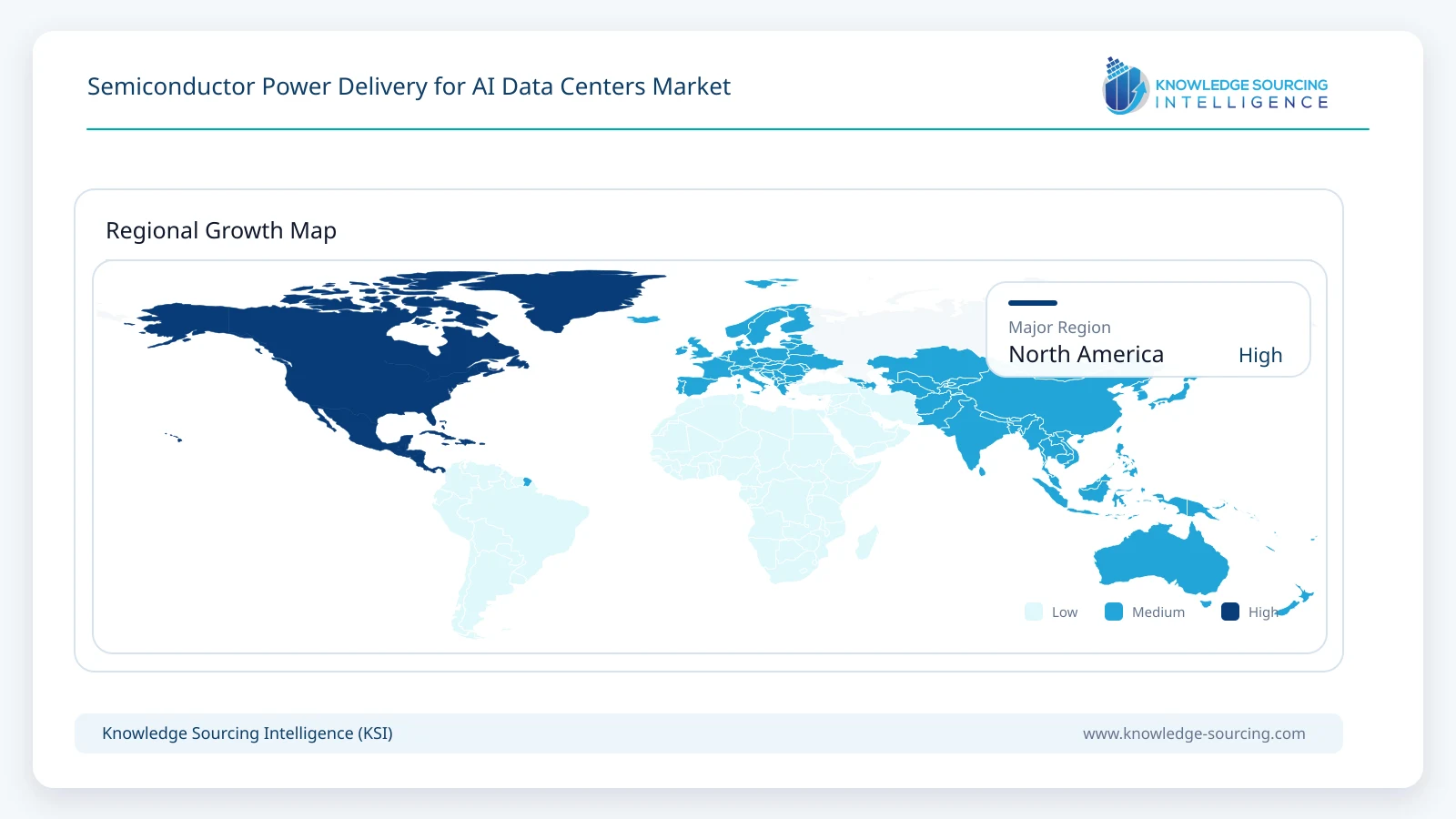
North America is the largest demand region for semiconductor power delivery in AI data centers because the United States contains the highest concentration of hyperscale cloud platforms, neocloud operators, accelerator deployments and advanced AI clusters. Power architecture decisions made by NVIDIA and major cloud operators influence semiconductor specifications across the global server supply chain. The region is also moving quickly from conventional 48-54 V rack power toward power-sidecar and 800 VDC concepts as operators confront utility constraints and very high rack densities.
The supplier ecosystem is unusually broad. Texas Instruments, onsemi, Monolithic Power Systems, Analog Devices and Vicor contribute power-management ICs, smart power stages, protection devices and high-density conversion technologies, while NVIDIA works with global power-semiconductor vendors on 800 VDC reference architectures. Large AI operators can qualify new power topologies at substantial volume, giving semiconductor vendors an incentive to co-develop devices around specific accelerator generations rather than sell only catalog components.
Power availability is also changing purchasing priorities. Where new substations, grid connections or backup systems take years to build, higher conversion efficiency can increase deployable compute without changing the contracted electrical envelope. This supports premium semiconductor content in SiC, GaN, digital multiphase control and vertical power delivery. Asia Pacific remains critical for semiconductor fabrication, server manufacturing and power-electronics supply, particularly Taiwan, South Korea, China and Japan, while Europe contributes through Infineon, STMicroelectronics, Nexperia and advanced power-semiconductor manufacturing.
Competitive Landscape
Competition spans high-voltage power semiconductors, analog and digital power-management ICs, processor-level regulators and integrated power modules. Infineon has one of the broadest grid-to-core portfolios across silicon, SiC, GaN, intermediate bus conversion and multiphase power. Texas Instruments combines high-voltage conversion, isolation, sensing and processor power management, while STMicroelectronics is developing compact 800 V conversion boards using SiC and GaN. onsemi, ROHM and Navitas compete strongly in high-voltage and wide-bandgap stages.
Closer to the processor, Monolithic Power Systems, Renesas, Infineon, Texas Instruments and Analog Devices compete in controllers, smart power stages and point-of-load regulation. Vicor differentiates through modular high-current conversion and vertical power delivery, while emerging integrated-voltage-regulator approaches aim to move more of the conversion function into the substrate or package. Competitive advantage depends increasingly on system efficiency, transient response, current density, telemetry and thermal behavior rather than a single device specification.
The transition to 800 VDC encourages broader co-design between semiconductor suppliers, accelerator vendors, server original design manufacturers and power-system companies. Suppliers that can support several stages of the power tree can optimize device selection and control across the architecture, while specialists can win where a particular technology provides a large density or efficiency advantage. Manufacturing capacity is becoming another differentiator as AI power semiconductor demand expands faster than many traditional industrial end markets.
Major companies and ecosystem participants covered: Infineon Technologies, Texas Instruments, STMicroelectronics, onsemi, Monolithic Power Systems, Renesas Electronics, Analog Devices, ROHM Semiconductor, Navitas Semiconductor, Vicor, Wolfspeed, Nexperia, Alpha and Omega Semiconductor, Microchip Technology, Power Integrations and Vishay Intertechnology.
Recent Developments
September 2026: Vicor licensed its Vertical Power Delivery technology to another leading AI OEM for high-current processor power.
August 2026: Infineon agreed to acquire C2i Semiconductors, adding digital multiphase control and vertical-power expertise for AI data centers.
August 2026: NVIDIA, Google and Microsoft expanded Open Compute Project work around standardized 800 VDC power for next-generation AI infrastructure.
June 2026: STMicroelectronics expanded its NVIDIA MGX power-delivery work across 40 V, 12 V and 6 V architectures for high-density AI racks.
March 2026: Texas Instruments demonstrated a complete 800 VDC power architecture with NVIDIA designed around fewer conversion stages.
March 2026: STMicroelectronics introduced direct 800 VDC-to-12 V and 800 VDC-to-6 V architectures alongside its existing 50 V conversion platform.
Semiconductor Power Delivery for AI Data Centers Market Scope:
| Report Metric | Details |
|---|---|
| Total Market Size in 2026 | USD 6.20 billion |
| Total Market Size in 2032 | USD 18.10 billion |
| Forecast Unit | Billion |
| Growth Rate | 19.5% |
| Study Period | 2021 to 2032 |
| Historical Data | 2021 to 2024 |
| Base Year | 2025 |
| Forecast Period | 2026 – 2032 |
| Segmentation | Power Delivery Function, Semiconductor Technology, Voltage Architecture, Conversion Location, AI Infrastructure Type, Geography |
| Companies |
|
Market Segmentation
By Power Delivery Function
High-Voltage AC/DC and 800 VDC Power Conversion
Intermediate Bus Conversion
Point-of-Load Controllers and Smart Power Stages
Hot-Swap, eFuse and Solid-State Protection
Gate Drivers, Isolation and Sensing
Vertical and Package-Adjacent Power Delivery
By Semiconductor Technology
Silicon Power Devices
Silicon Carbide Power Devices
Gallium Nitride Power Devices and Power ICs
Analog and Mixed-Signal Power Management ICs
Digital Power Controllers and Telemetry ICs
By Voltage Architecture
12 V Distribution
48-54 V Distribution
400 V / +/-400 V High-Voltage DC Architectures
800 VDC Distribution
Direct High-Ratio Conversion Architectures
By Conversion Location
Facility and Power-Rack Interface
Rack Power Shelf and Sidecar
Compute-Tray Intermediate Conversion
Accelerator Board Point-of-Load
Package / Substrate-Level Power Delivery
By AI Infrastructure Type
Hyperscale Cloud AI
Neocloud and Dedicated GPU Infrastructure
Colocation AI Deployments
Enterprise and Sovereign AI Infrastructure
Research and High-Performance Computing
By Geography
North America
United States
Canada
Asia Pacific
Taiwan
South Korea
China
Japan
Southeast Asia and India
Europe
Rest of World
Table of Contents
1. EXECUTIVE SUMMARY
1.1. Market Opportunity and Key Findings
1.2. AI Rack Power-Density Outlook
1.3. Principal Semiconductor Revenue Pools
2. MARKET OVERVIEW
2.1. AI Data Center Power Delivery Chain
2.2. 12 V, 48-54 V and 800 VDC Architectures
2.3. Grid-to-Core Conversion Stages
2.4. Processor Point-of-Load Regulation
2.5. Vertical Power Delivery and Integrated Voltage Regulation
3. MARKET SIZE AND FORECAST, 2026-2032
3.1. Global Market Revenue
3.2. Annual Growth Analysis
3.3. Semiconductor Content per Installed AI Power
4. MARKET BY POWER DELIVERY FUNCTION
4.1. High-Voltage AC/DC and 800 VDC Power Conversion
4.2. Intermediate Bus Conversion
4.3. Point-of-Load Controllers and Smart Power Stages
4.4. Hot-Swap, eFuse and Solid-State Protection
4.5. Gate Drivers, Isolation and Sensing
4.6. Vertical and Package-Adjacent Power Delivery
5. MARKET BY SEMICONDUCTOR TECHNOLOGY
5.1. Silicon Power Devices
5.2. Silicon Carbide Power Devices
5.3. Gallium Nitride Power Devices and Power ICs
5.4. Analog and Mixed-Signal Power Management ICs
5.5. Digital Power Controllers and Telemetry ICs
6. MARKET BY VOLTAGE ARCHITECTURE
6.1. 12 V Distribution
6.2. 48-54 V Distribution
6.3. 400 V / +/-400 V High-Voltage DC Architectures
6.4. 800 VDC Distribution
6.5. Direct High-Ratio Conversion Architectures
7. MARKET BY CONVERSION LOCATION
7.1. Facility and Power-Rack Interface
7.2. Rack Power Shelf and Sidecar
7.3. Compute-Tray Intermediate Conversion
7.4. Accelerator Board Point-of-Load
7.5. Package / Substrate-Level Power Delivery
8. MARKET BY AI INFRASTRUCTURE TYPE
8.1. Hyperscale Cloud AI
8.2. Neocloud and Dedicated GPU Infrastructure
8.3. Colocation AI Deployments
8.4. Enterprise and Sovereign AI Infrastructure
8.5. Research and High-Performance Computing
9. REGIONAL MARKET
9.1. North America
9.1.1. United States
9.1.2. Canada
9.2. Asia Pacific
9.2.1. Taiwan
9.2.2. South Korea
9.2.3. China
9.2.4. Japan
9.2.5. Southeast Asia and India
9.3. Europe
9.4. Rest of World
10. MARKET DYNAMICS
10.1. Drivers
10.1.1. Megawatt-Class AI Rack Power
10.1.2. Transition to 800 VDC Distribution
10.1.3. Processor Current Density and Transient Requirements
10.1.4. Efficiency and Power-Density Optimization
10.2. Restraints
10.2.1. Wide-Bandgap Device Cost and Qualification
10.2.2. High-Voltage Protection and Serviceability
10.2.3. Rapid Architecture and Interface Changes
10.2.4. Thermal and Mechanical Integration near the Processor
11. COMPETITIVE LANDSCAPE
11.1. Market Structure and Competitive Intensity
11.2. High-Voltage SiC and GaN Positioning
11.3. Multiphase Controller and Smart Power-Stage Strategies
11.4. Vertical Power Delivery and Integrated Regulation
11.5. Accelerator, ODM and Power-System Partnerships
12. COMPANY PROFILES
12.1. Infineon Technologies
12.2. Texas Instruments
12.3. STMicroelectronics
12.4. onsemi
12.5. Monolithic Power Systems
12.6. Renesas Electronics
12.7. Analog Devices
12.8. ROHM Semiconductor
12.9. Navitas Semiconductor
12.10. Vicor
12.11. Wolfspeed
12.12. Nexperia
12.13. Alpha and Omega Semiconductor
12.14. Microchip Technology
12.15. Power Integrations
12.16. Vishay Intertechnology
13. RECENT DEVELOPMENTS
14. APPENDIX
Navigate
Trusted by the world's leading organizations











