
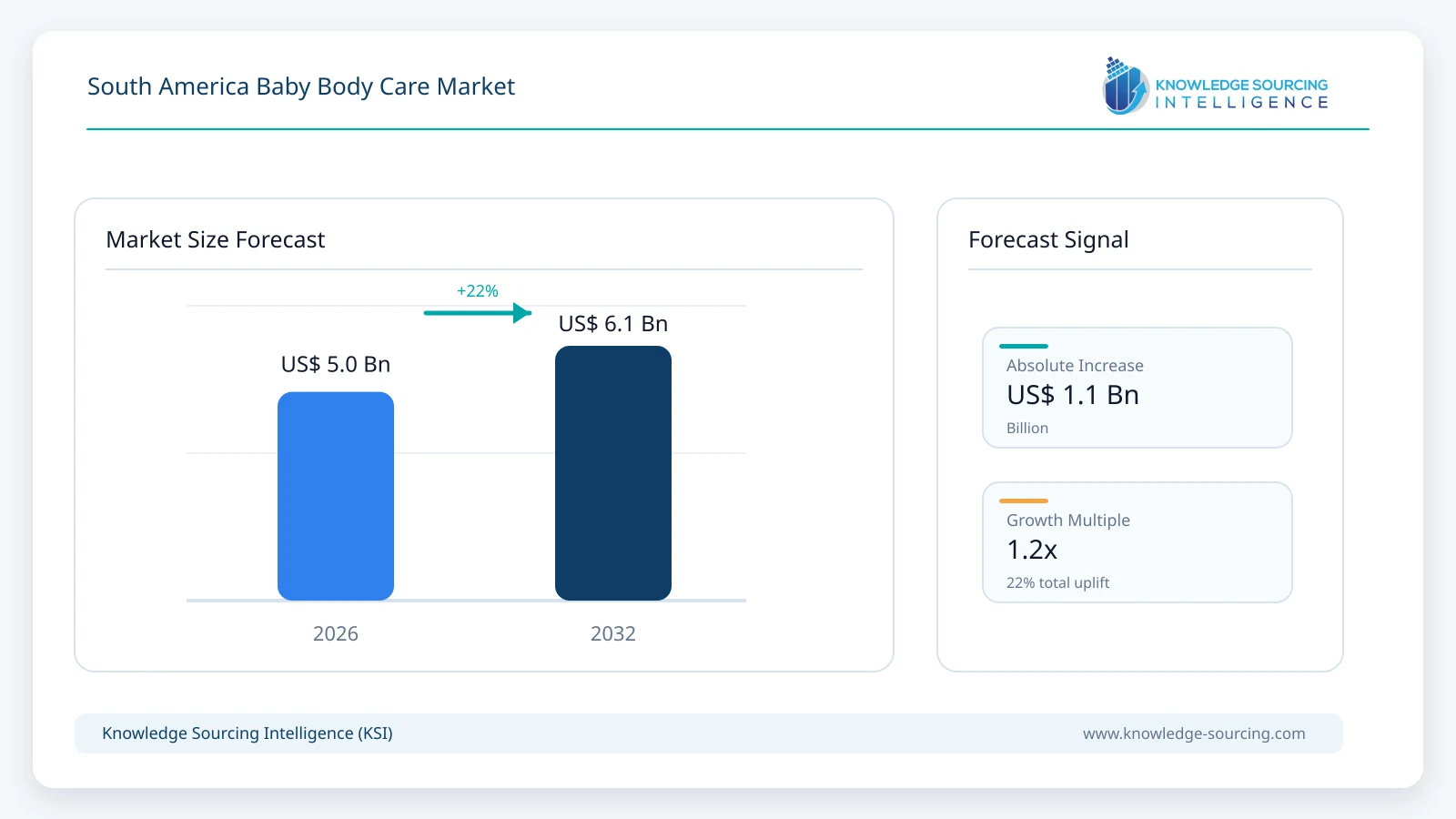
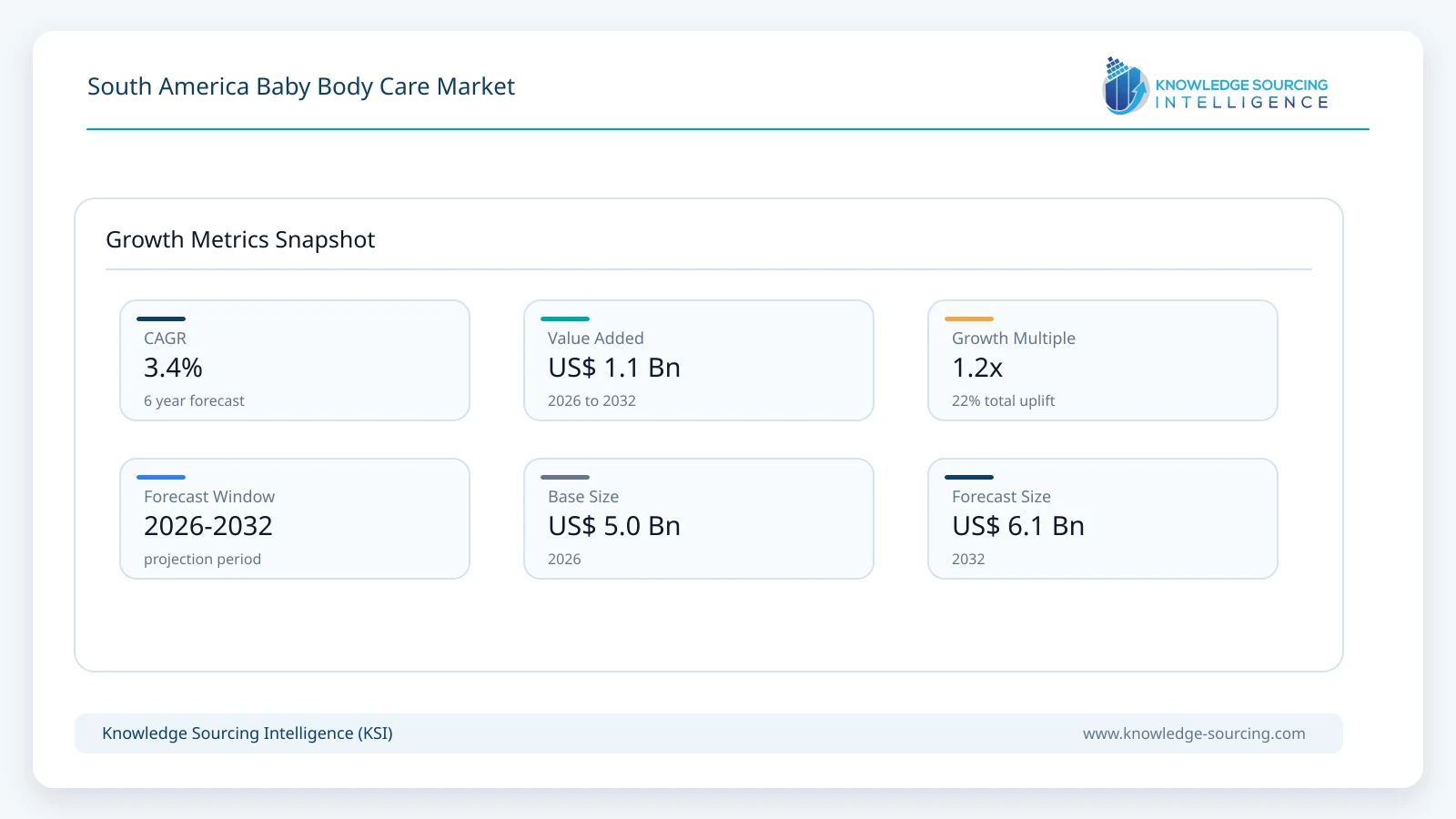
The South America Baby Body Care Market is estimated at USD 5.03 billion in 2026 and projected to reach USD 6.14 billion by 2032, a CAGR of 3.4% during the forecast period.
Highlights:
- 1Disposable diapers are estimated to account for 74.0% of South American baby body care revenue in 2026 as they remain the most frequently replenished product.
- 2Baby wipes are projected to generate US$0.72 billion in 2032 as convenience and routine use support repeat purchases.
- 3Baby skin care is forecast to grow at a 5.5% CAGR during 2026–2032 as parents spend more on gentle cleansing, moisturization and diaper-area care.
- 4Baby hair care is estimated at US$0.25 billion in 2026, reflecting a smaller but established shampoo-led product category.
- 5Brazil is estimated to generate US$2.98 billion in 2026, supported by its large child population and broad domestic distribution network.
- 6Other South American countries are projected to reach US$2.18 billion in 2032 as access and product mix improve beyond the two largest named markets.
Disposable diapers account for most spending, while wipes, skin care and hair care broaden the value of each household purchase. Growth will depend increasingly on product mix and spending per child as birth volumes decline in the largest markets. Brazil’s registered births fell to 2.38 million in 2024, and Argentina recorded 413,135 births, making demographic pressure a central factor in the forecast.
Consumer demand is resilient because diapers and basic hygiene products are recurring needs, yet families can change pack sizes, brands and purchase channels when budgets tighten. Suppliers therefore compete across value tiers. A premium diaper must demonstrate fit, absorbency and skin comfort; a premium lotion or wash must provide a credible reason to pay more than a basic formulation. These differences matter more when the number of new babies is falling.
Market Dynamics
The main constraint is birth cohort contraction. Brazil’s registered births declined from 2.52 million in 2023 to 2.38 million in 2024, while Argentina’s 2024 total was nearly half its 2014 level. Fewer newborns reduce the volume opportunity for entry-size diapers and newborn products even where household spending per baby rises. Expansion therefore requires better retention through later diaper sizes, stronger product mix, improved availability or greater adoption in underserved households.
Household purchasing power and currency movements affect the value reported in US dollars. Diapers and wipes are bought often enough that small price changes become visible in a monthly budget. Promotions, larger packs and private-label alternatives can shift share quickly. Premium lines can still grow where parents value leakage protection, overnight performance or formulations suited to sensitive skin, but brands must maintain a clear benefit over cheaper options.
Physical retail remains central because families need immediate replenishment and can compare pack price and count at the shelf. Pharmacies, supermarkets, local stores and wholesalers serve different shopping missions. Online channels offer subscriptions, larger packs and price comparison, especially in major cities, while delivery cost and access limit their role in less dense areas. An effective route to market must protect availability in both routine and urgent purchase occasions.
Technology and Product Economics
Disposable diapers
Diapers are estimated at US$3.72 billion in 2026 and US$4.39 billion in 2032. They are the largest segment because a child uses multiple units per day during infancy. The number of units falls with age, so the value of a birth cohort changes as children move through sizes and eventually stop using diapers. Suppliers compete through absorbent-core performance, fit, breathable materials and the cost per usable diaper. Pants formats and overnight products can lift spending per child, but households often compare them with standard tape diapers before trading up.
Baby wipes
Wipes are estimated at US$0.55 billion in 2026 and US$0.72 billion in 2032, implying 4.5% annual growth. Repeat use alongside diaper changes supports demand, while multipurpose and sensitive-skin variants create room for differentiation. Pack format and sheet count shape unit economics: a lower shelf price may conceal a higher cost per sheet. The strongest propositions balance reliable dispensing, acceptable skin feel and a price that fits routine household use.
Baby skin care
Skin care is estimated at US$0.51 billion in 2026 and US$0.70 billion in 2032, the fastest-growing type segment in this forecast. Moisturizers, face creams, powders and diaper-rash products serve distinct needs; demand for each depends on local care habits and parental preference. Ingredient clarity, gentle formulas and confidence in skin compatibility support premium pricing. Brands such as Johnson’s Baby, Natura Mamãe e Bebê, Mustela and Weleda compete in different price tiers and retail channels.
Baby hair care
Hair care is estimated at US$0.25 billion in 2026 and US$0.33 billion in 2032. Shampoo drives the category, while conditioners and hair oils serve narrower use cases that vary by age and local routines. Mildness, ease of rinsing and fragrance influence repeat purchases. Combined wash-and-shampoo products can shift spending between the skin and hair categories, so suppliers should assess total bathing-basket value as well as individual product sales.
Applications and Purchasing Behaviour
Parents buy the category through a sequence of recurring needs rather than a single annual purchase. Newborn care places particular weight on frequent diaper changes and gentle cleansing. As babies grow, fit, overnight protection, pack size and convenience gain importance. Caregivers also assess skin response and adjust products when irritation or discomfort appears. Trust is built by predictable performance over repeated use.
Offline distribution remains the main route for routine baby-care purchases, with supermarkets and pharmacies supporting broad brand comparison. Online stores are better suited to planned purchases, bulk packs and subscriptions. The channel mix can differ substantially by country and income group. For a supplier, distribution quality includes stock availability, product education and consistent pack architecture across channels; a good product loses value when the preferred size is unavailable at the point of need.
Country Market Outlook
Brazil is estimated at US$2.98 billion in 2026 and projected to reach US$3.56 billion in 2032. Its scale makes it the main market for large diaper launches and mass retail competition. However, the decline in registered births limits pure volume growth. Product upgrades, better coverage of later diaper sizes and the expansion of trusted baby-care lines will determine whether suppliers grow revenue per child. Kimberly-Clark’s Huggies Cushion Protection launch illustrates the emphasis on fit and leakage benefits in this market.
Argentina is estimated at US$0.35 billion in 2026 and US$0.39 billion in 2032. The sharp fall in births constrains unit demand, while inflation and currency volatility complicate comparisons of nominal sales across years. Value packs, local availability and careful price positioning are important. Softys’ Babysec and the major multinational brands compete for households that balance cost with reliable daily performance.
The remaining South American countries are estimated at US$1.70 billion in 2026 and US$2.18 billion in 2032. Colombia contributes a large birth cohort, although preliminary 2025 births were lower than the prior year. Peru, Chile and other markets add distinct price and channel structures. Broader retail access and premiumization can lift value, but the pace of growth depends on income, exchange rates and local distribution execution.
Competitive Landscape and Outlook
Procter & Gamble, Kimberly-Clark and Softys compete strongly in disposable diapers through Pampers, Huggies and Babysec. Their advantages include brand recognition, pack architecture, retail coverage and the ability to refine fit and absorbency. Kenvue extends competition across baby bathing and skin care through Johnson’s Baby. Natura brings a recognizable Brazilian mother-and-baby range, while Mustela and Weleda address more specialized and premium skin-care demand.
Competition is likely to intensify around clear performance claims and affordable cost per use. Suppliers can defend share by reducing leakage, improving comfort and keeping popular sizes in stock. In skin care, ingredient communication and a consistent experience matter more than adding product variants alone. Demographic pressure makes household retention and category participation more valuable than relying on new-birth growth.
Recent Developments
June 2026: Kenvue introduced a chamomile-scent Johnson’s Baby bar soap in Latin America with an updated formulation.
2025: Kimberly-Clark highlighted the launch of Huggies Cushion Protection in Brazil, emphasizing absorption and a softer waistband.
2025: Kenvue reported the use of refillable pouches for Johnson’s Baby shampoo and bath products in Latin America.
South America Baby Body Care Market Scope
| Report Metric | Details |
|---|---|
| Total Market Size in 2026 | USD 5.03 billion |
| Total Market Size in 2032 | USD 6.14 billion |
| Forecast Unit | Billion |
| Growth Rate | 3.4% |
| Study Period | 2021 to 2032 |
| Historical Data | 2021 to 2024 |
| Base Year | 2025 |
| Forecast Period | 2026 – 2032 |
| Segmentation | Type, Distribution Channel, Country |
| Companies |
|
| Customization Scope | 15% Free Customization included with purchase — Request Custom Breakdown → |
| Sample & Data Access | PDF Sample, Excel Databook & Analyst Briefing — Download Free Sample → |
Market Segmentation
By Type
Diapers
Wipes
Skin Care
Moisturizer
Powder
Face Cream
Diaper Rash Cream
Others
Hair Care
Shampoo
Conditioner
Hair Oil
By Distribution Channel
Online
Offline
By Country
Brazil
Argentina
Others
Table of Contents
1. INTRODUCTION
1.1. Market Definition
1.2. Market Segmentation
2. RESEARCH METHODOLOGY
2.1. Research Data
2.2. Assumptions
3. EXECUTIVE SUMMARY
3.1. Research Highlights
4. MARKET DYNAMICS
4.1. Market Drivers
4.2. Market Restraints
4.3. Porter's Five Forces Analysis
4.3.1. Bargaining Power of Suppliers
4.3.2. Bargaining Power of Buyers
4.3.3. Threat of Substitutes
4.3.4. Threat of New Entrants
4.3.5. Competitive Rivalry
4.4. Industry Value Chain Analysis
5. SOUTH AMERICA BABY BODY CARE MARKET, BY TYPE
5.1. Introduction
5.2. Diapers
5.3. Wipes
5.4. Skin Care
5.4.1. Moisturizer
5.4.2. Powder
5.4.3. Face Cream
5.4.4. Diaper Rash Cream
5.4.5. Others
5.5. Hair Care
5.5.1. Shampoo
5.5.2. Conditioner
5.5.3. Hair Oil
6. SOUTH AMERICA BABY BODY CARE MARKET, BY DISTRIBUTION CHANNEL
6.1. Introduction
6.2. Online
6.3. Offline
7. SOUTH AMERICA BABY BODY CARE MARKET, BY COUNTRY
7.1. Introduction
7.2. Brazil
7.3. Argentina
7.4. Others
8. COMPETITIVE ENVIRONMENT AND ANALYSIS
8.1. Major Players and Strategy Analysis
8.2. Emerging Players and Market Opportunities
8.3. Mergers, Acquisitions, Agreements and Collaborations
8.4. Vendor Competitiveness Matrix
9. COMPANY PROFILES
9.1. Procter & Gamble
9.2. Kimberly-Clark
9.3. Softys
9.4. Kenvue
9.5. Natura
9.6. Mustela
9.7. Weleda





Frequently asked questions
What is the projected growth rate of the South America baby body care market?
The South America Baby Body Care Market is projected to grow at a 3.4% CAGR from 2026 to 2032.
Which product segment dominates the South America baby body care market?
Disposable diapers are estimated to account for 74.0% of revenue in 2026.
Which baby body care segment is forecast for the fastest growth?
Baby skin care is forecast to grow at a 5.5% CAGR.
Which country is the largest contributor to the South America market?
Brazil is estimated to generate US$2.98 billion in 2026.
What is the primary constraint impacting the market's growth?
Birth cohort contraction is the main constraint on market growth.
How will the market achieve growth despite demographic pressures?
Growth depends on product mix, spending per child, and improved availability.
Cite this report
Knowledge Sourcing Intelligence. (Oct 2026). South America Baby Body Care Market - Strategic Insights and Forecasts (2026-2032). https://www.knowledge-sourcing.com/report/south-america-baby-body-care-market