
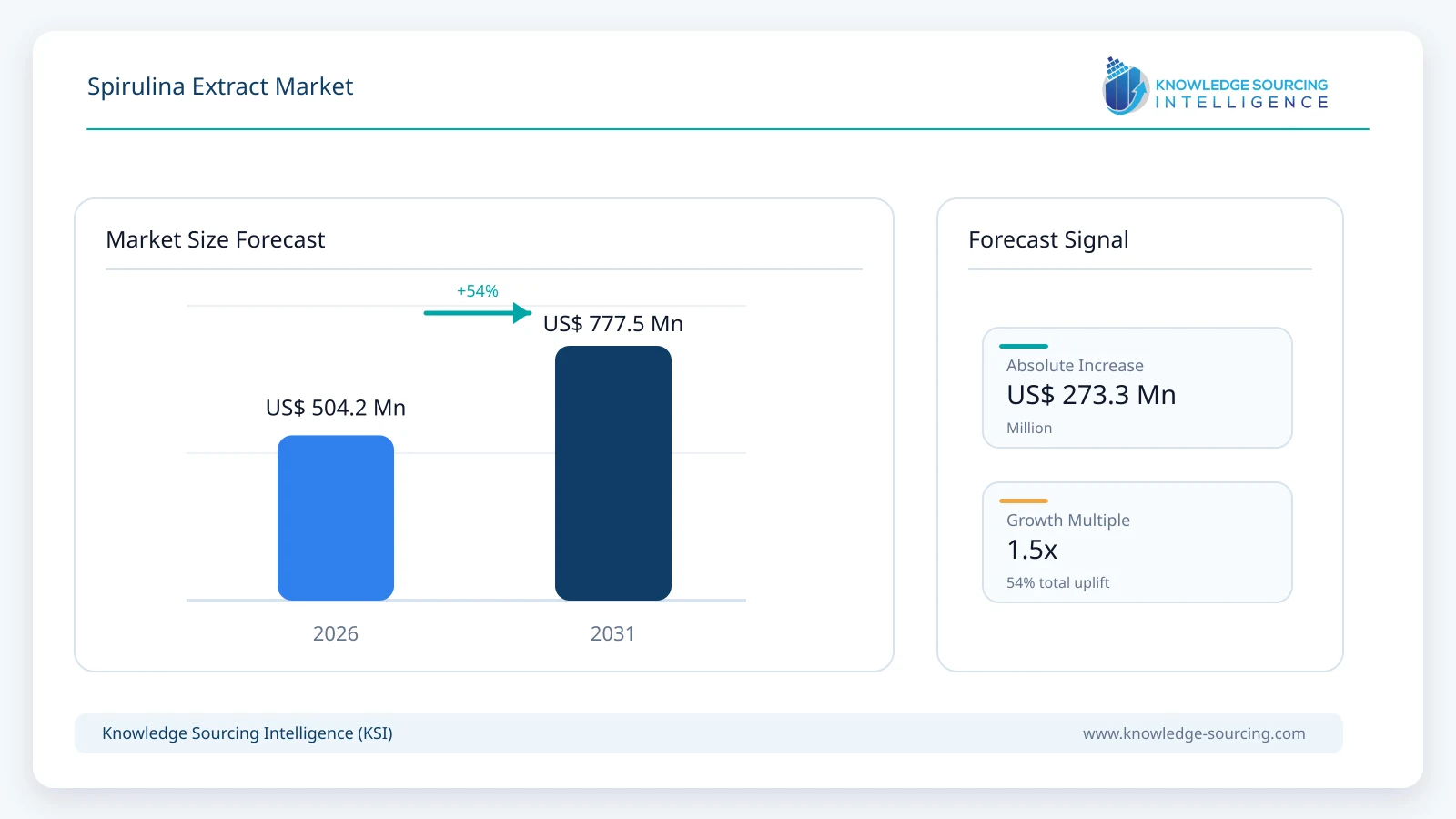
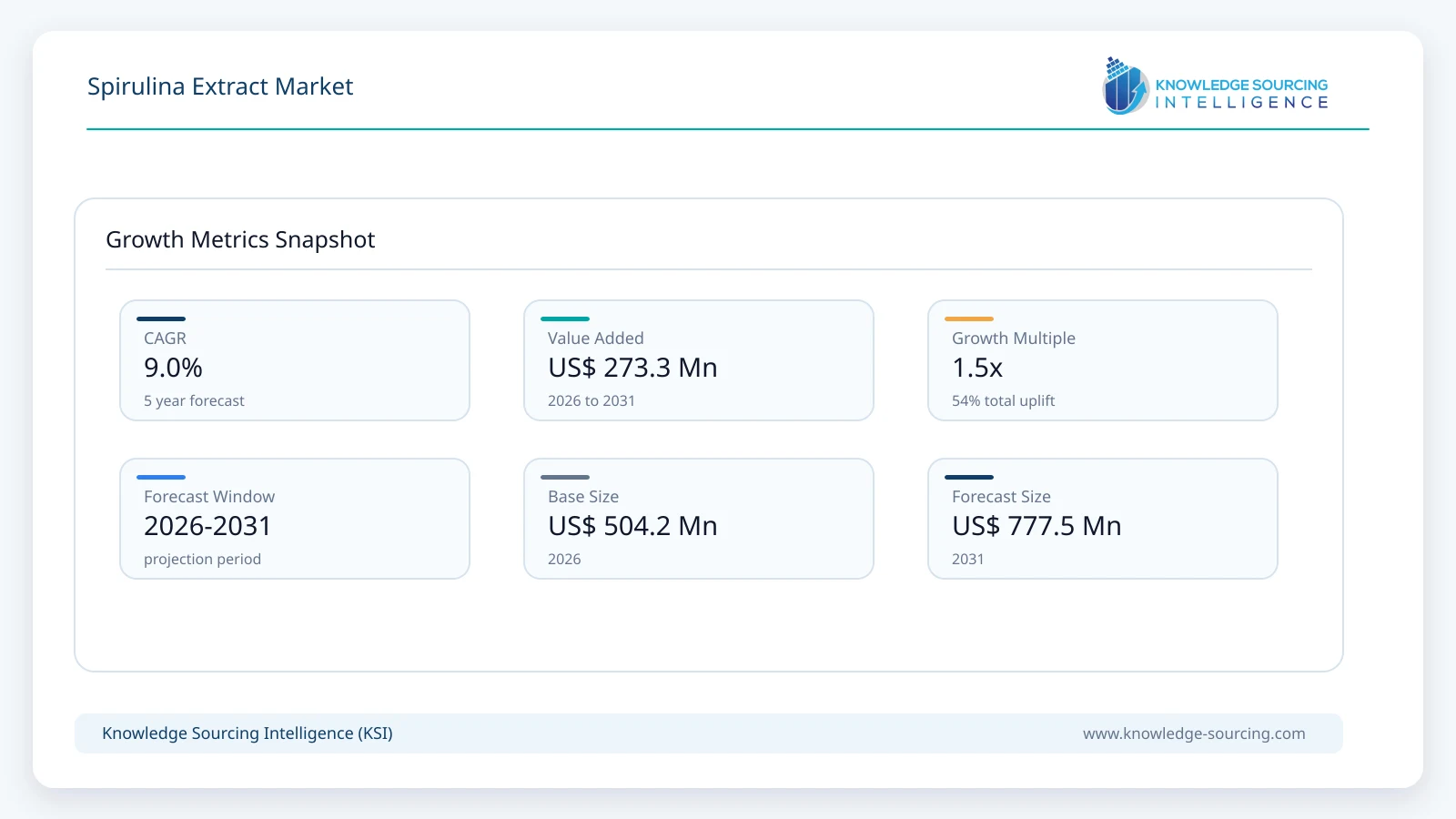
The Spirulina Extract Market is forecast to grow at a CAGR of 9.0%, reaching USD 777.5 million in 2031 from USD 504.2 million in 2026.
Highlights:
- 1Natural-color reformulation is strengthening demand for phycocyanin-rich spirulina extracts in selected food and beverage applications.
- 2Nutraceutical manufacturers remain important buyers, with purity, contaminant control, certification, and traceability influencing supplier selection.
- 3Asia Pacific combines cultivation capacity, processing expertise, expanding supplement consumption, and established algae ingredient manufacturing.
- 4North American demand is being influenced by natural-color adoption and regulatory developments affecting approved spirulina extract applications.
- 5Extraction and purification capabilities are becoming more important as customers shift from bulk biomass toward standardized, application-specific ingredients.
- 6Competition is increasingly based on quality assurance, application support, production consistency, certification, and geographic supply reliability.
The Spirulina Extract Market covers commercially produced extracts, concentrates, powders, liquids, and purified fractions derived primarily from Spirulina platensis (Limnospira platensis) and Spirulina maxima (Limnospira maxima). The market includes ingredients supplied to nutraceutical manufacturers, food and beverage companies, natural-color producers, cosmetics formulators, animal nutrition businesses, pharmaceutical developers, and consumer health brands. It spans cultivation, harvesting, biomass processing, extraction, purification, formulation, quality testing, packaging, and distribution.
Spirulina has two distinct commercial identities. As a whole biomass, it is primarily purchased for nutritional applications because of its protein, micronutrient, pigment, and bioactive composition. As an extract, its commercial value is determined more strongly by the concentration and consistency of targeted constituents, particularly phycocyanin. This distinction is important because buyers of extracts generally evaluate suppliers against tighter specifications for purity, color strength, solubility, microbiological quality, heavy metals, contaminants, stability, and batch-to-batch consistency than buyers of conventional dried spirulina biomass.
Demand is therefore moving beyond simple volume procurement. Ingredient buyers increasingly require documentation that connects cultivation conditions with finished-product specifications. For food and beverage applications, color performance and stability can determine purchasing decisions. For nutraceutical applications, buyers place greater emphasis on identity, purity, contaminant control, organic certification where relevant, traceability, and manufacturing controls. For large multinational customers, supplier qualification can also involve audits, analytical testing, technical documentation, and continuity-of-supply assessments.
The commercial structure remains fragmented across cultivation specialists, algae ingredient manufacturers, natural-color suppliers, nutraceutical companies, distributors, and vertically integrated producers. Some suppliers primarily cultivate and process their own biomass, while others compete through extraction technology, application expertise, formulation capability, geographic reach, or certification portfolios. The resulting competition is not based solely on the price of spirulina biomass. Suppliers must demonstrate that their extracts perform reliably in the customer's final application.
The nutraceutical channel remains an important demand base because spirulina has an established history as a dietary ingredient. India's FSSAI compendium, for example, identifies spirulina derived from Spirulina platensis/Arthrospira platensis within the permitted nutraceutical ingredient framework and specifies compositional criteria and usage parameters. This regulatory recognition supports the use of standardized spirulina ingredients in the Indian supplement market while placing greater emphasis on composition and labeling compliance.
Food coloring represents another commercially important route. Phycocyanin gives spirulina-derived extracts their characteristic blue color and provides food manufacturers with a natural alternative for selected applications. The economics of this segment differ from bulk nutritional spirulina because customers pay for color intensity, stability, formulation performance, and regulatory suitability rather than simply for biomass. Suppliers that can improve stability across processing conditions can therefore compete for higher-value applications.
The United States provides a particularly relevant example of the regulatory and commercial importance of spirulina extract. In February 2026, the U.S. Food and Drug Administration issued final orders expanding approved uses of spirulina extract as a color additive in human foods. The effective date was subsequently delayed in March 2026 while objections were evaluated, although FDA stated that the procedural delay did not change its determination that the approved color uses were safe under the specified conditions. The development illustrates how regulatory decisions can alter the addressable application base for spirulina-derived ingredients.
Buyer behavior is also becoming more application-specific. A beverage producer may prioritize dispersion, hue, pH tolerance, and shelf-life stability. A supplement manufacturer may prioritize nutrient retention, contaminant specifications, organic status, and capsule or powder compatibility. A cosmetics company may require color consistency and formulation compatibility. Consequently, suppliers with technical application support can achieve stronger customer retention than suppliers competing only on commodity pricing.
The market's revenue base is consequently influenced by five principal factors: cultivated biomass availability, extraction yield, purity and concentration, application-specific performance, and regulatory acceptance. Energy, water, labor, land productivity, harvesting efficiency, and downstream processing costs influence the supply economics. At the same time, the selling price can rise materially when a producer converts low-value biomass into a standardized extract or purified pigment.
The market is also affected by the difference between open-pond cultivation and controlled production environments. Large-scale open ponds can provide favorable production economics but expose cultivation to environmental variability and contamination risks. Suppliers therefore need monitoring systems, water management, controlled nutrient conditions, harvesting protocols, and quality testing to maintain consistent output. These requirements make process discipline an important competitive factor.
Market Drivers
Expansion of Natural Food Color Applications
The substitution of synthetic colors with naturally sourced alternatives is creating a specific demand channel for spirulina extract. Food manufacturers are not simply seeking a blue ingredient; they require a color system that delivers a predictable appearance under the processing conditions used for beverages, confectionery, dairy products, bakery products, and other foods.
Spirulina-derived phycocyanin is commercially attractive because it provides a natural blue source, but its technical limitations mean that application suitability must be assessed individually. Suppliers therefore compete by improving formulation, dispersion, stability, and compatibility rather than by selling pigment concentration alone.
Sensient's 2025 materials, for example, identify stabilized spirulina as a natural-color solution for beverage applications, including sports drinks, carbonated soft drinks, energy drinks, flavored waters, protein drinks, juices, and related formulations. Givaudan also maintains a dedicated portfolio around spirulina-derived blue coloring solutions and has been expanding its natural-color technology beyond conventional spirulina.
The commercial implication is important. As food companies reformulate products, demand can migrate from unprocessed spirulina biomass toward higher-value extracts that provide a defined technological function. This favors suppliers capable of supplying consistent pigment concentration and technical assistance.
Growth of Standardized Nutraceutical Ingredients
Nutraceutical producers represent a recurring buyer base because spirulina is already established as a dietary ingredient. However, commercial purchasing increasingly depends on standardized specifications rather than the generic availability of spirulina powder.
Large supplement manufacturers require documented identity, microbiological controls, contaminant limits, traceability, and reproducible composition. Organic products add another layer of certification and supply-chain requirements. Buyers serving premium markets may also seek evidence of controlled cultivation and validated manufacturing procedures.
Parry Nutraceuticals illustrates this model through its emphasis on organic certification, USP verification, manufacturing controls, and traceability. Its product portfolio includes organic spirulina and phycocyanin-based ingredients, demonstrating how suppliers can serve both whole-biomass nutrition and extract-oriented applications.
This demand structure supports higher-value products because manufacturers are paying for documented quality and reduced procurement risk in addition to the ingredient itself.
Increased Use of Spirulina-Derived Pigments in Premium Foods
Natural blue coloring is particularly valuable because blue is difficult to obtain from natural sources while maintaining satisfactory stability and visual intensity. This creates a commercial niche for phycocyanin-rich spirulina extracts.
The opportunity is strongest where manufacturers need a recognizable natural-color positioning and where product formulation conditions fall within the functional range of spirulina-derived colors. Beverage companies are particularly relevant because color is an important part of product identity, but low-pH and thermal processing conditions can restrict the use of conventional spirulina extracts.
Suppliers that improve stability or provide blended color systems can therefore address applications that conventional extracts cannot serve effectively. The competitive advantage shifts toward formulation science and application testing.
Investment in Algae Cultivation and Processing Infrastructure
Spirulina production requires more than cultivation capacity. Commercial suppliers need harvesting, drying, extraction, filtration, concentration, quality-control, storage, and logistics capabilities. Investments in downstream processing can increase the value recovered from each unit of biomass.
DIC Corporation reported that its group company Earthrise Nutritionals began operating a new edible algae cultivation facility in March 2025. The facility uses externally sourced refined CO?, obtains more than half of its energy from renewable sources, and produces Spirulina-derived Linablue natural blue food coloring through water-based extraction.
Such investments illustrate an important industry mechanism: suppliers are attempting to integrate cultivation efficiency with higher-value downstream products. The resulting economics can be more attractive than selling undifferentiated biomass alone.
Buyer Preference for Traceable and Certified Supply
Ingredient customers increasingly treat traceability and certification as procurement requirements rather than marketing additions. This is especially relevant for products entering regulated food, supplement, and cosmetic supply chains.
Parry Nutraceuticals reports sales across more than 40 countries and emphasizes certification, traceability, and quality systems in its commercial model. Its product information also highlights controls related to heavy metals, PAHs, pesticides, microbiological quality, and other quality attributes.
For suppliers, this creates a barrier to entry. A producer may be able to cultivate spirulina at low cost but still struggle to qualify for multinational customers without validated analytical methods, documented controls, certification, and consistent batch performance.
Market Restraints and Challenges
Cultivation Contamination and Quality Variability
Spirulina cultivation depends on controlled environmental conditions. Open-pond systems can achieve commercial scale but remain exposed to fluctuations in water quality, weather, contamination, and biological conditions.
Variability can affect pigment concentration, biomass composition, drying characteristics, and extraction yield. For buyers using standardized extracts, inconsistent raw material creates additional processing costs and can compromise finished-product specifications.
Suppliers mitigate this risk through controlled cultivation parameters, water monitoring, batch testing, segregation procedures, and process standardization. However, these controls increase operating costs and can limit the price advantage of low-cost producers.
Stability Constraints of Spirulina-Derived Colors
Phycocyanin provides a valuable natural blue color, but formulation conditions can constrain its use. Acidic environments, heat, light, and processing conditions can affect color performance.
This limitation directly affects food manufacturers because many beverages and processed foods require extended shelf life under challenging conditions. If a natural blue ingredient cannot maintain its appearance throughout the product's commercial life, the manufacturer may retain a synthetic alternative or choose another natural color source.
Suppliers are responding through stabilization technologies, formulation systems, and alternative microalgal color platforms. Givaudan's 2025 introduction of a Galdieria-based natural blue illustrates this competitive response. The company positioned the ingredient as a phycocyanin-rich alternative with broader low-pH stability than conventional spirulina solutions.
Regulatory Differences Across Applications and Countries
Spirulina extract does not face a single global regulatory framework. Requirements differ according to whether the ingredient is sold as food, dietary supplement, color additive, cosmetic ingredient, animal feed ingredient, or pharmaceutical material.
In the European Union, businesses must establish whether a food or ingredient falls within the Novel Food Regulation. The European Commission notes that the Novel Food Catalogue is a non-binding orientation tool and that businesses remain responsible for demonstrating the relevant history of consumption or obtaining authorization where required.
The Commission's consultation process also shows that modified spirulina products can receive a different regulatory status from conventional Arthrospira platensis. In July 2025, silicon-enriched spirulina was classified as novel food, while the underlying conventional spirulina was not considered novel.
These differences increase regulatory costs for suppliers developing new extracts, fortified products, or specialized derivatives.
Feedstock and Processing Economics
Extraction profitability depends on biomass yield, pigment concentration, extraction efficiency, energy use, water consumption, labor, equipment utilization, and purification losses. A supplier may therefore face pressure on margins when biomass prices increase or extraction yields decline.
Higher-purity extracts can command higher prices, but they also require additional processing. Filtration, concentration, purification, drying, and quality testing add cost. Suppliers must therefore balance purity against the specification actually required by the customer.
This is particularly relevant when buyers compare suppliers from different geographic regions. A low ex-factory price may not translate into a lower delivered cost if the product requires additional purification, certification, testing, or freight.
Major Segment Analysis
Nutraceuticals and Dietary Supplements
Nutraceuticals and dietary supplements represent one of the most commercially established application segments for spirulina-derived ingredients. The segment matters because spirulina has a long-established identity as a concentrated nutritional source, allowing manufacturers to build products around its protein, pigments, minerals, and other constituents without requiring consumers to become familiar with an entirely new ingredient category.
Buyer requirements in this segment are centered on consistency and compliance. Supplement manufacturers typically need reliable specifications for identity, moisture, microbiological parameters, contaminants, active or marker compounds, and physical characteristics. Premium products can also require organic certification, non-GMO status, allergen controls, and detailed traceability.
The procurement model varies by customer size. Large supplement companies often establish approved supplier lists and conduct qualification procedures before awarding recurring contracts. Smaller brands may purchase through ingredient distributors or online B2B channels. Private-label manufacturers can also become important intermediaries because they consolidate ingredient procurement for several consumer brands.
The strongest commercial opportunity lies in moving from commodity spirulina powder toward differentiated ingredients. Phycocyanin-rich extracts, organic spirulina, standardized powders, and specialized delivery formats can support greater value per unit of biomass. Parry Nutraceuticals, for example, offers both organic spirulina products and organic phycocyanin extract, indicating the commercial relationship between whole-biomass nutrition and targeted extraction.
Cyanotech provides another example of the segment's established economics. In fiscal 2025, the company reported USD 7.628 million in sales from spirulina products, compared with USD 7.351 million in fiscal 2024. Its filings also identify Parry Nutraceuticals, Earthrise Nutritionals, and several Chinese farms as direct competitors in spirulina.
For buyers, supplier differentiation therefore depends on more than ingredient availability. Cultivation origin, contamination controls, certification, processing method, extraction capability, supply continuity, and technical documentation can all influence vendor selection.
The segment should remain commercially relevant through 2031 because supplement manufacturers can incorporate spirulina into powders, tablets, capsules, functional foods, and blended nutritional formulations. However, price competition will remain intense in conventional powder products. Higher-value extracts and certified premium ingredients are likely to offer better margin opportunities for suppliers that can justify their specifications through measurable quality advantages.
Regional Analysis
North America
North America is an important market for spirulina extracts because of its established dietary supplement industry, sophisticated food ingredient sector, and demand for natural color systems. The United States combines a large base of supplement manufacturers with major food and beverage companies that evaluate natural alternatives to synthetic colors.
Regulation is particularly important. FDA requirements vary according to the intended use of the ingredient. Color additives require approval before use in food, and the agency's 2026 action concerning expanded uses of spirulina extract illustrates how regulatory decisions can directly influence application opportunities.
The procurement environment favors suppliers with strong documentation and established quality systems. Customers serving national retail brands generally have greater supplier-qualification requirements than small supplement companies. Canada and Mexico provide additional opportunities through dietary supplements, functional foods, and ingredient distribution, although market access and labeling requirements differ.
Competition is supported by producers such as Cyanotech and multinational natural-color companies. Cyanotech's 2025 filing indicates that its products are sold through natural-product distributors, retailers, online channels, and international distributors, demonstrating the importance of multi-channel market access.
Europe
Europe combines strong demand for natural ingredients with stringent regulatory and labeling requirements. Food manufacturers are particularly interested in natural colors, clean-label formulations, organic ingredients, and plant-based nutritional products.
The regulatory environment creates both opportunity and friction. Conventional Arthrospira platensis is not automatically treated as a novel food, but modified or specially enriched products can trigger different regulatory assessments. The European Commission's 2025 conclusion on silicon-enriched spirulina demonstrates this distinction.
European buyers also place considerable emphasis on documentation, certification, sustainability, and traceability. Suppliers seeking premium positioning therefore need to maintain strong compliance systems. Germany, France, the United Kingdom, and Spain provide important commercial bases, while other European markets offer opportunities through specialty nutrition and natural-color applications.
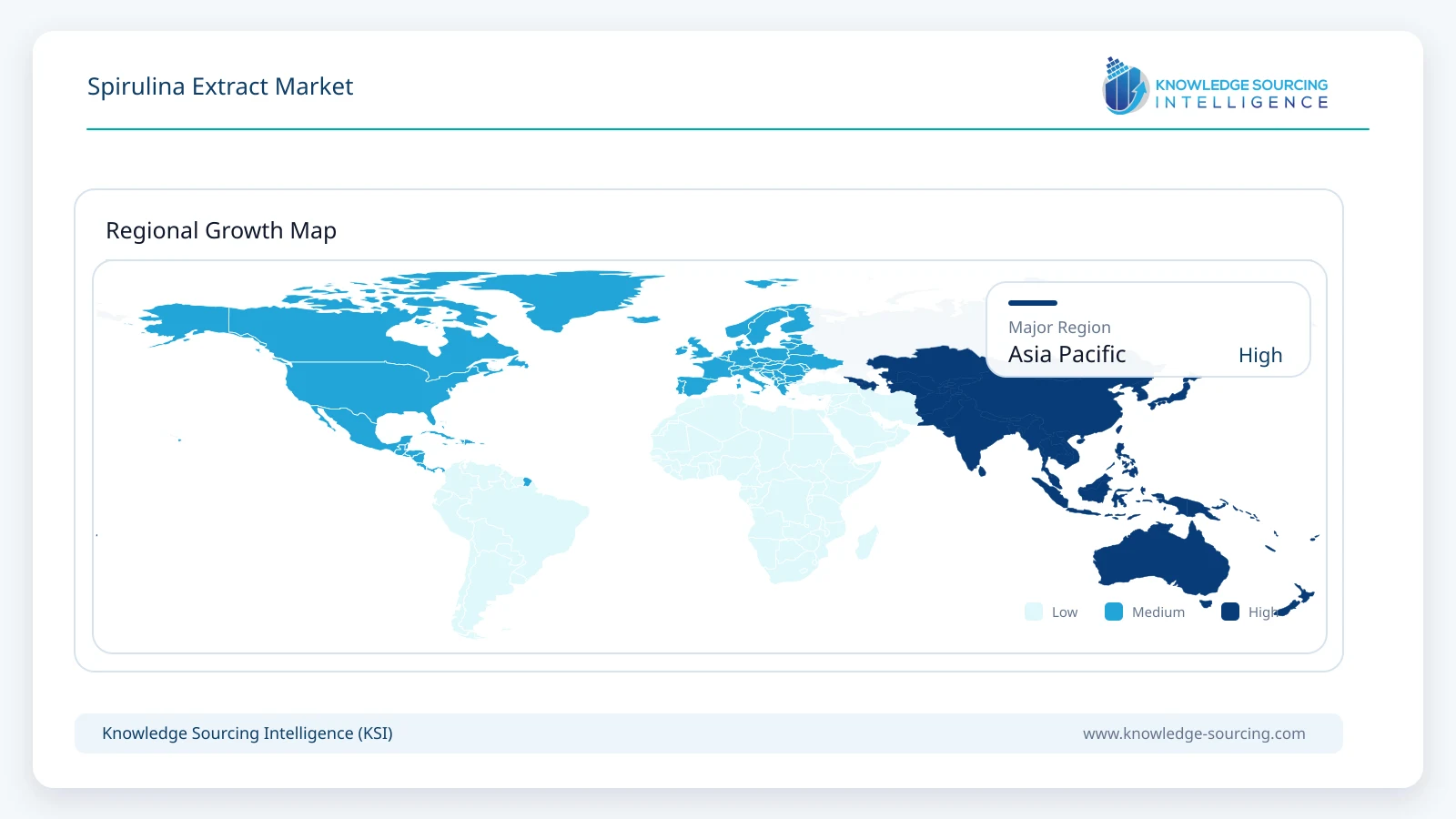
Asia Pacific
Asia Pacific is structurally important because it combines major spirulina cultivation capacity with large consumer markets and established ingredient-processing industries. China and India are particularly relevant to supply, while Japan, South Korea, Australia, Indonesia, and Thailand provide opportunities across food, nutraceutical, and specialty ingredient applications.
India has a long-established spirulina cultivation and nutraceutical ecosystem. FSSAI's regulatory framework specifically recognizes spirulina as a nutraceutical ingredient and provides compositional criteria.
The region also supports vertical integration. Producers can combine cultivation, extraction, formulation, and export operations. EID Parry's nutraceutical operations illustrate the importance of Indian manufacturing and international distribution, while its corporate disclosures identify international supplier qualification activity for spirulina.
Japan and South Korea are attractive for premium ingredients because buyers often emphasize quality, consistency, food safety, and technical performance. China remains important for production and processing economics, although international customers may differentiate suppliers according to certification, contaminant control, and traceability.
Middle East and Africa
The Middle East and Africa represent smaller but developing demand centers. Nutritional supplements, functional foods, specialty retail, cosmetics, and animal nutrition provide potential applications.
Gulf markets can support imported premium ingredients because food and supplement manufacturers often rely on international ingredient suppliers. The primary constraints include smaller local manufacturing bases, dependence on imported raw materials, and regulatory fragmentation between countries.
South Africa provides a more developed food and supplement market within the region, while Israel has strong capabilities in biotechnology and specialized food ingredients. Commercial expansion will depend heavily on distributor relationships and regulatory registration.
South America
South America presents opportunities through dietary supplements, functional foods, natural ingredients, and specialty nutrition. Brazil is the most significant market in the supplied regional structure because of its large food and consumer-health industries.
The principal commercial challenge is distribution. Suppliers must often work through local ingredient distributors or established food and supplement manufacturers to achieve broad coverage. Currency fluctuations, import costs, and regulatory requirements can also influence purchasing decisions.
Competitive Landscape
The competitive structure of the Spirulina Extract Market includes vertically integrated algae producers, ingredient specialists, natural-color companies, nutraceutical manufacturers, and biotechnology-oriented suppliers. The provided competitive set includes Givaudan, DIC Corporation, E.I.D.-Parry (India) Limited/Parry Nutraceuticals, Sensient Technologies Corporation, Döhler Group, Cyanotech Corporation, Botanic Healthcare, Vedan Biotechnology Corporation Co., Ltd., Medikonda Nutrients, AlgaVista, and Greentech Pvt. Ltd.
Competition occurs across several layers. Producers with cultivation assets can control biomass quality and supply continuity. Extraction specialists compete through yield, purity, concentration, and process efficiency. Natural-color companies compete through application performance, formulation expertise, and regulatory coverage. Nutraceutical suppliers compete through certifications, branding, product formats, and international distribution.
Vertical integration can be particularly valuable because it reduces dependence on third-party biomass suppliers. DIC's Earthrise operation demonstrates how cultivation and downstream color production can be combined within a broader ingredient platform.
E.I.D.-Parry's Parry Nutraceuticals competes through long-standing microalgae expertise, certification, organic production, international distribution, and product differentiation. Its disclosures indicate sales reach across more than 40 countries and a focus on quality verification.
Cyanotech competes from a specialized microalgae production base in Hawaii. Its fiscal 2025 filing identifies spirulina products as one of its two major product lines and reports direct competition from Parry Nutraceuticals, Earthrise Nutritionals, and Chinese producers.
Givaudan, Sensient, and Döhler occupy a different competitive position because their broader ingredient portfolios allow them to integrate spirulina-derived colors into application-specific food systems. Sensient's 2025 materials, for example, describe stabilized spirulina solutions for beverage applications, indicating competition based on functional performance rather than raw pigment supply alone.
The competitive environment therefore favors companies that can demonstrate three capabilities simultaneously: reliable biomass supply, technically consistent extraction, and application-specific support. Geographic reach and regulatory knowledge add further differentiation.
Recent Developments
June 2026: Starbucks announced Blue Coconut Refresher and Iced Blue Coconut Matcha, launching June 16 with blue spirulina to provide naturally vibrant coloration in limited-time beverages.
May 2026: Arborea and Vita Actives announced a partnership to scale BioSolar Spirulina, targeting premium food, beverage and nutrition applications with improved consistency, purity and sensory characteristics.
February 2026: The U.S. FDA issued final orders expanding approved uses of spirulina extract as a color additive in human foods. Although the effective date was delayed in March 2026 while objections were evaluated, the action reinforced the regulatory relevance of spirulina-derived natural colors in the U.S. food industry.
May 2025: Givaudan announced FDA approval for Everzure Galdieria, a natural blue color derived from Galdieria sulphuraria and positioned as a phycocyanin-rich alternative with broader low-pH application potential than conventional spirulina solutions. The development demonstrates intensifying competition between microalgal color technologies.
Regulatory and Policy Environment
Regulatory requirements represent a major commercial variable because spirulina extract can fall under different regulatory frameworks depending on its composition, intended use, and claims.
In the United States, food ingredients are generally subject to the Federal Food, Drug, and Cosmetic Act. FDA states that color additives require approval before they can be used in food, while substances used under other regulatory pathways can be subject to different requirements.
The February 2026 FDA action concerning spirulina extract is particularly relevant because it expands the potential food-color application base. The subsequent delay in effective date means suppliers and food manufacturers must monitor the procedural status before making commercial assumptions about the newly expanded uses.
The European Union applies Regulation (EU) 2015/2283 to novel foods. Businesses must determine whether an ingredient is novel and, where applicable, obtain authorization before placing it on the market. The European Commission also states that novel-food authorizations include specifications, conditions of use, and labeling requirements where applicable.
The regulatory distinction between conventional spirulina and modified derivatives is commercially important. The European Commission's 2025 consultation concluded that conventional Arthrospira platensis is not novel, while silicon-enriched spirulina was considered novel because of its modified characteristics and intended use.
India provides a defined framework for spirulina within nutraceuticals. FSSAI's compendium lists spirulina from Spirulina platensis/Arthrospira platensis and establishes compositional and usage parameters.
Across markets, suppliers must therefore manage product identity, purity, contaminant limits, microbiological safety, labeling, claims, manufacturing controls, and intended-use restrictions. The regulatory burden rises when suppliers move from conventional nutritional biomass into purified extracts, novel formulations, or color-additive applications.
Outlook and Strategic Implications
The Spirulina Extract Market will depend less on expansion of conventional spirulina consumption alone and more on the conversion of biomass into standardized ingredients with measurable functional value.
Extraction efficiency is likely to remain a major investment priority. Suppliers can improve economics by increasing pigment recovery, reducing processing losses, optimizing water and energy consumption, and integrating drying and purification processes. Producers with reliable cultivation and downstream extraction capabilities should have an advantage when customers require consistent specifications.
Procurement is also likely to become more qualification-driven. Large food, beverage, nutraceutical, and cosmetics companies cannot easily substitute a supplier when an ingredient affects color, product stability, regulatory compliance, or finished-product claims. Once a supplier has passed technical and quality qualification, continuity and documentation can become more important than the lowest quoted price.
The natural-color segment should receive particular attention. The 2026 U.S. regulatory development expands the commercial relevance of spirulina extract, while competing microalgal technologies are addressing limitations associated with conventional spirulina. This means the market opportunity is growing alongside technological substitution risk. Suppliers must demonstrate where spirulina performs best rather than assuming that natural-color demand automatically translates into spirulina demand.
Application-specific stabilization will therefore remain a central technology direction. Producers that can improve performance under acidic, thermal, light-exposed, or long-shelf-life conditions can access applications that conventional extracts cannot serve reliably.
Nutraceutical suppliers should continue to differentiate through certification, traceability, contaminant control, organic production, and standardized composition. The market contains a wide range of cultivation and processing practices, making quality assurance an important mechanism for separating premium ingredients from commodity products.
Geographic diversification will also influence investment decisions. Asia Pacific provides production and processing advantages, while North America and Europe offer high-value downstream markets. Suppliers that operate across these regions can reduce dependence on a single customer base and align production with application-specific demand.
Sustainability will become more relevant to procurement, but commercial buyers are likely to evaluate measurable operating attributes rather than broad sustainability claims. Energy consumption, water management, CO? utilization, wastewater management, biomass productivity, and renewable-energy use can increasingly form part of supplier qualification. DIC's Earthrise facility demonstrates how cultivation infrastructure can incorporate CO? utilization and renewable energy while producing higher-value pigment products.
The main risks through 2031 include raw-material variability, contamination, pigment stability, regulatory changes, competition from alternative natural colors, and pressure from lower-cost biomass suppliers. The greatest opportunities lie in standardized extracts, natural food colors, premium nutraceutical ingredients, certified organic products, and application-specific formulations.
From a strategic perspective, suppliers should avoid competing solely on spirulina biomass volume. The stronger commercial model is to control quality from cultivation through extraction and provide a specification that solves a defined customer problem. This approach can increase customer retention, improve pricing power, and reduce exposure to commodity competition.
For buyers, supplier selection should prioritize verified quality systems, analytical consistency, regulatory documentation, production continuity, and technical support. For investors and strategic partners, assets that combine cultivation with extraction, purification, and application development are more commercially differentiated than standalone biomass capacity.
Overall, the market's five-year trajectory will be shaped by the value captured from each unit of cultivated biomass. Nutritional applications will continue to provide a stable foundation, while purified phycocyanin and natural-color applications can create higher-value revenue opportunities. The companies best positioned for 2026–2031 will be those that combine dependable cultivation, efficient extraction, regulatory readiness, and application-specific product development.
Spirulina Extract Market Scope
| Report Metric | Details |
|---|---|
| Total Market Size in 2026 | USD 504.2 million |
| Total Market Size in 2031 | USD 777.5 million |
| Forecast Unit | Million |
| Growth Rate | 9.0% |
| Study Period | 2021 to 2031 |
| Historical Data | 2021 to 2024 |
| Base Year | 2025 |
| Forecast Period | 2026 – 2031 |
| Segmentation | Species Type, Form, Distribution Channel, Application, Geography |
| Companies |
|
Market Segmentation
By Species Type
By Form
By Distribution Channel
By Application
By Geography
Table of Contents
1. EXECUTIVE SUMMARY
2. MARKET SNAPSHOT
2.1. Market Overview
2.2. Market Definition
2.3. Scope of the Study
2.4. Market Size and Forecast
2.5. Market Segmentation
2.6. Key Market Trends
2.7. Regional Highlights
3. BUSINESS LANDSCAPE
3.1. Market Drivers
3.2. Market Restraints
3.3. Market Opportunities
3.4. Porter’s Five Forces Analysis
3.5. Industry Value Chain Analysis
3.6. Policies, Regulations, and Standards
3.7. Quality and Safety Considerations
3.8. Strategic Recommendations
4. TECHNOLOGICAL OUTLOOK
5. GLOBAL SPIRULINA EXTRACT MARKET BY SPECIES TYPE
5.1. Introduction
5.2. Spirulina Platensis (Limnospira Platensis)
5.3. Spirulina Maxima (Limnospira Maxima)
5.4. Others
6. GLOBAL SPIRULINA EXTRACT MARKET BY FORM
6.1. Introduction
6.2. Powder
6.3. Liquid
6.4. Concentrated Extract
6.5. Purified Extract
6.6. Other Forms
7. GLOBAL SPIRULINA EXTRACT MARKET BY DISTRIBUTION CHANNEL
7.1. Introduction
7.2. Direct Sales
7.3. Distributors and Ingredient Suppliers
7.4. Online
7.5. Offline
7.5.1. Supermarkets/Hypermarkets
7.5.2. Specialty Stores
7.5.3. Pharmacies and Health Stores
7.6. Others
8. GLOBAL SPIRULINA EXTRACT MARKET BY APPLICATION
8.1. Introduction
8.2. Nutraceuticals and Dietary Supplements
8.3. Food and Beverages
8.4. Natural Food Colors
8.5. Cosmetics and Personal Care
8.6. Animal Feed
8.7. Pharmaceuticals
8.8. Others
9. GLOBAL SPIRULINA EXTRACT MARKET BY GEOGRAPHY
9.1. Introduction
9.2. North America
9.2.1. United States
9.2.2. Canada
9.2.3. Mexico
9.3. South America
9.3.1. Brazil
9.3.2. Argentina
9.3.3. Others
9.4. Europe
9.4.1. Germany
9.4.2. France
9.4.3. United Kingdom
9.4.4. Spain
9.4.5. Others
9.5. Middle East and Africa
9.5.1. Saudi Arabia
9.5.2. United Arab Emirates
9.5.3. Israel
9.5.4. South Africa
9.5.5. Others
9.6. Asia Pacific
9.6.1. China
9.6.2. India
9.6.3. Japan
9.6.4. South Korea
9.6.5. Indonesia
9.6.6. Thailand
9.6.7. Australia
9.6.8. Others
10. COMPETITIVE ENVIRONMENT AND ANALYSIS
10.1. Major Players and Strategy Analysis
10.2. Market Share Analysis
10.3. Mergers, Acquisitions, Agreements, and Collaborations
10.4. Product Portfolio Analysis
10.5. Competitive Dashboard
11. COMPANY PROFILES
11.1. Givaudan
11.2. DIC Corporation
11.3. E.I.D.-Parry (India) Limited / Parry Nutraceuticals
11.4. Sensient Technologies Corporation
11.5. Döhler Group
11.6. Cyanotech Corporation
11.7. Botanic Healthcare
11.8. Vedan Biotechnology Corporation Co., Ltd.
11.9. Medikonda Nutrients
11.10. AlgaVista Greentech Pvt. Ltd.
12. APPENDIX
12.1. Currency
12.2. Assumptions
12.3. Base and Forecast Years Timeline
12.4. Key Benefits for the Stakeholders
12.5. Research Methodology
12.6. Abbreviations
LIST OF FIGURES
LIST OF TABLES
Navigate
Trusted by the world's leading organizations











