
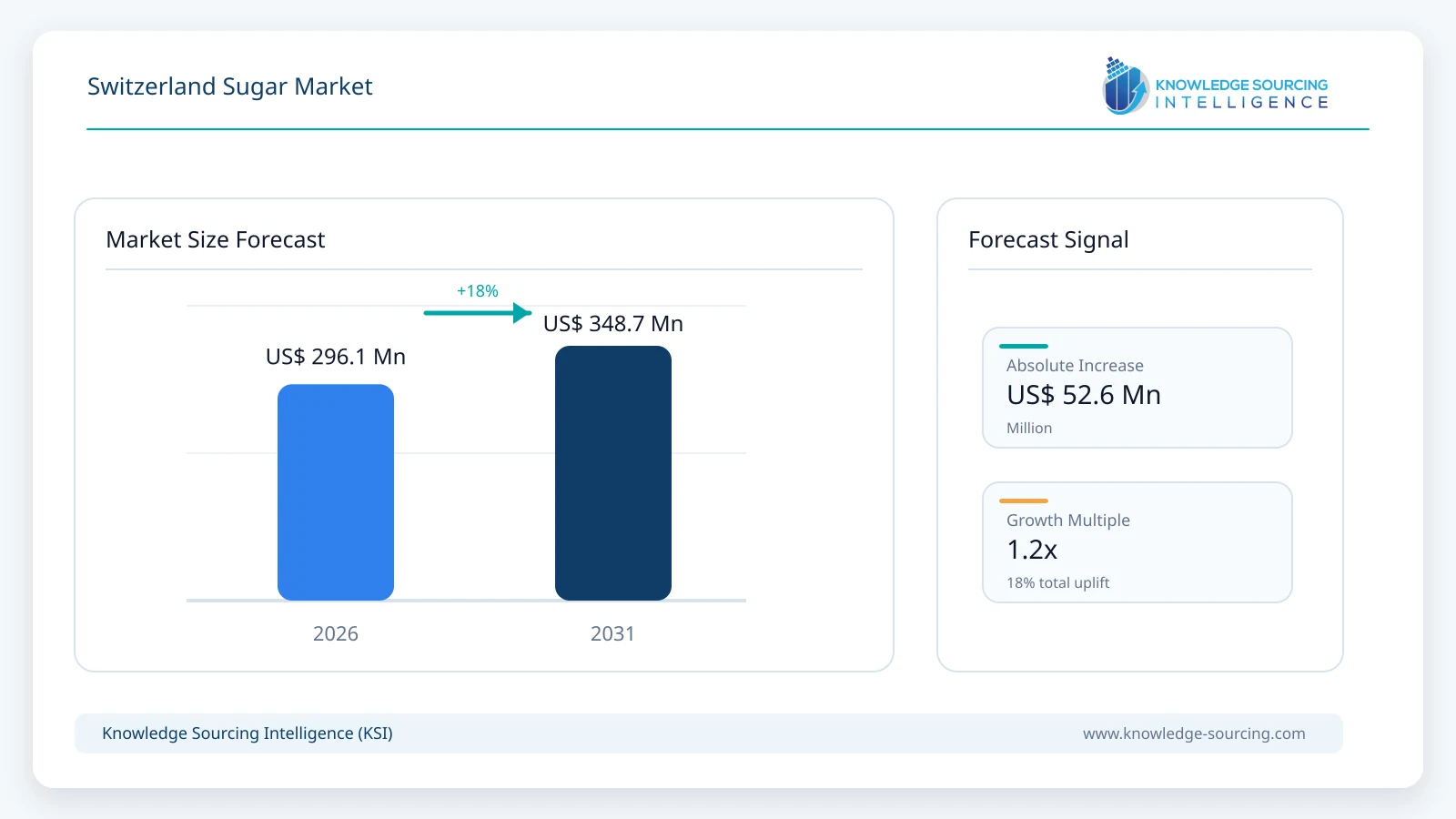
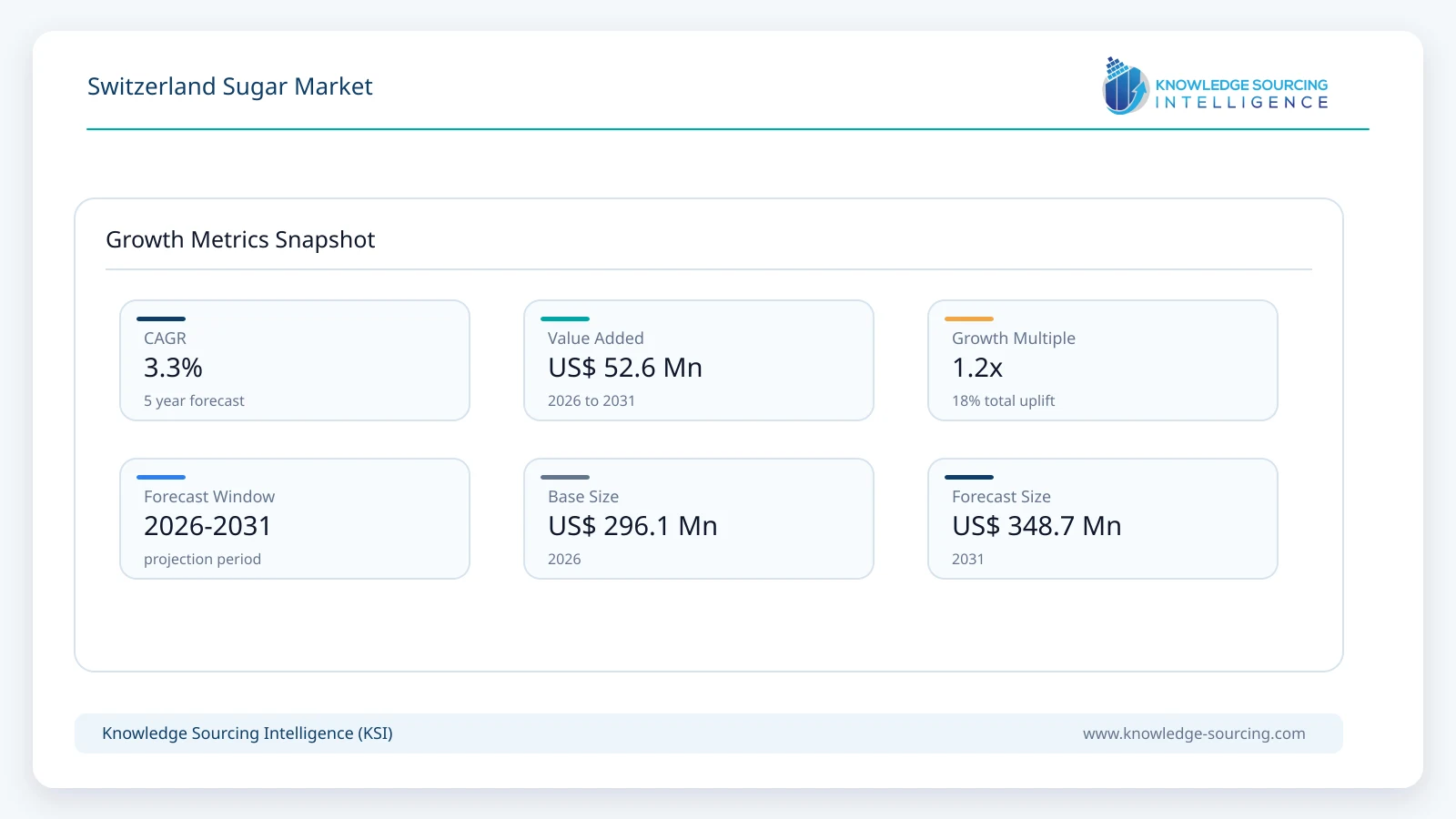
The Switzerland sugar market is forecast to grow at a CAGR of 3.3%, reaching USD 348.7 million in 2031 from USD 296.1 million in 2026.
Highlights:
- 1Switzerland's sugar market is supported by stable food manufacturing demand and regulated domestic beet sugar production.
- 2Food and beverage processors remain the largest commercial buyers, emphasizing supply reliability and product consistency.
- 3Domestic sugar production continues to depend primarily on sugar beet cultivation and government agricultural support measures.
- 4Import availability and European sugar price movements continue to influence procurement strategies and supplier competition.
- 5Sustainability standards, traceable sourcing, and locally produced sugar are becoming stronger purchasing considerations across industrial buyers.
Demand remains comparatively stable because sugar serves as an essential processing ingredient across multiple manufacturing industries rather than as a discretionary consumer product. Procurement decisions increasingly balance price with factors such as Swiss origin certification, sustainability credentials, logistics reliability, and long-term supply agreements. Domestic beet sugar production reduces dependence on imports for part of national consumption, while imported cane sugar and refined sugar continue to supplement industrial requirements and support product diversity. According to Schweizer Zucker AG, Switzerland's sugar industry supplies granulated, powdered, cube, preserving, specialty, and industrial sugar products from its production facilities in Aarberg and Frauenfeld.
Commercial activity is also influenced by agricultural policy. Government support for domestic sugar beet cultivation helps maintain production capacity despite fluctuations in international sugar prices and cultivation costs. At the same time, multinational trading companies and specialty distributors strengthen market competition by expanding sourcing options and value-added distribution services for industrial customers.
Food reformulation initiatives introduce another layer of market complexity. While health authorities continue encouraging reductions in added sugar across selected food categories, manufacturers remain dependent on sugar for sweetness, texture, preservation, fermentation, and product stability. As a result, purchasing decisions increasingly focus on optimized product formulations rather than simple reductions in sugar consumption.
Key Market Indicators
Indicator | Latest Evidence | Commercial Meaning |
Domestic production facilities | 2 sugar factories (Aarberg and Frauenfeld) | Domestic refining capacity supports national supply resilience. |
Primary domestic raw material | Sugar beet | Local beet cultivation remains the foundation of Swiss sugar production. |
Cultivation area | More than 18,000 hectares (2026) | Expanded beet acreage supports domestic raw material availability. |
Market applications | Food, beverage, pharmaceutical manufacturing | Industrial demand remains diversified across several downstream sectors. |
Product portfolio | Granulated, powdered, specialty and industrial sugars | Suppliers address both retail and industrial purchasing requirements. |
Key indicator: Swiss sugar beet cultivation exceeded 18,000 hectares in 2026.
Commercial meaning: Expanded cultivation improves domestic availability of raw materials while reducing exposure to import volatility.
Market Drivers
Stable procurement from Switzerland's food and beverage manufacturing industry.
Industrial food manufacturing remains the principal source of sugar demand because sugar performs multiple technical functions beyond sweetening, including preservation, texture development, fermentation, moisture retention, and color formation. These functional requirements limit substitution across bakery products, confectionery, dairy products, beverages, processed foods, and chocolate manufacturing. Industrial buyers generally prioritize consistent quality, reliable delivery schedules, and standardized product specifications over short-term price movements. Suppliers therefore compete through dependable production planning, technical support, and long-term commercial relationships rather than commodity pricing alone.
Government support for domestic sugar beet cultivation strengthens supply security.
Swiss agricultural policy continues supporting domestic sugar beet production to preserve national food security and maintain local processing capacity. Expansion of cultivated sugar beet acreage, together with continued investment in production efficiency, improves raw material availability for domestic sugar manufacturers. Schweizer Zucker AG has also highlighted sustainable cultivation practices and increased farmer participation in beet production, reinforcing domestic supply resilience. Stable agricultural production reduces procurement uncertainty for industrial customers while supporting traceability requirements that have become increasingly important within Swiss food manufacturing.
Growing demand for traceable and sustainably sourced sugar.
Large food manufacturers increasingly evaluate suppliers using sustainability, environmental certification, product traceability, and local sourcing criteria alongside price. Swiss-origin sugar provides manufacturers with shorter transportation distances, documented production practices, and compliance with domestic quality standards. These purchasing preferences are encouraging suppliers to strengthen sustainability programs and improve transparency throughout the supply chain. Schweizer Zucker AG continues to position sustainable beet cultivation and certified production as central elements of its commercial strategy, reflecting broader customer expectations within Switzerland's food industry.
Diversified industrial applications support steady purchasing volumes.
Commercial demand extends beyond food manufacturing into pharmaceutical production, where sugar is used in syrups, coated tablets, medicinal formulations, and excipients. Industrial buyers within pharmaceutical manufacturing emphasize purity, regulatory compliance, and batch consistency rather than commodity pricing. The coexistence of food processing and pharmaceutical applications reduces dependence on a single end-use sector and creates a broader customer base for suppliers. This diversification also encourages distributors to maintain wider product portfolios covering granulated, powdered, and syrup-based sugar products for different manufacturing requirements.
Market Restraints and Challenges
Exposure to international sugar price fluctuations despite domestic production.
Although Switzerland maintains domestic sugar production, industrial buyers continue relying on imported sugar for part of their procurement requirements. International sugar prices, exchange-rate movements, transport costs, and European market conditions therefore continue affecting procurement costs. Price volatility complicates purchasing decisions for food manufacturers operating under long-term retail contracts because increases in ingredient costs cannot always be transferred immediately to customers. Suppliers frequently respond through forward purchasing, inventory management, and diversified sourcing strategies rather than relying exclusively on domestic production.
Agricultural production remains vulnerable to climatic and crop-related risks.
Domestic sugar production depends heavily on sugar beet harvest quality and agricultural productivity. Weather variability, pests, crop diseases, and changing cultivation economics can influence beet yields and processing efficiency. Schweizer Zucker AG has recently highlighted agronomic initiatives addressing crop protection and sustainable cultivation practices, reflecting continued operational attention to farming risks. Although government support reduces some production uncertainty, seasonal agricultural conditions remain an unavoidable constraint affecting raw material availability and production planning.
Health-driven product reformulation changes purchasing patterns.
Swiss public health initiatives encouraging lower sugar consumption are gradually influencing food formulation strategies in selected product categories. Manufacturers increasingly seek to reduce added sugar while maintaining product taste, texture, shelf life, and consumer acceptance. Reformulation rarely eliminates sugar entirely because many manufacturing processes require its functional characteristics. Instead, suppliers must accommodate changing product specifications and smaller formulation adjustments, creating additional research, testing, and product development costs across the value chain. Industry agreements to reduce sugar content in selected food categories illustrate this gradual transition rather than a structural decline in industrial sugar demand.
High domestic production costs relative to larger international suppliers.
Swiss sugar production operates under comparatively higher labor, land, environmental compliance, and agricultural costs than many international producing regions. Domestic manufacturers therefore face continuing pressure to improve operational efficiency while maintaining competitive prices against imported sugar. Company disclosures and industry studies indicate ongoing attention to production economics, sustainable operations, and cost management. Maintaining domestic competitiveness will continue to require productivity improvements alongside policy support for sugar beet cultivation throughout the forecast period.
Major Segment Analysis
Food and Beverage
Food and beverage remains the most commercially important end-use segment because sugar performs multiple technical functions that extend beyond sweetness. Manufacturers use granulated, powdered, and syrup sugar in confectionery, bakery products, dairy items, beverages, processed foods, and chocolate production, where sugar contributes to texture, preservation, fermentation, moisture retention, and colour development. These functional characteristics make substitution technically challenging in many product categories, particularly premium confectionery and chocolate products that require consistent formulation and processing performance.
Industrial buyers typically purchase under long-term supply agreements and place considerable emphasis on product consistency, traceability, food safety compliance, and delivery reliability. Suppliers therefore compete through quality assurance, logistics capability, technical support, and the ability to provide customized product specifications rather than on price alone. Pharmaceutical demand provides additional market stability, but purchasing volumes remain comparatively smaller and subject to stricter regulatory specifications. Consequently, performance within the food and beverage segment continues to influence production planning, inventory management, and supplier investment decisions across the broader Swiss sugar market.
Competitive Landscape
The Switzerland sugar market exhibits a moderately concentrated structure in domestic production while remaining competitive in distribution and international sourcing. Schweizer Zucker AG occupies a central position through its domestic beet sugar processing facilities, whereas Zumar AG and Sugro Interchoc AG strengthen market competition through specialty ingredient distribution, industrial supply, and customer-specific sourcing solutions. Wilmar International Ltd contributes through its global procurement network and diversified sugar trading capabilities.
Competition extends beyond commodity pricing. Industrial customers increasingly evaluate suppliers based on supply reliability, traceability, sustainability performance, food safety compliance, logistics capability, and technical support. Domestic production provides advantages in product traceability and shorter delivery times, while international suppliers compete through broader sourcing options and procurement flexibility. Companies are also responding to changing customer expectations by improving production efficiency, strengthening sustainability initiatives, diversifying sourcing strategies, and expanding value-added services that support long-term industrial procurement relationships.
Recent Developments
August 2025: Ricola launched its sugar-free Drink Cubes in Switzerland. Developed with waterdrop®, the dissolvable cubes combine Swiss Alpine herbs, fruit flavors, and vitamins, expanding Ricola into functional hydration while promoting sugar-free beverage consumption.
Regulatory and Policy Environment
Swiss sugar production operates within a policy framework that combines agricultural support, food safety regulation, and trade management. The Swiss Federal Office for Agriculture (FOAG) continues supporting domestic sugar beet cultivation through agricultural policy measures intended to preserve national production capacity and strengthen food security. These measures remain commercially relevant because domestic beet production supplies an important share of Switzerland's refined sugar requirements.
Food manufacturers must also comply with food safety requirements administered by the Swiss Federal Food Safety and Veterinary Office (FSVO). Product quality, contaminant control, labelling, and traceability standards influence procurement specifications across both domestic and imported sugar. Buyers increasingly require documented compliance throughout the supply chain, particularly for products supplied to premium food and pharmaceutical applications.
Switzerland's nutrition policy encourages gradual reductions in added sugar across selected processed food categories through voluntary industry agreements rather than mandatory production limits. Consequently, manufacturers continue reformulating products while preserving functionality, taste, and shelf life. The regulatory environment therefore promotes product optimization instead of materially reducing industrial sugar demand.
Outlook and Strategic Implications
Switzerland's sugar market is expected to remain fundamentally stable during the 2026-2031 forecast period because industrial demand continues to originate from established manufacturing sectors with relatively predictable purchasing patterns. Food processing, confectionery, bakery, dairy, beverage, and pharmaceutical manufacturers are expected to remain the primary revenue contributors, while domestic sugar beet cultivation continues supporting supply resilience within the national market.
Future competition is likely to depend less on commodity pricing and more on operational performance. Suppliers that demonstrate reliable delivery, traceable sourcing, sustainability credentials, and consistent product quality are expected to strengthen relationships with industrial customers. Continued investment in agricultural productivity, manufacturing efficiency, and supply-chain resilience will remain important as producers manage climate-related risks and international price fluctuations.
Key strategic priorities include:
Manufacturers: Improve production efficiency while maintaining quality and sustainability standards.
Food and pharmaceutical buyers: Diversify sourcing strategies to reduce exposure to international price volatility.
Distributors: Expand value-added technical support and customized product offerings for industrial customers.
Policymakers: Continue balancing domestic agricultural support with competitive market conditions and long-term food security objectives.
These factors indicate that commercial performance over the forecast period will depend primarily on supply reliability, agricultural productivity, regulatory compliance, and the ability of suppliers to meet increasingly demanding industrial procurement requirements, rather than on large changes in overall sugar consumption.
Switzerland Sugar Market Scope:
| Report Metric | Details |
|---|---|
| Total Market Size in 2026 | USD 296.1 million |
| Total Market Size in 2031 | USD 348.7 million |
| Forecast Unit | Million |
| Growth Rate | 3.3% |
| Study Period | 2021 to 2031 |
| Historical Data | 2021 to 2024 |
| Base Year | 2025 |
| Forecast Period | 2026 – 2031 |
| Segmentation | Form, Source, Use, Distribution Channel |
| Companies |
|
Market Segmentation
By Form
- Granulated
- Powdered
- Syrup
By Source
- Cane Sugar
- Beet Sugar
By Use
- Food and Beverage
- Pharmaceuticals
By Distribution Channel
- Online
- Offline
Table of Contents
1. INTRODUCTION
1.1. Market Overview
1.3. Market Definition
1.4. Market Segmentation
2. RESEARCH METHODOLOGY
2.1. Research Data
2.2. Assumptions
3. EXECUTIVE SUMMARY
3.1. Research Highlights
4. MARKET DYNAMICS
4.1. Market Driver
4.2. Market Restraints
4.3. Porters Five Forces Analysis
4.3.1. Bargaining Power of End-Users
4.3.2. Bargaining Power of Buyers
4.3.3. Threat of New Entrants
4.3.4. Threat of Substitutes
4.3.5. Competitive Rivalry in the Industry
4.4. Industry Value Chain Analysis
5. SWITZERLAND SUGAR MARKET BY FORM
5.1. Introduction
5.2. Granulated
5.3. Powdered
5.4. Syrup
6. SWITZERLAND SUGAR MARKET BY SOURCE
6.1. Introduction
6.2. Cane Sugar
6.3. Beet Sugar
7. SWITZERLAND SUGAR MARKET BY USE
7.1. Introduction
7.2. Food and Beverage
7.3. Pharmaceuticals
8. SWITZERLAND SUGAR MARKET BY DISTRIBUTION CHANNEL
8.1. Introduction
8.2. Online
8.3. Offline
9. COMPETITIVE ENVIRONMENT AND ANALYSIS
9.1. Major Players and Strategy Analysis
9.2. Emerging Players and Market Lucrativeness
9.3. Mergers, Acquisitions, Agreements, and Collaborations
9.4. Vendor Competitiveness Matrix
10. COMPANY PROFILES
10.1. Schweizer Zucker AG
10.2. Zumar AG
10.3. Wilmar International Ltd
10.4. Sugro Interchoc AG
Navigate
Trusted by the world's leading organizations











