
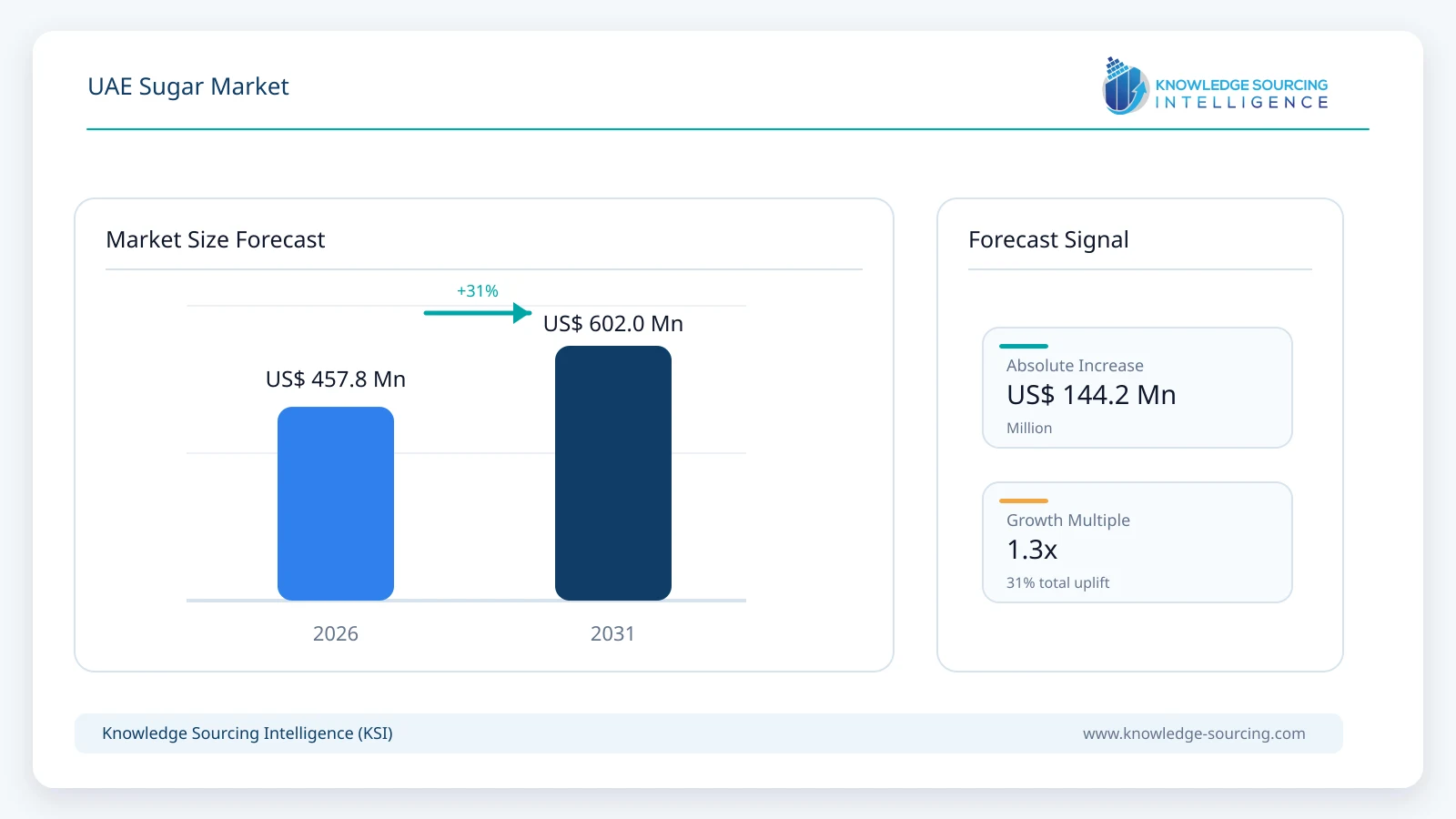
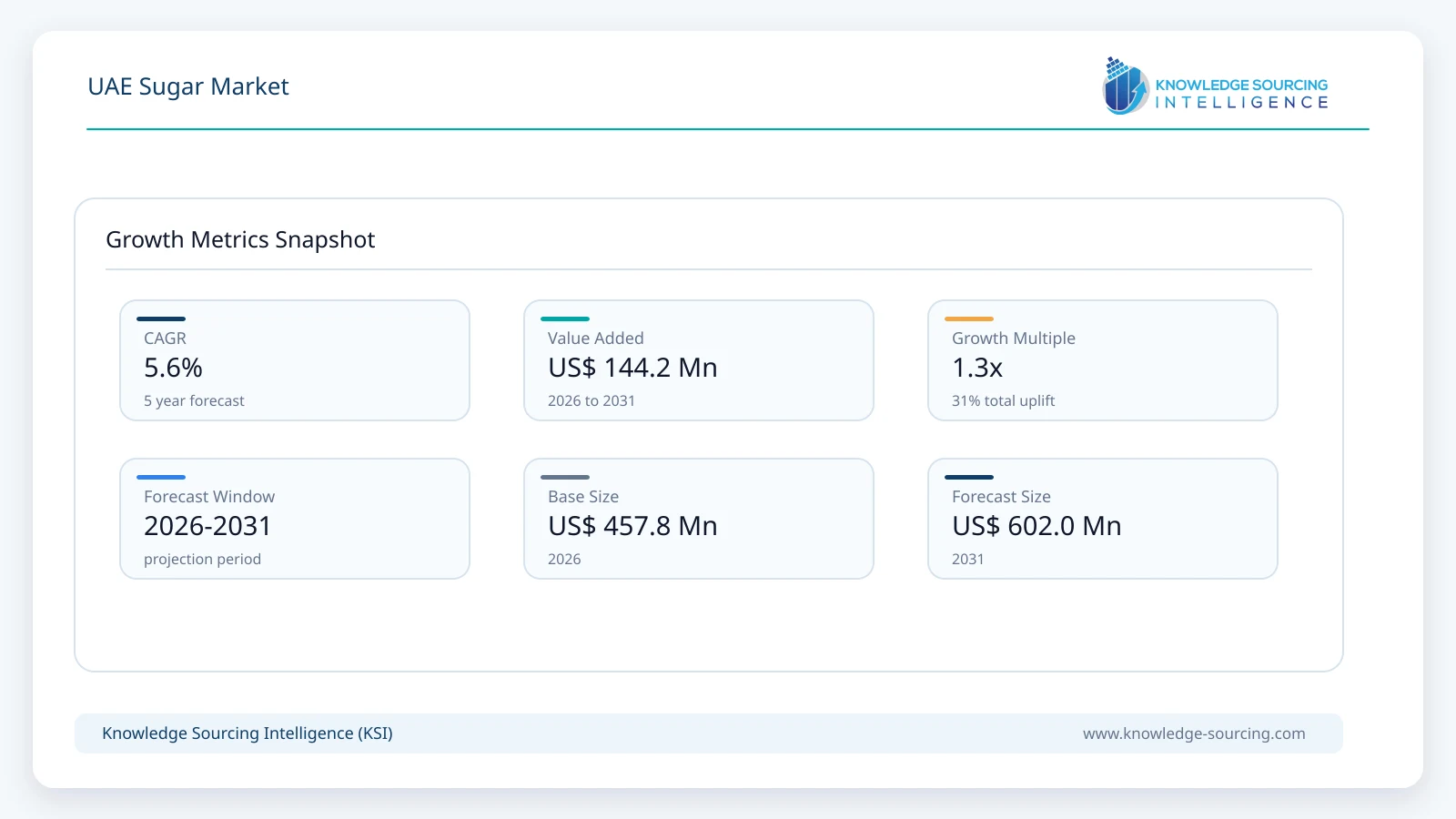
The UAE sugar market is expected to grow at a compound annual growth rate of 5.6% over the forecast period to reach a market size of USD 602.0 million in 2031 from USD 457.8 million in 2026.
Highlights:
- 1Consumers increasing daily sugar intakeResidents are consuming high amounts of sugar through beverages and snacks.
- 2Snack manufacturers boosting sugar usageCompanies are adding more sugar in confectionery and ready-to-eat products.
- 3Households preferring sweetened food itemsFamilies are choosing chocolates, biscuits, and sugary drinks regularly.
- 4Government imposing sugar taxesAuthorities are applying levies on sweetened beverages to reduce consumption.
- 5Food producers facing rising costsBusinesses are dealing with inflation impacting sugar and ingredient prices.
- 6Brands developing lower-sugar alternativesCompanies are innovating recipes to cut sugar content in popular products.
There are two categories of sugars: naturally occurring sugars and added sugars. Simple sugars, often known as naturally occurring sugars, are present in foods like milk and fruits (lactose and fructose, respectively). Sugars or sweeteners that are added to food during processing or preparation are referred to as added sugars. UAE consumers consume more sugar than is healthy in the current environment. The UAE is the greatest sugar consumer in the world, with each customer using almost 214 kg of sugar per year.
Growth Drivers:
Along with the economy, rising income, and growing young and immigrant populations, the snacks and confectionery food segment, particularly chocolates, sweet biscuits, and sugar confectionery, continues to rise. Over the past ten years, the demand for packaged foods and snacks that are ready to eat has increased in the region due to factors like busy lives, an increase in the number of women working, and increased industrialization. Dual-income professional households have increased demand for snacks as a meal replacement, a reward after a long day at work, and a snack in between meals.
Market Restraints:
Tax on sweetened beverages
It's been claimed that having too much of anything is bad. That includes sugar, which is currently regarded as an addiction and one of the main drugs that plagues modern man and causes physical waste. Everywhere, including in the UAE, governments implement policy through taxation. The UAE implemented a sugar tax in October 2017 that raised the price of carbonated soft drinks like Coca-Cola and Pepsi by 50%. As a powerful disincentive to reduce escalating sugar consumption, the UAE Cabinet announced an extended list of taxable products, including sugary drinks, in August 2020.
Effect of Inflation
According to data from the National Bureau of Statistics of the United Arab Emirates, annual inflation rose to 2.58 percent in November 2021 from 1.86 percent the month before. Between May 2020 and February of this year, the FAO's Food Price Index jumped by 55.2%. This increase was mostly due to a 159.4% increase in the price of cooking oils, which was followed by major price increases for staples including sugar, dairy, and wheat.
The rising costs of ingredients and raw materials have presented significant issues for the food and beverage (F&B) industry. Due to this, it has become challenging for F&B businesses to maintain a competitive advantage and achieve sustainable profitability. As a result, businesses that are unable to handle the increased costs are forced to increase product prices, further burdening customers.
Key Developments:
October 2026: Almarai participated as a Gold Partner in Future Food Forum 2026 in Dubai, supporting UAE food-system development, supply-chain resilience, innovation, and collaboration across the regional food industry.
March 2026: Dubai-based Al Khaleej Sugar confirmed uninterrupted refinery operations and export/import continuity despite regional disruptions, leveraging strategic reserves and alternative ports to maintain global supply stability.
January 2026: Dalmia Bharat Sugar & Industries received Abu Dhabi Global Market approval for its UAE-based subsidiary Eagle Agrotech Holdings, advancing regional sugar production investments and expanding UAE-linked global supply operations.
January 2026: UAE implemented the new sugar-based volumetric tax system on beverages, directly impacting domestic sugar demand, pricing structures, and encouraging manufacturers to reformulate products with reduced sugar content.
October 2025: UAE government finalized a tiered sugar-content excise tax framework on sweetened beverages, replacing the flat-rate system to reduce sugar consumption and reshape demand toward low- and zero-sugar products.
UAE Sugar Market Scope:
| Report Metric | Details |
|---|---|
| Total Market Size in 2026 | USD 457.8 million |
| Total Market Size in 2031 | USD 602.0 million |
| Forecast Unit | Million |
| Growth Rate | 5.6% |
| Study Period | 2021 to 2031 |
| Historical Data | 2021 to 2024 |
| Base Year | 2025 |
| Forecast Period | 2026 – 2031 |
| Segmentation | Form, Source, Use, Distribution Channel |
| Companies |
|
Market Segmentation
By Form
Granulated
Powdered
Syrup
By Source
Cane Sugar
Beet Sugar
By Use
Food and Beverage
Pharmaceuticals
By Distribution Channel
Online
Offline
Table of Contents
1. INTRODUCTION
1.1 Market Overview
1.4. Market Segmentation
2. RESEARCH METHODOLOGY  
2.1. Research Data
2.2. Assumptions
3. EXECUTIVE SUMMARY
3.1. Research Highlights
4. MARKET DYNAMICS
4.1. Market Drivers
4.2. Market Restraints
4.3. Porter's Five Force Analysis
4.3.1. Bargaining Power of Suppliers
4.3.2. Bargaining Power of Buyers
4.3.3. Threat of New Entrants
4.3.4. Threat of Substitutes
4.3.5. Competitive Rivalry in the Industry
4.4. Industry Value Chain Analysis
5. UAE SUGAR MARKET BY FORM
5.1 Granulated
5.2 Powdered
5.3 Syrup
6. UAE SUGAR MARKET BY SOURCE
6.1 Cane Sugar
6.2 Beet Sugar
7. UAE SUGAR MARKET BY USE
7.1 Food and Beverage
7.2 Pharmaceuticals
8. UAE SUGAR MARKET BY DISTRIBUTION CHANNEL
8.1 Online
8.2 Offline
9. COMPETITIVE ENVIRONMENT AND ANALYSIS
9.1 Major Players and Strategy Analysis
9.2 Emerging Players and Market Lucrativeness
9.3 Mergers, Acquisitions, Agreements, and Collaborations
9.4 Vendor Competitiveness Matrix
10. COMPANY PROFILES
10.1 Al Khaleej Sugar Company LLC
10.2 Ali Bin Ali Group
10.3 Almarai Co
10.4 A'Saffa Foods SAOG
10.5 Bahrain Flour Mills Company BSC
10.6 Dubai Refreshments PJSC
10.7 Halwani Brothers Co. Ltd
Navigate
Trusted by the world's leading organizations











