
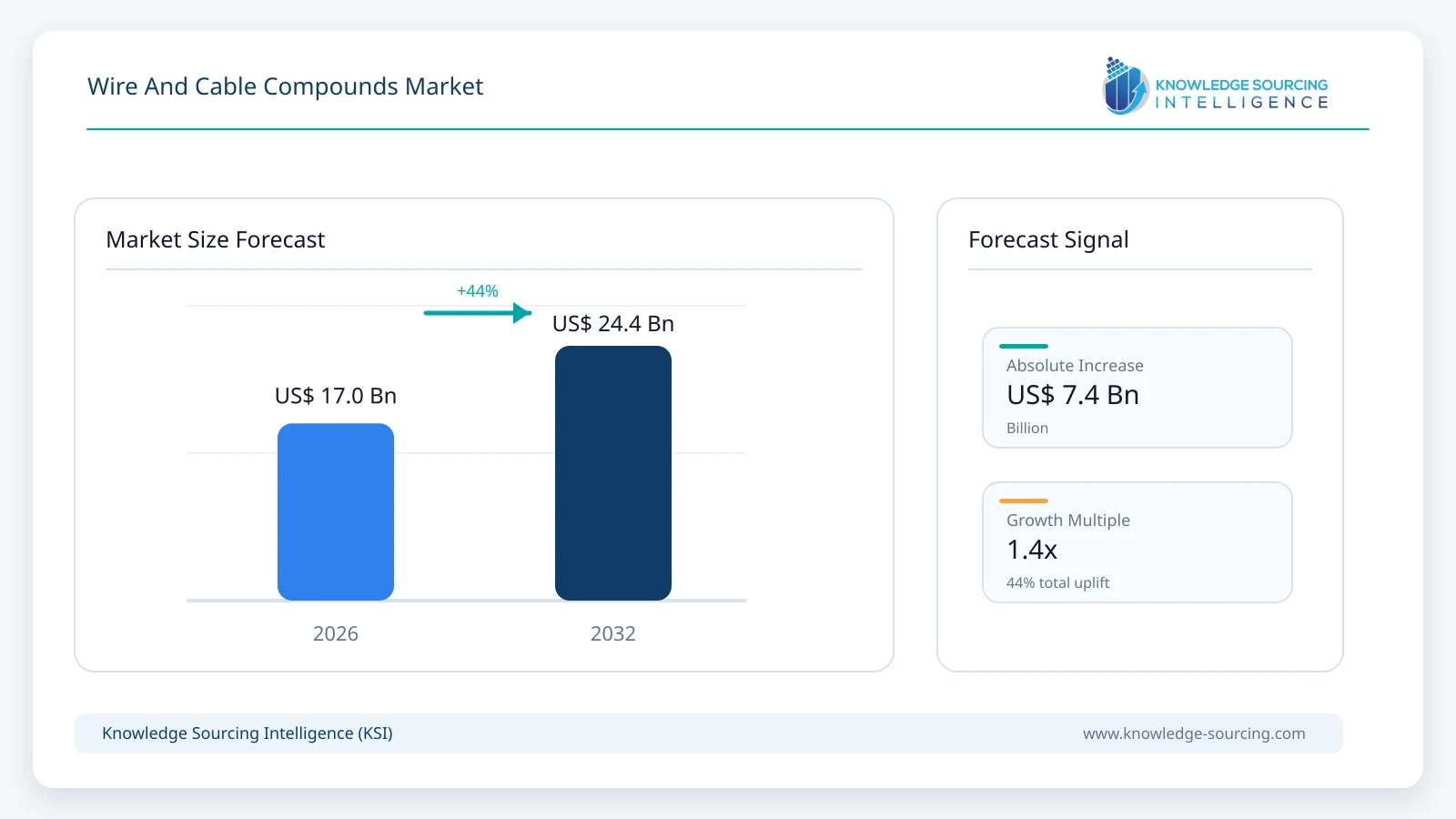
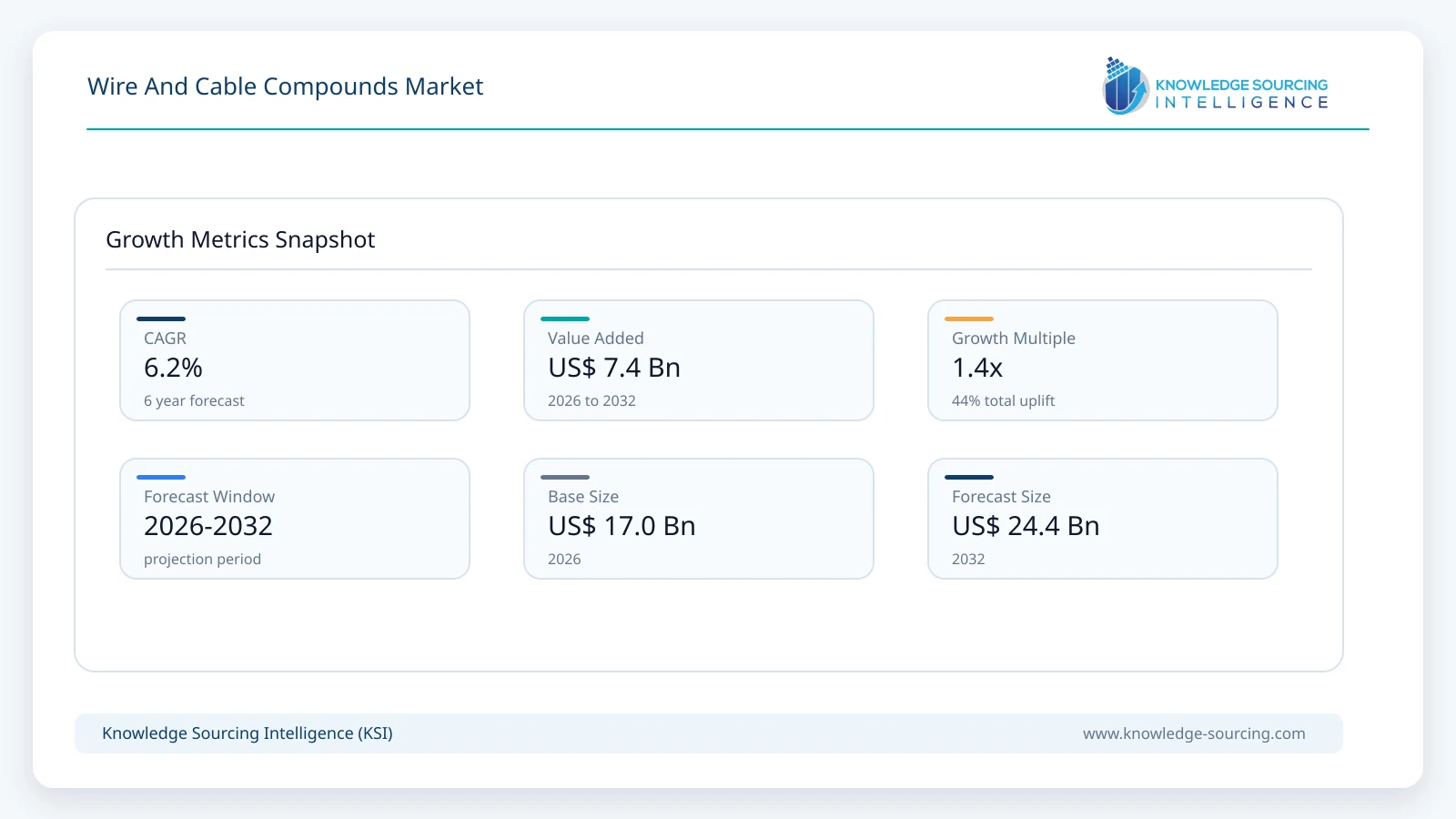
The global wire and cable compounds market is estimated at USD 16.97 billion in 2026 and is projected to reach USD 24.40 billion by 2032, growing at a CAGR of 6.23% during the forecast period.
Highlights:
- 1PVC compounds account for 31.5% of 2026 market revenue, remaining the largest material segment even as premium fire-rated and cable-grade polyolefins grow more quickly.
- 2High-voltage cable qualification raises barriers to supplier substitution, strengthening the commercial value of ultra-clean XLPE and compatible semiconductive layers.
- 3HFFR/LSZH compounds are projected to expand at a 9.43% CAGR during 2026–2032, supported by low-smoke, halogen-free cable specifications in transport, public buildings and data centers.
- 4Supplier investment remains selectivenew XLPE and HFFR capacity is being developed alongside conventional resin and PVC-compound operations.
Market Trends
Grid investment shifts value toward qualified insulation systems
The fastest-growing opportunities are not necessarily the cable grades with the greatest polymer tonnage. Medium-, high- and extra-high-voltage systems require stable dielectric properties, insulation cleanliness and predictable interfaces between insulation and semiconductive shields. Defects that appear minor during compounding can cause failures under electrical stress, making qualification history a commercial asset. Suppliers able to demonstrate stable quality across long production runs can defend pricing against generic polymer alternatives.
The economics become more consequential as offshore wind links and cross-border transmission systems use progressively demanding cable constructions. Dow introduced a fully qualified 525 kV HVDC insulation system in March 2026, combining XLPE insulation with a semiconductive compound and targeting operation at 90°C rather than a conventional 70°C benchmark. The supplier states that the material system has been qualified on full-size cables. For cable manufacturers, this reduces the uncertainty attached to qualifying isolated materials while providing a route toward more capable transmission designs.
Investment in capacity is also following these technical constraints. Borouge announced a 100,000-tonne annual XLPE expansion in the UAE in May 2026 and subsequently confirmed initial customer deliveries after performance testing. Such capacity matters more than a generic polymer plant announcement because cable-grade purity and manufacturing controls can limit the availability of qualified insulation material. Additional supply can ease material sourcing, but it does not immediately eliminate certification, field-history or process-compatibility requirements.
Fire-performance requirements increase formulation complexity
Fire performance introduces a distinct cost and processing trade-off. PVC remains widely used because it balances flexibility, extrusion performance and material economics, but certain indoor, public-infrastructure and transportation applications require low-smoke, halogen-free construction. HFFR formulations often use mineral fillers and other additives that can increase compound loading and change melt-flow behavior. Cable producers must balance flame performance with extrusion speed, surface quality, flexibility and the mechanical strength required by the installation environment.
For compounders, the commercial opportunity comes from delivering repeatable performance within the cable producer’s manufacturing window, not simply replacing one polymer with another. Formulations with superior fire ratings may create little economic value if extrusion throughput falls enough to offset the material benefit. Conversely, an HFFR compound that reduces processing variation can generate savings through fewer rejected batches and lower line interruptions. The shift rewards suppliers that can support trials, compound dispersion, testing and final cable certification.
Raw-material availability is part of that equation. Hindalco commissioned a 30,000-tonne-per-year superfine precipitated aluminium hydrate facility in August 2026 to serve high-value halogen-free flame-retardant applications. Although mineral ATH is an input rather than a finished cable compound, local availability can influence HFFR lead times and the price competitiveness of domestic compounders. Compound suppliers must therefore manage both polymer feedstock exposure and specialist additive sourcing.
Regional production strategy increasingly matters as much as chemistry
Cable polymers combine freight-sensitive commodity grades with specification-sensitive specialty compounds. Producers serving high-volume building-wire applications need a reliable local supply of PVC and polyethylene formulations, while makers of high-voltage and specialty data cables require tighter process control and more extensive technical support. Inventory quality, delivery reliability and laboratory turnaround can determine supplier selection when production campaigns and cable testing are expensive.
The April 2026 Teknor Apex and Shriram Polytech joint venture illustrates this combination of local manufacturing and global formulation expertise. Its strategic relevance lies in shortening the distance between compound development, customer trials and commercial-scale supply. Local capacity is especially valuable for custom colors, construction-specific material systems and smaller formulation runs. By contrast, ultra-clean high-voltage XLPE may continue to favor a more concentrated network of qualification-intensive production sites.
Market Growth Drivers
Power-grid reinvestment and connection of renewable generation
Grid renewal creates demand for multiple materials within the same cable construction. Conductors determine current-carrying capability, insulation maintains electrical separation, semiconductive shields control electric-field distribution, and jacketing protects against moisture and installation damage. Each layer imposes different compound requirements, allowing changes in the grid’s voltage mix to affect revenue even when total cable length grows modestly.
For an electrical utility specifying medium-voltage cables, a small saving in insulation compound procurement may be immaterial compared with the cost of an early cable failure. This shifts procurement toward documented long-term performance, water-tree resistance and material traceability. Suppliers offering stable compounds and technical support can capture the premium associated with lower operational risk. This mechanism is particularly relevant to underground and subsea circuits where replacement costs are high.
Electric vehicles, charging and industrial automation
Automotive harnesses and high-voltage vehicle cables place greater emphasis on bend life, thermal endurance and dimensional consistency than standard building wire. Charging cables add flexibility requirements under repeated handling, while vehicle architectures introduce demanding electrical and packaging constraints. These specifications create demand for engineered elastomeric and polyolefin compounds that differ from conventional PVC insulation, although commodity vehicle wiring remains cost-sensitive.
The financial outcome depends on grade migration rather than vehicle sales alone. A manufacturer may buy fewer kilograms of a thinner-wall premium compound for a compact cable and still spend more per cable because qualification, flame performance and temperature ratings raise realized material prices. Conversely, heavy price competition in mass-produced harnesses can suppress compounder margins even when unit demand improves. Application-based purchasing analysis is consequently more informative than a single market-wide automotive growth rate.
Market Restraints
Volatility in polymer and additive costs
Feedstock costs influence virtually every compound category, but the ability to pass them through differs by customer and specification. Commodity PVC and polyethylene grades can face sharp competition during resin oversupply, while clean XLPE and custom HFFR compounds embed greater testing, processing and formulation costs. Contract structures may contain price-adjustment provisions, but short-term changes in resin, plasticizer and mineral-filler prices can still pressure margins and working capital.
Qualification time and process-change risk
Cable producers are cautious when modifying an established insulation system. A new formulation may require extrusion trials, thermal and mechanical testing, electrical testing and qualification of the final cable to project specifications. Even where a replacement compound has favorable unit economics, the risk of line downtime or rejected qualification can outweigh savings. Smaller manufacturers may find it particularly difficult to finance extensive materials validation.
Wire and Cable Compounds Market Segment Analysis
By Compound Type
PVC compounds retain the largest revenue pool
PVC is the largest material category, generating approximately USD 5.35 billion in 2026 and USD 6.66 billion by 2032, representing a comparatively modest 3.72% CAGR. The category serves building wire, low-voltage insulation, general-purpose sheathing and selected flexible cable constructions. Its established processing infrastructure gives PVC an important commercial advantage: cable plants already possess extrusion equipment, formulation knowledge and testing histories suited to a wide range of PVC grades.
This installed processing base makes substitution gradual. A cable maker does not choose a halogen-free alternative purely on the basis of material claims. The replacement must satisfy final-cable fire requirements, surface quality, line throughput, ageing performance and delivery economics. HFFR formulations can require more demanding compounding and extrusion conditions, and qualification may involve entire cable assemblies. As a result, PVC retains a substantial addressable market in cost-sensitive building wire and industrial cables even as premium projects adopt halogen-free constructions.
Within PVC, purchasing is shaped by the tension between resin cost and formulation performance. Compounders blend PVC resin with plasticizers, fillers, stabilizers, lubricants and pigments to achieve target flexibility, flame response, weather resistance and extrusion behavior. A supplier can reduce costs through formulation optimization, but aggressive filler loading may impair mechanical properties or process stability. End-users therefore assess total converted cable cost, not the quoted compound price in isolation.
The importance of process stability becomes clear in high-volume wire production. A small deterioration in extrusion speed or scrap rate can offset a lower compound purchase price because the cable line also consumes labor, energy, conductor material and production time. Conversely, improved melt uniformity and handling may justify a premium compound if it reduces reject rates across sustained production campaigns. The commercial advantage lies in repeatable performance across customer machinery and operating conditions.
PVC must also adapt to regulatory and customer sustainability requirements. Changes in plasticizer preferences, stabilizer packages, recycling content and smoke-performance targets can alter formulation costs. Suppliers with the technical capacity to maintain product quality while changing raw-material packages may retain customers through material transitions. Alphagary’s 2025 expansion for flame-retardant cable compounds and the development of alternative formulations illustrate why material portfolios are evolving rather than switching abruptly from PVC to a single replacement technology.
Regional differences reinforce this trajectory. Price-sensitive markets with expanding housing and distribution networks remain substantial consumers of conventional PVC-based insulation and jacketing. In contrast, public buildings, rail infrastructure and certain large data facilities more frequently specify low-smoke or halogen-free material systems. Suppliers serving both types of demand benefit from maintaining differentiated compound families rather than relying on a universal formulation.
Competition in PVC compounds is therefore based on local reliability, formulation range, quality consistency and service responsiveness. Smaller regional compounders can compete effectively where customer requirements are well understood and delivery lead times are important. Larger companies retain advantages in product development, global procurement, technical support and multisite supply. Revenue growth is likely to remain less rapid than in advanced HFFR or high-voltage materials, but PVC continues to provide the sector’s principal volume base.
Other compound types
XLPE compounds represent an estimated USD 4.22 billion in 2026, equivalent to 24.9% of cable-compound revenue. The segment is forecast to expand at 6.47% annually through 2032, as demand shifts toward power distribution and transmission cables where voltage capability, dielectric performance and long-term reliability justify higher-grade formulations. Ultra-clean insulation and compatible semiconductive compounds remain specialized products because manufacturing contamination and layer-interface failures can have severe operational consequences.
Non-crosslinked PE and PP compounds account for an estimated USD 2.62 billion in 2026 and serve cable jackets, communications insulation and selected recyclable systems. HFFR/LSZH compounds are forecast to reach USD 4.90 billion by 2032, raising their market share to 20.1% as specifications place greater weight on smoke and halogen-acid reduction. Elastomeric compounds are projected to reach USD 1.96 billion by 2032 as flexible industrial and mobility cables gain traction. Semiconductive and specialty grades start from a smaller revenue base but are forecast to register an 8.90% CAGR on the strength of electrically demanding cable constructions.
By Function and End Use
Insulation compounds account for an estimated USD 9.12 billion, or 53.7% of the global market, in 2026 because most cable architectures require a protective dielectric layer around conductors. The segment grows at a 6.04% CAGR through 2032. Jacketing and sheathing are projected to account for 43.8% of 2032 revenue, reflecting abrasion, moisture and weather-protection requirements. Semiconductive shielding has a smaller tonnage base but is forecast to reach USD 0.73 billion by 2032 under the tighter specifications applied to medium- and high-voltage systems.
Power transmission and distribution accounts for an estimated USD 5.77 billion in compound sales in 2026, with a 6.61% CAGR through 2032 as utilities expand and renew cable networks. Building and construction wiring is forecast to reach USD 6.91 billion by 2032, supporting broad consumption of PVC and low-voltage compounds. Telecommunications and data centers represent approximately USD 2.70 billion in 2026 and emphasize polyethylene jackets, controlled smoke behavior and high-density cable management. Automotive and EV applications are projected to reach USD 3.09 billion by 2032 as demand shifts toward flexibility, thermal endurance and compact high-voltage wiring.
Geographical Outlook
Asia Pacific is the largest geographic market, with 2026 revenue of USD 9.14 billion and a 53.8% global share. Regional revenue is projected to reach USD 13.47 billion by 2032, implying a 6.68% CAGR. The region combines high-volume construction and distribution wiring with expanding specialist power cable, electronics and industrial manufacturing capabilities. China remains central to global cable production, while India and Southeast Asian markets provide opportunities for localized compounding, qualification support and higher-value fire-rated formulations.
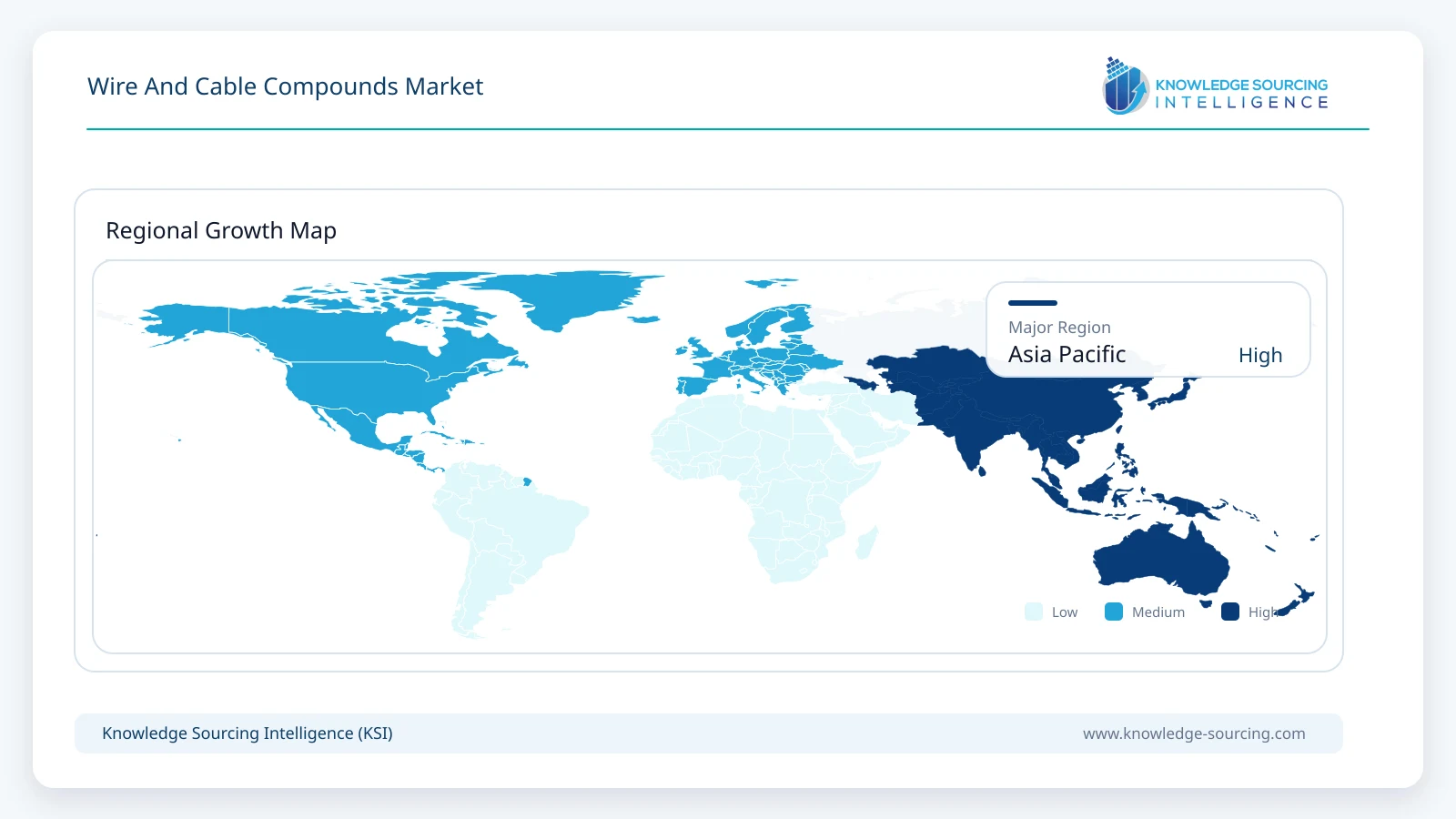
The commercial distinction within Asia Pacific is between commodity cable-volume growth and supplier localization for qualified compounds. Manufacturers serving price-sensitive regional distribution systems need competitive delivered resin and reliable transport. Conversely, exporters supplying high-voltage cables must meet international qualification requirements that may constrain the list of approved compound sources. Local expansions can shorten procurement cycles, but technical acceptance still determines access to the most demanding applications.
North America has a USD 2.74 billion market in 2026, supported by grid renewal and demand for advanced data-center and energy-network products. Europe is projected to reach USD 4.20 billion by 2032, with a 5.14% CAGR as regulated construction and infrastructure cable performance supports HFFR and tested materials. South America and the Middle East and Africa combine infrastructure upgrades with localized cable conversion; the latter is to grow at 7.41% annually through 2032 as specialist power projects enter commercial production.
Competitive Landscape
Competition spans integrated polymer suppliers and dedicated compound specialists. Borouge International, including the former Borealis business, and Dow compete in advanced polyolefin and high-voltage material systems. Alphagary, Teknor Apex, Ddev Plastiks, Avient, Melos and smaller regional compounders supply formulation-specific products across PVC, HFFR, elastomeric and specialty applications. Performance comparisons should be tied to actual product lines: a base-polymer producer, a masterbatch supplier and a finished cable manufacturer are not equivalent market participants.
Leading manufacturers compete on qualification history, compound cleanliness, extrusion consistency, low-smoke performance, local supply reliability and formulation support. Corporate consolidation and partnerships affect the ability to offer these capabilities across regions, while specialist compounders can maintain attractive positions in localized or technically demanding niches.
Recent Developments
August 2026: Hindalco commissioned a 30,000-tonne-per-year superfine aluminium trihydrate plant in India to supply halogen-free flame-retardant applications, including cables.
September 2026: Borouge confirmed first customer deliveries from its expanded XLPE plant after performance testing, adding 100,000 tonnes of annual cable-grade capacity.
September 2026: Borouge announced successful completion of performance testing and commercialization for the Borouge 4 XLPE facility serving medium- and high-voltage cable requirements.
April 2026: Teknor Apex and Shriram Polytech announced the PolyTek joint venture for advanced specialty polymer compounds in India.
March 2026: Dow introduced a qualified 525 kV HVDC XLPE insulation and semiconductive materials system for next-generation transmission cables.
Market Segmentation
The scope covers merchant-market sales of formulated cable-specific polymer compounds used in insulation, sheathing, jackets and semiconductive shields. Polymeric material transferred internally within integrated production is counted only when valued consistently at the compound transfer stage and not again in finished cable revenue. It excludes copper and aluminium conductors, raw unformulated general-purpose resins, cable equipment and finished cable systems.
By Compound Type: PVC compounds; XLPE compounds; non-crosslinked polyethylene and polypropylene; HFFR and LSZH compounds; elastomeric compounds including TPE, TPU and rubber; semiconductive and other specialty compounds. Fire-rated materials are classified in the HFFR category before base resin so that the material categories remain mutually exclusive.
By Function: Insulation; Sheathing and Jacketing; Semiconductive Shielding. By End-Use Industry: Power Transmission and Distribution; Building and Construction Wiring; Telecommunications and Data Centers; Automotive and EV; Industrial and Other. By Geography: North America; South America; Europe; Middle East and Africa; Asia Pacific.
Wire and Cable Compounds Market Scope:
| Report Metric | Details |
|---|---|
| Total Market Size in 2026 | USD 16.97 billion |
| Total Market Size in 2032 | USD 24.40 billion |
| Forecast Unit | Billion |
| Growth Rate | 6.23% |
| Study Period | 2021 to 2032 |
| Historical Data | 2021 to 2024 |
| Base Year | 2025 |
| Forecast Period | 2026 – 2032 |
| Segmentation | Compound Type, Function, End-Use Industry, Geography |
| Companies |
|
| Customization Scope | 15% Free Customization included with purchase — Request Custom Breakdown → |
| Sample & Data Access | PDF Sample, Excel Databook & Analyst Briefing — Download Free Sample → |
Market Segmentation
By Compound Type
PVC Compounds
XLPE Compounds
Non-crosslinked PE and PP Compounds
HFFR and LSZH Compounds
Elastomeric Compounds (TPE, TPU, Rubber)
Semiconductive and Other Specialty Compounds
By Function
Insulation
Sheathing and Jacketing
Semiconductive Shielding
By End-Use Industry
Power Transmission and Distribution
Building and Construction Wiring
Telecommunications and Data Centers
Automotive and EV
Industrial and Other
By Geography
North America
United States
Canada
Mexico
South America
Brazil
Argentina
Others
Europe
Germany
United Kingdom
France
Italy
Spain
Others
Middle East and Africa
Saudi Arabia
UAE
South Africa
Others
Asia Pacific
China
India
Japan
South Korea
Southeast Asia
Others
Table of Contents
1. INTRODUCTION
1.1. Market Definition and Scope
1.2. Research Methodology
1.3. Market Segmentation
1.4. Currency, Assumptions, Base and Forecast Years
2. EXECUTIVE SUMMARY
2.1. 2026–2032 Market Size and Growth
2.2. Strategic Findings and Commercial Implications
3. MARKET DYNAMICS
3.1. Drivers
3.1.1. Transmission and Distribution Investment
3.1.2. Fire-Safety and Low-Smoke Specifications
3.1.3. Electrification, Data Centers and Mobility
3.2. Restraints
3.2.1. Polymer and Additive Price Volatility
3.2.2. Qualification and Processing Constraints
3.3. Opportunities and Value Chain
3.4. Porter’s Five Forces
4. WIRE AND CABLE COMPOUNDS MARKET BY COMPOUND TYPE
4.1. PVC Compounds
4.2. XLPE Compounds
4.3. Non-crosslinked PE and PP Compounds
4.4. HFFR and LSZH Compounds
4.5. Elastomeric Compounds (TPE, TPU, Rubber)
4.6. Semiconductive and Other Specialty Compounds
5. WIRE AND CABLE COMPOUNDS MARKET BY FUNCTION
5.1. Insulation
5.2. Sheathing and Jacketing
5.3. Semiconductive Shielding
6. WIRE AND CABLE COMPOUNDS MARKET BY END-USE INDUSTRY
6.1. Power Transmission and Distribution
6.2. Building and Construction Wiring
6.3. Telecommunications and Data Centers
6.4. Automotive and EV
6.5. Industrial and Other
7. WIRE AND CABLE COMPOUNDS MARKET BY GEOGRAPHY
7.1. North America
7.1.1. United States
7.1.2. Canada
7.1.3. Mexico
7.2. South America
7.2.1. Brazil
7.2.2. Argentina
7.2.3. Others
7.3. Europe
7.3.1. Germany
7.3.2. United Kingdom
7.3.3. France
7.3.4. Italy
7.3.5. Spain
7.3.6. Others
7.4. Middle East and Africa
7.4.1. Saudi Arabia
7.4.2. UAE
7.4.3. South Africa
7.4.4. Others
7.5. Asia Pacific
7.5.1. China
7.5.2. India
7.5.3. Japan
7.5.4. South Korea
7.5.5. Southeast Asia
7.5.6. Others
8. COMPETITIVE ENVIRONMENT AND ANALYSIS
8.1. Major Players and Strategy Analysis
8.2. Product and Capacity Comparison
8.3. Partnerships, Investments and Developments
8.4. Competitive Dashboard
9. COMPANY PROFILES
9.1. Borouge International (including Borouge and former Borealis businesses)
9.2. The Dow Chemical Company
9.3. Orbia Polymer Solutions (Alphagary)
9.4. Teknor Apex Company
9.5. Ddev Plastiks Industries Limited
9.6. Avient Corporation
9.7. SACO AEI Polymers
9.8. Electric Cable Compounds Inc.
9.9. Melos GmbH
9.10. SCG Chemicals Public Company Limited
9.11. Hanwha Solutions Corporation
9.12. Shriram PolyTech / PolyTek
9.13. Trelleborg AB
9.14. ENEOS NUC Corporation
9.15. Shakun Polymers Private Limited
10. APPENDIX
10.1. Currency and Units
10.2. Definitions and Exclusions
10.3. Research Methodology
10.4. Assumptions and Data Sources
10.5. Abbreviations





Frequently asked questions
What is the projected market size for wire and cable compounds by 2032?
The Wire And Cable Compounds Market is projected to reach USD 24.40 billion by 2032.
What is the forecast CAGR for the Wire And Cable Compounds Market?
The Wire And Cable Compounds Market is growing at a 6.23% CAGR during the 2026–2032 forecast period.
Which material segment holds the largest market revenue share in 2026?
PVC compounds account for 31.5% of 2026 market revenue.
Which compound type is projected for the fastest growth?
HFFR/LSZH compounds are projected to expand at a 9.43% CAGR.
What is a key trend in the Wire And Cable Compounds Market?
Grid investment shifts value toward qualified insulation systems.
What drives the growth of HFFR/LSZH compounds?
Low-smoke, halogen-free specifications in transport, public buildings, and data centers.
Cite this report
Knowledge Sourcing Intelligence. (Oct 2026). Wire And Cable Compounds Market - Strategic Insights and Forecasts (2026-2032). https://www.knowledge-sourcing.com/report/wire-and-cable-compounds-market