BlogMarch 22, 2024•8 min read
LED Lights Illuminating the Future of Farming
Executive Summary & Key Takeaways
Increased illumination is ideal for agricultural situations. LED grow lights are one means of providing artificial illumination to farms. They utilize less energy and, as a result, this industry is commonly known as the LED grow lights or agricultural lights market. LED lights are highly energy-e...
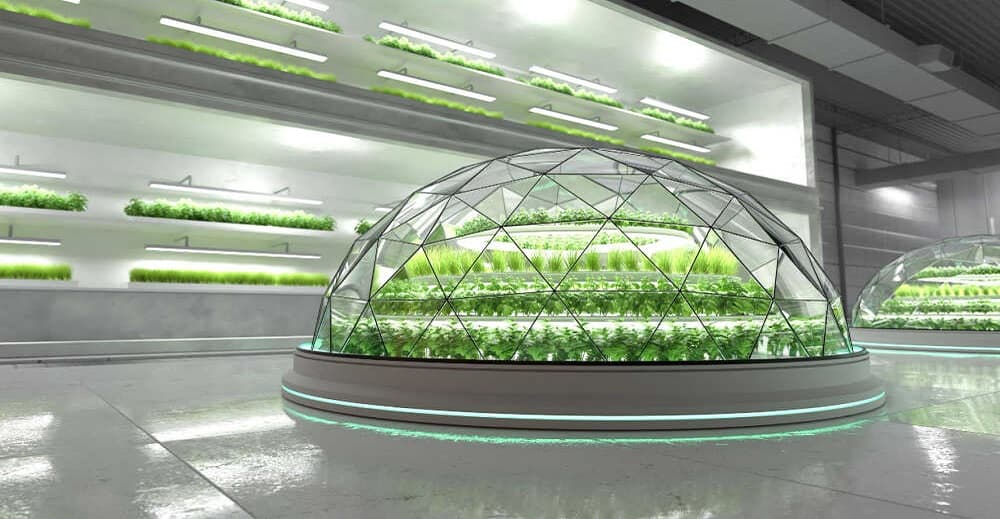
Increased illumination is ideal for agricultural situations. LED grow lights are one means of providing artificial illumination to farms. They utilize less energy and, as a result, this industry is commonly known as the LED grow lights or agricultural lights market.
LED lights are highly energy-efficient compared to traditional lighting sources such as incandescent or fluorescent bulbs. They produce more light per watt of electricity consumed, resulting in lower energy costs and reduced environmental impact.
These lights allow growers to customize the spectrum of light emitted, which can be tailored to meet the specific needs of different plant species and growth stages. By adjusting the light spectrum, growers can optimize plant growth, improve crop yields, and enhance the quality of produce.
These lights also help prolong regular agricultural hours beyond daylight hours, increasing production. They have applications in four types of farming: vertical farming, indoor farming, commercial greenhouses, and turf and landscaping. Because of their plastic covering, LED grow lights are more durable than traditional light bulbs.
LED lighting is particularly well-suited for indoor farming, including vertical farming, hydroponics, and aeroponics. It allows growers to control light intensity, spectrum, and duration to optimize plant growth regardless of external conditions.
The adoption of ecologically friendly procedures for fruits and vegetables, as well as growing food product demand, are the primary drivers of market growth. Controlled environments in LED farming help reduce the incidence of pests and diseases, thereby minimizing the need for chemical pesticides. This contributes to healthier, more sustainable agricultural practices and reduces the risk of pesticide residues in the final product.
The market is also growing as a result of more urban gardening, vertical farming, and consumer acceptance of ecologically friendly fruit and vegetable production. The global population is rising at an unprecedented rate, which has raised the demand for urban agriculture.
Additionally, the sector is rising due to vertical farming, which includes producing food in a vertically stacked layer within an abandoned skyscraper, warehouse, or shipping container. LED farming is particularly suitable for urban agriculture initiatives, where land availability is limited, and there is a growing demand for locally grown, fresh produce. By utilizing indoor spaces such as warehouses, shipping containers, or vacant buildings, urban farmers can produce food closer to consumers, reducing transportation costs and carbon emissions.
The effectiveness of new LEDs continues to climb, but it has to increase by around 30% by 2030 to correspond with the Net Zero Scenario. LEDs have become more efficient than any other commercially viable option. Improved LED modules or continual optics upgrades might accomplish additional gains. Because LEDs operate on direct current, direct current grids can decrease conversion losses.
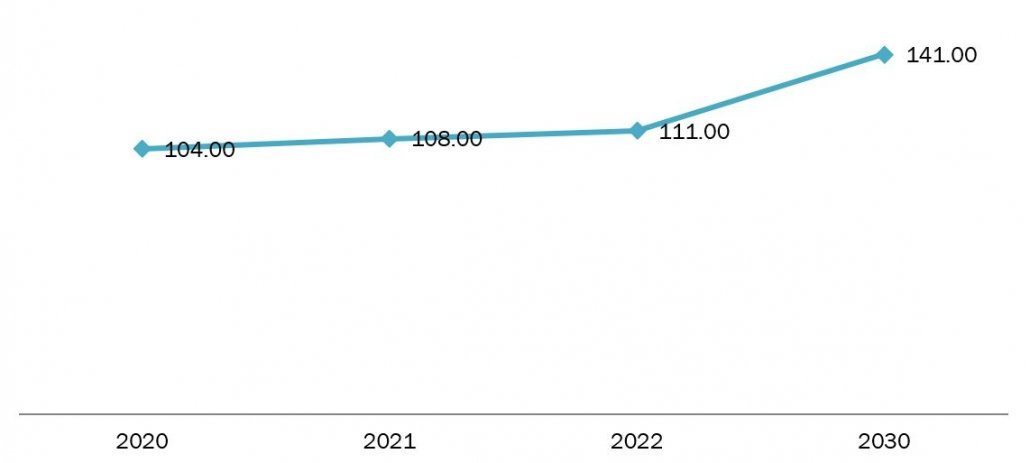
LED efficiency has increased dramatically in recent years, with household LEDs often achieving effectiveness levels of more than 100 lm/W. Since 2010, average efficacy has grown by around 4 lm/W every year. The best-in-class technologies produce more than 200 lm/W but are more costly. New LEDs must achieve 140 lm/W by 2030 to meet the Net Zero Scenario, which is 30% higher than the 2022 average.
Increased lighting efficacy by technology in the net zero scenarios due to increased demand for efficient lighting options especially LED lighting across the globe from 2020 to 2022 is as follows: 104 lumens/watt in 2020, 108 lumens/watt in 2021, and 111 lumens/watt in 2022 which expected to reach 141 lumens/watt by 2030.
Figure 1: Lighting Efficacy by Technology in the Net Zero Scenario Lumens/Watt, 2020-2030
 Source: International Energy Agency
The rising use of controlled environment agriculture, which includes vertical farming and indoor farming, has significantly increased demand for LED agricultural goods. Another element leading to rising demand is the world's growing population. The need for agricultural produce will expand exponentially as the population grows.
LED farming enables growers to create ideal growing conditions by controlling factors such as temperature, humidity, and light intensity. This level of control is particularly beneficial for crops that are sensitive to environmental fluctuations or require precise growing conditions.
However, with limited land resources, alternative farming methods, such as vertical and indoor farming, are needed. These methods use smaller sections of farmed land, including indoor farms, to create a larger crop. LED farming is well-suited for indoor or vertical farming systems where space is limited. By utilizing vertical stacking or compact layouts, growers can maximize the use of available space and increase crop yields per square foot.
LED lights contribute to improving the quality and quantity of such harvests by improving energy efficiency, increasing visibility and durability, and lowering long-term expenses. Cannabis is one such plant that is mostly produced in controlled environments, and the legalization of cannabis in many nations will increase demand for LED lights for farming purposes. As a result of such efforts, key enterprises in this industry have increased their income in recent years.
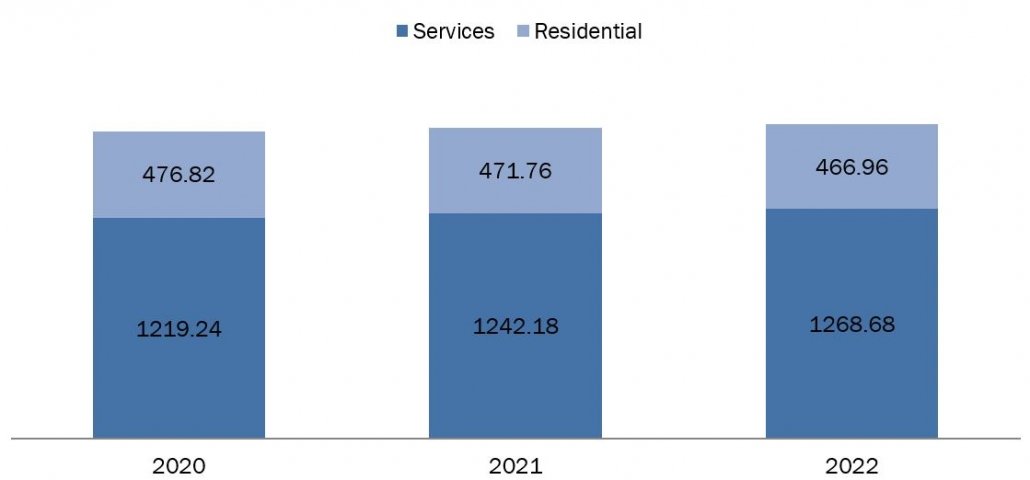
According to data from the International Energy Agency, global electricity consumption in lighting in the net zero scenario services has increased from 1219.24 TWh in 2020 and 1242.18 TWh in 2021 to 1268.68 TWh in 2022 while for the residential it decreased from 476.82 TWh in 2020 and 471.76 TWh in 2021 to 466.96 TWh in 2022.
Figure 2: Global Electricity Consumption in Lighting in the Net Zero Scenario in Twh, 2020-2022
Source: International Energy Agency
The rising use of controlled environment agriculture, which includes vertical farming and indoor farming, has significantly increased demand for LED agricultural goods. Another element leading to rising demand is the world's growing population. The need for agricultural produce will expand exponentially as the population grows.
LED farming enables growers to create ideal growing conditions by controlling factors such as temperature, humidity, and light intensity. This level of control is particularly beneficial for crops that are sensitive to environmental fluctuations or require precise growing conditions.
However, with limited land resources, alternative farming methods, such as vertical and indoor farming, are needed. These methods use smaller sections of farmed land, including indoor farms, to create a larger crop. LED farming is well-suited for indoor or vertical farming systems where space is limited. By utilizing vertical stacking or compact layouts, growers can maximize the use of available space and increase crop yields per square foot.
LED lights contribute to improving the quality and quantity of such harvests by improving energy efficiency, increasing visibility and durability, and lowering long-term expenses. Cannabis is one such plant that is mostly produced in controlled environments, and the legalization of cannabis in many nations will increase demand for LED lights for farming purposes. As a result of such efforts, key enterprises in this industry have increased their income in recent years.
According to data from the International Energy Agency, global electricity consumption in lighting in the net zero scenario services has increased from 1219.24 TWh in 2020 and 1242.18 TWh in 2021 to 1268.68 TWh in 2022 while for the residential it decreased from 476.82 TWh in 2020 and 471.76 TWh in 2021 to 466.96 TWh in 2022.
Figure 2: Global Electricity Consumption in Lighting in the Net Zero Scenario in Twh, 2020-2022
 Source: International Energy Agency
The rising adoption of vertical farming, which allows farmers to plant crops in a controlled environment with less water and no soil, is one of the important factors driving the LED farming industry. Vertical farming relies heavily on LED lighting since it delivers the appropriate light spectrum for plant development.
The increased use of smart lighting systems allows farmers to monitor and regulate lighting settings remotely to increase production and efficiency. With the introduction of vertical farming, light-emitting diode (LED) technology has undergone a revolutionary shift.
With the introduction of low-cost and effective LED lighting pushing the agricultural technology industry, Controlled Environment Agriculture (CEA) has witnessed a rapid change from focusing solely on high-value crops like cannabis to various crops such as microgreens and vegetables.
In July 2022, Crop One, Emirate, inaugurated Dubai's "world's largest vertical farm." The roughly 330,000-square-foot complex is located in Dubai, United Arab Emirates, near Al Maktoum International Airport and Dubai World Central. It can produce more than 2 million pounds of leafy greens every year. ECO 1 will focus on expanding supply chain constraints and food security concerns while also educating millions of new customers about the benefits of vertically farmed produce.
Energy efficiency is presently receiving considerable worldwide emphasis from policymakers, who see its importance in improving energy security and affordability, as well as speeding up renewable energy transitions.
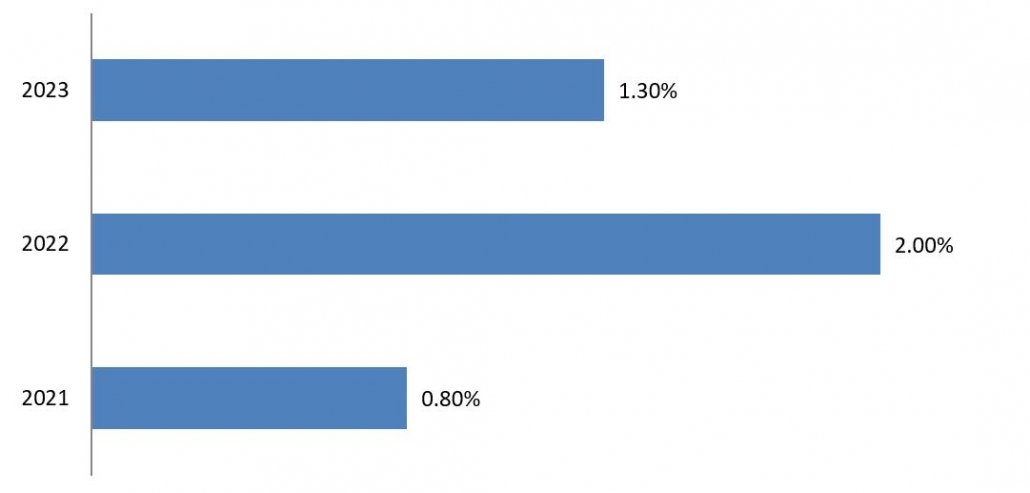
However, the predicted 2023 rate of development in energy intensity - the primary parameter used to assess the world economy's energy efficiency is 1.3% from a robust 2% the previous year. The lower rate of energy intensity improvement is mostly due to a 1.7% rise in energy demand in 2023, up from 1.3% the previous year.
Figure 3: Global Annual Primary Energy Intensity Improvement in Percentage, 2021-2023
Source: International Energy Agency
The rising adoption of vertical farming, which allows farmers to plant crops in a controlled environment with less water and no soil, is one of the important factors driving the LED farming industry. Vertical farming relies heavily on LED lighting since it delivers the appropriate light spectrum for plant development.
The increased use of smart lighting systems allows farmers to monitor and regulate lighting settings remotely to increase production and efficiency. With the introduction of vertical farming, light-emitting diode (LED) technology has undergone a revolutionary shift.
With the introduction of low-cost and effective LED lighting pushing the agricultural technology industry, Controlled Environment Agriculture (CEA) has witnessed a rapid change from focusing solely on high-value crops like cannabis to various crops such as microgreens and vegetables.
In July 2022, Crop One, Emirate, inaugurated Dubai's "world's largest vertical farm." The roughly 330,000-square-foot complex is located in Dubai, United Arab Emirates, near Al Maktoum International Airport and Dubai World Central. It can produce more than 2 million pounds of leafy greens every year. ECO 1 will focus on expanding supply chain constraints and food security concerns while also educating millions of new customers about the benefits of vertically farmed produce.
Energy efficiency is presently receiving considerable worldwide emphasis from policymakers, who see its importance in improving energy security and affordability, as well as speeding up renewable energy transitions.
However, the predicted 2023 rate of development in energy intensity - the primary parameter used to assess the world economy's energy efficiency is 1.3% from a robust 2% the previous year. The lower rate of energy intensity improvement is mostly due to a 1.7% rise in energy demand in 2023, up from 1.3% the previous year.
Figure 3: Global Annual Primary Energy Intensity Improvement in Percentage, 2021-2023
 Source: International Energy Agency
Demand for urban horticulture and vertical farming is predicted to increase in the next years as the population grows and ecologically friendly fruit and vegetable production becomes more popular. Due to a lack of arable land and population expansion, the business may profit from growing knowledge of alternative farming.
LED farming is the most recent technology in the agriculture industry, providing low-cost client solutions and installation. Agricultural lighting is currently in high demand for applications such as urban farming, supplementary illumination, and daylight agriculture.
Greenhouse farming is becoming increasingly popular, as it employs LED lighting to supplement natural light and provide plants with the entire spectrum of light they require to develop. The cost of LED lighting systems for greenhouse farming is determined by the greenhouse's size and the level of customization required.
LED lighting systems for indoor farming are normally more expensive than greenhouse farming, but they can provide considerable long-term cost savings due to their better production potential and increased energy efficiency.
In conclusion, the LED farming business offers considerable prospects for innovation, investment, and growth as agriculture shifts towards more sustainable and efficient techniques. However, market dynamics, technology improvements, and regulatory issues will continue to influence its course in the coming years.
Table 1: Key Developments
Source: International Energy Agency
Demand for urban horticulture and vertical farming is predicted to increase in the next years as the population grows and ecologically friendly fruit and vegetable production becomes more popular. Due to a lack of arable land and population expansion, the business may profit from growing knowledge of alternative farming.
LED farming is the most recent technology in the agriculture industry, providing low-cost client solutions and installation. Agricultural lighting is currently in high demand for applications such as urban farming, supplementary illumination, and daylight agriculture.
Greenhouse farming is becoming increasingly popular, as it employs LED lighting to supplement natural light and provide plants with the entire spectrum of light they require to develop. The cost of LED lighting systems for greenhouse farming is determined by the greenhouse's size and the level of customization required.
LED lighting systems for indoor farming are normally more expensive than greenhouse farming, but they can provide considerable long-term cost savings due to their better production potential and increased energy efficiency.
In conclusion, the LED farming business offers considerable prospects for innovation, investment, and growth as agriculture shifts towards more sustainable and efficient techniques. However, market dynamics, technology improvements, and regulatory issues will continue to influence its course in the coming years.
Table 1: Key Developments
Source: Knowledge Sourcing Intelligence Analysis
Source: International Energy Agency
The rising use of controlled environment agriculture, which includes vertical farming and indoor farming, has significantly increased demand for LED agricultural goods. Another element leading to rising demand is the world's growing population. The need for agricultural produce will expand exponentially as the population grows.
LED farming enables growers to create ideal growing conditions by controlling factors such as temperature, humidity, and light intensity. This level of control is particularly beneficial for crops that are sensitive to environmental fluctuations or require precise growing conditions.
However, with limited land resources, alternative farming methods, such as vertical and indoor farming, are needed. These methods use smaller sections of farmed land, including indoor farms, to create a larger crop. LED farming is well-suited for indoor or vertical farming systems where space is limited. By utilizing vertical stacking or compact layouts, growers can maximize the use of available space and increase crop yields per square foot.
LED lights contribute to improving the quality and quantity of such harvests by improving energy efficiency, increasing visibility and durability, and lowering long-term expenses. Cannabis is one such plant that is mostly produced in controlled environments, and the legalization of cannabis in many nations will increase demand for LED lights for farming purposes. As a result of such efforts, key enterprises in this industry have increased their income in recent years.
According to data from the International Energy Agency, global electricity consumption in lighting in the net zero scenario services has increased from 1219.24 TWh in 2020 and 1242.18 TWh in 2021 to 1268.68 TWh in 2022 while for the residential it decreased from 476.82 TWh in 2020 and 471.76 TWh in 2021 to 466.96 TWh in 2022.
Figure 2: Global Electricity Consumption in Lighting in the Net Zero Scenario in Twh, 2020-2022
Source: International Energy Agency
The rising adoption of vertical farming, which allows farmers to plant crops in a controlled environment with less water and no soil, is one of the important factors driving the LED farming industry. Vertical farming relies heavily on LED lighting since it delivers the appropriate light spectrum for plant development.
The increased use of smart lighting systems allows farmers to monitor and regulate lighting settings remotely to increase production and efficiency. With the introduction of vertical farming, light-emitting diode (LED) technology has undergone a revolutionary shift.
With the introduction of low-cost and effective LED lighting pushing the agricultural technology industry, Controlled Environment Agriculture (CEA) has witnessed a rapid change from focusing solely on high-value crops like cannabis to various crops such as microgreens and vegetables.
In July 2022, Crop One, Emirate, inaugurated Dubai's "world's largest vertical farm." The roughly 330,000-square-foot complex is located in Dubai, United Arab Emirates, near Al Maktoum International Airport and Dubai World Central. It can produce more than 2 million pounds of leafy greens every year. ECO 1 will focus on expanding supply chain constraints and food security concerns while also educating millions of new customers about the benefits of vertically farmed produce.
Energy efficiency is presently receiving considerable worldwide emphasis from policymakers, who see its importance in improving energy security and affordability, as well as speeding up renewable energy transitions.
However, the predicted 2023 rate of development in energy intensity - the primary parameter used to assess the world economy's energy efficiency is 1.3% from a robust 2% the previous year. The lower rate of energy intensity improvement is mostly due to a 1.7% rise in energy demand in 2023, up from 1.3% the previous year.
Figure 3: Global Annual Primary Energy Intensity Improvement in Percentage, 2021-2023
Source: International Energy Agency
Demand for urban horticulture and vertical farming is predicted to increase in the next years as the population grows and ecologically friendly fruit and vegetable production becomes more popular. Due to a lack of arable land and population expansion, the business may profit from growing knowledge of alternative farming.
LED farming is the most recent technology in the agriculture industry, providing low-cost client solutions and installation. Agricultural lighting is currently in high demand for applications such as urban farming, supplementary illumination, and daylight agriculture.
Greenhouse farming is becoming increasingly popular, as it employs LED lighting to supplement natural light and provide plants with the entire spectrum of light they require to develop. The cost of LED lighting systems for greenhouse farming is determined by the greenhouse's size and the level of customization required.
LED lighting systems for indoor farming are normally more expensive than greenhouse farming, but they can provide considerable long-term cost savings due to their better production potential and increased energy efficiency.
In conclusion, the LED farming business offers considerable prospects for innovation, investment, and growth as agriculture shifts towards more sustainable and efficient techniques. However, market dynamics, technology improvements, and regulatory issues will continue to influence its course in the coming years.
Table 1: Key Developments
| Year | Development |
| November 2023 | AMS OSRAMMED introduced its OSTAR® Projection Compact LED family with red, green, and blue colors, boosting its high-powered illumination capabilities. These LEDs, with their high current density and brightness, were perfect for high-power lighting applications. The True Green variant shines the brightest at 520 nm and provides 1000 lm at 6 a. |
| April 2022 | California LightWorks, a leading manufacturer of horticultural lighting systems, announced today that Nipomo aG, a licensed 70,000-square-foot cannabis greenhouse in San Luis Obispo County, had implemented the latest MegaDrive LED system. Nipomo Ag switched from cultivating roses to cannabis some years ago. The firm realized that to compete in the market, particularly during the winter months, it needed to install high-tech supplementary lighting. |
Get in Touch
Interested in this topic? Contact our analysts for more details.
Related Insights

Which OSAT Companies Are Best Positioned for AI and HPC Chip Demand?
Jun 29, 2026
Wearable Health Devices and Their Role in Modern Healthcare
Jun 11, 2026
Beyond the Glass: The Decisive Transition to Computational Tissue Intelligence
May 25, 2026
Companion Diagnostics for Targeted Therapies Market: The U.S. Edge In Personalized Medicine
May 21, 2026
Clinical Decision Support Diagnostic Systems Market: Why the U.S. Healthcare System Is Quietly Rebuilding Diagnosis Around Algorithms
May 19, 2026