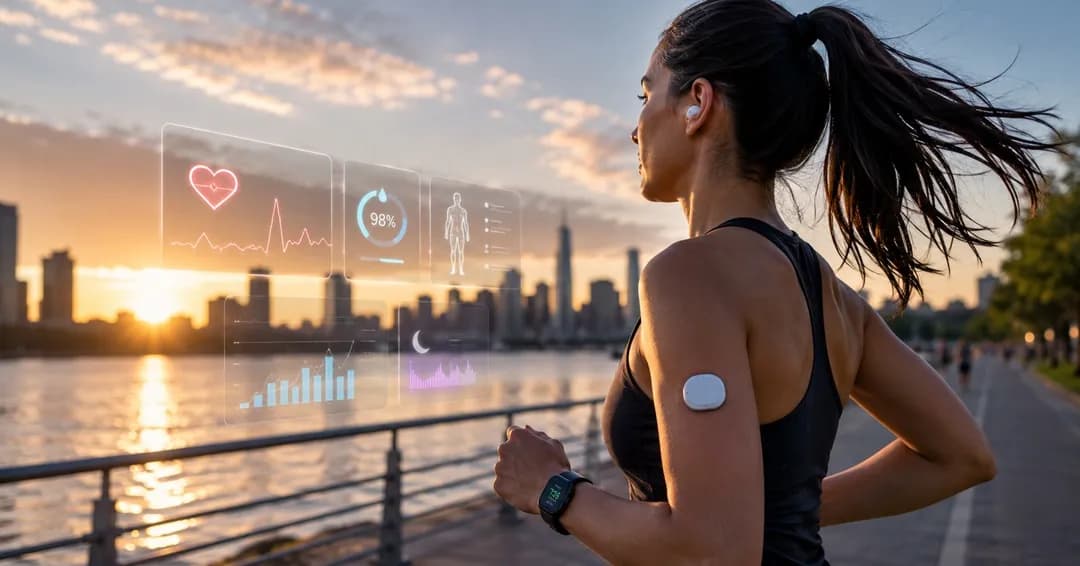
The wearable health tracking market is evolving beyond consumer electronics into a clinically integrated healthcare ecosystem. Continuous bio-telemetry, AI-driven analytics, and regulatory support are enabling preventive care, decentralized clinical trials, and remote patient monitoring. As healthcare shifts toward value-based models, wearable technologies are becoming essential tools for personalized medicine.
The structural shift occurring within global medical technology is often obscured by the consumer electronics narrative surrounding wearable devices. While market expansion continues to attract investment and innovation, focusing solely on device adoption or hardware advancements overlooks the more significant transformation underway. The true evolution lies in data liquidity the conversion of consumer-facing wearables into clinically relevant, continuously connected health-monitoring systems. These devices are increasingly functioning as validated data nodes within a decentralized healthcare ecosystem, enabling real-time monitoring, preventive care, and more personalized medical interventions beyond traditional clinical settings.
For decades, medicine operated on a episodic, reactive framework; a patient was evaluated only when symptomatic, generating isolated clinical data points within the walls of a hospital. The current expansion reflects a structural migration toward continuous, ambient bio-telemetry. This paradigm shift addresses the fundamental economic vulnerabilities of modern health systems by restructuring chronic disease management, reducing hospital readmissions, and rewriting the economics of clinical trials on a global scale.
The U.S. Healthcare Crucible: Driving Clinical Integration
The consumer adoption of medical technology is expected to be high across the Asia Pacific markets as well as the European market, but till date, the United States represents to be one of the primary highest-grossing clinically integrated variable development regions. Variable technology in the United States is related to its direct structural response to the regulatory frameworks which governs the American healthcare as well as the distinct financial pressures.
The system of the United States operates under an unsustainable cost burden, which results in the spending of nearly 18% of it's GDP on healthcare while also delivering a high variable clinical outcome. The friction created to do this unsustainable cost burden has forced a systematic migration away from the traditional fee-for-service payment models towards a model which focuses on value-based care frameworks.
Under these risk-bearing structures, accountable care organizations (ACOs) and commercial payers are financially penalized for clinical failures, such as preventable hospital readmissions or poorly managed chronic diseases.
Consequently, continuous physiological monitoring has shifted from a novel digital health experiment to a core operational necessity. In real time, when a health system can utilize bio telemetry to identify the early signs of fluid retention in a heart failure patient, someone who also lives very far from the United States, and then this helps the system can also intervene with a simple adjustment to their outpatient medication. This proactive approach adopted by the country may prevent an expensive emergency department admission and also preserve the health systems operating margin.
The introduction and expansion of dedicated reimbursement codes for Remote Physiological Monitoring (RPM) and Remote Therapeutic Monitoring (RTM) have fundamentally changed the financial viability of these technologies. In this regard, the physicians I'm not at all expected to review the continuous patient data lines; instead, they can explicitly build for the setup, time spent for reviewing transmitted biometric data each month and also for device supply.
Furthermore, the federal government has also created a predictable recurring revenue stream for digital health platforms by institutionalizing continuous monitoring within the standard medical bill framework. This regulatory shift is one of the major reasons for enterprise procurement of medical-grade variables far beyond the traditional consumer retail channels.
Concurrently, the U.S. Food and Drug Administration (FDA) has streamlined its approach to software-as-a-medical-device (SaMD), establishing clearer, standardized pathways for algorithmic diagnostics running on consumer hardware. The clearance of advanced wearable features such as photoplethysmography (PPG) algorithms for atrial fibrillation detection, nocturnal oximetry tracking, and non-invasive bio-impedance analysis has effectively narrowed the historical gap between consumer gadgets and regulated medical machinery.
The modern wrist-worn or ring-form device is no longer just a passive pedometer. It functions as an ambulatory electrocardiogram, a continuous pulse oximeter, and a predictive tool for metabolic and cardiovascular anomalies.
Corporate Spotlights: Institutionalizing Innovation
The structural transformation of the U.S. wearable health market is best understood by analyzing the operational strategies of key domestic companies. These organizations have successfully transitioned from consumer-centric hardware sales to enterprise-grade, data-driven healthcare platforms.
Apple Inc. (Cupertino, California)
Apple has systematically leveraged its vast consumer hardware footprint to build an authoritative position within clinical research and decentralized patient care. Operating from Cupertino, California, the company has transformed the Apple Watch from a luxury smartphone companion into a highly sophisticated, FDA-cleared clinical screening tool.
Apple has efficiently shifted the focus to large-scale institutional integration, rather than limiting its focus to individual consumer subscriptions. The company has also efficiently embedded a deep compatibility with the electronic health record system via standardized FIHR (Fast Healthcare Interoperability Resources) APIs, which allows Apple users to seamlessly share biometric data directly with their primary care networks.
Dexcom, Inc. (San Diego, California)
Headquartered in San Diego, California, Dexcom Has worked efficiently in redefining the management paradigm for metabolic disease through its major continuous glucose monitoring architectures.
The company’s core innovation revolves around shifting diabetes care away from episodic fingerstick measurements which are invasive towards the one which are continuous and are in real time interstitial glucose telemetry. Additionally, the company has also focused on its strategic initiatives expansion of its market presence beyond traditional type 1 diabetes management towards the one with the broader type 2 diabetes and metabolic health sector.
WHOOP, Inc. (Boston, Massachusetts)
Operating out of Boston, Massachusetts, WHOOP has taken a distinct approach to bio-telemetry by deliberately omitting a digital screen on its wearable device. This step, adapted by the company, plays a major role in minimizing user distraction while on the other hand maximizing sensor optimization as well as data collection efficiency. The company's analytical focus centers on one of the complex relationships between sleep architecture, systemic recovery and autonomic nervous system strain. Additionally, high-frequency heart rate variability calculations are utilized efficiently by the company along with continuous resting heart rate metrics which are responsible and generating a high actionable physiological profile.
WHOOP has also aggressively scaled its business model into a corporate wellness program, which is extremely popular among military units and elite athletic organizations. With this, the company's primary market advantage is its high retention subscription model worships consumer focus to continuous, algorithmically generated health insights. Additionally, the company also provides enterprise partners with a validated tool to track the population health trajectories while optimizing human performance metrics.
Oura Health Inc. (San Francisco, California)
Though originating with Finnish design roots, Oura has centered its corporate growth, enterprise partnerships, and clinical validation strategies within San Francisco, California. The company has pioneered the consumer smart ring category, demonstrating that highly accurate bio-telemetry can be delivered from a minimal, non-intrusive finger form factor. Oura leverages the digital arteries in the finger, which offer a significantly stronger, cleaner PPG signal pulse than the capillaries in the wrist. This approach enables highly accurate tracking of resting heart rate, HRV, blood oxygen levels, and minute variations in skin temperature.
The strategic expansion of the company has efficiently focused on reproductive health, Sleep Medicine virtualization as well as early illness detection. Furthermore, the company has also partnered with multiple organizations like major clinical research institutions and WNBA, which has proved that subtle deviations in cardiovascular strain baseline skin temperature can actually serve as early indicators of viral onset or hormonal shifts. With their efficient integration directly into the corporate wellness ecosystem, the company provides a high-compliance alternative which captures clean and continuous physiological baselines over multi-year periods.
Market Configurations and Urban Innovation Hubs
The deployment of these technologies requires highly specialized hardware and software engineering talent. This demand has led to the formation of distinct geographic innovation clusters across the United States. Each region focuses on a specific aspect of the broader wearable technology ecosystem.
Parent Company | Primary Innovation Center | Core Product Name | Primary Bio-Telemetry Modality | Enterprise Ecosystem Alignment |
Apple Inc. | Cupertino, California | Apple Watch Series / Ultra | Multi-wavelength PPG, Electrical Biosensor (ECG), Skin Temperature | Direct EHR integration via FHIR APIs, Institutional Longitudinal Studies |
Dexcom, Inc. | San Diego, California | Dexcom G7 / Stelo | Interstitial Enzymatic Glucose Sensing | Automated Insulin Delivery (AID) loops, Commercial Payer Value Contracts |
WHOOP, Inc. | Boston, Massachusetts | WHOOP Strap 4.0 | High-frequency PPG, 3-Axis Accelerometer + Gyroscope | Enterprise Behavioral Analytics, Corporate Wellness, Military Readiness |
Oura Health Inc. | San Francisco, California | Oura Ring Gen3 | Infrared PPG, Digital Temperature Sensors, Accelerometer | Virtualized Research Triaging, FemTech Monitoring, Sleep Medicine Channels |
Deconstructing the Technical Stack: Sensor Evolution and Edge Computing
The projected growth of the wearable market cannot be achieved through iterative software updates alone; it requires a fundamental evolution of the underlying physical sensor architectures. The industry is rapidly moving past basic optical heart rate monitoring toward advanced multi-wavelength spectroscopy and electrochemical analysis.
What are the major hurdles in the consumer world wearables market has been the artifact noise along with the corruption which happens in biometric signals, that are caused by the user's physical movement, along with the poot skin-to-sensor contact and changes in ambient lighting. In order to resolve these issues, that is a requirement of the shift from simple green light PPG configurations to the advanced arrays that are essential in combining red, infrared and amber wavelengths. This is known as a multispectral approach, which is adopted with the motive of alarm devices to penetrate deeper into the subdermal tissue layers for a better reading.
Simultaneously, the industry is investing heavily in microfluidic and electrochemical sensing mechanisms. Continuous glucose monitoring platforms paved the way by using glucose oxidase enzymes immobilized on tiny, subcutaneous wire arrays to generate an electrical current proportional to interstitial glucose concentrations. The next frontier involves applying this electrochemical approach to non-invasive, surface-level sweat analysis.
Strategic Implications for Clinical Trials and Decentralized Research
Beyond standard patient care, continuous bio-telemetry is fundamentally reorganizing the economics of clinical pharmaceutical development. Traditional clinical trials are notoriously slow, expensive, and logistically rigid. They depend heavily on participants making frequent, in-person visits to specialized academic medical centers for physical evaluations.
These strategic implications are a result of a significant selection bias, which typically attracts healthier and more urban demographics who have the resources and the time to travel to physical travel sites. Additionally, episodic in-office assessments are regarded to be highly vulnerable as the patient's blood pressure spikes simply do you do the stress of being present in a clinical environment.
Pharmaceutical sensors are shifting towards a decentralized clinical trial with the integration of medical-grade variables. Trial coordinators are able to monitor physiological responses continuously in real-world environments by the deployment of validated sensors. This transition significantly expands the geographic and demographic reach of recruitment efforts, allowing individuals from rural or historically underserved communities to participate without disrupting their daily routines.
Trial Dimension | Traditional Centralized Model | Decentralized Wearable Model (DCT) |
Participant Recruitment Reach | Limited to urban areas near major academic medical centers | Nationally distributed; accessible to rural and underserved populations |
Data Collection Frequency | Episodic; isolated snapshots captured during monthly clinic visits | Continuous; ambient bio-telemetry streamed 24/7 in real-world settings |
Data Integrity & Realism | High risk of confounding anomalies (e.g., white-coat hypertension) | Reflects actual lifestyle baselines and true circadian variations |
Patient Retention Rates | Lower; driven by travel fatigue and logistical friction | Higher; passive tracking minimizes disruption to daily routines |
Continuous tracking these days are replacing subjective, patient-reported outcomes with the ones which are objective and are of high fidelity data. Researchers these days are using wrist-worn accelerometers which are efficient in precisely measuring micro mobility, sleep disruption patterns throughout the night that of asking a patient with rheumatoid arthritis to qualitatively rate their morning stiffness on a scale of 1 to 10.
Additionally, in regard of cardiovascular trials, investigators are continuously analyzing a participant's real-world submaximal heart rate kinetic and walking efficiency over several months instead of just relying on a single in-office 6-minute walk test. Overall, this results in the continuous data collection which is important as it provides superior statistical power, allowing researchers in identifying subtle therapeutic benefits
Overcoming Structural Hurdles: Interoperability, Security, and Data Overload
Despite clear economic incentives, the widespread adoption of wearable health devices faces significant operational challenges. The most critical issue is data fragmentation and the lack of standardization across different technology providers.
In recent times, the ecosystem of digital health is being divided among closed proprietary platforms which use different and distinct API structure as well as siloed cloud storage architectures.
This interoperability challenge is further complicated by stringent data privacy and cybersecurity regulations, particularly under the Health Insurance Portability and Accountability Act (HIPAA). Consumer wearables capture highly sensitive, continuous lifestyle data that goes far beyond traditional medical records, mapping out detailed sleep schedules, location histories, and daily behavioral choices. This comprehensive tracking creates an incredibly high-value target for cybercriminals.
If a digital health platform suffers a data breach, it exposes more than just basic static identifiers; it compromises a continuous, real-world map of a user's biological life. Securing this infrastructure requires technology vendors to move away from standard password authentication and toward robust end-to-end encryption frameworks. This includes implementing zero-trust network architectures, hardware-isolated cryptographic enclaves, and strict tokenized access protocols for all shared health data.
Finally, the sheer volume of continuous biometric data poses a significant challenge to the medical workforce. Frontline clinicians are already facing historic levels of operational burnout and administrative fatigue. They do not have the time or the desire to review thousands of individual data points or raw heart rate charts for every patient in their practice. If a wearable platform simply dumps raw data into a hospital's workflow, it will be quickly ignored by busy clinical staff.
To overcome this, digital health platforms must invest heavily in advanced algorithmic triaging layers. These systems use specialized AI networks to analyze raw biometric data streams, filtering out normal everyday variations and presenting clinicians with highly distilled, actionable insights.
A physician should only be alerted when a patient's data indicates a true clinical anomaly such as a sustained trend of cardiac decoupling or a dangerous, multi-day rise in baseline skin temperature. By transforming massive data streams into clear, actionable clinical alerts, wearables can protect clinician workflows while delivering on the promise of proactive, preventative medicine.
The Analyst's Verdict: Navigating the $118 Billion Landscape
The projected expansion of the wearable health tracking market to US$118.226 billion by 2030 represents a fundamental reconfiguration of medical delivery channels. In this regard, the market will separated into two distinct operational tiers, a low-margin commodity tier focused on basic consumer lifestyle tracking and a high-margin enterprise tier characterized by deep clinical validation, robust regulatory clearance, and direct integration into value-based healthcare systems.
For technology providers, institutional investors, and healthcare administrators, navigating this changing landscape requires moving past standard hardware metrics. The long-term value of these platforms does not reside in the physical device worn on the wrist or finger; it is held entirely within the algorithmic and software layers that translate raw, noisy sensor data into actionable, medically validated insights.
As healthcare systems face escalating financial pressures and shifting demographic demands, the organizations that successfully deploy interoperable, secure, and highly automated bio-telemetry platforms will lead the transition toward a truly preventative, decentralized model of global medicine.
Have questions?
More Blogs
Top U.S. Healthcare Industry Trends to Watch in 2026 for the Global Healthcare Market
The global healthcare industry in 2026 is shifting toward AI-driven efficiency, stronger cybersecurity, outpatient care expansion, and domestic pharmaceutical manufacturing. U.S. healthcare leaders are prioritizing workforce support, operational resilience, value-based care, and integrated digital systems to improve patient outcomes while controlling costs.
How AI Is Reshaping the American Healthcare Industry
The U.S. healthcare industry is rapidly integrating artificial intelligence across clinical, administrative, and pharmaceutical operations. AI is improving diagnostics, automating workflows, reducing clinician burden, accelerating drug discovery, and enhancing personalized care. With strong adoption by hospitals and tech companies, AI is transforming healthcare delivery while driving the U.S. AI healthcare market toward significant growth by 2031.
Top Companies Leading the Silicon-Based Capacitor Revolution
Introduction: The Rise of Silicon-Based Capacitors: Electronic circuits use basic capacitors as storage devices to handle three essential tasks including filtering, decoupling, and signal coupling. High-performance silicon capacitors h...